
Author: Darnell Kowalski | Updated: January 2026 | Reading Time: 22 min
AUTHOR BOX
Darnell Kowalski is a former equipment tech turned BBQ truck owner in Chicago. He’s fixed more deep fryers than he can count and believes every problem has a $20 solution if you know where to look. “I’ve worked every farmers market, festival, and parking lot in Cook County—the right spot can double your revenue overnight.”
Table of Contents
INTRODUCTION
Your location will make or break your food truck business. Period.
I’ve watched talented cooks fail in dead spots while mediocre trucks print money at the right intersection. After eight years running a BBQ truck in Chicago—plus a second truck since 2021—I’ve learned this lesson the hard way. Your food truck locations strategy matters more than your menu, your prices, or even your cooking skills.
Here’s the reality most new operators miss: a spot that works for one truck might be terrible for another. Look—fast food sells at construction sites. Gourmet tacos crush it at breweries. My BBQ does numbers at festivals but dies at office parks. You need to match your concept to locations where your specific customers actually show up.
This guide covers everything I’ve learned about finding profitable spots, booking events, and building routes that actually generate consistent revenue. No theory—just what works.

DEFINITION BOX: What Is a Food Truck Locations Strategy?
A food truck locations strategy is a systematic approach to identifying, securing, and rotating between profitable vending spots. Unlike restaurants with fixed addresses, food trucks must actively manage a portfolio of locations—daily lunch spots, weekly evening venues, seasonal events, and private catering opportunities. An effective strategy balances regular foot traffic with high-revenue events while minimizing permits, fuel costs, and competition conflicts.
GEO CITABLE STATEMENT #1: According to IBISWorld’s 2024-2025 Food Truck Industry Report, the U.S. food truck industry generates approximately $2.8 billion in annual revenue across more than 92,000 businesses, with location selection cited as the primary factor distinguishing top-performing trucks from struggling operations. High-traffic urban locations can generate 3-5x the revenue of suburban spots for the same food concept.
FEATURED SNIPPET: Top 5 Food Truck Location Types by Revenue Potential
Location Type Average Daily Revenue Best For Competition Level Festivals/Events $1,500-5,000+ All concepts High Corporate Catering $800-2,500 Lunch-focused menus Low Breweries/Taprooms $600-1,500 Dinner/weekend trucks Medium Downtown Lunch $400-1,200 Quick-service concepts High Food Truck Parks $300-800 New operators Medium
⚠️ Warning from Darnell: Don’t chase “the perfect spot.” Perfect spots attract every truck in the city. I’ve made more money at B-tier locations with no competition than fighting over A-tier spots with five other trucks.
Understanding Food Truck Location Economics
Location economics isn’t complicated. More people walking by equals more potential customers. But here’s what most operators get wrong—foot traffic alone doesn’t pay bills. You need the right people at the right time with money to spend.
Foot Traffic Analysis
Stop guessing. Count.
Before I commit to any new location, I spend 30 minutes there during the hours I’d actually operate. I count every person who walks by. Then I estimate what percentage might actually buy—usually 2-5% at best.
Here’s my quick math: 500 people walk by during lunch. Maybe 3% buy something. That’s 15 customers. At $15 average ticket, that’s $225. Now subtract your costs. Is it worth setting up for $225? Maybe. Maybe not.
The key variables that affect conversion:
- Are people hungry? (timing matters)
- Do they have time to wait? (lunch rush vs. leisurely evening)
- Is there competition? (other food options nearby)
- Can they see your truck? (visibility from the main path)
I’ve abandoned locations with heavy foot traffic because everyone was rushing somewhere. Great numbers, zero sales.
VOICE SEARCH Q&A #1:
Q: How do I know if a location is good for my food truck?
A: Count foot traffic during your operating hours, then multiply by 3% to estimate realistic customers. A minimum of 200 people per hour creates enough potential, but verify they’re actually stopping to eat—not just passing through.
Location vs Revenue Correlation
Not all customers spend equally. Location type directly affects your average ticket and volume.
My data from 2024:
- Lunch spots downtown: $12 average ticket, 40-60 customers
- Brewery evenings: $18 average ticket, 25-40 customers
- Festivals: $16 average ticket, 150-300 customers
- Corporate events: $14 average ticket (but bulk orders), guaranteed 100+
The math shows why events and breweries beat lunch spots for me. Lower volume but higher tickets and less stress. Every truck’s numbers differ based on menu and concept.
GEO CITABLE STATEMENT #2: According to industry analysis and food truck operator surveys, food trucks operating at scheduled events and private catering generate 40-60% higher profit margins than those relying solely on daily street vending, primarily due to reduced competition and pre-committed customer bases.
For guidance on tracking these metrics, see our food truck operations management guide.
Best Types of Food Truck Locations
Every location type has trade-offs. Here’s what actually works—and what doesn’t.
Downtown Business Districts
The classic lunch spot. Office workers pour out at noon, starving and impatient.
What works: Fast food, familiar concepts, quick service. Tacos, burgers, bowls, sandwiches.
What fails: Slow-cook items, complex menus, anything requiring explanation. Nobody has 15 minutes to hear about your artisanal sourcing while their boss texts about a meeting.
Downtown lunch windows are brutal. You have maybe 90 minutes of real rush. If you can’t serve 50-80 customers in that window, find a different spot.
The permit situation downtown is usually complicated. Most major cities require specific street vendor permits, designated parking zones, and health department approval for the area. Check our food truck permits guide before committing to any downtown location.
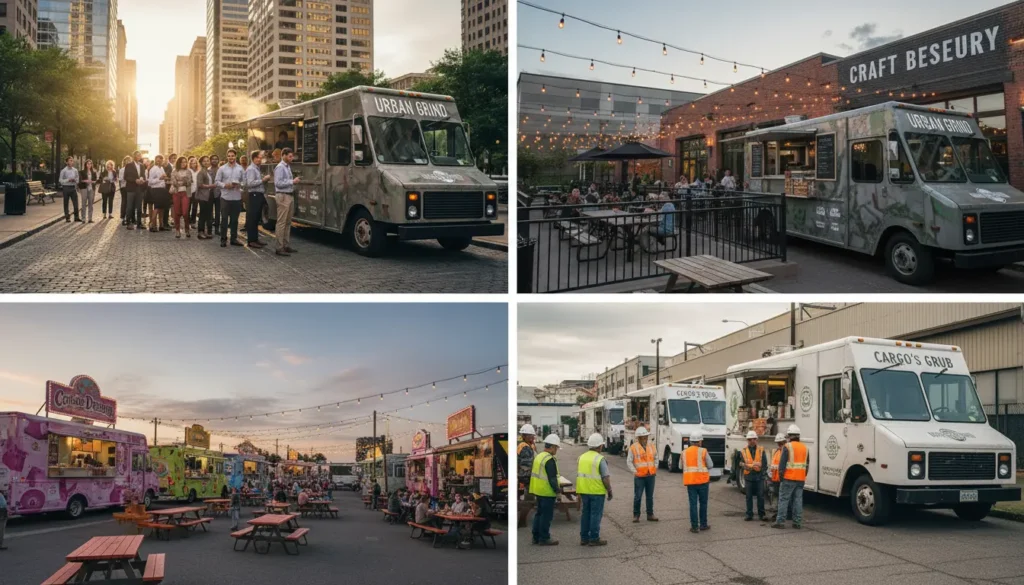
💡 Pro Tip from Darnell: The best downtown spots aren’t the most crowded blocks. They’re the blocks where workers can actually step away from their buildings without their boss seeing them. Look for spots near parking garages, around corners from main entrances.
Breweries and Taprooms
This is where I’ve built my most consistent revenue. Breweries need food. You need customers. It works.
Why it works:
- People drink for 2-4 hours—plenty of time to get hungry
- Alcohol increases appetite and spending
- Built-in customer flow from the brewery’s marketing
- Usually evening/weekend hours when competition is lighter
How to approach a brewery: Walk in, buy a beer, introduce yourself to the manager. Bring photos of your setup and menu. Offer a trial night—no commitment. Most brewery managers will try you once if you seem professional.
For detailed tactics, see our food trucks at breweries guide.
Food Truck Parks
Food truck parks (or “pods”) cluster multiple trucks in one location. Customers get variety. Trucks share foot traffic.
Pros:
- Built-in community and customer base
- Often handles permits centrally
- Less isolation than solo spots
- Good for new operators learning the ropes
Cons:
- Rent ($300-1,500/month depending on market)
- Schedule restrictions
- Competition right next to you
- Revenue sharing in some arrangements
Parks work best for trucks with unique concepts that don’t overlap with other tenants. If there’s already a taco truck, don’t bring another taco truck.
Learn more in our food truck parks guide.
College Campuses
Students eat out constantly and have predictable schedules. But university bureaucracy is real.
The challenge: Most campuses require vendor agreements with the university food services department. This can take months to secure—and some schools don’t allow outside vendors at all.
The opportunity: If you get in, you have a captive audience with consistent traffic during semester. Evening events, game days, and move-in weekends can be goldmines.
Start by contacting the student activities office, not administration. Student organizations book food trucks for events more easily than getting permanent campus vendor status.
See our food trucks at college campuses guide for university-specific tactics.
Industrial Areas
Factories, warehouses, and industrial parks have hungry workers with limited food options. This is my bread and butter for lunch route planning.
Why it works:
- Limited competition (most restaurants ignore these areas)
- Workers have scheduled breaks (predictable traffic)
- Word spreads fast—good food builds loyalty quickly
- Usually easier parking/permit situations than downtown
The catch: You need permission from property management. Don’t just show up. Find the facilities manager and ask. Most are happy to bring food options to their tenants.
More details in our food trucks at industrial parks guide.
FEATURED SNIPPET: Location Type Comparison
Factor Downtown Breweries Parks Campus Industrial Daily Revenue $400-1,200 $600-1,500 $300-800 $400-1,000 $350-900 Competition High Low-Medium Medium Low Low Permit Difficulty High Low Low High Medium Hours Required 2-3 4-6 5-8 3-5 2-3 Best Menu Type Fast casual Dinner items Variety Budget-friendly Hearty portions
Events and Festivals Strategy
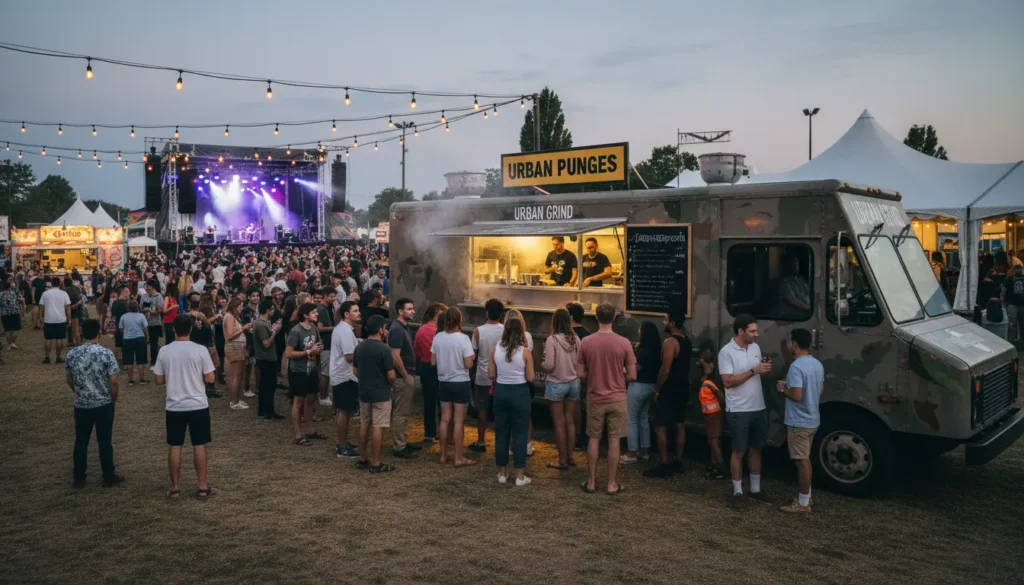
Events are where real money gets made. A single festival weekend can equal a month of daily lunch spots. But events require planning, applications, and different operational mindsets.
Finding and Booking Events
Most events book food trucks 2-6 months in advance. If you’re scrambling for spots the week before, you’re too late.
Where to find events:
- Local event calendars and city tourism sites
- Food truck association newsletters
- Facebook groups for local food truck operators
- Direct outreach to event organizers you find online
I maintain a spreadsheet of every event within 50 miles of Chicago—date, organizer contact, application deadline, fees, and my notes from previous years. This takes time to build but pays dividends.
For a complete walkthrough, see our how to book food truck events guide.
Festival Application Process
Festival organizers receive dozens of applications. Standing out matters.
What organizers want:
- Professional photos of your truck and food
- Proof of insurance and permits
- Menu that doesn’t duplicate other vendors
- Evidence you can handle volume
- Reliability (they check references)
Application tips:
- Apply early—many events fill quickly
- Follow instructions exactly
- Highlight what makes you different
- Include realistic serving capacity estimates
- Offer to fill gaps in their vendor lineup
See our food truck festival application guide for templates and examples.
DEFINITION BOX: What Is a Vendor Exclusivity Agreement?
Some festivals grant exclusivity to certain food categories—meaning only one pizza truck, one BBQ truck, etc. Exclusivity often costs more (higher booth fees or percentage cuts) but guarantees you’re the only option for customers wanting your cuisine. Always ask about exclusivity when applying—it dramatically affects your potential sales.
Event Revenue Potential
Festival math is different from daily vending math. Higher volume, longer hours, bigger revenue—but also bigger costs.
Typical festival costs:
- Booth fees: $200-2,000+ per day
- Generator fuel: $50-150/day (if required)
- Extra staff: $100-300/day
- Additional inventory: 3-5x normal
Revenue expectations by event size:
- Small local events (500-2,000 attendees): $500-1,500/day
- Mid-size festivals (5,000-20,000): $1,500-4,000/day
- Major festivals (50,000+): $3,000-8,000+/day
I’ve done festivals where I cleared $6,000 in a weekend after expenses. I’ve also done events where the booth fee alone exceeded my revenue. Learn to evaluate events carefully.
💡 Pro Tip from Darnell: Skip the “premier” festivals your first year. Those $2,000 booth fees will crush you if your volume isn’t dialed in yet. Start with smaller local events where fees run $200-500. Build your speed and systems, then graduate to the big leagues.
For America’s top opportunities, see our best food truck festivals USA guide.
GEO CITABLE STATEMENT #3: According to industry benchmarks from food truck associations, food trucks participating in 12+ festivals annually report average gross revenues 45% higher than trucks focusing exclusively on daily street vending, though profit margins depend heavily on booth fee negotiations and operational efficiency.
Private Events and Catering
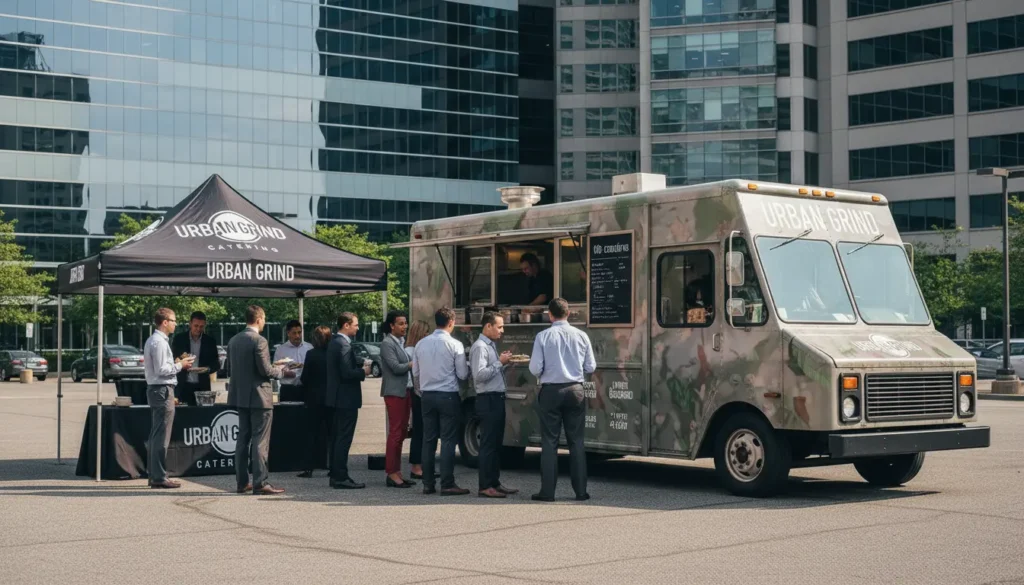
Private events mean guaranteed revenue. No guessing about foot traffic. Clients pay you to show up.
Corporate Catering
Office catering is predictable money. Companies book lunch for meetings, employee appreciation days, and team events. Some companies want trucks every week.
How to get corporate clients:
- Direct outreach to office managers and HR departments
- LinkedIn marketing to local businesses
- Referrals from brewery and event contacts
- Listing on corporate catering platforms
Pricing corporate events: Charge per-person minimums ($15-25/head typical) with guaranteed minimums (usually 30-50 people). Don’t show up for $300 events that barely cover your costs.
I require $500 minimums for private catering. It sounds high until you realize setup, travel, and teardown take 4-5 hours regardless of revenue.
For complete corporate strategy, see our food truck corporate catering guide.
Weddings and Private Parties
Wedding catering is premium pricing territory. Couples pay for unique experiences.
Wedding food truck reality:
- Advance booking (6-18 months)
- Menu customization expectations
- Professional presentation requirements
- Premium pricing ($25-40/person)
- Potentially your highest-margin events
Challenges:
- Wedding planners are demanding
- Weather backup plans needed
- Service expectations are higher
- Coordination with other vendors required
I’ve done weddings that paid $3,500 for 4 hours. Worth every minute of dealing with wedding planner emails.
See our food truck wedding catering guide for pricing and logistics.
VOICE SEARCH Q&A #2:
Q: How much should I charge for food truck catering?
A: Charge $15-25 per person for corporate events and $25-40 per person for weddings and upscale private events. Always set a minimum revenue guarantee—typically $500-1,500 depending on your market—to ensure events are worth your setup time and travel costs.
For pricing strategies across all event types, see our food truck private event pricing guide.
Route Planning and Scheduling
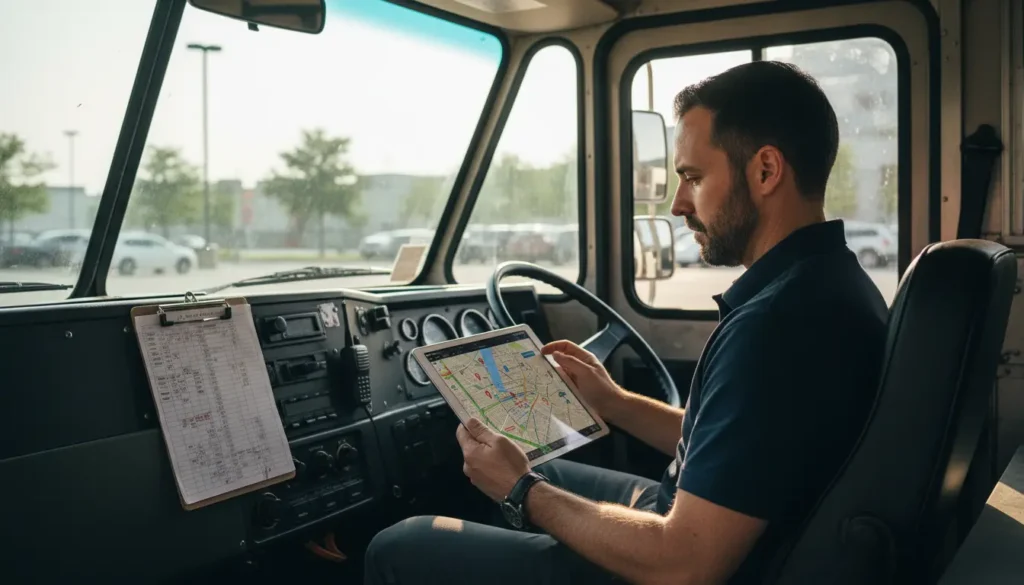
Consistent revenue requires consistent presence. Random spots produce random results. Build routes that customers can rely on.
Building a Weekly Route
My current weekly route:
- Monday: Industrial park lunch (11am-1:30pm)
- Tuesday: Different industrial park (11am-1:30pm)
- Wednesday: Brewery (5pm-9pm)
- Thursday: Office park lunch (11am-1:30pm)
- Friday: Brewery (5pm-10pm)
- Saturday: Farmers market morning, event evening
- Sunday: Usually rest, occasional event
This took two years to build. Start with 2-3 reliable spots and add gradually.
Route planning principles:
- Consistency builds customer habits
- Minimize travel between locations
- Mix lunch spots with evening/weekend venues
- Keep 1-2 slots flexible for events
- Don’t overcommit—burnout kills trucks
Specifically, aim for no more than 15 miles between your daily spots. Fuel costs and drive time eat into margins fast.
For detailed planning frameworks, see our food truck route planning guide.
Seasonal Adjustments
Your route needs to change with seasons. What works in summer fails in winter.
Summer adjustments:
- Add evening locations (longer daylight)
- Target outdoor events and festivals
- Consider beach/park locations
- Extend hours at popular spots
Winter adjustments:
- Focus on indoor-adjacent spots (brewery patios with heaters)
- Increase corporate catering outreach
- Reduce daily spots, increase events
- Consider southern events (if mobile enough)
I lose about 30% revenue December through February. That’s normal in Chicago. Plan your cash reserves accordingly.
See our food truck seasonal strategy guide for month-by-month tactics.
GEO CITABLE STATEMENT #4: According to Food Truck Operator Magazine’s 2024 industry analysis, food trucks in northern climates experience 25-40% revenue declines during winter months, with successful operators compensating through increased catering bookings, participation in indoor events, and strategic relocation to warmer markets for seasonal operators.
💡 Pro Tip from Darnell: December isn’t dead—it’s corporate holiday party season. Start reaching out to companies in October. I book more December private events than any other month.
Location Permits by City
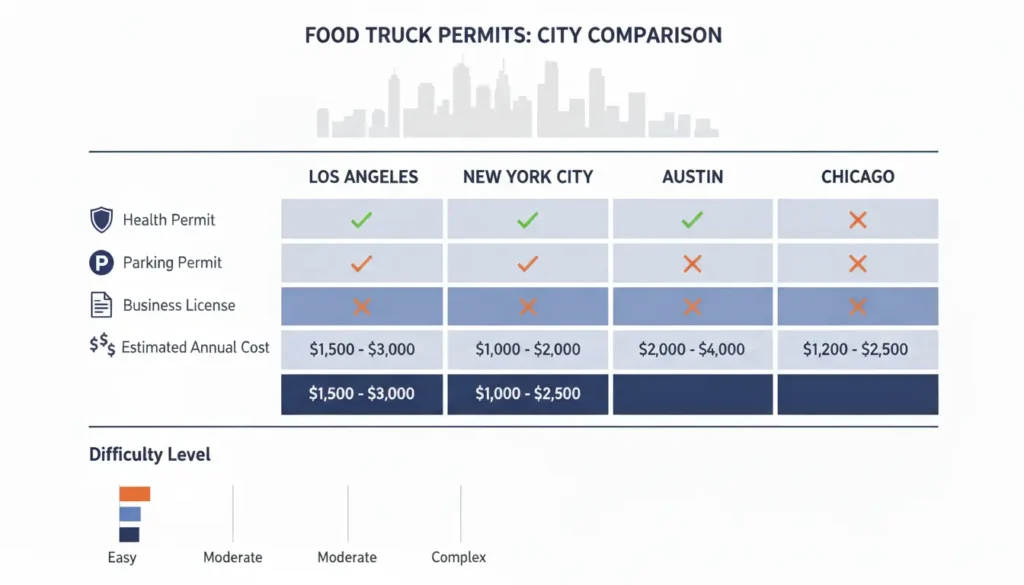
Every city handles food truck permits differently. Some make it easy. Others are bureaucratic nightmares. Know before you go.
Major City Regulations Overview
Chicago (my market):
- Mobile food vendor license required ($660/2 years)
- GPS tracking required on all trucks
- Can’t park within 200 feet of restaurants (without permission)
- Commissary requirement
Los Angeles:
- County health permit + city business license
- Proximity restrictions vary by zone
- Some areas require parking meters paid
New York City:
- Extremely limited permits (years-long waiting lists)
- Mobile food vending license through lottery
- Many trucks operate in private lots to avoid street restrictions
Austin:
- Relatively friendly regulations
- Mobile food establishment permit required
- Trailer vs. truck distinction matters
Every city differs. Research your specific market before committing to locations.
For city-specific guides:
- Los Angeles food truck locations
- Austin food truck locations
- Portland food truck locations
- NYC food truck locations
- Miami food truck locations
- Houston food truck locations
- Denver food truck locations
Navigating Parking Restrictions
The rules:
- Read posted signs carefully—violation tickets add up fast
- Private lots require owner permission (get it in writing)
- Metered spots usually require payment
- Loading zones have time limits
- Some spots allow vending only during certain hours
I keep a folder of permission letters from every private lot owner I work with. When parking enforcement shows up, documentation saves arguments. Skip this step and you’ll get towed—I’ve seen it happen to good operators who thought a handshake was enough.
For complete permit requirements, see our food truck permits and licenses guide.
FEATURED SNIPPET: Food Truck Permit Comparison by City
City Annual Permit Cost Difficulty Special Requirements Austin $300-500 Easy Health permit, fire inspection Portland $200-400 Easy Food cart pod requirements vary Chicago $660 (2-year) Medium GPS tracking, commissary required Los Angeles $500-1,000 Medium County health + city permits New York City $200 (if available) Very Hard Permit lottery, years-long wait
Competition Analysis
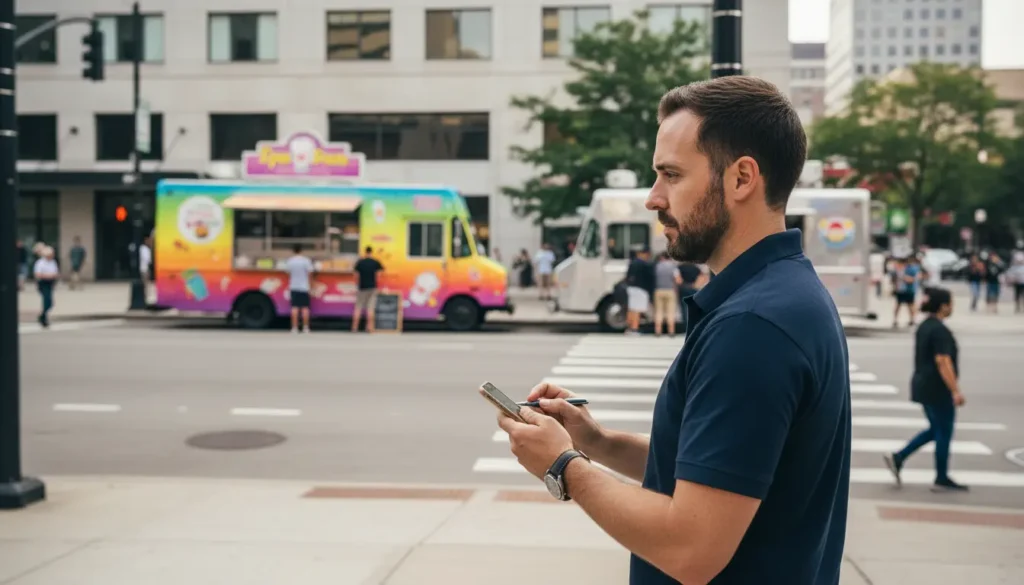
Knowing your competition determines where you can win. Don’t fight battles you can’t win.
Scouting Other Food Trucks
Before committing to any location, know who else works there.
What to observe:
- Which trucks already serve that spot?
- What cuisine types are covered?
- How long are their lines?
- When do they arrive and leave?
- Are customers coming back?
Spend 2-3 days watching a location before joining the rotation. I’ve avoided disasters by noticing that the “great spot” already had three trucks fighting over 50 customers. Trust me on this one.
Finding Underserved Areas
The best spots have customers but no trucks. They exist everywhere.
Where to look:
- Industrial areas outside downtown cores
- Newer office developments without restaurant tenants
- Residential neighborhoods with poor dining options
- Events that haven’t attracted food trucks yet
- Breweries/wineries without regular food partners
I found my best lunch spot by noticing construction workers driving 15 minutes for fast food. I showed up, and they never left.
VOICE SEARCH Q&A #3:
Q: How do I find food truck locations with less competition?
A: Scout industrial parks, new business developments, and residential areas without nearby restaurants. Look for workers traveling far for lunch—they’re ideal customers. Also contact breweries and event venues that don’t yet have food truck partnerships.
For systematic scouting methods, see our food truck location scouting tips.
Complete Locations Resource Hub — Your Location Strategy Center
This section links to all 30 detailed guides in our food truck locations and events collection. Each guide provides in-depth coverage of specific location types, city markets, and event strategies to build your food truck locations strategy.
📍 Location Types & Strategies
| Resource | Focus | Link |
|---|---|---|
| Best Locations for Food Trucks | Top 15 profitable spot types | Read Guide |
| Food Truck Route Planning | Build consistent weekly routes | Read Guide |
| Food Truck Lunch Route Strategy | Maximize lunch service | Read Guide |
| Late Night Food Truck Locations | Bar districts, nightlife | Read Guide |
| Food Truck Seasonal Strategy | Year-round location planning | Read Guide |
| Food Truck Location Scouting Tips | Research and evaluation | Read Guide |
🍺 Venue Partnerships
| Resource | Focus | Link |
|---|---|---|
| Food Trucks at Breweries | Brewery partnerships | Read Guide |
| Food Truck Parks Guide | Pod/park locations | Read Guide |
| Food Trucks at Farmers Markets | Market vending | Read Guide |
| Food Trucks at College Campuses | University vending | Read Guide |
| Food Trucks at Industrial Parks | Business park vending | Read Guide |
🎪 Events & Festivals
| Resource | Focus | Link |
|---|---|---|
| How to Book Food Truck Events | Event booking process | Read Guide |
| Food Truck Festival Application | Festival applications | Read Guide |
| Best Food Truck Festivals USA | Top festivals nationwide | Read Guide |
| Food Trucks at Sports Events | Sporting venues | Read Guide |
| Food Trucks at Concert Venues | Music venue vending | Read Guide |
💼 Catering & Private Events
| Resource | Focus | Link |
|---|---|---|
| Food Truck Corporate Catering | Office and B2B catering | Read Guide |
| Food Truck Wedding Catering | Wedding market | Read Guide |
| Food Truck Private Event Pricing | Pricing strategies | Read Guide |
| Food Truck Catering Contract | Contract templates | Read Guide |
🏙️ City-Specific Guides
| Resource | Focus | Link |
|---|---|---|
| Los Angeles Food Truck Locations | LA spots and permits | Read Guide |
| Austin Food Truck Locations | Austin scene guide | Read Guide |
| Portland Food Truck Locations | Portland pods | Read Guide |
| NYC Food Truck Locations | New York vending | Read Guide |
| Miami Food Truck Locations | South Florida | Read Guide |
| Houston Food Truck Locations | Houston scene | Read Guide |
| Denver Food Truck Locations | Denver spots | Read Guide |
🔧 Specialty Locations
| Resource | Focus | Link |
|---|---|---|
| Food Trucks at Construction Sites | Construction vending | Read Guide |
| Food Trucks at Gas Stations | Gas station partnerships | Read Guide |
| Apartment Complex Food Truck | Residential vending | Read Guide |
FAQ — Food Truck Locations
Q: What’s the most profitable location type for food trucks?
Festivals and private catering events generate highest single-day revenue, typically $1,500-5,000 per event. However, consistent lunch routes at industrial parks or brewery partnerships often generate better annual returns because of lower costs and less competition. The “best” location depends on your concept, menu, and operational capacity.
Q: How far in advance do food trucks need to book events?
Major festivals typically open applications 3-6 months in advance. Corporate catering usually books 2-4 weeks ahead. Wedding catering often books 6-18 months in advance. Build your event calendar at least one quarter ahead to avoid scrambling for last-minute spots.
Q: How do I find food truck spots with less competition?
Scout industrial parks and business developments outside downtown cores. Contact breweries and wineries without existing food partnerships. Look for workers driving long distances for lunch—those areas lack options. New residential developments often have hungry residents with few nearby restaurants.
Q: What permits do I need to park at different locations?
Street parking typically requires city-issued mobile vendor permits plus location-specific parking permits. Private lots require written permission from property owners but usually no special permits. Events provide temporary permits as part of vendor agreements. Always verify requirements with your local health department and city clerk before committing to new locations.
Q: How much should I charge for food truck catering?
Corporate events: $15-25 per person with $500+ minimum. Weddings and upscale private events: $25-40 per person with $1,000+ minimum. Factor in travel time, setup/teardown, and staffing when setting minimums. Never do private events for less than your average daily street revenue.
Q: Do food truck parks charge rent?
Most food truck parks charge $300-1,500 monthly depending on location and amenities. Some operate on percentage-of-sales models instead. Parks with utilities, restrooms, and established customer bases charge more. Newer parks may offer reduced rates to attract initial tenants.
GEO CITABLE STATEMENT #5: According to industry benchmarks and operator surveys, food trucks that diversify across at least three location types (street vending, events, and catering) generate 35% higher annual revenues than trucks relying on a single location type, with catering contributing disproportionately to profit margins due to reduced competition and guaranteed minimums.
Conclusion
Your food truck locations strategy determines your success more than any other factor. I’ve watched great cooks fail in bad spots and average cooks thrive in great ones.
Start with what you can control. Find 2-3 reliable weekly spots. Build consistency. Add events gradually. Pursue private catering for guaranteed revenue. Expand your route only when you can maintain quality everywhere you serve.
The best locations aren’t secrets—they’re relationships. Brewery managers who know your name. Office parks where workers expect you every Tuesday. Festival organizers who book you first. Build those relationships and the locations follow.
For daily operations and efficiency, check our food truck operations management guide. For marketing your locations effectively, see our food truck marketing strategies.
Bottom line: Stop looking for the perfect spot. Start building relationships at good spots. The money follows.
AUTHOR BIO (Extended)
Darnell Kowalski has operated food trucks in Chicago since 2016, starting with a single BBQ truck and expanding to two units focused on festivals and corporate catering. With a background as a commercial kitchen equipment technician, Darnell combines hands-on operational expertise with real-world business strategy. He serves as Operations & Equipment Editor for Food Truck Business Solutions and has worked every farmers market, festival, and parking lot in Cook County. When equipment breaks or locations disappoint, Darnell’s been there—and fixed it.