
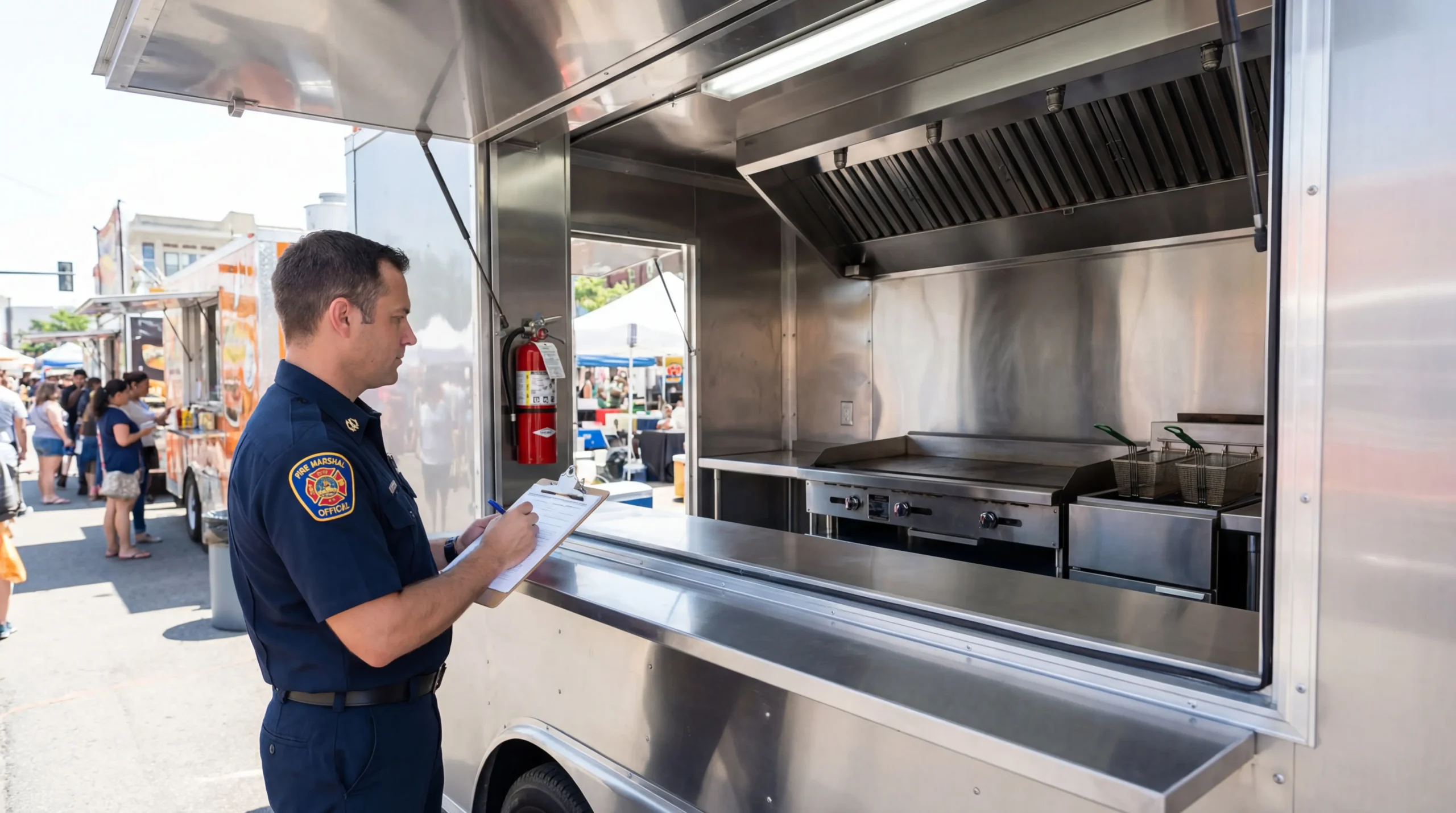

Food truck fire safety requirements are something nobody warns you about until you’re standing in front of a fire marshal wondering why your permit application got denied. Can we talk about this for a minute? When I first started my food truck journey in Portland, I assumed the health department handled everything fire-related. Spoiler alert: they don’t. There’s an entirely separate fire marshal inspection with its own regulations, equipment mandates, and permits that you absolutely must pass.
Here’s the thing about food truck fire safety requirements: they’re not optional suggestions. They’re mandated by NFPA 96 (the national standard for commercial cooking operations) and enforced by your local fire department. Without meeting these requirements, you simply cannot operate legally—your food truck permits and licenses application will be denied or revoked. The good news? Once you understand what’s needed, getting compliant is straightforward. Let me walk you through exactly what the food truck fire safety requirements are and how to pass your fire inspection the first time.
Food Truck Fire Safety Requirements: Regulations Overview
Understanding the food truck fire safety requirements starts with knowing which regulations apply to your mobile operation. Multiple standards work together to create a comprehensive fire safety framework.
NFPA 96: The Primary Standard
NFPA 96 (Standard for Ventilation Control and Fire Protection of Commercial Cooking Operations) is the big one. The 2024 edition now includes Chapter 17 specifically dedicated to “Mobile and Temporary Cooking Operations”—that’s you and me. This standard covers everything from fire suppression systems to hood ventilation to propane safety.
NFPA 58: Propane Safety
If you use propane (and most food trucks do), NFPA 58: Liquefied Petroleum Gas Code governs how you store, handle, and use LP gas in your mobile operation. This includes tank mounting, leak detection, and shut-off requirements.
International Fire Code (IFC)
Many jurisdictions adopt the IFC, which incorporates NFPA standards and adds local requirements. Your fire marshal enforces whichever codes your city or county has adopted.
Key 2024-2025 Food Truck Fire Safety Requirements Updates
The standards have become more stringent recently. Here’s what changed:
| Update | What It Means |
|---|---|
| UL-300 compliance mandatory | All fire suppression systems must be UL-300 listed—no grandfathering older systems |
| LP-gas detectors required | Every food truck with propane must have a listed propane detector installed |
| Semi-annual inspections | Fire suppression systems require inspection every 6 months (not annually) |
| Digital documentation | Some jurisdictions now require digital records of cleaning and inspection activity |
| 10-foot clearance | Mobile cooking operations must maintain 10 ft separation from buildings and exits |
💡 Pro Tip from Jolene: Don’t assume your fire marshal knows about the latest NFPA updates—some departments are still enforcing older codes. Print out the relevant sections of NFPA 96 Chapter 17 and bring them to your inspection. It shows you’ve done your homework and can actually help the process go smoother.
Food Truck Fire Safety Requirements: Fire Suppression Systems
The most critical of all food truck fire safety requirements is having a proper automatic fire suppression system. If your food truck produces grease-laden vapors—meaning you cook with oils, fats, or anything that creates grease—you need one. Period.
When Is a Fire Suppression System Required?
Per NFPA 96, you need an automatic fire suppression system if you operate:
- Deep fryers
- Griddles or flat-top grills
- Charbroilers
- Woks or stir-fry stations
- Any equipment producing grease-laden vapors
The only exemption is if you exclusively serve prepackaged foods or only use equipment that doesn’t produce grease vapors (like a coffee-only operation or hot dog steamer).
Types of Fire Suppression Systems for Food Trucks
| System | Best For | Cost Range | Notes |
|---|---|---|---|
| ANSUL R-102 | Most food trucks | $3,000-$5,500 | Industry standard, widely serviced |
| Range Guard | Budget operations | $2,800-$4,500 | Good reliability, fewer service providers |
| Kidde Systems | Various sizes | $3,000-$5,000 | Often pre-installed in concession hoods |
| Amerex | Heavy-duty cooking | $3,500-$5,500 | Popular for high-volume operations |
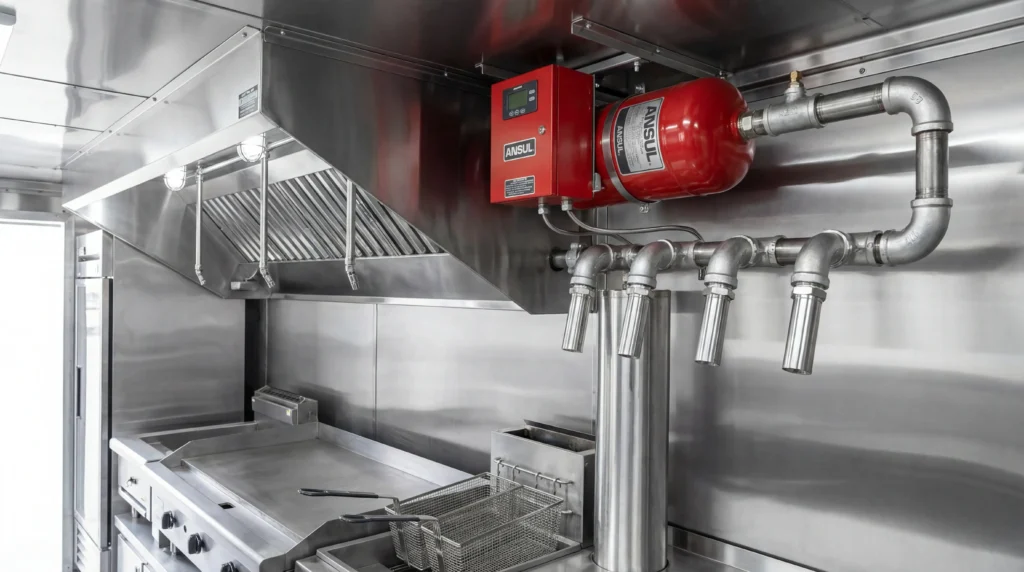
All systems must be UL-300 listed and use wet chemical agents. For detailed guidance on selecting and installing the right system, see our complete fire suppression system food truck guide.
How Fire Suppression Systems Work
Modern wet chemical systems use fusible links or thermo-bulb detectors mounted above your cooking equipment. When temperature exceeds approximately 450-500°F, the system automatically:
- Detects the fire condition
- Deploys wet chemical suppressant over cooking surfaces
- Shuts off fuel supply to all cooking equipment
- Activates audible and visual alarms (visible from outside truck)
- Creates a foam blanket to prevent re-flash
Installation Requirements
Your fire suppression system must meet these food truck fire safety requirements:
- Nozzles positioned to cover ALL cooking surfaces
- Manual pull station installed and readily accessible
- Automatic fuel shut-off linked to system activation
- Exterior alarm visible and audible to the public
- Installation by licensed fire protection contractor only
💡 Pro Tip from Jolene: Get your fire suppression system installed by the same company that will service it. They’ll configure it for easy inspection access, and you’ll have one point of contact for the mandatory semi-annual maintenance. Trust me—this simplifies everything.
Food Truck Fire Safety Requirements: Fire Extinguishers
Even with an automatic suppression system, portable fire extinguishers are a non-negotiable part of food truck fire safety requirements. You need two types—and this is where many operators get tripped up.
Required Fire Extinguisher Types
| Type | Purpose | Size Required | Why You Need It |
|---|---|---|---|
| Class K | Cooking oils, fats, grease fires | 6-liter minimum | Wet chemical agent designed for kitchen fires |
| Class ABC | Paper, wood, electrical, flammable liquids | 2A:10-B:C rating (5# typical) | General fire protection per NFPA 96 |
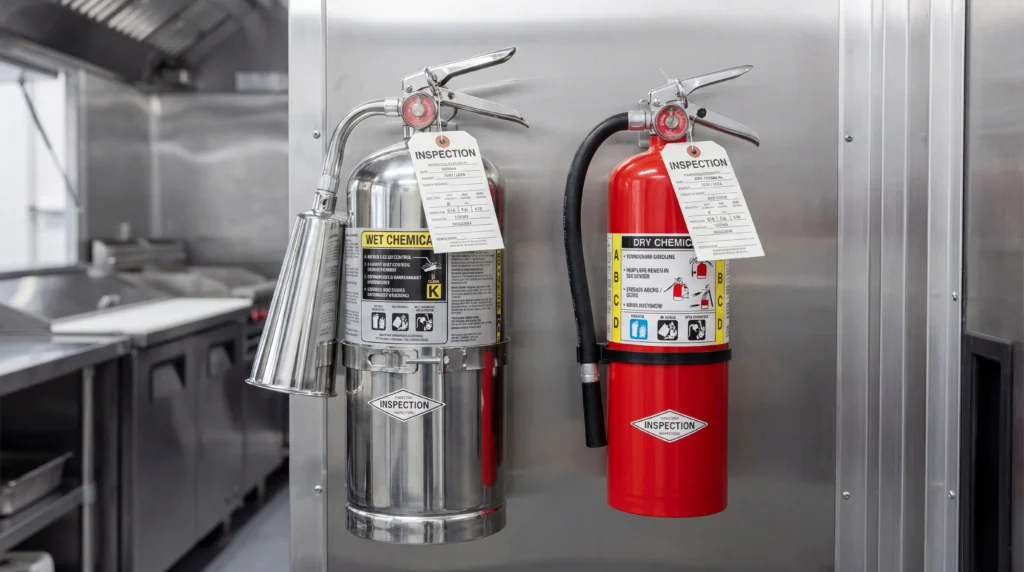
You need BOTH types. This is a common mistake—operators think one multi-purpose ABC extinguisher covers everything. It doesn’t. Class K extinguishers use wet chemical agents specifically designed for cooking fires that ABC dry chemical cannot effectively suppress.
Placement and Mounting Requirements
Per NFPA and the food truck fire safety requirements:
- Mounted on brackets (not sitting on floor)
- Easily accessible without moving equipment
- Within 30 feet travel distance from any cooking area
- Clearly visible with unobstructed access
- Not exposed to temperatures exceeding 120°F
Inspection and Maintenance Schedule
| Task | Frequency | Who Performs |
|---|---|---|
| Visual pressure check | Monthly | You (owner/operator) |
| Professional inspection | Annually | Licensed contractor |
| Hydrostatic testing | Every 5-12 years (per type) | Licensed contractor |
| Recharging | Immediately after any use | Licensed contractor |
Keep a log of all inspections—fire marshals will ask for documentation during spot checks.
Food Truck Fire Safety Requirements: Ventilation and Hood Systems
Your ventilation system isn’t just about keeping your truck comfortable—it’s a critical component of food truck fire safety requirements that directly affects whether you pass inspection.
Hood Requirements
If you produce grease-laden vapors, you need a Type I commercial exhaust hood. The food truck fire safety requirements mandate:
- Material: Stainless steel or other non-combustible materials
- Grease filters: Listed and labeled, removable for cleaning
- Clearance: Minimum 18″ above cooking surface (or per manufacturer)
- Ductwork: Non-combustible, properly sealed, with access panels for cleaning
Ventilation Specifications by Cooking Type
| Cooking Type | CFM Required | Hood Type |
|---|---|---|
| Light-duty (steam, warming) | 150-200 CFM | Type II acceptable |
| Medium-duty (griddle, pasta) | 300-400 CFM | Type I required |
| Heavy-duty (fryer, charbroiler) | 400-600 CFM | Type I required |
For complete guidance on selecting and installing the right system, see our food truck ventilation hood guide.
Hood Cleaning Schedule (Per NFPA 96)
| Cooking Volume | Cleaning Frequency |
|---|---|
| High-volume (24/7 operations, solid fuel, charbroiling) | Monthly |
| Moderate-volume (typical food truck) | Quarterly |
| Low-volume (seasonal, light cooking) | Semi-annually |
I’m not gonna lie—most food trucks fall into the quarterly category. But if you’re working high-volume events multiple times a week or using solid fuel, you might need monthly cleanings to stay compliant with food truck fire safety requirements.
Food Truck Fire Safety Requirements: Fire Department Inspection Process
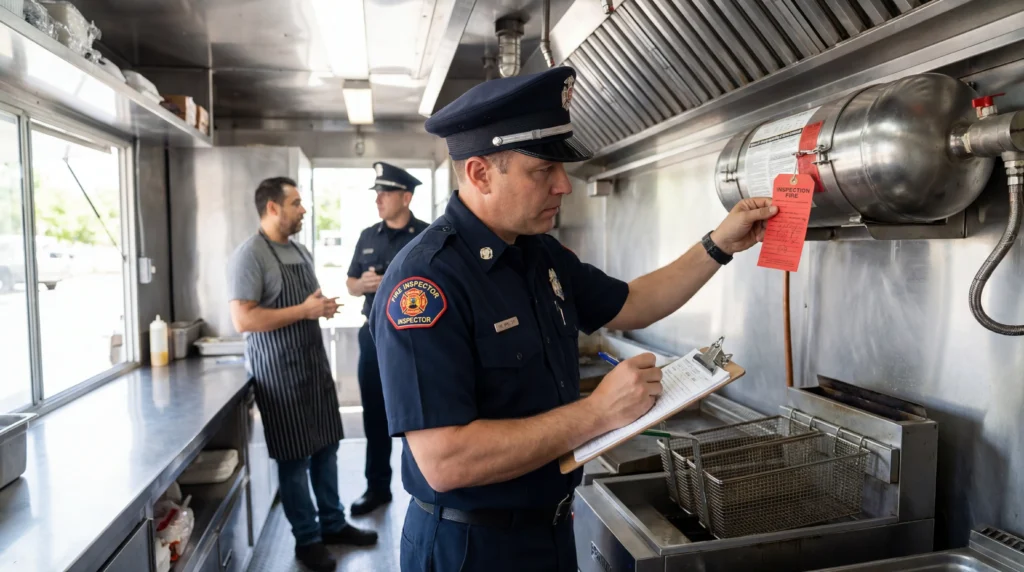
The fire marshal inspection is often the final hurdle before you can legally operate. Understanding the food truck fire safety requirements inspection process will help you pass the first time—and avoid costly delays.
Before the Inspection
Schedule your fire inspection by contacting your local fire department or fire marshal’s office. Most jurisdictions require this inspection before issuing your health permit, so it typically happens early in the permitting process. The inspection is often coordinated with your food truck health permit inspection.
Documents to have ready:
- Fire suppression system installation certificate
- Current fire suppression inspection tag (within 6 months)
- Fire extinguisher inspection tags (current year)
- Propane system installation documentation
- LP-gas detector installation documentation
- Electrical inspection certificate (if required)
- Floor plan showing equipment layout
What Fire Inspectors Check
Here’s a typical food truck fire safety requirements inspection checklist:
Fire Suppression System:
- [ ] UL-300 listed and properly installed
- [ ] Nozzles covering all cooking surfaces
- [ ] Manual pull station accessible and unobstructed
- [ ] Current inspection tag (within 6 months)
- [ ] Automatic fuel shut-off functional and tested
- [ ] Exterior alarm operational
Fire Extinguishers:
- [ ] Class K extinguisher present and charged
- [ ] Class ABC extinguisher present and charged
- [ ] Properly mounted on brackets
- [ ] Current inspection tags
- [ ] Unobstructed access
Propane System:
- [ ] Tanks within hydrostatic test dates (stamped on collar)
- [ ] LP-gas detector installed and operational
- [ ] Main shut-off valve accessible
- [ ] Piping protected from impact and vibration
- [ ] Caution plate posted near tanks
Ventilation:
- [ ] Hood properly installed over all cooking equipment
- [ ] Grease filters clean and in place
- [ ] No excessive grease buildup
- [ ] Ductwork sealed and intact
General Safety:
- [ ] Clear exit path (no blocked exits)
- [ ] No extension cords used as permanent wiring
- [ ] No combustible storage near cooking equipment
- [ ] 10-foot clearance from buildings maintained
Inspection Fees and Timeline
| Jurisdiction Type | Typical Fee | Re-inspection Fee |
|---|---|---|
| Small city/county | $50-$100 | Often free (first re-inspection) |
| Major metro area | $100-$250 | $50-$100 |
| State-level | $75-$200 | Varies by state |
Most fire departments can schedule inspections within 1-2 weeks. Some offer specific days for food truck inspections—always ask when you call.
Food Truck Fire Safety Requirements: Permit Application
Once you pass inspection, you’ll receive a fire safety permit, certificate, or inspection sticker. Here’s how the food truck fire safety requirements permit process typically works:
Application Steps
- Contact your local fire department — Ask specifically about mobile food vendor or food truck fire permits
- Submit application — Include truck documentation, equipment list, floor plan
- Pay application fee — Typically $50-$250
- Schedule inspection — Usually within 1-2 weeks
- Pass inspection — Fix any violations and re-inspect if needed
- Receive permit/sticker — Display prominently on your truck
Permit Duration and Renewal
| Jurisdiction Type | Duration | Renewal Process |
|---|---|---|
| Most cities | Annual | Inspection + fee |
| Some states | 1-2 years | Inspection + fee |
| Washington State (WSAFM) | 12 months | Accepted across participating jurisdictions |
Multi-Jurisdiction Operations
If you operate in multiple cities, you may need fire permits from each jurisdiction. However, some states have reciprocity programs—Washington State’s WSAFM program, for example, allows one inspection to be recognized by multiple participating fire departments.
💡 Pro Tip from Jolene: Keep copies of ALL your fire permits in the truck at all times. Fire marshals do random spot checks at events and festivals, and you’ll need to produce documentation on the spot. I keep mine in a clear plastic sleeve right by my serving window.
Food Truck Fire Safety Requirements: Common Fire Code Violations
Knowing the most frequent violations helps you avoid them. Here are the top food truck fire safety requirements violations that fail inspections:
Critical Violations (Immediate Fail)
- No fire suppression system when cooking produces grease vapors
- Expired suppression system inspection — Must be current within 6 months
- Missing fire extinguishers — Need both Class K AND Class ABC
- No LP-gas detector — Required for all propane-equipped trucks
- Blocked exit — Must have clear egress path at all times
Common Violations (Correct and Re-inspect)
| Violation | How to Fix |
|---|---|
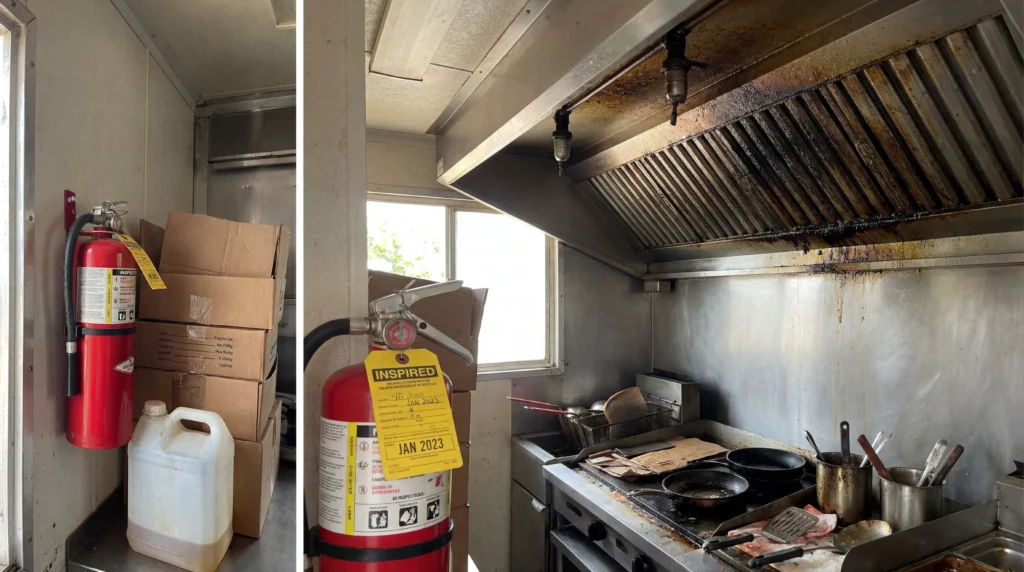
| Extension cords as permanent wiring | Install proper electrical outlets |
| Grease buildup on hood/filters | Clean thoroughly before inspection |
| Fire extinguisher sitting on floor | Mount on proper brackets |
| Missing fuel shut-off signage | Post required caution plates |
| Propane tank not secured | Install proper tank mounting brackets |
| Manual pull station blocked | Ensure 30″ clearance maintained |
| Expired fire extinguisher tag | Get professional inspection |
Weekly Prevention Checklist
Run through this weekly to maintain food truck fire safety requirements compliance:
- [ ] Fire extinguisher pressure gauges in green zone
- [ ] Fire suppression system inspection tag current
- [ ] LP-gas detector functioning (push test button)
- [ ] Hood filters cleaned
- [ ] Exit path clear and unobstructed
- [ ] No grease accumulation on walls or surfaces
- [ ] Electrical connections in good condition
- [ ] Propane connections secure (no smell)
Frequently Asked Questions
How much does a food truck fire suppression system cost?
A food truck fire suppression system typically costs between $3,000 and $5,500 for equipment and installation. Popular systems like the ANSUL R-102 fall within this range. Budget an additional $150-$300 per semi-annual inspection, making first-year total costs approximately $3,500-$6,100. Installation must be performed by a licensed fire protection contractor.
What fire extinguisher do I need for a food truck?
Food truck fire safety requirements mandate at least two fire extinguishers: a Class K extinguisher (6-liter minimum) for cooking oil and grease fires, and a Class ABC extinguisher (2A:10-B:C rating) for general fires including electrical and combustible materials. Both must be mounted on brackets, accessible, and professionally inspected annually.
How often do food truck fire suppression systems need inspection?
Fire suppression systems require professional inspection every 6 months per NFPA 96 food truck fire safety requirements. Operating with an expired inspection tag is a critical violation that can result in fines, permit suspension, or immediate shutdown. Semi-annual inspections cost $150-$300 each.
Do I need a fire permit for my food truck?
Yes, most jurisdictions require a separate fire permit or inspection certificate as part of food truck fire safety requirements. This permit is typically obtained before your health department permit and must be renewed annually. Contact your local fire marshal’s office for specific requirements in your area.
What is NFPA 96 and how does it affect my food truck?
NFPA 96 is the National Fire Protection Association’s Standard for Ventilation Control and Fire Protection of Commercial Cooking Operations. The 2024 edition includes Chapter 17 specifically for mobile cooking operations. It establishes food truck fire safety requirements for fire suppression, ventilation, fire extinguishers, propane safety, and maintenance schedules.
Can I operate my food truck without a fire suppression system?
Only if you don’t produce grease-laden vapors. If you cook with oils, fats, or anything that creates grease (fryers, griddles, grills), food truck fire safety requirements mandate an automatic fire suppression system. Coffee-only or prepackaged food operations may be exempt—but always verify with your local fire marshal before assuming exemption.
Meeting Food Truck Fire Safety Requirements: Your Action Plan
Meeting food truck fire safety requirements isn’t just about passing inspections—it’s about protecting yourself, your staff, your customers, and your livelihood. The equipment and maintenance costs are real (budget $4,000-$7,000 for initial setup), but they’re a fraction of what a fire could cost you in damages, injuries, and lost business.
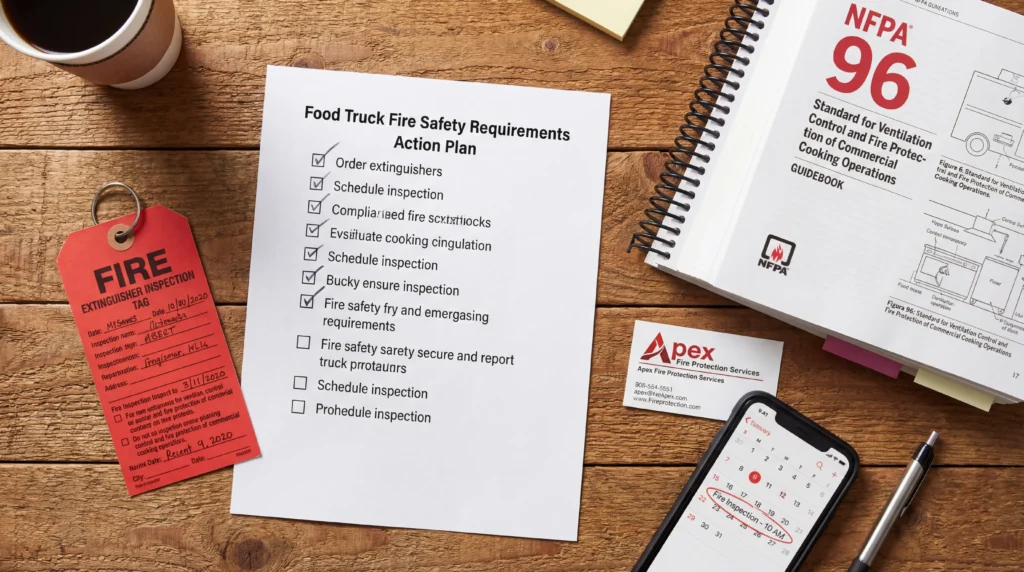
Here’s your action checklist:
This Week:
- [ ] Contact your local fire marshal’s office about food truck permits
- [ ] Get quotes from 2-3 licensed fire suppression installers
- [ ] Order Class K and Class ABC fire extinguishers
Before You Open:
- [ ] Install fire suppression system (licensed contractor only)
- [ ] Install LP-gas detector near propane components
- [ ] Schedule and pass fire inspection
- [ ] Create emergency response plan for staff
- [ ] Train all employees on extinguisher use (PASS method)
Ongoing Maintenance:
- [ ] Monthly: Visual check of all fire safety equipment
- [ ] Quarterly: Hood and duct cleaning (or per your cooking volume)
- [ ] Semi-annually: Fire suppression system professional inspection
- [ ] Annually: Fire extinguisher professional inspection
For the complete picture of all the permits and licenses you need to operate legally, head back to our comprehensive food truck permits and licenses guide. You’ve totally got this—and future you will thank present you for doing this right from the start.
