
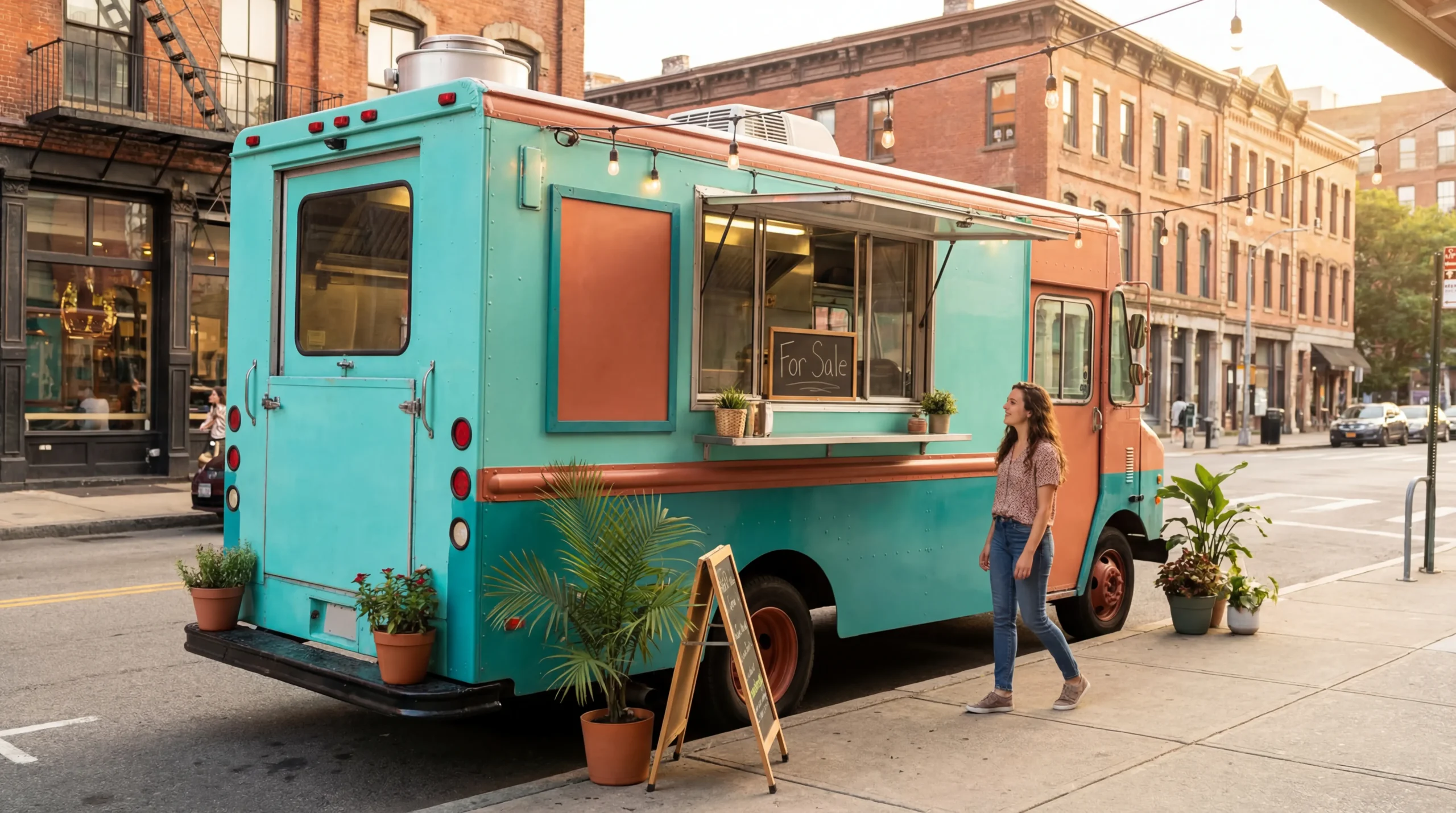

What Is a Food Truck on Sale?
If you’ve been scrolling through listings at midnight, comparing prices you can’t quite afford and wondering if this whole food truck dream is even realistic — you’re not alone. When I was in your shoes, I felt the exact same way.
A food truck on sale is any mobile kitchen — new, used, or custom-built — being offered for purchase through online marketplaces, brokers, private sellers, or dealer platforms across the United States. Buyers typically spend between $50,000 and $200,000 on a startup-ready food truck, according to Square’s pricing data, though options range from under $5,000 for basic carts to over $200,000 for fully custom builds.
Here’s the thing — the market has exploded with options. Between eBay, Facebook groups, specialized brokers, and even Amazon, finding the right truck means knowing where to look, what to pay, and what to avoid.
This guide walks you through every step. From choosing a platform to inspecting your future truck to signing the paperwork without getting burned.
📚 Part of our complete How to Start a Food Truck Business guide.
So Where Do You Actually Find a Food Truck on Sale?
The biggest mistake first-time buyers make is shopping on just one platform. Each marketplace has its own strengths. And its own blind spots.
Here’s a breakdown of the major places to find a food truck on sale in the US right now.
| Platform | Best For | Typical Price Range | Buyer Protection | Notes |
|---|---|---|---|---|
| UsedVending.com | Verified used trucks with broker support | $25,000–$150,000 | Strong (broker-facilitated) | Handles paperwork and negotiations; financing available |
| UsedFoodTrucks.com | Browsing by state with interactive map | $15,000–$160,000 | Moderate (listing platform) | Large inventory nationwide; no broker involvement |
| Facebook Marketplace / Groups | Local deals from private owners | $5,000–$80,000 | Limited (varies by transaction type; groups have none) | Always inspect in person; vet the seller before paying |
| eBay | Wide variety with auction or buy-now options | $10,000–$200,000+ | Moderate (eBay Buyer Protection applies) | Shipping logistics can be complex for large vehicles |
| Craigslist | Budget trucks in your area | $3,000–$50,000 | None (peer-to-peer, no platform mediation) | Inspect in person; use escrow or certified check for payment |
| Amazon | New food trailers (not drivable trucks) | $5,000–$30,000 | Strong (standard Amazon returns) | Mostly trailers and carts, not full mobile kitchens |
| BizBuySell | Turnkey food truck businesses for sale | $50,000–$400,000+ | Strong (broker-facilitated) | Includes business value, customer base, and brand |
| Commercial Truck Trader | Commercial-grade vehicles and chassis | $20,000–$200,000 | Moderate (dealer-facilitated) | Better for base vehicles; less food-specific equipment |
A standard food truck listing should include the vehicle make, model, year, and mileage. It should also list installed kitchen equipment, generator brand and hours, water tank capacity, and fire suppression system status. If a listing is missing this basic information, that’s a yellow flag. The truck might be fine, but you need to ask more questions before scheduling a viewing.
I’ve used UsedVending to help three mentees find their trucks. The broker support made a real difference for first-timers who didn’t know what to ask. For my own truck, I found it through a local Facebook group. Riskier, but I knew what to look for by then.
💡 Pro Tip from Jolene: Set up email alerts on UsedVending and UsedFoodTrucks so you’re notified when trucks in your price range hit the market. The best deals go fast — sometimes within days.
📎 Related: If you’re still deciding between buying a food truck outright or exploring other paths, that guide compares all your options.
How Much Does a Food Truck on Sale Actually Cost?
This is the first question everyone asks. The honest answer? It depends on what you’re buying.
Here’s what the current market looks like.
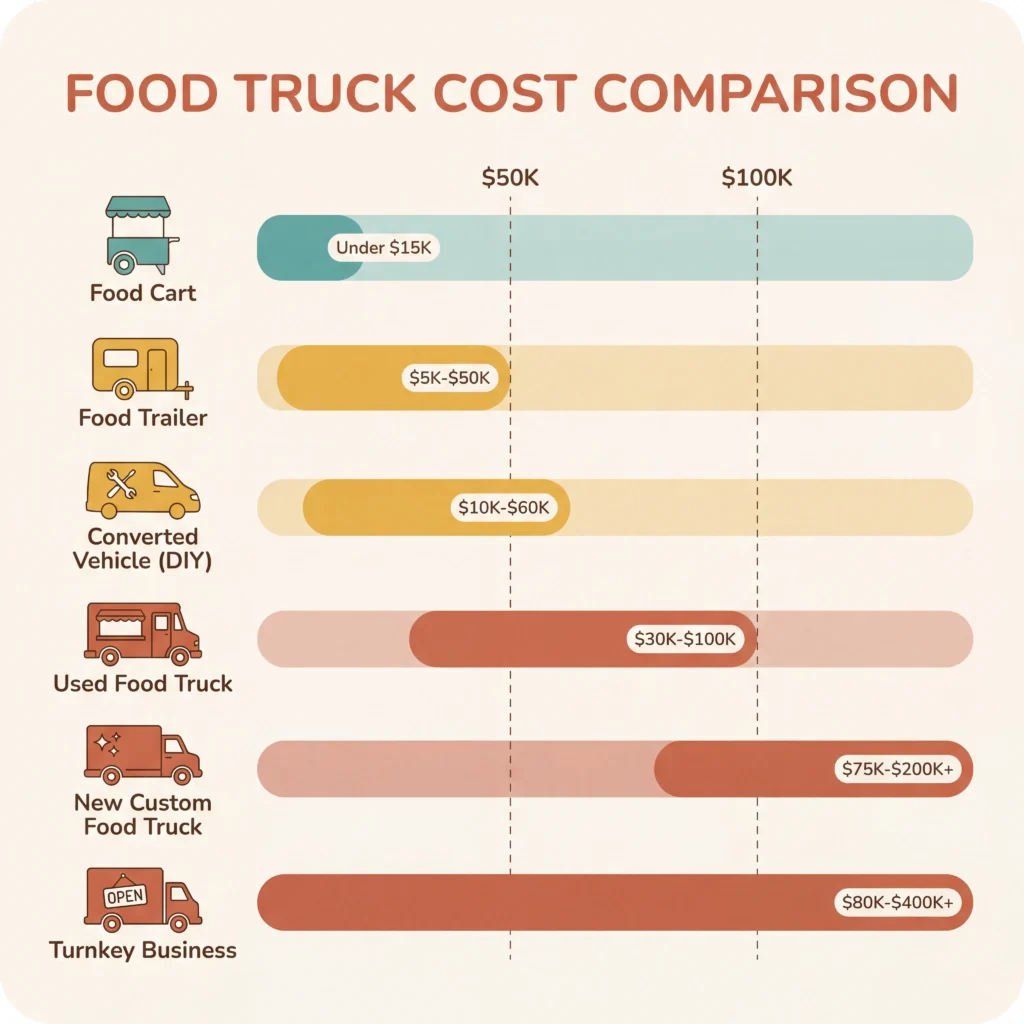
| Type | Typical Price Range | What You Get | Best For |
|---|---|---|---|
| Used food truck | $30,000–$100,000 | Pre-built kitchen, may need updates | Budget-conscious first-timers |
| New custom food truck | $75,000–$200,000+ | Built to your exact specs | Established concepts with capital |
| Food trailer (new) | $5,000–$50,000 | Towable, smaller kitchen | Low-budget startups and events |
| Food cart | $2,000–$15,000 | Smallest option, limited menu | Coffee, hot dogs, simple menus |
| Converted vehicle (DIY) | $10,000–$60,000 | You build the kitchen yourself | Handy owners on tight budgets |
| Turnkey business | $80,000–$400,000+ | Truck + brand + permits + customers | Buyers who want to skip the startup phase |
According to Square’s food truck cost guide, startup costs typically range between $50,000 and $200,000. That includes the vehicle, equipment, initial permits, and first batch of inventory.
I’m not gonna lie — when I saw my first price quote for a custom build, I nearly choked on my coffee. But after running the numbers with my colleague Marcus (I’m honestly terrible with the spreadsheet side of things, which is why I lean on him), I realized the cheapest truck isn’t always the cheapest path to opening day. A $15,000 truck that needs $20,000 in repairs plus $5,000 in code compliance updates costs $40,000 and three months of delays.
Scary numbers, right? Don’t let them scare you off. Let them help you plan.
For a deeper breakdown, check out our complete food truck cost guide.
Should You Buy a New, Used, or Custom Food Truck?
Okay, so here’s the deal. There’s no single right answer. It depends on your budget, your timeline, and how specific your kitchen needs are.
Buying used is the most popular route for first-timers. You save significantly upfront, and many used trucks come with equipment already installed. The risk? You inherit someone else’s problems. A fryer on its last legs. A generator that drinks fuel. Electrical wiring that won’t pass inspection in your county.
Always get a mechanical inspection before handing over money.
Buying new or custom gives you exactly what you want. Builders will work with your menu concept to design the kitchen around your workflow. The downside is cost and time. A custom build can take weeks to months, and you’ll pay a premium.
Converting a vehicle yourself is the budget path. You buy a step van, box truck, or sprinter van and build out the kitchen. Plenty of owners have done it. But underestimating the complexity of plumbing, propane, and electrical work is the number one reason DIY builds stall out.
When I helped a mentee choose between used and custom, she went used. She was serving customers three weeks later. Her friend’s custom build was still in production two months after that.
| Factor | Used | New/Custom | DIY Conversion |
|---|---|---|---|
| Cost | $30K–$100K | $75K–$200K+ | $10K–$60K |
| Timeline | Days to weeks | Weeks to months | Months |
| Customization | Limited | Full | Full (if you can build it) |
| Risk | Hidden mechanical issues | Low (warranty coverage) | High (your skills set the ceiling) |
| Best for | Getting started fast | Specific concepts | Handy owners on tight budgets |
📎 Related: Thinking about a trailer instead? Our food truck vs food trailer comparison breaks down the real differences.
Food Truck vs. Food Trailer vs. Food Cart — Which Is Right for You?
Before you commit to a food truck on sale, make sure a truck is actually what you need. A lot of first-time buyers jump straight to “food truck” when a trailer or cart would serve them better for less money.
Now, I know what you’re thinking — isn’t a food truck the only real option? Not necessarily.
A food truck is a self-propelled mobile kitchen. You drive it to your location, set up, and serve. It’s the most versatile option. It’s also the most expensive. You’re maintaining an engine, transmission, tires, and a full kitchen.
A food trailer is a towable kitchen. You need a separate vehicle to move it. Trailers are often cheaper, offer similar kitchen space, and are easier to maintain because there’s no engine to worry about. The tradeoff: you need a tow vehicle and a storage spot.
A food cart is the most stripped-down option. Think hot dog stands, coffee carts, and small setups at farmers markets. Startup costs can be under $5,000, but your menu and earning potential are limited.
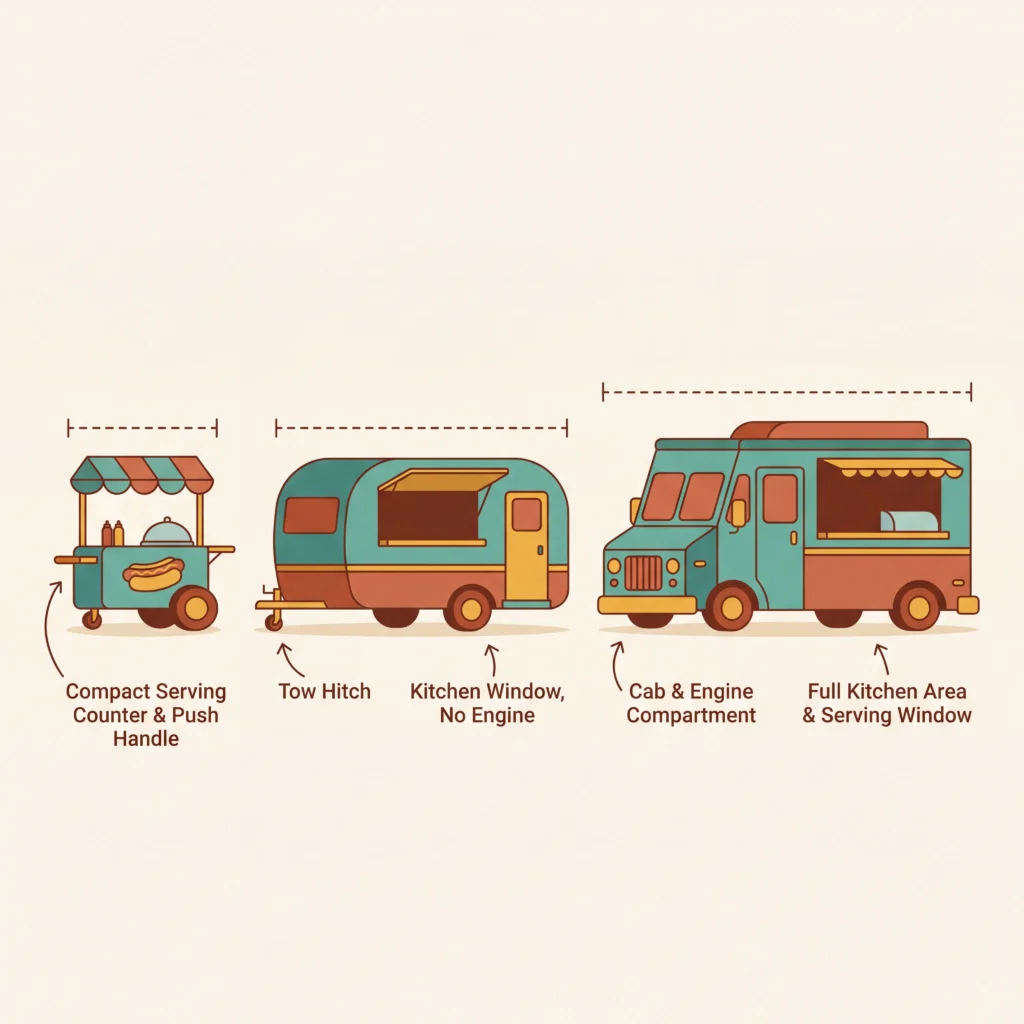
| Feature | Food Truck | Food Trailer | Food Cart |
|---|---|---|---|
| Startup cost | $30K–$200K+ | $5K–$50K | $2K–$15K |
| Mobility | Drive anywhere | Need tow vehicle | Push or pull |
| Kitchen size | Medium to large | Medium to large | Small |
| Permit complexity | Higher | Medium | Lower |
| Maintenance | Engine + kitchen | Kitchen only | Minimal |
| Best for | Full-service mobile food | Events, fixed locations | Simple menus, markets |
Real talk: if you’re testing a concept before going all-in, a food trailer or cart lets you validate your menu without the financial weight of a full truck. Several people I’ve mentored started with a trailer, built their following, and upgraded to a truck once revenue supported it.
📎 Related: Explore our guide on food trailers and trucks for sale for listings and buying advice.
What Should You Check Before Buying a Food Truck?
This is the section I wish someone had given me before I started helping people buy trucks. Whether you’re buying from a broker, a private seller on Facebook, or a dealership — never skip the inspection.
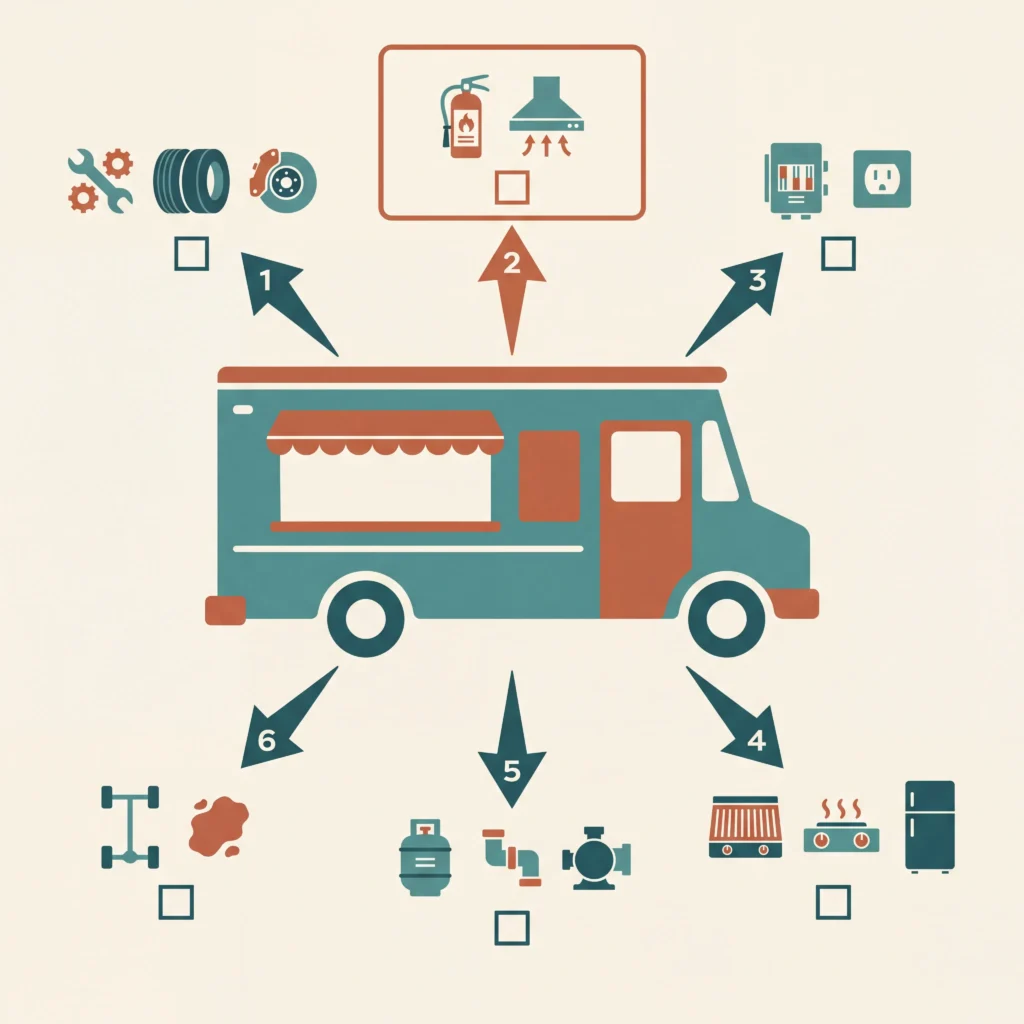
Mechanical inspection (for drivable trucks):
☐ Engine condition — listen for unusual sounds, check for leaks, request a compression test if possible
☐ Transmission — smooth shifting, no slipping or grinding
☐ Brakes — test at speed and check for spongy or grinding response
☐ Tires — check tread depth and age (tires with good tread can still dry-rot after a few years)
☐ Mileage and maintenance records — high miles aren’t bad if maintenance was consistent
☐ Frame and body — check underneath and around wheel wells for rust
Kitchen and equipment inspection:
☐ Generator — check hours of use, start it up, listen for consistent operation
☐ Propane system — inspect all lines, fittings, and tanks for leaks (use the soap and water test)
☐ Refrigeration — confirm fridge and freezer hold temperature for at least 30 minutes
☐ Cooking equipment — fire every burner, run the fryer, test the griddle
☐ Fire suppression system — verify current inspection tag and expiration date
☐ Plumbing — test the water pump, hot water heater, and check joints for leaks
☐ Electrical panel — test all outlets, check for flickering, confirm the panel isn’t overloaded
Compliance and documentation:
☐ Clean title — verify VIN matches the title with no liens
☐ Health department history — has this truck passed inspection where you plan to operate?
☐ Permits — are they transferable, or do you start from scratch?
☐ Insurance history — any claims indicating structural or equipment damage?
💡 Pro Tip from Jolene: Bring someone who knows commercial kitchen equipment. A $200 inspection from a mobile mechanic plus a kitchen equipment tech could save you $10,000 in surprise repairs.
📎 Related: For the full breakdown on permits after purchase, see our food truck permits guide.
How Do You Spot Scams and Red Flags?
The food truck resale market is mostly filled with honest sellers. But scams happen — especially on platforms without buyer protection.
Here’s what to watch for.
Sellers who refuse in-person inspections. If they insist on shipping the truck before you’ve seen it, walk away. Legitimate sellers have nothing to hide. If they won’t let you bring a mechanic, that tells you everything.
Prices that seem impossibly low. A fully equipped truck listed at $8,000 when comparable trucks sell for $40,000 is almost certainly a scam or hiding serious problems. If the deal feels too good, it probably is.
Pressure to pay via wire transfer, cryptocurrency, or gift cards. These payments are irreversible. Use a broker service, escrow, or at minimum a certified check with a signed bill of sale.
Missing or unclear titles. A truck without a clean title is a truck you can’t legally register, insure, or operate. Always verify the VIN against the title. Run a vehicle history report.
Sellers who can’t answer basic questions. If they don’t know what generator is in the truck or when the fire suppression system was last serviced, that’s a problem.
Can we talk about something that doesn’t get mentioned enough? Emotional buying. When you’ve been searching for weeks and finally find a truck that looks perfect, it’s easy to rush. I’ve seen mentees overlook serious issues because they fell in love with the exterior wrap. Sound familiar? Don’t let excitement override due diligence.
📎 Related: Learn more about finding used food trucks and what makes a good deal.
How Can You Actually Afford a Food Truck?
Here’s where it gets interesting. Not everyone has $50,000 to $100,000 in the bank. That’s completely normal. Several financing paths exist.
SBA microloans are often the best starting point. The Small Business Administration backs loans up to $50,000 through nonprofit lenders. You’ll need a business plan and decent credit, but the barrier is lower than traditional bank loans.
Equipment financing uses the truck itself as collateral. Lenders finance a percentage of the truck’s value, and you make monthly payments. This is often easier to qualify for than an unsecured loan.
Seller financing is more common than you’d think. Some private sellers and brokers offer payment plans. Terms vary widely, so read every clause.
Personal loans or lines of credit work if your credit is strong. Rates tend to be higher than SBA options, but approval is faster with less paperwork.
Grants exist, particularly for minority-owned, veteran-owned, and women-owned businesses. They’re competitive and slow, but free money is worth the effort.
I bootstrapped my first truck with savings and a small SBA microloan. It wasn’t glamorous. But it got me on the road.
But what if your credit isn’t great? Some smaller dealers and private sellers offer owner financing without traditional credit checks. The terms are usually less favorable — higher rates, larger down payments — but they can get you started when banks won’t.
⚠️ Important: I’m not a financial advisor. Loan terms, interest rates, and eligibility requirements change frequently. Always consult a qualified financial professional before committing to any financing arrangement.
For the detailed breakdown on every financing path, visit our food truck loans guide.
What Happens After You Buy Your Food Truck?
Buying the truck is actually the easy part. What comes next is where most new owners get overwhelmed.
I ugly cried in a health department parking lot when my permit got rejected the first time. So trust me — you want to know this stuff in advance.
Business registration. Register your food truck as an LLC, sole proprietorship, or other entity. Requirements vary by state but registration is mandatory everywhere.
Permits and licenses. At minimum, you’ll need a food handler’s certification, a mobile food vendor permit, a health department permit, and likely a fire department inspection. Some cities require additional zoning or parking permits.
Insurance. Commercial food truck insurance typically covers general liability, auto liability, and property damage. Most health departments and event organizers require proof of insurance before you can operate.
Commissary agreement. Many jurisdictions require food trucks to operate out of an approved commercial kitchen for food prep, storage, and cleaning. Secure a commissary before applying for your health permit.
Vehicle registration and inspection. Re-register the truck in your name. Get it inspected per your state’s requirements.
This sounds like a lot because it is. But it’s completely doable step by step.
📎 Related: Our food truck license guide walks through every permit you’ll need.
📎 Related: Don’t skip insurance — here’s our guide to commercial food truck insurance.
Putting It Into Practice
☐ Today: Set your budget range. Create free accounts on at least two platforms (UsedVending and UsedFoodTrucks are good starting points). Set up listing alerts for your price range.
☐ This Week: Browse listings actively. Save 5–10 that fit your criteria. Compare prices across platforms to build your sense of fair market value.
☐ This Month: Schedule your first in-person viewing. Bring the inspection checklist from this guide. Bring a mechanic and a kitchen equipment tech if you can. Start your permit research and financing applications in parallel — don’t wait until the truck is in your driveway.
Frequently Asked Questions About Food Trucks on Sale
How much does a used food truck cost on average?
Most used food trucks sell between $30,000 and $100,000, depending on age, condition, equipment, and location. Trucks under $20,000 exist but often need significant repairs or equipment upgrades. Trucks from specialized brokers tend to be at the higher end but come with more vetting and support.
What is the most profitable food to sell on a food truck?
Menu items with low ingredient costs and high perceived value perform best. Tacos, burgers, loaded fries, and fusion dishes consistently rank among the highest-margin food truck items. The key is keeping ingredient costs below roughly 30% of your selling price while offering something people can’t easily get elsewhere.
Are food trucks still profitable in 2026?
According to IBISWorld, the food truck industry reached $2.8 billion in market size in 2024, and recent CNBC reporting suggests the industry is now approaching $3 billion. Most successful food truck owners report profit margins between roughly 6% and 9% after all expenses, which is comparable to or better than many traditional restaurants.
Can I buy a food truck with no credit check?
Some private sellers and smaller dealers offer owner financing without traditional credit checks. Terms are usually less favorable — higher interest rates, larger down payments, shorter repayment periods. Your best bet for accessible financing with fair terms is an SBA microloan through a community lender, which has more flexible credit requirements than banks. Always consult a financial professional to explore your options.
What questions should I ask a seller before buying?
Ask about maintenance history, generator hours, last health department inspection result, whether the title is clean, what equipment is included in the sale price, whether any equipment is leased rather than owned, and why they’re selling. A seller who can’t answer these basics is a seller to avoid.
Is it better to buy a food truck or build one from scratch?
Buying a ready-to-operate truck is faster and often more cost-effective for first-timers. Building from scratch gives total customization but requires mechanical knowledge and patience — most DIY builds take three to six months or longer. If speed to launch matters, buy. If budget and customization matter more, build.
How do I know if a food truck listing is a scam?
Red flags include prices far below market value, sellers who refuse in-person inspections, requests for wire transfer or cryptocurrency payments, missing vehicle titles, and listings with stolen photos. Always verify the VIN, meet in person, and use a broker or escrow for transactions over $10,000.
How do I determine if a food truck on sale is fairly priced?
Compare the asking price against three factors: the vehicle’s year, mileage, and mechanical condition; the age and brand of kitchen equipment installed; and whether permits, inspection history, or a customer base transfer with the sale. Check comparable listings on UsedVending and BizBuySell for similar trucks in similar condition. A truck with documented maintenance and current permits is typically worth more than an identical truck without them.
Your Next Steps: From “For Sale” to “Open for Business”
Finding a food truck on sale is just the beginning. But it’s the most exciting beginning there is.
Here’s your quick action plan:
- Set your budget and start browsing on two or three platforms at the same time. Turn on alerts so you don’t miss new listings.
- When you find a truck you like, schedule an in-person inspection. Bring the checklist from this guide and, if possible, bring a mechanic.
- Line up financing and start permits in parallel. These run at the same time — don’t wait until the truck is yours to begin the paperwork.
You’ve totally got this. Every food truck owner started exactly where you are. Scrolling through listings. Doing the research. Wondering if it’s really going to happen.
It is.
For the complete roadmap from dream to launch day, head back to our full How to Start a Food Truck Business guide.
— Jolene Matsumoto
📖 From Jolene’s Notebook: When I was helping a mentee find her first truck, we spent two weeks comparing listings across four different platforms before she even scheduled a single viewing. It felt slow at the time. But it saved her from a truck on Facebook that turned out to have a cracked propane line hidden behind the oven. Slow and thorough beats fast and sorry — every time.
