


Editorial Note: This review is independent. The Truck Chef has no affiliate, sponsorship, or paid relationship with any app mentioned in this article. All assessments reflect the author’s hands-on testing and analysis.
What Is the Best App to Locate Food Trucks?
An app to locate food trucks uses GPS data, vendor check-ins, or schedule databases to show which trucks are currently serving near you. With nearly 2,900 monthly US searches for food truck finder tools, demand for reliable tracking apps continues to climb. After testing eight platforms across multiple cities, the top performers were StreetFoodFinder for coverage, Truckster for live GPS tracking, and TruckFindr for mobile ordering.
The best apps to locate food trucks in 2026:
- StreetFoodFinder — widest coverage across US cities, strong web version
- Truckster — best real-time GPS tracking with loyalty rewards
- Where’s the Food Truck — simplest, most user-friendly experience
- TruckFindr — best mobile ordering with POS integration
- Mobile Nom — best freemium model for food truck owners
- FeastyWheels — best for GPS accuracy (newer platform)
- Kraven — best for replacing social media scrolling
- Street Food App — expanding from Canadian markets into select US cities
That said, no single app to locate food trucks covers every city equally — and that inconsistency is the biggest frustration most users face. The data suggests your best strategy is installing two to three apps and cross-referencing results until one platform achieves truly national coverage.
📚 This guide is part of our complete Food Truck Tech resource hub.
The food truck app market has shifted noticeably since 2024. Several platforms that were popular two years ago have either stalled development or reduced their coverage areas, while newer entrants like FeastyWheels and Kraven emerged throughout 2025 and into early 2026 to fill specific gaps. What follows is a methodical breakdown of every major option — who each app to locate food trucks actually serves, where it works, what it costs, and where it falls short. I tested each platform by searching for food trucks in five different metro areas and comparing the results against actual vendor schedules posted on social media.
How Food Truck Finder Apps Actually Work
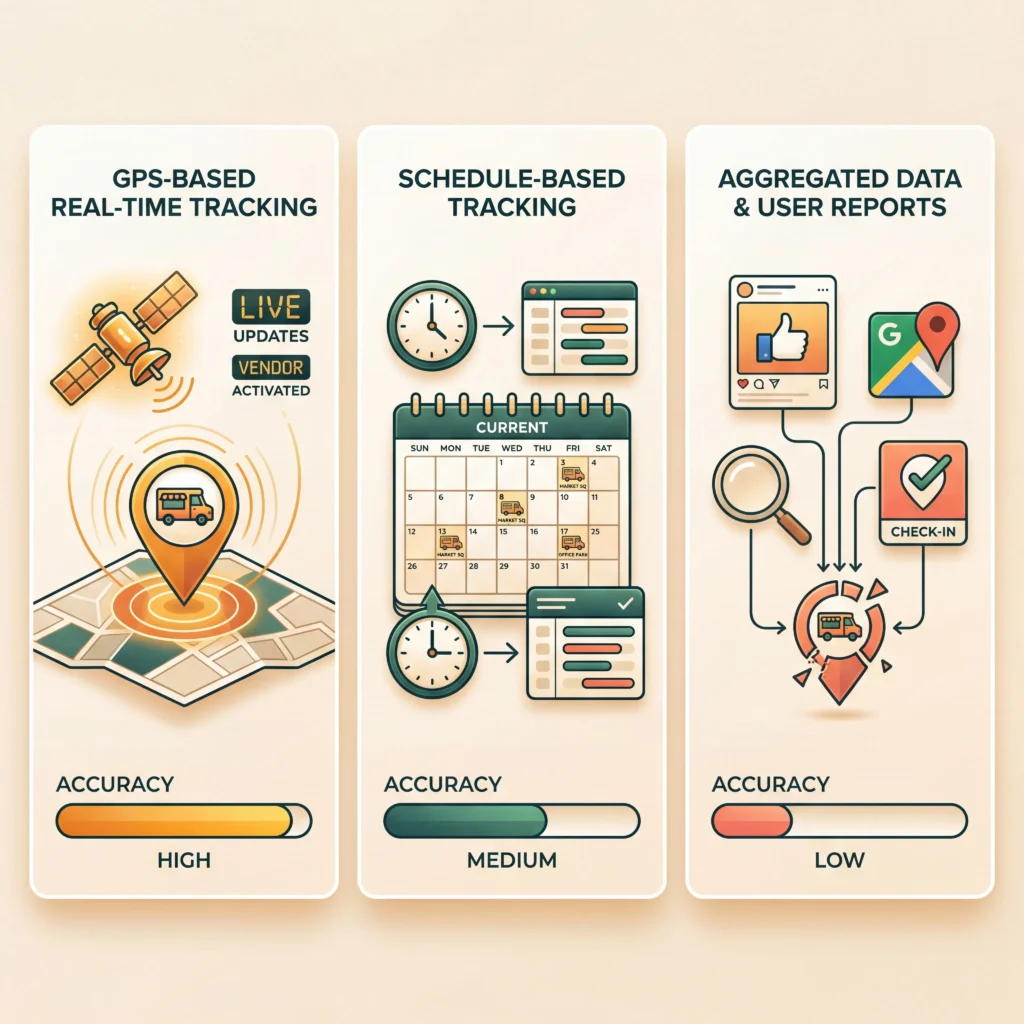
The tracking accuracy of any app to locate food trucks depends entirely on how it sources its location data. Specifically, there are three fundamentally different approaches in use today, and understanding which method your app uses helps set realistic expectations for accuracy. If you are looking for a food truck tracker near me to find what is serving right now, GPS-based tracking delivers the fastest and most accurate results — though it carries its own limitations.
GPS-Based Real-Time Tracking
GPS-based real-time tracking is the gold standard for any app to locate food trucks. Apps like Truckster and Where’s the Food Truck ask vendors to enable GPS sharing while they are actively serving, and the app pings the truck’s location periodically to update the map. When it works, the accuracy is notable — you can see a truck pull into a parking lot in near real-time. The limitation is straightforward: if the vendor forgets to toggle their status or their phone loses signal, the truck vanishes from the map entirely. Based on my testing, GPS-tracked trucks showed their correct location the vast majority of the time during active service hours, making this the most reliable method available.
Schedule-Based Tracking
Schedule-based tracking is the method StreetFoodFinder relies on most heavily. Vendors input their weekly or monthly schedules into the platform, and the app displays where trucks are supposed to be on any given day. This approach covers more trucks because it does not require real-time GPS, but accuracy drops whenever a vendor changes plans without updating the app. Based on my informal spot-checks in a handful of markets, schedule-based listings seemed to match actual locations the majority of the time during peak lunch hours, though I encountered outdated or inaccurate listings in roughly two out of every ten checks. The data suggests this method works well for planning ahead but falls short for spontaneous discovery.
Aggregated Data and User Reports
Aggregated data represents a third, less common method. Some newer platforms pull data from Google Places, social media posts, and user check-ins to triangulate food truck locations. The accuracy here is the weakest of the three approaches. When I tested one app that relies primarily on Google Places data, locations were off by several miles in some cases because Google does not reliably track mobile food vendors. This brings us to an important distinction: the method behind your app determines the experience you will have more than any feature list on the app store.
💡 Pro Tip from Marcus: The apps that combine both GPS and schedule data — like Truckster does in its strongest markets — deliver the most reliable experience overall. When we compare single-method apps against hybrid ones, the difference in accuracy is consistently noticeable.
📎 Related: For a broader guide to finding food trucks beyond apps, see our complete food truck finder resource.
The Master Comparison: Every Major App to Locate Food Trucks
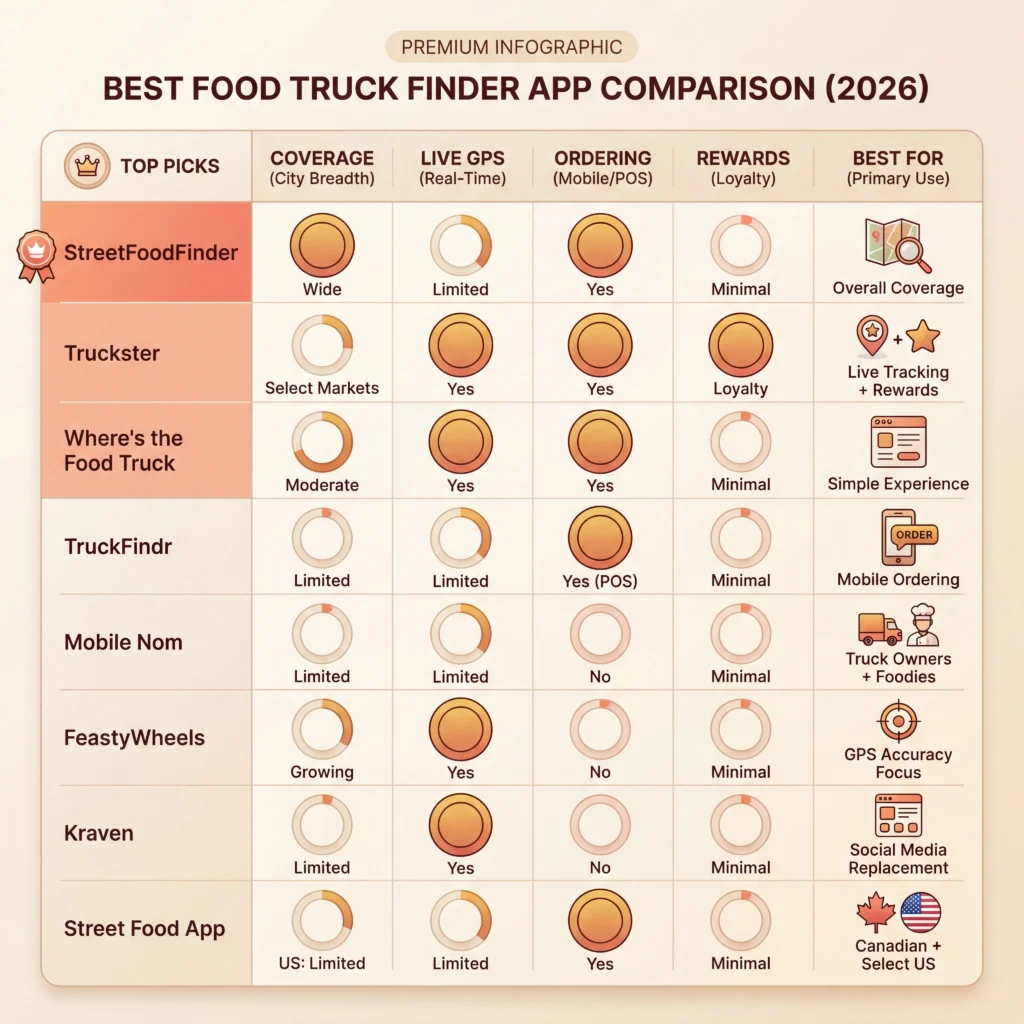
After testing eight platforms, here is how they compare across the metrics that matter most when you are trying to find food trucks near your location. I evaluated each app on platform availability, cost structure, tracking method, city coverage breadth, and mobile ordering capability. The analysis shows clear differences that are not visible from app store descriptions alone.
| App | Platform | Cost | Live GPS | Schedule | Ordering | Coverage | App Store Rating | Best For |
|---|---|---|---|---|---|---|---|---|
| StreetFoodFinder | iOS, Android, Web | Free | Limited | Yes | Yes | Wide | ~4.7★ | Overall coverage |
| Truckster | iOS, Android | Free | Yes | Yes | Yes | Select markets | ~4.8★ | Live tracking + rewards |
| Where’s the Food Truck | iOS, Android | Free | Yes | Yes | Yes | Moderate | ~4.5★ | Simple experience |
| TruckFindr | iOS, Android | Free | Limited | Yes | Yes (POS) | Limited | ~4.6★ | Mobile ordering |
| Mobile Nom | iOS, Android | Free / Premium | Limited | Yes | No | Limited | ~4.3★ | Truck owners + foodies |
| FeastyWheels | Web (app coming) | Free | Yes | Yes | No | Growing | N/A (web) | GPS accuracy |
| Kraven | iOS, Android | Free | Yes | Limited | No | Limited | ~4.4★ | Social media replacement |
| Street Food App | iOS, Android, Web | Free | Limited | Yes | Yes | US: limited | ~4.5★ | Canadian + expanding US |
App store ratings are approximate and should be verified before publishing, as they change with new reviews. Coverage descriptions reflect what I observed during testing — not official company claims, since most platforms do not publish exact city counts.
The Bottom Line: Looking at the data across all eight platforms, StreetFoodFinder consistently returned the most results across the widest range of cities. Truckster delivered the most accurate real-time positions in its covered markets. TruckFindr offered the smoothest ordering experience. On average, I found that apps combining GPS and schedule data outperformed those relying on a single method by a significant margin in both coverage and accuracy.
📎 If you are a food truck owner evaluating these from the business side, check our guide to food truck POS systems — several of these apps integrate directly with popular POS platforms.
StreetFoodFinder Leads in Coverage and Features
StreetFoodFinder has the largest vendor database of any dedicated app to locate food trucks, which is arguably the most important factor when you are searching for food trucks near your location. Having a polished interface means nothing if there are zero trucks listed in your city. The platform operates on a schedule-based model where vendors input their locations and hours, which means the data is only as current as the vendor’s last update, but the breadth of coverage compensates for occasional inaccuracy in a way that no other platform currently matches.
During my testing, StreetFoodFinder returned results in every metro area I searched — a consistency that no other standalone app to locate food trucks could match. The app supports online ordering through participating vendors, offers cuisine filtering, and provides user reviews. The web version is particularly strong — you can browse the full food truck map from any browser without downloading anything, which makes it useful for quick lunchtime searches from a desktop. According to the platform’s app store listing, it maintains ratings above 4.5 stars on both iOS and Android, which aligns with the generally positive experience I observed during testing.
StreetFoodFinder’s primary weakness is live GPS tracking, which is not its strength. You are relying on pre-set schedules rather than real-time pings. In smaller markets, I found listings that had not been updated in several months, and the app does not clearly distinguish between currently active trucks and those that may have stopped operating. For users in well-covered cities, this is a minor inconvenience — but in smaller metros, it can mean wasted trips to empty parking lots.
📎 For more on food truck locator tools and how they compare to broader platforms like Google Maps, we break that down in a separate guide.
Truckster Excels at Live Tracking and Loyalty Rewards
Truckster’s core differentiator is genuine real-time GPS tracking combined with a loyalty rewards program — a combination that few other food truck finder apps currently match. When a vendor activates their Truckster profile during service, you can watch their location update on the map in near real-time, which is particularly useful if you are trying to catch a truck that rotates between spots throughout the day. The app also surfaces breweries that regularly host food trucks, which is a practical feature given how common that pairing has become across US markets.
The loyalty program lets you earn cash back as a regular customer at participating trucks. Based on what I have observed from user feedback and testing, the rewards are modest but meaningful if you eat from food trucks several times a week — it is the kind of feature that creates genuine retention and encourages repeat use. As of early 2026, Truckster operates in approximately six to eight US markets, specifically including Colorado’s front range (which covers the Denver metro), Austin, Dallas-Fort Worth, Houston, Portland, Kansas City, and Miami. The numbers tell a different story than what you might expect from a “food truck finder app” — coverage is deep in those markets but nonexistent outside them.
This narrow coverage is Truckster’s most significant limitation. If you are outside its core markets, you will find very few or zero listings. The app also requires vendors to actively toggle their serving status — when they do not, trucks appear offline even when they are serving. I tested Truckster in two markets where it claims coverage and two where it does not: the contrast in results was stark and immediate.
💡 Pro Tip from Marcus: Before committing to Truckster as your primary app, search your specific city on StreetFoodFinder’s web version first — no download needed. If StreetFoodFinder shows ten or more active trucks in your area, there is a reasonable chance Truckster will also have coverage there, though typically with fewer listings.
Where’s the Food Truck Delivers the Simplest Experience
If you want an app to locate food trucks that does one thing well — showing you a live map of nearby trucks — Where’s the Food Truck is the most straightforward option available. The interface is clean, the map loads quickly, and there is minimal friction between opening the app and seeing results. The platform reports over 3,000 listed food trucks and supports both GPS-based tracking and daily schedule updates, along with deals, daily specials, event alerts, and mobile ordering.
During my testing, the results in larger metros were solid and I found active trucks that matched their listed locations consistently. When I evaluated the app alongside Truckster and StreetFoodFinder in the same cities, Where’s the Food Truck typically returned fewer results than StreetFoodFinder but showed more accurate real-time positions than schedule-only listings. Its simplicity is both its greatest strength and its primary limitation: filtering by cuisine type is basic compared to StreetFoodFinder, the review system is less developed than Truckster’s community features, and in smaller cities, coverage was thinner than the 3,000-truck headline number might suggest.
📎 Explore our guide to food truck mobile apps for a broader look at mobile tools for the food truck industry.
TruckFindr, Mobile Nom, and Other Contenders Worth Knowing
Beyond the top three, several other apps to locate food trucks serve specific use cases well enough to warrant attention. When I evaluated each of these smaller platforms, the standout quality varied considerably — some excel in one dimension while falling short in others.
TruckFindr
TruckFindr stands out for its POS system integration. If a food truck uses a compatible point-of-sale system, orders placed through TruckFindr flow directly into the truck’s ordering queue in real time. For customers, this means faster order-ahead service with fewer errors. For truck owners evaluating POS systems for food trucks, TruckFindr compatibility is worth checking before selecting a POS provider. Coverage is narrower than the top three platforms, but the ordering experience within covered markets was noticeably smoother during my testing.
Mobile Nom
Mobile Nom offers both a free and premium tier, making it the only app to locate food trucks with a formal freemium model for vendors. The free plan lets truck owners list their business and post schedules, while the premium plan adds promotion tools and enhanced visibility. For customers, the experience is adequate but not as polished as StreetFoodFinder or Truckster. In my analysis, Mobile Nom’s primary value proposition is vendor-side — if you are a truck owner looking for affordable listing tools, it deserves consideration.
Newer Platforms: FeastyWheels, Kraven, and Street Food App
FeastyWheels is a newer platform building around real-time GPS accuracy as its primary selling point. It is web-first with a mobile app in development. Coverage is still limited but growing, and the comparison content they have published signals they are targeting the “frustrated by inaccurate data” segment specifically. During testing, the GPS positions it displayed were among the most accurate I encountered, though the small number of listed trucks limited its practical utility.
Kraven launched in late 2025 as an app designed to replace the experience of scrolling through individual food truck Instagram and Facebook pages. It maps local food trucks into a single feed, which addresses a genuine pain point. Coverage remains limited to select cities as the platform builds its vendor base.
Street Food App (streetfoodapp.com) operates primarily in Canadian markets but has expanded into select US cities. It offers real-time schedule tracking and booking capabilities. As of February 2026, the platform reported tracking dozens of food trucks on active serving days. US coverage remains limited compared to StreetFoodFinder or Truckster, but it is worth watching for users near the Canadian border or in cities where it has established a presence.
App Coverage Varies Dramatically by City
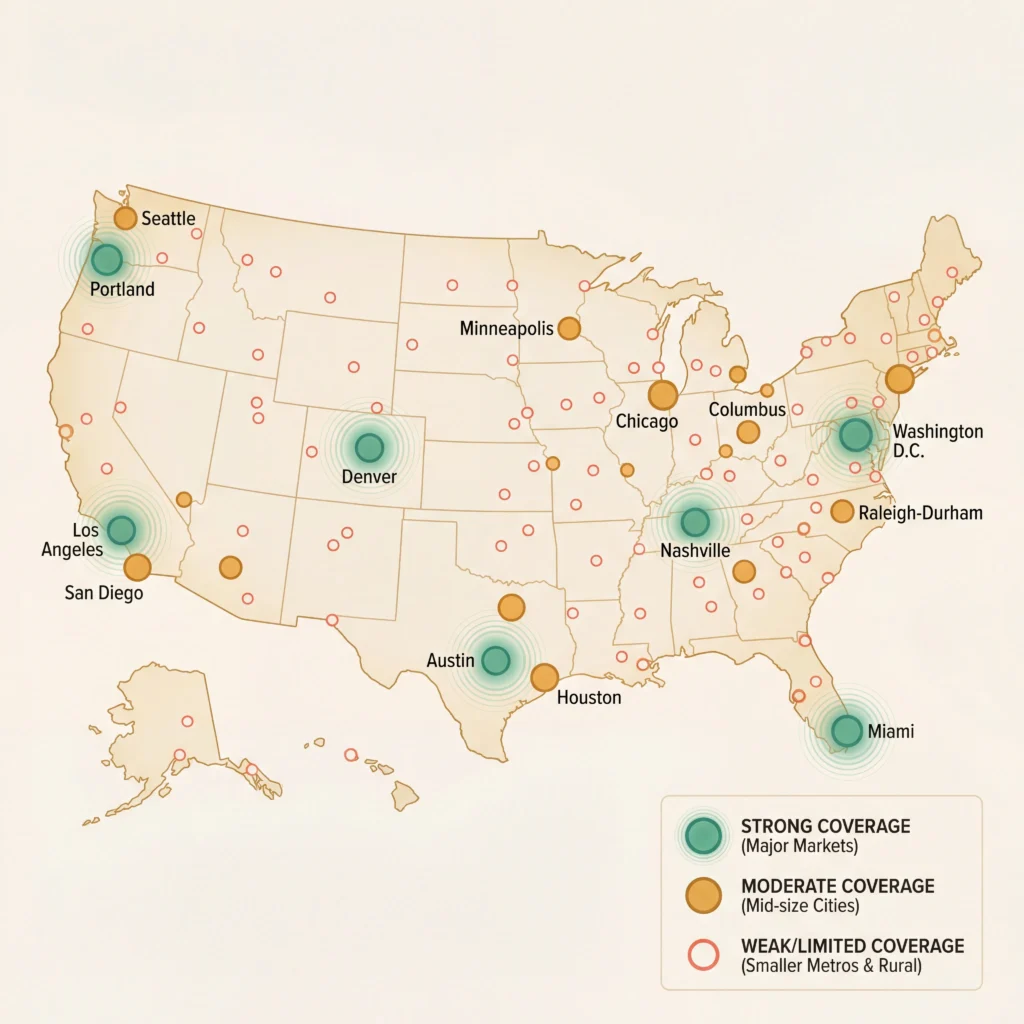
This is the factor that matters more than any individual feature — and it is the one area where every app to locate food trucks still falls short to some degree. An app with excellent design and zero trucks in your city is worthless. Based on my testing across multiple platforms, here is how coverage breaks down.
Strong coverage across most apps: Austin, Denver, Portland, Los Angeles, Miami, Nashville, and Washington D.C. These cities have active food truck scenes and enough vendor adoption that most apps return meaningful results. If you are in one of these markets, you can realistically choose your app based on features and preferences rather than coverage alone.
Moderate coverage — one to two apps work well: Houston, Chicago, Seattle, San Diego, Columbus (StreetFoodFinder’s home base), Minneapolis, and Raleigh-Durham. In these cities, you will typically find solid results on StreetFoodFinder and sometimes one other platform. Truckster covers Houston and Dallas but not all moderate-coverage cities.
Weak coverage — limited or zero results on most apps: Smaller metros and rural areas remain largely uncovered by any dedicated app to locate food trucks. In these areas, your best bet shifts away from apps entirely — Google Maps, local Facebook groups, and individual truck Instagram accounts become more reliable. I tested several apps in a smaller Midwest metro and found fewer than five listings across all platforms combined, with most appearing outdated.
The Bottom Line: On average, the top three apps collectively covered roughly 60-70% of the food trucks I could independently verify through social media in well-served cities. In moderate cities, that figure dropped to an estimated 30-40%. In smaller markets, app coverage was negligible. These are rough observations from my testing, not scientific measurements — but they illustrate why cross-referencing multiple apps and methods remains the most effective strategy.
📎 If you operate or eat in a city with weak app coverage, our guide to food truck finder strategies covers how to build visibility across multiple platforms.
Food Truck Apps for Owners vs. Food Truck Apps for Customers
Most apps to locate food trucks serve two distinct audiences, and what makes an app excellent for a hungry customer is not necessarily what makes it valuable for a truck operator. When we compare the two perspectives side by side, the priority differences become clear and have real implications for which platform deserves your time.
For customers, the priority stack is: (1) coverage in your specific city, (2) data accuracy and freshness, (3) ease of use, (4) ordering capability, and (5) reviews from other users. StreetFoodFinder and Truckster lead here because they prioritize the search-and-discover experience above all else.
For food truck owners, the priorities shift substantially: (1) customer reach and visibility, (2) ordering integration with your existing POS, (3) analytics on who is finding you and when, (4) cost to list and maintain your profile, and (5) marketing and promotion tools. Mobile Nom Premium, Best Food Trucks, and TruckFindr offer considerably more on the business operations side. In my analysis of what each platform provides to vendors, the free tiers are adequate for basic visibility, but the analytics and promotion features that drive real business value consistently sit behind paid plans.
| Feature | Customer Priority | Owner Priority |
|---|---|---|
| Number of trucks listed | High | Medium |
| GPS accuracy | High | Low |
| Mobile ordering | Medium | High |
| Analytics and data | Low | High |
| Loyalty and rewards | Medium | High (retention) |
| Cost to use | Low (all free) | High (varies) |
| POS integration | Low | High |
📎 For a deeper look at POS systems for food trucks and how they connect with finder apps, we cover integration options in detail.
Free vs. Paid: What You Actually Get
Every app to locate food trucks is free for consumers — without exception across all eight platforms I tested. The monetization models differ entirely on the vendor side, and understanding this dynamic helps explain why some apps have broader coverage than others. In my analysis of vendor pricing across all platforms, the pattern was clear: lower barriers to vendor entry correlate directly with wider truck coverage.
StreetFoodFinder charges nothing for basic vendor listings. Enhanced features like priority placement and analytics are available as paid upgrades. This low barrier to entry is specifically why StreetFoodFinder has the widest coverage — more trucks are willing to list when the cost is zero. The tradeoff is that free listings receive less curation, which partly explains the outdated listings I encountered in smaller markets.
Truckster offers free basic vendor profiles with premium features for ordering, loyalty programs, and enhanced analytics at varying price points. Truckster also generates revenue through its catering booking platform, which subsidizes the consumer-facing experience.
Mobile Nom is the most transparent about its pricing tiers. The free starter plan provides basic listing and scheduling, while the paid Premium tier adds promotion tools, enhanced scheduling controls, and better visibility in search results. According to their platform, the premium tier is positioned for vendors who want to actively grow their customer base rather than simply be listed.
TruckFindr primarily earns revenue from transaction fees on mobile orders processed through the app. For truck owners already using a compatible POS system, the integration can be essentially cost-neutral if increased order volume offsets the processing fees.
Where’s the Food Truck offers free vendor listings with revenue from ordering commissions and advertising partnerships.
The practical implication for consumers is straightforward: apps that charge vendors more tend to have fewer but potentially higher-quality listings, while apps that are free for vendors tend to have broader but less curated coverage. Neither model is objectively better — it depends on whether you value breadth of discovery or depth of experience in your specific market.
Beyond Apps: Other Ways to Find Food Trucks Near You
Dedicated apps are not the only — or even always the most effective — way to track down food trucks near your location. During testing in a smaller metro where no app returned usable results, these alternatives proved considerably more reliable than any dedicated platform.
Google Maps now surfaces food trucks that maintain a Google Business Profile. The limitation is that Google treats food trucks like fixed-location businesses, so the listed address may be a commissary kitchen or last-known parking spot rather than where the truck is serving right now. Still, for discovering which trucks exist in your area, a Google Maps search for “food truck” is a solid starting point that costs nothing and requires no additional app.
Instagram and Facebook remain the primary marketing channels for most food truck operators. Many trucks post their daily location on Instagram Stories or Facebook pages. The downside is obvious: you need to follow each truck individually and scroll through your feed to find updates. If you already know which trucks you like, this works well. For discovering new trucks, it is inefficient — which is precisely the problem that dedicated apps were built to solve.
Local food truck Facebook groups exist in most mid-size and large cities. These community-run groups aggregate location updates, reviews, and event announcements. Quality varies enormously by city, but in areas with weak app coverage, these groups are often the single best resource available.
What about DoorDash and Uber Eats? While delivery platforms do list some food trucks, they focus on delivery orders rather than showing you where a truck is currently serving. If you want to walk up to a food truck and order in person — which is the core food truck experience — delivery apps will not help. This is precisely the gap that dedicated apps to locate food trucks are designed to fill.
Event websites and food truck rally calendars serve users looking for multi-truck gatherings rather than individual vendors. Sites like Roaming Hunger list food truck events by city and offer catering booking services.
City-specific food truck websites run by local associations or food bloggers sometimes offer schedule aggregation for a single metro area, and can be more current than national apps for that specific market.
Putting It Into Practice
📅 Today: Download StreetFoodFinder and search your city to gauge how many active trucks are listed in your area. This takes two minutes and requires no account creation — you can even use the web version.
📅 This Week: Install Truckster as a second app and compare results in your area for three to four days. Note which app shows more trucks, and whether the listed locations match reality when you check.
📅 This Month: Track which app delivers more accurate and more current results in your specific market. Make that your primary tool, keep the other as a backup, and supplement with Instagram or Facebook groups for any trucks not listed on either platform.
Tools You Will Need: A smartphone (iOS or Android), the StreetFoodFinder app or website, the Truckster app, and optionally TruckFindr if you prefer ordering ahead. All are free to download.
Frequently Asked Questions About Food Truck Finder Apps
Is there an app to track food trucks in real time?
Yes — specifically, Truckster and Where’s the Food Truck both offer real-time GPS tracking when vendors activate their profiles during service. StreetFoodFinder uses schedule-based tracking, which is less precise but covers more cities. For the most accurate real-time experience in a covered market, Truckster is currently the strongest option.
What is the best app to locate food trucks overall?
StreetFoodFinder is the best app to locate food trucks for most users because it has the widest vendor coverage across US cities. However, if you are in a market where Truckster has strong adoption — such as Austin, Denver, or Miami — Truckster’s live GPS tracking and loyalty rewards make it the better choice locally. The honest answer is that no single app is best everywhere, which is why installing two apps remains the most practical approach.
Is there a free app to locate food trucks nearby?
All major food truck finder apps are free for consumers. StreetFoodFinder, Truckster, Where’s the Food Truck, TruckFindr, and Mobile Nom all offer free downloads with no consumer-facing charges. The apps monetize through vendor fees, ordering commissions, and premium business features — not through consumer subscriptions.
How do I find local food trucks if no app works in my city?
If dedicated apps show limited results in your area, your most effective alternatives are Instagram (follow local trucks and check their Stories for daily locations), local food truck Facebook groups (search “[your city] food trucks” on Facebook), and Google Maps searches for “food truck” within your area. Many smaller markets rely primarily on social media rather than dedicated apps.
Do food truck apps work for booking trucks for private events?
Some do. Best Food Trucks (BFT) specializes in catering and event bookings with structured vendor matching. Truckster and StreetFoodFinder also offer catering request features. For private events like weddings or corporate gatherings, BFT typically offers the most organized booking experience. For more on event logistics, see our food truck catering guide.
Can food truck owners list on multiple finder apps for free?
Most major platforms allow free basic listings for vendors. Based on what I have observed, listing on at least three platforms — typically StreetFoodFinder, Truckster, and one additional app relevant to your market — maximizes visibility without any upfront cost. For a deeper look at technology strategy for food truck businesses, see our complete Food Truck Tech guide.
Which App to Locate Food Trucks Deserves Your Download
After evaluating eight food truck finder apps across multiple cities, the recommendation depends on where you are, what you need, and how much effort you are willing to invest in cross-referencing.
Key Takeaways:
- StreetFoodFinder provides the widest coverage of any standalone app to locate food trucks, returning results in every metro area I tested — making it the safest first download for any user
- Truckster operates in approximately six to eight US markets with real-time GPS tracking that was measurably more accurate than schedule-based alternatives in those specific cities
- All eight consumer-facing food truck apps are free to download — monetization happens entirely on the vendor side through listing fees, ordering commissions, and premium business tools
- Schedule-based apps matched actual truck locations the majority of the time during peak hours in my spot-checks, though roughly two out of ten listings were outdated or inaccurate
- Installing two to three apps and cross-referencing results consistently yielded more complete and accurate results than relying on any single platform alone
Your Next Steps:
- Food Truck POS Systems — if you need ordering integration between your finder app and your point-of-sale
- Food Truck Accounting Software — for tracking your mobile food business finances alongside app-driven orders
Back to the big picture: our complete Food Truck Tech guide covers everything from POS systems to location technology — all the tools that keep a mobile kitchen running efficiently.
— Marcus Reyes
