
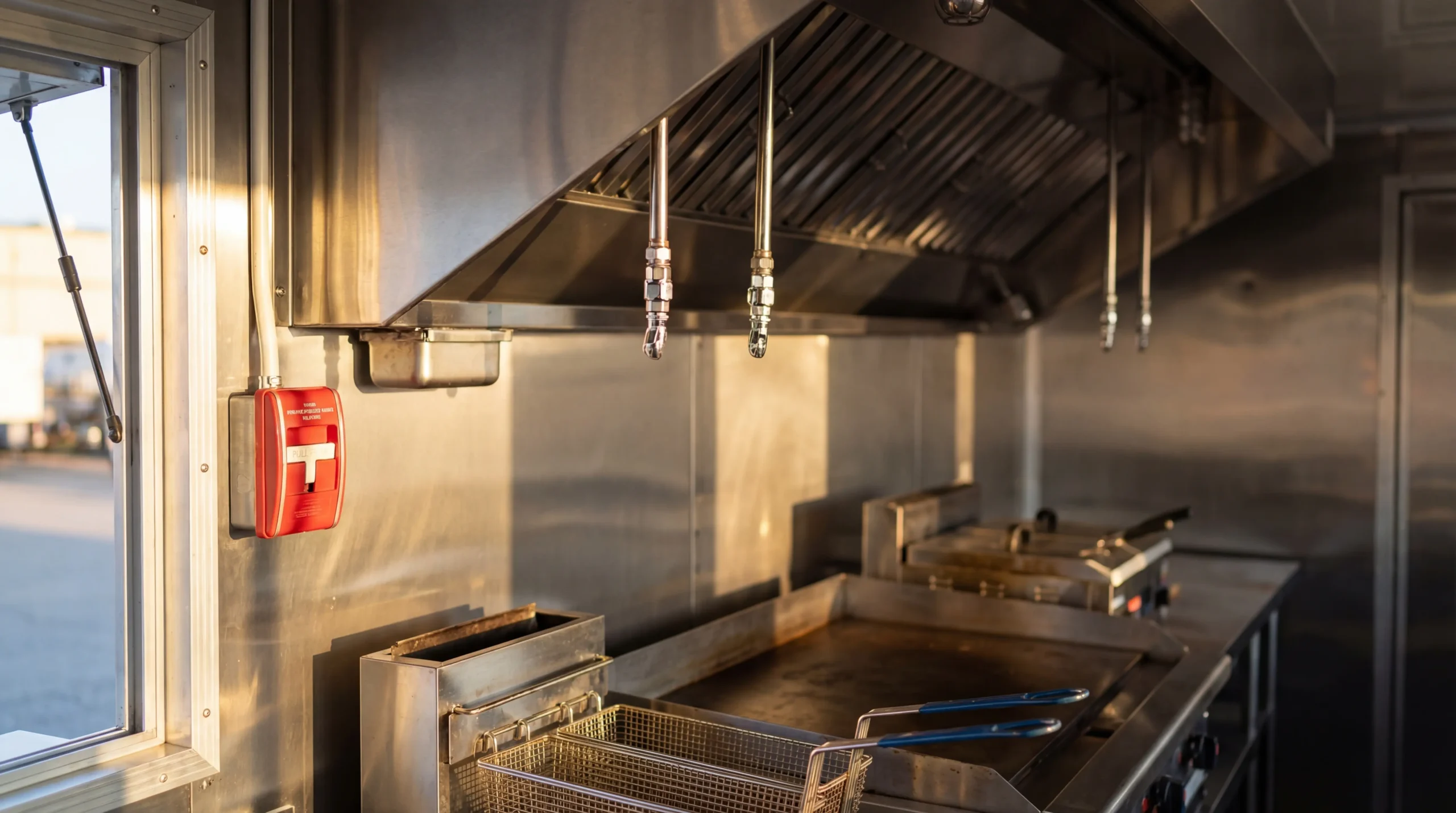

I’ll never forget standing in the fire marshal’s office. He flipped through my paperwork. Then came the words I was dreading: “Your system isn’t compliant. You can’t open.”
Months of planning. Thousands of dollars spent. And my food truck sat parked because I didn’t fully understand what a fire suppression system needed to be.
Here’s the thing: a food truck fire suppression system is a pre-engineered safety setup that automatically detects and extinguishes kitchen fires inside your truck. It uses wet chemical agents, heat-sensing detection lines, and strategically placed nozzles to stop grease fires before they destroy everything you’ve built. Most cities won’t let you serve a single customer without one.
If you’re navigating food truck permits and licenses for the first time, the fire suppression requirement is one of the biggest line items you’ll face. This guide walks you through exactly what you need, what it costs, and how to avoid the mistakes that almost shut me down.
📚 Part of: Food Truck Permits and Licenses — Complete Guide
Quick note: I’m not a fire safety engineer or attorney. I’m a food truck owner who survived the process. Always verify your specific requirements with a certified professional and your local fire marshal before making purchasing or compliance decisions.
[IMAGE: Labeled diagram of a food truck fire suppression system showing tank, nozzles, detection line, manual pull station, and gas shut-off valve — max 150KB, WebP, width=“800” height=“500”, alt=“food truck fire suppression system diagram showing tank nozzles detection line and pull station”]
So What Exactly Is a Food Truck Fire Suppression System?
A food truck fire suppression system is a compact, pre-engineered fire safety setup installed inside your truck’s cooking area. It’s designed to detect extreme heat — typically from a grease fire — and automatically deploy a wet chemical agent that smothers flames, cools surfaces, and prevents re-ignition. The system also cuts your gas or electric supply the moment it activates.
Think of it as a built-in firefighter that works even when you’re too shocked to react. These systems are required under NFPA 96 (the standard for commercial cooking ventilation and fire protection) and must be UL 300 listed, meaning they’ve been tested and certified for commercial kitchen use.
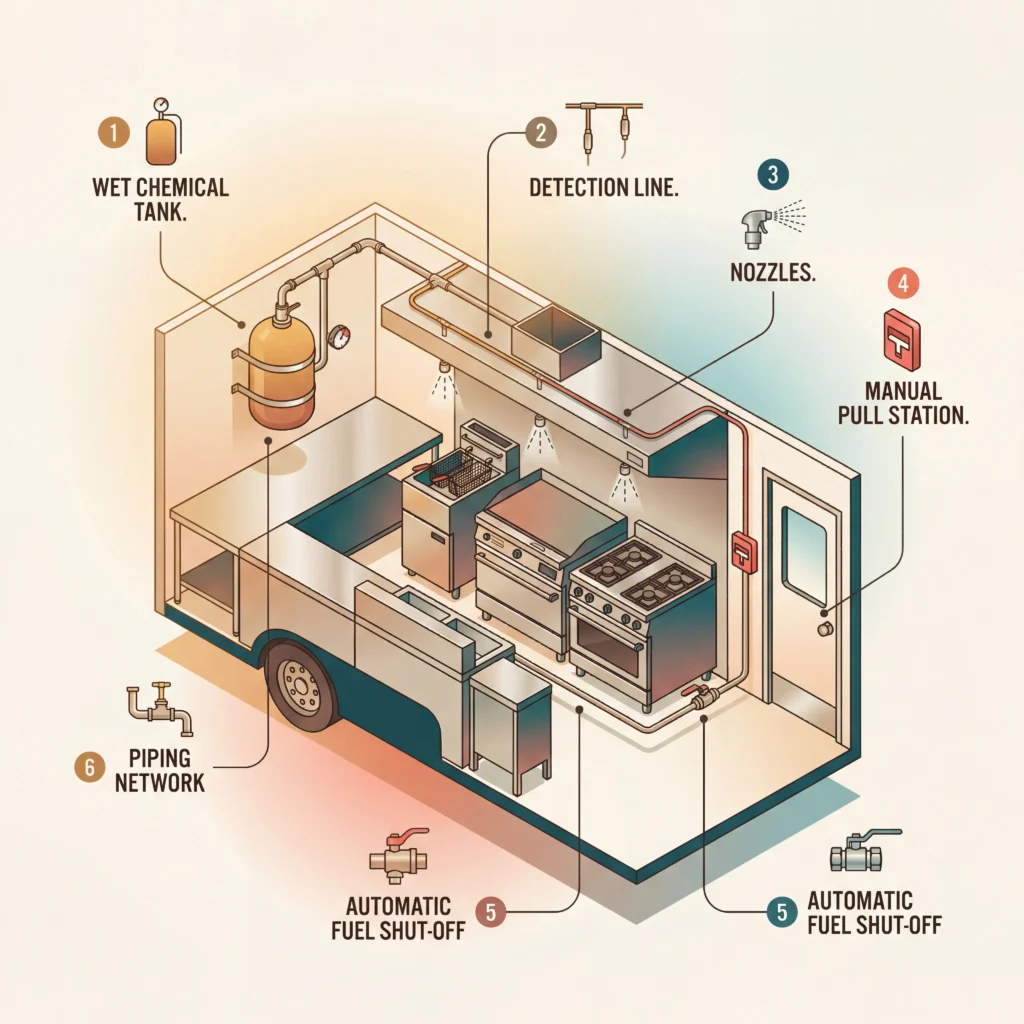
A typical system includes these core components:
- Wet chemical tank — stores the potassium-based suppression agent under pressure
- Detection line — heat-sensitive tubing or fusible links installed above cooking equipment
- Nozzles — positioned over each cooking surface (fryers, griddles, ovens) and inside the hood
- Manual pull station — a clearly labeled handle you can pull to activate the system manually
- Automatic fuel shut-off — cuts gas or electric supply when the system triggers
- Piping network — connects the tank to nozzles through your hood system
Every one of these components matters during an inspection. Miss one, and you’re not opening. I learned that the hard way. Speaking of food truck inspections, you’ll want to know exactly what they’re looking for.
Do You Actually Need One? (Spoiler: Yes)
Yes. If your food truck has any cooking equipment that produces grease, smoke, or high heat, you need a fire suppression system. This isn’t optional in most of the country.
The requirement comes from multiple levels. The National Fire Protection Association sets the baseline through NFPA 96 and NFPA 1 Section 50.7.3.3, which specifically states that deep fat fryers and appliances with combustible liquids must be protected by an approved fire suppression system.
On top of that, your city and county likely have their own fire codes that add additional requirements. As of 2026, most jurisdictions follow these federal baselines but enforce them locally.
Here’s what catches people off guard: even if your state doesn’t explicitly mandate a system, your local fire department almost certainly does. Requirements do vary more than you’d expect. States like California have aggressive mobile food vending codes with extra documentation requirements. Others defer heavily to local fire marshal discretion. Before you buy anything, call your city or county fire department and ask specifically what they require for mobile food units. And without their sign-off, you won’t get your food truck permits.
Beyond the legal side, the practical case is just as strong. Food trucks are small, enclosed spaces with propane, hot oil, open flames, and electrical wiring crammed together. According to the National Fire Protection Association, cooking equipment is responsible for roughly 61% of fires in eating and drinking establishments. In a space as tight as a food truck, a fire can go from manageable to devastating in seconds.
I’m not gonna lie — when I first saw the price tag, I hesitated. But after talking to a truck owner who lost everything to a grease fire that started in his fryer, I stopped thinking of it as an expense and started seeing it as protection for my entire business.
Wet Chemical vs. Dry Chemical — Which One Do You Need?
There are two main types of fire suppression systems you’ll encounter, and understanding the difference saves you money and headaches.
Wet chemical systems are the standard for food trucks. They’re specifically designed for commercial kitchens and grease fires (Class K fires). When triggered, they spray a potassium carbonate-based solution that cools the fire, creates a soapy foam layer over the grease, and prevents re-ignition. This is what NFPA 96 requires for cooking equipment.
Dry chemical systems use a powder agent that smothers flames by cutting off oxygen. They handle a wider range of fire types, including electrical and fuel fires, but they’re not as effective on grease fires. Food trucks sometimes use these as a secondary backup for areas outside the cooking zone — near the generator, for instance.
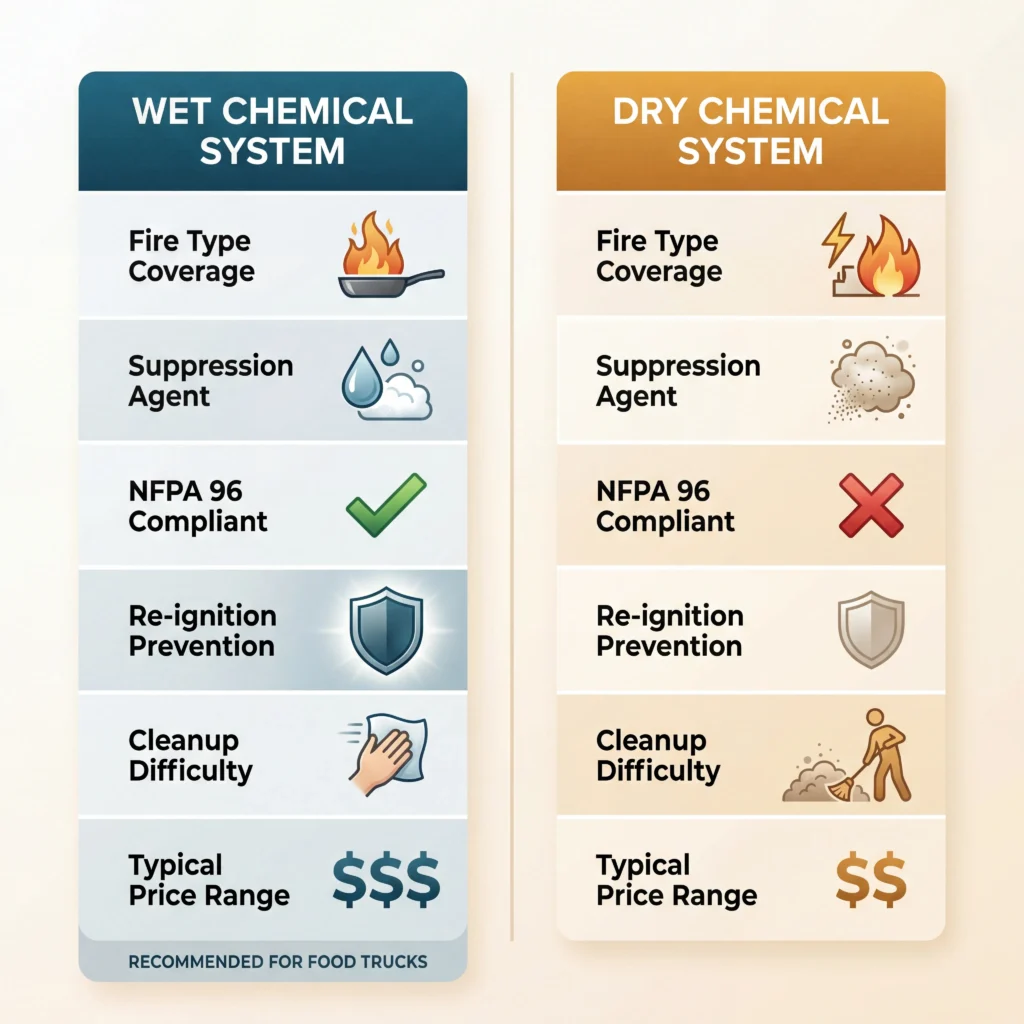
When I was shopping for my system, the wet vs. dry distinction confused me at first. Here’s a quick breakdown to make it easier:
| Feature | Wet Chemical | Dry Chemical |
|---|---|---|
| Best for | Grease/cooking fires (Class K) | Electrical, fuel, general fires |
| Agent | Potassium carbonate solution | Dry powder (sodium bicarbonate) |
| NFPA 96 compliant | Yes | Not for cooking equipment |
| Re-ignition prevention | Excellent — creates foam barrier | Limited |
| Cleanup | Moderate — wipe-down required | Significant — powder everywhere |
| Typical use | Primary system (required) | Backup/secondary (optional) |
| Price range | $1,500–$3,500 for equipment | $300–$800 for equipment |
Quick note on hoods: your fire suppression system works hand-in-hand with your hood. If you’re cooking with grease, oil, or open flame, you need a Type I hood — it includes built-in fire suppression and grease filtration. Type II hoods handle steam and heat only, without suppression. Most food trucks need a Type I, and your suppression system gets integrated directly into it during installation.
For most food trucks, a wet chemical system is what you need and what inspectors will require. If you have a small food truck with limited cooking equipment, a compact wet chemical system handles the job. If your setup includes multiple fryers plus a generator, you might want both wet and dry coverage.
You’ve totally got this — just make sure the system you choose is UL 300 listed. That certification isn’t negotiable. If you also need a Class K fire extinguisher for your food truck, that’s a separate requirement on top of the suppression system.
💡 Pro Tip from Jo: When your installer talks about “nozzle count,” that’s the number of spray points in your system. More cooking stations = more nozzles = higher cost. Map out every piece of cooking equipment before you get quotes so you’re comparing apples to apples.
How Do the Big Brands Stack Up?
If you’re choosing an actual system, you’ll mainly see three names: Kidde, Ansul, and a few newer players like Lehavot. Here’s how they compare based on what I’ve seen from other truck owners and the research I did before buying mine.
I put together a quick comparison to make this easier:
| Brand | Best For | Price Range | Warranty | Key Detail |
|---|---|---|---|---|
| Kidde (WHDR / Pre-Pipe) | Most food trucks; compact spaces | $2,800–$3,300 | 3 years | Most popular for food trucks; widely available through distributors |
| Ansul (R-102) | Larger setups; inspector credibility | $3,000–$5,500 | Varies by dealer | Industry standard for commercial kitchens; widely recognized by inspectors |
| Lehavot (FoodTruckShield) | Flexible layouts; newer trucks | ~$2,500–$4,000 (verify with dealer) | Contact dealer | Newer option; patented dual-directional release; gaining traction |
A few things to know when deciding.
Kidde is the brand I see most often in the food truck world. Their Pre-Pipe systems are specifically designed for concession trailers and food trucks — compact, flexible, and widely available. The 3-year warranty is solid, and most fire safety companies are trained on Kidde systems, which makes inspections and maintenance straightforward.
Ansul is the heavyweight in commercial kitchens. If you say “Ansul system,” most fire marshals know exactly what you’re talking about. It tends to cost more, but it carries serious credibility. Some jurisdictions specifically reference Ansul-type systems in their codes.
Lehavot’s FoodTruckShield is a newer option designed specifically for the food truck market. Their patented dual-directional release mechanism offers flexible installation, which can be a big deal in a cramped truck layout.
Real talk: all three will pass inspection if properly installed. Your choice often comes down to what your local fire safety installer carries and what your budget allows. I went with a Kidde Pre-Pipe system for my truck because my installer had the most experience with it, and the compact design fit my layout perfectly.
📎 If you’re comparing overall food truck costs, fire suppression is typically 3–7% of your total build-out budget.
How Much Will This Actually Cost You?
Now, I know what you’re thinking — how much is all of this going to set me back? Here’s the real breakdown. Not just the sticker price, but the total year-one cost nobody talks about.
| Cost Component | Low End | High End | Notes |
|---|---|---|---|
| Suppression system (equipment) | $1,500 | $3,500 | Depends on brand and nozzle count |
| Professional installation | $500 | $1,500 | Required — DIY is not code-compliant |
| Permit/inspection fee | $100 | $300 | Varies by city |
| First 6-month inspection | $150 | $300 | Mandatory under NFPA 96 |
| Class K fire extinguisher | $50 | $150 | Required alongside the system |
| ABC fire extinguisher | $30 | $80 | Required if you have a generator |
| Total Year-One Cost | $2,330 | $5,830 | Before ongoing maintenance |

After year one, your main recurring costs are the semi-annual professional inspections (roughly $150–$300 each) and any maintenance or recharging needed. Budget around $400–$700 per year for ongoing costs.
Can we talk about the “cheap route” for a second? I’ve seen people in online forums trying to piece together systems themselves or buy used equipment to save money. I understand the temptation — when I was budgeting my truck, every dollar mattered. But here’s what I learned: a system that wasn’t professionally installed won’t pass inspection. Period. And if your system fails during a fire, no amount of savings is worth it.
That said, you can save legitimately by getting quotes from multiple fire safety companies, buying the system through your hood supplier (some bundle deals save hundreds), and scheduling your installation during the build-out phase instead of retrofitting later.
💡 Pro Tip from Jo: Ask your hood supplier if they bundle fire suppression systems with the hood purchase. I saved a few hundred dollars by buying both together instead of sourcing them separately.
What Happens During Installation? Here’s the Process
Okay, so here’s the deal with installation — it’s not something you do yourself. Fire codes require a certified fire protection professional to handle it. My installation took about six hours while my truck was still being built out, which made everything easier. Here’s what the process typically looks like so you know what to expect.

Step 1: Assessment. The installer visits your truck (or reviews your build plans) and evaluates your cooking equipment, hood system, layout, and fuel sources. They determine how many nozzles you need and where everything goes.
Step 2: System selection. Based on the assessment, they recommend a specific system configuration. This is where the nozzle count, tank size, and piping layout get finalized.
Step 3: Mounting and piping. Your installer mounts the tank (usually overhead, inside the hood area or on a wall) and runs piping from the tank to each nozzle location. Nozzles go directly over every cooking surface — fryers, griddles, ovens, and inside the hood.
Step 4: Detection line installation. They install the heat-sensing detection line or fusible links above the cooking area. These are what trigger the automatic activation.
Step 5: Manual pull station. They mount a clearly labeled pull station near the exit — somewhere accessible but out of the way of normal operations.
Step 6: Fuel shut-off integration. They wire the system to your gas valve (or electric disconnect) so it automatically cuts fuel when activated.
Step 7: Testing and certification. The installer tests the system, verifies every component works, and provides you with a certification tag and documentation.
The whole process typically takes 4–8 hours for a standard food truck, though complex setups with multiple cooking stations can take longer. If you’re building a new truck, schedule the installation as part of the build — retrofitting later costs more and gets more complicated.
When looking for an installer, search for “food truck fire suppression system installation near me” and verify they’re licensed in your state. Ask specifically about food truck experience — restaurant installers sometimes aren’t familiar with compact layouts and mobile-specific codes.
How Do You Pass Your Fire Suppression Inspection?
This is the section I wish someone had given me before my first inspection. Here’s your pre-inspection checklist — the things fire marshals and inspectors actually look for:
☐ System is UL 300 listed — check the certification label on your tank
☐ All nozzles are positioned correctly — one over every piece of cooking equipment, plus inside the hood
☐ Manual pull station is accessible and clearly labeled — within reach, not blocked by equipment
☐ Automatic fuel shut-off is connected and functional — inspector will test this
☐ Detection line/fusible links are intact — not damaged, corroded, or disconnected
☐ Current inspection tag is visible — shows date of last professional inspection (must be within 6 months)
☐ Class K fire extinguisher on board — fully charged, accessible, with current inspection tag
☐ ABC fire extinguisher on board — required if you have a generator or LP gas appliance
☐ Hood and duct system is clean — grease buildup is a red flag
☐ System documentation available — installation certificate, maintenance records, system manual
☐ No modifications to the system — any changes after installation must be done by a certified professional
☐ Piping is secure and undamaged — no loose connections, no visible wear
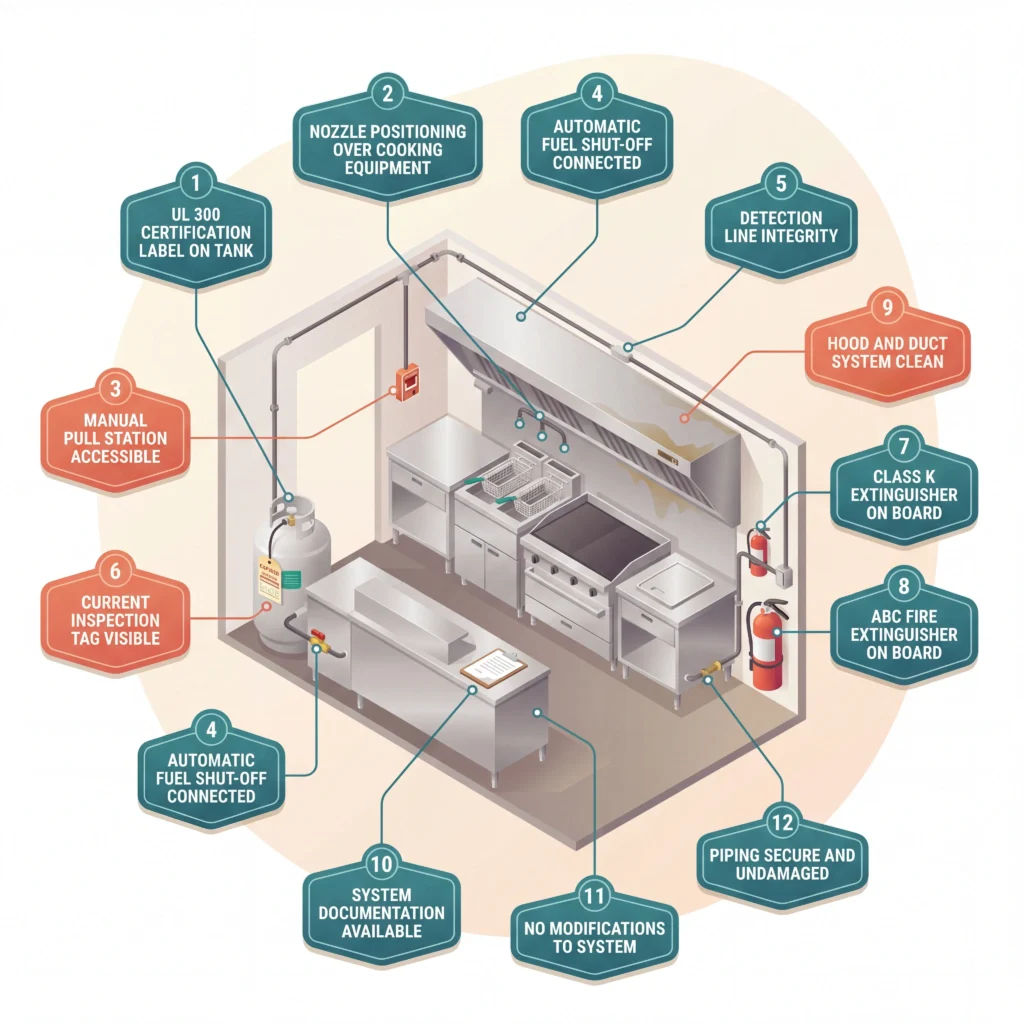
Here’s where it gets interesting: the things that most commonly fail inspections aren’t the big stuff. It’s the details — an expired inspection tag, a nozzle that got bumped out of position, a pull station blocked by a storage bin. After years of helping new truck owners get started, the pattern is always the same: it’s the small overlooked things that cause problems.
💡 Pro Tip from Jo: Take a photo of your entire system right after a successful inspection. When something gets moved during daily operations (and it will), you have a reference photo showing exactly where everything should be.
📎 For a broader look at what inspectors check beyond fire suppression, see our guide on what to expect during a food truck inspection.
What Does the Maintenance Schedule Look Like?
Your food truck fire suppression system needs professional inspection every 6 months and routine checks in between. Here’s the schedule I follow:
Weekly (you do this yourself):
- Visual check: are all nozzles in position? Any visible damage to piping or detection lines?
- Is the manual pull station unobstructed?
- Are both fire extinguishers in place and accessible?
Monthly (you do this yourself):
- Check the pressure gauge on your suppression tank (if equipped) — it should be in the green zone
- Verify the manual pull station moves freely (don’t actually pull it — just confirm it isn’t stuck or blocked)
- Clean grease buildup around nozzle areas
- Check that the fuel shut-off valve moves freely
Every 6 months (certified professional — mandatory):
- Full system inspection and certification per NFPA 96 and NFPA 17A
- Test all automatic and manual activation mechanisms
- Inspect and replace fusible links if needed
- Verify fuel shut-off functionality
- Check agent level and tank pressure
- Update the inspection tag with date and technician info
- Provide you with updated documentation
Annually (certified professional — recommended):
- Complete system service including internal component check
- Hood and duct cleaning verification
- Fire extinguisher annual inspection and recharge if needed
The 6-month professional inspection is the one that matters most for compliance. Miss it, and your inspection tag expires — which means you’re technically operating out of compliance. Most fire safety companies offer service contracts that include both semi-annual inspections for a flat annual fee, typically ranging from $400 to $700.
💡 Pro Tip from Jo: I keep a small laminated card on the inside of my serving window with my weekly and monthly check items. Takes two minutes and I never forget a single one.
What Mistakes Can Actually Shut Down Your Truck?
After years of mentoring new food truck owners, I’ve seen the same mistakes come up again and again. Sound familiar? Here’s what to avoid.
Buying a used system without certification. Used fire suppression systems might seem like a deal, but if the system can’t be re-certified by a licensed professional, it’s worthless for inspection purposes. Some systems can be refurbished — but only by a certified company, and only if the components meet current UL 300 standards. Always get written confirmation that a used system can be inspected and tagged before you buy it.
Skipping the professional installation. I get it — you’re handy, you’ve watched YouTube videos, and you want to save money. But fire codes require professional installation, and inspectors will verify it. A self-installed system won’t pass. More importantly, a poorly installed system might not work when you need it most.
Letting your inspection tag expire. The 6-month inspection window is strict. Set a calendar reminder for 5 months out so you have time to schedule the appointment. An expired tag can result in fines, failed inspections, and temporary closure.
Moving nozzles or equipment without updating the system. If you rearrange your cooking stations — even slightly — your nozzle positioning might no longer cover the right areas. Any time you move equipment, have your fire safety company verify that the suppression coverage still matches your layout.
Ignoring the Class K extinguisher. Your automatic system is your primary defense. Your Class K extinguisher is your backup. Inspectors check both. Make sure it’s charged, accessible, and has a current tag.
Not knowing what happens if your system discharges. If your system ever goes off — whether from a real fire or accidental activation — you stop service immediately, call the fire department to confirm the scene is safe, then call your fire safety company to recharge and re-certify the system. Budget roughly $300–$500 for a recharge. And yes, you’ll lose whatever product was out. Keep your documentation handy so you can get back up and running as fast as possible.
How Does Fire Suppression Affect Your Insurance?
Here’s something nobody told me before I started: your fire suppression system directly impacts your food truck insurance in several ways.
First, most commercial food truck insurance policies require a compliant fire suppression system as a condition of coverage. Know what happens if your tag is expired when you file a claim? Your insurer could deny it entirely. That’s a risk that far outweighs the cost of maintaining your system.
Second, having a certified, regularly-inspected system can qualify you for lower premiums. The exact discount varies by insurer, but fire safety compliance is a factor in how they assess your risk. When shopping for commercial food truck insurance, ask specifically about fire suppression discounts and what documentation they need.
Third, keep your records clean. Insurers may request proof of your last inspection, your installation certificate, or your maintenance history — especially after a claim. That binder of documentation I mentioned? This is where it earns its keep.
The investment in fire suppression doesn’t just protect you from fires. It protects you from coverage gaps, claim denials, and premium increases.
Putting It Into Practice
☐ 📅 Today: Call 2-3 local fire safety companies for quotes — ask specifically about food truck experience
☐ 📅 This Week: Confirm your hood type (Type I or II) and get suppression system specs matched to your equipment
☐ 📅 This Month: Schedule installation during your build-out window — not after. You’ve got this.
Got Questions? Here’s What I Hear Most
What is the best fire suppression system for a food truck?
For most food trucks, a wet chemical system from Kidde (WHDR or Pre-Pipe series) or Ansul (R-102) is the go-to choice. Both are UL 300 listed, NFPA 17A and 96 compliant, and widely supported by fire safety professionals. The “best” system depends on your truck’s size, cooking equipment, and what your local installer specializes in. I’d recommend getting quotes from at least two certified installers before deciding.
Do you need an Ansul system specifically in a food truck?
Not necessarily. While “Ansul system” has become a generic term for fire suppression (like “Band-Aid” for bandages), any UL 300 listed wet chemical system that meets NFPA 96 standards will satisfy code requirements. Kidde and Lehavot systems are equally acceptable. What matters is the certification, not the brand name.
Can I buy a used fire suppression system for my food truck?
You can, but proceed with caution. A used system must be inspectable and re-certifiable by a licensed fire protection professional. Components degrade over time, and older systems may not meet current UL 300 standards. Always have a certified technician evaluate a used system before purchasing, and get written confirmation that it can be tagged and certified for your truck.
How often does a food truck fire suppression system need to be inspected?
Every 6 months, per NFPA 96 and NFPA 17A. This must be done by a licensed fire protection professional who will test all activation mechanisms, check agent levels, inspect components, and update your certification tag. Missing this window means you’re operating out of compliance.
What’s the difference between a fire suppression system and a fire extinguisher?
Your fire suppression system is a permanent, automatic installation built into your truck’s hood and cooking area. A fire extinguisher is a portable, handheld device. You need both. The suppression system handles the automatic response; the extinguisher is your manual backup. Most jurisdictions require a Class K extinguisher (for grease fires) and an ABC extinguisher (for general fires) in addition to your installed system.
Does my food truck need fire suppression if I only do cold food or prepackaged items?
Generally, no — if you have zero cooking equipment that produces grease, smoke, or high heat. But requirements vary by jurisdiction. Some areas require basic fire safety equipment even for cold-prep trucks. Always check with your local fire marshal or verify your specific permit requirements before assuming you’re exempt.
So, What Now?
Here’s the thing — fire suppression isn’t the most exciting part of running a food truck. It’s not your menu, your branding, or your first big event. But it’s the thing that protects all of that.
The key takeaways:
- A wet chemical fire suppression system is required for virtually all food trucks with cooking equipment, and you should budget roughly $2,300 to $5,800 for year-one costs.
- Kidde, Ansul, and Lehavot all make compliant systems — choose based on your layout, installer expertise, and budget.
- You can’t skip professional installation or the 6-month inspection cycle — period.
- Your fire suppression compliance directly affects your insurance coverage, premiums, and ability to file claims.
You’ve got this — and now you know exactly what to expect.
Your next steps from here:
- If you’re still in the planning phase, our food truck permits and licenses guide covers the complete legal picture.
- If you’re budgeting your build-out, the food truck business plan guide helps you map every cost — including fire suppression.
- If you’re shopping for coverage, start with our food truck insurance breakdown.
Back to the full picture: Food Truck Permits and Licenses — Complete Guide
Most food trucks need a UL 300 listed wet chemical fire suppression system, professional installation, and semi-annual inspections to stay compliant with NFPA 96 and pass local fire safety reviews.
— Jolene
