
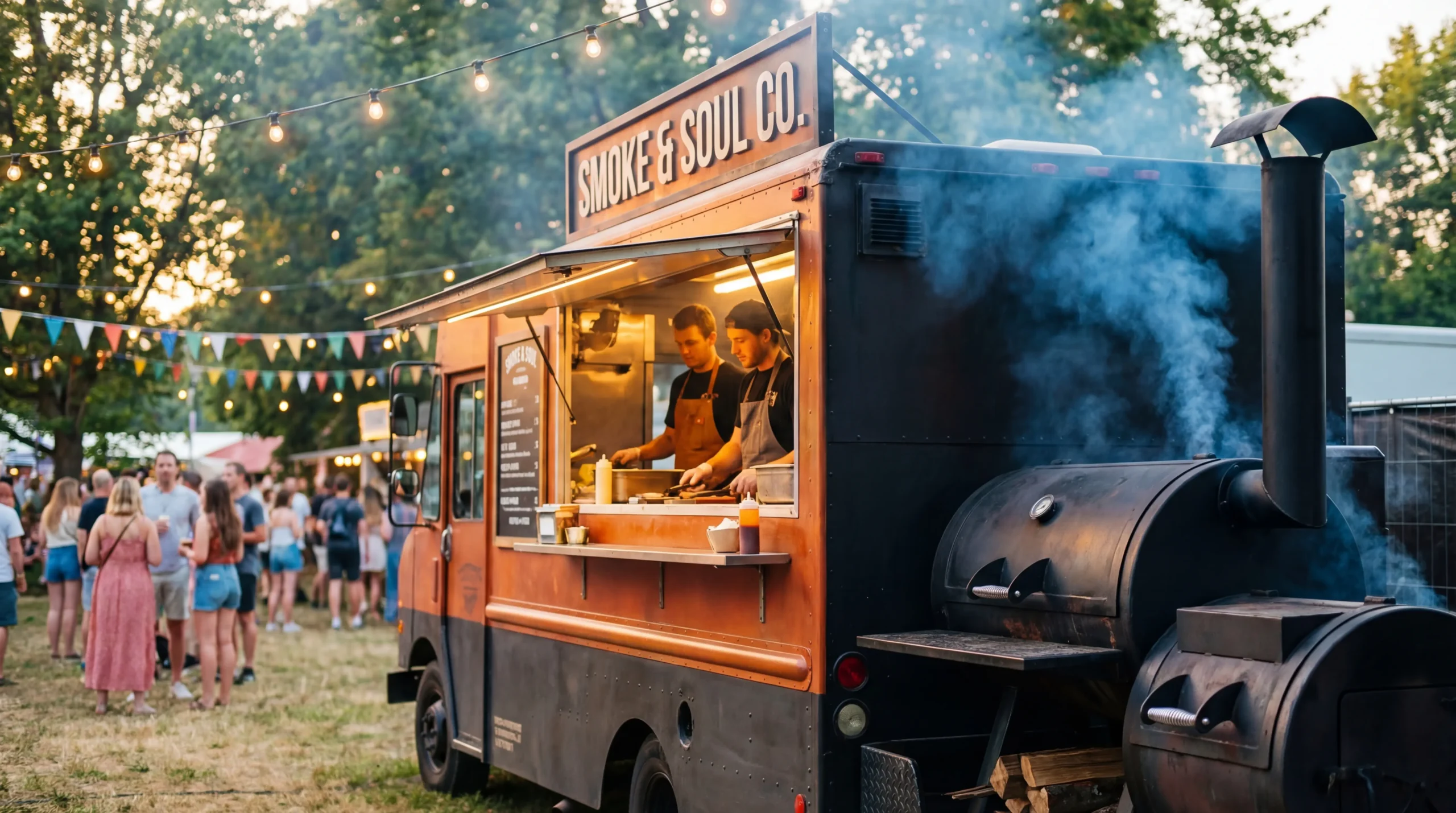

So you’re dreaming about rolling up to a festival with smoke billowing from your truck, the smell of brisket pulling people toward you like a magnet. I get it. That dream kept me up at night for months before I finally took the leap into food trucks myself.
Here’s the thing: starting a BBQ food truck is one of the most rewarding (and challenging) paths in the mobile food world. You’re not just serving sandwiches or tacos that come together in minutes. You’re committing to a craft that demands hours of smoking before you even open your window.
The quick answer? A BBQ food truck typically costs between $50,000 and $200,000 to launch, depending on whether you buy new or used, the equipment you choose, and your local permit requirements. Monthly revenue ranges from $20,000 to $50,000 for well-positioned trucks, with profit margins averaging 6-10% after expenses.
Quick heads up: commercial food truck operation involves working with smokers, propane systems, and high-temperature equipment. This isn’t backyard grilling. Follow your equipment manufacturer’s safety guidelines, maintain proper ventilation, and stay compliant with local fire codes. The techniques I share come from my experience; always test in your specific setup.
But those numbers only tell part of the story. The real question is whether you’re ready for the grind (and I mean that literally, if you’re grinding your own rubs). This guide covers everything from startup costs to equipment essentials, menu strategy to common mistakes I’ve watched rookies make.
If you’re exploring the food truck world more broadly, check out our complete Food Truck Startup Guide for the full picture.
What Is a BBQ Food Truck and Why Is It Different?
A BBQ food truck is a mobile kitchen built around one thing: smoke. Unlike other food trucks where you’re cooking to order, you’re managing a process that started hours before your first customer shows up.
Most BBQ trucks run on an offset smoker or a commercial pellet smoker mounted on (or towed behind) the vehicle. Some operators use a separate smoker trailer. The truck itself handles holding, slicing, and serving while the smoker does the heavy lifting overnight or in the early morning hours.
What makes this different from, say, a taco truck? Time management becomes your entire life. You can’t just prep ingredients and cook them fresh. Brisket takes 12-16 hours. Pork shoulder needs 8-12. Ribs run 5-6 hours minimum. I’ve pulled brisket at 11 hours when the bark was perfect and held others to 18 when they needed more time. It depends on your setup, your meat, and about a dozen variables you’ll learn to read over time. If you run out mid-service, you’re done for the day.
On the other hand, when you get it right, people will drive across town to find you. BBQ has a loyal following that other cuisines would kill for.
Why Start a BBQ Food Truck? The Real Pros and Cons
Can we talk about why BBQ specifically? Because not every food concept makes sense on wheels, and I’ve seen plenty of people pick the wrong one.
The honest pros:
BBQ commands premium prices. People expect to pay more for smoked meats, which means your average ticket tends to run higher than a burger truck or hot dog cart. A pulled pork sandwich at $12-15 doesn’t raise eyebrows the way it might for other street food.
The food holds well. Unlike dishes that need to be plated immediately, smoked meats sit happily in a hot box for hours. This makes catering and events much more manageable (and catering is where the real money lives, from what I’ve seen).
You’re building a brand around craft. BBQ has stories, regional traditions, family recipes. That’s marketing gold.
The honest cons:
Your prep time is brutal. While taco truck operators are sleeping, you’re checking internal temps at 3 AM. This isn’t a side hustle you can ease into.
Ingredient costs run high. Brisket prices have climbed significantly in recent years. Pork shoulder is more forgiving, but you’re still dealing with protein costs that cut into margins.
Equipment is specialized and expensive. A quality commercial smoker capable of handling food truck volume costs $5,000 to $20,000. Then you need hot holding equipment, slicers, and adequate refrigeration.
Real talk: if you’re not already obsessed with smoking meat, this probably isn’t your concept. The learning curve is steep, and customers can taste the difference between someone who’s passionate and someone who’s just copying a recipe.
BBQ Food Truck Startup Costs: What You’ll Actually Spend
The cost ranges below reflect typical 2026 market prices. Equipment and supply costs fluctuate, so verify current pricing with manufacturers and suppliers before finalizing your budget.

I’m sharing what I’ve learned and observed, not professional financial advice. Your actual costs, revenue, and margins will depend on your market, your hustle, and factors I can’t predict. For detailed financial projections specific to your situation, work with an accountant familiar with food service businesses.
Let me break down the numbers, because the range you’ll see online (anywhere from $30,000 to $250,000) isn’t very helpful without context.
The Truck or Trailer Itself
A new, fully built-out BBQ food truck runs $75,000 to $150,000. Used trucks in decent condition cost $40,000 to $80,000, but you’ll likely need another $10,000 to $30,000 for repairs, upgrades, or equipment replacement.
Going the trailer route? A BBQ trailer (smoker plus serving area) typically costs $25,000 to $75,000, plus you need a vehicle capable of towing it.
Smoker and Cooking Equipment
This is where BBQ trucks diverge from other concepts. A commercial-grade offset smoker suitable for truck volume runs $5,000 to $20,000. Brands like Southern Pride, Cookshack, and Ole Hickory are industry standards. For beginners, I’d lean toward a pellet smoker for consistency, though offset purists might disagree.
Beyond the smoker, budget for: commercial refrigeration ($2,000-$5,000), hot holding equipment like Cambro boxes ($1,000-$2,500), a meat slicer ($500-$2,000), prep tables, and a three-compartment sink.
Permits, Licenses, and Insurance
Health permits, fire inspections, business licenses, and mobile food vendor permits add up to $1,000 to $5,000 depending on your location. Some cities are notoriously expensive (looking at you, California).
Commercial auto insurance plus general liability typically runs $3,000 to $8,000 annually for a food truck.
Initial Inventory and Supplies
Your first major meat order, plus rubs, sauces, serving supplies, and packaging, runs $2,000 to $5,000.
Marketing and Branding
A professional wrap for your truck costs $2,500 to $5,000. Add website, social media setup, and initial advertising for another $1,000 to $3,000.
Working Capital
I can’t stress this enough: have 3-6 months of operating expenses in reserve. That’s usually $15,000 to $30,000 sitting in the bank for when equipment breaks, a slow month hits, or you need to pivot locations.
Pro Tip from Jolene: Don’t skimp on your working capital cushion. I’ve seen more trucks fail from cash flow crunches than from bad food. That emergency fund isn’t optional.
If you want the detailed financial breakdown, Marcus has a whole guide on food truck startup costs that goes deeper into the numbers than I ever could (spreadsheets make my eyes glaze over, honestly).
Essential Equipment for Your BBQ Food Truck
Your equipment list looks different than most food trucks because smoking is the whole operation. Here’s what you actually need versus what’s nice to have.
Must-Have Equipment
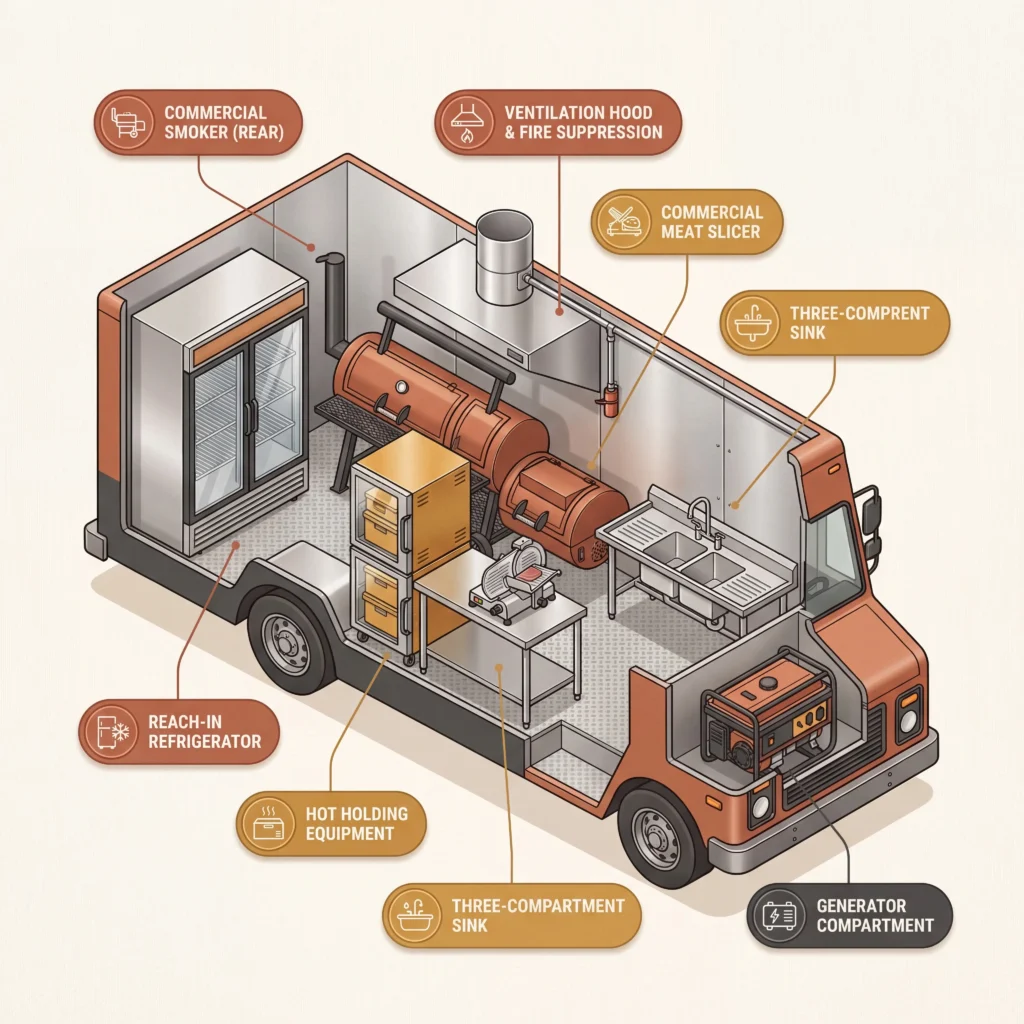
The smoker is your heart. For truck volume (serving 100+ customers daily during events), you need a unit that can handle at least 200 pounds of meat. Offset smokers from Southern Pride or Ole Hickory run $8,000 to $15,000. Pellet smokers offer more consistency with less babysitting but cost similarly.
Hot holding equipment keeps your meat at safe temperatures (above 140°F) without drying it out. Cambro insulated food carriers ($200-$400 each) are the industry standard. Electric hot boxes provide more control but need power.
A commercial meat slicer ($500-$2,000) makes the difference between professional presentation and shredded mess. Get one with at least a 10-inch blade.
Refrigeration needs vary, but plan for a reach-in refrigerator ($2,000-$4,000) and potentially a small freezer. Your health department will have specific requirements.
A proper ventilation hood and fire suppression system are non-negotiable for cooking inside the truck. Budget $3,000 to $8,000 for a compliant setup.
Your smoker needs reliable power. Most BBQ trucks run a dedicated generator, especially for events without electrical hookups. Budget $2,000 to $5,000 for a commercial generator that can handle your load.
Nice-to-Have Equipment
A flat-top griddle lets you toast buns, make grilled cheese for kids, or prepare sides. A steam table keeps sides like beans and coleslaw at serving temp. Vacuum sealers help with prep efficiency and storage.
Related: See our full food truck equipment checklist for everything beyond BBQ-specific gear.
Creating a Profitable BBQ Food Truck Menu
Your menu makes or breaks your margins. I’ve watched trucks with incredible barbecue struggle because they offered too much, priced too low, or ignored the math entirely.
Start with Your Hero Proteins
Most successful BBQ trucks focus on 3-4 main proteins: brisket (highest price point, highest skill requirement), pulled pork (best margins, most forgiving), ribs (crowd favorite, takes display space), and smoked chicken (lower cost, appeals to lighter eaters).
You don’t need all four. Some of the best trucks I know do two proteins exceptionally well and that’s it.
Build Around Sandwiches and Plates
Sandwiches should be your volume item. They’re portable, they hold well, and people expect to pay $12-16 for a loaded BBQ sandwich in most markets.
Plates (meat plus two sides) command $15-22 and work better for lunch crowds and catering. Keep your sides simple: coleslaw, beans, mac and cheese, cornbread. Every additional side is more prep, more holding equipment, more waste if it doesn’t sell.
The Money Is in Add-Ons
Loaded fries (fries plus pulled pork plus cheese plus sauce) cost you maybe $3 in ingredients and sell for $10-12. Same with nachos. These high-margin add-ons can boost your average ticket by 20-30%.
Drinks matter too. A $3 sweet tea or lemonade is pure profit.
Pricing Strategy
Your food cost should target 25-30% of menu price. If your brisket costs $8 per pound and you get four sandwiches per pound, each sandwich has $2 in meat cost. With bun, sauce, and packaging adding another dollar, you’re at $3 cost for a sandwich you sell at $14. That’s roughly 21% food cost, which is healthy.
Pulled pork runs cheaper (around $4-5 per pound wholesale), giving you even better margins.
Pro Tip from Jolene: Take photos of every plate before you open. Your early menu photos become your Instagram content and menu board images. Your future self will thank you.
For menu ideas specific to events and festivals, check out our guide on food truck menu planning.
Regional BBQ Styles: Finding Your Identity
Nobody tells you this, but choosing a regional style is actually a business decision, not just a taste preference. Each style has different cost structures, equipment needs, and customer expectations.
Texas style centers on beef, particularly brisket. Simple salt and pepper rubs let the meat shine. This is the highest-cost, highest-skill approach. Your brisket needs to be exceptional because there’s nowhere to hide.
Kansas City style goes sweeter and saucier. Tomato-based sauces with molasses. This style works well on pork ribs and burnt ends. The sauce can help mask minor smoking inconsistencies (I’m just being honest).
Memphis style splits between “wet” (sauced) and “dry” (rub only) preparations. The focus is on pork, especially ribs. Dry rubs with paprika and garlic dominate. Lower ingredient costs than Texas brisket-focused menus.
Carolina style is all about pulled pork with vinegar-based sauce (Eastern) or tomato-vinegar hybrid (Western). This is the most forgiving style for beginners and has the lowest protein costs.
What should you choose?
Pick what you’re genuinely good at. If you’ve been smoking Texas-style brisket for ten years, don’t suddenly pivot to Carolina pulled pork because the margins are better. Customers taste authenticity.
Still, if you’re starting from scratch, Carolina or Memphis styles offer a gentler learning curve and better margins while you find your footing.
How Much Can a BBQ Food Truck Actually Make?
Let’s get into the money, because I know that’s why you’re really here. The numbers vary wildly based on location, events, and how hard you hustle.
Monthly Revenue Expectations

A well-positioned BBQ food truck generates $20,000 to $50,000 in monthly revenue. The range is huge because it depends entirely on your market, your schedule, and your event strategy.
Daily numbers: A typical weekday lunch spot might bring in $400-$800. A good festival day can hit $2,000-$5,000. Catering events run $1,500-$10,000 depending on headcount.
Profit Margins
Industry data suggests food truck profit margins average 6-10% after all expenses. BBQ trucks often run slightly lower due to higher protein costs and equipment needs. A 8% net margin on $400,000 annual revenue is $32,000 in profit. Not getting rich, but a living.
Where does the money go? Food costs eat 25-35%, labor (even if it’s just you) takes 25-30%, overhead (truck payment, insurance, permits, fuel, commissary fees) consumes another 30-35%.
The Real Money: Catering and Events
Regular street service is volume with thin margins. Catering is where BBQ trucks shine. A single wedding or corporate event can net more profit than a week of lunch service.
Build your catering business early. Even while you’re doing street service, collect emails, hand out catering menus, follow up with every corporate customer. One guy I talked to spent his entire budget on the truck and had nothing left for marketing. He struggled for months before word of mouth finally kicked in. Don’t be that person.
BBQ Food Truck vs BBQ Trailer: Which Should You Choose?
This decision trips up a lot of first-timers, and I see people overthinking it constantly.
The Food Truck (Self-Contained) Option
Everything lives in one vehicle: smoker (often a smaller unit or cook elsewhere and hold on truck), prep area, serving window, refrigeration. You drive to location and open.
Pros: Easier permitting in most cities, simpler setup, more professional appearance. Cons: Limited smoking capacity, higher upfront cost, expensive repairs if the truck itself breaks.
The Trailer Setup
A dedicated smoker trailer plus a separate serving trailer (or tent setup), towed by a pickup or SUV. The smoker does its thing, you transfer meat to holding equipment for service.
Pros: Bigger smoking capacity, cheaper entry point, can upgrade components separately. Cons: Need a tow vehicle, more complex logistics, some events won’t accommodate trailers, storage is a challenge.
My Take
If you’re doing mostly street service and urban events, go with a truck. The simplicity is worth the premium.
If you’re targeting festivals, catering, and rural areas where space isn’t an issue, trailers let you smoke more meat and scale up faster.
Many operators start with a trailer to test the business, then upgrade to a truck once they’ve proven the concept.
Related: Our breakdown of food truck vs food trailer covers the broader considerations beyond BBQ.
Common Mistakes New BBQ Food Truck Owners Make
I’ve watched enough rookies stumble through their first year to spot the patterns. Here’s what trips people up.
Underestimating prep time. You will lose sleep. Literally. If you’re serving at 11 AM, your brisket went on the smoker at 11 PM the night before. Build your schedule around the meat, not your preferred waking hours.
Trying to do too much. Ten menu items sound impressive until you’re managing inventory, prep, and holding for all of them. Start with four or five items. Master those. Add more later if demand supports it.
Ignoring the commissary requirement. Most jurisdictions require food trucks to operate from a licensed commissary kitchen for prep, storage, and cleaning. Budget for this ($500-$2,000/month) and build it into your operating model from day one.
Pricing too low. “I’ll charge less and make it up on volume” has killed more food trucks than bad food ever did. Your prices need to cover costs plus profit plus the inevitable surprise expenses. Don’t race to the bottom.
Skipping the soft launch. Before you commit to a festival or catering gig, do small test events. Friends and family cookouts, local farmers markets, pop-ups. Work out the kinks when the stakes are low.
Neglecting maintenance. Your smoker needs cleaning and seasoning. Your truck needs oil changes and tire rotation. Your generator needs service. Deferred maintenance becomes emergency repairs at the worst possible moment.
BBQ Food Truck FAQ: Your Questions Answered
How much does it cost to start a BBQ food truck?
Total startup typically runs $50,000 to $200,000. A used truck or trailer setup on the lower end might squeeze into $40,000 to $60,000 if you’re handy with repairs. A new, fully equipped truck with quality smoker pushes $150,000 or more. Don’t forget working capital: three to six months of operating expenses sitting in reserve.
What equipment is essential for a BBQ food truck?
You need a commercial smoker (offset or pellet, sized for your volume), hot holding equipment like Cambro boxes, a meat slicer, refrigeration that meets health code, and proper ventilation with fire suppression. Beyond that, basics like prep tables, a three-compartment sink, and food-safe storage round out the kitchen. A reliable generator is essential for events without power hookups.
Is a BBQ food truck profitable?
It can be, though results depend heavily on your market and approach. Industry profit margins average 6-10% for food trucks, with BBQ sometimes running slightly lower due to protein costs. The difference-maker is catering and events, where margins improve significantly. Trucks focusing purely on street service often struggle; those with strong catering business tend to thrive.
What permits do I need for a BBQ food truck?
Requirements vary by location, but expect: business license, mobile food vendor permit, health department permit, fire department inspection, and potentially a commissary agreement. Some cities require additional certifications like ServSafe (the industry-standard food safety certification) food handler training. Budget $1,000 to $5,000 for permits and annual renewals. Check our food truck permits guide for the full breakdown.
Should I buy a BBQ food truck or trailer?
Trucks offer simplicity and easier urban permitting. Trailers offer more smoking capacity and lower entry cost. If you’re targeting street service, a truck makes sense. If you’re focused on festivals and catering where space isn’t limited, a trailer setup lets you scale. Many operators start with trailers and upgrade to trucks after proving the concept.
What’s the best BBQ style for a food truck?
It depends on your skills and market. Carolina and Memphis styles offer the best margins and most forgiving learning curves, centered on pork. Texas style commands premium prices but requires exceptional brisket skills. Kansas City works well for variety and sauced preparations. Pick what you’re genuinely good at. Authenticity matters more than trends.
How do I find locations for my BBQ food truck?
Start with commissary connections; they often know where trucks are needed. Farmers markets and brewery taprooms welcome food trucks. Festival and event directories list opportunities. Apps like Roaming Hunger connect trucks with events. Word of mouth from other truck owners is invaluable once you’re in the community.
Your Next Steps in the BBQ Food Truck Journey
Alright, you’ve got the overview. Now what?
If you’re serious about this, here’s your action list:
Start with local permit research before anything else, because this determines your timeline and costs. Talking to existing BBQ truck owners in your area helps more than you’d expect. Get your food handler certification if you don’t have one already. Build a basic business plan with realistic cost projections. Then decide on truck versus trailer based on your primary service model.
From there, the learning curve is long but the community is welcoming. BBQ people genuinely want to see each other succeed (it’s one of the things I love about this corner of the food world).
For your next deep dives:
- Food Truck Business Plan Guide for building your financial roadmap
- Food Truck Loans and Financing if you need funding options
- Food Truck Catering Guide for building that revenue stream early
And of course, our complete Food Truck Startup Guide ties everything together if you’re building your business from scratch.
You’ve totally got this. The pit’s waiting.
— Jolene
