
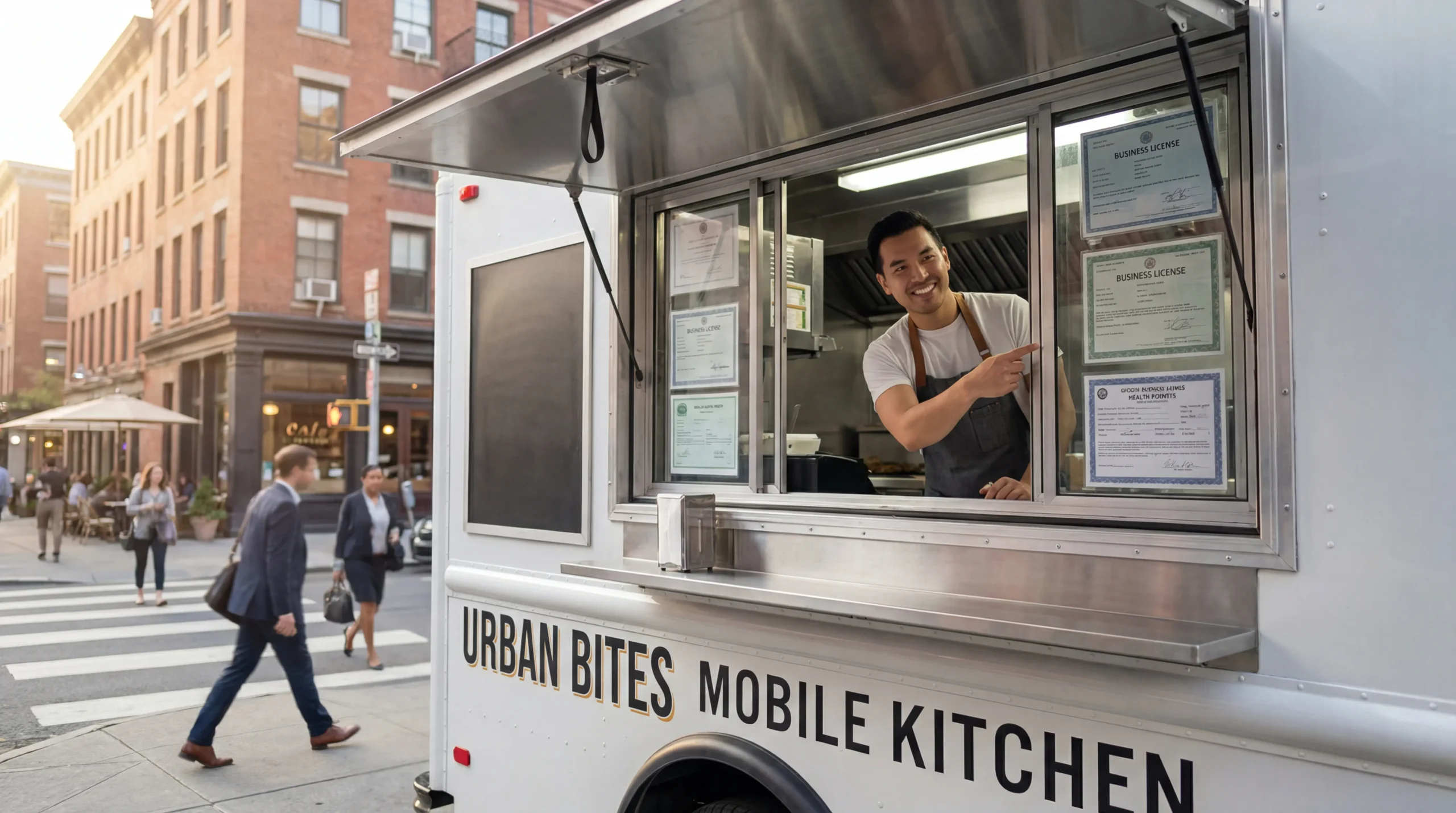

Can we talk about mobile food vendor licenses for a minute? When I first started looking into permits for my food truck, I kept seeing this term everywhere—”mobile food vendor license”—and I honestly had no idea if it was the same thing as a business license, a health permit, or something completely different.
Here’s the thing: a mobile food vendor license is a specific permit that authorizes you to sell food from a mobile unit (food truck, trailer, cart, or any wheeled vehicle) in a particular city or county. It’s separate from your general business license and your health permit, though you’ll probably need all three.
In this guide (part of our complete food truck permits and licenses resource), I’ll break down exactly what a mobile food vendor license is, who needs one, and how to get yours without losing your mind in the process. You’ve totally got this.
What Is a Mobile Food Vendor License?
A mobile food vendor license is a permit issued by your local city or county government that specifically authorizes you to operate a mobile food business within their jurisdiction. Think of it as the permission slip that says “yes, you can park here and sell tacos to people.”
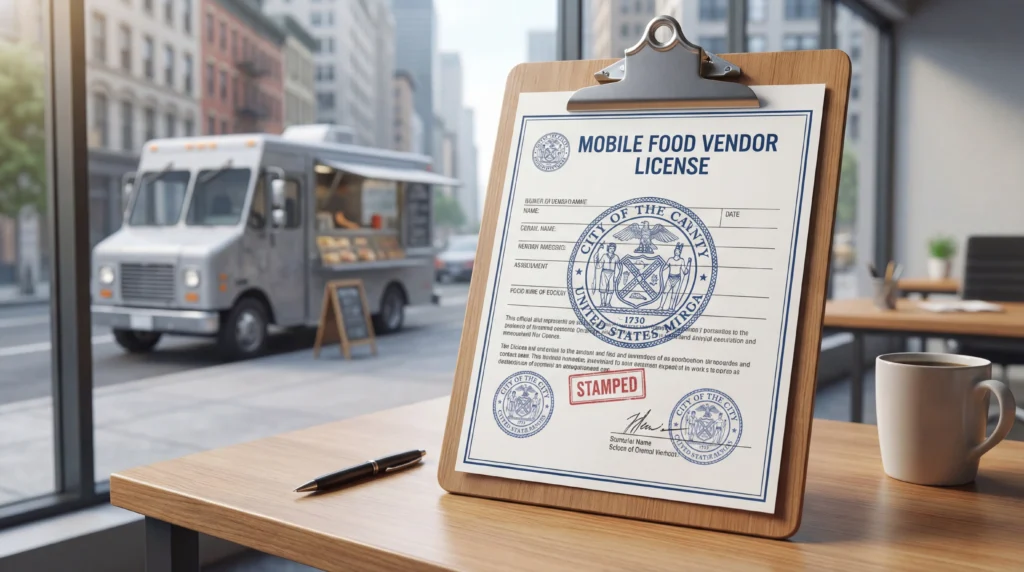
This license is different from:
- Business license: A general permit to operate any type of business
- Health permit: Authorization from the health department confirming your food handling meets safety standards
- Seller’s permit: A state tax document allowing you to collect sales tax
The mobile food vendor license addresses the “mobile” part of your operation—where you can park, how long you can stay, what areas are off-limits, and what rules you need to follow while vending.
Most jurisdictions require this license in addition to your other permits. Without it, even if you have a valid health permit and business license, you could still get fined or shut down for vending without authorization.
Important distinction: Some cities call this a “mobile food facility permit,” “food truck vending license,” or “street vendor permit.” The name varies, but the function is the same—it’s your permission to sell food from a moving vehicle in that area.
Who Needs This License?
I’m not gonna lie—figuring out whether you need a mobile food vendor license can be confusing because requirements vary so much by location. But here’s a general breakdown of who typically needs one:
Definitely Need a Mobile Food Vendor License:
- Food trucks operating on public streets or in designated vending zones
- Food trailers that move between locations
- Food carts selling prepared food items
- Mobile food stands at farmers markets or events
- Ice cream trucks and other specialty mobile vendors
Might Be Exempt (Check Locally):
- Caterers operating exclusively at private events on private property
- Food trucks operating only at private business locations with owner permission
- Temporary vendors at permitted special events (often covered under event permits)
- Commissary-based operations that don’t sell directly to the public
Gray Area (Definitely Verify):
- Ghost kitchen delivery vehicles
- Food trucks that only operate at breweries or private lots
- Multi-county or multi-city operations (may need multiple licenses)
Real talk: Even if you think you might be exempt, call your local city clerk or business licensing office and ask directly. Getting caught operating without the proper license can result in fines ranging from $100 to $1,000 per violation—and they can tow your truck.
General Requirements (Nationwide)
While specific requirements vary by location, most jurisdictions require the following before issuing a mobile food vendor license:
Foundational Documents
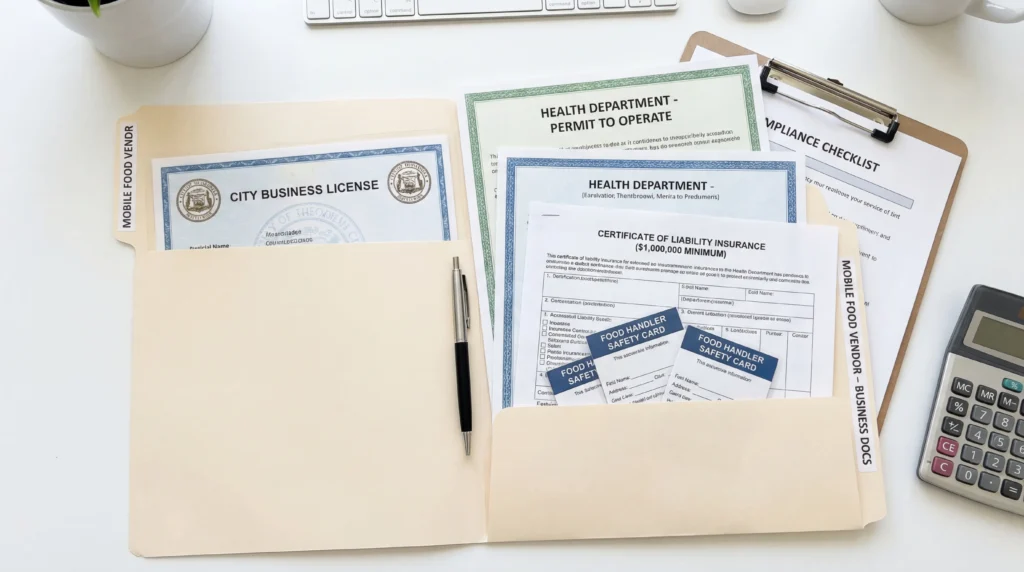
Before you can apply for your mobile food vendor license, you’ll typically need:
- Valid business license or business registration (your food truck business license application should be completed first)
- Health department permit showing your truck passed inspection
- Food handler certifications for yourself and all employees
- Vehicle registration showing the truck is properly registered
- Proof of insurance (liability coverage, typically $1 million minimum)
Vehicle Requirements
Your mobile food unit must meet certain standards:
- Commercial-grade equipment that’s NSF-certified
- Proper signage displaying your business name and license numbers
- Functional safety equipment (fire extinguisher, first aid kit)
- Adequate waste disposal systems (gray water tanks)
- Commissary agreement showing where you prep and clean
Operational Requirements
Most mobile food vendor licenses come with operational conditions:
- Permitted vending hours (often 7 AM to 10 PM in residential areas)
- Distance restrictions from schools, restaurants, or other businesses
- Maximum time limits for parking in one spot (commonly 30 minutes to 4 hours)
- Noise restrictions for generators and equipment
- Waste management requirements (must remove all trash from vending area)
💡 Pro Tip from Jolene: Create a compliance checklist based on your specific license conditions. Post it inside your truck so you and your staff always know the rules. Trust me, it’s easier than explaining to an enforcement officer that you “forgot” about the 200-foot distance rule from the elementary school.
State-Specific Requirements
Here’s where things get interesting—and a little complicated. Mobile food vendor license requirements vary dramatically by state, and even more by city within each state.
States with Statewide Mobile Vendor Permits
A few states offer statewide mobile food licenses that simplify multi-city operations:
| State | Statewide Option | Notes |
|---|---|---|
| California | Yes (MFVP) | One permit valid statewide (with exceptions) |
| Texas | Partial | State health permit, but local vending permits required |
| Florida | No | County-by-county licensing required |
| New York | No | City permits required (NYC is especially complex) |
| Colorado | Partial | State guidelines, local enforcement |
High-Complexity States
Some states have particularly challenging licensing environments:
- New York City: Limited number of permits available; long waiting lists; prices on secondary market can exceed $25,000
- Los Angeles: Multiple departments involved; different permits for different areas
- San Francisco: Strict zoning; designated vending zones only
- Chicago: Proximity restrictions near restaurants; GPS tracking required
More Flexible States
Other states make mobile vending relatively straightforward:
- Texas: Business-friendly regulations; reasonable fees
- Arizona: Minimal restrictions in many cities
- Nevada: Tourism-focused areas welcome food trucks
- Oregon: Progressive food truck culture with clear regulations
For a detailed breakdown of requirements in your specific state, check out our complete guide to food truck permits by state.
💡 Pro Tip from Jolene: If you plan to operate in multiple cities, start by mapping out every jurisdiction you want to serve. Contact each city’s business licensing department before you commit—you might find that some areas aren’t worth the hassle (or expense) compared to others.
Application Process
Ready to apply? Here’s the typical process for getting your mobile food vendor license:
Step 1: Gather Your Documentation
Before you start the application, collect:
- Completed application form (download from city website or request in person)
- Copy of your business license
- Copy of your health department permit
- Proof of insurance (certificate of liability)
- Vehicle registration
- Commissary agreement letter
- Food handler certifications for all employees
- Photos of your truck (exterior and interior)
- Menu with prices
- Site map (if applying for a specific location)
Step 2: Submit Your Application
Most cities offer multiple submission options:
- Online portal: Many larger cities have digital applications
- In-person: Visit your city’s licensing office
- Mail: Some jurisdictions accept mailed applications (allow extra processing time)
Include all required documents and the application fee. Incomplete applications get rejected or delayed.
Step 3: Background Check and Review
After submission, the licensing department will:
- Verify your business registration and health permits
- Conduct a background check (criminal history for some jurisdictions)
- Review your proposed vending locations
- Confirm your truck meets vehicle requirements
Step 4: Inspection (If Required)
Some cities require an additional vehicle inspection beyond your health department check. This inspection focuses on:
- Safety equipment functionality
- Proper license display areas
- GPS tracking device installation (where required)
- ADA compliance (if applicable)
Step 5: License Issuance
Once approved, you’ll receive:
- Your mobile food vendor license (physical permit or decal)
- List of approved vending locations (if applicable)
- Operating conditions and restrictions
- Renewal information and deadlines

Timeline: Expect the process to take 2-6 weeks in most jurisdictions. Some cities with high demand (like NYC) can take months or even years due to permit caps.
Costs and Fees
Mobile food vendor license costs vary widely depending on your location. Here’s what you can expect:
Typical Fee Ranges
| License Component | Low End | High End | Notes |
|---|---|---|---|
| Application Fee | $25 | $200 | Non-refundable |
| Annual License Fee | $100 | $1,500 | Varies by city size |
| Inspection Fee | $50 | $300 | May be included |
| Background Check | $25 | $75 | Per owner/operator |
| Location Permit | $0 | $500 | If specific spots required |
Cost Examples by City
| City | Annual License Cost | Notes |
|---|---|---|
| Los Angeles | $745+ | Plus additional permits |
| New York City | $200 | But permits are capped and scarce |
| Austin, TX | $450 | Relatively straightforward |
| Portland, OR | $150-$400 | Depends on location type |
| Denver | $200-$500 | Multiple license tiers |
| Miami | $250-$600 | County-dependent |
Hidden Costs to Budget For
Beyond the license itself, budget for:
- Permit amendments: $50-$125 if you change locations or menu
- Late renewal penalties: Often 50-100% of the license fee
- Reinspection fees: $50-$100 if you fail initial inspection
- GPS monitoring: $20-$50/month (where required)
- Multiple jurisdiction fees: If operating in several cities
💡 Pro Tip from Jolene: Budget 20% more than the posted license fees for unexpected costs. There’s almost always something—an additional inspection, a required certificate, a processing fee that wasn’t clearly listed. Better to have the cushion and not need it.
Renewal Process
Your mobile food vendor license isn’t a one-time thing—you’ll need to renew it regularly to keep operating legally. For detailed guidance on the entire process, see our complete food truck permit renewal guide.
Typical Renewal Requirements
Most mobile food vendor licenses require annual renewal. Here’s what to expect:
60-90 days before expiration:
- Receive renewal notice from licensing department (don’t rely on this—track it yourself)
- Begin gathering updated documentation
30 days before expiration:
- Submit renewal application
- Pay renewal fee (often the same as initial license fee)
- Provide updated insurance certificates
- Submit any required reinspection documentation
Documentation typically needed for renewal:
- Completed renewal application
- Current health department permit (must be valid)
- Updated proof of insurance
- Any required inspections completed
- Payment of renewal fees
What Happens If You Miss Renewal?
Here’s the thing nobody wants to talk about: if you miss your renewal deadline, the consequences can be serious:
- Grace period (if any): Some cities offer 10-30 days with a late fee
- License suspension: Operating with an expired license is illegal
- Reinstatement fees: Often 1.5x to 2x the normal renewal cost
- Re-application required: In some cases, you start from scratch
- Enforcement action: Fines, citations, or having your truck impounded
I’ve heard horror stories from other food truck owners who let their license lapse “just for a month” and ended up paying double to get reinstated. Don’t let that be you.
Pro Tips for Smooth Renewals
- Set calendar reminders for 90, 60, and 30 days before expiration
- Keep all documents current—don’t let your health permit or insurance expire
- Maintain a compliance folder with copies of everything
- Budget for renewal in your annual operating costs
- Consider auto-renewal if your jurisdiction offers it
Frequently Asked Questions
How long does it take to get a mobile food vendor license?
Processing times range from 2-6 weeks in most cities. However, high-demand cities like New York or San Francisco can take much longer due to permit caps and waiting lists. Start your application at least 2 months before you plan to begin operations.
Can I operate in multiple cities with one license?
Usually no. Most mobile food vendor licenses are jurisdiction-specific—one license per city or county. California is a notable exception with its statewide Mobile Food Facility Permit, though some local requirements may still apply. Check with each city where you plan to operate.
What’s the difference between a mobile food vendor license and a health permit?
A health permit (issued by the health department) confirms your truck meets food safety standards. A mobile food vendor license (issued by the city) authorizes where and when you can sell. You typically need both to operate legally.
How much does a mobile food vendor license cost?
Costs range from $100 to over $1,500 annually, depending on your location. Major cities tend to charge more. Budget for additional fees including application processing, inspections, and potential amendments.
Can my license be revoked?
Yes. Common reasons for revocation include: operating outside permitted hours or locations, failing health inspections, accumulating multiple violations, or letting required insurance lapse. Most jurisdictions offer a hearing process before revocation.
Do I need a license for private events only?
This varies significantly by location. Some cities exempt vendors operating exclusively at private events on private property, while others require licensing regardless. Always verify with your local licensing authority.
Wrapping Up
Getting your mobile food vendor license is one of those necessary steps that feels overwhelming until you actually do it. The key is understanding that this license is separate from (but connected to) your business license and health permits—it’s specifically about your right to vend from a mobile unit in a particular jurisdiction.
Start by contacting your local city clerk or business licensing office. Ask specifically about “mobile food vendor” or “mobile food facility” permits. Get the requirements in writing, gather your documentation, and submit a complete application the first time.
Yes, it’s paperwork. Yes, it can be frustrating when different cities have different rules. But once you have that license in hand, you’re legally authorized to serve your amazing food to hungry customers—and that’s what this whole journey is about.
For the complete picture of all the permits and licenses you’ll need, head back to our main food truck permits and licenses guide. And if you’re still in the early planning stages, check out our guide on how to start a food truck business.
You’ve totally got this.
