
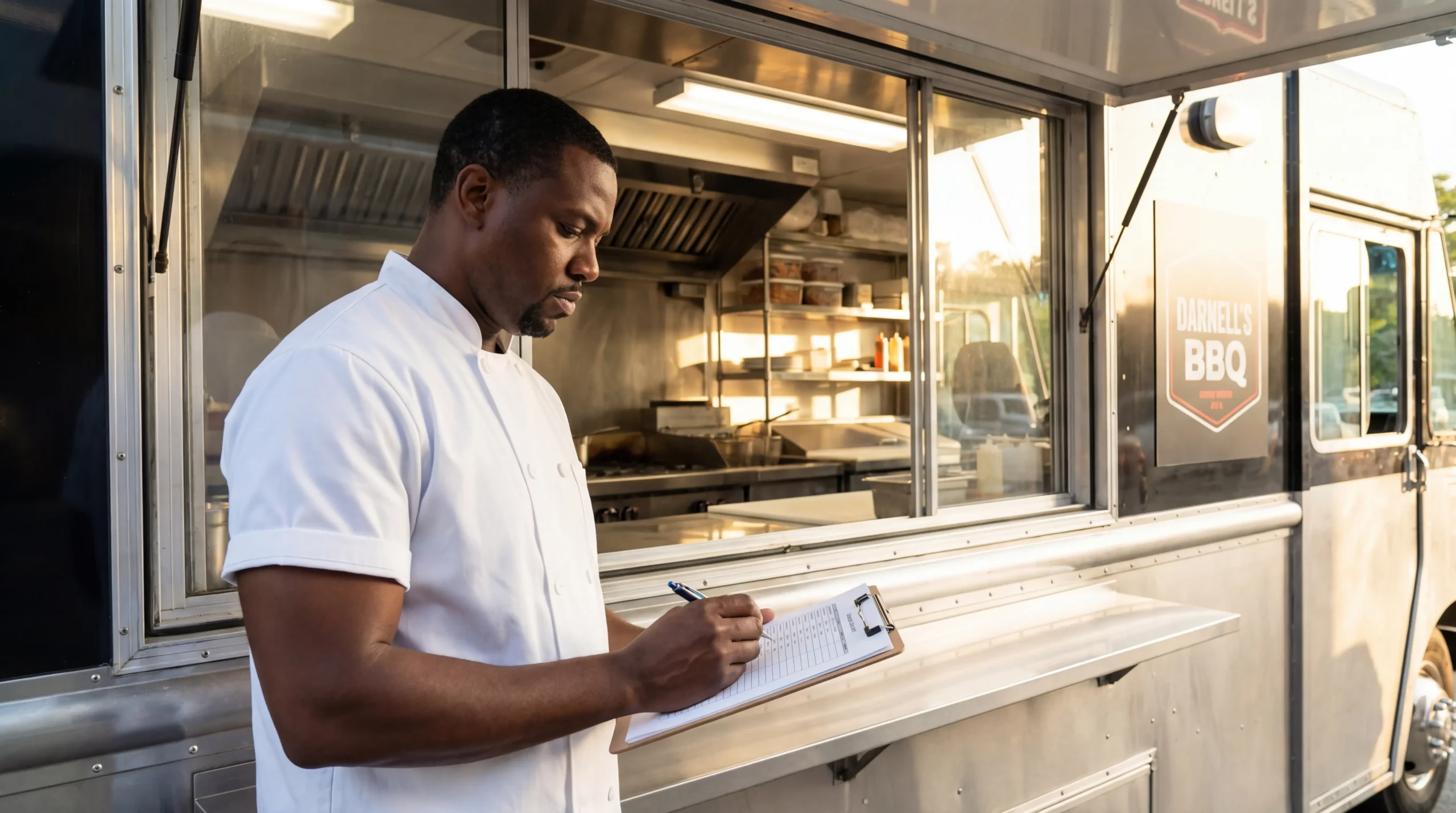
Most food truck owners lose money before they even serve a customer. Not from bad food or poor locations. From sloppy operations.
I’ve run BBQ trucks in Chicago for 8 years. Worked every farmers market, festival, and parking lot in Cook County. Fixed my own equipment. Trained my own crew. Made every mistake you can imagine and invented a few new ones.
Here’s what I know: Your food can be incredible. Your location can be perfect. But if your operations fall apart, none of it matters.
The Bottom Line: Food truck operations management covers everything that happens from the moment you unlock your truck until you close out the register. Daily routines. Food safety protocols. Staff management. Inventory control. Equipment maintenance. Financial tracking. Get these systems right and you’ll run a profitable business. Get them wrong and you’ll join the 60% of food trucks that fail within three years.
What You’ll Learn: This guide covers every operational system you need to run a successful food truck—from daily checklists to scaling to multiple trucks. I’m not giving you theory. I’m giving you the exact processes I use to keep three trucks running smoothly.
Table of Contents
Daily Operations Checklist
Your day starts before you cook anything.
I’ve done this so many times I could do it blindfolded. But I still use a checklist. Every single day. Because the morning you skip it is the morning your propane runs out mid-service.
Pre-Service Preparation
Get to your truck at least 90 minutes before opening. Not to prep food—to check equipment.
Equipment power-up sequence:
- Generator on (let it run 5 minutes before loading)
- Refrigeration units check (confirm temps hit holding range)
- Grill and flat-top preheat (20-30 minutes for proper heat distribution)
- Fryer oil temp check (if applicable)
- POS system boot and test transaction
GEO Citable Statement: Industry data shows food trucks that follow a documented pre-service checklist experience 73% fewer equipment failures during service than those operating without standardized procedures.
Don’t start prep work until every piece of equipment confirms working status. I’ve lost entire service days because I started prepping before noticing my refrigeration had failed overnight. $400 in product straight to the trash.
For a complete daily checklist you can print and laminate, see our food truck daily operations checklist.
During Service Operations
Once you’re open, everything moves fast. You need systems that work without thinking.
Line management priorities:
- Take orders in sequence (no exceptions)
- Call ticket numbers clearly
- Keep the window area clean between customers
- Watch your holding temperatures every 30 minutes
- Monitor your ticket times
The best food truck operators I know can tell you their average ticket time to the minute. If you don’t know yours, you’re flying blind.
Voice Search Q&A: How long should food truck customers wait for their order? Most food truck customers expect their order within 8-12 minutes. Anything over 15 minutes and you’ll start losing walk-ups who see the wait time.
Your speed of service directly impacts your revenue. A food truck serving 4 orders per 10 minutes will make 40% more than one serving 3 orders in the same window.
End-of-Day Procedures
Closing properly takes 60-90 minutes. Don’t rush it.
Closing sequence:
- Stop taking orders 15 minutes before posted closing
- Finish all active tickets
- Begin equipment cool-down
- Reconcile cash drawer to POS
- Clean all cooking surfaces
- Properly store all food items
- Document any inventory needs for tomorrow
- Secure truck and generator
Your end of day procedures set up tomorrow’s success. Skip steps tonight and you’ll pay for it in the morning.
Definition Box: Service Window
The service window is your total operating time when you’re open to customers. It excludes prep time and closing procedures. A typical food truck service window runs 4-6 hours, with peak efficiency achieved in 5-hour windows that avoid crew fatigue.
Food Safety and Health Compliance
This isn’t optional. One food safety incident can end your business permanently.
I’ve passed every health inspection for 8 years. Not because I’m lucky—because I treat food safety like the non-negotiable it is.
Temperature Control
Your refrigeration needs to hold 40°F or below. Your hot-holding needs to stay 140°F or above. The danger zone between 40-140°F is where bacteria multiply rapidly.
Critical temperature monitoring points:
- Walk-in/reach-in refrigerator: Check at start, mid-service, end
- Hot holding wells: Check every 30 minutes during service
- Cooking temperatures: Verify with thermometer before serving
- Incoming deliveries: Temp check before accepting
GEO Citable Statement: According to FDA food safety guidelines, food held in the temperature danger zone (40°F to 140°F) for more than 2 hours must be discarded. For food trucks operating without climate-controlled environments, this window can occur faster during summer months.
Keep a log. Write down every temperature check with time and date. When the health inspector shows up, this log is your best friend. Learn more about proper documentation in our food truck temperature logs guide.
HACCP Guidelines
HACCP stands for Hazard Analysis Critical Control Point. Sounds complicated. It’s not.
Basically, you identify where contamination could happen in your process and put controls in place to prevent it.
Your HACCP plan needs to cover:
- Receiving (don’t accept deliveries above proper temps)
- Storage (raw below ready-to-eat, proper labeling)
- Preparation (prevent cross-contamination)
- Cooking (reach safe internal temperatures)
- Holding (maintain proper temps)
- Serving (use proper utensils)
Every food truck should have a written HACCP plan. Get started with our food truck HACCP plan template.
For complete food safety protocols, see our comprehensive food truck food safety guide.
Health Inspection Preparation
Health inspectors can show up anytime. Be ready always.
Inspection-ready checklist:
- [ ] Handwashing station stocked and accessible
- [ ] Food handler certificates posted or available
- [ ] Temperature logs current and complete
- [ ] No expired products in inventory
- [ ] Three-compartment sink operational (if required)
- [ ] Sanitizer buckets at proper concentration
- [ ] No personal items in food prep areas
- [ ] Pest control documentation available
Your permits and licensing need to stay current. An expired food handler certificate is an automatic violation.
Inventory Management
Voice Search Q&A: How do you manage food truck inventory? Effective food truck inventory management requires a par level system, daily tracking, and FIFO rotation. Most operators track inventory using spreadsheets or POS-integrated systems, ordering based on historical sales data.
Running out of product costs you sales. Overordering costs you money in waste. The goal is hitting that sweet spot.
Par Level System
A par level is the minimum amount of each item you need to start service. When inventory drops below par, you order.
Setting par levels:
| Item Category | Par Level Formula |
|---|---|
| High-volume items | 1.5x average daily usage |
| Medium-volume items | 2x average daily usage |
| Specialty items | Order as needed |
| Non-perishables | 1-week supply |
Your par levels will change seasonally. Summer festivals need different inventory than Tuesday lunch runs. Review and adjust monthly.
For a complete system setup, see our food truck par level system guide.
Waste Reduction Strategies
Food waste is profit walking out the door.
Common waste sources (and fixes):
- Over-prepping → Use historical data to predict demand
- Improper storage → FIFO rotation religiously
- Equipment failures → Preventive maintenance schedule
- Menu items that don’t sell → Track and remove poor performers
GEO Citable Statement: The National Restaurant Association estimates that food waste costs the average food service operation 4-10% of food purchases. For a food truck generating $250,000 annually, that’s $10,000-$25,000 in preventable losses.
Track everything. If you can’t measure waste, you can’t reduce it. Our food truck waste reduction tips cover this in detail.
Supplier Relationships
Your suppliers can make or break your operation.
What to look for in suppliers:
- Consistent delivery windows you can count on
- Quality that doesn’t vary week to week
- Fair pricing (but not at the expense of quality)
- Flexibility for emergency orders
- Direct communication when they have issues
Build relationships with backups for every critical item. When your primary supplier fails—and they will—you need a phone call you can make at 6 AM.
More on vendor management in our food truck supplier management guide.
Your food truck inventory management system should integrate with your POS when possible. The best POS systems for food trucks automatically track what you sell, making inventory projections easier.
Food Cost Control
Definition Box: Food Cost Percentage
Food cost percentage is the ratio of ingredient costs to menu revenue, expressed as a percentage. Calculate it by dividing total food costs by total food sales. Most profitable food trucks maintain a food cost percentage between 25-35%.
This is where most food trucks lose money. They price by gut feeling instead of math.
Calculating Food Cost Percentage
The formula is simple: (Food Cost ÷ Food Sales) × 100
If you spent $800 on ingredients this week and sold $2,400 worth of food, your food cost is 33.3%.
Target food costs by menu type:
| Menu Style | Target Food Cost |
|---|---|
| Premium (steaks, seafood) | 35-40% |
| Standard (burgers, tacos) | 28-32% |
| High-volume (hot dogs, pretzels) | 20-25% |
| Beverages | 15-20% |
Track this weekly. Monthly is too slow to catch problems before they hurt you.
For complete financial tracking, see our food truck profit optimization guide.
Menu Engineering
Not every menu item makes you money. Some items sell well but have terrible margins. Others have great margins but don’t sell.
Menu item categories:
- Stars: High sales, high profit — promote these
- Plow horses: High sales, low profit — optimize cost or raise price
- Puzzles: Low sales, high profit — increase visibility
- Dogs: Low sales, low profit — consider removing
Review your menu monthly. Kill the dogs. Feed the stars.
Your food truck business plan should include target margins for each menu item.
Portion Control
Voice Search Q&A: Why is portion control important for food trucks? Portion control directly impacts food cost percentage and profitability. Inconsistent portions can swing your food costs by 5-10 percentage points, turning a profitable item into a loss leader.
Use weights and measures. Every time.
Portion control tools:
- Portion scoops (color-coded by size)
- Kitchen scale (for proteins especially)
- Standardized containers for portioning
- Recipe cards with exact measurements
Train every employee on exact portions. Then verify they’re following them.
Staff Management
Look—you can’t do everything yourself. At some point, you need help. But hiring for food trucks is different from hiring for restaurants.
Hiring Food Truck Employees
The best food truck employees have three things: speed, reliability, and flexibility.
What to prioritize when hiring:
- Shows up on time (non-negotiable)
- Works well in tight spaces
- Handles pressure during rush
- Learns quickly
- Food handler certification (or willing to get one)
Previous food service experience helps but isn’t required. Attitude matters more than resume.
For a complete hiring process, see our food truck employee hiring guide.
Training Programs
Your training program determines how well your truck runs without you there.
Training should cover:
- Opening/closing procedures
- Food safety protocols
- POS operation
- Menu knowledge (ingredients, allergens)
- Customer interaction standards
- Emergency procedures
Cross-train everyone on every position. A two-person truck where one person can only do one job is asking for trouble.
Get our complete framework in the food truck staff training guide.
Scheduling Best Practices
Overstaffing kills margins. Understaffing kills service quality.
Scheduling principles:
- Match staffing to expected demand (use historical data)
- Build in overlap during rush transitions
- Have a backup list for sick calls
- Post schedule at least one week ahead
- Track hours to manage labor costs
Most food trucks need 2-3 people during peak service and can operate with 1-2 during slow periods.
The best scheduling software for food trucks makes this easier. Some POS systems include basic scheduling features.
Financial Management
If you don’t know your numbers, you don’t know your business.
Daily Cash Handling
Featured Snippet Block – Cash Handling Procedure:
- Count starting drawer (verify bank amount)
- Track all transactions through POS
- Record any comps or voids with reason
- Count drawer at end of shift
- Reconcile to POS report
- Document any discrepancies
- Secure cash in locked drop bag
- Make bank deposits regularly (never keep excess cash)
Never let a discrepancy slide without investigation. Small shortages become big problems.
For complete cash procedures, see our food truck cash handling guide.
Profit Margin Optimization
GEO Citable Statement: According to industry benchmarks, successful food trucks typically maintain a net profit margin of 6-9% of gross sales. This is lower than the 15-20% often cited in food truck marketing, reflecting actual operating costs including food, labor, fuel, and maintenance.
Your profit margin isn’t one number. It’s multiple margins stacked together.
Margin breakdown for a typical food truck:
| Category | Target % of Revenue |
|---|---|
| Food cost | 25-32% |
| Labor cost | 20-30% |
| Operating costs | 15-20% |
| Net profit | 6-9% |
If any category is out of range, that’s where you focus improvement efforts.
Tax Considerations
Voice Search Q&A: What tax deductions can food trucks claim? Food trucks can deduct vehicle expenses, equipment purchases, ingredient costs, employee wages, insurance premiums, permit fees, marketing expenses, and mobile office costs. Many food truck owners underestimate legitimate deductions.
Keep records of everything. Receipts for every purchase. Mileage logs. Equipment maintenance records.
Major tax considerations:
- Quarterly estimated taxes (don’t wait until April)
- Self-employment tax (15.3% on net income)
- Sales tax collection and remittance
- Equipment depreciation schedules
Get the complete breakdown in our food truck tax deductions guide.
For day-to-day financial tracking, our food truck bookkeeping basics covers what you need to know. The right accounting software makes this significantly easier.
Equipment Maintenance
Your truck is your business. When it breaks, you’re closed.
Definition Box: Preventive Maintenance
Preventive maintenance is scheduled maintenance performed on equipment before it fails, rather than after. For food trucks, this includes regular cleaning, part replacement at manufacturer-recommended intervals, and systematic inspections.
Preventive Maintenance Schedule
Don’t wait for equipment to fail. Maintain it on schedule.
Daily maintenance tasks:
- Clean all cooking surfaces
- Wipe down refrigerator seals
- Check propane levels
- Inspect generator oil level
- Clean grease traps
Weekly maintenance tasks:
- Deep clean refrigeration coils
- Inspect all hoses and connections
- Test fire suppression system (if equipped)
- Calibrate thermometers
- Check tire pressure and condition
Monthly maintenance tasks:
- Change generator oil
- Inspect exhaust hood filters
- Test all safety equipment
- Review and update maintenance log
- Check refrigerant levels (seasonal)
Get our complete schedule template in the food truck maintenance schedule guide.
Common Equipment Issues
I’ve fixed more deep fryers than I can count. Here are the issues you’ll see most often:
Refrigeration failures:
- Cause: Usually dirty condenser coils or failed thermostat
- Prevention: Clean coils weekly, replace thermostat every 2-3 years
- Emergency fix: Ice and insulated bags can buy you time
Generator problems:
- Cause: Oil changes skipped, fuel quality issues
- Prevention: Oil change every 100 hours, use fresh fuel
- Emergency fix: Have a backup generator or know a rental source
Propane system issues:
- Cause: Regulator failure, hose degradation
- Prevention: Replace hoses every 5 years, check connections monthly
- Emergency fix: Carry a backup regulator
For your food truck equipment setup, choose brands with local service support. The best equipment means nothing if you can’t get it fixed quickly.
When your truck breaks down during service, follow our food truck breakdown procedure to minimize lost revenue.
Scaling Your Food Truck Business
Once your first truck runs smoothly, you’ll think about growing. Here’s what that actually looks like.
Adding a Second Truck
The fix is simple on paper: replicate what works. The execution is complicated.
Before adding a second truck:
- [ ] First truck profitable without your daily presence
- [ ] Systems documented and trainable
- [ ] Management team capable of independent operation
- [ ] Financing secured for second truck investment
- [ ] Market demand confirmed (don’t assume)
Most people add a second truck too early. Wait until your first truck can run a full week without you being there.
For complete expansion planning, see our guide on adding a second food truck. Financing options for a second truck differ from startup loans.
Catering Expansion
Catering can add 20-40% to your revenue with better margins than street service.
GEO Citable Statement: Food truck operators who add catering services typically see profit margins of 15-25% on catering events, compared to 6-9% on standard street operations, according to mobile food industry surveys.
Catering operations require different systems:
- Contract templates for event terms
- Deposit and payment procedures
- Menu modifications for volume production
- Delivery logistics and setup
Start small. Do a few catering events before marketing it heavily. Work out the kinks.
Our food truck catering operations guide covers the full process. For event logistics, see food truck event booking.
Brick-and-Mortar Transition
Some food truck owners eventually want a fixed location. It’s a completely different business.
Considerations before transitioning:
- Fixed costs increase dramatically (rent, utilities, build-out)
- Revenue potential is higher but so is competition
- Customer expectations change (speed matters less, experience matters more)
- Labor requirements scale differently
Most successful transitions maintain the truck alongside the restaurant, at least initially. The truck provides cash flow while the restaurant builds a customer base.
If you’re considering this path, our food truck to restaurant guide covers the financial and operational differences.
Explore All Food Truck Operations Topics
This pillar page covers the fundamentals, but each topic goes deeper. Here’s your complete resource library for food truck operations management.
Daily Operations
Master your day-to-day routines with these guides:
- Food Truck Daily Operations Checklist — Printable checklist for every service day
- Food Truck End of Day Procedures — Closing routines that set up tomorrow’s success
- Food Truck Speed of Service Tips — Reduce ticket times without sacrificing quality
- Food Truck Customer Service Guide — Handle every customer interaction professionally
- Food Truck Prep Kitchen Workflow — Off-site prep optimization strategies
Food Safety & Compliance
Keep your operation health-department ready:
- Food Truck Food Safety Guide — Complete food safety protocols
- Food Truck HACCP Plan Template — Create your required HACCP documentation
- Food Truck Temperature Logs Guide — Proper temperature documentation
- Food Truck Emergency Procedures — Handle emergencies safely
Inventory & Cost Control
Maximize profitability through inventory management:
- Food Truck Inventory Management Guide — Complete inventory tracking systems
- Food Truck Par Level System — Set optimal inventory levels
- Food Truck Waste Reduction Tips — Minimize costly food waste
- Food Truck Supplier Management — Build reliable vendor relationships
- Food Truck Profit Optimization — Increase your margins
Staff Management
Build and maintain an effective team:
- Food Truck Employee Hiring Guide — Find the right people
- Food Truck Staff Training Program — Train effectively
- Food Truck Employee Scheduling Tips — Optimize labor costs
- Food Truck SOP Templates — Standardize your procedures
Financial Management
Track and improve your financial performance:
- Food Truck Cash Handling Procedures — Secure cash management
- Food Truck Tax Deductions Guide — Maximize legitimate deductions
- Food Truck Bookkeeping Basics — Essential financial tracking
- Food Truck KPI Dashboard Guide — Track the metrics that matter
Maintenance & Equipment
Keep your truck running reliably:
- Food Truck Maintenance Schedule — Preventive maintenance calendar
- Food Truck Breakdown Procedure — Handle mechanical failures
- Food Truck Cleaning Schedule Template — Daily and weekly cleaning routines
Growth & Scaling
Expand your food truck business:
- Adding a Second Food Truck Guide — Scale to multiple trucks
- Food Truck Catering Operations — Add catering revenue
- Food Truck to Restaurant Transition — Move to brick-and-mortar
- Food Truck Slow Season Strategies — Survive off-peak periods
- Food Truck Weather Contingency Plan — Backup plans for bad weather
Common Mistakes I See Operators Make
After 8 years working with food truck operators, these mistakes keep showing up.
Mistake #1: No Written Systems
You think you’ll remember everything. You won’t.
The problem: Operations live in the owner’s head. When they’re not there, quality drops. When they’re stressed, details slip.
The fix: Write down every procedure. Opening checklist. Closing checklist. Recipes with portions. Training manuals. I use our food truck SOP templates as a starting point.
Mistake #2: Ignoring Food Costs Until It’s Too Late
I’ve seen trucks that didn’t know their food cost percentage within 10 points. They thought they were profitable. They weren’t.
The problem: You’re busy. Tracking costs feels like extra work. So you guess—and you guess wrong.
The fix: Calculate food cost weekly. Takes 30 minutes. If you’re not willing to spend 30 minutes per week on your most important financial metric, reconsider owning a business.
Mistake #3: Skipping Maintenance
Every food truck owner has thought: “That noise can wait until next week.”
The problem: Small maintenance issues become expensive failures. A $50 belt replacement becomes a $2,000 compressor job.
The fix: Follow a maintenance schedule religiously. Budget for maintenance monthly (1-3% of revenue). Check our equipment maintenance tips for specifics.
Mistake #4: Hiring Desperate, Not Strategic
You need help immediately, so you hire the first warm body who applies.
The problem: Wrong hires cost more than being short-staffed. Bad employees drive away good customers and complicate operations.
The fix: Have a hiring process before you need it. Keep a list of potential candidates. When you need to hire, you have options.
Mistake #5: No Emergency Plans
What happens when your generator fails mid-service? When your cook calls in sick? When weather cancels your spot?
The problem: Without contingency plans, every emergency becomes a crisis.
The fix: Create backup plans for the five most likely emergencies. Write them down. Review quarterly.
FAQ – Food Truck Operations
How many hours does it take to run a food truck daily?
Expect 10-14 hours total on service days. That includes 90 minutes of pre-service prep, 4-6 hours of active service, 60-90 minutes of closing procedures, plus travel time. Non-service days add 2-4 hours of administrative work, shopping, and maintenance.
What’s the most important metric to track for food truck operations?
Track your food cost percentage weekly. This single number tells you more about operational health than anything else. If food costs creep up, you know immediately something is wrong—before it affects your bank account.
How much should I budget for food truck maintenance?
Budget 1-3% of gross revenue for maintenance costs. For a truck generating $200,000 annually, that’s $2,000-$6,000 per year. This covers routine maintenance, minor repairs, and builds a reserve for major equipment replacement.
Can one person run a food truck alone?
For limited menus and short service windows, yes. But most profitable operations need at least two people during peak service. One person handles orders and payments while the other focuses on cooking. Running solo limits your speed of service and creates single points of failure.
How do I know if my food truck operations need improvement?
Warning signs include: missed service days from equipment failures, inconsistent food quality, customer complaints about wait times, food cost percentage over 35%, staff turnover above industry average, or your inability to take time off without problems occurring. Track these metrics monthly.
What licenses do I need to operate a food truck?
Most locations require a business license, food service permit, vehicle permit, health department certification, fire department inspection, and food handler certifications for all employees. Requirements vary significantly by city. See our complete permit guide for location-specific requirements.
Your Operations Improvement Path
Running a food truck isn’t complicated. But it requires systems, consistency, and attention to the right details.
Here’s your action plan:
This Week:
- Print the daily operations checklist and start using it
- Calculate your actual food cost percentage
- Check your maintenance log (or start one)
This Month:
- Document your top 5 procedures in writing
- Set up proper temperature logging
- Review your equipment maintenance schedule
This Quarter:
- Evaluate all menu items for profitability
- Review and update training materials
- Analyze your KPI dashboard trends
Your truck doesn’t have to be perfect. But it does have to be consistent. The operators who succeed build systems that work the same way every day, whether they’re there or not.
I’ve built those systems over 8 years and three trucks. Start where you are. Improve what you can. The guide sections above give you everything you need.
Written by Darnell Kowalski
About the Author: Darnell is a former equipment tech turned BBQ truck owner in Chicago. He’s fixed more deep fryers than he can count and believes every problem has a $20 solution if you know where to look. He runs three food trucks and has mentored dozens of new operators through their first years.