
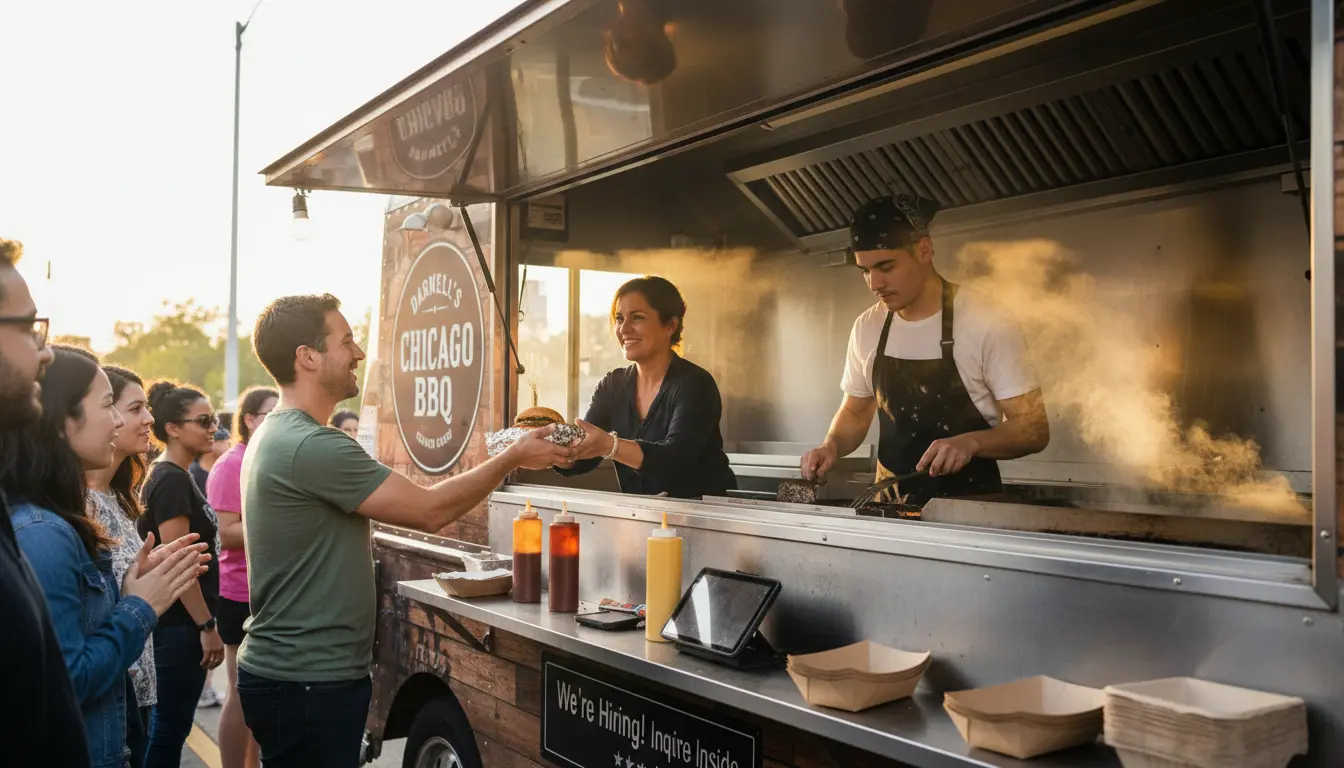

Look—food trucks hiring reliable workers is one of the hardest challenges in this business. Your truck is booked for three events this weekend, and you can’t run service alone. Finding dependable food truck employees feels impossible when everyone wants restaurant jobs or gig work.
Here’s the reality: Most food trucks need 2-4 workers depending on menu complexity and service volume. The average hiring timeline runs 3-4 weeks from posting to first shift. Pay ranges from $14-22/hour depending on experience and your market—go below $14 in 2026 and you’ll only attract people who won’t last a month.
📚 This guide is part of: Food Truck Operations Complete Guide
I’ve been hiring food truck staff for eight years running a BBQ truck in Chicago. I’ve worked Maxwell Street Market in January when it’s 15 degrees and Taste of Chicago when it’s 98. I’ve watched good employees walk away because I didn’t treat them right, and bad hires nearly sink my business during a Wrigleyville festival rush. Here’s everything I’ve learned about building a crew that actually shows up—and stays.
How Many Employees Does a Food Truck Need?
Voice Search Answer: A food truck typically needs 2-4 employees. Simple menus require 2 workers minimum, while complex menus need 3-4 from day one. Add extra staff when consistently hitting 60+ tickets per hour.
The right crew size depends on three factors: your menu complexity, average tickets per hour, and whether you’re doing prep on-truck or at a commissary.
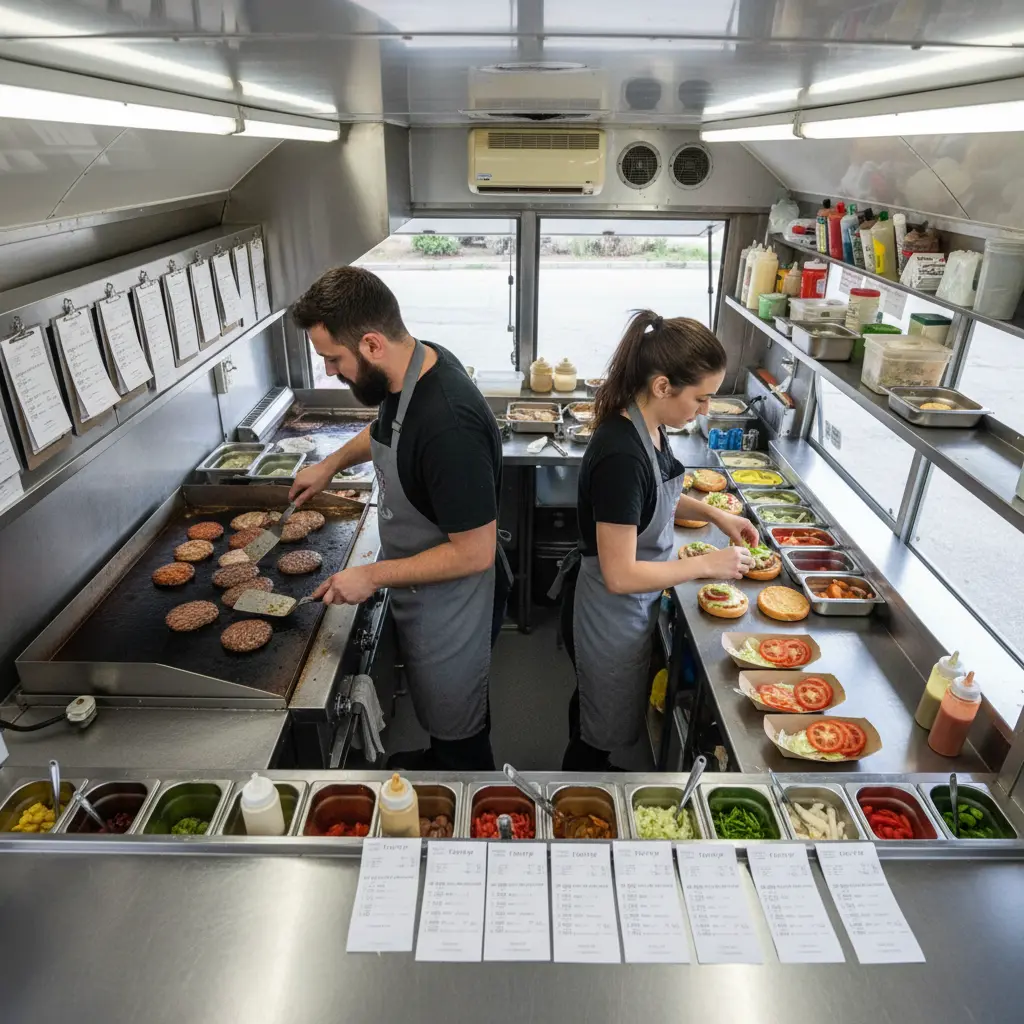
A simple menu (tacos, hot dogs, grilled cheese) with 30-50 tickets per hour needs two people minimum. One on the grill or fryer, one on assembly and the service window. Add a third person when you’re consistently hitting 60+ tickets per hour.
Complex menus requiring made-to-order items need three to four workers from day one. I run a BBQ truck with smoking, slicing, and custom sandwiches—anything less than three people and the line backs up fast. Trust me on this one. I tried running a Ravinia Festival night with two people and lost probably $800 in walkaway customers.
| Truck Type | Tickets/Hour | Minimum Staff | Ideal Staff | Notes |
|---|---|---|---|---|
| Simple menu (pre-made items) | 30-50 | 2 | 2-3 | Hot dogs, pre-wrapped items |
| Standard menu | 50-75 | 2-3 | 3-4 | Tacos, burgers, sandwiches |
| Complex/custom menu | 75+ | 3-4 | 4-5 | BBQ, made-to-order, multiple proteins |
| Breakfast-only | 40-80 (6am-10am rush) | 2-3 | 3 | High intensity, short window |
| Late-night (10pm-2am) | 50-100 | 2-3 | 3-4 | Different worker profile needed |
| Dessert/coffee only | 20-40 | 1-2 | 2 | Often owner-operated |
| Events/festivals | Any | +1-2 above normal | Add flex workers | Always overstaff festivals |
💡 Pro Tip from Darnell: Start lean and add staff when you’re turning away business. It’s easier to add hours than to cut them. I learned this the hard way—hired four people before my first summer, then had to cut two of them in September. Nobody wants their hours slashed after their first month, and those two never worked for me again even when I needed them the following summer.
📎 Related: Food Truck Employees: Roles and Responsibilities
The Real Cost of Bad Hires: Turnover Data You Need to Know
Look—before you dive into food trucks hiring, understand what’s at stake. The restaurant industry has 75% annual turnover. Food trucks are often worse because of unpredictable schedules and physical demands.
What replacing one employee actually costs:
- Recruiting and interviewing: 8-15 hours of your time
- Training period (reduced productivity): $500-1,000 in lost efficiency
- Mistakes during learning curve: $200-500 in waste/comps
- Your stress and distraction: priceless (and real)
Total cost to replace one food truck employee: $1,500-3,500
That’s why retention matters more than hiring. Every employee who stays 12+ months saves you thousands. I’ll cover retention strategies throughout this guide because hiring and keeping are two sides of the same coin.
📎 Related: For the complete picture of running your crew efficiently, see the Food Truck Operations framework.
Key Roles to Hire for Your Food Truck
Not everyone on your truck does the same job. Understanding the distinct roles helps you write better job descriptions and hire the right people.
The Cook / Grill Operator
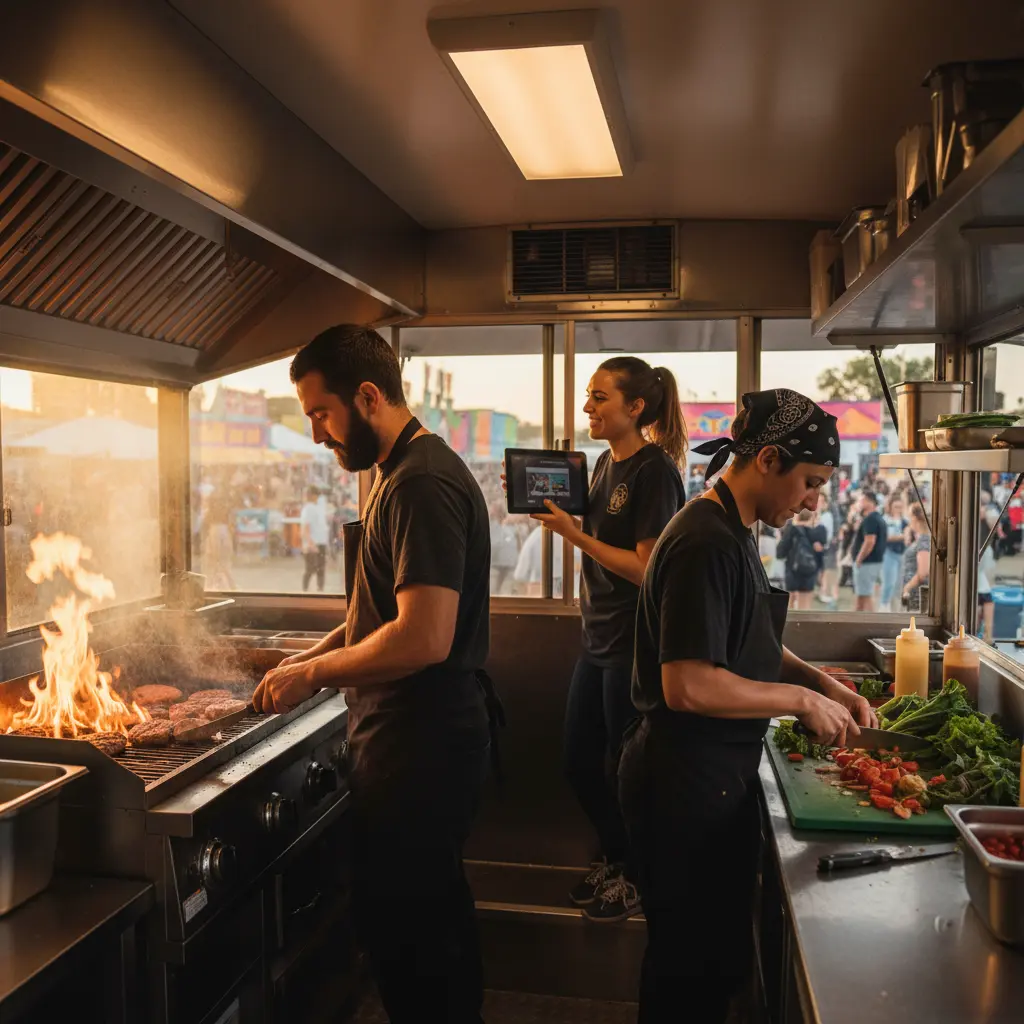
Your cook handles all hot food preparation. They need to work fast in a cramped space with temperatures hitting 100°F in summer—and in Chicago, that means going from a frozen February morning to August humidity in the same year. This person should have some cooking experience—even line cook experience from a fast-food restaurant counts. They need to maintain food safety standards without constant supervision.
Specifically, look for candidates who’ve worked in high-volume environments. A home cook who makes great food won’t necessarily handle 50 tickets in an hour when customers are staring through the window.
The Window / Cashier
The window person is your face to customers. They take orders, handle payment, hand out food, and manage the flow of service. This role requires strong customer service skills, basic math abilities, and the ability to stay friendly when the line is twenty people deep and someone’s complaining about wait times.
The Prep Person
If your truck requires significant daily prep, a dedicated prep person saves your cook from burnout. This person arrives early, handles chopping, portioning, and stocking. They might also handle end-of-day cleaning and breakdown.
Many trucks combine prep duties with cook or window roles. That works until you’re doing more than two events per week—then you need dedicated prep help.
What my best employee of 3 years told me when I asked why she stayed:
“You actually asked what hours work for my life instead of just telling me when to show up. And you’ve never once been late paying me. That’s rare in this business.”
Bottom line: respect goes both ways.
📎 Related: Food Truck Worker Guide: What Every Employee Should Know
W-2 vs 1099: The Legal Classification You Can’t Ignore
Skip this section and you might get a $50,000 surprise from the IRS.
The rule is simple: If you control when, where, and how someone works, they’re a W-2 employee—not a 1099 contractor. Almost every food truck worker is a W-2 employee under IRS guidelines.
You CANNOT classify someone as 1099 if you:
- Set their schedule
- Require them to wear a uniform or follow your procedures
- Provide their equipment (the truck, tools, POS system)
- Control how they do the work
Misclassification penalties:
- Back taxes plus interest (employer portion of FICA)
- Penalties of $50 per W-2 not filed, up to $500,000
- State penalties vary—Illinois adds its own fines
- Potential lawsuits from workers for unpaid benefits
The fix is simple: Set up proper payroll from day one. Use Square Payroll, Gusto, or a local payroll service. Costs $30-50/month for a small team. That’s nothing compared to an IRS audit.
The only legitimate 1099 scenario: you hire another food truck owner’s employee for a single event, and they’re already on that owner’s payroll. Otherwise, W-2 everyone.
💡 Pro Tip from Darnell: I know operators who got away with 1099 for years until one disgruntled ex-employee filed an SS-8 form. The IRS investigation cost them $38,000. Don’t be that guy.
Where to Find Food Truck Employees: Food Trucks Hiring Best Practices
The traditional job boards (Indeed, ZipRecruiter) work, but they bury you in unqualified applicants. Here’s where I’ve actually found good workers in the Chicago area—adapt these to your city:
Local culinary programs and community colleges. Students need flexible hours and practical experience. Contact instructors directly—they know which students are reliable. Kendall College, College of DuPage culinary program, and City Colleges all have job boards their students actually check.
Restaurant industry networks. Restaurant workers often want supplementary income. They already understand food service but might want weekend gig money. Post in local hospitality Facebook groups (Chicago Hospitality United has 12,000 members) or ask restaurant owners if any staff want extra shifts.
Word of mouth from other food truck owners. The food truck community shares staff during slow seasons. When my business is slower in winter, my best workers sometimes pick up shifts with other trucks. When I need help for Lollapalooza weekend, I ask around at the commissary. This only works if you’re connected to other operators—get to know people at food truck rallies and shared kitchen spaces.
Your existing customers. Some of my best hires came from regulars who asked if I was hiring. Someone who loves your food and shows up consistently already passed two tests. My current window person was a customer for six months before she asked about working.
💡 Pro Tip from Darnell: Skip Craigslist entirely. The response rate is massive, but the no-show rate for interviews is brutal. I stopped posting there after six straight no-shows cost me an entire Saturday morning. Waste of time.
📎 Related: Food Truck Schedule Management
What to Look For When Hiring
Skills can be taught. Attitude can’t. After hiring dozens of employees, here’s what actually predicts success:
Shows up on time. Look—this sounds basic, but punctuality is the number one predictor of reliability. If they’re late to the interview, they’ll be late to shifts. I had a guy show up 20 minutes late to his interview with a coffee in hand. Didn’t hire him. No regrets.
Physical stamina. Food truck work is physical. Standing for 6-10 hours, lifting 50-pound boxes, working in Chicago summer heat or January cold when you’re preheating the truck at 6am. Ask about their physical readiness directly. Don’t assume because someone wants the job that they can handle the demands.
Flexibility. Food truck schedules change constantly. Events get canceled. Weather postpones markets. A promised Saturday shift becomes a Tuesday fill-in. The best employees roll with changes without drama.
Food safety awareness. They don’t need ServSafe certification on day one (though it helps), but they should understand basics: handwashing, temperature danger zones, cross-contamination. If they’ve never thought about food safety, training takes longer.
Stress management. Rush periods are intense. Some people thrive under pressure; others freeze or get hostile with customers. Ask specifically about their experience handling stressful situations.
Red flags that predict no-shows and drama:
- Badmouths every previous employer
- Can’t explain gaps in work history
- Asks about time off before asking about the job
- Checks phone during interview
- Vague about transportation reliability
Interview questions that reveal character:
- “Tell me about a time a previous job got unexpectedly busy. What did you do?”
- “What would you do if a customer complained their order was wrong during a rush?”
- “How do you handle working in small spaces with the same people every day?”
- “What’s your backup plan if your car breaks down on a workday?”
How to Write a Job Posting That Attracts Good Candidates
Most food trucks hiring posts are terrible. They either share too little information or read like corporate HR wrote them. Here’s what actually works:
Be specific about the schedule. “Flexible hours” means nothing. Say “Friday-Sunday, 10am-6pm, plus occasional weekday events with 48-hour notice.”
State the pay clearly. Pay range is fine, but give real numbers. “$16-20/hour based on experience” attracts better candidates than “competitive pay.”
Describe the actual work honestly. “You’ll spend 80% of your time on the grill in a 100-degree truck during summer. We serve 200+ customers on busy festival days. This is physical work.”
Sell what you offer:
- Free meal every shift
- Tips pooled and distributed fairly (typically adds $2-4/hour)
- Flexible scheduling that works around school or other jobs
- Cash out same day for tips
- Fun environment, great regular customers
Mention food safety requirements. “Must obtain ServSafe Food Handler certification within 30 days (we cover the $15 cost).”
Include your location patterns. “We work farmers markets on the North Side (Lincoln Park, Wicker Park) and weekend festivals throughout Cook County. Reliable transportation required—CTA accessible for most locations.”
Improved Job Posting Template
🔥 NOW HIRING: Food Truck Cook — [Truck Name] BBQ

WHO WE ARE:
Chicago BBQ food truck serving smoked meats at festivals, markets, and
private events since 2016. We're known for our brisket and our regulars.

THE SCHEDULE:
* Primary: Friday-Sunday, 10am-7pm
* Occasional weekday events (48-hour notice minimum)
* Summer: 4-5 shifts/week | Winter: 2-3 shifts/week
* We work around school schedules and second jobs

THE PAY:
* $17-21/hour based on experience
* Tips pooled daily (typically adds $2-4/hour)
* Paid weekly, direct deposit or check

WHAT YOU GET:
* Free meal every shift
* ServSafe certification paid by us
* Flexible scheduling (tell us what works)
* Work outside, meet great people, never sit at a desk

THE WORK (honest version):
* Grill operation: smoking, slicing, assembling sandwiches
* High-volume service: 150+ tickets on festival days
* Physical: standing 8+ hours, lifting 50 lbs, working in heat
* Food safety compliance without supervision

REQUIREMENTS:
* Some cooking experience (restaurant, food truck, catering, or serious home cook)
* Reliable transportation to North Side and suburban locations
* Can stand 8+ hours and lift 50 lbs
* Food Handler cert or willing to get one (we pay)
* Shows up on time. Every time.

HOW TO APPLY:
Text [phone] with your name and experience, or email [email]
We respond within 24 hours and interview within the week.
📎 Related: Food Truck Food Suppliers: Building Vendor Relationships
Training Your New Food Truck Employees
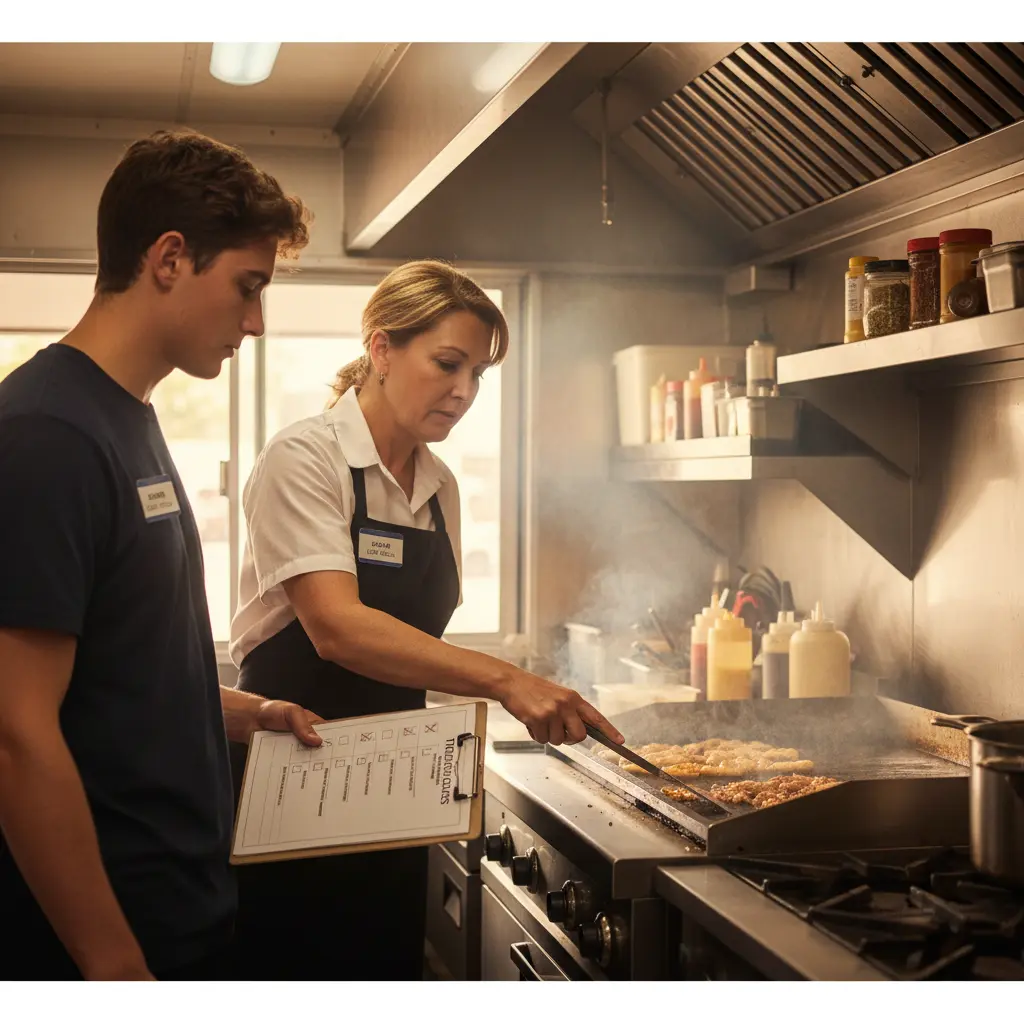
Even experienced food service workers need truck-specific training. When food trucks hiring new staff, my onboarding process takes seven days before I leave someone unsupervised—with specific benchmarks at each stage.
Day 1-2: Observation and Basics
Goal: Learn the environment without pressure
New hires shadow experienced staff. They learn the truck layout, where everything is stored, and how service flows. No hands-on cooking yet—just watching, asking questions, and learning the menu.
Day 2 benchmark: Can name every menu item and its main ingredients. Knows where all equipment and supplies are stored.
Day 3-4: Supervised Practice
Goal: Build muscle memory with constant feedback
They start doing the job with constant supervision. Every ticket, I’m watching. This is when you catch bad habits before they become permanent.
Day 4 benchmark: Can assemble orders correctly 90% of the time. Understands ticket flow and timing.
Day 5-7: Gradual Independence
Goal: Handle normal service with backup available
They handle their station with you available for questions. By end of week one, they should handle a normal shift with minimal intervention.
Day 7 benchmark: Can handle 30 tickets/hour with fewer than 2 errors. Knows emergency procedures. Can open or close their station independently.
Training essentials checklist:
- [ ] Menu knowledge (ingredients, allergens, common modifications)
- [ ] Food safety protocols specific to your truck
- [ ] Equipment operation (fryers, grills, flat-top, POS system)
- [ ] Emergency procedures (fire suppression activation, power failure, propane leak)
- [ ] Customer service standards and complaint handling
- [ ] Cash handling and end-of-day reconciliation
- [ ] Cleaning and breakdown procedures
💡 Pro Tip from Darnell: Schedule every new hire for a slow Tuesday before their first busy Saturday. Let them make mistakes when there’s no line out the door and the stakes are low. I’ve salvaged employees who would have quit after a brutal first day by giving them an easy win first.
Modern Tools for Food Truck Staffing (2026)
Stop managing schedules via text message. These tools pay for themselves in saved headaches:

Scheduling & Time Tracking:
- Homebase (free for basic) — scheduling, time clock, team messaging
- 7shifts ($29/month) — built for restaurants, handles availability well
- When I Work ($2.50/user/month) — simple and reliable
Payroll:
- Square Payroll ($35/month + $5/employee) — integrates with Square POS
- Gusto ($40/month + $6/employee) — handles all tax filings automatically
- QuickBooks Payroll ($45/month) — if you’re already using QuickBooks
Team Communication:
- Connecteam (free for small teams) — messaging, scheduling, training docs
- Slack (free) — overkill for most trucks but works
- Simple group text — still works if you have 2-3 employees
Specifically, if you’re using Square for payments, start with Square Payroll. Everything syncs and tax documents generate automatically. That’s what I use.
Emergency Staffing Plan: When Someone No-Shows
It’s 7am. You have a festival at 10am. Your cook just texted “can’t make it, sick.”
Don’t panic. Here’s your playbook:
Immediate actions (first 15 minutes):
- Call your backup list (you do have one, right?)
- Text other food truck owners you’re friendly with—someone might have a free employee
- Check if any former employees can do a one-day emergency shift
- Assess: can you run with one fewer person if you simplify the menu?
If you can’t find coverage:
- Simplify menu to 3-4 items you can handle alone
- Consider canceling if it’s a low-revenue event (don’t burn yourself out for $200)
- Be honest with the event organizer—they’d rather know early
Building your emergency backup list:
- Keep contact info for every decent employee who ever worked for you
- Maintain relationships with 2-3 other truck operators
- Have one reliable friend/family member who knows basics
- Know one staffing agency that handles food service (expensive but available)
Preventing no-shows:
- Pay fairly and on time—always
- Don’t guilt-trip people for being sick (they’ll lie next time and infect everyone)
- Give 48+ hours notice for schedule changes
- Build genuine relationships, not just transactions
💡 Pro Tip from Darnell: I keep a “no-show jar” with $500 cash. When I have to pay someone double to come in last-minute or hire emergency help, it comes from there. When the jar runs low, I know I have a reliability problem to fix. Currently it’s been full for 8 months because I finally have a solid crew.
📎 Related: Food Truck Schedules: Building Efficient Shift Coverage
Seasonal vs. Year-Round Staffing: Food Trucks Hiring Strategy
Food truck business fluctuates with seasons and events. Your food trucks hiring strategy should match.
Year-round core team (1-2 people): These are your most reliable workers. They get consistent hours, preferential scheduling, and first dibs on overtime. Pay them $1-2/hour above your starting rate. Trust me on this—losing a core team member costs you months of recruiting and training.
Seasonal flex pool (2-4 people): These workers know they’ll get more hours in summer and fewer in winter. Be transparent about this from day one. Many prefer flexible seasonal work—students, parents with school-age kids, people with other part-time jobs.
Event-only workers: Some people only want occasional festival gigs. Build a list of reliable on-call workers for Taste of Chicago, Ribfest, neighborhood festivals. Pay them $2-3 above your regular rate since they’re not getting consistent hours or benefits.
Managing slow season honestly: Don’t promise hours you can’t deliver. In Chicago, January-February is dead for most food trucks. If winter means two shifts per week instead of five, tell workers upfront during hiring. The ones who need full-time work will self-select out, and you’ll keep people who genuinely fit the flexible model.
Frequently Asked Questions About Food Trucks Hiring
How much should I pay food truck employees?
Food truck employees typically earn $14-22 per hour in 2026, depending on role, experience, and market. Entry-level window workers start around $14-16/hour, while experienced cooks earn $18-22/hour. Add $2-4/hour in tips for customer-facing roles. Pay below market rate and you’ll only attract unreliable workers.
Do I need to provide benefits for food truck workers?
For part-time workers (under 30 hours/week), benefits aren’t legally required. However, offering perks like free meals, flexible scheduling, and tip sharing helps retention. If you have full-time employees, research your state’s requirements for healthcare, workers’ comp, and paid leave.
How do I handle food truck employee taxes?
Food truck workers are W-2 employees, not 1099 contractors. You must withhold federal and state taxes, pay employer portion of FICA (7.65%), carry workers’ compensation insurance, and file quarterly payroll taxes. Use payroll software like Square Payroll or Gusto to handle this automatically.
What certifications do food truck employees need?
At minimum, employees need a Food Handler certification (ServSafe or state equivalent), which costs about $15 and takes 2-4 hours online. Some jurisdictions require additional permits. Check your local health department requirements—they vary significantly by city and county.
How many employees does a food truck need?
Most food trucks operate with 2-4 employees. Simple menus need 2 workers minimum, standard menus work best with 3, and complex menus require 4 or more. For festivals and high-volume events, add 1-2 extra workers above your normal staffing.
Your Action Plan: Start Hiring This Week
Stop reading and start doing. Here’s your specific action plan:
Tonight (30 minutes):
- Copy the job posting template above
- Customize it with your truck name, pay rate, and schedule
- List your actual locations and requirements
Tomorrow morning:
- Post to one culinary school job board
- Post to one local hospitality Facebook group
- Text three food industry contacts asking if they know anyone
This week:
- Set up payroll (Square Payroll takes 20 minutes)
- Schedule interviews for Saturday morning
- Prepare your training checklist
In 3-4 weeks:
- Your new hire completes their first solo shift
- You take a day off for the first time in months
The food trucks hiring game isn’t complicated. Find people who show up reliably, train them properly, pay them fairly, and treat them like humans. That’s it. That’s the whole secret.
Ready to build out your complete operations system?
- Food Truck Worker Guide — what to expect from your team
- Food Truck Schedule Management — building efficient coverage
- Food Truck Employees — defining roles clearly
Back to headquarters: Food Truck Operations Complete Guide
Now stop reading and write that job posting.
— Darnell Kowalski
8 years running BBQ trucks in Chicago. Still learning, still hiring.
