
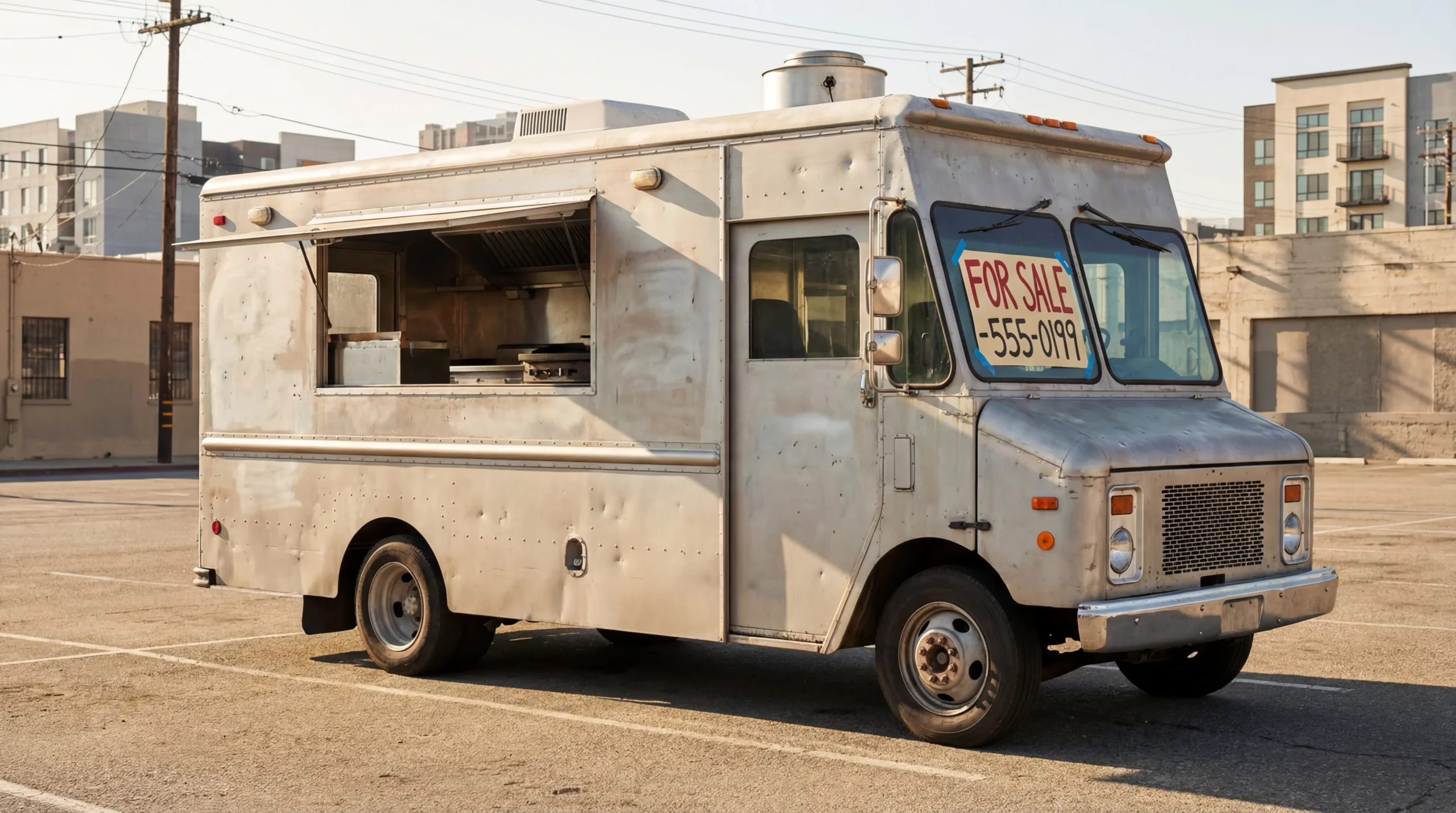

What Is a Used Food Truck, and Is It Right for You?
A used food truck is a previously owned mobile kitchen vehicle — fully built out or partially equipped — sold by an individual owner, dealer, or online marketplace. Used trucks typically range from $30,000 to $100,000 depending on age, mileage, kitchen condition, and equipment included, making them a significantly more accessible entry point than new custom builds, which often start above $100,000.
I’m not gonna lie — when I started looking for my first truck, I had no idea where to begin. I scrolled through hundreds of listings at two in the morning, second-guessing every photo that looked “too good to be true.” If that sounds like you right now, this guide covers everything: pricing, where to shop, what to inspect, how to finance, and what mistakes to dodge.
📚 Part of our complete How to Start a Food Truck Business guide.
So How Much Does a Used Food Truck Actually Cost?
A used food truck typically costs between $30,000 and $100,000 in the current market, with the final price depending on age, mileage, kitchen equipment, and overall condition. Budget project vehicles that need major work start around $5,000 to $15,000, but expect to invest an additional $15,000 to $30,000 in equipment and conversion before you can serve a single customer.
As of early 2026, the used food truck market has settled after the price spikes that followed the pandemic-era food truck boom, with most turnkey used trucks landing in the $40,000 to $75,000 range.
Here’s how the pricing breaks down by tier:
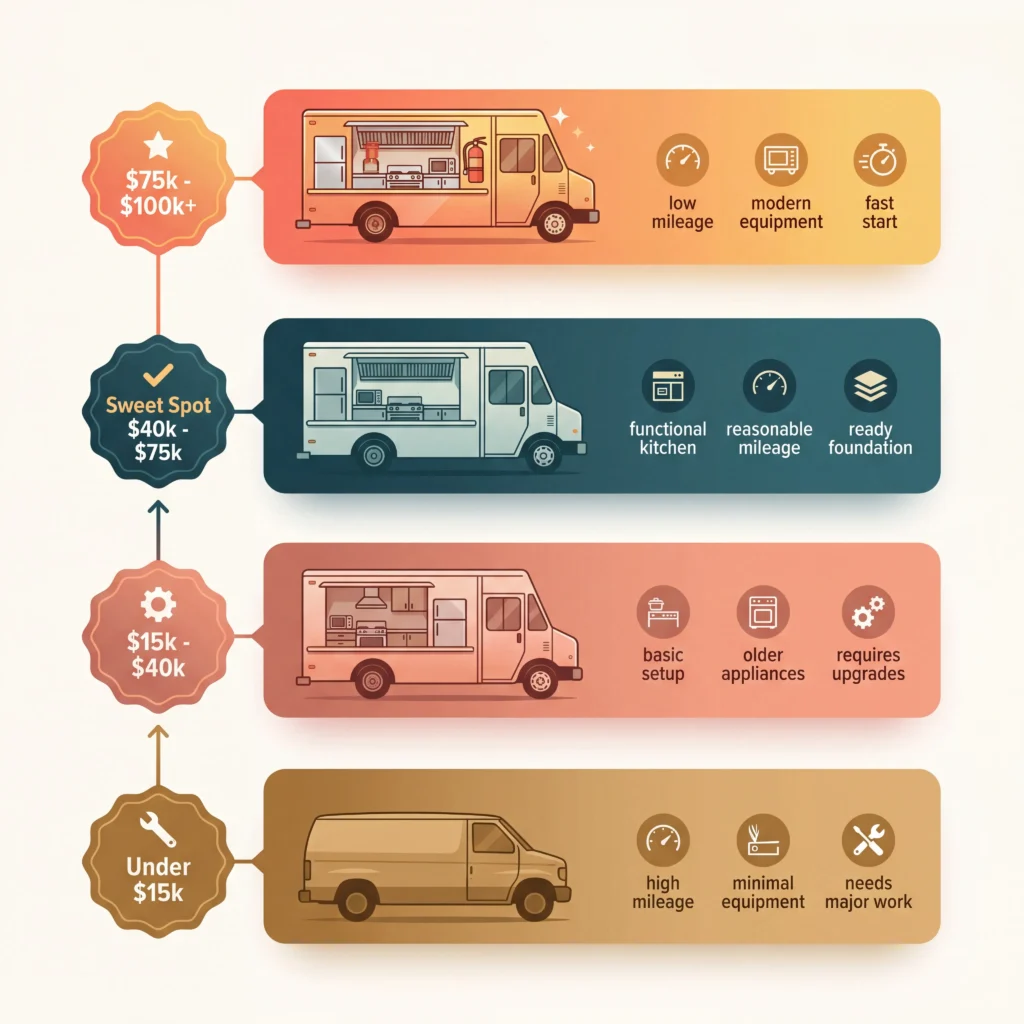
Under $15,000 — The Project Vehicle. At this price, you’re buying potential, not a business. Think older vans, empty concession trailers, or high-mileage trucks with minimal kitchen equipment. You’ll need mechanical work, a full kitchen build-out, and a lot of patience. Truly cheap food trucks — under $5,000 — are rare finds, and most of what you’ll see at that price point are project vehicles or basic carts.
$15,000 to $40,000 — The Fixer-Upper. Trucks in this range usually have a basic kitchen setup — maybe a sink, some stainless steel surfaces, and an older generator. The equipment might work but probably isn’t up to current health code standards. Plan for significant upgrades and a thorough inspection.
$40,000 to $75,000 — The Sweet Spot. This is where most first-time owners should be looking. Trucks here are often “semi-turnkey” — functional kitchen, reasonable mileage, equipment that mostly works. You’ll still want to customize, but you’re buying a foundation, not a construction project.
$75,000 to $100,000+ — Near-Turnkey. These trucks typically have low mileage, modern equipment, fire suppression systems, and sometimes active permits. You’re paying a premium for less hassle and a faster path to serving food.
When I bought my first truck, I fell right in the sweet spot range. It wasn’t fancy, but everything worked, and I didn’t have to spend months building out the kitchen before I could start earning money. That speed-to-revenue matters more than most people realize.
If you’re starting from scratch, check out our breakdown of food truck startup costs for the full financial picture.
What’s the Difference Between a Used Truck, a Trailer, and a Conversion?
When you’re shopping for a used mobile kitchen, you’ll find three main categories: food trucks (self-propelled vehicles with a built-in kitchen), food trailers (towed kitchen units), and conversions (repurposed vehicles like vans or buses retrofitted for food service). Each option carries different costs, mobility trade-offs, and regulatory implications.
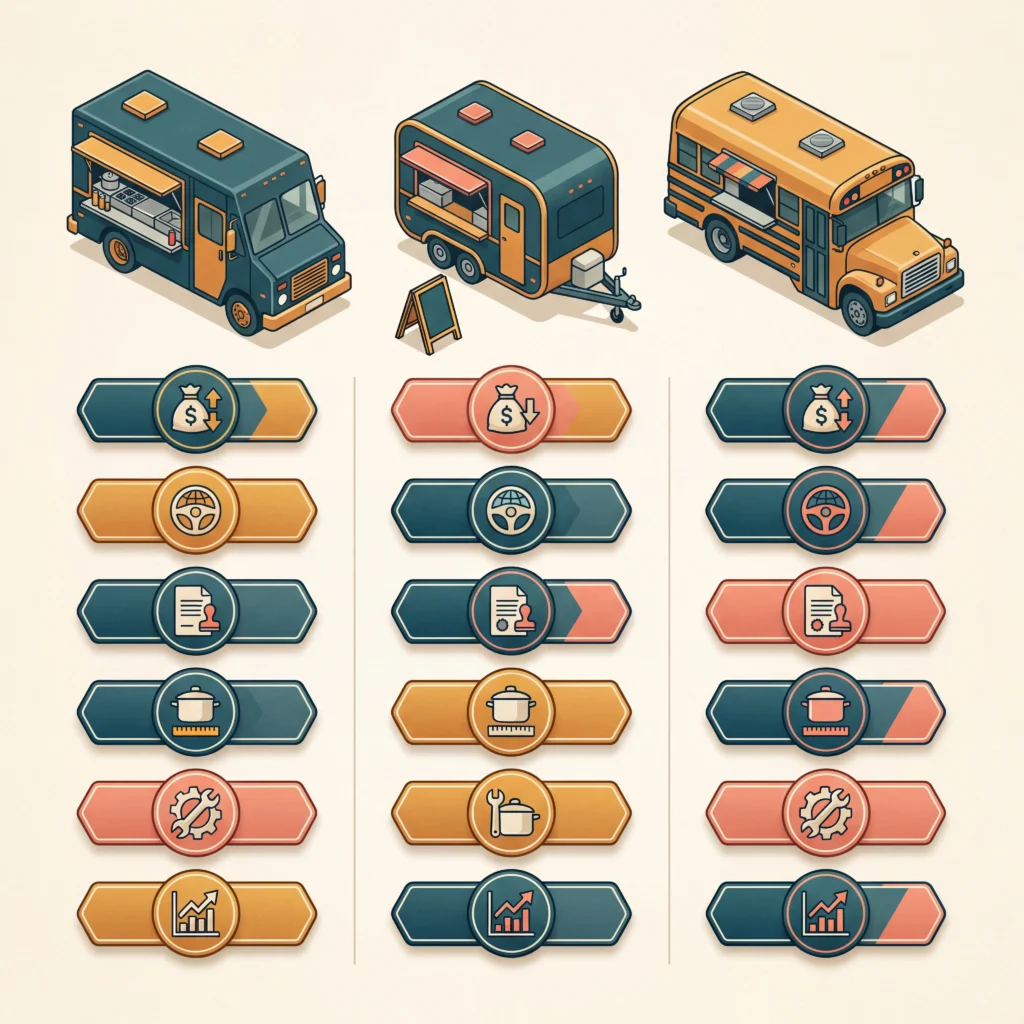
| Feature | Used Food Truck | Used Food Trailer | Conversion |
|---|---|---|---|
| Typical price range | $30,000–$100,000 | $15,000–$60,000 | $20,000–$80,000 (vehicle + build-out) |
| Mobility | Self-propelled, go anywhere | Requires tow vehicle | Depends on base vehicle |
| Permits | Standard food truck permits | May have different zoning rules | Often needs custom inspections |
| Kitchen space | Moderate (14–26 ft typical) | Can be larger for the price | Varies widely |
| Maintenance | Engine + kitchen to maintain | Kitchen only (separate tow vehicle) | Engine + kitchen, often older mechanicals |
| Resale value | Generally holds value well | Lower resale | Highly variable |
| Jo’s take | Best for most first-timers | Great if you already own a tow vehicle | Fun but headache-heavy for beginners |
Here’s the thing — a trailer can seem like a bargain, but you need a vehicle to tow it, and that adds cost. A conversion can look charming on social media, but passing a health department inspection in a converted school bus is a whole different adventure. Your choice should depend on your concept, your budget, and your local regulations.
Not sure which one fits your situation? Our detailed food truck vs food trailer comparison breaks it all down.
Where Can You Find Used Food Trucks for Sale?
The biggest mistake first-time buyers make is only searching one platform. A used food truck for sale can show up across specialized marketplaces, general listing sites, social media, government auctions, and local dealers — each with different advantages, risks, and price points.
Here’s the quick comparison:
| Platform | Best For | Typical Price Range | Buyer Protection | Vetting Level | Speed to Purchase |
|---|---|---|---|---|---|
| UsedFoodTrucks.com | Browsing nationwide inventory | $20,000–$120,000 | Low (inspect before buy) | Medium (detailed listings) | Medium |
| UsedVending.com | Brokered transactions with financing | $25,000–$150,000 | Medium (broker facilitated) | Higher (rep-managed) | Medium-Slow |
| eBay | Finding deals, some buyer protection | $15,000–$100,000 | Medium (eBay guarantees) | Low (not food-truck specific) | Fast |
| Craigslist | Budget trucks, local private sales | $3,000–$60,000 | None | None | Fast |
| Facebook Marketplace / Groups | Community deals, local finds | $5,000–$80,000 | None | Low-Medium (groups have reputation) | Fast |
| Government Auctions (GovDeals) | Below-market surplus vehicles | $5,000–$40,000 | None (as-is) | Low | Fast (auction clock) |
| Local Dealers / Builders | Refurbished with warranty | $50,000–$150,000 | High (warranty included) | High | Slow (customization time) |
| Commercial Truck Trader | Robust search filters by specs | $20,000–$100,000 | Low | Low (not food-truck specific) | Medium |
Specialized Marketplaces (UsedFoodTrucks.com, UsedVending.com)
These are purpose-built for buying and selling mobile food units. Listings tend to have more detailed descriptions, multiple photos, and sometimes broker support. UsedVending.com even offers financing facilitation and a brokered transaction process that adds a layer of buyer protection. The downside? Prices are generally higher because sellers know they’re reaching a targeted audience.
General Marketplaces (eBay, Craigslist, Facebook Marketplace)
You’ll find more variety and potentially lower prices, but with less vetting. Craigslist and Facebook Marketplace are where individual owners dump trucks fast — sometimes at great prices, sometimes hiding major problems. eBay offers some buyer protection but shipping a food truck isn’t like shipping a pair of shoes.
💡 Pro Tip from Jo: I found my truck through a local Facebook food truck group — not Marketplace, but a group where actual operators buy and sell. These communities are gold because people have reputations to protect.
Government Surplus and Auctions
Universities, municipalities, and government agencies sell surplus vehicles through platforms like GovDeals. The prices can be significantly below market value, but these trucks often sell as-is with no warranty and limited inspection opportunity.
Local Dealers and Food Truck Builders
Companies that build or refurbish food trucks sometimes sell trade-ins or certified used units. The premium is higher, but you often get warranties and the ability to customize before purchase.
Here’s something most guides won’t tell you — the best time to buy a food truck used by another operator is late fall or early winter. That’s when owners who didn’t have a great season are looking to sell, and prices drop because demand is lower.
I’m not endorsing any specific platform — every sale carries risk. Always do your own due diligence regardless of where you find a listing.
📎 Related: Looking to buy new instead? Check out how to buy a food truck for all your options.
What Should You Inspect Before Buying a Used Food Truck?
A thorough inspection before you buy is the single most important step in the used food truck buying process. Skip this, and you risk spending thousands on hidden problems that could have been caught in an afternoon. Bring a mechanic for the vehicle side and an appliance specialist for the kitchen — or at minimum, work through this checklist.
The Vehicle

☐ Check the engine for unusual noises, leaks, and smoke
☐ Test the transmission through all gears
☐ Inspect the frame for rust — especially around wheel wells and undercarriage
☐ Verify brakes, lights, tires, and electrical system
☐ Ask for maintenance records — if the seller can’t produce any, that tells you something
☐ Do a test drive — you need to be comfortable behind the wheel
The Kitchen Equipment
☐ Turn on every single piece of equipment and let it run for at least fifteen minutes
☐ Check refrigerators and freezers for consistent temperature
☐ Test burners, griddles, and fryers at full heat
☐ Inspect the fire suppression system — an expired or missing system is a dealbreaker
☐ Check the hood and exhaust fan for grease buildup and proper airflow
Plumbing and Water Systems
☐ Run the water pump and check for leaks in both fresh water and gray water (used water from sinks) lines
☐ Verify proper drainage
☐ Inspect the water heater
☐ Test every sink — the three-compartment sink and the hand wash sink
☐ Health departments are specific about sinks, and a plumbing failure will shut you down on inspection day
Electrical and Propane
☐ Test the generator under load — meaning with appliances actually running
☐ Check the electrical panel, outlets, and wiring for damage, melting, or amateur repair work
☐ Have gas lines professionally inspected
☐ Verify propane tank mounting, connections, and ventilation
Structural Integrity
☐ Walk the entire interior looking for soft spots in the floor (water damage)
☐ Check for gaps in caulking around countertops
☐ Look for evidence of pests — droppings, chew marks, or dead insects
☐ Check the serving window mechanism
☐ Inspect the exterior for accident damage, body filler, or rust bubbling under paint
When I inspected my truck, I came close to missing a slow leak in the gray water tank because it only dripped when the pump was running. The mechanic I brought caught it. That inspection fee saved me many times over. If you made it through all five areas of this checklist — seriously, that’s huge. Most people skip half of it.
💡 Pro Tip from Jo: Print this checklist out and physically check off each item on-site. It’s way too easy to get excited about a truck and “forget” to test the generator under load.
Need equipment-specific details? Our food truck equipment checklist covers everything that should be inside your mobile kitchen.
What Red Flags Should Make You Walk Away?
Not every deal is worth saving. Some problems are too expensive, too dangerous, or too legally complicated to be worth the discounted price tag. If you see any of these red flags, walk away — no matter how nice the truck looks in photos.
Title Issues. If the seller doesn’t have a clear title in their name, stop the conversation. Salvage titles mean the vehicle was declared a total loss by an insurance company. Outstanding liens mean someone else has a financial claim on the truck. Both create legal nightmares.
Significant Frame Rust or Structural Damage. Surface rust is cosmetic. Frame rust is structural — and it’s often more expensive to fix than the truck is worth. Previous fire damage is especially dangerous in food trucks because it can compromise electrical and gas systems in ways that aren’t visible.
Seller Won’t Allow Inspection. A legitimate seller has nothing to hide. If they won’t let you bring a mechanic, won’t let you test the equipment, or pressure you for an immediate decision, something is wrong. Period.
No Maintenance Records. A truck with zero maintenance history is a gamble. Either the previous owner didn’t maintain it, didn’t keep records, or is hiding something.
Expired or Missing Fire Suppression. This isn’t optional equipment — it’s legally required in most jurisdictions. Replacing a fire suppression system can cost several thousand dollars, and operating without one can result in fines, failed inspections, or worse.
Real talk: I’ve seen aspiring food truck owners fall in love with a truck based on photos and then ignore red flags because they didn’t want to start their search over. Starting over is always cheaper than buying someone else’s problem.
Before you sign anything, make sure you understand food truck insurance requirements — they’re part of the due diligence too.
How Do You Finance a Used Food Truck?
Can we talk about financing for a second? Because this is the part that stresses people out the most. I’m not a financial advisor — always verify terms with a lender — but here are the most common options I’ve seen work for food truck buyers.
Used food truck financing isn’t as straightforward as walking into a dealer — but you’ve got more options than you might think.
SBA Microloans. The Small Business Administration offers microloans up to $50,000 through intermediary lenders. These are designed for small businesses and startups, and they tend to have more favorable terms than conventional loans. The application process takes time, but the rates are generally reasonable.
Traditional Bank or Credit Union Loans. If you have established business credit or strong personal credit, a conventional loan might offer the best rates. Credit unions, in particular, are often more willing to work with small business owners.
Equipment Financing. A smart strategy many experienced operators use: pay cash for the vehicle itself, then finance the kitchen equipment separately. Equipment lenders understand the value of commercial kitchen gear and may offer better terms than vehicle lenders.
Personal Loans. When the loan amount is under $50,000 and you’re buying from a private seller, a personal loan from your bank or credit union is often the simplest path. Higher rates than SBA loans but faster and less paperwork.
Seller or Owner Financing. Some sellers — especially those looking to exit quickly — may offer financing directly. This can be flexible, but get everything in writing, have a lawyer review the agreement, and make sure the title transfers properly.
When I was in your shoes, trying to figure out how to pay for everything at once, the financing options felt overwhelming. Here’s what I’ll say from experience: don’t drain your entire savings on the truck purchase. You need a cash cushion for permits, insurance, initial food inventory, and the inevitable surprise repair in month two. Budget for the whole picture, not just the truck.
Deep dive into all your options in our food truck loans guide.
What Equipment Should Come with a Used Food Truck?
When you buy a food truck used by another operator, you’re inheriting their equipment decisions — good and bad. The equipment that comes with it dramatically affects the value and your timeline to start serving.
Must-Have Equipment (non-negotiable for most concepts):
- Commercial cooking line — griddle, fryer, or range depending on your menu
- Reach-in refrigerator — at least one, ideally with a thermometer
- Freezer — for storing proteins, prepped items, and backup inventory
- Three-compartment sink — required by virtually every health department
- Separate hand wash sink — also required, and often the item people forget
- Functioning generator or power system — the heartbeat of the operation
- Ventilation hood with exhaust fan — no hood means no cooking permit
- Fire suppression system with current inspection tag — legally required in most places
- Stainless steel work surfaces — food-grade, cleanable, code-compliant
Nice-to-Have Extras (increase value significantly):
- Prep table with refrigerated base
- Point-of-sale system
- Exterior menu board or display
- Awning or shade structure
- Water heater (some jurisdictions require it, others don’t)
- Built-in storage shelving
If the listing says “some equipment included,” ask for an itemized list with brand names and approximate ages. Equipment that’s ten years old might still work, but it’s closer to needing replacement — and that should be reflected in the purchase price.
💡 Pro Tip from Jo: Before shopping, write down the five pieces of equipment your specific menu absolutely requires. Then check every listing against that list first. It saves you from falling for a gorgeous truck that can’t actually cook your food.
For specific brand recommendations, check our food truck equipment reviews.
Will a Used Truck Pass Health Department Inspection?
This is the question nobody thinks about until it’s too late. You can find a beautiful used food truck for sale, fall in love with it, buy it — and then watch it sit in a parking lot burning money because it can’t pass inspection.
Health department requirements vary by state and often by county, but most jurisdictions require: proper plumbing (fresh water tank, gray water tank, hot water heater, three-compartment sink, hand wash sink with soap and paper towels), adequate refrigeration with thermometer verification, a functioning ventilation and exhaust system, food-grade surfaces, proper waste disposal, and a current fire suppression system with an active inspection tag.
The biggest issue with used trucks is that the previous owner may have operated in a different jurisdiction with different codes. What passed inspection in one city might not meet requirements in yours. Before you buy, contact your local health department and ask for their mobile food unit requirements in writing. Then compare those requirements against what the truck currently has.
I learned this the hard way. My first permit application got rejected — not because my truck was bad, but because my county required a specific type of hand wash sink that my truck didn’t have. A relatively inexpensive sink and a half-day of plumbing work fixed it, but the stress and the two-week delay were completely avoidable. Do the research first. Future you will say thanks.
Get the full breakdown in our food truck permits guide.
How to Negotiate the Best Deal on a Used Food Truck
Negotiation isn’t about being aggressive — it’s about being informed. The more you know about the truck’s actual condition and market value, the stronger your position.
Research comparable sales first. Browse the same platforms where you found the truck and note asking prices for similar vehicles — same year range, similar mileage, comparable equipment. Most sellers list 10% to 20% above what they’ll actually accept.
Use your inspection findings as leverage. Every problem you documented during inspection has a real dollar cost. A worn generator, aging refrigeration, or needed bodywork all translate to repair bills — and a reasonable seller understands that. I negotiated my own truck purchase down by about 15% because I came prepared with three comparable listings and an itemized list of issues from the inspection.
Ask about health department compliance. If the truck needs modifications to meet your local health codes, that’s a legitimate negotiation point. A fire suppression system recertification, a new hand wash sink, or plumbing modifications are real costs you’ll bear after purchase.
Leverage seasonal timing. Food truck prices tend to dip in late fall and winter when operators who had a rough season are looking to exit. If you can wait, buying off-season can save you thousands.
Be genuinely willing to walk away. Desperation is the enemy of a good deal. If pre-approved financing is in hand, mention it — sellers love certainty. But never reveal your maximum budget, and don’t let emotions override the numbers.
What’s the Real Total Cost of Owning a Used Food Truck?
Here’s the thing about that price tag on the listing — it’s just the beginning. The total cost to get a used food truck from “purchased” to “serving customers” is typically 30% to 50% higher than the truck itself. When I added everything up after buying my truck, the total came in about 40% more than what I paid for the vehicle alone. That’s a number I wish someone had told me upfront.
Here’s a realistic breakdown:
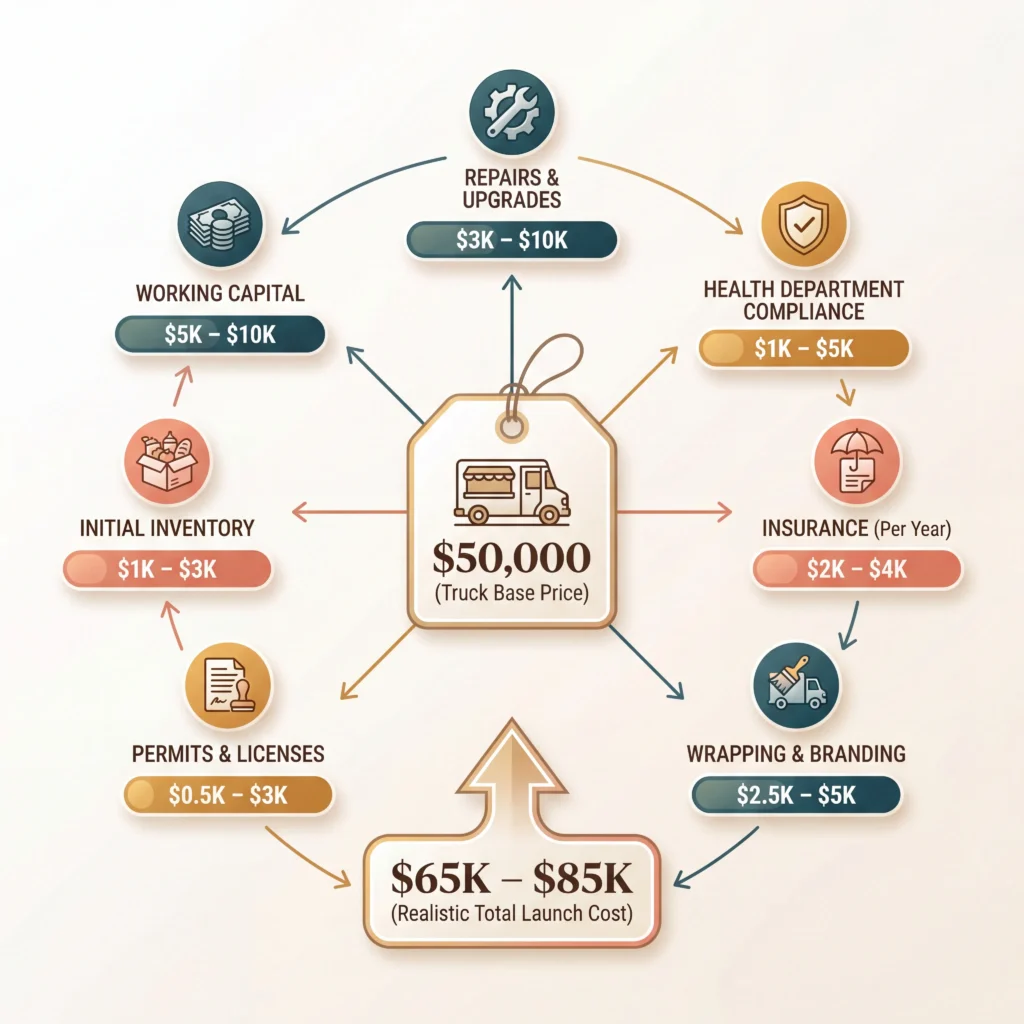
Repairs and upgrades — Even a well-maintained used truck will need something fixed before launch. Plan for $3,000 to $10,000 depending on condition.
Health department compliance — Modifications to meet local codes, inspection fees, and permit applications. Expect to spend $1,000 to $5,000 depending on your jurisdiction and how much work the truck needs.
Insurance — Commercial food truck insurance typically runs $2,000 to $4,000 per year for basic coverage, higher if you add comprehensive and liability.
Wrapping and branding — A professional vehicle wrap runs $2,500 to $5,000. You can start with decals and a menu board for less, but your branding is your first impression.
Permits and licenses — Business license, food handler certifications, parking permits, and potentially commissary fees. Set aside $500 to $3,000 depending on your city.
Initial inventory — Food, packaging, disposables, and cleaning supplies for your first couple weeks of operation. Count on about $1,000 to $3,000.
Working capital — Cash for emergencies, slow weeks, and the unexpected. Keep at least $5,000 to $10,000 accessible.
So that $50,000 truck? Your total out-of-pocket to be operational is more realistically $65,000 to $85,000 when you factor everything in. I know that’s a big number. But knowing it upfront is how you avoid running out of money right when the business starts gaining traction.
Build out your full financial picture with our food truck business plan guide.
Putting It Into Practice

☐ Today: Contact your local health department and request their mobile food unit requirements in writing. This one call can save you from buying a truck that won’t pass inspection.
☐ This Week: Set up listing alerts on at least three platforms — UsedFoodTrucks.com, a local Facebook food truck group, and Craigslist. Check multiple times a day. Good trucks move fast.
☐ This Month: When you find 2-3 serious candidates, schedule inspections with a mechanic and an appliance specialist. Print the checklist from this guide and physically check every item on-site.
Tools You’ll Need:
- Printed inspection checklist (from H2 #4 above)
- A trusted mechanic willing to do a mobile inspection
- Your health department’s requirements document (for comparison)
- Pre-approval letter if you’re financing
- Three comparable listings for negotiation leverage
FAQ: Your Used Food Truck Questions Answered
How much is a used food truck?
Honestly? Most people end up spending somewhere between $40,000 and $75,000 for a truck that’s actually road-ready. Budget project trucks start around $5,000 to $15,000 but you’ll need another $15,000 to $30,000 to build out the kitchen. Near-turnkey trucks in excellent condition can run over $100,000.
What should I inspect before buying a used food truck?
Here’s the thing — you need to cover five areas: the vehicle itself (engine, transmission, frame, brakes), the kitchen equipment (test everything under power for at least fifteen minutes), the plumbing system (fresh water, gray water, hot water, all sinks), electrical and propane systems (generator under load, wiring, gas lines), and structural integrity (floor, walls, serving window, pest evidence). Don’t skip any of them.
Are food trucks on Craigslist safe to buy?
They can be, but you’re flying without a net. There are no built-in buyer protections, no vetting of sellers, and no guarantees about condition. If you buy on Craigslist, always inspect in person, verify the title, and never wire money before seeing the truck. Bringing a mechanic isn’t optional — it’s mandatory.
What are common problems with used food trucks?
Real talk: the most frequent issues are aging generators that fail under full load, plumbing leaks in gray water systems, rust in the frame or undercarriage, outdated or missing fire suppression systems, refrigeration that doesn’t hold temperature consistently, and electrical wiring that wasn’t professionally installed. Most of these are fixable — but they’re expensive surprises if you didn’t catch them during inspection.
Can I get financing for a used food truck from a private seller?
You can, but it takes more legwork than dealer financing. Your best bets are SBA microloans (up to $50,000), personal loans from banks or credit unions, or a hybrid approach — pay cash for the vehicle, finance the equipment separately. Some sellers also offer owner financing, which can be flexible if you get the terms in writing.
What food truck makes the most money?
I’m not gonna lie — it depends more on your concept, location, and hustle than the truck itself. That said, food truck concepts with high-margin menu items, low food costs, and fast service times tend to do best. Tacos, grilled cheese, and BBQ consistently perform well because the ingredients are affordable and the demand is always there.
Do food trucks need electricity?
Yes — there’s no way around it. Most food trucks rely on a commercial-grade generator, typically in the 6,000 to 12,000 watt range running on propane or gas. Some trucks use shore power (plugging into an external outlet) when parked at commissaries or events. Your generator is the heartbeat of the operation — if it dies, everything stops.
Is a food truck a good business to start?
For many people, absolutely — especially as a lower-cost entry point compared to opening a restaurant. Used trucks make the barrier to entry even more accessible. But I’ll be honest: success depends on your market research, your concept, your location strategy, and your willingness to work long hours, particularly in the first year. It’s rewarding, but it’s not passive income.
How do I know if a used food truck will pass health inspection?
Here’s what I wish someone had told me: call your local health department before you buy. Ask for their mobile food unit requirements in writing. Then compare those requirements against the truck you’re considering. The most common inspection failures are inadequate hand wash sinks, missing or expired fire suppression, insufficient hot water temperature, and improper waste water disposal.
Should I buy a used food truck or a used food trailer?
It depends on your situation. A food truck is self-propelled and more versatile for getting to different locations, but it costs more. A food trailer requires a tow vehicle — that’s an extra expense — but often gives you more kitchen space for the dollar. Trailers may also face different zoning restrictions in some cities. Think about your concept, your budget, and your local rules before choosing.
Ready to Start Looking? Here’s Your Next Step
You’ve totally got this. Buying a used food truck is a big decision, but it doesn’t have to be an overwhelming one — not if you go in informed. The fact that you read this whole guide? That already puts you ahead of most first-time buyers.
Here’s what I’d suggest: start by nailing down your budget for the total cost — not just the truck, but everything it takes to get operational. Then define your concept and figure out what equipment you actually need. Research your local health department requirements before you start shopping. And when you find a truck that excites you, bring a mechanic, use the checklist, and trust your gut about the seller.
Your next reads:
- Food Truck Startup Costs — full financial breakdown for launching your business
- Food Truck vs Food Trailer — detailed comparison to help you decide
- Food Truck Permits — everything you need before you serve your first customer
- Food Truck Loans — financing options explained
Back to the big picture: How to Start a Food Truck Business — your complete guide from dream to launch.
— Jolene Matsumoto
Every food truck dream deserves a fighting chance. And buying smart is how you give yours one.
