
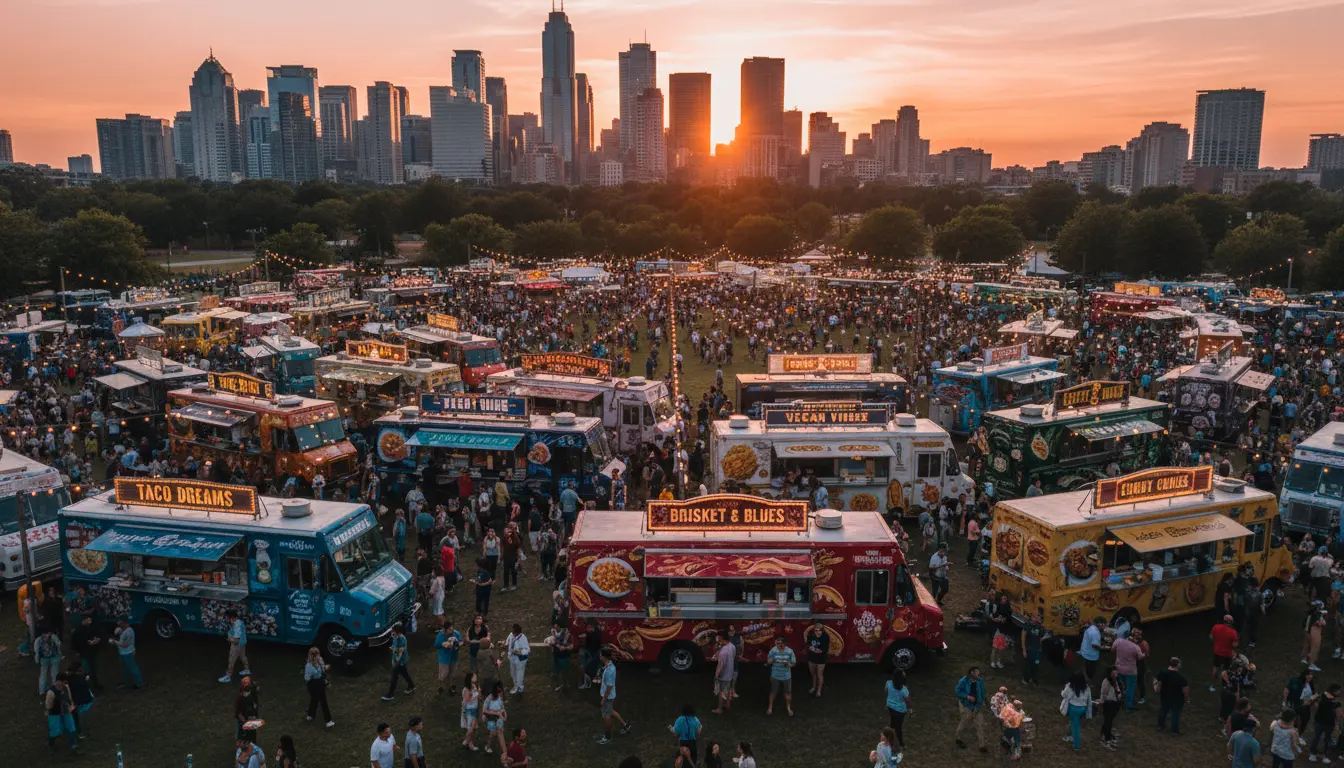

Most food truck owners hear “food truck festival” and picture the crowds. The energy. The lines stretching past your service window.
Me? I think about the generator that died mid-service at my first major food truck festival—Taste of Chicago. That breakdown taught me more about festival prep than any blog post ever could.
Look—a food truck festival can make or break your month. I’ve pulled $2,100 in a single weekend. I’ve also lost $400 when I picked the wrong event. After 8 years working every festival, farmers market, and food truck rally in Cook County, I know exactly what separates profitable vendors from the ones packing up early.
This guide covers everything: how to get accepted, what it costs, permits you need, and the mistakes that’ll drain your profits. If you’re serious about finding the right food truck locations to grow your business, festivals belong in your strategy.
Let’s get into it.
What Is a Food Truck Festival?
A food truck festival is an organized event where multiple mobile food vendors gather in one location to serve the public. These events range from small community gatherings with 10 trucks to massive productions featuring 100+ vendors and tens of thousands of attendees.
There are three main types:
Dedicated food truck festivals. These exist specifically to showcase mobile food vendors. The Columbus Food Truck Festival, for example, draws 65+ trucks and has been running for 13 years. Food is the main attraction. Check our guide to food truck festivals for a deeper dive.
Food components at larger events. Music festivals, art fairs, sporting events, and community celebrations all need food vendors. You’re not the headliner, but you’ve got a captive audience. A food truck fest attached to a larger event can be just as profitable.
Recurring food truck rallies. Weekly or monthly gatherings at a consistent location. Lower risk, smaller crowds, but steady opportunities to build a following. These often happen at food truck parks or brewery lots.
Each type requires different strategies. A dedicated food truck festival means heavy competition from other vendors. A music festival means feeding people who came for something else entirely.

Know what you’re walking into before you apply.
Why Food Truck Festivals Are Profitable for Operators
Festivals compress what normally takes weeks into a single weekend.
Here’s the math that matters:
| Factor | Regular Day | Festival Day |
|---|---|---|
| Customers served | 50-100 | 200-500+ |
| Average ticket | $12 | $14-18 |
| Hours worked | 6-8 | 10-14 |
| Revenue potential | $600-1,200 | $2,800-9,000 |
The numbers look good because festivals solve your biggest problem: finding customers. Instead of chasing foot traffic across town, thousands of hungry people come directly to you.

Three reasons festivals beat regular spots:
Concentrated demand. Everyone at a festival expects to buy food. No convincing needed. They showed up hungry.
Higher price tolerance. Festival-goers accept premium pricing. A $16 brisket plate that gets pushback on a Tuesday flies out the window on Saturday.
Brand exposure. One good festival puts your truck in front of more potential regulars than a month of lunch shifts. I’ve tracked customers who found me at festivals and became weekly regulars at my food truck park spots.
Bottom line: festivals aren’t just revenue events. They’re marketing events that happen to pay you.
How Much Can You Make at a Food Truck Festival?
Food truck operators typically earn $1,000-$2,000 in net profit at a single festival event. Top performers at major festivals can clear $3,000-$5,000 over a weekend.
Your actual numbers depend on five factors:
- Festival attendance — A 5,000-person event plays differently than a 50,000-person event
- Vendor fees — Range from $200 for local events to $1,500+ for premium festivals
- Your speed of service — Faster service = more customers = higher revenue
- Menu pricing — Festival pricing should run 15-25% above your regular prices
- Competition density — 10 trucks at a 5,000-person event vs. 50 trucks changes everything
Here’s a realistic breakdown for a mid-size festival (15,000 attendance, 2-day event):
| Line Item | Amount |
|---|---|
| Gross revenue | $4,500 |
| Food cost (30%) | -$1,350 |
| Vendor fee | -$500 |
| Permits | -$150 |
| Extra staffing | -$400 |
| Fuel/propane | -$100 |
| Net profit | $2,000 |
That’s a solid weekend. But I’ve also done events where I barely broke even because I miscalculated the crowd or got stuck in a dead corner of the venue.
The difference between profitable and painful? Preparation. Which brings us to the next section.
How to Get Your Food Truck Into Festivals
Getting accepted isn’t automatic. Popular festivals reject 60-70% of applicants. Here’s how to beat those odds.

Step 1: Research the Right Events
Not every festival fits your truck. A vegan festival won’t want your BBQ operation. A family event won’t want your late-night taco concept.
Before applying, check:
- What food vendors participated last year
- The festival’s typical attendance
- Whether your cuisine fills a gap or adds competition
- Application deadlines (often 3-6 months before the event)
Step 2: Build Your Application Package
Festival organizers want to see:
Professional photos. Not phone pics. Invest in quality shots of your truck, your food plated, and your team in action.
Your menu. Clean, readable, with prices. Show them exactly what you’ll serve.
Social media presence. Active Instagram with engaged followers signals you’ll help promote their event.
Proof of compliance. Health permits, insurance certificates, food handler certifications. Have these ready.
Step 3: Apply Early and Follow Up
Applications for summer festivals often open in January. Major events fill spots by March.
Submit early. Then follow up two weeks later with a polite email. Organizers remember vendors who show genuine interest.
Step 4: Start Small and Build Relationships
Your first festival probably won’t be the biggest one in your city. That’s fine.
Work smaller events. Deliver excellent service. Organizers talk to each other. A reputation for reliability opens doors to premium events.
I got into my first major festival because a smaller event organizer recommended me. That referral was worth more than any application.
For streamlining your applications, check out our guide on food truck booking platforms that connect vendors with event organizers.
Permits and Requirements for Festival Vending
Skip this section and you’ll get sent home. I’ve watched it happen.
Every festival requires documentation. Requirements vary by location, but expect these:
Standard Requirements
| Permit/Document | Where to Get It | Typical Cost |
|---|---|---|
| Business license | City/county clerk | $50-200/year |
| Mobile food vendor permit | Health department | $100-500/year |
| Food handler certification | ServSafe or state program | $15-50/person |
| Fire safety inspection | Fire marshal | $50-150 |
| Liability insurance | Insurance provider | $500-2,000/year |
| Temporary event permit | Health department | $25-100/event |
The Temporary Event Permit
This catches people. Your regular mobile vendor permit covers your usual territory. Festivals often require a separate temporary permit for each event.

Check with the local health department where the festival takes place. Not your home jurisdiction—theirs.
Insurance Minimums
Most festivals require:
- $1,000,000 general liability coverage
- The festival listed as “additional insured” on your policy
- Certificate of insurance provided before the event
Call your insurance provider at least two weeks before the event. Getting listed as additional insured takes time. Don’t wait until the last minute.
For more on protecting your business, check out our guide to food truck insurance requirements.
Food Truck Festival Costs and Fees Breakdown
Know your costs before you commit. Some festivals aren’t worth it once you do the math.
Typical Fee Structures
Flat vendor fee: You pay a set amount regardless of sales. Common range: $200-$1,500.
Percentage of sales: You pay 10-20% of your gross revenue. Better for uncertain events.
Flat fee + percentage: The worst of both worlds. Avoid if possible.
Electricity/generator fees: Some festivals provide power ($50-150 extra). Others expect you to bring your own.
Full Cost Example
Here’s what a mid-tier festival actually costs:
| Expense | Cost |
|---|---|
| Vendor fee | $750 |
| Temporary permit | $75 |
| Insurance certificate | $50 |
| Extra inventory | $800 |
| Additional staff (2 people × 2 days) | $480 |
| Generator fuel | $60 |
| Ice and supplies | $100 |
| Total investment | $2,315 |
That means you need to gross roughly $3,300+ just to turn a profit (assuming 30% food cost).
Run these numbers before every event. I’ve turned down festivals that sounded exciting but didn’t pencil out.
Best Food Truck Festivals in the US (2026 Directory)
These are the festivals worth targeting. They’re well-organized, draw real crowds, and pay vendors fairly.
Major Destination Festivals
| Festival | Location | Attendance | Application Opens |
|---|---|---|---|
| Columbus Food Truck Festival | Columbus, OH | 40,000+ | January |
| Taste of Chicago | Chicago, IL | 1.5M+ | February |
| LA Food Fest | Los Angeles, CA | 30,000+ | March |
| Atlanta Food Truck Park Festival | Atlanta, GA | 20,000+ | January |
| Portland Food Cart Festival | Portland, OR | 15,000+ | February |
| Denver Food Truck Rally | Denver, CO | 25,000+ | February |
| Austin Food Truck Festival | Austin, TX | 20,000+ | January |
| Seattle Street Food Festival | Seattle, WA | 18,000+ | March |
| Miami Food Truck Invasion | Miami, FL | 15,000+ | February |
| Phoenix Food Truck Festival | Phoenix, AZ | 12,000+ | January |
Regional Favorites Worth Targeting
| Festival | Location | Attendance | Best For |
|---|---|---|---|
| Kenner Food Truck Festival | Kenner, LA | 8,000+ | Gulf Coast operators |
| Fort Collins Food Truck Rally | Fort Collins, CO | 10,000+ | Mountain West trucks |
| Nashville Food Truck Friday | Nashville, TN | 5,000+ | Southern cuisine |
| San Diego Food Truck Festival | San Diego, CA | 12,000+ | SoCal vendors |
| Boston Food Truck Festival | Boston, MA | 15,000+ | New England area |
| Minneapolis Food Truck Fair | Minneapolis, MN | 8,000+ | Midwest operators |
| Charlotte Food Truck Friday | Charlotte, NC | 6,000+ | Southeast trucks |
| Detroit Food Truck Rally | Detroit, MI | 7,000+ | Great Lakes region |
How to Find Local Festivals
National lists miss hundreds of regional events. Here’s how to find them:
- Search “[your city] food truck festival 2026” — Simple but effective
- Check Eventbrite and Facebook Events — Filter by food events in your area
- Join local food truck associations — Members share opportunities first
- Ask other vendors — The food truck community talks. A lot.
- Follow your city’s parks department — They organize many community events
- Monitor brewery and winery calendars — These venues love hosting food trucks
Build a calendar. Mark application deadlines. The best events fill up 4-6 months before they happen.
Tips for Succeeding at Your First Food Truck Festival
Your first festival will feel chaotic. These tips reduce the chaos.
Before the Event
Prep more than you think you need. First-timers consistently underestimate demand. Prep 40% more than your calculations suggest. Running out at 2 PM on a Saturday is painful. Trust me on this one.
Simplify your menu. Cut it to 4-6 items maximum. Speed matters more than variety at festivals. The trucks moving the fastest make the most money.
Do a full equipment check. Generators, fryers, coolers—test everything 48 hours before the event. Not the morning of.
Confirm your spot and arrival time. Know exactly where you’re parking and when setup begins. Arrive early.
During the Event
Staff up. You need at least one more person than you think. Festivals are marathons, not sprints.
Keep the line moving. Batch cooking, streamlined ordering, pre-portioned ingredients. Every second counts.
Stay stocked in the window. An empty display kills sales. Keep visual product visible.
Take breaks in shifts. You can’t run 12 hours straight at peak performance. Rotate.
After the Event
Document everything. What sold, what didn’t, total revenue, total costs. This data shapes future decisions.
Thank the organizers. A simple email helps you get invited back.
Post on social media. Tag the festival. Share photos of your crowd. This builds your application for next year.
Common Food Truck Festival Mistakes to Avoid
I’ve made most of these. Learn from my failures.

Mistake #1: Underpricing
Festival pricing is not regular pricing. You’ve got vendor fees, extra labor, and one-time customers. The fix is simple: price accordingly.
Don’t do this: Keep your everyday prices at festivals.
Do this instead: Add 15-25% to your regular menu prices. Nobody’s comparison shopping at a festival.
Mistake #2: Wrong Location Acceptance
Not all spots at a festival are equal. The entrance? Gold. Near the bathrooms? Rough.
Don’t do this: Accept any spot without asking questions.
Do this instead: Ask organizers about foot traffic patterns. Request the layout map. Negotiate if you can.
Mistake #3: Ignoring the Weather
Rain cuts attendance in half. Extreme heat kills appetite.
Don’t do this: Assume every day will be perfect.
Do this instead: Have a rain plan. Bring fans and shade. Adjust your prep based on the forecast.
Mistake #4: Going Solo
Festivals require more hands than regular service.
Don’t do this: Try to run a festival booth with just one or two people.
Do this instead: Staff with at least 3-4 people for serious events. The labor cost is worth it.
Food Truck Festival Checklist
Print this. Use it before every event.
One Month Before
- [ ] Application submitted and accepted
- [ ] Vendor fee paid
- [ ] Insurance certificate requested
- [ ] Temporary permits applied for
- [ ] Staff scheduled
One Week Before
- [ ] Menu finalized and printed
- [ ] Inventory ordered
- [ ] Equipment tested and maintained
- [ ] Generator serviced and fuel purchased
- [ ] Setup/load-in time confirmed
Day Before
- [ ] All inventory prepped
- [ ] Truck fully stocked
- [ ] Cash bank prepared ($200-400 in small bills)
- [ ] Phone chargers, POS backup ready
- [ ] Route to venue confirmed
Event Day
- [ ] Arrive 1 hour before required time
- [ ] Test all equipment immediately
- [ ] Display signage visible
- [ ] Menu boards clean and readable
- [ ] Staff briefed on roles
After Event
- [ ] Revenue and costs documented
- [ ] Leftover inventory assessed
- [ ] Equipment cleaned and inspected
- [ ] Thank-you email sent to organizers
- [ ] Social media content posted

Frequently Asked Questions
How much does it cost to be a vendor at a food truck festival?
Vendor fees typically range from $200 for small local events to $1,500+ for major festivals. Add permits ($50-150), extra staffing ($300-600), and increased inventory ($500-1,000). Budget $1,500-3,000 total investment for a mid-size festival.
How early should I apply for food truck festivals?
Apply 3-6 months before the event. Major summer festivals open applications in January and fill by March. Late applications rarely get accepted at popular events.
Do I need different permits for each festival?
Usually yes. Most jurisdictions require a temporary event permit in addition to your regular mobile food vendor license. Check with the health department where the festival takes place—not your home territory.
What’s the best food to sell at festivals?
Foods that are fast to serve, easy to eat while walking, and have strong visual appeal. Think tacos, loaded fries, BBQ sandwiches, gourmet hot dogs. Avoid anything requiring plates and utensils.
How many festivals should I do per month?
Start with 1-2 per month while you learn. Experienced operators can handle 4-6, but burnout is real. Each festival requires significant prep and recovery time.
Can I make a living just doing festivals?
Possible but risky. Festival income is seasonal and weather-dependent. Most successful operators combine festivals with regular spots, food truck catering, private events, and food truck weddings.
What happens if I get rejected from a festival?
Ask for feedback. Sometimes it’s just oversaturation of your cuisine type. Apply again next year with an updated application. Build relationships with smaller events first.
Conclusion: Is Festival Vending Right for You?
Food truck festivals offer the highest earning potential of any vending situation. A single weekend can match a full week of regular operations.
But they require investment. Planning. Execution under pressure.
Here’s my honest assessment after 8 years:
Festivals are worth it if:
- You can handle high-volume service
- Your menu works for fast, walking-friendly consumption
- You’ve got reliable staff
- You can absorb a bad weekend financially
Festivals might not be for you if:
- You prefer slow, steady income
- Your concept requires sit-down dining
- You work alone
- You hate unpredictability
Start with one smaller event. See how it feels. Build from there.
And when your generator dies mid-service—because eventually something will break—you’ll handle it. That’s what operators do.
Now get out there and work some festivals.
