
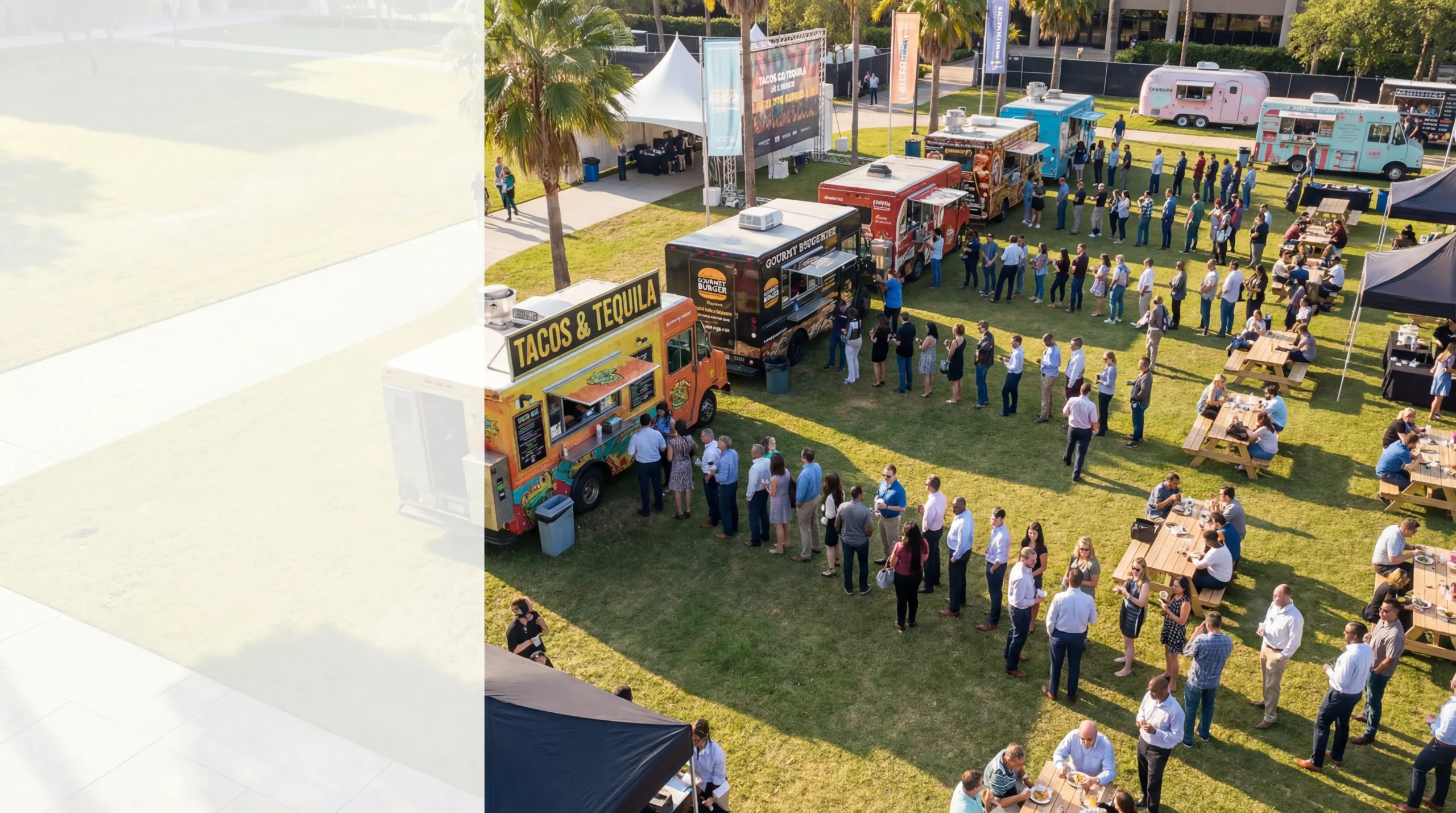

Most event planners wait until 4 weeks out to book food trucks for events. That’s when the good ones are already gone.
Here’s what to check first: You need 1 truck per 75-100 guests for 2-hour meal service. Budget $800-$2,500 per truck depending on cuisine and minimum orders. Start booking 8-12 weeks ahead for popular dates.
📚 This guide is part of: Food Truck Equipment Guide
I’ve coordinated food trucks for 50+ events over 8 years, from 100-person corporate lunches to 2,000-person festivals. The logistics matter more than most planners realize. Here’s what works.
Why Food Trucks Work for Events
Food trucks give you variety without the overhead of traditional catering. Your guests get made-to-order meals instead of steam table buffets. Service stays hot because trucks cook on-site.
The practical benefits add up fast. I’ve seen venues charge $500-$2,000 in kitchen fees that you skip entirely with mobile vendors. Setup takes 30-45 minutes instead of 2-3 hours for traditional caterers. One truck has equipment issues? The others keep serving.
Food trucks also create what event professionals call “food truck moments.” People photograph their meals and the trucks themselves. That translates to organic social media coverage you cannot buy with traditional catering.
Look— the real advantage is redundancy. At a 2022 corporate event I coordinated, one truck’s generator failed 20 minutes into service. The other two trucks absorbed the load. With a single caterer, the entire event would have collapsed.
For equipment reliability tips, check our Food Truck Generator Guide.
Bottom line: Food trucks turn feeding people from a logistics problem into part of the event experience.
How Much Food Trucks Cost for Events
Pricing breaks down by guest count and service style. Here’s what I’ve seen across hundreds of bookings:
| Event Size | Trucks Needed | Total Cost | Per Person |
|---|---|---|---|
| Small (50-100 guests) | 1 truck | $800-$1,200 | $16-$24 |
| Medium (200-300 guests) | 2-3 trucks | $1,800-$2,500 | $12-$15 |
| Large (500+ guests) | 4-6 trucks | $3,500-$6,000 | $10-$14 |
Based on 50+ events coordinated by author, 2018-2025 Chicago market. Travel fees apply for venues 20+ miles from truck’s home base.
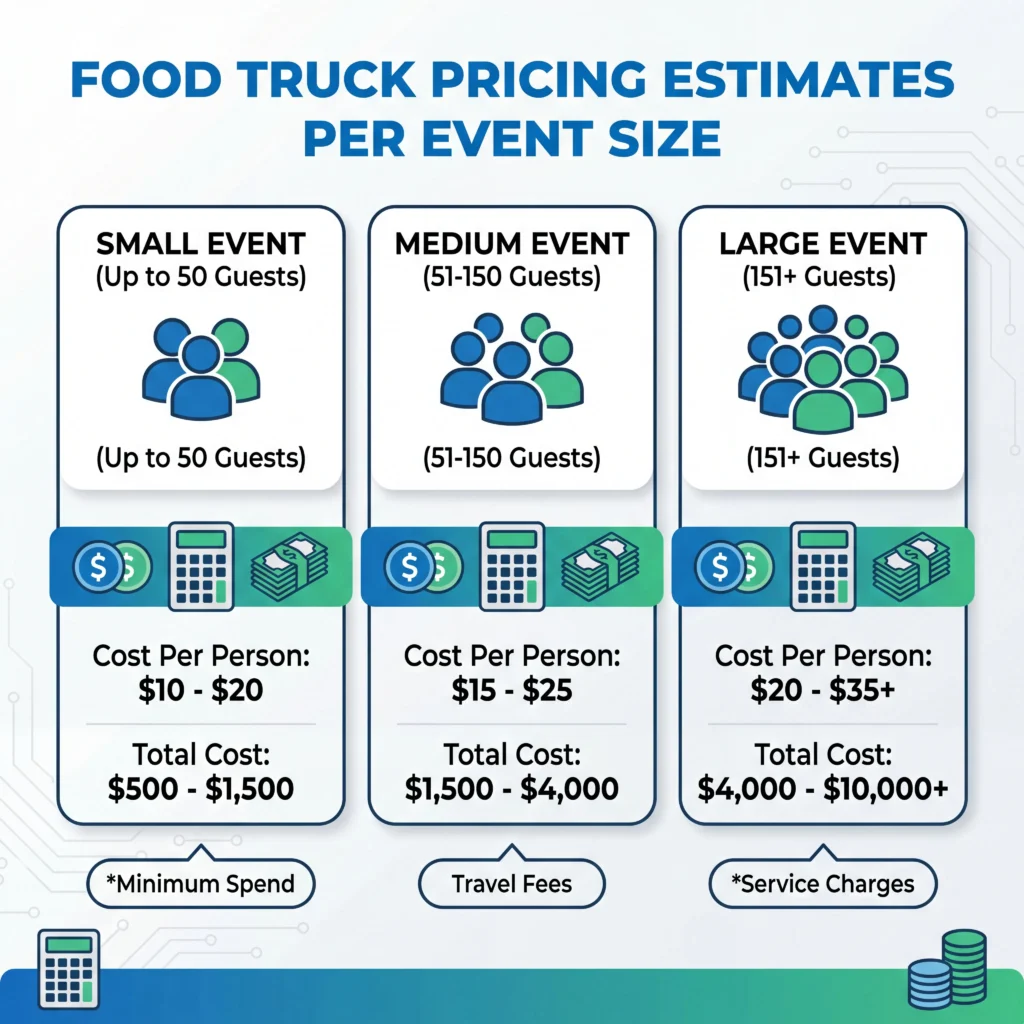
Cuisine type affects pricing significantly. BBQ and tacos tend toward $12-18 per person. Specialty options like sushi or gourmet burgers push toward $18-25 per person. Coffee trucks add $3-5 per person for beverage service.
💡 Pro Tip from Darnell: Get deposit terms in writing before signing. I’ve seen trucks no-show when they got bigger bookings. Without clear contract language, you’re stuck scrambling 24 hours before your event.
Hidden costs to watch for:
- Travel fees ($50-$150): Apply when venue is 20+ miles from truck’s home base
- Overtime charges ($100-$200/hour): Kick in beyond agreed service window
- Equipment rental ($75-$150): Required if trucks need additional warming units
- Permit fees ($50-$300): Some venues require special event permits filed 2-4 weeks ahead
Most trucks require 50% deposit 2-4 weeks before the event. Balance due day-of or within 7 days.
For comprehensive equipment planning, see our Food Truck Design guide.
Calculate How Many Trucks You Need
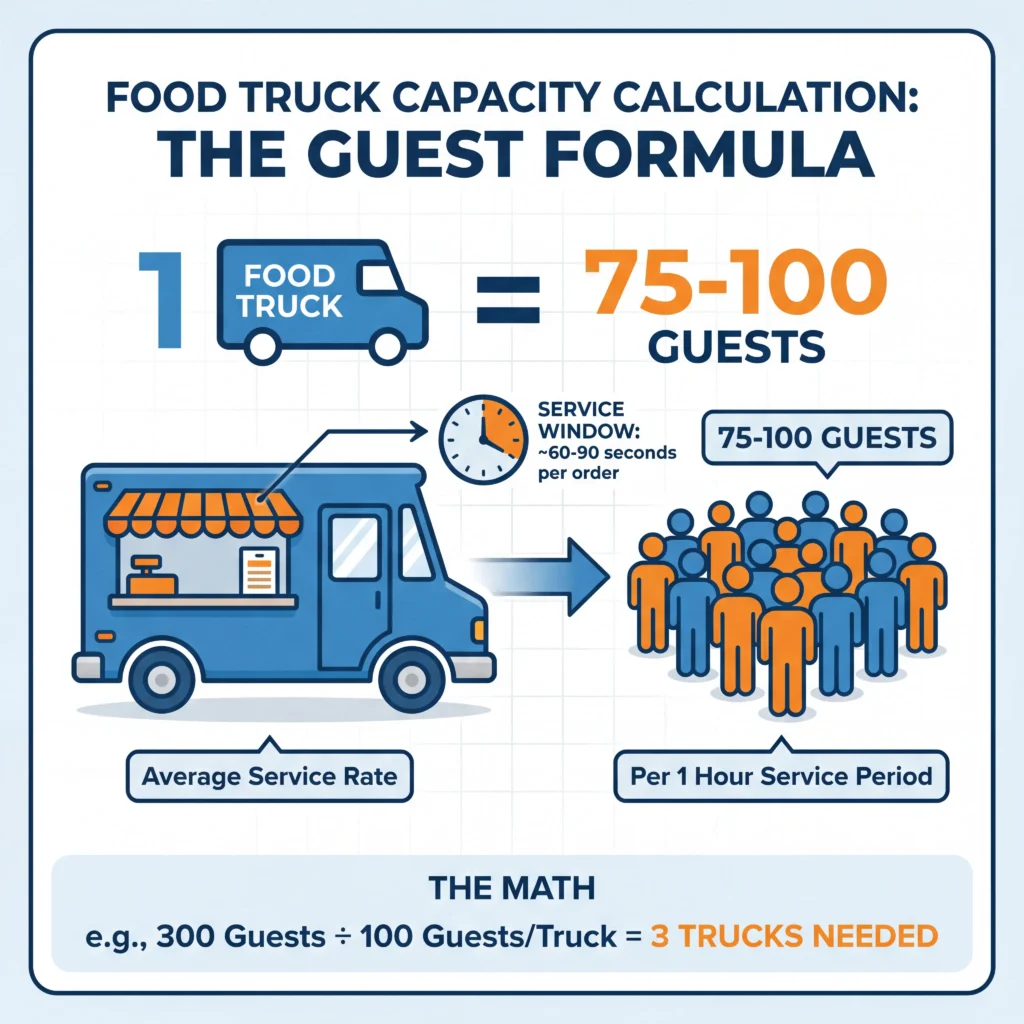
The formula matters. One truck serves 75-100 people per hour comfortably. Push beyond that and service slows to a crawl.
For a 300-guest event with 2-hour service window:
- Wrong approach: Book 1 truck (service stretches to 3-4 hours, food gets cold, guests frustrated)
- Right approach: Book 3 trucks (each serves 100 guests, lines stay manageable, hot food throughout)
Guest flow patterns affect this calculation. Everyone arrives at once for lunch? You need more trucks. Staggered arrival or open-house format? You can use fewer.
Service style changes the math:
- Festival-style (guests visit trucks throughout 3-4 hours): 1 truck per 150-200 guests works
- Meal service (everyone eats within 30-60 minutes): 1 truck per 75-100 guests minimum
- Snack service (appetizers, not main meal): 1 truck per 200-250 guests
I learned this at a 2019 corporate event in Chicago. Booked 2 trucks for 400 people (thinking we’d be fine). Service stretched to 90 minutes. The client complained about cold food and long lines. Final cost: $2,400 for food + $800 in angry client appeasement. Now I over-estimate trucks and scale back if needed.
Skip this calculation and you’ll watch your event timeline collapse in real-time.
Booking Methods: What Actually Works
You’ve got three main paths to book food trucks for events:
Marketplace Platforms (FoodtruckBooking.us, Roaming Hunger, Food Truck Club)
- Pros: One submission reaches multiple vendors, escrow payment protection, replacement guarantee if truck cancels
- Cons: 10-20% platform fee added to pricing, less direct control over menu specifics
- Best for: Events with flexible menus, first-time planners, high-stakes gatherings needing backup guarantees
Direct Contact (finding trucks via Instagram/website, booking direct)
- Pros: No platform fees, negotiate directly, build relationships for repeat events
- Cons: You handle all communication and contracts yourself, no backup protection if truck cancels
- Best for: Repeat events, specific truck preferences, tighter budgets
Aggregator Services (local food truck associations, catering companies with truck networks)
- Pros: Pre-vetted vendors, established service standards, often handle permits and insurance paperwork
- Cons: Limited truck selection, may cost 15-25% more than direct booking
- Best for: Corporate events needing reliability over cost savings
Which method I use depends on event stakes. Corporate client with 500 guests? Platform with escrow protection. Neighborhood block party? Direct booking with trucks I trust.
Reality check: The “lowest price” route often costs more when you factor in 10-15 hours of coordination emails. Platforms charge fees but save your time.
💡 Pro Tip from Darnell: Email breaks down day-of. Get direct phone numbers for truck operators during contract signing. I’ve seen events delayed 45 minutes because planners could not reach vendors by email during setup emergencies.
For ongoing vendor relationships, explore our Food Truck Operations best practices.
The 8-Week Event Planning Timeline
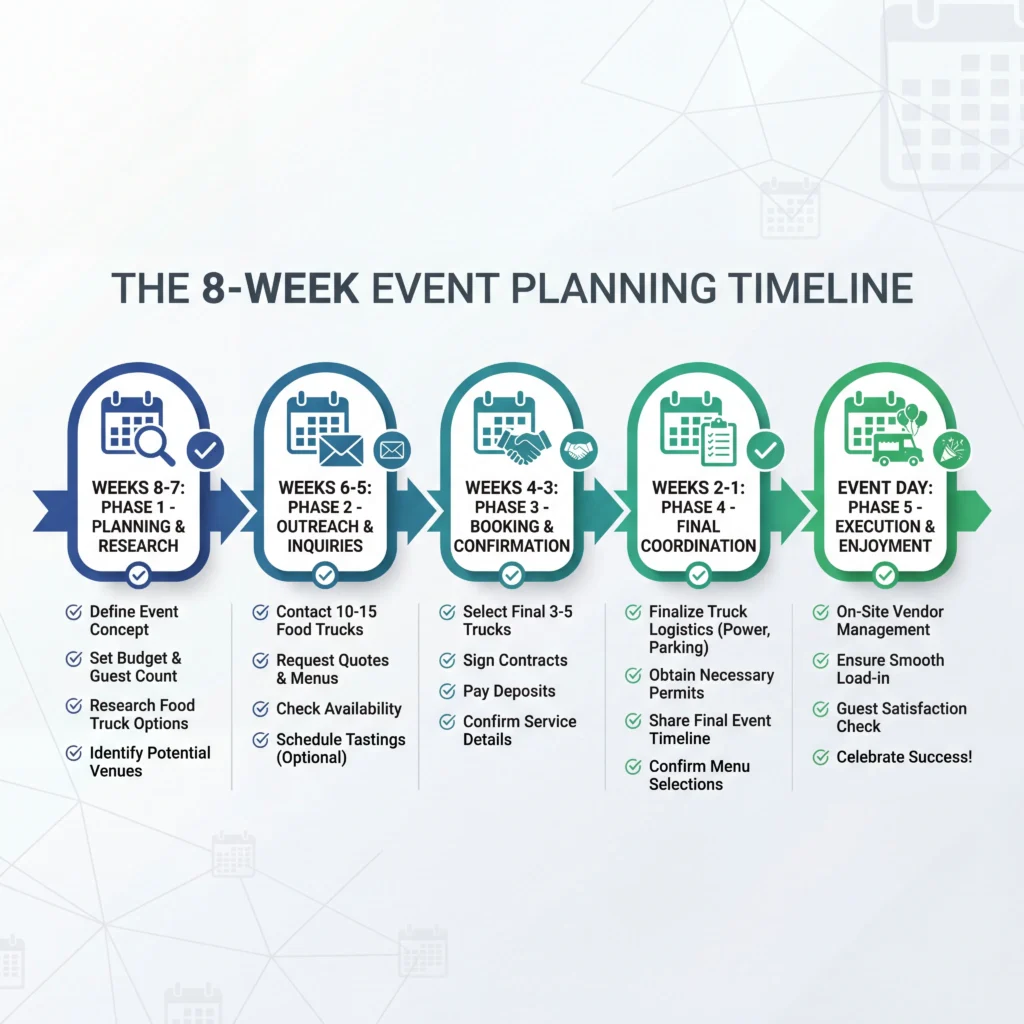
Here’s the booking timeline that works for food trucks for events:
Weeks 8-7: Research and Vendor Outreach
- Finalize guest count range (minimum 25% accuracy)
- Research trucks via platforms or direct search
- Request availability for your date
- Collect sample menus and pricing quotes
- Note: Add 2-4 weeks for weekend/holiday dates—trucks book 12-16 weeks ahead for peak times
Weeks 6-5: Vendor Selection and Contracts
- Compare quotes and menu options
- Check references and insurance coverage
- Negotiate terms (minimums, service hours, travel fees)
- Sign contracts with 50% deposit
- Confirm dietary accommodations (vegetarian, gluten-free, allergies)
Weeks 4-3: Logistics Coordination
- Walk venue with truck operators (critical step)
- Map parking spots (10-12 feet wide × 20-25 feet long per truck)
- Verify power access (most need 20-30 amps, 110V minimum)
- File special event permits if required by venue
- Confirm generator fuel or electrical hookup plans
Week 2: Final Confirmations
- Send final guest count to vendors
- Confirm arrival time (typically 60-90 minutes before service)
- Review contingency plans (weather, equipment failure)
- Verify insurance certificates name you as additional insured
- Provide parking diagrams and site contact numbers
Week 1: Day-Before Check
- Reconfirm all details via phone (not just email)
- Weather check and backup plans
- Verify payment method (most prefer check or Venmo day-of)
Event Day
- Truck arrival: 60-90 minutes pre-service for setup
- Equipment check: Generator test, propane levels, refrigeration
- Service window: Stick to agreed hours or negotiate overtime in advance
- Payment: Balance due immediately post-service or within 7 days per contract
This timeline assumes popular dates (weekends, summer, holidays). For off-peak events, you can compress to 4-6 weeks. But the extra lead time prevents last-minute scrambling when trucks are booked solid.
For location strategy beyond events, see Food Truck Locations.
Vendor Selection: What Actually Matters
I’ve seen all the ways vendors fail. The truck that showed up 90 minutes late because they “got lost” (they never scouted the venue). The one who ran out of propane mid-service (no backup tank). The operator who could not handle the line and gave up after 30 minutes.
The fix is simple: Reliable event vendors have completed 50+ events minimum and carry $1M+ general liability insurance. Specifically, verify these criteria before signing:
Equipment Reliability
- Generator: Ask about backup power (spare generator or dual-fuel capability)
- Propane: Confirm they bring backup tanks (primary runs out during peak service)
- Refrigeration: Verify they have truck-mounted units (coolers fail in hot weather)
- For technical details, see our Food Truck Refrigeration Systems guide
Event Experience
- Ask: “How many events have you worked this year?”
- Red flag: Fewer than 10 events (limited experience managing crowds)
- Green flag: 50+ events (proven track record under pressure)
Insurance and Permits
- Require: $1M+ general liability insurance
- Request: Certificate naming you as “additional insured” (protects you from liability claims)
- Verify: Workers comp if they have employees
- Confirm: They handle their own health permits (you should not be responsible)
Backup Plans
- Ask: “What happens if your truck breaks down day-of?”
- Best answer: They have a backup truck or partnership with another vendor
- Worst answer: Vague promises about “figuring it out”
References
- Request: 3 recent event contacts (within past 6 months)
- Check: Punctuality, food quality, professionalism under pressure
- Warning sign: They hesitate to provide references
💡 Pro Tip from Darnell: Test their food before committing. Visit their truck during regular service or request a paid tasting. Menu photos lie. Your taste buds do not.
Event Logistics: Setup, Power, and Space
Space requirements kill events when ignored. Food trucks need 10-12 feet wide × 20-25 feet long per truck minimum. Add 3-5 feet clearance on service side for customer queuing.
Power needs vary by equipment:
- Coffee trucks: 20 amps minimum (espresso machines draw heavy load)
- Full kitchen trucks: 30 amps (multiple cooking appliances)
- Generator-only trucks: No electrical needed (but verify generator fuel capacity)

For power planning details, check our Food Truck Water Systems guide covering full utility requirements.
Setup time: 30-45 minutes is standard. Trucks need to level equipment, connect power, fire up cooking equipment, and arrange service windows. Do not schedule service to start immediately upon arrival.
Weather Contingency Plans
I’ve worked events in all weather conditions. The ones that go smoothly always have backup plans documented in advance:
- High heat (90°F+): Trucks need shade or additional cooling (ventilation struggles in direct sun)
- Rain: Canopy or tent over service area (customers will not stand in downpours)
- High wind: Secure truck stabilizers and outdoor signage (I’ve seen menus blow into traffic)
- Freezing temps: Extended warm-up time (equipment takes 60+ minutes to reach temperature)
Common Setup Mistakes
- Parking trucks on slopes (equipment does not work on angles beyond 5 degrees)
- Placing trucks near fire exits (code violations will shut you down)
- Forgetting about exhaust direction (smoke blows into guest areas)
- Ignoring noise levels (generators next to speaking areas = disaster)
Day-of Checklist
- Clear parking spots 2 hours before truck arrival
- Test electrical outlets 1 day before event
- Mark parking spots with tape or cones
- Assign staff member as truck liaison
- Have venue manager phone number ready for trucks
Final Takeaways: Book the Right Trucks
Quick Recap:
- Start booking food trucks for events 8-12 weeks before popular dates (12-16 weeks for holidays/weekends)
- Calculate 1 truck per 75-100 guests for meal service, fewer for festival-style
- Budget $800-$2,500 per truck depending on cuisine and event size
- Walk the venue with operators 3-4 weeks before event date
- Verify $1M+ liability insurance and request additional insured status

Your Next Steps:
Ready to explore equipment? Check these guides:
- Food Truck Design for layout planning
- Food Truck Generator Guide for power requirements
- Food Truck Refrigeration Systems for cold storage
- Food Truck Water Systems for utility planning
Back to the Big Picture:
For the complete equipment overview, see our Food Truck Equipment Guide. If you’re expanding beyond events, check out food truck location strategies and daily operations best practices.
Start booking early, calculate trucks accurately, and verify insurance coverage. The key to successful food truck events is starting the vendor selection process 8-12 weeks before your planned date—not 4 weeks when good operators are already booked solid.
Darnell Kowalski is a former commercial kitchen equipment technician turned BBQ food truck owner in Chicago. He’s coordinated 50+ events and festivals over 8 years and has consulted on 200+ food truck setups across 3 states. He believes every logistics problem has a practical solution if you know where to look.
