Buying food truck equipment is where a mobile kitchen dream meets a spreadsheet, and the two do not always get along. The cooking line, the hood, the generator, the water tanks, the sinks, the point-of-sale terminal: each one carries a price tag and, more importantly, a rule that decides whether the health inspector signs off. Skip the wrong piece and you fail the inspection. Oversize the right piece and you burn cash you needed for the first six months of gas and permits. This guide walks the full outfitting list, item by item, with real 2026 price ranges and the sizing math for power, propane, and water.
I am Sal Bendetti, and when I outfitted my first rig I made most of the classic mistakes: too small a generator, a gray tank the same size as the fresh one, and a griddle that ate half my power budget. What follows is the checklist I wish someone had handed me, tied to the codes that actually enforce it. If you are still shaping the concept, the food truck business plan should set your budget before any of this gets ordered.
Here is the short version. A code-ready buildout runs roughly $6,200 to $21,800 for the cooking line alone, plus $5,000 to $10,000 for a hood and fire suppression system, and another few thousand for power and plumbing. Everything that touches food should be NSF-certified. Any grease-producing hood needs a UL 300 suppression system under NFPA 96. Hot holding sits at 140 degrees F or higher. Get those four facts right and the rest is arithmetic.
What food truck equipment you actually need
Menu drives the list. A taco rig and a coffee trailer share maybe half their gear. Still, most mobile kitchens converge on the same core: a cooking surface, refrigeration, a way to hold food hot, ventilation and fire safety, power, water and sinks, and a way to take money. Below is the 14-item checklist I use when I spec a new build, with typical price ranges pulled from 2026 supplier catalogs. Treat these as planning numbers, then get quotes for your exact model and menu.
| Item | Typical cost | Why it is required |
|---|---|---|
| Flat-top griddle | $1,147 to $6,000 | Primary cook surface |
| Deep fryer | $1,500 to $4,000 | Fried menu items |
| Range or burner set | $1,000 to $4,000 | Sauces, boiling, saute |
| Undercounter refrigeration | $2,500 to $6,000 | Cold storage, NSF food safety |
| Warming or holding cabinet | $100 to $1,200 | Hold at 140 degrees F |
| Vent hood + suppression | $5,000 to $10,000 | NFPA 96 compliance |
| Generator | $500 to $3,000 | Electrical power |
| Propane system | $800 to $2,500 | Cooking fuel |
| Fresh + gray water tanks | $300 to $1,200 | Health code plumbing |
| 3-compartment sink | $500 to $1,500 | Warewashing |
| Handwash sink | $200 to $500 | Hygiene, required separately |
| Water heater | $200 to $900 | Hot water for sinks |
| Fire extinguisher | $100 to $300 | Class K, code required |
| POS terminal | $500 to $2,000 | Payments and reporting |
Notice the pattern. Almost every line ties back to a rule, not a preference. That is the difference between a truck that passes and a truck that sits in the yard.
The cooking line: griddle, fryer, and range
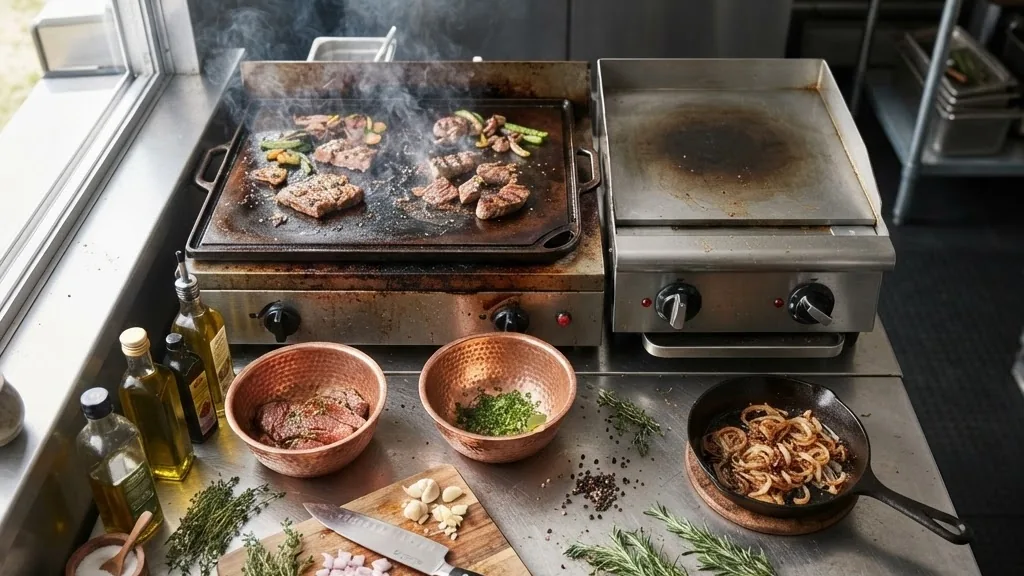
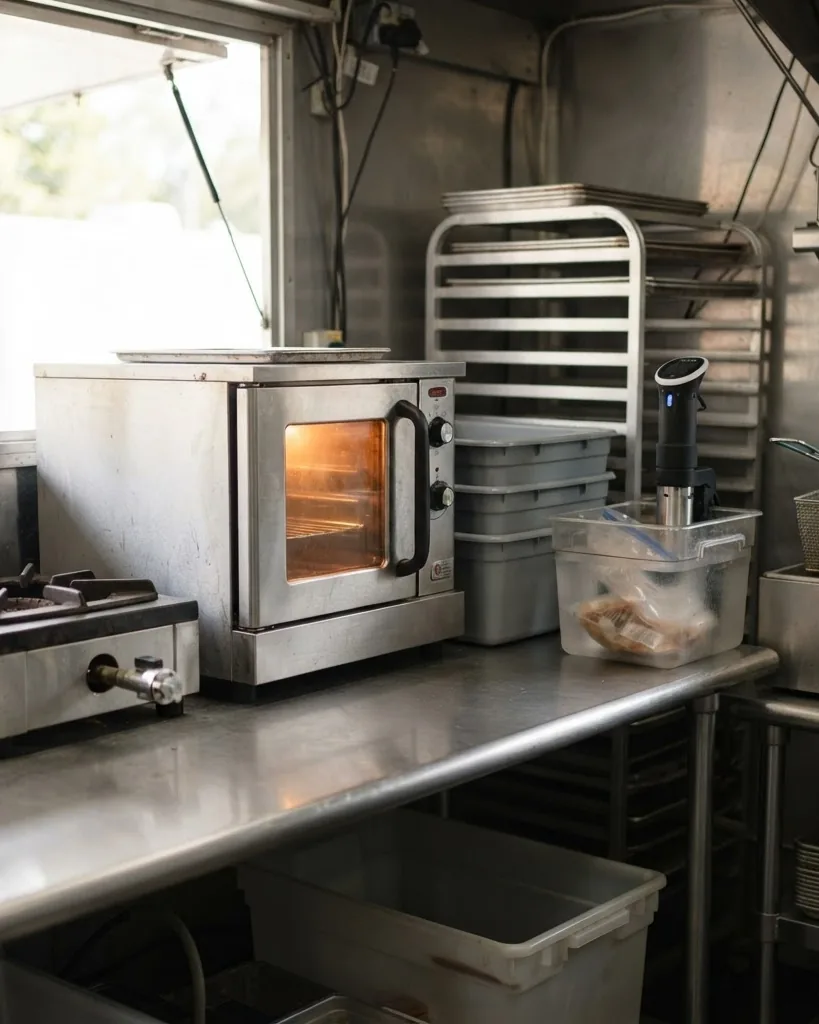
The cooking line is the heart of the rig, and it is where most of your fuel and power go. A 36-inch flat-top griddle runs $2,000 to $6,000, while a compact 18-inch model starts near $1,147. Griddles are workhorses: burgers, smash tacos, breakfast, cheesesteaks. If your menu leans fried, budget $1,500 to $4,000 for a commercial deep fryer, and remember that a fryer draws heavy amps and heavy propane at the same time. A four-burner range or a bank of open burners adds roughly $1,000 to $4,000 and covers sauces, boiling, and saute work.
My rule of thumb from the yard: pick the two surfaces your menu truly needs, then stop. I have watched operators cram a griddle, a fryer, a range, and a charbroiler into a 16-foot box, then discover the generator cannot run three of them at once. The full cooking line, sized to a real menu, tends to land between $6,200 and $21,800. Wide range, I know, but the spread is the menu talking. Simple concepts sit low; a fried-and-grilled hybrid sits high.
Fuel type shapes the choice too. Gas griddles and fryers heat fast and lean on your propane supply, while induction burners and electric flat-tops shift the load onto the generator instead. A charbroiler adds smoky flavor but also adds grease, which raises your hood and cleaning burden under NFPA rules. Match the surface to both the menu and the power plan, not just the recipe. A specialty piece like a rotisserie or a wok range can define a concept, yet each one is another 30 to 50 amps and another BTU line to feed, so add them with eyes open.
Every cook surface should be commercial-grade and NSF-certified. The USDA and FDA both care about internal cook temperatures, so a reliable griddle that holds an even surface heat is not a luxury; it is how you hit safe temperatures every ticket.
Refrigeration, holding, and warming
Cold storage keeps you legal and keeps your food costs sane. Undercounter refrigerators and freezers run $2,500 to $6,000 and fit under the prep line, which is where they belong on a tight rig. If you need volume, reach-in units and small walk-ins climb to $4,000 to $15,000, but few trucks have the floor space or the power for that. A refrigerated prep table earns its keep by putting cold ingredients at the cook’s fingertips.
Holding is the other half of the temperature story. The FDA Food Code and USDA guidance both draw a line: hot food held for service must stay at 140 degrees F or above, and cold food stays cold. The window between is the danger zone where bacteria multiply, and the federal guidance at foodsafety.gov spells out why that matters. A countertop warmer runs $100 to $300, while soup kettles and steam tables land at $300 to $1,200. Holding gear also speeds service, because proteins and sauces are ready the second an order lands.
One mistake I made early: I skipped a warming cabinet to save $600 and then served lukewarm brisket at a lunch rush. Cold protein is a health risk and a refund line. The cabinet paid for itself in a week.
Ice and freezing round out the cold side. A small undercounter freezer or a good cooler for backup stock keeps you from a mid-service run to the store, and an inspector may ask how you log temperatures. A cheap $15 probe thermometer and a clipboard cover that question. The USDA and FDA both expect you to prove cold food stayed below 41 degrees F and hot food stayed at 140 degrees F or above, so build the habit of checking twice a shift. Reliable refrigeration is the one place I never cut corners, because a warm walk-in on a hot day can spoil a whole day of food cost in a couple of hours.
Ventilation hood and Ansul fire suppression
This is the system people underestimate, and it is the one that shuts you down fastest if it is wrong. Any rig with a grease-producing cook surface needs a Type I hood, and under NFPA 96, that hood requires a UL 300-listed wet-chemical fire suppression system. Ansul and Kidde are the common brands. The wet chemical smothers a grease fire and forms a blanket that stops it from reflashing. A complete, code-compliant hood and suppression install runs $5,000 to $10,000.
NFPA is the National Fire Protection Association, and its NFPA 96 standard is the rulebook fire marshals cite. It also sets maintenance: hood and duct cleaning every 3 to 6 months depending on how much grease you throw. Semi-annual suppression inspections are standard for mobile units. You can read the standard-development detail at the NFPA, and it is worth doing before you sign a fabrication contract.
Do not treat the hood as an add-on. An 8-foot integrated hood with a UL 300 system is often the single most regulated purchase on the truck, and inspectors check the tag. A Class K fire extinguisher, at $100 to $300, rides alongside it as a code-required backup for cooking-oil fires.
Power and propane, sized right
Here is where the arithmetic saves you. A food truck generator costs $500 to $3,000, and mobile kitchens draw anywhere from 1,000 to 10,000 watts. Small coffee and dessert rigs live around 1,000 to 4,000 watts; a full griddle-and-fryer operation needs 5,000 to 10,000 watts. Plan for at least 50 amps of service, though a light setup running only a fridge and a blender may get by on 25 amps.
The trap is startup surge. Commercial fryers, griddles, and compressors run on 220-240V lines and draw 20 to 50 amps in normal use, but each one pulls three to five times its running wattage for the instant it kicks on. Size the generator for that surge, not the steady draw, or you will trip breakers mid-service. I learned that on a Saturday when my fridge compressor and fryer element fired at the same second and dropped the whole rig.
Propane fuels most cook lines, and tanks are rated in BTU. A 20 lb tank holds about 430,270 BTU, a 30 lb tank about 649,980 BTU, a 40 lb tank about 860,542 BTU, and a 100 lb tank about 2,160,509 BTU. Add up the BTU rating on each burner, then choose tank size and a service window that gets you through a full day without a swap. A regulated propane system with pressure testing typically adds $800 to $2,500. How that gear fits the floor is a big part of food truck design, so plan power and fuel before you weld a single bracket.
A word on generator type. Inverter generators cost more but run quieter and cleaner, which matters at events that cap noise at a set decibel level and at markets that ban open exhaust near the crowd. A conventional 7,000-watt unit is cheaper up front but louder and thirstier. Some operators skip the gas generator entirely and run a propane or diesel unit tied into the same fuel logic as the cook line, which means one refuel routine instead of two. Whichever you pick, mount it where the exhaust vents away from the service window, and keep at least a full spare day of fuel on board for a busy 8-hour event.
Water tanks and sinks
Plumbing is pure health code, and the numbers are strict. Most health departments require a fresh water tank of at least 30 gallons, and the gray or waste tank must be at least 15 percent larger, roughly 35 gallons. The logic is simple: you should never be able to fill the gray tank and be tempted to dump on the ground. Fresh and gray tank pairs run $300 to $1,200.
Sinks come in two jobs that inspectors keep separate. A 3-compartment sink for wash, rinse, and sanitize costs $500 to $1,500 and handles warewashing. A dedicated handwash sink, $200 to $500, is required on its own so nobody rinses a knife where they scrub their hands. A water heater rounds it out: warewashing usually needs a 4-gallon minimum unit or an instantaneous heater reaching 120 degrees F, while a handwash-only setup can use a 0.5-gallon heater to 100 degrees F.
- Fresh water tank: 30 gallons minimum.
- Gray water tank: at least 15 percent larger than fresh.
- 3-compartment sink for wash, rinse, sanitize.
- Separate handwash sink, always.
- Water heater: 4-gallon minimum for warewashing, or instant to 120 degrees F.
NSF certification and passing inspection
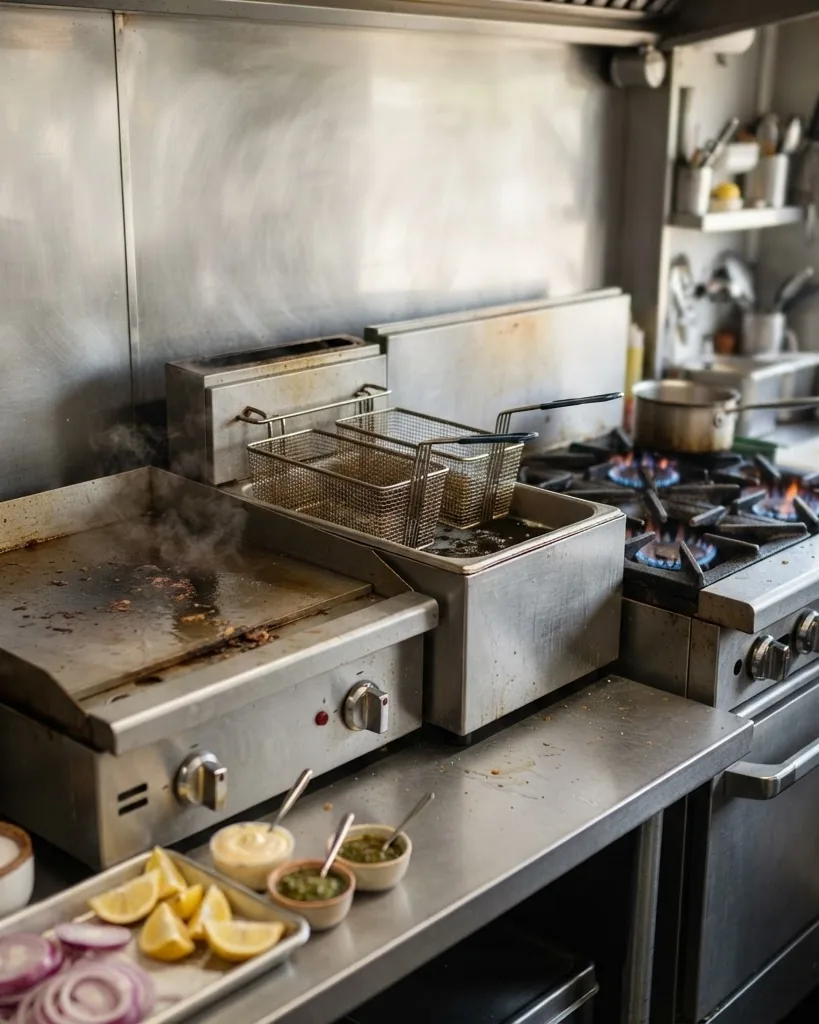
NSF stands for the National Sanitation Foundation, and its mark is the shortcut inspectors look for. NSF-certified equipment is built from food-safe materials and designed to be cleaned thoroughly, with no seams that trap grime. Health departments across the country treat NSF certification as the baseline for anything that contacts food or gets washed. Show up with an uncertified prep table and you risk a failed inspection, a fine, or a shutdown order.
Certification is not just a sticker. The FDA writes the Food Code that states and counties adopt, and NSF certification is how equipment demonstrates it meets those material and cleanability standards. When I buy used, the first thing I check is the NSF tag; if it is missing or scratched off, I walk. The USDA weighs in on the food-handling side, setting the safe internal and holding temperatures your gear has to achieve. You can review the federal food-safety basics at the FDA before your plan review.
New versus used, and where the money goes
New gear is clean, warrantied, and expensive. Used gear is a gamble that often pays. Quality used commercial equipment typically costs 40 to 75 percent less than new, and outfitting a full kitchen with reconditioned units can save $15,000 to $30,000. That is real money on a startup budget.
My split, learned the hard way: buy refrigeration, hoods, and fire suppression new or professionally reconditioned, because a failure there costs you a service day or an inspection. Griddles, worktables, shelving, and warming cabinets are fine used. A steel worktable does not care how old it is. Here is roughly where a modest budget goes once you total the line items.
| Category | Budget share | Cost band |
|---|---|---|
| Cooking line | Largest | $6,200 to $21,800 |
| Hood + suppression | Major | $5,000 to $10,000 |
| Refrigeration | Major | $2,500 to $15,000 |
| Power + propane | Moderate | $1,300 to $5,500 |
| Plumbing + sinks | Moderate | $1,000 to $3,200 |
| POS + smallwares | Smaller | $1,000 to $4,000 |
Used warmers alone tell the story: a reconditioned warming cabinet runs $200 to $1,200 against much more new, and a used steam table can start under $100. Spend the savings on refrigeration reliability.
Layout and workflow inside the truck
Great gear in a bad order still cooks slow. The line should flow the way a ticket flows: cold storage, prep, cook surface, hold, then hand-off at the window. Keep the hood directly over the griddle and fryer so the ductwork stays short and the NFPA 96 inspector stays happy. Put the handwash sink near the entry so staff wash in before touching food, and keep the 3-compartment sink out of the cook path.
Weight and power balance matter as much as reach. Heavy water tanks and the generator want to sit low and centered so the rig drives straight. Cluster the 220-240V appliances so your heaviest amp draws share short cable runs. When I re-planned my second build around workflow instead of just fitting boxes, ticket times dropped and the crew stopped bumping elbows. If you are still testing concepts, browsing food truck ideas helps you match a menu to a layout before you commit steel.
One more workflow note. Leave a clear path to the propane shutoff and the fire suppression pull station. In a grease fire you have seconds, and the whole point of the UL 300 system and that Class K extinguisher is speed. Nobody should have to move a cooler to reach either one.
Smallwares, POS, and the parts people forget
The big machines get the attention, but the small stuff decides whether a shift runs smooth. A modern point-of-sale terminal costs $500 to $2,000, and a compact wireless system with an onboard router keeps you taking cards when the venue Wi-Fi drops. That matters more than it sounds, because a dead POS at a festival means cash-only and a line that walks away. Budget for a backup battery and a mobile hotspot too.
Smallwares are the long tail: sheet pans, tongs, squeeze bottles, cutting boards, a scale, storage containers, and a first set of chemicals for the 3-compartment sink. Plan on $1,000 to $2,000 to stock a new rig properly, and buy NSF-certified boards and containers so they clear inspection alongside the big equipment. Gloves, sanitizer test strips, and a Class K fire extinguisher at $100 to $300 belong on the same order.
Maintenance is the cost nobody quotes you. NFPA 96 calls for hood and duct cleaning every 3 to 6 months, and suppression systems need a professional inspection about twice a year. Propane lines get pressure-tested on a schedule, and the generator wants oil changes on its own hours-based clock. I keep a simple log for all of it, because a lapsed hood-cleaning tag is the kind of paperwork gap that fails an otherwise clean truck. Set aside a few hundred dollars a quarter and none of it surprises you.
Frequently asked questions
How much does full food truck equipment cost?
A code-ready outfit usually lands between $30,000 and $60,000 once you total everything. The cooking line alone runs $6,200 to $21,800, the hood and fire suppression $5,000 to $10,000, refrigeration $2,500 to $15,000, and power, propane, plumbing, and POS fill in the rest. Buying quality used gear can trim 40 to 75 percent off individual items and save $15,000 to $30,000 across a full build, so the range is wide by design.
Does food truck equipment have to be NSF-certified?
For anything that touches food or gets washed, effectively yes. Health departments treat NSF certification as the baseline, because it proves the equipment uses food-safe materials and can be cleaned without trapping bacteria. The FDA Food Code that counties adopt is built around those standards, and the USDA sets the safe holding temperatures, like the 140 degrees F hot-hold line, that your gear must actually hit. Uncertified equipment risks a failed inspection or a shutdown order.
What size generator does a food truck need?
It depends on the cook line. Small coffee and dessert rigs run on 1,000 to 4,000 watts, while a full griddle-and-fryer truck needs 5,000 to 10,000 watts and at least 50 amps of service. The key is sizing for startup surge, since compressors and heating elements pull three to five times their running wattage for a moment. Undersize it and you trip breakers during the lunch rush, which is the worst possible time to lose power.