I run these numbers again every year because fuel prices and generator models move, and after eight years running trucks I would rather hand you the current math than the math I used back when I started.
Food truck generator sizing is the one number I wish somebody had drilled into me before I ever bought a truck. My first summer running the flat-top out of a lot in Austin, I cheaped out on a little open-frame unit, and it quit on me mid-rush at a Saturday market with twelve tickets on the rail and a line to the corner. Melted ice cream, warm slaw, forty bucks of dropped orders, and a very long drive home to think about my choices. This guide is the load math and the gear reasoning I use now, written so you never have that Saturday.
Here is the short version. Add up the running watts of everything that draws power at the same time (fridges, flat-top, fryer, lights, POS), then add the single largest starting surge, then pad it 20 to 50 percent for headroom and hot days. Most small carts run fine on a 2 to 3.5 kW inverter, a mid-size truck wants 4 to 6 kW, and a full rig with electric cooking lands at 7 kW or more. Pick an inverter for clean power under 5 percent THD, keep it under 70 dB so events let you park, and never run it in an enclosed space.
How I size a food truck generator
Sizing is just addition plus respect for surge. Write down every appliance that can be on at once, list its running watts, add them, then find the one item with the biggest startup spike and add that gap on top. Compressors and motors pull two to three times their running draw for a split second when they kick on, and that spike is what trips a generator that looked big enough on paper.
Here is the worksheet I hand new operators, the same four steps I built my first truck’s power plan around:
- Step 1 – List every appliance that can run at the same time and write down its running watts.
- Step 2 – Add those running watts together for your baseline total load.
- Step 3 – Find your single largest startup surge, usually a compressor, and add that spike on top of the baseline.
- Step 4 – Pad the result 20 to 30 percent for headroom and hot-day derating, then shop that class of generator.
Say your gear runs 5,200 running watts total. Your worst surge item is a fridge compressor that jumps roughly 1,500 watts extra at startup. That puts your real peak near 6,700 watts. Now add 20 to 30 percent headroom because a generator hates running at 100 percent all day and loses output on a 100-degree afternoon. You are shopping for something in the 8,000-watt surge, 6,500-watt running class. Undersize this and you brown out your POS every time the fridge cycles. What most guides get wrong is stopping at running watts and skipping the surge step entirely, which is exactly the gap that stranded me that first Saturday.
The mistake I see most is people sizing for average draw instead of worst-case simultaneous draw. Your fryer, flat-top, and fridge do not politely take turns. On a rush they are all live, the freezer kicks on, and the roof fan spins up at the same second. Size for that ugly moment, not for a quiet Tuesday.
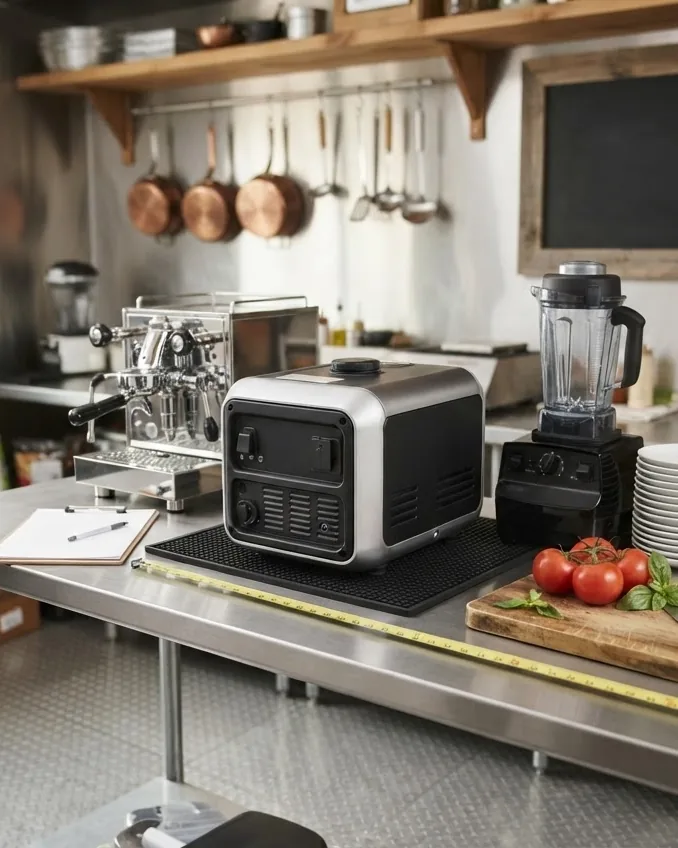
Running watts of the gear that actually matters
Most of your load hides in three or four appliances, and everything else is rounding error. Refrigeration and electric cooking are the giants; lights and your point-of-sale are almost nothing by comparison. Get the big items right and your food truck generator math falls into place.
A commercial reach-in or under-counter fridge pulls roughly 600 to 800 running watts, and a busier or older unit can hold 800 to 1,500 watts continuous. Chest freezers sit in a similar band. An electric deep fryer is the heavy hitter and can push past 4,000 watts on its own; commercial electric fryers commonly sit between 3,000 and 5,000 watts. An electric griddle or flat-top runs 1,200 to over 3,000 watts depending on plate size. Your LED string lights, a tablet POS, and a router together barely crack 100 to 400 watts.
Having spent six seasons at the window watching these numbers play out in real service, here is the quick-reference list I keep taped inside the pass-through:
- Reach-in or under-counter fridge: 600 to 1,500 running watts.
- Chest freezer: similar band to a fridge, watch the startup surge.
- Electric deep fryer: 3,000 to 5,000-plus running watts, the single biggest load on board.
- Electric griddle or flat-top: 1,200 to 3,000-plus running watts depending on plate size.
- LED lights, tablet POS, and router combined: 100 to 400 running watts.
Notice the theme: if you cook with electricity, your generator gets big and expensive fast. This is exactly why so many operators keep the fryer and flat-top on propane and run only refrigeration, lights, ventilation, and POS off the generator. That single decision can drop you from an 8 kW machine to a 4 kW one. My truck cooks on gas and the generator only babysits the cold side and the electronics, and it has never once let me down since.
Tip: Put a clamp meter on each appliance for one full service before you buy anything. Nameplate ratings run high, and measuring your real draw can save you a full kW of generator you do not need to haul or fuel.
What size you actually need: 3.5 kW to 8 kW and up
Size follows how you cook. If propane handles your heat and the generator only runs cold storage, lights, a vent fan, and POS, you live in the 3.5 to 5 kW band. If you run any electric cooking, an espresso machine, or a rooftop AC unit, plan on 6 to 8 kW or more. Full trucks with electric fryers routinely need 7,000 watts and up.
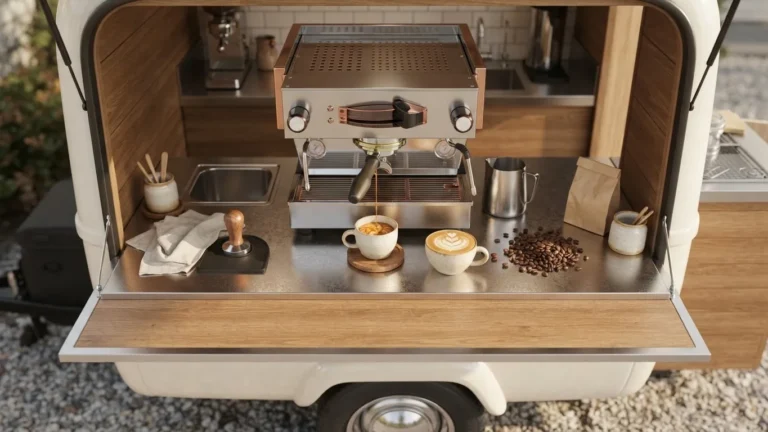
Here is how I bucket it. A coffee or dessert cart with a fridge, blender, and lights is happy on a 2 to 3.5 kW inverter. A standard taco or burger truck cooking on propane, running two fridges and a freezer, wants 4 to 6 kW. A big rig with electric cooking equipment, a beverage cooler, and climate control belongs at 7 to 12 kW. When you are between two sizes, buy up. A generator loafing at 60 percent load lasts longer, burns cleaner, and stays quieter than one pinned at the top all day.
If you are still spec’ing the whole build, size the generator against your finished gear list rather than guessing. My full food truck equipment checklist lays out the appliances that drive this number, and mapping them onto your truck layout and power plan before you buy keeps you from over- or under-sizing.
Inverter vs conventional generators
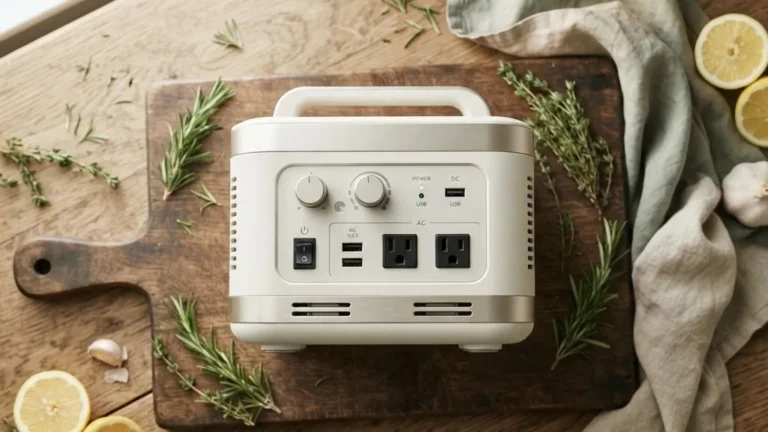
For a food truck, buy an inverter generator and do not overthink it. Inverters produce clean, stable power with total harmonic distortion under 5 percent, which is what your POS tablet, card reader, espresso controller, and LED drivers need. A cheap conventional open-frame unit throws dirty power that can glitch a card reader mid-transaction or slowly cook sensitive electronics.
Inverters also throttle the engine to the load instead of screaming at full RPM all day. That means less fuel burned, far less noise, and lighter weight for the same output. The tradeoff is price: an inverter costs more up front than an open-frame conventional unit of the same wattage. For a mobile kitchen full of electronics that runs eight hours a day, that premium pays for itself in reliability and in events that actually let you park. I have never met an operator who regretted going inverter, and I have met plenty who regretted a bargain open-frame.
Diesel vs gas vs propane
Fuel choice is about how many hours you run, where you refuel, and how much noise and smell you can get away with. Gasoline is cheapest to buy and available everywhere but goes stale and needs frequent refueling. Diesel is the most efficient and durable for heavy daily commercial use but costs more up front and can be louder. Propane burns cleanest and quietest, ties straight into the cook tanks you already carry, and never goes stale, at a small cost in peak output.
| Fuel | Typical use | Runtime and cost | Best for |
|---|---|---|---|
| Gasoline | Small to mid inverters, part-time trucks | Cheap fuel, short shelf life, ~0.3-0.7 gal/hr | Occasional events, lowest upfront cost |
| Diesel | Large rigs, daily heavy service | Best efficiency and engine life, higher price | Full-time trucks that cook on electric |
| Propane (LP) | Trucks already running LP cook tanks | Clean, quiet, no stale fuel, slightly lower peak | Quiet events, simple fuel logistics |
| Dual / tri-fuel | Operators who want flexibility | Gas for peak, propane for clean long-shelf burn | Anyone unsure or working varied venues |
My honest take after years of this: dual-fuel is the smart default for most new operators. Run propane off your spare tank for a quiet market where the crowd is close, and switch to gasoline when you need every watt at a big electric-heavy event. You stop babysitting stale gas in the off-season, and you always have a second fuel option when one runs dry at the worst possible time.
Noise, dB, and festival limits
Noise is not a comfort issue, it is a permit issue. A screaming generator loses you customers and gets you thrown off event sites. Aim for a unit rated under 70 dB, and read every event contract for a noise floor. Festival vendor packets routinely require 65 dB at 7 meters, and some go tighter.
For reference, a quality inverter like the Honda EU7000iS runs about 58 dB at rated load and 52 dB at quarter load, which is close to normal conversation. Super-silent rental units hit 60 dB at 7 meters. An old open-frame unit runs 70 to 80-plus dB, which sounds like loud traffic and will get you a complaint. Cities write this into law too: one Louisville ordinance capped vendor generators at 70 dB. When I upgraded from my old open-frame to a quiet inverter, two farmers markets that had quietly stopped calling me started booking me again. The generator paid for itself in bookings, not just fuel.
Fuel runtime and how long a tank lasts
Runtime is a function of tank size, load, and how the generator throttles. Manufacturers quote two very different numbers: runtime at rated load and runtime at quarter load. The gap is huge, and knowing which one applies to your service saves a lot of mid-shift refueling.
Take the Honda EU7000iS again as a benchmark. It carries a 5.1-gallon tank, runs about 6.4 hours at rated load, and stretches to roughly 16 hours at quarter load, burning near 0.32 gallons per hour when lightly loaded. Your truck sits somewhere in between. A realistic food-truck load might give you 7 to 10 hours on a tank, which covers most single-day services with a little margin.
If you work long festival days, carry enough fuel to run the whole day plus a buffer, and never let it run bone dry mid-rush because a hot restart under load is how you cook a starter. Track your real burn rate for a few services and you will know your truck cold.
Mounting, venting, and carbon monoxide safety
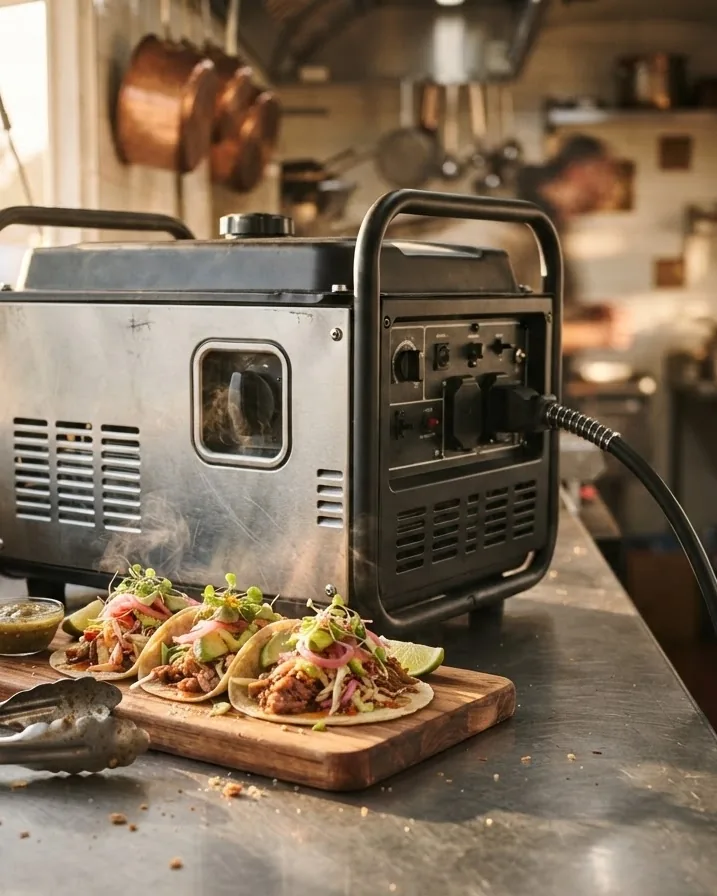
This is the section that actually keeps people alive, so read it twice. Portable generators produce high concentrations of carbon monoxide, an odorless gas that can build to fatal levels in minutes even in spaces that feel ventilated. Carbon monoxide is behind roughly 450 deaths a year in the United States, and more than 150 of those tie to consumer products including portable generators. Never run a generator inside the truck box, in a trailer tongue box with the lid down, or under a closed awning.
Mount the generator outside the service area, downwind, with the exhaust pointed away from the truck and away from any open window, vent, or your own workspace. According to the CDC, generator safety guidance is blunt about clearance and open air, and according to OSHA, CO is treated as a serious workplace hazard on any job site. Newer units carry CO auto-shutoff (marketed as CO SECURE or CO Detect) built to the ANSI/PGMA G300-2023 standard, and I would not buy a new generator without it.
Warning: A generator is not the only fire and air item your inspector checks. According to NFPA, your cooking exhaust hood and fire suppression fall under NFPA 96, the standard for commercial cooking ventilation, and fire marshals look at both the generator placement and the hood at inspection. Unlike most operators who treat the generator and the hood as separate checklists, I walk both at once, because confirming your own city and county rules before you build is what keeps local code from overriding your plan on inspection day.
Real models and 2026 price ranges
You do not need the most expensive machine, you need the right class of machine bought clean. Here is where real money lands in 2026. At the premium end, the Honda EU7000iS runs 5,500 running and 7,000 surge watts, is fuel injected, quiet, and reliable, at roughly $4,500 MSRP. It is the unit every full-time operator eventually wishes they had bought first.
In the value tier, the Predator 9500 inverter from Harbor Freight puts out about 7,600 running and 9,500 surge watts with built-in CO auto-shutoff, and typically sells for $1,800 to $2,000. Units like the Powerhorse 7500 inverter deliver similar output with a long runtime for roughly $3,000 less than the Honda. For a small cart, a Champion 4500-watt dual-fuel inverter runs around $474 and covers a fridge, blender, and lights with room to spare. Tri-fuel inverters in the 6,800-watt class are popular with trucks that already carry propane. Buy from a dealer who stocks parts, because a generator you cannot service fast is a generator that will strand you.
Budget for more than the sticker. A quality inverter is one of the larger single line items in your build, alongside refrigeration and the truck itself. If you are still pricing the whole project, my breakdown of what a food truck really costs folds the generator into the full startup picture, and buyers weighing a cheaper entry can compare against buying a used food truck that may already include a working power setup.
Mistakes I made so you do not have to
I bought on price twice before I learned. The first open-frame unit was loud enough to lose me two markets and dirty enough to glitch my card reader on busy afternoons. The second was a hair too small, so every time the fridge cycled my lights dipped and my POS blinked, which looks unprofessional and eventually corrupts a sale. Both got replaced inside a year, which means I paid for three generators to end up with one good one. From my years on the truck, the overlooked detail is almost never the generator’s headline wattage, it is the surge you forgot to plan for.
The other lesson was fuel discipline. I let a tank run dry once during a lull, restarted it warm under a full load when the rush hit, and spent the next week nursing a cranky starter. Now I refuel during slow moments, carry a full spare can, and log my burn rate. Size right, buy inverter, respect surge, respect CO, and keep fuel in the tank. Do those five things and your power just disappears into the background where it belongs, which is exactly what you want from it.
Frequently asked questions
What size generator do I need for a food truck?
Add the running watts of everything that runs at once, add your largest startup surge, then pad 20 to 50 percent. Propane-cooking trucks usually land at 4 to 6 kW, while trucks with electric cooking need 7 kW or more. Small carts run fine on a 2 to 3.5 kW inverter. Size for worst-case simultaneous draw, not average.
How many watts does a food truck fridge use?
A commercial reach-in or under-counter fridge draws about 600 to 800 running watts, and a busier or older unit can hold 800 to 1,500 watts continuously. Just as important is the startup surge, which can spike an extra 1,000 to 1,500 watts for a moment. Size your generator around that surge or your lights will dip every cycle.
Is diesel, gas, or propane better for a food truck generator?
Gasoline is cheapest to buy but needs frequent refueling and goes stale. Diesel is the most efficient and durable for heavy daily use but costs more up front. Propane burns clean and quiet and ties into your cook tanks. For most new operators a dual-fuel unit is the smart default, giving gas for peak output and propane for quiet events.
How loud can my generator be at events?
Aim for under 70 dB and read every event contract, because festival vendor packets often require 65 dB at 7 meters and some cities cap vendor generators at 70 dB by ordinance. A quality inverter runs near 58 dB at load, close to conversation level. An old open-frame unit at 70 to 80-plus dB will draw noise complaints and can cost you bookings.
Can I run a generator inside or under my food truck?
No. Portable generators produce high levels of carbon monoxide that can reach fatal concentrations within minutes even in spaces that feel ventilated. CO causes roughly 450 deaths a year in the United States. Always run the generator outside, downwind, with exhaust pointed away from any window, vent, or your workspace, and buy a unit with CO auto-shutoff.
How long will a generator run on one tank?
It depends on tank size and load. A 5-gallon inverter running a realistic food-truck load often gives 7 to 10 hours, though the same unit may quote 6 hours at rated load and 16 hours at quarter load. Track your real burn rate for a few services, carry a full spare, and refuel during slow moments rather than mid-rush.
The bottom line
A food truck generator is not the exciting part of the build, but it is the part that decides whether you serve or send people home. Do the load math honestly, size for the worst simultaneous moment plus headroom, buy an inverter for clean quiet power, match your fuel to how you actually work, and treat carbon monoxide as the real danger it is. Confirm the noise and fire rules with your own city, because local code always wins.
Get this right once and you will forget your generator exists, which after that melted-ice-cream Saturday is the highest praise I can give any piece of gear. Sources for the numbers here include the CDC, OSHA, the NFPA, and the SBA.