Food truck wraps are the cheapest advertising you will ever buy per set of eyeballs, and the fastest way to look amateur if you cheap out on the film. That is the tension every operator hits the week their truck is finally roadworthy and still bare metal. After eight years running trucks out of Austin, I have come to treat the wrap as a piece of equipment, not decoration, because a good one pulls a line off the sidewalk and a bad one peels at the corners by month eighteen and makes you look broke.
The first truck I wrapped, I chased the low quote and got exactly what I paid for. It looked sharp in the parking lot on day one, then the sun did its work, the edges lifted around the service window, and I was re-wrapping inside two years while my neighbor’s truck still looked new. That mistake taught me the one number that actually matters with wraps, which is not the sticker price – it is the cost per year of a wrap that stays stuck and stays bright.
I re-priced every figure below against current shop quotes on my own trucks and two builds I helped friends spec this season, so these are working numbers, not brochure numbers.
Quick answer: A full wrap on a 14-16 foot food truck runs roughly $3,500-$5,500; a 22-foot truck or trailer runs $5,500-$8,500; a partial wrap with your name and logo over a painted base runs $1,500-$3,000. Insist on cast vinyl with a laminate overlay, which lasts 5-7 years, not the cheap calendared film that fades in 18-30 months. Design it to read at 50 feet, keep it to two or three high-contrast colors, and let a pro shop install it. As mobile advertising it is one of the lowest-cost buys anywhere, generating tens of thousands of daily impressions for a one-time cost spread over years.
Full wrap versus partial, and what a wrap actually is
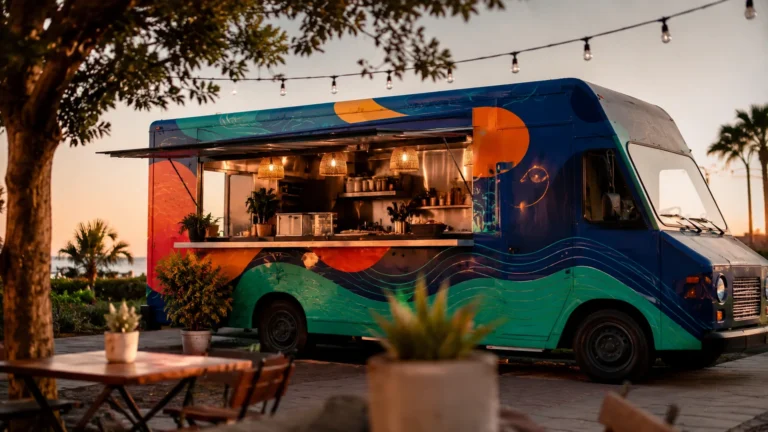
A vehicle wrap is a large-format print on adhesive vinyl film that is applied panel by panel over your truck’s exterior, then trimmed and heat-set into the seams and around the rivets so it reads as paint, not a sticker. A full wrap covers essentially every visible surface. A partial wrap puts your logo, name, and a graphic element over a painted or solid-vinyl base, leaving big fields of the base color showing. The choice is full coverage versus targeted branding, and it is the first fork in the budget.
Full is what most food trucks want, because the whole side of the truck becomes the billboard and you control every inch of the color story. Partial makes sense when your truck already wears a clean base color that fits your brand, or when you are launching lean and want a professional look without the full spend. In my experience the middle path burns people: they buy a partial to save money, then wish they had gone full within a season once they see how much real estate they left blank. If you are still shaping the whole look of the rig, my walkthrough of food truck design covers how the wrap should follow the concept, not the other way around.
What a food truck wrap really costs
Wrap pricing works two ways, and you should understand both so a shop cannot fog you. The per-square-foot way: installed, figure roughly $9-$10 per square foot as a rule of thumb, with the real market landing anywhere from $5 to $12 per square foot and premium jobs pushing $15. The per-truck way: a 14-16 foot truck has about 250 to 320 square feet of wrappable surface once you account for both sides, the back, and the serving-side panels. Run those together and the math lines up.
Break the job into its parts and it stops feeling like a mystery. The printed cast vinyl itself is about $4-$9 per square foot in cut form. The clear laminate that goes over it adds another $400-$800 to the total. Labor and install run $2,000-$4,500 depending on how boxy or curvy your truck is and what the shop charges an hour. Stack those and a full 16-foot wrap sits comfortably in that $3,500-$5,500 band, while a 22-foot rig climbs to $5,500-$8,500 because there is simply more surface and more hours. I have seen operators talk themselves into a $15,000 “custom” number that was mostly markup; the honest full-wrap range is public, and you should hold your shop to it.
If you are financing the truck and the branding as one package, read up before you sign anything. According to the U.S. Small Business Administration, marketing is a legitimate startup line you can plan and, in some cases, finance, and according to SBA, small businesses are advised to budget advertising as a percentage of projected revenue rather than an afterthought. That framing matters here, because a wrap is not a cost you eat once – it is a multi-year advertising asset. I lay out how the wrap fits the whole launch number in my breakdown of food truck cost. Here is roughly how a full wrap on a mid-size truck splits out.
| Wrap line item | Typical range | Notes |
|---|---|---|
| Printed cast vinyl film | $4-$9 per sq ft | 250-320 sq ft on a 16 ft truck |
| Laminate overlay | $400-$800 | The clear coat that buys the years |
| Design and print proof | $300-$1,000 | More if you need art from scratch |
| Labor and installation | $2,000-$4,500 | Boxy is cheaper than curvy |
| Full wrap, 14-16 ft truck | $3,500-$5,500 | All in, cast vinyl and laminate |
| Full wrap, 22 ft truck/trailer | $5,500-$8,500 | More surface, more hours |
| Partial wrap over a base | $1,500-$3,000 | Logo, name, accent graphics |
Cast vinyl, laminate, and the film that is a trap
This is where the cheap quotes hide their savings, so read closely. There are two families of wrap film. Cast vinyl is poured as a liquid onto a casting sheet, which makes it thin, flexible, and dimensionally stable; it conforms over rivets and compound curves and stays where you put it. Calendared vinyl is rolled and stretched during manufacturing, which makes it thicker, cheaper, and prone to shrinking back over curves and lifting at the edges. Cast runs about $4-$9 per square foot; calendared runs $1.50-$3. That gap is the whole story of the low quote.
Here is what most guides get wrong: they quote you a price without naming the film, and price without film is meaningless. A cast wrap with a laminate overlay lasts 5-7 years on a working truck, and up to about 8 with careful care. A calendared wrap shrinks, cracks, and fades in 18-30 months. So the “cheaper” film is not cheaper – it is roughly triple the cost per year of service because you are buying it two or three times over the same span. The trap I see most often is a new operator comparing two quotes as if they are the same product when one is cast and one is calendared, and nobody said so out loud. Ask the question directly and get the answer in writing.
The two names worth knowing are 3M and Avery Dennison, the film makers most reputable shops print on. When you are deciding between them, here is what actually separates the options:
- 3M IJ180 with a matching laminate is the hot-climate go-to; its UV resistance and conformability hold up in places like Texas where a truck bakes all summer
- Avery Dennison MPI 1105 and the SW900 line are usually a little cheaper at the material level and perform well for most builds
- Both are cast films, which is the part that matters more than the brand – a cast Avery beats a calendared anything
- The laminate is not optional; the clear overlay is what blocks UV, resists cleaning chemicals, and takes the scratches instead of your print
- Ask for the material warranty in writing, because cast films typically carry a 5-7 year rating that a calendared film cannot touch
Designing a wrap that sells from 20 feet away
A food truck wrap is not a business card you read up close; it is a sign that has to land on someone walking a festival midway or glancing from a car. The working rule is that your name and your hook need to read at 50 feet and be recognizable from a vehicle moving at 45 miles per hour. That single constraint kills most of the busy designs people fall in love with on a screen. Big letterforms, simple fonts without hair-thin strokes, and two or three primary colors with hard contrast are what carry across a parking lot. Black on yellow, white on black, dark on cream – those combinations win because the eye separates them instantly.
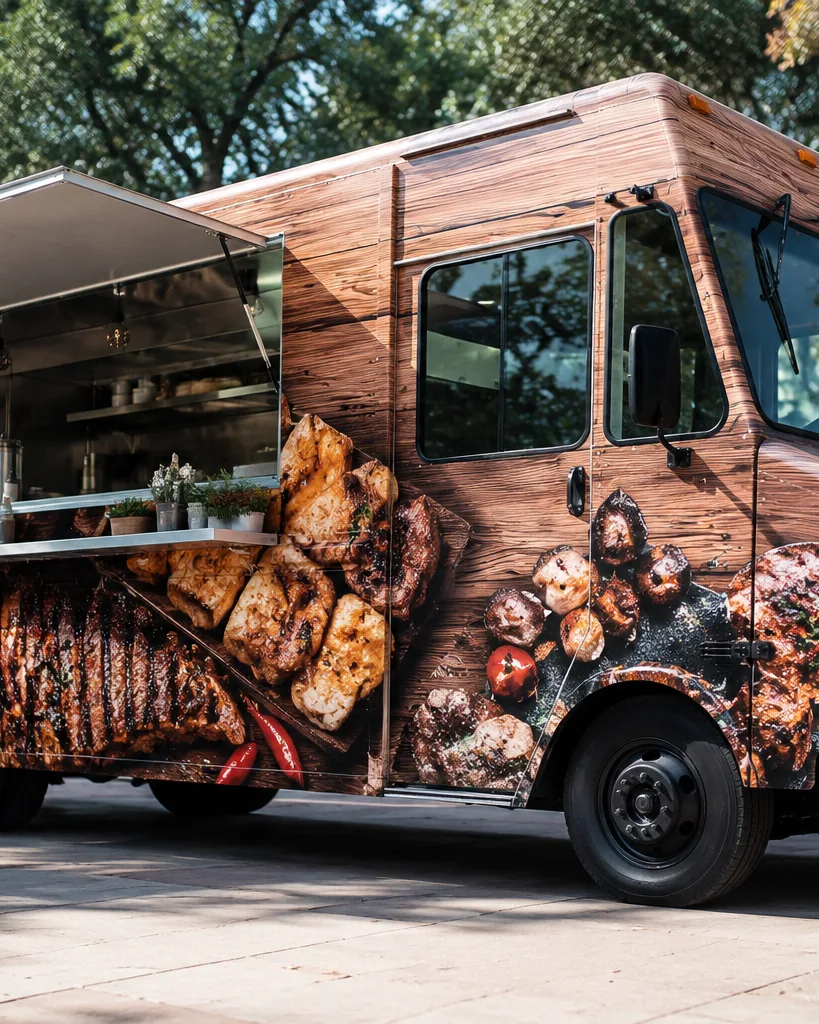
Having spent enough seasons watching which trucks pull a line and which ones get walked past, I can tell you the wraps that work say one thing loudly and everything else quietly. Your business name is the biggest element. The single thing you sell – tacos, birria, lobster rolls, whatever your hook is – comes second, usually as a bold hero photo of the food itself, because people buy with their eyes before they read a word. One contact channel, a single social handle or a short website, is plenty; five ways to reach you just clutters the panel and none of them stick. If you are still landing on the concept and the name that goes on the truck, my notes on food truck names feed straight into this, because the name is the loudest thing on the wrap.
Keep the service-window side calmest of all. That panel competes with your menu board, your prices, and the customer standing right there, so a wall of graphics behind the window just fights your own signage. I built my first wrap the wrong way, cramming art edge to edge, and learned that the window side needs breathing room more than it needs another logo.
Install time and DIY versus a pro shop
Plan for the truck to be off the road for a stretch. A full professional wrap takes about 2-4 days start to finish, including surface prep, the actual application, trimming, and the cure time the film needs before the truck goes back to work; on a big or oddly shaped rig it can run to five days. The prep is not optional filler – a wrap only bonds to a truck that has been washed, degreased, and clayed until it squeaks, and skipping that is the number one reason edges fail early.
Can you do it yourself? Honestly, only the easy parts. A logo, a set of decals, or one flat panel on a small trailer is within reach for a careful DIYer with a heat gun and patience. A full wrap on a boxy truck, with door jambs, rivets, compound curves, and long panels that have to be stretched and post-heated so they do not shrink back, is a professional job, and a botched self-install lifts within months and throws away the film cost. From my 8 years around these trucks, the money you save doing it yourself gets eaten the first time a corner peels on the highway. Here is the sequence a good shop actually follows, so you know what you are paying for:
- Step 1 – Wash, degrease, and clay the entire exterior, then wipe every panel with a solvent so nothing is left for the adhesive to fail against.
- Step 2 – Dry-fit and align each printed panel to the truck, checking that logos and seams land where the design intended before anything sticks.
- Step 3 – Apply each panel with a squeegee, working out air and matching the film to the body, then heat and stretch it into curves and around rivets.
- Step 4 – Trim the edges clean, tuck the film into seams and door jambs, and post-heat the stretched areas so they lock in and will not shrink back.
- Step 5 – Let the wrap cure and outgas before hard washing or heavy sun exposure, then inspect every edge and re-seal anything that looks lifted.
The mobile-billboard math that makes it pay
Here is why the wrap is the best advertising dollar a food truck spends. A wrapped vehicle in traffic generates a lot of impressions – research cited by the Outdoor Advertising Association of America puts a single wrapped vehicle in the range of 30,000 to 70,000 impressions a day in normal driving, and urban routes push higher. Your truck is not just driving; it is parked at a lunch rush, a brewery lot, a farmers market, a festival, sitting in front of a crowd for hours. That parked time is prime billboard time that a real billboard charges a fortune for.
Now put a price on it. Vehicle wraps run about $0.35-$0.77 per thousand impressions over the life of the wrap, versus roughly $3.56 for a billboard and near $19.70 for print. That is the comparison that should settle the decision: a $4,500 wrap that lives 5-7 years and works every day you drive or park is one of the cheapest cost-per-thousand buys in advertising, and unlike a monthly billboard it stops charging you after you pay for it. In my experience the wrap pays for itself in walk-up traffic and social tags long before the vinyl wears out. The pattern I see is that operators who treat the wrap as an advertising investment, not a vanity cost, quote the whole thing calmly and spend where it matters; the ones who treat it as an expense to minimize end up re-wrapping and paying twice.
Legibility, contact, and the marking rules inspectors check
Pretty is not the only bar a wrap has to clear. If your truck ever runs interstate commerce or crosses a weight threshold, the Federal Motor Carrier Safety Administration requires your legal business name and USDOT number displayed on both sides of the power unit, in lettering at least 2 inches tall, in a color that contrasts with its background, and legible from 50 feet in daylight. A gorgeous wrap that buries or omits that marking is a citation waiting to happen, so the designer has to leave a clean, legible spot for it rather than treat it as an afterthought.
Your local health department has its own expectation that the business name and a contact are legible on the unit, and inspectors will look. The practical move is to design the required text into the layout from the start – a clean band on the lower door panel, high contrast, standard font – so it satisfies the rule and does not fight your branding. I have seen a beautiful wrap get flagged simply because the USDOT number was set in a stylized script nobody could read at distance. Confirm your specific obligations before you print, because rules vary by how and where you operate, and a wrap is expensive to redo for a two-inch line of text.
Keeping the wrap alive for its full life
A wrap earns its 5-7 year life only if you treat it right, and the care is simple. Hand wash it weekly with a pH-neutral soap and a soft mitt, rinse from the top down, and dry it so hard water does not spot the laminate. Skip the automatic brush tunnels, which drag grit across the print and catch the edges, and never aim a high-pressure jet straight at a seam or a lifted corner, because that is how you peel a panel you paid good money for. Park in shade when you can; UV is what ages the film even with laminate on top.
From my years on the street, the wraps that make it to year seven belong to operators who fix small things fast – a lifted corner re-sealed the week it appears, a scuff cleaned before it sets, a bird-dropping wiped before it etches. After 8 years I still walk my truck every few days and run a hand along the edges near the window, because that is where heat and traffic work the vinyl hardest. When it is finally time to replace, a cast wrap that was laminated and cared for comes off clean and leaves the body ready for the next one, which is one more reason the good film pays. If you are shopping a rig to wrap in the first place, my guide to used food trucks for sale covers what body condition makes a wrap go on clean versus fighting rust and old adhesive.
Frequently asked questions
How much does it cost to wrap a food truck?
A full wrap on a 14-16 foot truck runs about $3,500-$5,500, a 22-foot truck or trailer runs $5,500-$8,500, and a partial wrap over a painted base runs $1,500-$3,000. Per square foot, figure roughly $9-$10 installed, with the market spanning $5-$12. The film, the laminate, the design, and the labor are the four parts of that number.
Should I get a full wrap or a partial wrap?
Go full if you want to control every panel and turn the whole truck into a billboard, which is what most food trucks need. Go partial if your truck already wears a clean base color that fits your brand or you are launching lean. The trap is buying partial to save money and wishing you had gone full within a season once you see the blank space.
How long does a food truck wrap last?
A properly installed cast vinyl wrap with a laminate overlay lasts 5-7 years on a working truck, and up to about 8 with careful washing and shade. Cheap calendared vinyl shrinks, cracks, and fades in 18-30 months, so it costs more per year of service even though the sticker price is lower. Always ask which film you are buying.
Can I wrap my food truck myself?
You can handle decals, a logo, or one flat panel on a small trailer with a heat gun and patience. A full wrap on a boxy truck has door jambs, rivets, and compound curves that need professional heat and stretch control, and a botched self-install lifts within months and wastes the film cost. Save DIY for the simple pieces and let a shop do the full job.
Is a food truck wrap worth it as advertising?
Yes, by the numbers it is one of the cheapest ad buys you can make. A wrapped vehicle generates roughly 30,000-70,000 impressions a day, and wraps run about $0.35-$0.77 per thousand impressions versus $3.56 for a billboard and near $19.70 for print. It is a one-time cost spread over 5-7 years, and your truck advertises hardest exactly when it is parked in front of a crowd.
What is the difference between cast and calendared vinyl?
Cast vinyl is poured as a liquid, so it is thin, flexible, and stays put over curves and rivets; it is the only film that belongs on a food truck. Calendared vinyl is rolled and stretched, which makes it cheaper but prone to shrinking, lifting, and fading. Cast runs $4-$9 per square foot and lasts 5-7 years; calendared runs $1.50-$3 and fades in 18-30 months.
The bottom line
A food truck wrap is an advertising asset, not decoration, and the only number that really matters is the cost per year of a wrap that stays stuck and stays bright. Buy cast vinyl with a laminate overlay, hold your shop to the honest $3,500-$5,500 range for a mid-size full wrap, and design it to read at 50 feet with two or three high-contrast colors and one loud hook. Leave a clean, legible spot for your required markings, hand wash it weekly, and fix small lifts fast. Do that and the wrap will pull traffic for 5-7 years at one of the lowest cost-per-thousand rates in advertising – and it will keep selling for you every hour the truck sits parked in front of a hungry crowd.