
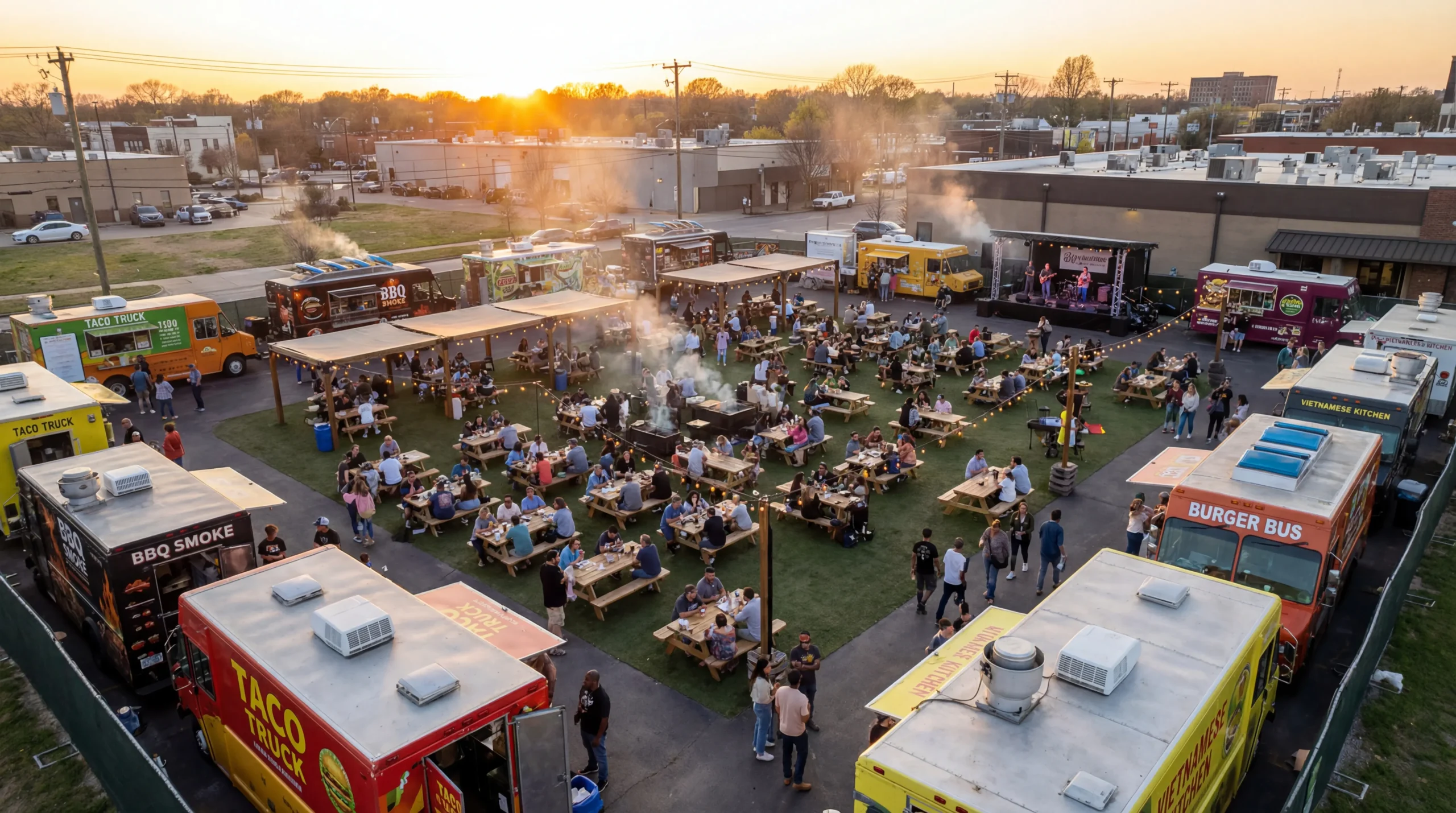

Looking for a place where you can sample six different cuisines without moving your car? That’s exactly what a food truck park delivers—and they’re popping up in cities nationwide for a reason.
Quick answer: A food truck park is a permanent outdoor venue where multiple food trucks gather daily or weekly to serve customers in a centralized location with shared seating and amenities. These parks typically host 8-20 trucks, offer covered seating for 50-300 people, and provide parking, restrooms, and live entertainment. They operate year-round (weather permitting) with consistent schedules, unlike food truck rallies which are temporary events.
📚 This guide is part of: Food Truck Locations
I’ve worked 30+ food truck parks across six major cities over the past eight years. Some were well-designed permanent setups with covered seating and stage lighting. Others were glorified parking lots with a porta-potty. Here’s what separates the good from the bad—and how to find them wherever you are.
What Is a Food Truck Park (And Why They Exist)
A food truck park is a permanent venue where mobile food vendors set up shop on a regular schedule.
Think of it like a food court, except the restaurants are on wheels and you’re sitting outdoors. The concept took off around 2010-2012 when cities realized food trucks needed central gathering spots. Instead of trucks competing for random street corners, parks gave them stable locations with built-in foot traffic.
Customers benefited from variety. Truck owners got predictable business without the constant hustle for permits and parking.
Most parks operate on a vendor fee model. Trucks typically pay $50-200 per day (or $500-1,500 per month in my experience) for a designated spot. In return, they get access to power hookups, water, waste disposal, and a steady stream of hungry customers who know exactly where to find them.
I’ve seen parks host yoga classes, farmers markets, and movie nights on slower days. They become community hubs, not just food venues.
Food Truck Park vs Rally vs Pod: What’s the Difference?
People confuse these three types constantly. Here’s the breakdown:
| Type | Duration | Trucks | Frequency | Seating | Location |
|---|---|---|---|---|---|
| Food Truck Park | Permanent venue | 8-20 | Daily/Weekly | 50-300 seats | Converted lot or field |
| Food Truck Rally | 1-3 days | 20-50+ | Monthly/Seasonal | Limited/BYO | Event grounds, parks |
| Food Truck Pod | Semi-permanent | 3-7 | Daily | 10-30 seats | Corner lots, breweries |
Food truck parks are the closest thing to a permanent home base. They operate year-round (weather permitting) with set hours. For example, established parks in Austin and Portland run daily operations from 11 AM to 9 PM, though specific hours vary by venue.
Rallies are temporary events—think festivals. They draw massive crowds (5,000-15,000 people in my experience) but only happen a few times per year. Great for exposure, exhausting to work. I’ve done the Fort Collins rally multiple seasons running. It’s a 12-hour grind serving 800-1,000 customers in a day. (Food truck festivals have their own playbook entirely.)
Pods are small-scale operations. Usually 3-5 trucks sharing a parking lot or brewery patio. Less infrastructure than parks, but more flexibility. Common in Portland where zoning allows trucks to set up shop semi-permanently on private property.
Bottom line: Parks are stable, rallies are events, pods are small and scrappy.
What Makes a Good Food Truck Park
Not all parks are created equal. Here’s what separates the good ones from the terrible ones.

Power and Utilities
Look—reliable 30-50 amp electrical hookups are non-negotiable.
I’ve worked parks where the power cut out mid-rush because 12 trucks were pulling from the same circuit. Your fryer shuts down, your customers walk away. Good parks have dedicated service for each spot.
Water access and gray water disposal matter too. Parks without proper hookups force trucks to haul water in tanks and dump elsewhere—which adds hours to your day.
Location and Foot Traffic
Parks near office buildings, shopping centers, or residential neighborhoods do better than isolated lots. I worked a popular downtown park in Portland surrounded by bars and apartments. We never had a slow night.
Vendor Fees That Make Sense
Daily fees typically range from $50 (small parks) to $200 (premium spots in high-traffic areas) based on what I’ve seen operating in multiple markets. Monthly contracts run $500-1,500 depending on the city. Anything above $200/day better come with serious foot traffic to justify the cost.
💡 Pro Tip from Darnell: Before committing to a monthly contract, work the park on a daily rate for 2-3 weeks first. Track your sales per hour. If you’re not clearing at least 3x the daily fee in profit, the location isn’t worth it.
Weather Protection
Covered seating keeps customers around even when weather turns. I’ve worked parks in Austin where summer heat hits 105°F. Without shade structures, people order to-go instead of sitting. That cuts average ticket size significantly based on what I observed.
Trust me on this one—covered seating makes the difference between a 10-minute customer and a 45-minute customer who orders a second round.
How Do Food Truck Parks Make Money?
Here’s the business model breakdown from working both sides:
| Revenue Stream | Details |
|---|---|
| Vendor Fees | Daily ($50-200) or Monthly ($500-1,500) spot rentals |
| Beverage Sales | Some parks run their own bar or sell drinks (10-25% markup) |
| Event Rentals | Private events, corporate catering at premium rates |
| Sponsorships | Local business advertising, stage naming rights |
The majority of park revenue comes from vendor fees. Parks with liquor licenses add significant income from beverage sales. I’ve worked parks where the bar alone covered utilities and overhead.
Notable Food Truck Parks Worth Visiting Across the USA
Here are six parks I’ve either worked personally or visited enough to vouch for. These represent what a well-run park looks like.

1. Picnic — Austin, Texas
A popular Austin food truck park with covered seating for 200, live music Thursday-Sunday. Located on Burnet Road in North Austin. This place gets packed Friday nights. Expect 30-45 minute waits for popular trucks. Worth it.
2. The Bite — Portland, Oregon
12 trucks rotating weekly, dog-friendly patio, craft beer on tap. Southeast Portland location makes it a local favorite. Open daily 11 AM – 9 PM.
3. Smorgasburg LA — Los Angeles, California
Technically a weekly market, but functions like a park. 90+ vendors including 20+ food trucks every Sunday. ROW DTLA location draws 5,000-8,000 people. Arrive before 11 AM or forget about parking.
4. Trucks Off Track — The Colony, Texas
30 trucks, two bars, covered seating for 400, live music every night. This is what happens when someone builds a park with an actual budget. Formerly located in Lower Greenville, now in The Colony.
5. Thicket Food Park — Austin, Texas
10 trucks, family-friendly vibe, open Wednesday-Sunday. Located in Woodstock (northern suburbs). Smaller than downtown Austin parks but solid local following.
6. Matt’s BBQ — Portland, Oregon
Technically a brick-and-mortar with a truck court attached. 8 trucks rotate through weekly. Covered seating, heaters for winter. Northeast Portland location near commercial district.
For more comprehensive lists, check out food truck catering companies that know local park networks.
How to Find Food Truck Parks in Your City
Specifically, here are five methods that actually work:

Method 1: Google Maps Search
Search “food truck park near me” or “food truck pod [your city]”. Look for clusters of trucks with reviews mentioning regular schedules. The map view shows multiple trucks at one address—that’s usually a park.
Method 2: Social Media Following
Food trucks announce their locations daily on Instagram and Facebook. Follow 5-10 trucks in your city. If multiple trucks post from the same spot regularly, that’s likely a park.
Method 3: Food Truck Association Websites
Most cities with active food truck scenes have associations. Nashville, Portland, Austin, LA, and Chicago all maintain directories. These list permanent parks and regular vending locations.
Method 4: Ask Commissary Kitchens
Commissaries know where trucks are parking because that’s where operators talk shop. Stop by a local commissary and ask which parks have the best foot traffic.
If you’re looking to book a food truck for your event, many park operators also run private catering coordination.
Method 5: Check City Food Truck Permits
Many cities publish lists of permitted food vending locations. Search “[your city] mobile food vendor permits” or “[your city] food truck map”. Not all cities maintain these, but larger food-truck-friendly cities do.
💡 Pro Tip from Darnell: Don’t just Google and go. Join local food truck Facebook groups. Operators will warn you about parks with bad management, terrible foot traffic, or sketchy fee structures. That insider knowledge saved me from committing to a park with consistently poor sales—I would have lost money for six months.
First-Timer’s Guide: What to Expect at a Food Truck Park
If you’ve never been to a food truck park, here’s how it works:
Arrival and Parking
Most parks have dedicated parking lots. Free parking is standard in my experience, though some downtown parks charge $5-10. Arrive early on weekends (before 6 PM on Friday/Saturday) or expect to circle for a spot.
Browse Before You Commit
Walk the entire park before ordering. I’ve watched first-timers commit to the first truck they see, then discover their favorite cuisine three trucks down. Menus are usually posted outside each truck.
Ordering and Payment
Order directly from each truck. Most established trucks accept credit cards these days. Expect to pay $10-18 per person for an entree. Wait times vary—weeknight orders take 5-10 minutes, weekend rushes can hit 20-30 minutes for popular trucks.
Seating and Atmosphere
Parks provide communal seating—usually picnic tables under shade structures. BYOB policies vary. Some parks have full bars, others allow outside alcohol, many prohibit it entirely. Check before you bring beer.
Timing Your Visit
Lunch rush (11:30 AM – 1:30 PM) and dinner rush (6 PM – 8 PM) are packed. Service is slower, seating is limited. I personally hit parks Tuesday or Wednesday around 6 PM. Same food, half the wait, actual conversations with truck owners.

💡 Pro Tip from Darnell: Hit the park at off-peak hours first to scope the scene. Weeknight visits let you chat with operators, learn which trucks are worth the weekend wait, and grab business cards for catering opportunities later.
What Amenities Do Food Truck Parks Typically Offer?
Here’s what you’ll find at most established parks based on venues I’ve worked:
| Amenity | Standard at Most Parks? | Notes |
|---|---|---|
| Seating | ✅ Yes | 50-300+ seats, mix of tables and benches |
| Shade/Cover | ⚠️ Varies | Better parks have permanent structures |
| Restrooms | ✅ Yes | Usually portable, some have permanent facilities |
| Parking | ✅ Yes | Free to $10, paved or gravel lots |
| Live Music | ⚠️ Varies | Weekends at larger parks |
| Alcohol Sales | ⚠️ Varies | Full bar, BYOB, or prohibited |
| Pet-Friendly | ✅ Usually | Most allow leashed dogs |
| WiFi | ❌ Rare | Don’t count on it |
The biggest differentiator? Weather protection. Parks with permanent covered seating, sidewalks, and drainage operate year-round. Parks without cover shut down during rain or extreme heat.
Common Mistakes to Avoid at Food Truck Parks
I’ve watched thousands of people visit food truck parks over the years. Here are the five mistakes that drive me crazy:
Mistake 1: Committing to One Truck Immediately
First-timer move. You see a truck, you’re hungry, you order. Skip this and you’ll waste 20 minutes waiting for food you don’t really want. Walk the park first. Always.
Mistake 2: Going During Peak Hours Without a Plan
Friday night at 7 PM? Expect 30-45 minute waits at popular trucks. Saturday lunch? Same. Either arrive early (before 5:30 PM) or come at off-peak times.
Mistake 3: Not Bringing Cash (Sometimes)
Nearly all trucks I’ve worked with at established parks accept credit cards, but smaller operations or new trucks occasionally have card reader issues. Carry $20 cash as backup.
Mistake 4: Ignoring Weather
Parks without cover are miserable in rain or extreme heat. Check the forecast. If it’s 95°F and the park has no shade, go somewhere else.
Mistake 5: Not Checking Operating Hours
Parks post schedules, but individual trucks rotate. That truck you drove 30 minutes to try? It might not be there. Follow trucks on social media to confirm locations before you go.
I learned the hard way about mistake #2. Committed to a park location during a major festival weekend without checking the event calendar. Took me 90 minutes to get food and leave. Never again.
FAQ: Food Truck Park Questions Answered
Q: Do food truck parks charge admission?
No. Admission is free at most parks in my experience. You pay individual trucks directly for food. Some special event parks may charge entry, but standard operations are free.
Q: Are food truck parks open year-round?
Most parks operate year-round in warm climates (Austin, LA, Miami). Cold-weather cities (Chicago, Portland) often scale back operations November-March or close entirely during winter. Individual truck schedules vary—some take breaks during slow seasons.
Q: Can I bring my own alcohol to a food truck park?
Depends on the park. Some have BYOB policies, others run full bars and prohibit outside alcohol, many don’t allow any alcohol on premises. Check the park’s website or posted rules before bringing drinks.
Q: Are food truck parks family-friendly?
Yes. Most parks welcome families and kids. Look for parks with lawn areas, games, or playgrounds. Weekend afternoons (2-5 PM) tend to be the most family-oriented time slots.
Q: What if it rains?
Parks with covered seating stay open. Parks without weather protection often close during heavy rain. Check social media for real-time updates. Trucks decide individually whether to operate in bad weather.
Q: Do trucks at food truck parks accept credit cards?
Nearly all trucks at established parks accept credit cards based on what I’ve seen working multiple markets. Smaller operations may be cash-only, but that’s increasingly rare. Carry $20 cash as backup.
Q: How do food truck parks make money?
Parks charge trucks daily or monthly vendor fees (typically $50-200/day or $500-1,500/month). Some parks also profit from beverage sales, event rentals, or business sponsorships.
Your Next Steps: Finding Great Food Truck Parks
Start with the five methods I outlined earlier: Google Maps, social media, food truck associations, commissary recommendations, and city permit lists.
Visit on a weeknight first. Browse before you commit. Learn the schedules. Get to know the truck owners.
The best park experiences come from becoming a regular. You’ll learn which trucks are worth the weekend wait, which days have live music, and when new trucks rotate in.
What works in my Chicago market may look different in your city—park density, fee structures, and operating models vary by region. Adapt these strategies to your local food truck scene.
For more strategies on finding profitable food truck locations, events, and festivals, check out the full Food Truck Locations guide. Or explore related topics like finding the best food truck spots in your area.
About the Author
Darnell Kowalski is a former equipment tech turned BBQ truck owner in Chicago. He’s fixed more deep fryers than he can count and believes every problem has a $20 solution if you know where to look. Darnell has worked 30+ food truck parks across 6 cities in 8 years and writes from hands-on experience in the industry.
