
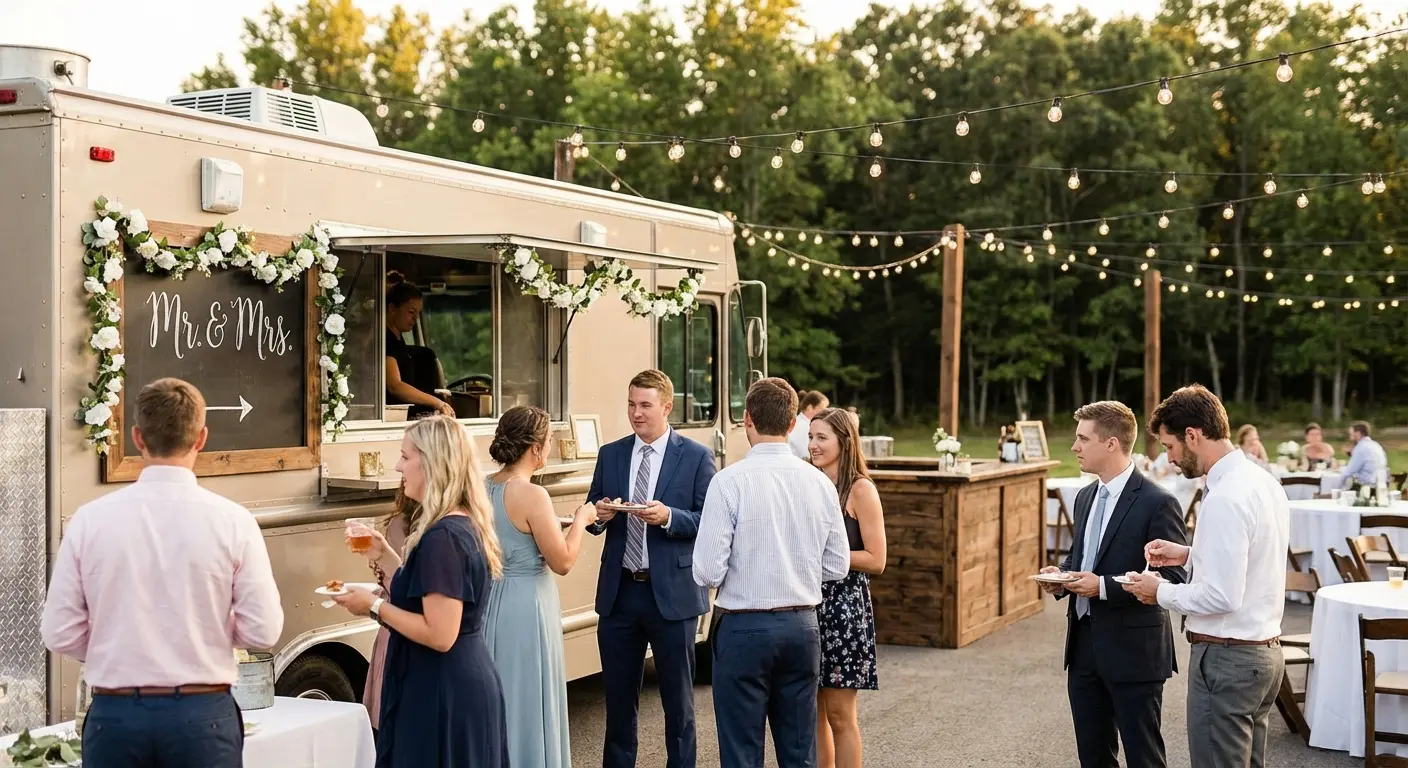

A food truck wedding saves most couples thousands on catering. Based on 2025–2026 national averages, traditional caterers charge $70–$100 per plate. A food truck runs $15–$35 per person. For 150 guests, that gap is $8,000–$10,000.
Bottom line:
- Plan 1 truck per 75–100 guests.
- Book 4–6 months early.
- Budget $2,250–$5,250 for food at 150 guests.
- Add $1,000–$3,000 for tables, chairs, and power.
What is a food truck wedding? A food truck wedding is a reception format where one or more mobile food vendors replace traditional sit-down catering. Guests order directly from the truck. Service is casual, flexible, and typically costs 50–70% less than plated meals. Food truck weddings work best at outdoor or semi-outdoor venues with level ground, power access, and space for truck parking.
📚 This guide is part of: Food Truck Locations and Events — your complete resource for finding, booking, and managing food truck events.
Know the Real Food Truck Wedding Cost
Food truck wedding costs split into two buckets. The food itself. And everything around it. Look — most couples only budget for the first one. That is a mistake.
Here is what to expect for 150 guests, based on 2025–2026 industry data:
Food and Service Costs
| Category | Food Truck | Traditional Caterer |
|---|---|---|
| Per-person food | $15–$35 | $70–$100 |
| Total food (150 guests) | $2,250–$5,250 | $10,500–$15,000 |
| Service staff | Often included | $500–$1,500 extra |
| Travel fee (25+ miles) | $100–$500 | Usually included |
Venue and Rental Add-Ons
| Category | Estimated Cost |
|---|---|
| Tables and chairs | $800–$1,500 |
| Linens and place settings | $400–$800 |
| Generator/power | $0–$300 |
| Weekend premium | 10–20% markup |
Total realistic budget: $3,500–$8,000 for a food truck wedding vs. $12,000–$20,000 for traditional catering.
Hidden costs catch people off guard. Insurance riders. Overtime fees if service runs long. Tasting sessions at $50–$150 per truck. Ask about every single fee before signing.
I have worked weddings where the couple got hit with a $300 overtime charge. Speeches pushed dinner back 45 minutes. Nobody planned for it.
Tipping: If the host covers everything, 15–20% gratuity is standard for food truck wedding service. Some trucks include it in the quote. Ask upfront.

📎 Related: Need detailed event pricing? See our guide on food truck catering for full cost breakdowns.
Pick the Right Food Truck for Your Wedding
Not every truck works for every food truck wedding. The food you choose affects service speed, guest satisfaction, and your timeline.
Specifically, speed matters more than variety. A truck serving 30 plates an hour creates a 90-minute line for 150 guests. A truck cranking out 70 per hour keeps lines under 30 minutes.
Service Speed by Cuisine
| Cuisine | Plates Per Hour | Best For |
|---|---|---|
| Tacos/burritos | 60–80 | Casual outdoor weddings |
| Pizza (wood-fired) | 50–70 | Rustic or backyard receptions |
| BBQ (pre-smoked, served) | 50–70 | Southern or ranch venues |
| Burgers/sliders | 40–60 | Classic American themes |
| Desserts/ice cream | 80–100 | Late-night add-on service |
Multiple trucks solve both speed and variety. Two trucks handling different menus can serve 150 guests in under 45 minutes. Three trucks — main course, sides, dessert — create a festival atmosphere guests remember.
Match the truck to the venue. Not the other way around. A wood-fired pizza truck at a barn wedding is perfect. That same truck at a rooftop venue with no ventilation is a fire hazard. Think logistics first. Menu second.
Moving on —
Set Up Your Venue for Food Truck Wedding Service
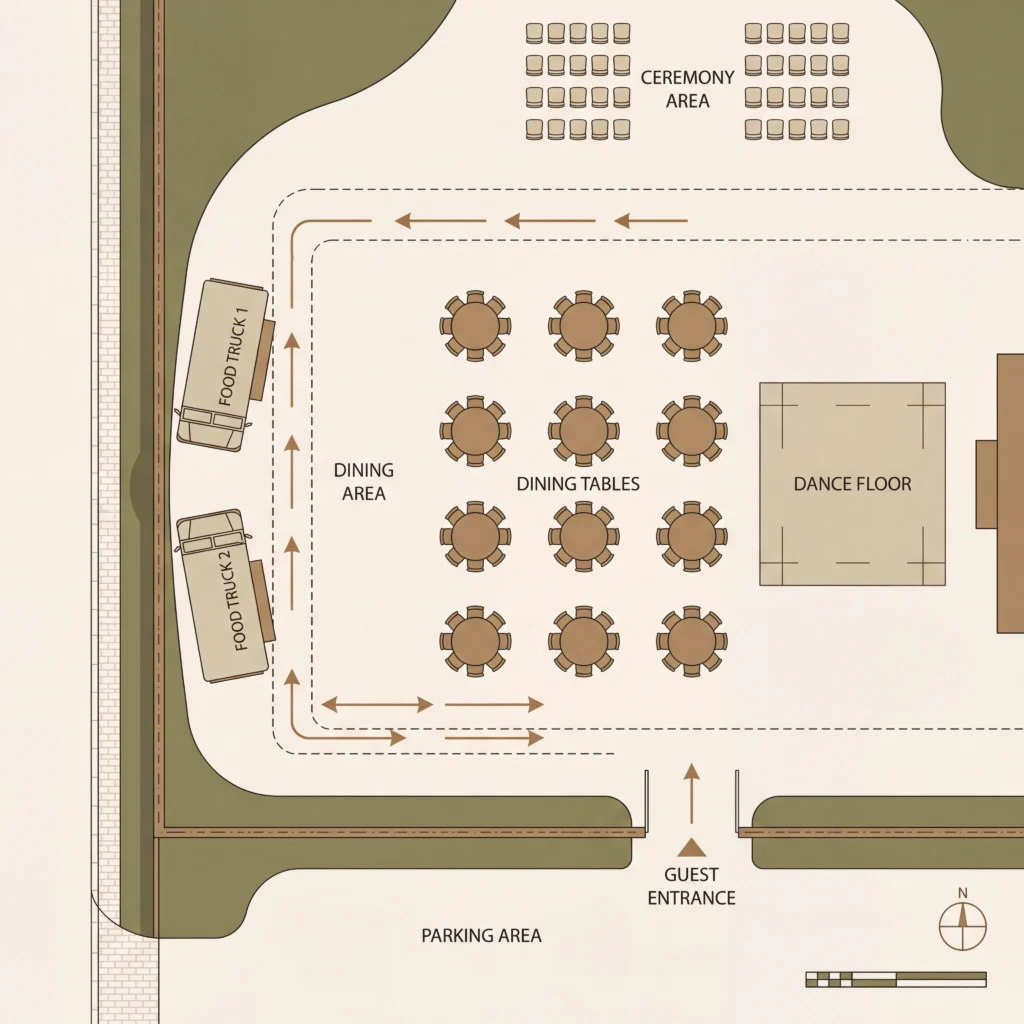
Here is where most people mess up. The venue is not ready for a 26-foot truck weighing 14,000 pounds. It needs level ground. Power access. Clearance on the serving side.
Venue Requirements Checklist
- Parking space: 12 feet wide × 30 feet long per truck. Add 8 feet of clearance on the serving side
- Ground surface: Asphalt or concrete preferred. Compacted gravel works. Soft grass after rain will sink a loaded truck. I have seen it happen twice
- Grade: Must be level. A truck on a slope means hot oil shifts in the fryer. Dangerous
- Power access: Most trucks bring generators at 20–30 amp output. Some venues ban generators due to noise. Check first
- Generator noise: Expect 65–80 decibels. Position trucks 50–100 feet from ceremony and dining areas
- Water access: Trucks need hookups for service over 3 hours. Confirm with your vendor
- Waste disposal: Trucks produce grease waste and gray water. Confirm your venue allows this
Permits and Insurance for Food Truck Wedding Events
Now for the important part. Most wedding venues require food truck vendors to carry specific insurance. Expect general liability at $1 million minimum, auto liability, and a certificate of insurance naming the venue as additional insured.
Some municipalities require separate event permits when food trucks serve at private venues. Skip this and your vendor risks a shutdown mid-reception. Confirm permit requirements with your local health department before the event date.
Get written food truck permission in your venue contract. Some venues charge $200–$500 as a vendor fee. Others ban food trucks entirely. Do not assume.
📎 Related: For more on finding truck-friendly locations, check our guide to food truck spots.
Book Your Food Truck Wedding Step by Step
Booking a food truck wedding is different from booking a corporate lunch. Weddings require tastings, venue coordination, and locked-in timing. Start early.
12-Month Booking Timeline
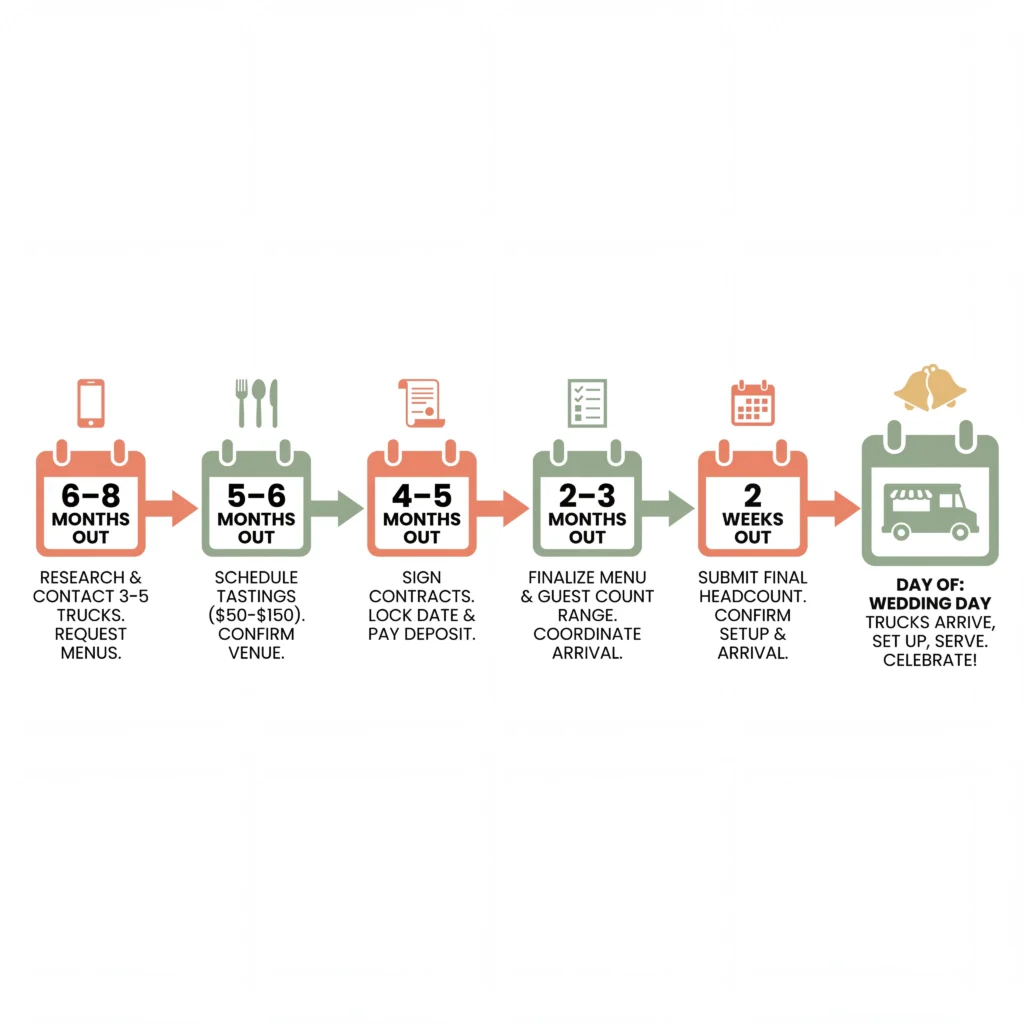
- 6–8 months out: Research trucks. Contact 3–5 vendors. Request wedding-specific menus and pricing
- 5–6 months out: Schedule tastings at $50–$150 per truck. Confirm venue allows food trucks
- 4–5 months out: Sign contracts. Lock in the date. Pay deposit — typically 25–50%
- 2–3 months out: Finalize menu. Confirm guest count range. Coordinate arrival with venue and planner
- 2 weeks out: Submit final headcount. Confirm parking location, power setup, and arrival time — usually 2–3 hours before service
- Day of: Trucks arrive. Set up. Serve. Done
Popular wedding food trucks book fast during peak season — May through October. Trust me on this one. I have turned down July weddings because I was booked solid 5 months ahead.
Next step: finding vendors. Use food truck booking platforms or your local food truck association. Browse our Food Truck Locations and Events hub for vendor ideas. Spot trucks at food truck festivals and approach them directly. That is how most food truck wedding bookings happen.
The fix is simple for couples who start late: expand your search radius. Trucks within 50 miles of your venue may have open dates when local trucks are full.
📎 Related: For the full booking process, see our guide on how to book a food truck.
Manage Guest Flow at Your Food Truck Wedding
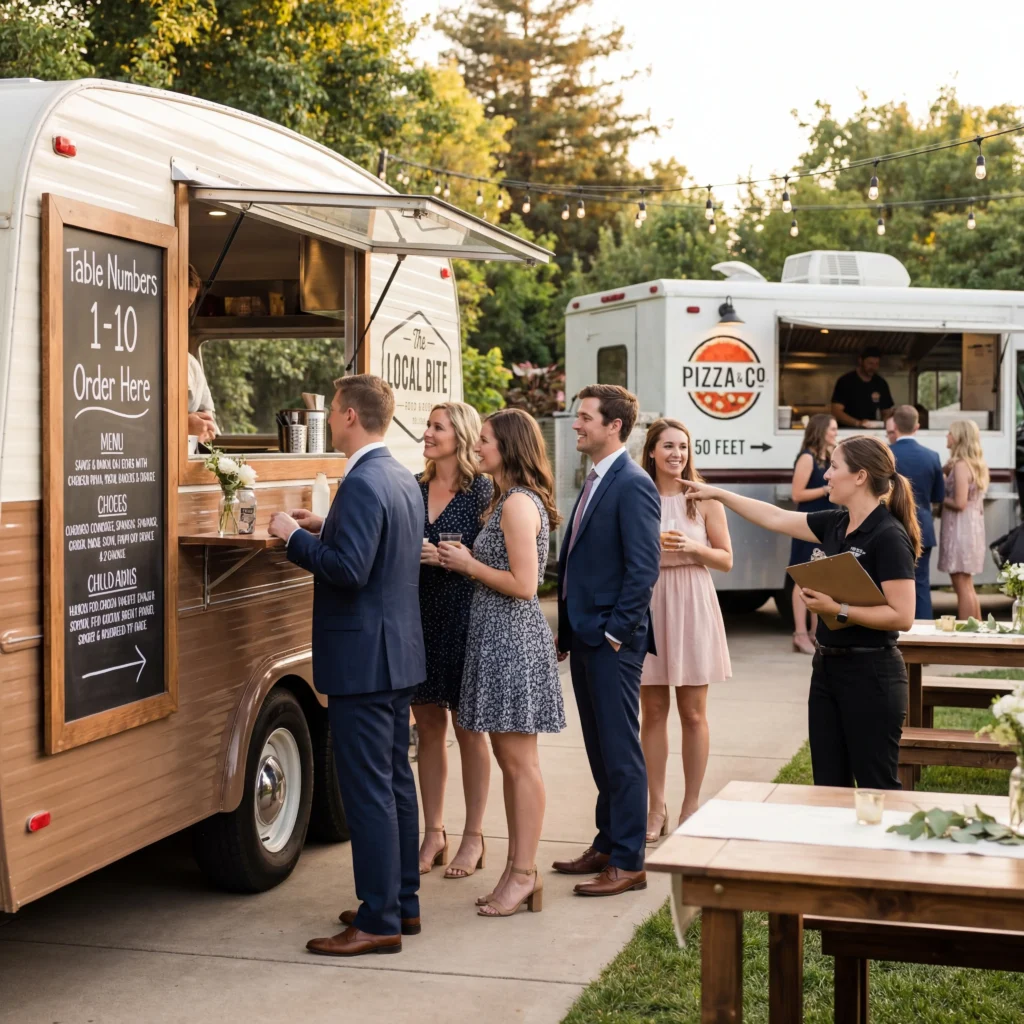
The number one complaint at a food truck wedding is the line. Nobody wants to stand 45 minutes in heels or a suit. Solve this before it happens.
Guest flow formula: 1 food truck per 75–100 guests for a 2-hour service window. Two trucks for 150. Three for 200+.
Strategies That Work
- Stagger service by table. Announce groups of 20–30 at 5-minute intervals. Keeps lines at 10–15 people max
- Use pre-ordering. Some trucks offer QR code ordering. Guests select meals in advance. Service time drops 30–40%
- Space trucks apart. Place them 30–50 feet apart so separate lines form. Side-by-side trucks cause confusion
- Serve appetizers first. A separate station keeps guests occupied during initial service. Platters work. No extra truck needed
- Stagger dessert timing. Main course at 6:00 PM. Dessert truck opens at 8:00 PM. Splits the traffic
I have worked food truck weddings where the couple skipped staggering. One truck had a 50-person line. The other had 10. Guests did not know both trucks served different food. Signage and a coordinator who directs traffic fix this completely.
Stop Making These Food Truck Wedding Mistakes
I have seen every one of these go wrong at real events. Do not learn the hard way.
❌ Don’t: Skip weather backup / ✅ Do: Rent a tent on booking day
Outdoor food truck weddings need a rain plan. Guests will not stand in line getting soaked. Rent a tent over the serving area — 10×20 minimum per truck, $200–$400. Get your tent quote the same day you book. Tent companies book out too.
❌ Don’t: Ignore dietary needs / ✅ Do: Confirm restrictions with every truck
At least 15–30% of your guests will have dietary restrictions — vegetarian, gluten-free, nut allergies, or strong preferences. Confirm each truck can handle these. If they cannot, add a second truck that covers the gap.
❌ Don’t: Assume power is handled / ✅ Do: Verify electrical with an electrician
If your venue bans generators, you need 30-amp access within 100 feet of each truck. Extension cords over 100 feet lose voltage and trip breakers. Verify with a licensed electrician. Not just the venue coordinator.
❌ Don’t: Leave timing vague / ✅ Do: Lock every detail in the contract
Arrival time. Service start. End time. Overtime rates. Write it all down. A truck that shows up 30 minutes late throws your entire food truck wedding reception off schedule.
❌ Don’t: Skip the tasting / ✅ Do: Budget $50–$150 per truck
What tastes great from a lunch truck at noon may not work for a formal 7 PM dinner. Tastings cost $50–$150 but save you from a menu disaster with 150 witnesses.
❌ Don’t: Forget alcohol logistics / ✅ Do: Plan a separate bar setup
Food trucks do not serve alcohol. You need a separate bar — either a mobile bar truck at $1,500–$3,000 or your own setup with proper licensing.
❌ Don’t: Ignore grease and exhaust / ✅ Do: Position trucks with wind in mind
Generator exhaust blowing toward guest seating ruins the atmosphere. Grease trap overflow during extended 4+ hour service creates a slip hazard on paved surfaces. Position trucks downwind. Check grease trap capacity before long events. I have cleaned up that mess mid-service. You do not want to.

Start Planning Your Food Truck Wedding Now
Quick Recap:
- Budget $3,500–$8,000 total for a food truck wedding — saving $5,000–$12,000 vs. traditional catering
- Book 5–6 months ahead. Popular trucks sell out during peak season
- Plan 1 truck per 75–100 guests. Stagger service to prevent lines
- Verify venue requirements: flat surface, 12×30 foot parking, power, noise clearance
- Confirm permits, insurance certificates, and vendor fees before signing
⚠️ Regional Note: Pricing, permit requirements, and vendor availability vary by region. What I have seen in the Midwest may differ in your market. Always verify with local vendors, venues, and health departments.
Your Next Steps:
- Food Truck Catering — full event catering cost breakdowns
- Book a Food Truck — step-by-step booking for any event
- Food Truck Festival Guide — find trucks to hire at local festivals
- Food Truck Parks — discover permanent food truck venues
Back to the hub: Food Truck Locations and Events — the complete guide to food truck event strategy.
Frequently Asked Questions About Food Truck Weddings
How much does a food truck wedding cost?
A food truck wedding costs $3,500–$8,000 total for 150 guests, based on 2025–2026 national averages. That includes $2,250–$5,250 for food service and $1,000–$3,000 for tables, chairs, power, and venue fees. Traditional catering for the same guest count runs $12,000–$20,000.
How many food trucks do you need for a wedding?
Plan 1 food truck per 75–100 guests for a 2-hour service window. A 150-guest food truck wedding needs 2 trucks. Events over 200 guests need 3 or more. Adding a dessert truck on separate timing helps split traffic and reduce wait times.
How far in advance should you book a food truck for a wedding?
Book your food truck wedding vendor 4–6 months in advance. Popular trucks in peak season — May through October — book 5+ months ahead. Start researching 6–8 months before your date. Schedule tastings 5–6 months out.
Can you have a food truck wedding at any venue?
Not every venue allows a food truck wedding. You need level ground, a 12×30 foot parking area per truck, power access, and clearance for generator noise. Some indoor venues ban food trucks entirely. Get written confirmation of food truck permissions in your venue contract before booking vendors.
— Darnell Kowalski
