
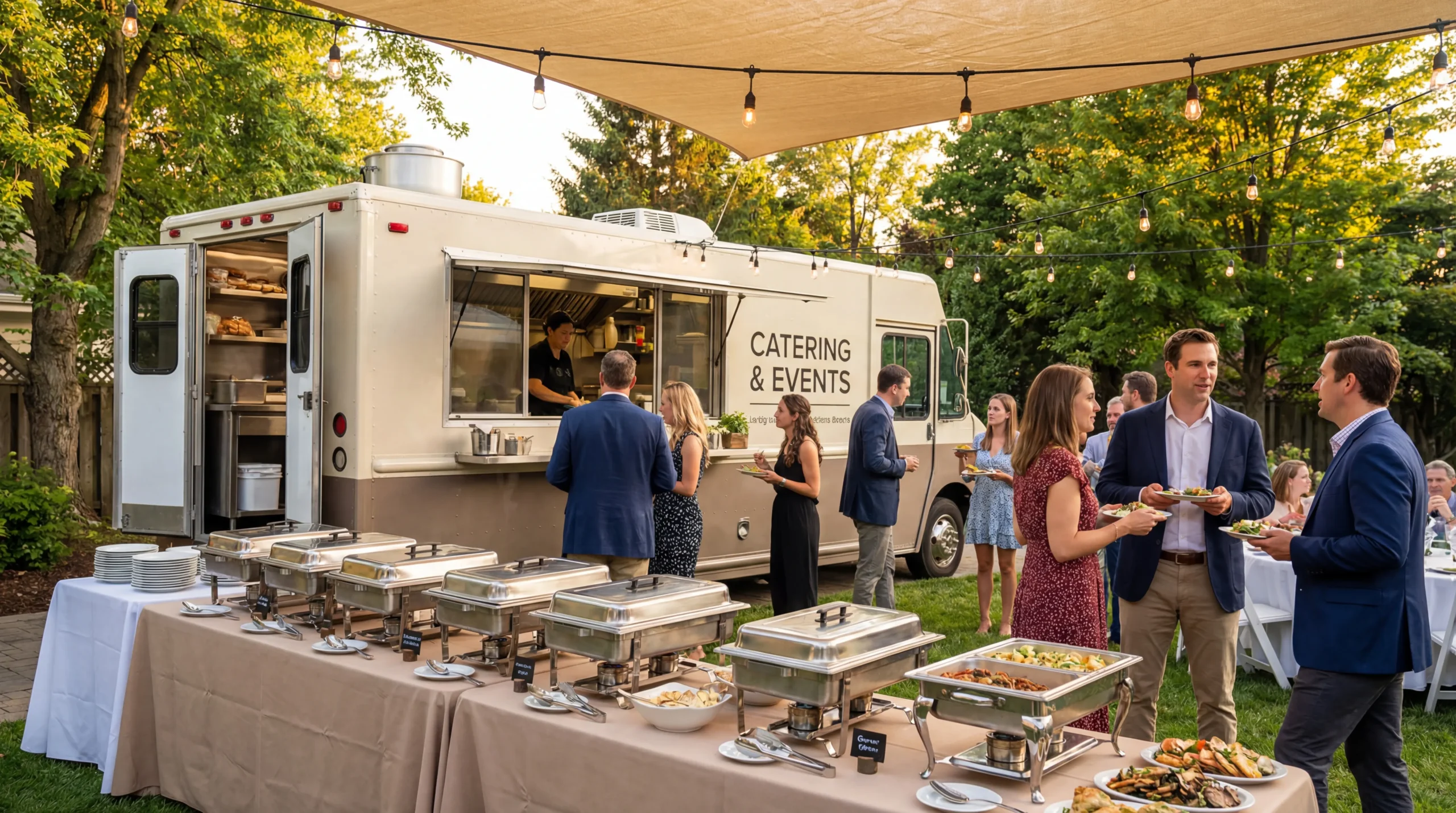

Food truck catering is not regular street service. Most operators treat it the same way and lose money every time. You need a set catering menu, per-person pricing, a signed catering contract, and a realistic capacity plan before quoting a single gig.
This guide covers what I built after 8 years of on-site food preparation for private events. It’s part of our Food Truck Locations & Events pillar.
Stop Treating Food Truck Catering Like Window Service
Here’s where most people mess up. They bring their full street menu to a private event. Then everything falls apart.
What you need for food truck catering:
- Set catering menu: 3-5 items that batch and hold temperature
- Per-person pricing: $10 to $35 per guest
- Written catering contract with catering deposit terms
- Capacity plan: 60-100 guests per hour per truck
Food truck catering is a private event food service. A client hires your truck for a guaranteed guest count. Fixed menu, set time, contracted payment.
That separates it from street service completely. Specifically, the prep volume is the biggest shift.
For a 100-guest event, you prep everything in advance. You can’t cook 100 orders to-order from a window in 90 minutes. Batch cooking and warming trays become the operation.
| Factor | Street Service | Food Truck Catering |
|---|---|---|
| Menu | Full menu, cook to order | Limited catering menu (3-5 items) |
| Pricing | Per item at window | Per-person pricing or flat rate |
| Revenue | Variable, depends on foot traffic | Contracted amount with catering deposit |
| Prep | Standard daily prep | Heavy advance prep (2-3x normal) |
| Staffing | 1-2 people | 2-4 people minimum |
| Payment | Cash/card at window | 50% deposit + balance invoiced |
I made this chart after my third catering disaster. The differences aren’t subtle.

Most operators set a catering minimum between $500 and $1,500. That minimum covers travel, staffing, and food costs.
Without it, you end up feeding 20 guests for $300. A busy corner would have paid four times that.
⚠️ Warning: “I won’t book a mobile catering event under $800. Factor in travel, catering setup, teardown, and two hours of service. Anything less means working for free.”
Set Up Your Food Truck Catering Operations Before Booking
Don’t wing this. Build the system before your first event booking.
Step 1: Build a catering menu. Pick 3-5 items that travel well and hold temperature. Drop anything needing per-order finishing.
Step 2: Create a pricing sheet. Calculate per-person pricing based on food cost, labor, and travel. Food truck catering typically runs $10 to $35 per person. Keep food cost under 30%.
Step 3: Write a catering contract. Non-negotiable. Skip this and you will get burned on cancellations and no-shows.
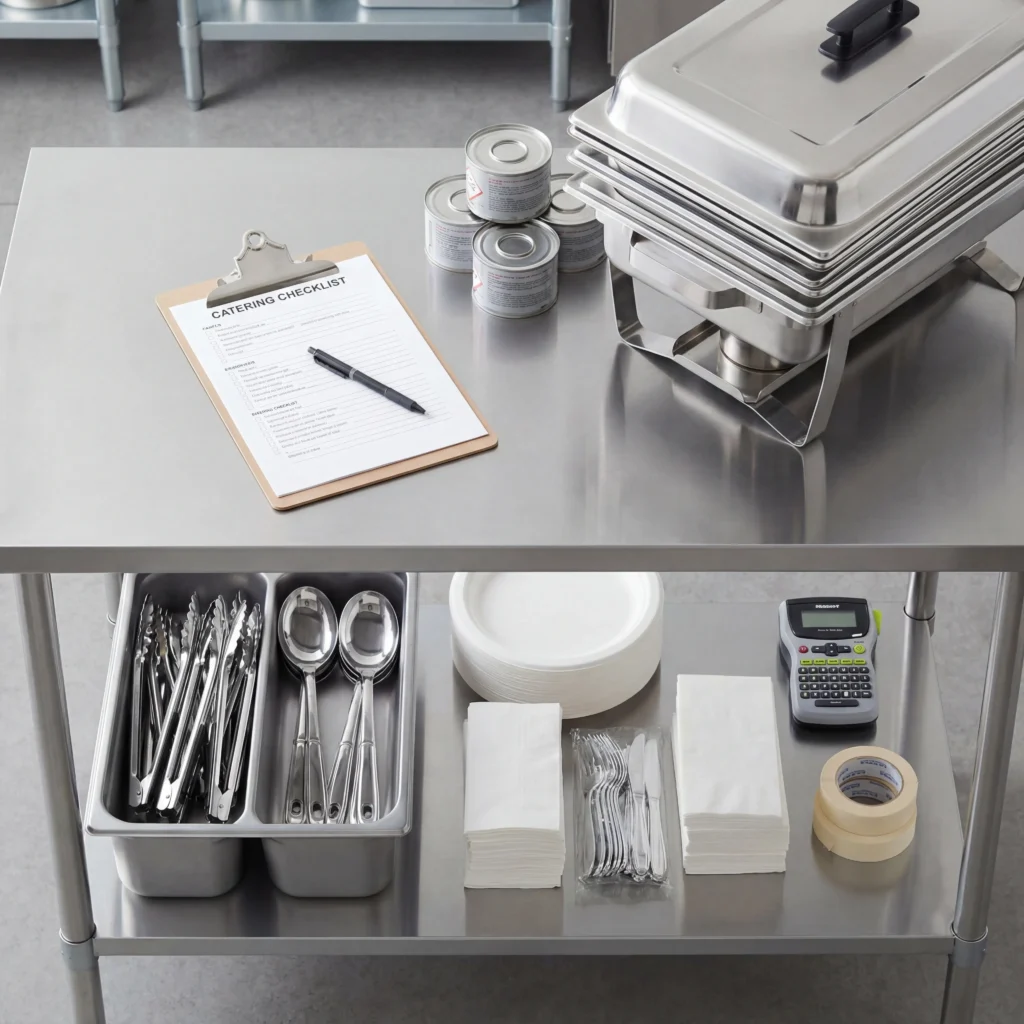
Step 4: Build a catering setup kit. Chafing dishes, serving utensils, disposable plates, napkins, and a folding table. Budget $200 to $400. This gear stays in your truck permanently.
Step 5: Set your event booking process. Inquiry, then menu discussion, then quote, then signed contract, then catering deposit at 50%, then event, then final payment. No exceptions.
Moving on — if you are building a food truck business plan from scratch, add a catering revenue line. Operators who add event catering typically see a meaningful bump in monthly income.
⚠️ Warning: “Keep a separate prep checklist for catering events. Regular daily prep won’t cut it. Catering prep starts 24 to 48 hours before service.”
Also verify your food safety certifications cover off-site work. Some health departments require a separate permit for private event food service.
Price Your Food Truck Catering to Keep Actual Profit
Underpricing kills catering faster than anything else. I’ve seen operators charge $8 per person for wedding catering and lose money after staff and catering setup costs.
The fix is simple: calculate your real per-person cost first.
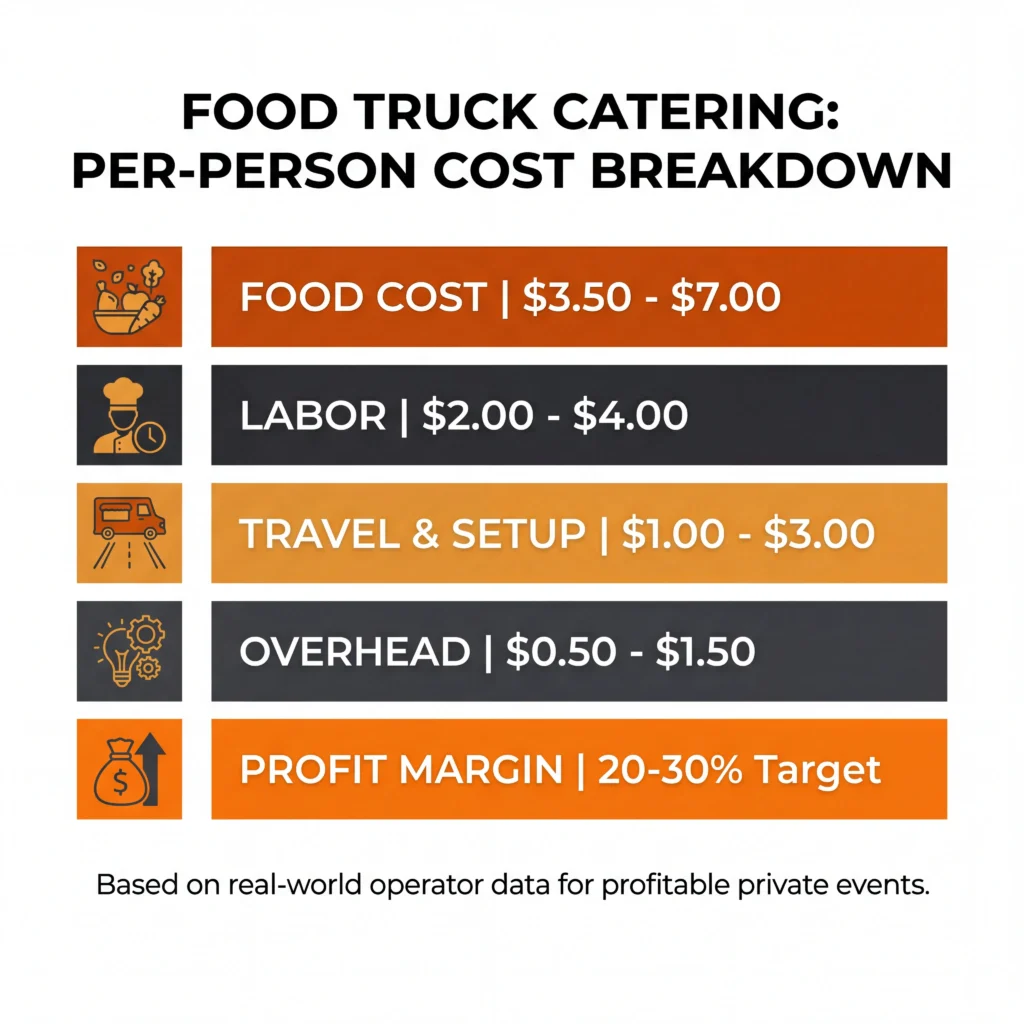
- Food cost per person: $3.50 to $7.00 depending on menu
- Labor per person: $2.00 to $4.00 (staff hours divided by guest count)
- Travel and catering setup: $1.00 to $3.00 per person
- Overhead: $0.50 to $1.50 (disposables, fuel, insurance)
- Profit margin: target 20-30% on top of all costs
Typical food truck catering rates by event type:
| Event Type | Per-Person Range | Typical Minimum | Average Revenue |
|---|---|---|---|
| Corporate catering | $18 – $30 | $1,000 – $2,000 | $1,200 – $2,500 |
| Wedding catering | $20 – $35 | $1,500 – $3,000 | $2,000 – $5,000 |
| Party catering | $12 – $22 | $500 – $1,000 | $600 – $1,500 |
| Community event | $10 – $18 | $500 – $800 | $500 – $1,200 |
How much does food truck catering cost? Food truck catering typically costs $10 to $35 per person depending on menu and event type. Corporate catering averages $1,200 to $2,500 per event. Wedding catering pays more but demands more.
Party catering brings lower revenue per event but repeats frequently. That repeat rate matters over a full year.
Food truck catering generally costs less than traditional catering. That’s your sales pitch: better food, lower price, more personality.
⚠️ Warning: “Never quote a price without knowing the guest count and event type. I’ve been burned by ‘about 50 people’ that turned into 120. Get the headcount guarantee in writing before sending any quote.”
Pricing examples reflect typical operator experience. Your results will vary by market, menu complexity, and overhead costs. These are not income guarantees.
Match Your Catering Setup to Each Event Type
Not every event works the same way. Your approach shapes which types you pursue.
Corporate catering demands speed and simplicity. Lunch service means 60 to 90 minutes of peak time. Have food ready on arrival.
Wedding catering is the opposite. Presentation and timing matter. Expect catering setup 2 to 3 hours before service.
Party catering is the most flexible type. Backyard birthdays, graduations, and reunions run 30 to 80 guests. These are your best source of repeat bookings.
Community and fundraiser events are high-volume but lower margin. Negotiate a flat fee for charity events.
Now for the important part. A single food truck serves 60 to 100 guests per hour depending on menu complexity.
For events over 150 guests, plan a second truck. For 300 or more, two trucks minimum with staggered service times.
I learned this the hard way at a large event. The line hit 45 minutes deep by hour two. Don’t repeat that mistake.
What is the capacity for food truck catering? A single truck handles 60 to 100 guests per hour with a streamlined catering menu. For 150+ guests, add a second truck. For 300+, use two trucks with staggered times.

Lock Down a Catering Contract Before Every Event
No catering contract, no event. Period. Trust me on this one.
I don’t care if it’s family. Get it in writing. Every catering contract needs these items:
- Event date, time, and location with catering setup and breakdown times
- Guaranteed guest count with headcount guarantee deadline (7 days prior)
- Catering menu details including exact items, quantities, and accommodations
- Total price as per-person rate times guaranteed headcount or flat fee
- Catering deposit terms at 50% non-refundable deposit at signing
- Balance due date at remaining 50% due day-of or 48 hours prior
- Cancellation policy where deposit is forfeited within 14 days
- Catering setup requirements including power, parking, water, and waste
- Liability and insurance confirming coverage for mobile catering events
The headcount guarantee is what most operators forget. If the client says “about 100 people,” lock in 100 guests.
If 60 show, they still pay for 100. If 120 show, bill the extra at per-person rate.
⚠️ Warning: “I add a site visit clause for weddings and large events. I drive out beforehand to check parking, power, and terrain.”
Always verify your insurance covers private event catering. Your standard food truck policy might not cover it. Call your agent before your first gig.
Build Your Event Booking Pipeline Without Paying Platforms
Booking platforms take 10-20% of revenue. That’s a massive cut on a $2,000 wedding event booking. Build your own pipeline instead.
Direct outreach works. Contact office managers, wedding planners, and event coordinators. Bring a one-page catering menu and pricing sheet.
Your regulars are your best leads. Every person at your window is a potential event catering client. Put a card in every bag with your phone and email.
Brewery and venue partnerships pay off. Many breweries want food trucks but don’t handle booking logistics. One solid partnership generates 10 to 15 bookings yearly.
Repeat corporate clients are everything. One account booking you twice monthly at $1,200 per event brings $14,400 to $28,800 per year. That is real, predictable revenue.
Next step: track every inquiry in a spreadsheet. Date, event type, guest count, and status.
Most operators lose event bookings because they forget to follow up. The system doesn’t need to be fancy. It needs to exist.
Avoid These Food Truck Catering Mistakes That Kill Margins
Look — I’ve made most of these. Learn from my losses.
Mistake 1: Underestimating prep time. Catering for 100 guests takes 3-4 times longer than normal service. Plan 6 to 8 hours. Start the day before.
Mistake 2: No equipment backup plan. Your generator dies during a reception. Bring backup power, extra propane, and spare serving equipment.
Mistake 3: Accepting events beyond capacity. A 300-guest gig when you’ve only done 50-person parties is a disaster. Scale up gradually.
Mistake 4: Skipping the catering deposit. Client cancels 3 days out. You already bought $400 in food. Without the 50% deposit, you eat that cost.
Mistake 5: Forgetting travel in pricing. An event 45 minutes away costs 3 hours of drive time round trip. Add catering setup and teardown. Price that in.
Mistake 6: Ignoring food safety off-site. Temperature holding requirements are stricter for private event food service. Bring a thermometer. Check temps every 30 minutes.

Key Takeaways
Bottom line:
- Food truck catering is a separate operation from street service — build dedicated catering menus, per-person pricing, and catering contracts before accepting any event booking
- Price at $10-$35 per person, set a catering minimum of $500-$1,500, and keep food cost under 30% to protect margins
- Every event needs a written catering contract with a catering deposit, headcount guarantee, cancellation policy, and insurance verification
- One truck handles 60-100 guests per hour — plan two trucks above 150 guests and build your own event booking pipeline through direct outreach
Do this now. Pick one event type to start with. Build your catering menu, pricing sheet, and catering contract template this week. Then start outreach with these guides:
- Food Truck Festival Guide — high-volume public event strategy
- Food Truck Party Guide — casual event logistics and repeat bookings
What works in my market might need adjusting for yours. Always verify local health codes, insurance requirements, and permit rules before offering on-site food preparation services. I am not a licensed attorney or accountant — consult professionals for legal and tax questions.
— Darnell Kowalski
