


What Is a Food Truck Business Plan?
A food truck business plan is a formal document that maps out your concept, target market, financial projections, and daily operations strategy. Most lenders require a food truck business plan before approving any financing, and the strongest versions run 15 to 25 pages with month-by-month cost breakdowns. Even self-funded operators benefit from pressure-testing their numbers on paper before committing real capital.
When I wrote the food truck business plan for our first taco truck in Texas, the process took about six weeks. That felt slow at the time. But running the numbers upfront saved us from two expensive mistakes — overestimating first-year revenue and underestimating permit costs by nearly $2,000.
That plan became the financial backbone for securing funding across all three of our trucks. It’s also the reason I consult on business plans today.
This guide walks through every section of a food truck business plan, with the specific financial frameworks and projection methods that have worked across my seven years in this industry. For the full planning process, see the complete Food Truck Planning guide.
In short: your food truck business plan is both your financial roadmap and your funding ticket. Here’s how to build one that lenders actually approve.
The 9 Essential Sections of a Food Truck Business Plan

A complete food truck business plan follows a standard structure that lenders and investors expect. Missing any section raises immediate red flags during review.
- Executive Summary — A 1–2 page overview of your concept, market opportunity, and funding needs
- Company Description — Your business structure, concept, and competitive positioning
- Market Analysis — Target demographics, competitor landscape, and demand validation
- Organization and Management — Ownership structure, team roles, and relevant credentials
- Menu and Product Line — Offerings, pricing rationale, and food cost percentages
- Marketing and Sales Strategy — Customer acquisition and retention methods
- Operations Plan — Daily workflow, location strategy, equipment, and supply chain
- Financial Projections — Startup costs, monthly expenses, revenue forecasts, and break-even analysis
- Funding Request — Amount needed, allocation breakdown, and repayment plan
The financial projections section is where most food truck business plans fall apart. In my experience with over a dozen plans reviewed from both sides of the desk — six years approving loans in commercial banking and seven years running trucks — the plans that get funded are the ones with realistic month-by-month projections, not optimistic annual guesses.
If you’re still estimating your total investment, the detailed food truck cost breakdown covers that in depth.
Financial Projections That Actually Convince Lenders

Financial projections are the section lenders turn to first. It’s also where roughly half of all food truck business plans lose credibility. The issue is almost always the same: revenue estimates that assume full capacity from day one.
The data suggests that operators who build conservative first-year models are significantly more likely to secure funding on the first application. A more realistic approach starts with your break-even calculation.
Break-even point is the minimum number of transactions you need to cover all fixed and variable costs — the exact point where your food truck stops losing money and starts generating profit.
The framework I apply to every food truck business plan follows three variables:
Monthly fixed costs. Add your truck payment, insurance, permits, commissary fees, and any salaried labor. For a single-truck operation, this typically falls between $3,500 and $5,500 per month.
Average ticket price. Calculate your expected average transaction. Most food trucks land between $10 and $15 per customer.
Food cost percentage. Target roughly 28% to 35% of revenue going to ingredients, though this varies by cuisine type — a sushi truck may run 38% or higher and still be viable.
Gross margin per transaction. If your average ticket is $12 and food cost is 32%, your cost of goods sold is $3.84, leaving a gross margin of approximately $8.16 per sale.
Break-even point. Divide monthly fixed costs by gross margin per sale. At $4,200 in fixed costs and $8.16 margin, you need roughly 515 transactions per month — about 21 per service day if you operate 25 days.
The mistake I see most often is projecting 80 to 100 transactions per day from the start. In our first three months, we averaged 35 transactions daily. By month six, we hit 55. Build your food truck business plan around a realistic ramp-up, not peak performance.
💡 Pro Tip from Marcus: “Build two versions of your projections — a conservative model and a realistic model. Present the conservative one to lenders. If reality lands between the two, you’re already ahead of the game.”
For a deeper look at profit margins and what to expect long-term, see the food truck profits analysis.
⚠️ I’m not a CPA. These projections reflect my experience in Texas and may not match your market. Always verify financial projections and tax implications with a licensed professional before making investment decisions.
Startup Cost Breakdown for Your Food Truck Business Plan

Every lender wants to see exactly where their money goes. A vague line item that reads “truck and equipment: $100,000” won’t survive the first review. Break your startup costs into detailed categories with ranges that reflect actual vendor quotes.
The U.S. food truck industry is approaching $3 billion in annual revenue across more than 90,000 businesses — which means your food truck business plan is competing for funding in a growing but crowded market.
Based on my experience outfitting three trucks and consulting with operators across the Southwest, here’s a realistic cost framework for 2026:
| Cost Category | Low Range | Mid Range | High Range |
|---|---|---|---|
| Food truck (used, inspected) | $25,000 | $50,000 | $80,000 |
| Food truck (new or custom build) | $75,000 | $125,000 | $200,000 |
| Kitchen equipment and build-out | $10,000 | $25,000 | $50,000 |
| Permits, licenses, and inspections | $1,000 | $3,000 | $5,000 |
| Initial food inventory | $1,500 | $3,000 | $5,000 |
| Insurance (first 6 months) | $2,000 | $4,000 | $6,000 |
| Branding, wrap, and signage | $2,500 | $5,000 | $8,000 |
| POS system and technology | $500 | $1,500 | $3,000 |
| Marketing (launch period) | $500 | $2,000 | $5,000 |
| Working capital (3-month reserve) | $5,000 | $15,000 | $30,000 |
| Total | $48,000 | $133,500 | $292,000 |
The wide range reflects real variation across markets, truck types, and menu concepts. A used truck with a simple menu in a mid-size city falls toward the low end. A custom-built truck with specialized equipment in a major metro pushes toward the high end.
When I ran the numbers on our second truck, the total came to roughly $87,000 — used truck at $42,000, equipment build-out at $22,000, and the remaining $23,000 spread across permits, insurance, inventory, and working capital. Including that level of specificity in our food truck business plan was the single biggest factor in getting our SBA loan approved on the first submission.
💡 Pro Tip from Marcus: “Get three actual vendor quotes for every line item before you finalize your plan. Lenders can tell the difference between researched numbers and numbers pulled from a blog post.”
If you’re exploring how to fund these costs, the food truck loans guide covers SBA options, equipment financing, and alternative lending.
The Market Analysis and Operations Plan Lenders Expect to See
The market analysis proves demand exists for your concept in your specific location. The operations plan proves you can execute daily. Together, they answer the question every investor asks: “Why will this work here, and how will you run it?”
Building Your Market Analysis
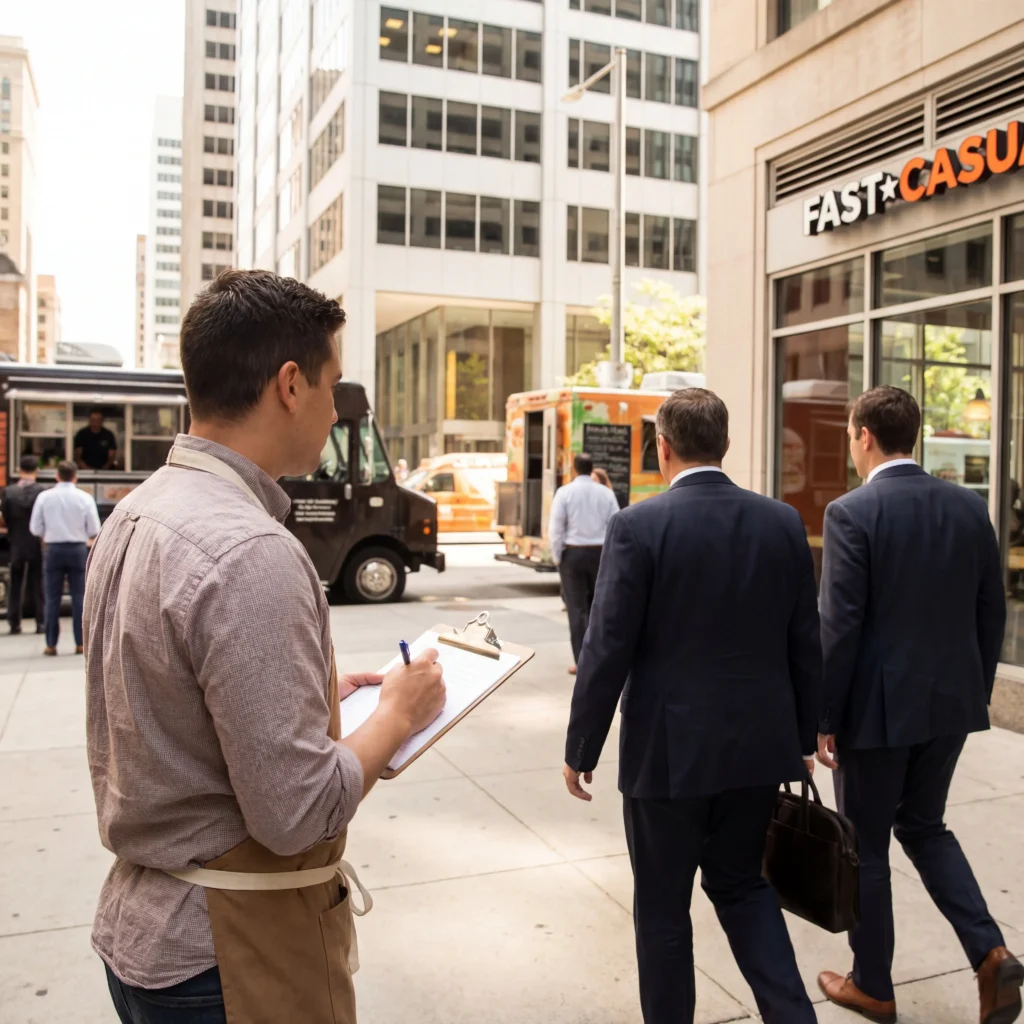
Define your target customer — not “everyone who eats lunch,” but a specific profile. Our target is office workers aged 25 to 45 within a 2-mile radius of downtown business parks, spending $10 to $15 per meal between 11:00 AM and 1:30 PM.
Map your competitive landscape. Identify the 3 to 5 closest competitors — other food trucks and fast-casual restaurants in your target zones — and articulate what differentiates your concept. It’s worth considering that your competitive landscape shifts seasonally. The trucks parked alongside you in July may not be operating in January.
If you’re evaluating whether a food truck is the right model versus a physical restaurant, the food truck vs restaurant comparison breaks down the key financial trade-offs.
Validate demand with evidence. Foot traffic counts, local event calendars, office park employee estimates, or even a pre-launch social media following. Data beats optimism in every food truck business plan.
Structuring Your Operations Plan
Cover your daily workflow, supply chain, and staffing model. Include your commissary arrangement, your food truck menu rotation strategy, and how you’ll handle peak-service volume.
Keep your management section lean. Most food truck business plans need only three roles defined: owner-operator, primary cook, and a part-time server or cashier. Lenders don’t expect a corporate org chart — they want to see that you’ve thought through who does what during a lunch rush.
What Lenders Actually Look for First

After six years reviewing small business loan applications in banking — and then writing three food truck business plans of my own — I’ve sat on both sides of the desk. Here’s what I can tell you from the lender’s chair.
The first thing most loan officers do is flip to the financial projections. Not the executive summary. Not the mission statement. The numbers. If the projections don’t hold up in 30 seconds — if the revenue line looks too aggressive or the expenses seem too thin — the plan goes to the rejection pile. I’ve watched it happen dozens of times.
That insight shaped how I write every food truck business plan today. Lead with numbers that are defensible, not impressive.
The 5 Mistakes That Kill Funding Applications

Mistake 1: Inflated revenue projections. If your Year 1 projection shows $300,000 in revenue with no supporting math, credibility vanishes immediately. Show your calculation. Transactions per day × average ticket × operating days = revenue. Let the arithmetic build the case.
Mistake 2: Ignoring seasonality. Most food truck operators in northern climates see revenue drop 25% to 40% during winter months. Even in warmer markets, summer heat and holiday periods create dips. Your monthly projections should reflect seasonal variation — not a flat line across 12 months.
“I once reviewed a plan that projected identical revenue every single month for three years. No seasonality, no ramp-up, no holiday dips. That’s not a projection — that’s a wish. Rejected before page five.” — Marcus
Mistake 3: Omitting permit and insurance costs. These are real line items that compound fast. I’ve seen food truck business plans that budget $150,000 for equipment but forget to account for $3,000 to $5,000 in annual permits and $4,000 to $8,000 in annual insurance. Lenders always notice.
| Commonly Forgotten Costs | Typical Annual Range |
|---|---|
| Permits and licenses | $1,000 – $5,000 |
| Commercial insurance | $4,000 – $8,000 |
| Health department inspections | $200 – $800 |
| Commissary kitchen rental | $400 – $1,500/month |
| Fire suppression maintenance | $150 – $500 |
Mistake 4: No contingency budget. Equipment breaks. A generator fails mid-service. Your truck needs a repair that takes it offline for a week. Without a contingency fund — typically 10% to 15% of your total budget — your food truck business plan shows no buffer for reality.
💡 Pro Tip from Marcus: “I allocated 12% of our total budget as contingency. We used 9% in Year 1. That remaining 3% cushion is the reason we survived August, when our generator died during a 102-degree week and cost $2,800 to replace.”
Mistake 5: Generic market analysis. Saying “the food truck industry is growing” without connecting that growth to your specific market tells a lender nothing useful. Localize your data. Reference your city’s food truck density, nearby competition, foot traffic in your target zones, and any gaps you plan to fill.
For help building the marketing and branding sections of your food truck business plan, the food truck marketing strategy guide covers the tactical details.
Food Truck Business Plan Template: Your Starting Framework

One of the most common requests from aspiring operators is a ready-made template. Templates provide useful structure — but they should be customized extensively with your own numbers, market data, and operational details.
A strong food truck business plan template covers all 9 sections outlined above and includes placeholder fields for your specific financial data. Several free options exist:
The SBA’s online business plan tool walks you through each section with prompts and guidance tailored to small business lending requirements. It’s the closest thing to a lender-approved format.
SCORE’s food truck planning resources offer mentorship alongside templates — useful if you want feedback from experienced business advisors as you build your plan.
The key with any template: replace every placeholder with data from your own research. A generic template filled with sample text signals to lenders that you haven’t done the work. The food truck business plan that gets funded is the one where every number comes from a vendor quote, a foot traffic count, or a financial calculation you can defend in a meeting.
📥 Want a head start? Download our free food truck business plan template with built-in financial projection spreadsheets. It includes pre-formatted sections for all 9 components, plus a break-even calculator and a monthly cash flow tracker.
Putting Your Food Truck Business Plan Into Practice

📅 Today: Download a template. Fill in your executive summary and company description — even in rough draft form. Get words on the page.
📅 This Week: Contact three vendors for quotes on your top cost categories: the truck itself, kitchen equipment, and insurance. Replace every placeholder number in your plan with a real quote.
📅 This Month: Complete your financial projections with month-by-month revenue estimates for Year 1. Run your break-even calculation. Have someone outside your project — an accountant, a mentor, or a fellow food truck owner — review your numbers for blind spots.
Tools to help you build your plan:
- SBA Business Plan Tool (sba.gov) — free, lender-aligned format
- SCORE mentorship and templates — free, with advisor feedback
- Your own spreadsheet — the most flexible option for financial modeling
Frequently Asked Questions About Food Truck Business Plans
How long should a food truck business plan be?
Most effective food truck business plans run 15 to 25 pages, including financial tables and appendix materials. The executive summary should stay under 2 pages. Lenders spend the most time on your financial projections and funding request, so allocate your detail accordingly. A plan that’s 8 pages with vague financials will lose every time to a focused 20-page plan with month-by-month projections.
How much does it cost to start a food truck business?
Total startup costs for a food truck typically range from $50,000 to $200,000, with the truck itself accounting for the largest share. A used truck in good condition runs $25,000 to $80,000, while a new custom build can exceed $150,000. Beyond the truck, budget for equipment, permits, insurance, initial inventory, and at least three months of working capital. The food truck cost guide provides a complete breakdown by category.
Do I need a food truck business plan if I’m not seeking a loan?
Yes. Even self-funded operators benefit from writing a formal plan because it forces you to run the numbers before spending real money. When I launched our first truck, the food truck business plan process revealed that our original menu concept had a food cost percentage above 40% — well above the sustainable range. Without the plan, I would have discovered that problem with actual revenue at stake instead of on a spreadsheet.
What financial projections should a food truck business plan include?
At minimum, include a startup cost breakdown, monthly operating expense estimate, revenue projections for the first 12 to 36 months, a break-even analysis, and a cash flow forecast. The break-even analysis matters most because it shows lenders the specific volume of sales required to cover your costs. Build projections monthly for Year 1 and quarterly for Years 2 and 3.
Can I use a free food truck business plan template?
Templates provide useful starting structure, but they need extensive customization with your specific numbers, market research, and operational details. A template filled with placeholder text signals to lenders that you haven’t done the homework. Use a template as scaffolding, then replace every section with data from your own vendor quotes, financial modeling, and market research.
What section of a food truck business plan do lenders focus on most?
Financial projections, followed immediately by the funding request. In my banking years, the first thing most loan officers turn to is the numbers section. They want to see realistic revenue ramp-up, accurate expense estimates, a clear break-even point, and a repayment plan that makes mathematical sense given the projected cash flow. If those don’t add up in 30 seconds, the rest of the plan rarely gets read.
Building Your Food Truck Business Plan: Next Steps
The difference between food truck business plans that get funded and those that don’t usually comes down to one word: specificity. Lenders have seen hundreds of plans that say “we’ll serve great food in a growing market.” What they haven’t seen enough of is a plan that shows the exact cost per transaction, the realistic daily volume over 12 months, and a contingency for when the generator fails in the middle of July.
Start with your financial projections — the numbers anchor everything else in your food truck business plan. Once you know your break-even point, every other section becomes easier to write because you have a concrete target to build toward.
Your next steps from here:
- Estimate your full investment with the food truck cost breakdown
- Explore financing options in the food truck loans guide
- Return to the complete Food Truck Planning guide for the full process
📥 Ready to start writing? Download our free food truck business plan template with built-in financial calculators and get your first draft on paper this week.
The numbers don’t lie — but they don’t write themselves either. Open the spreadsheet, pull up your vendor quotes, and start building.
Always consult a licensed financial professional before making major business investment decisions. The figures and frameworks in this guide reflect personal experience and industry estimates — your results will depend on your market, concept, and execution.
— Marcus Reyes
