
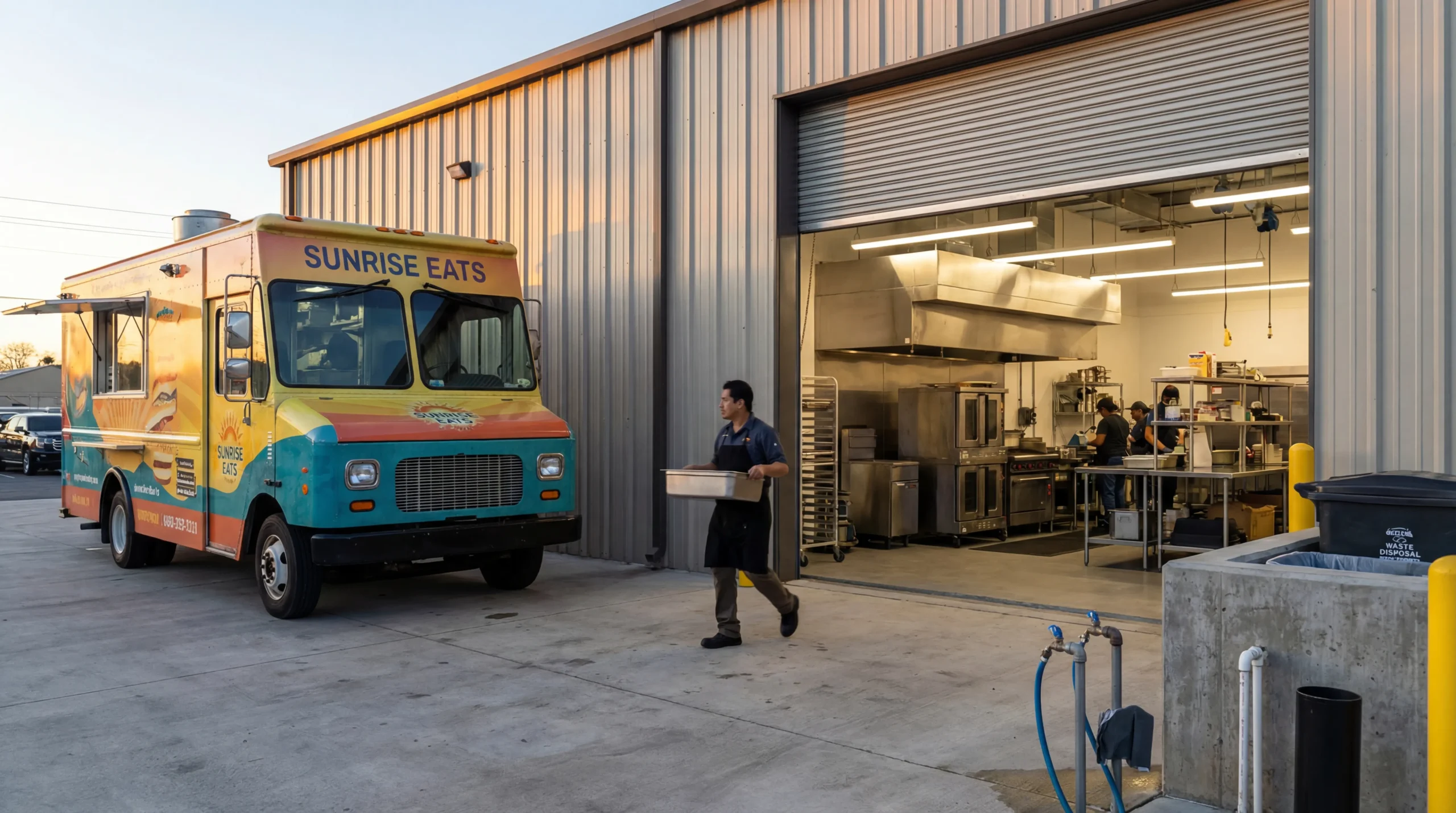

What Is a Food Truck Commissary?
A food truck commissary is a licensed commercial kitchen where mobile food operators prep meals, store ingredients, clean equipment, and park their trucks overnight. In nearly every state, health departments require food trucks to operate in connection with an approved commissary before issuing permits. Monthly costs typically range from $300 to $2,500 depending on location and services.
📚 Part of our complete guide: Food Truck Permits and Licenses
I didn’t know what a commissary was until the Portland health department asked me for my “commissary agreement” — and I just sat there blinking at the woman behind the counter. Nobody had mentioned it in any of the startup guides I’d read. I went home that night and fell into a research hole that lasted until 2 AM, scrolling through Reddit threads and Facebook groups trying to figure out what I’d missed.
Turns out, I’d missed one of the most important parts of running a food truck.
This guide walks you through everything I wish someone had told me on day one: what a food truck commissary actually includes, whether your state requires one, how much you’ll pay in 2026, the different types available, what to look for in a commissary agreement, and how to find one near you — even if you’re in a smaller market with limited options.
Does Your State Actually Require a Food Truck Commissary?
In nearly every U.S. state, food trucks must operate in connection with a licensed commissary kitchen. The specific rules, enforcement intensity, and exemptions vary by state and even by county, but the vast majority of jurisdictions require some form of commissary agreement before they’ll issue you a mobile food vendor permit.
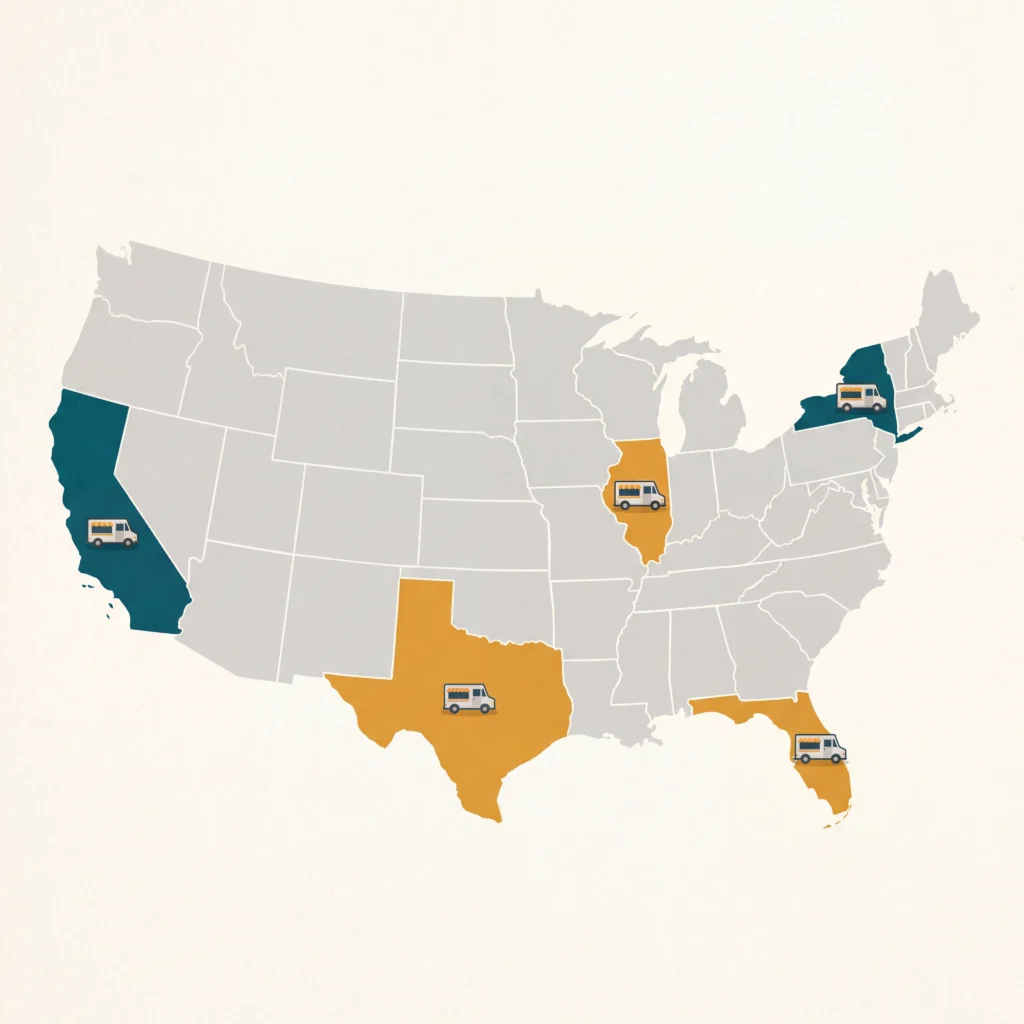
Here’s what the rules look like in five major states, based on current regulations as of early 2026. Requirements can change, so always confirm with your local health department before making any commitments.
California
California has some of the strictest commissary rules in the country. Under the California Health and Safety Code (Chapter 10, Sections 114294–114327), all mobile food facilities must report to a commissary at least once per operating day for cleaning and servicing. Food must be stored at the commissary at the end of each operating day. In Los Angeles, the city explicitly requires that mobile food vendors rent space from a commissary and cannot park their truck in a residential driveway overnight (source: LA Business Navigator).
Texas
Texas recently passed a law in September 2025 establishing a single statewide mobile food vendor license, replacing the previous patchwork of city and county permits. That said, many areas — including Houston and Harris County — still require access to a licensed commissary kitchen (called a “Central Preparation Facility” in Texas regulations) as part of the mobile food unit permitting process. Rules vary between cities, so check directly with your local health department.
Florida
Florida requires food trucks to use a commissary if the truck can’t meet all health and safety standards on its own. In practice, most trucks need one. Miami-Dade County requires annual renewal of your commissary agreement, with documentation that the facility is currently licensed and inspected.
New York
New York City has specific rules codified in NYC Health Code Article 89, Section 89.27. Commissaries must hold their own permit from the NYC Department of Health, and your truck must be cleaned and stored there daily. Inspectors can visit the commissary unannounced.
Illinois
In Illinois, the Food Service Sanitation Code requires mobile food units to use a licensed commissary. Chicago’s health department needs to see your commissary agreement before they’ll issue your mobile food vendor license.
The takeaway? Don’t assume you can skip this step. Call your local health department before you buy your truck and ask specifically: “Do I need a commissary agreement to get my mobile food vendor permit?”
💡 Pro Tip from Jo: Ask your health department for a list of currently approved commissary facilities in your area. Many departments maintain one but don’t advertise it. That list alone can save you weeks of searching.
📎 Related: Still sorting out your licenses? Start with our guide on how to get a food truck license.
How Much Does a Food Truck Commissary Cost in 2026?
Most food truck operators pay between $500 and $1,500 per month for a commissary with shared kitchen access, overnight parking, and waste disposal services. In major metro areas, that number can climb to $2,500 or higher. In small towns, you may find basic plans starting around $300.
These ranges are based on pricing shared by food truck operators in online communities (Reddit’s r/foodtrucks, Facebook food truck groups) and listings on commissary directories like The Kitchen Door. Your actual cost depends on three things: where you operate, what services you need, and whether you’re using shared or private space.
Cost by city size:
| City Size | Monthly Range | Examples |
|---|---|---|
| Major metro | $1,000 – $2,500+ | NYC, LA, San Francisco, Chicago |
| Mid-size city | $500 – $1,200 | Portland, Tampa, Phoenix, Denver |
| Small town / rural | $300 – $700 | Varies widely |
Cost by service level:
| Service Level | Monthly Cost | Includes |
|---|---|---|
| Parking + waste only | $250 – $500 | Overnight parking, grey water dump, water refill |
| Shared kitchen + parking | $500 – $1,200 | Above + scheduled kitchen time, storage |
| Full-service private | $1,200 – $3,000+ | Dedicated kitchen, 24/7 access, full storage |
| Hourly (pay-as-you-go) | $15 – $50/hour | Kitchen time only, no parking |
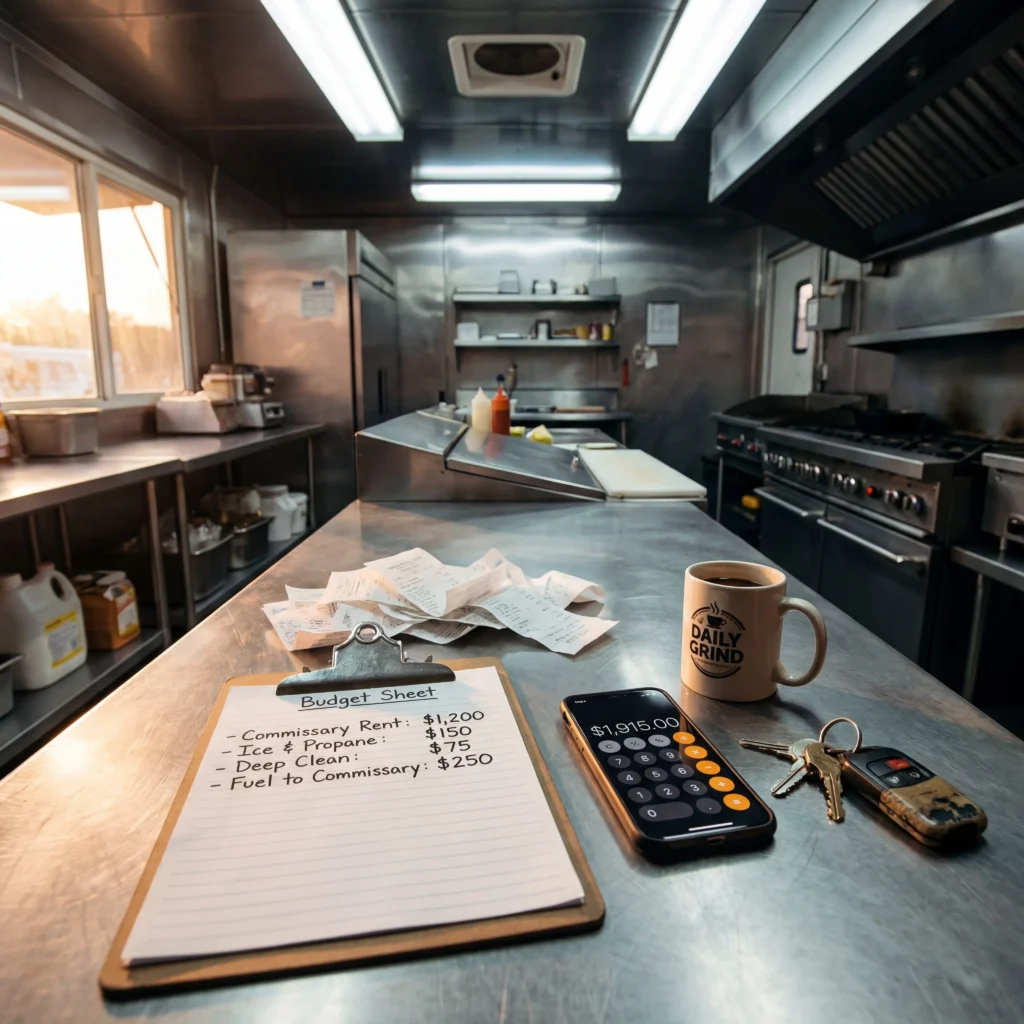
Hidden costs most operators forget:
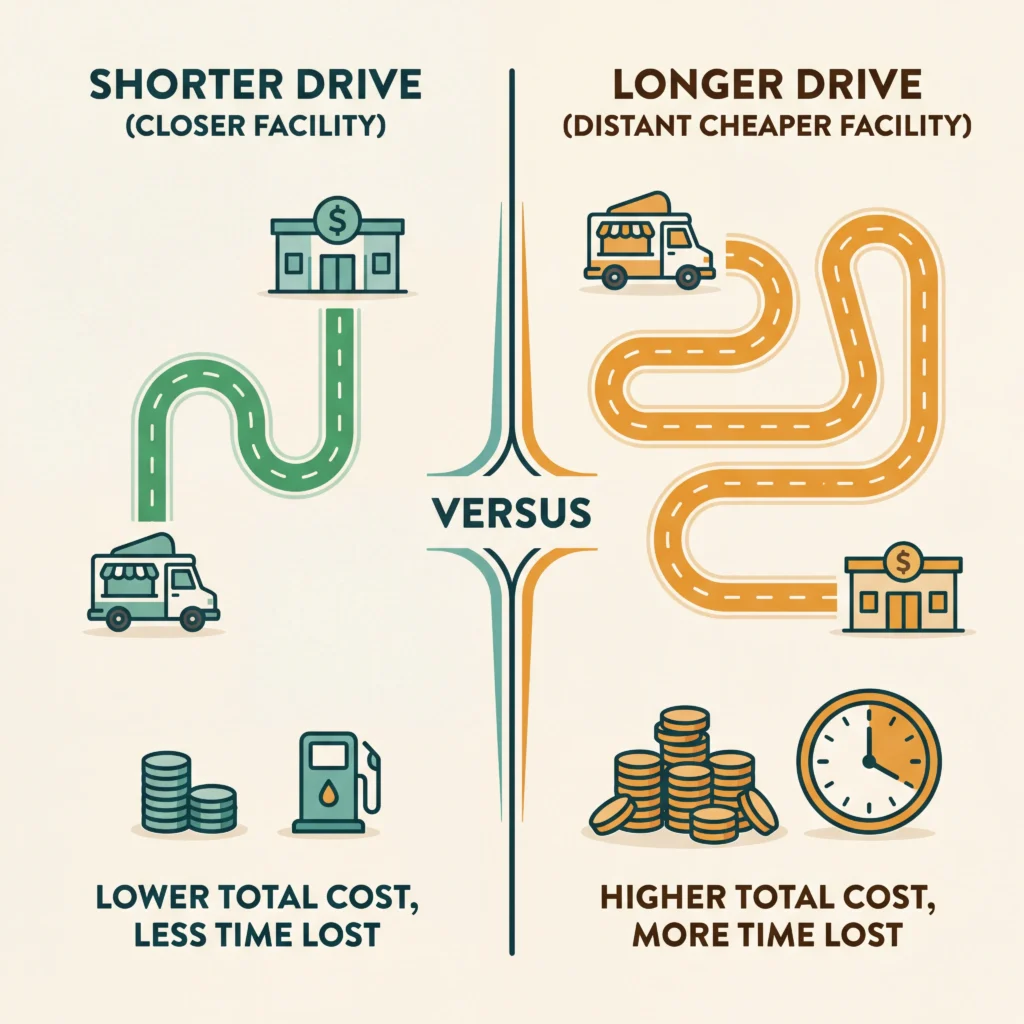
- Drive time. If your commissary is 30 minutes from your usual route, that’s an hour of driving every day. Over a year of 5-day weeks, that adds up to roughly 250 hours and potentially $3,000–$5,000 in fuel and lost serving time.
- Add-on fees. Some facilities charge separately for ice, deep cleaning, propane refills, or extra storage. Ask upfront what’s included in the base price.
- Insurance requirements. Many commissaries require proof of general liability insurance before you can sign up. If you don’t already have it, that’s an additional $500–$2,000 per year depending on your coverage.
When I first saw commissary prices in Portland, my stomach dropped. But then I did the math on what it would cost to get shut down for not having one — lost revenue, spoiled inventory, permit reinstatement fees — and the commissary suddenly looked like a bargain.
📎 Related: For a full picture of every expense you’ll face, see our food truck cost breakdown.
📎 Related: Many commissaries require proof of insurance. Learn about your options in our guide to commercial food truck insurance.
What Are the Different Types of Food Truck Commissaries?
The four main types of food truck commissaries are shared-use kitchens, private commissaries, restaurant partnerships, and food truck hubs — each with different costs, access levels, and trade-offs. The right choice depends on your budget, your menu, and how often you operate.
Shared-Use Kitchens
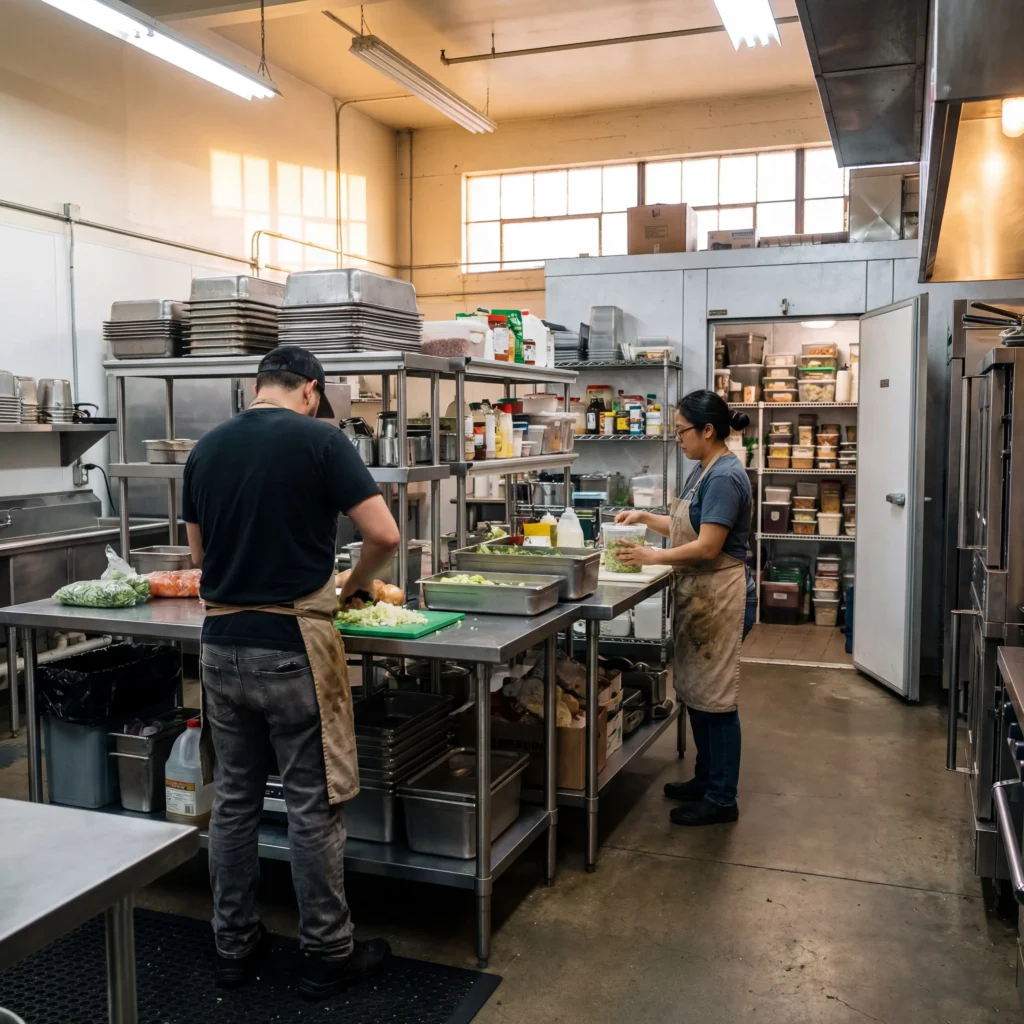
The most common option for new operators. You’re sharing commercial kitchen space with other food businesses on a scheduled basis. You reserve time blocks, prep your food, and leave. Shared kitchens typically run $10–$45 per hour or $500–$1,200 per month.
Best for: Operators on a budget, trucks that prep 3–5 days per week, solo operators.
Watch out for: Scheduling conflicts during peak hours (early morning and weekends). I once showed up at 4:30 AM to find three other operators already jammed into the shared walk-in, rearranging each other’s hotel pans just to make room. That’s the reality of shared space.
Private Commissaries
Leased or owned by a single business, with dedicated kitchen, storage, and 24/7 access. You control the schedule and the space.
Best for: Multi-truck operations, high-volume prep, operators who need early morning or late-night access.
Cost: $1,500–$3,000+ per month in metro areas.
Restaurant Partnerships
A brick-and-mortar restaurant lets you use their kitchen during off-hours — typically early mornings or late nights. This is more common in smaller towns where dedicated commissaries are scarce.
Best for: Budget-conscious operators in areas with few commissary options.
Watch out for: Make sure the restaurant’s health permit explicitly covers mobile vendor use. Not all do. Check with your health department before relying on this arrangement.
Food Truck Hubs and Parks
All-in-one facilities designed specifically for mobile food businesses. They often include kitchen access, overnight parking, power hookups, waste disposal, and sometimes event space. These are growing in popularity in cities like Atlanta, Austin, and Jacksonville.
Best for: Operators who want everything in one location and value community.
| Type | Cost Range | Access | Scheduling Flexibility |
|---|---|---|---|
| Shared kitchen | $500 – $1,200/mo | Shared, scheduled blocks | Low to medium |
| Private | $1,500 – $3,000+/mo | Exclusive, 24/7 | High |
| Restaurant off-hours | $300 – $800/mo | Limited hours only | Low |
| Food truck hub | $600 – $1,500/mo | Shared with dedicated parking | Medium |
💡 Pro Tip from Jo: Before signing anything, visit your top two or three commissary options during their busiest hours — usually 4–6 AM on a weekend. A kitchen that looks spacious on a Tuesday afternoon looks very different when five operators are all trying to prep at once. Bring a tape measure and check whether your largest pots and pans actually fit in the shared storage.

📎 Related: Make sure your commissary meets local fire safety standards. See our guide on fire suppression systems for food trucks.
What’s in a Food Truck Commissary Agreement (and What Should You Look For)?
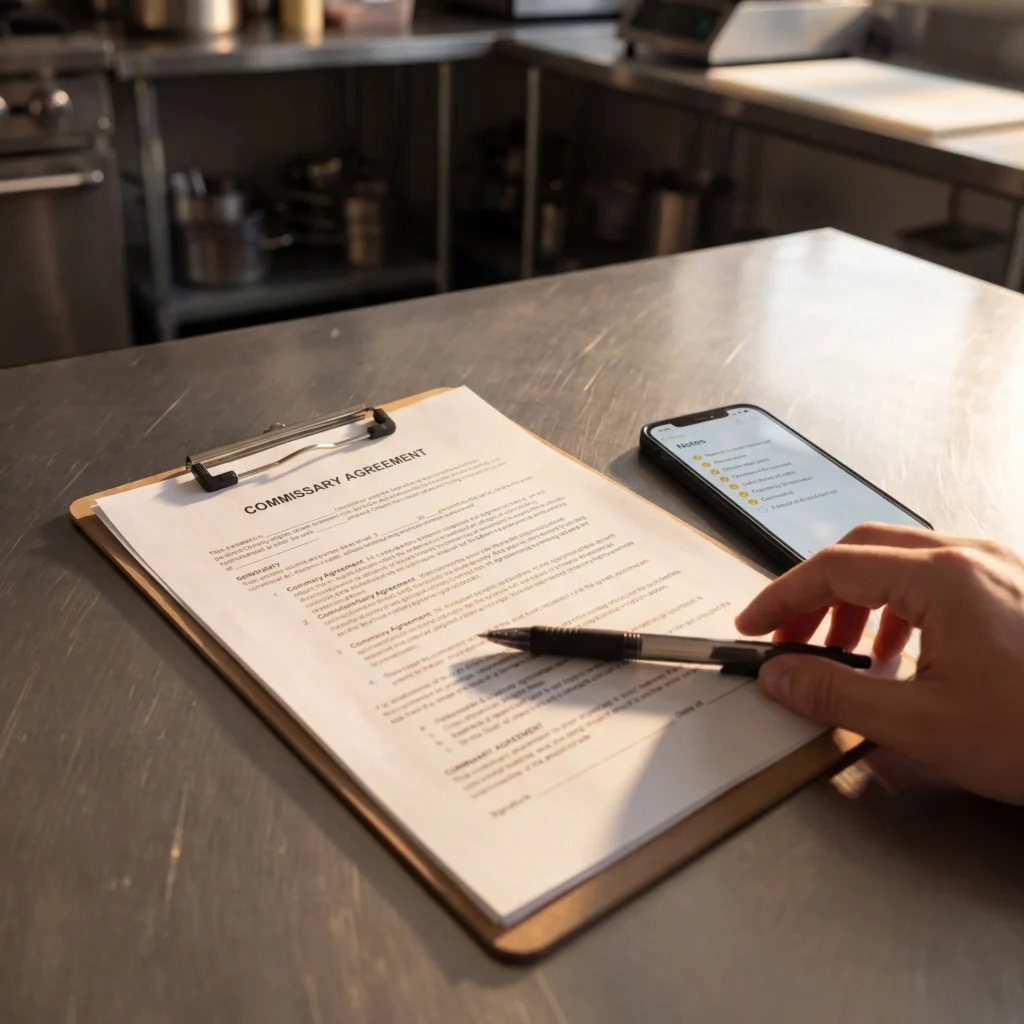
A food truck commissary agreement is the signed contract between you and the commissary facility that documents your approved base of operations. Most health departments require you to submit this agreement as part of your mobile food vendor permit application — without it, your permit gets denied.
Not all agreements are equal. Some are simple one-page forms. Others are multi-page leases with clauses that can cost you money if you’re not paying attention. Here’s what to look for and what to avoid.
What a standard agreement should include:
☐ Facility name, address, and health department license number ☐ Your business name, permit number, and truck description ☐ Services included (kitchen access, parking, storage, water, waste disposal) ☐ Hours of access (24/7 or scheduled? weekdays only or weekends too?) ☐ Monthly cost and payment terms ☐ Duration (month-to-month or annual contract?) ☐ Cancellation policy with required notice period ☐ Liability and insurance requirements ☐ Rules for shared equipment use and storage
What a good clause looks like vs. a bad one:
A weak clause says: “Tenant has access to shared kitchen during business hours.” That tells you nothing. What are business hours? Which kitchen equipment? How many hours per week?
A strong clause says: “Tenant has reserved access to Prep Station B from 4:00 AM to 10:00 AM, Monday through Saturday, including use of the 6-burner range, convection oven, and a dedicated shelf in the walk-in cooler (Section C, Shelf 3).” That’s specific. That protects you.
Red flags that should make you walk away:
☐ Lock-in periods over 6 months with no exit clause — especially if you’re new ☐ Vague service descriptions with no specifics on equipment, hours, or storage ☐ No health department license number listed in the agreement ☐ Surprise fees for basics (water refills, waste disposal, ice) not disclosed upfront ☐ No cancellation clause or an unreasonable termination fee
Real talk: I signed my first commissary agreement without reading the cancellation terms. Six months later, when I found a closer facility that would have saved me 40 minutes of driving every day, I discovered a $500 early termination fee buried in the fine print. I paid it — but I also learned to read every single line before signing anything.
📎 Related: Your commissary agreement will be reviewed during your food truck inspection, so keep it current and accessible in your truck at all times.
How Do You Find a Food Truck Commissary Near You?
Start with your local health department, search commissary directories, and ask other operators in your area. The process takes most people one to three weeks, and touring at least two or three facilities before committing is well worth the time.
Here’s the step-by-step process that worked for me and for the operators I’ve mentored:
Step 1: Call your local health department. Ask for their list of approved commissary facilities. Many departments maintain one but don’t post it online. This is your most reliable starting point because every facility on that list has already been inspected and approved.
Step 2: Search commissary directories. Several online platforms list commercial kitchens available for food truck operators. The Kitchen Door (thekitchendoor.com) is one of the largest directories. The Food Corridor (thefoodcorridor.com) also lists shared kitchens. You can filter by city and food truck compatibility.
Step 3: Join food truck Facebook groups for your state. Search “[your state] food trucks” on Facebook and ask where people commissary. These groups are goldmines for honest reviews and pricing intel. People share things there that you won’t find on any website — like which commissaries have rat problems or which ones quietly raised prices.
Step 4: Check Reddit. The r/foodtrucks subreddit has years of threads on commissary recommendations, pricing, and horror stories. Search the subreddit for your city name + “commissary.”
Step 5: Ask at food truck events. Other operators are almost always happy to share where they prep. The food truck community is more collaborative than competitive when it comes to infrastructure.
Step 6: Explore restaurant partnerships. If dedicated commissaries are scarce in your area, reach out to local restaurants and ask if they’d rent off-hours kitchen time. Churches, community centers, and catering halls sometimes have licensed commercial kitchens too. Just verify that any arrangement is approved by your health department before you rely on it.
💡 Pro Tip from Jo: When you tour a commissary, bring your own padlock and check whether the shared storage has individual locking areas. Then ask every operator you meet: “What’s the one thing you wish you’d known before signing up here?” That single question has saved me from two bad decisions.
📎 Related: While setting up your commissary, make sure your business license for your food truck is also in order.
What If You Can’t Afford a Food Truck Commissary?
The most affordable alternatives to a standard commissary are restaurant off-hours partnerships (often $300–$500 per month), co-op arrangements with other food truck owners, and minimal-use parking-and-waste-only plans. Each option requires extra legwork, but all can satisfy health department requirements if set up correctly.
Here’s how to make each alternative work:
Restaurant off-hours deals. Approach restaurants that close early or don’t open until lunch. Offer a flat monthly fee for access to their kitchen from, say, midnight to 6 AM or 4 AM to 10 AM. Be specific in your pitch: “I need access to your prep table, one burner, and a shelf in your walk-in, three mornings a week.” Most restaurant owners respond better to specific requests than vague ones. Expect to pay $300–$500 per month. You’ll need a written agreement, and your health department must approve the restaurant as your commissary location.
Church and community center kitchens. Some churches and community organizations have commercial-grade kitchens that sit idle most of the week. Contact your local chamber of commerce or nonprofit directories to find licensed commercial kitchens in non-traditional settings. The key question: “Is this kitchen currently licensed and inspected by the health department?” If yes, it can potentially serve as your commissary. If no, it can’t — no matter how nice the kitchen looks.
Co-op arrangements. Team up with two or three food truck owners to share a commissary space and split costs. This works best when your prep schedules don’t overlap. Draft a simple shared-use agreement between yourselves that covers scheduling, cleaning responsibilities, and how shared costs get split. Your individual commissary agreements with the facility remain separate.
Parking-and-waste-only plans. If your truck is fully equipped for on-board food prep and your health department allows it, some commissaries offer stripped-down plans that cover just overnight parking, water refills, and grey water disposal. This is usually the cheapest option — often $250–$400 per month.
One thing I tell every new operator I mentor: don’t let commissary costs stop you from starting. The food truck industry has over 48,000 active trucks across the U.S. right now, according to Food Truck Profit’s 2026 industry survey. Every single one of those operators figured out the commissary piece. You will too.
📎 Related: Understanding all your food truck permits upfront helps you plan your budget around commissary costs.
Common Food Truck Commissary Mistakes That Cost You Money
Even experienced operators get tripped up by commissary decisions. Here are the mistakes I’ve seen most often — and how to avoid each one.
Choosing the cheapest option without calculating drive time. A commissary that’s $200 per month cheaper but 25 minutes farther away costs you roughly 200 extra hours per year in driving. At even a modest opportunity cost of $15 per hour, that “savings” actually costs you $3,000 per year — plus fuel. Always map the round-trip drive time before comparing prices.
Signing a long lease before testing the facility. Never sign anything longer than month-to-month until you’ve used the commissary for at least 60 days. Some facilities look great during tours but have problems that only emerge during actual use — broken equipment that takes weeks to fix, overcrowded peak hours, or unreliable hot water.
Not verifying health department approval. A commissary must be licensed and inspected by your local health department. If it’s not on the approved list, your permit application gets rejected — and you’ve wasted the deposit. Ask to see their current health permit certificate before signing.
Ignoring the cancellation clause. Read the fine print on termination fees, required notice periods, and what happens if the facility raises prices mid-contract. A 30-day notice requirement is standard. Anything requiring 90+ days of notice or charging more than one month’s rent as a termination fee is worth questioning.
Not bringing your own padlock. In shared commissaries, your ingredients and prep containers are only as secure as your storage setup. Bring your own padlock on day one. Label everything. And keep a small inventory sheet in your truck so you know immediately if anything goes missing.
📎 Related: Your commissary setup will be checked during inspections. Read about food truck inspection requirements so you’re always prepared.
Frequently Asked Questions
Do I need a food truck commissary in California?
Yes. California’s Health and Safety Code requires all mobile food facilities to report to a licensed commissary at least once per operating day. Food must be stored at the commissary at the end of each operating day, and trucks cannot be parked at residential locations overnight. Enforcement is particularly strict in Los Angeles County. For current requirements, check the California Retail Food Code or contact your county environmental health department.
How much does a food truck commissary cost per month?
Most operators pay between $500 and $1,500 per month for a commissary that includes shared kitchen access, overnight parking, and waste disposal. In major cities like New York, Los Angeles, or San Francisco, costs can reach $2,000–$2,500. In smaller markets, $300–$700 is more common. Hourly rates for kitchen-only use typically run $15–$50 per hour. These figures are based on operator-reported data from food truck communities and commissary directory listings in 2026.
What is a food truck commissary agreement?
A commissary agreement is the signed contract between you and the commissary facility that serves as proof of your approved base of operations. It documents the services provided, hours of access, cost, and facility license information. Most health departments require you to submit this agreement as part of your mobile food vendor permit application. Without a valid agreement on file, your food truck permit application will typically be denied.
Can I use my home kitchen as a food truck commissary?
In most states, no. Residential kitchens don’t meet commercial health and safety standards. A small number of states and cities have cottage food or microenterprise home kitchen laws — like California’s MEHKO (Microenterprise Home Kitchen Operations) program — but these are designed for cottage food producers and small-scale home cooking operations, not for food truck businesses. Don’t assume these laws apply to your truck without confirming directly with your health department.
Do food carts and trailers need commissary agreements too?
Generally, yes. Health departments typically apply the same commissary requirements to food trucks, food trailers, and food carts. If you’re handling, prepping, or selling non-prepackaged food from any mobile unit, you’ll almost certainly need a commissary agreement. Exemptions usually exist only for vendors selling factory-sealed, prepackaged items that require no preparation or temperature control.
What happens if I operate a food truck without a commissary?
Operating without a required commissary agreement can result in fines, permit suspension, or permanent permit revocation — depending on your jurisdiction. In cities like Los Angeles and New York, inspectors actively check for commissary compliance. Beyond the legal consequences, getting shut down even temporarily means lost revenue, spoiled inventory, and a compliance record that makes future permit renewals more difficult.
Putting It Into Practice
📅 Today: Call your local health department and ask two questions: “Do I need a commissary agreement?” and “Can you send me your list of approved commissary facilities?”
📅 This week: Tour at least two commissaries during peak hours (early morning, weekends). Bring a checklist: verify the health permit is current, check storage security, ask about cancellation terms, and talk to other operators on-site.
📅 This month: Sign a month-to-month agreement with your best option. Submit the signed agreement with your permit application. Set a calendar reminder to reassess after 60 days — by then you’ll know if the facility actually works for your schedule and workflow.
Tools you’ll need:
- Your own padlock for shared storage
- A printed copy of your commissary agreement (keep one in your truck at all times)
- A simple spreadsheet or notebook to track what you’re actually using versus what you’re paying for

Your Commissary Is Your Home Base — You’ve Totally Got This
A food truck commissary is where the invisible work happens: the early-morning prep, the late-night cleaning, the behind-the-scenes grind that makes your truck run smoothly. In most areas it’s a legal requirement, and even where it isn’t, having a solid base of operations makes everything about running a food truck easier.
Key takeaways:
- Nearly every state requires a commissary agreement before issuing food truck permits — check your local rules early
- Monthly costs range from $300 to $2,500 depending on city, services, and space type
- Tour facilities during peak hours, read every clause in the agreement, and start with month-to-month terms
- If you can’t afford a traditional commissary, restaurant partnerships and co-op arrangements are legitimate alternatives
- The biggest hidden cost isn’t the monthly fee — it’s the drive time to a commissary that’s too far away
Your next steps:
- If permits are still on your to-do list → Food truck permits guide
- If you need to get your license sorted → How to get a food truck license
- For the full picture of startup costs → Food truck cost breakdown
📚 Back to the big picture: Food Truck Permits and Licenses — Complete Guide
Regulations mentioned in this article reflect information available as of early 2026. Requirements vary by city, county, and state, and change frequently. This guide is for informational purposes only and does not constitute legal advice. Always verify current requirements with your local health department before making business decisions.
— Jolene
