
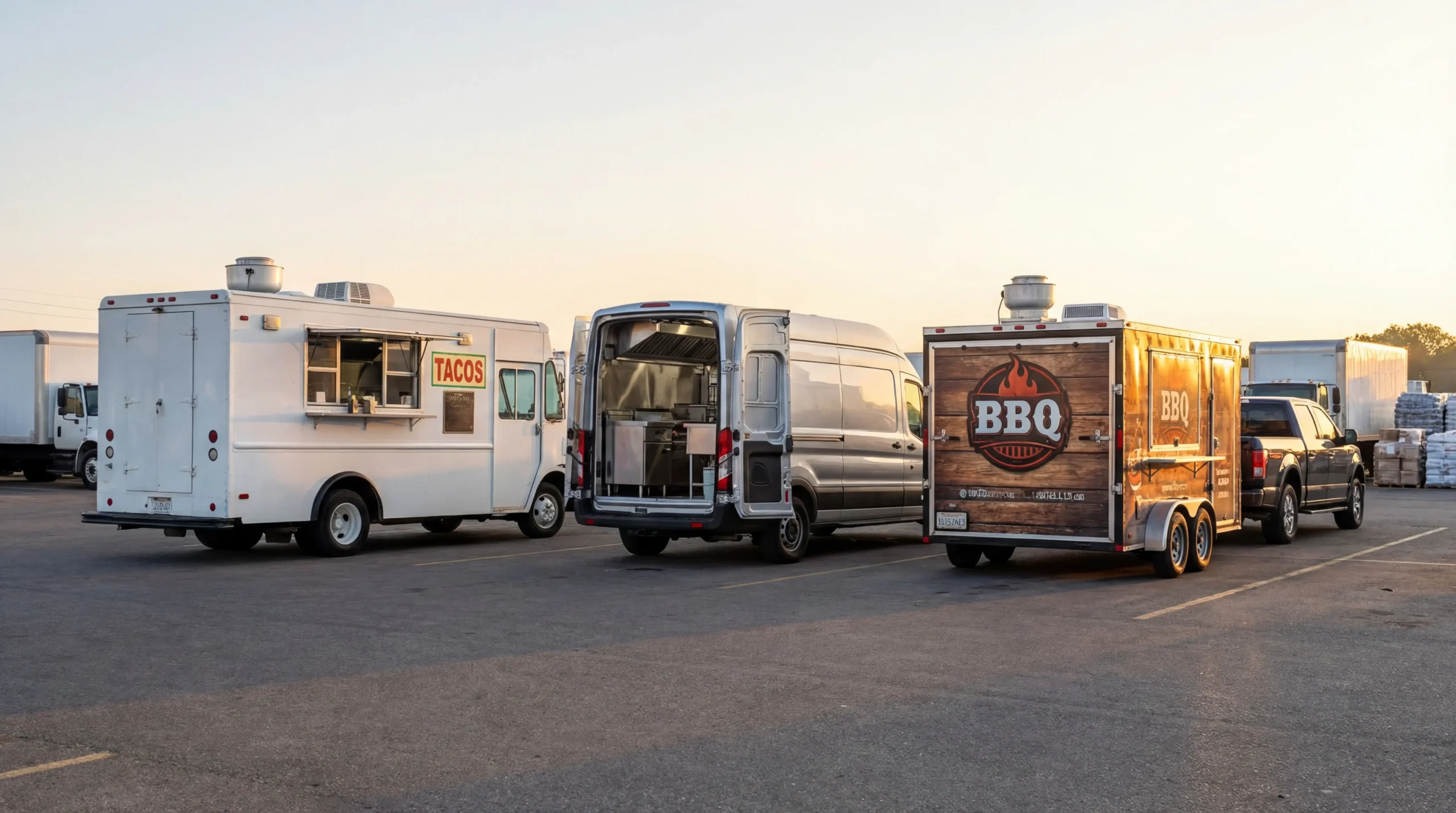

Many food truck operators I’ve worked with over the years admit the same thing: if they could go back, they’d pick a different vehicle. The mismatch usually comes down to choosing a truck for food truck operations based on sticker price alone, without running the five-year numbers on fuel, maintenance, insurance, and resale.
Bottom line: Choosing the right truck for food truck success depends on three variables — your menu complexity, your daily parking footprint, and your total cost of ownership over five years. Step vans remain the industry standard for full-service operations, cargo vans deliver stronger returns for compact menus, and trailers offer the lowest entry cost when you already own a capable tow vehicle.
This guide is part of our complete 📚 Food Truck Equipment Reviews resource, where we break down every major purchasing decision for mobile food operators.
Step Vans Still Dominate Full-Service Truck for Food Truck Builds
Step vans are the most widely used vehicle type for a truck for food truck conversion, and the reasons are measurable: walk-in access, high payload capacity, and enough square footage to support a full cook line with hood, fryer, flat-top, refrigeration, and a two-person crew working side by side.
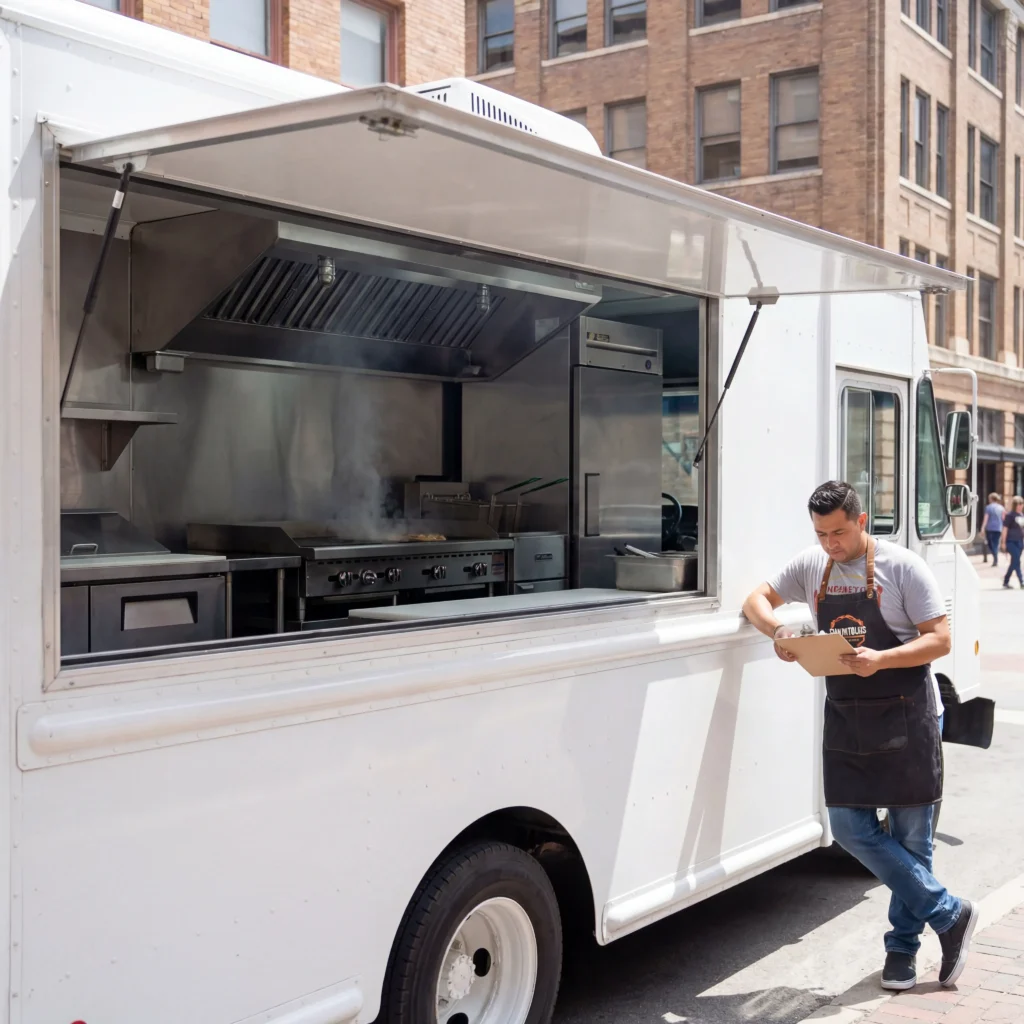
When I built out our second taco truck in San Antonio, we evaluated four step van chassis head to head. The differences in payload rating, parts availability, and fuel economy were significant enough to shift our projected operating costs by several thousand dollars per year. That kind of variance deserves careful analysis before you sign anything.
The most common step van platforms for food truck conversion are the Chevrolet P30, the Freightliner MT45, the Workhorse W62, and the Grumman/Morgan Olson. Chevy P30 chassis were discontinued in 1999, but they remain widely available on the used market and have one of the largest aftermarket parts ecosystems of any commercial vehicle. Freightliner MT45 units handle heavier payloads and are better suited for operators running large equipment — double fryers, brick pizza inserts, or extensive refrigeration.
Based on my testing, fuel economy across these platforms sits between 8 and 12 miles per gallon for gasoline engines. At current fuel prices, that translates to roughly $400 to $700 per month depending on mileage and route density. If you are evaluating specific models, our top rated food trucks guide compares builds across multiple chassis types.
💡 Pro Tip from Marcus: Don’t just compare purchase price — request the maintenance history for the last 24 months on any used step van. I’ve seen trucks listed at $22,000 that needed $8,000 in deferred engine work within six months. The upfront “deal” evaporated on the shop floor.
The Bottom Line: Step vans are the right choice when your menu requires a flat-top grill, fryer, hood system, refrigeration, and prep space for two or more staff members. If your equipment list fits on a single countertop, you are probably overspending on vehicle.
Cargo Vans Deliver Better ROI for Compact Truck for Food Truck Operations
Cargo vans — specifically the Ford Transit, Mercedes-Benz Sprinter, and RAM ProMaster — are the fastest-growing segment in truck for food truck builds. Looking at the data, their appeal comes down to three measurable advantages: lower acquisition cost, better fuel efficiency, and the ability to fit into urban parking spaces that would be impossible for a 20-foot step van.
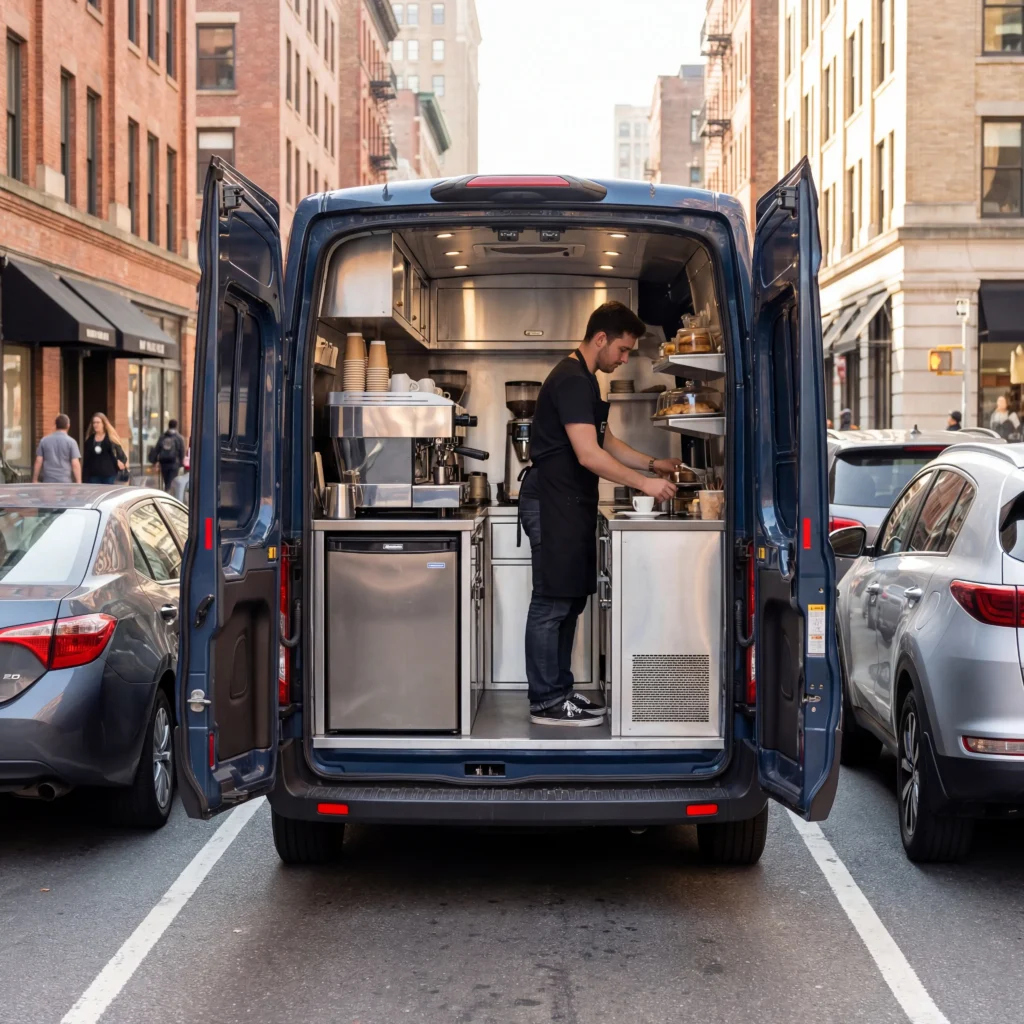
A new Ford Transit starts around $48,000 to $51,000 depending on configuration, while a RAM ProMaster begins near $45,000. Used models of both can be found for $15,000 to $25,000. The Mercedes Sprinter commands a premium — starting above $50,000 new — but diesel variants deliver 15 to 18 miles per gallon compared to 10 to 14 for gas competitors. Over five years of daily operation, that fuel gap compounds into a meaningful cost difference.
The trade-off is interior space. Standard cargo vans offer 10 to 15 feet of usable length, compared to 16 to 22 feet in a step van. That is plenty for a coffee operation, a dessert truck, or any concept built around one or two core appliances. It is not enough room for a full cook line with hood, fryer, flat-top, and cold prep station.
When I ran the numbers on conversion costs, cargo van build-outs run roughly 25 to 40 percent less than step van projects because there is simply less square footage to cover in stainless steel and equipment. That freed-up capital makes a real difference for first-year cash flow — marketing, inventory, an emergency fund. All things I wish I had budgeted more aggressively when we launched our first truck. For a broader look at pre-built options that skip the conversion process, our best food trucks overview covers ready-to-operate units.
Food Trailers Beat Trucks on Purchase Price but Carry Hidden Costs
A food trailer is often the most affordable entry point for operators who already own a tow vehicle with sufficient capacity. Basic enclosed trailers start under $10,000 from manufacturers like Diamond Cargo, while fully equipped custom trailers with kitchen build-outs typically range from $20,000 to $40,000.
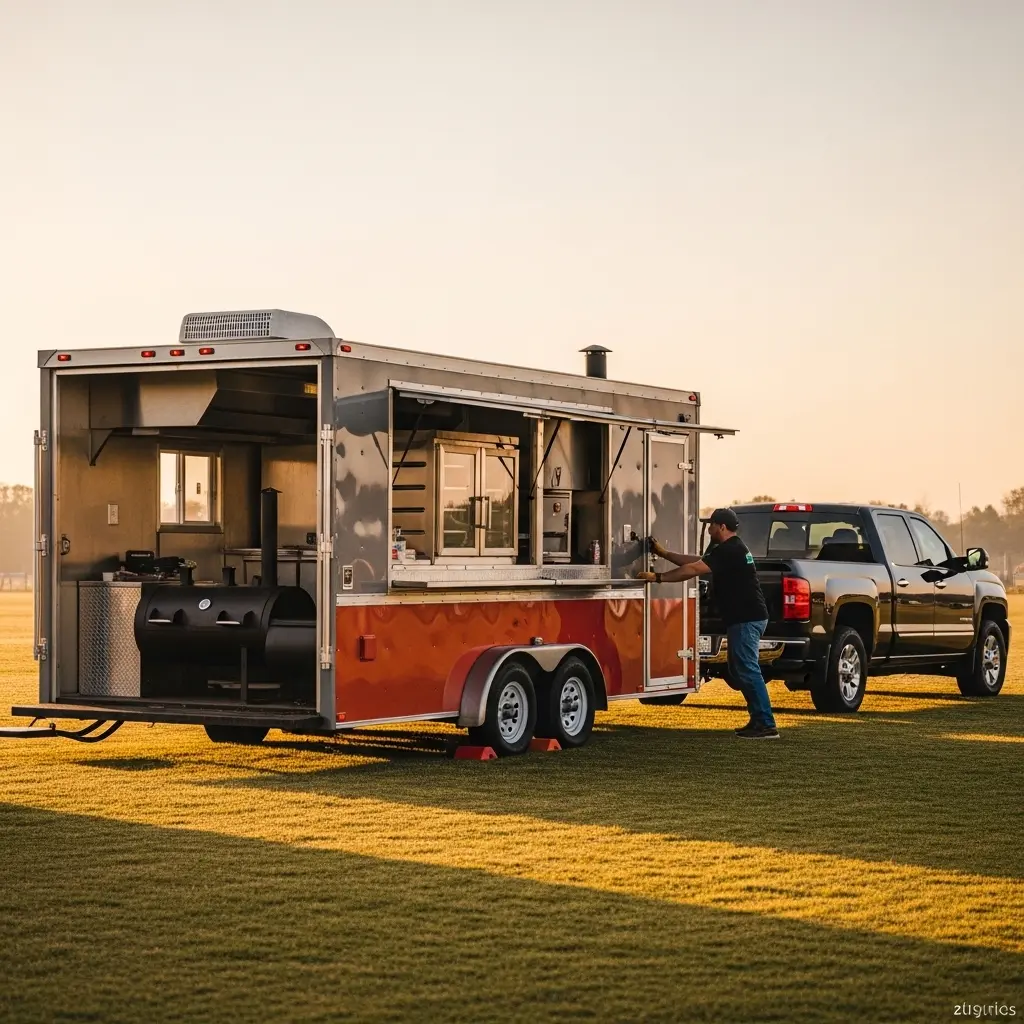
I’ve helped two operators in our San Antonio network evaluate the trailer vs. truck decision, and in both cases the math favored a trailer for their specific situation — one ran a smoker-heavy BBQ concept and the other needed a 400-pound wood-fired pizza oven. Mounting that kind of equipment on a trailer tongue is far more practical than trying to fit it inside a step van. The operational advantage is flexibility: unhitch at the event, use your tow vehicle for errands, and your business doesn’t shut down because the engine is in the shop.
The numbers tell a different story on the cost side, though. Tow vehicle wear, additional insurance, separate trailer permits, and the 10-minute setup-and-teardown ritual at each stop add up. Some high-traffic urban locations simply don’t have space for a tow vehicle plus trailer footprint. Before committing, physically visit your intended operating locations and measure the available space.
You should also know that trailers often require separate licensing. Many jurisdictions classify them as a distinct “mobile food unit — trailer” category, and your tow vehicle may need commercial plates depending on combined gross vehicle weight. Our detailed comparison in the food truck vs food trailer guide breaks down every operational trade-off.
💡 Pro Tip from Marcus: Calculate the total monthly cost of your tow vehicle — payment, fuel, insurance, maintenance — and add it to your trailer cost. Operators who compare only the trailer price to a truck price are leaving out half the equation. When I ran this calculation for one operator, the “cheaper” trailer option was actually $380 per month more expensive than a used step van.
CDL Requirements Depend on Vehicle Weight, Not on Selling Food
One question I hear constantly from operators evaluating a truck for food truck use: do you need a commercial driver’s license? The answer hinges entirely on your vehicle’s gross vehicle weight rating, not on the fact that you are cooking and selling food from it.
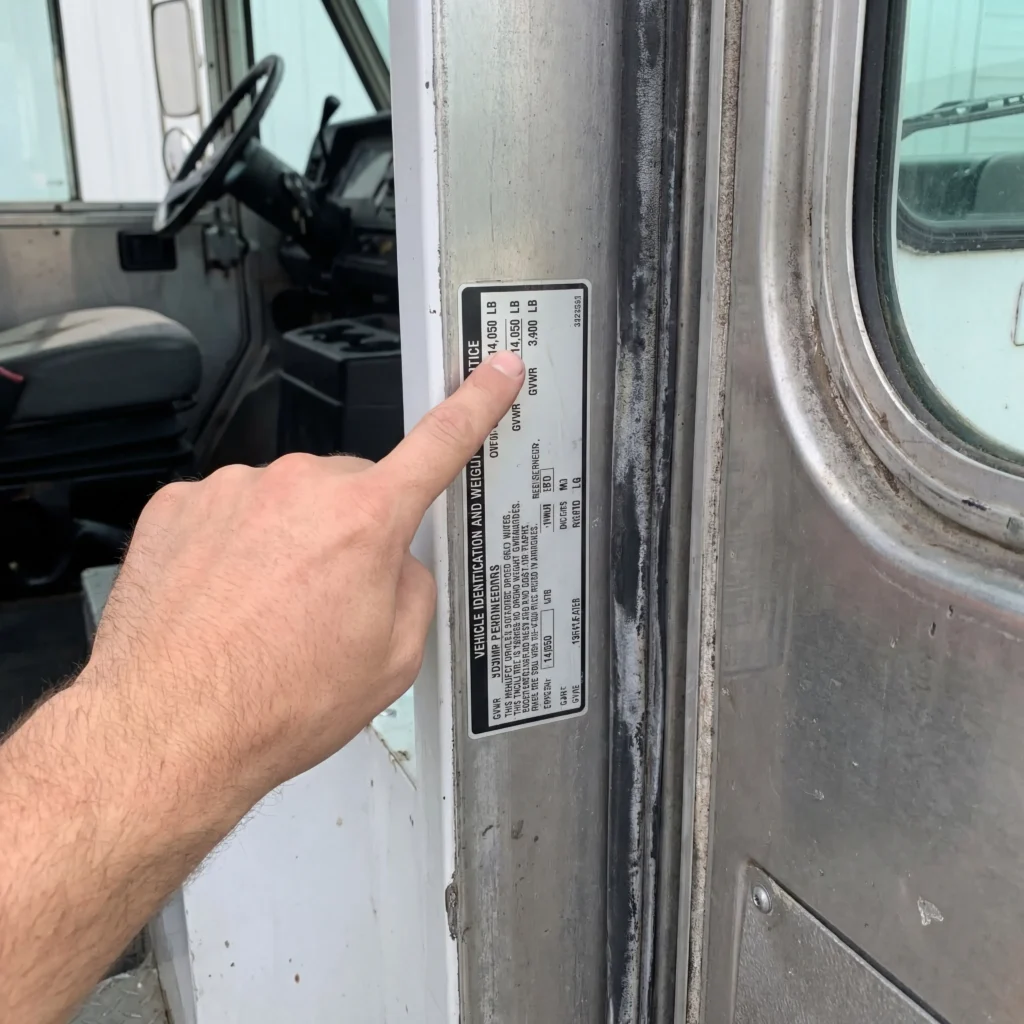
Under federal regulations, a CDL is required for any single vehicle with a GVWR exceeding 26,000 pounds. Most step vans fall well below this line — a Chevy P30 typically carries a GVWR between 10,000 and 14,000 pounds, and a Freightliner MT45 generally ranges from 14,500 to 19,500 pounds depending on configuration. Standard cargo vans like the Transit and Sprinter are lighter still.
Where operators run into trouble is with combination weight. If you are towing a food trailer, the combined GVWR of your tow vehicle plus trailer may approach or exceed the CDL threshold, especially with a loaded-out kitchen adding thousands of pounds to the rated trailer weight. States also apply their own rules on top of federal minimums — some require specific endorsements or commercial plates at lower weight thresholds.
Based on conversations with our insurance broker in Texas, commercial auto policies for non-CDL food trucks typically run $3,000 to $5,000 per year. Vehicles requiring a CDL can push that figure considerably higher, and the CDL itself requires time and testing to obtain. Verifying weight ratings and license requirements with your state’s DMV before you purchase is not optional — it is the kind of detail that can halt your operation on launch day.
This brings us to a practical point: always ask the seller for the vehicle’s exact GVWR — not just the curb weight. Curb weight is the empty vehicle. GVWR includes maximum cargo. When you add a generator, a full kitchen build-out, propane tanks, food inventory, and water tanks, the loaded weight of a food truck can be 3,000 to 5,000 pounds above curb weight. If that pushes you past a regulatory threshold, you have a problem.
The Bottom Line: Most food trucks do not require a CDL. But “most” is not “yours.” Verify your specific vehicle’s GVWR, calculate your expected loaded weight, and check your state’s requirements before you write a check.
Electric Truck for Food Truck Builds Are Gaining Ground in 2026
Electric step vans and cargo vans have moved beyond the experimental stage and into active food truck service in several metro markets. I’ve been tracking the electric truck space since early 2023, and the progress in range, charging speed, and total cost of ownership has been significant enough to make electric a serious option for the right operator.
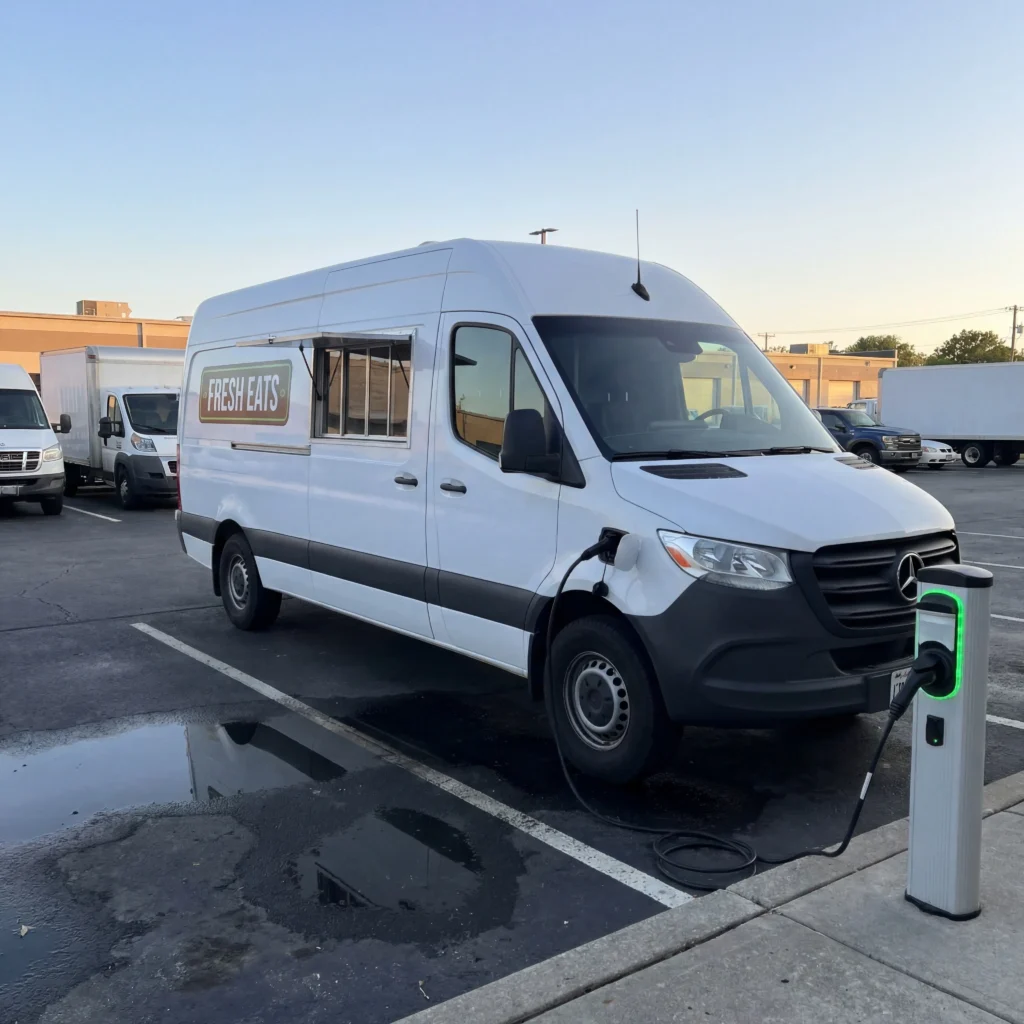
Current electric step van platforms claim ranges of 100 to 150 miles per charge — more than sufficient for operators running fixed daily routes within a city. The financial case on paper is straightforward: electricity costs roughly half as much per mile as gasoline, and maintenance drops substantially without oil changes, transmission service, or exhaust system work. Several states offer rebates and tax incentives for commercial EV purchases that reduce upfront cost by thousands.
The constraints remain real, though. Festival and event locations without shore power or reliable charging infrastructure require a backup generator, which partially negates the emissions benefit. Overnight charging on a Level 2 system covers most weekday use cases, but double-shift operations or long-distance event circuits require careful route planning. The Mercedes eSprinter and several electric step van platforms from companies like Workhorse and Lightning eMotors are the models I see mentioned most frequently by operators who have made the switch.
For operators whose current generator setup is already a pain point, our food truck generator guide covers sizing, fuel consumption, and maintenance for both conventional and hybrid setups. Comparing generator costs against an electric chassis’s lower operating expenses is one of the most useful analyses you can run before committing.
If your daily route is under 80 miles, you park in a location with overnight charging, and your state offers commercial EV incentives, an electric truck for food truck use deserves a serious spot on your comparison spreadsheet. If you are running a festival circuit across state lines, the infrastructure isn’t there yet.
Your Menu Determines Your Vehicle — The Matching Framework
The most reliable method for choosing a truck for food truck operations is working backward from your equipment list. Every item on your cook line — grill, fryer, hood, refrigerator, freezer, prep table, hand-wash sink, POS terminal — has a footprint measured in square feet and a weight measured in pounds. Add those up, then add six inches of clearance per appliance for airflow and code compliance.
When I consult with new operators, I always start with this equipment-first approach. It eliminates emotional decisions and forces the math to lead. Here is how the mapping typically plays out:
| Cuisine / Concept | Core Equipment | Min Interior Length | Recommended Vehicle |
|---|---|---|---|
| Tacos, burgers, full grill menu | Flat-top, fryer, hood, fridge, prep table | 16+ ft | Step van |
| Coffee, espresso, beverages | Espresso machine, under-counter fridge, ice bin | 8–12 ft | Cargo van or mini truck |
| BBQ, smoked meats | Offset smoker, warming cabinet, prep area | 16–20 ft | Trailer (smoker on tongue) |
| Pizza (wood-fired) | Pizza oven (400+ lbs), prep surface, fridge | 14–18 ft | Trailer |
| Ice cream, frozen treats | Soft-serve machine or chest freezer | 8–12 ft | Cargo van or mini truck |
| Desserts, pastries | Display case, small oven, countertop | 10–14 ft | Cargo van |
| Event catering (premium) | Flexible setup, high visual branding priority | 16–20 ft | Vintage rig or custom step van |
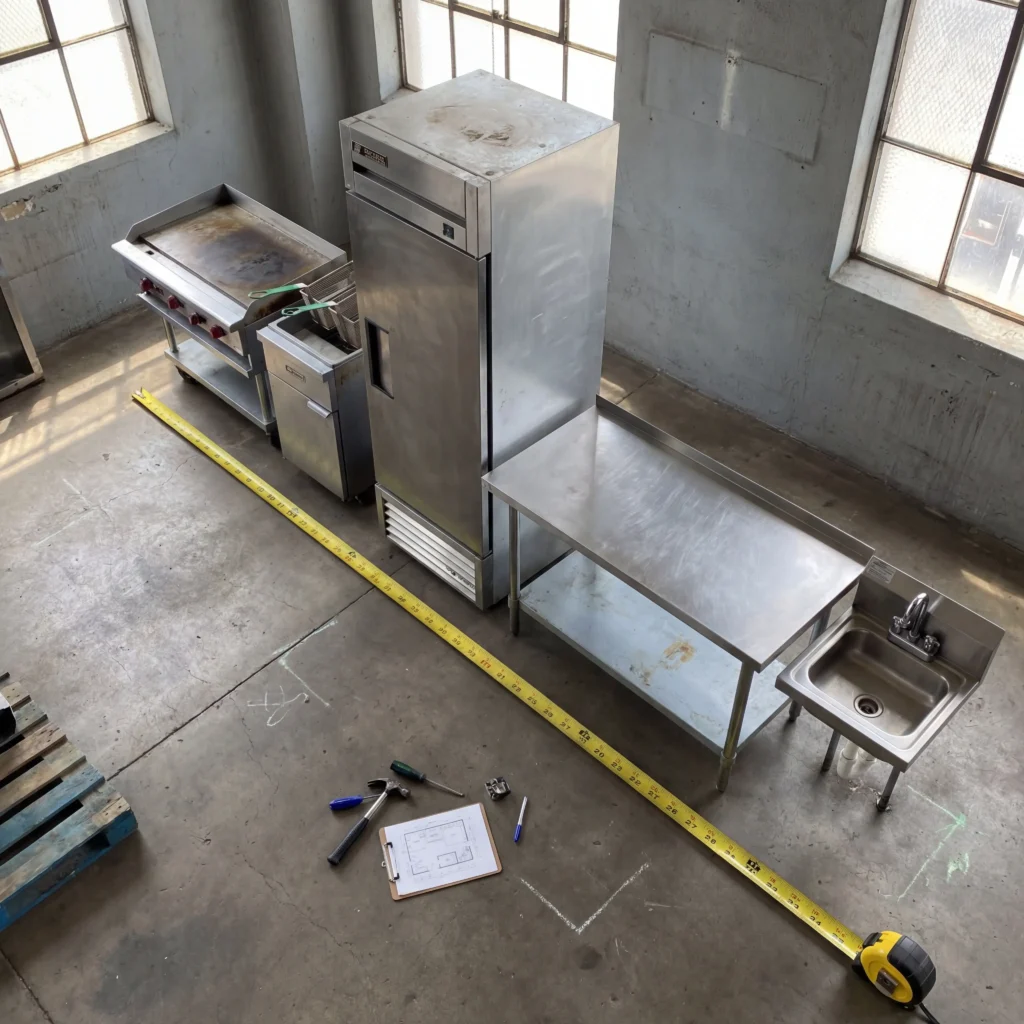
Notice that BBQ and pizza both point to trailers rather than trucks — that is driven entirely by equipment weight. A 400-pound smoker or brick oven changes the structural requirements of your build. If your concept falls between two categories, optimize for the heavier equipment requirement. Underestimating weight is the mistake I see most frequently, and it leads to expensive mid-build redesigns.
Beyond equipment, your operating environment matters. Dense urban routes favor smaller, more maneuverable vehicles. Festival circuits reward larger rigs capable of high-volume service. Suburban commissary-based operations offer more parking flexibility, which makes trailers viable. If you plan to cater weddings or private events, the vehicle itself becomes part of your brand presentation — our guide on food trucks for parties covers how event operators choose vehicles specifically for client-facing appeal.
The Five-Year Cost Comparison Most Operators Skip
Here is where a truck for food truck decision gets interesting — and where most buyers make their most expensive mistake. The sticker price of a vehicle represents roughly 30 to 40 percent of your true five-year cost. Fuel, maintenance, insurance, and depreciation make up the rest, and these numbers vary dramatically by vehicle type.
I built this comparison model for our three-truck operation and have since shared it with a dozen operators I consult with. The ranges below reflect typical costs for a mid-volume urban food truck operation:
| Cost Category | Step Van (Used) | Cargo Van (Used) | Food Trailer + Tow Vehicle |
|---|---|---|---|
| Vehicle purchase | $25,000–$45,000 | $15,000–$30,000 | $15,000–$35,000 (trailer + tow) |
| Conversion / build-out | $30,000–$60,000 | $20,000–$40,000 | $15,000–$35,000 |
| Fuel (5 years) | $24,000–$42,000 | $14,000–$24,000 | $18,000–$30,000 |
| Maintenance (5 years) | $12,000–$20,000 | $8,000–$15,000 | $10,000–$18,000 |
| Insurance (5 years) | $15,000–$25,000 | $12,000–$20,000 | $15,000–$25,000 |
| Estimated 5-year total | $106,000–$192,000 | $69,000–$129,000 | $73,000–$143,000 |
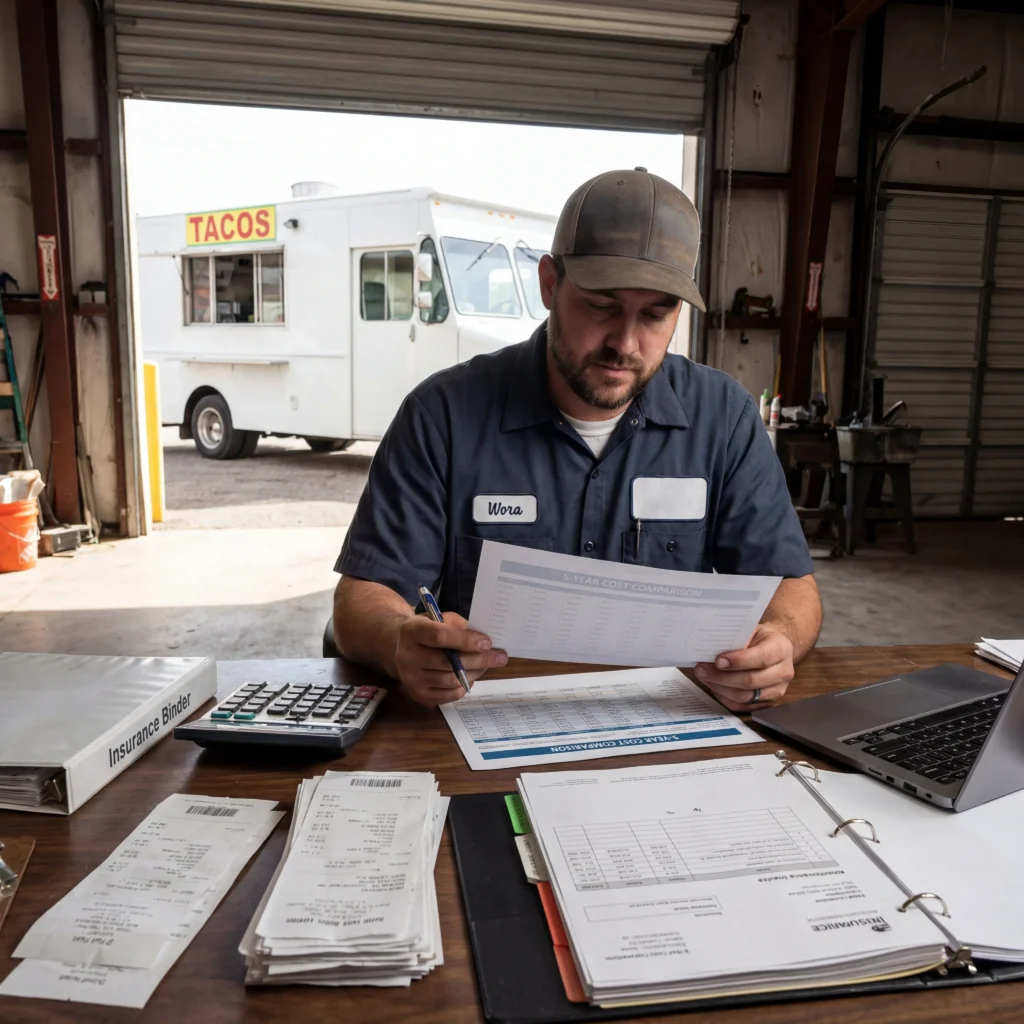
These are estimates based on my experience operating in the Texas market. Your local fuel prices, insurance rates, and maintenance costs will shift these numbers. But the relative relationships hold: cargo vans consistently carry the lowest total cost of ownership for small-menu operations, step vans justify their higher cost through volume capacity and resale value, and trailers fall in between when you account for the tow vehicle’s full operating cost.
The Bottom Line: The operator who spends $25,000 on a used step van and then $42,000 in fuel over five years has spent more on fuel than on the truck. Run the total math before you sign. The cheapest vehicle to buy is not always the cheapest vehicle to own.
A Pre-Purchase Inspection Prevents the Most Expensive Surprises
Whether you are looking at a used step van, a pre-owned Sprinter, or a trailer from an online listing, a professional mechanical inspection is not optional. The frame and floor are where I have seen the most expensive surprises in my years of evaluating vehicles — and the cost of missing a problem here can turn a $25,000 purchase into a $40,000 project before you install a single appliance.
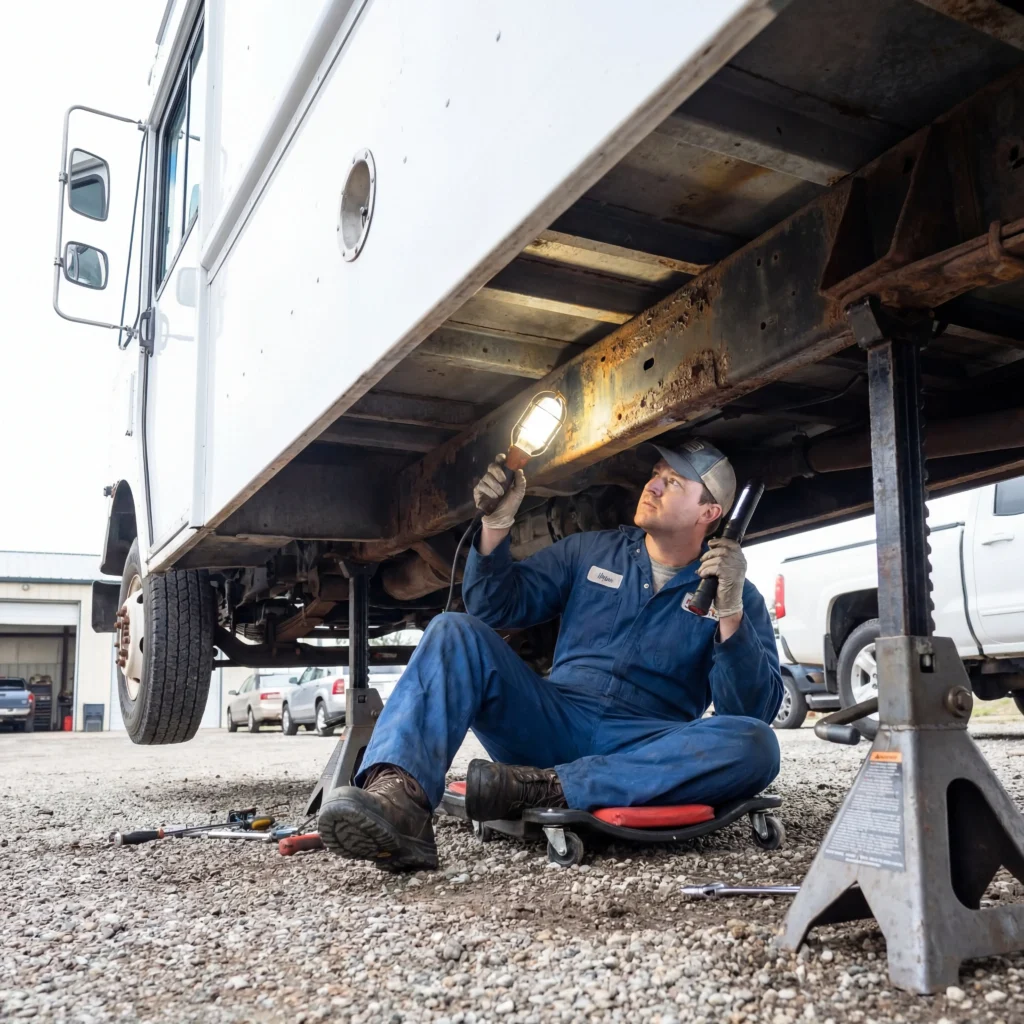
Here is the inspection sequence I recommend, based on what has saved me and operators I work with the most money:
- Engine and transmission: Hire a diesel or commercial vehicle mechanic — not a general shop. Request a compression test and transmission fluid analysis. Dark or burnt-smelling fluid is a walk-away signal.
- Frame and undercarriage: Crawl underneath. Look for rust scaling, cracked welds, and soft spots in crossmembers. If the seller will not let you inspect the underside, that tells you everything you need to know.
- Floor integrity: Push hard on the floor in multiple locations, especially near the rear doors and along the walls. Soft or spongy wood subfloor means moisture damage and a full floor replacement — typically $3,000 to $6,000.
- Electrical panel: Verify total amperage capacity, GFCI outlet placement, and whether the system can handle your planned equipment load. An underpowered electrical system is the single most common reason food truck operators face unexpected upgrade costs in their first year of operation.
- Plumbing system: Test the water pump, check freshwater and greywater tank integrity, and verify hot water heater function. Leaks in a food truck are not just inconvenient — they cause floor rot and health code violations.
- Previous kitchen systems (if converting a used food truck): Check hood condition, fire suppression system certification dates, and propane line integrity. Expired fire suppression certification means recertification cost before you can legally operate.
For keeping your equipment running at safe temperatures during service, especially in hot-climate markets, our food truck AC guide covers cooling solutions that protect both operators and temperature-sensitive inventory.
Putting It Into Practice
📅 Today: List every piece of kitchen equipment your menu requires. Measure each item’s footprint (length × width) and look up its weight. Add the total and add 20 percent for clearance and ancillary items (fire extinguisher, hand-wash sink, storage).
📅 This Week: Visit at least three vehicle listings in your target category. Bring a tape measure and a flashlight. Crawl under each vehicle. Photograph the frame, floor, electrical panel, and engine compartment. Compare your equipment footprint against actual interior dimensions.
📅 This Month: Arrange a professional inspection on your top candidate. Run the five-year TCO calculation using the framework above with your local fuel prices and insurance quotes. Verify CDL requirements and permit classifications with your state DMV. If the numbers work, secure financing and negotiate.
Tools You’ll Need: Tape measure (25 ft), flashlight, smartphone camera, a notepad for recording GVWR and VIN numbers, and your equipment footprint spreadsheet.
Frequently Asked Questions
What kind of truck for food truck is best for a full menu?
Step vans like the Chevy P30 or Freightliner MT45 are the standard choice for full-service menus requiring multiple cooking stations, refrigeration, and a two-person crew. They offer 16 to 22 feet of interior length and payload ratings that accommodate heavy commercial kitchen equipment. Our top rated food trucks guide compares specific models.
Do I need a CDL to drive a food truck?
Most food trucks do not require a CDL because their gross vehicle weight rating falls below the 26,000-pound federal threshold. However, if you tow a heavy trailer, the combined weight of your tow vehicle plus trailer could exceed that line. Requirements also vary by state. Always verify with your DMV before purchasing.
How much does it cost to convert a truck into a food truck?
Conversion costs typically range from $20,000 to $60,000 depending on vehicle type, equipment list, and build quality. Cargo van conversions tend to run 25 to 40 percent less than step van projects because of the smaller interior footprint. These figures do not include the base vehicle purchase price.
What is the best van to convert into a food truck?
The Ford Transit is widely considered the most versatile option for cargo van conversions due to its multiple roof heights, 270-degree rear door opening, and strong parts network. The Mercedes Sprinter offers better diesel fuel economy and premium build quality. The RAM ProMaster provides a lower floor height that simplifies loading, at a slightly lower starting price.
Are electric food trucks practical for daily use?
Electric food trucks are practical for operators with fixed urban routes under 80 to 100 miles per day and access to overnight Level 2 charging. They offer meaningfully lower fuel and maintenance costs over time. They are less practical for event circuits or locations without charging infrastructure. Our food warmer guide covers equipment that pairs well with electric setups where power management matters.
How do I calculate the true cost of owning a food truck vehicle?
Add five categories: vehicle purchase price, conversion or build-out cost, projected fuel cost over five years, estimated maintenance over five years, and annual insurance premiums multiplied by five. The five-year total cost of ownership ranges from roughly $69,000 for a used cargo van operation to $192,000 for a fully built step van — and those numbers shift significantly based on your local market.
Key Takeaways and Your Next Move
Quick Recap:
- Match your equipment to your vehicle, not the other way around. Your cook line determines the minimum interior length and payload capacity you need — that single calculation eliminates half the options and clarifies the right vehicle category.
- Run the five-year TCO, not just the purchase price. The cheapest vehicle to buy is often not the cheapest to own. Fuel and maintenance compound over five years into figures that dwarf the sticker price difference between vehicle types.
- Get a professional inspection on any used vehicle. Frame rust, floor rot, and underpowered electrical systems are the three most common sources of budget-destroying surprises. A $300 inspection can save $10,000.
Your Next Steps:
- If you’ve identified your vehicle type and want to compare specific builds → Best Food Trucks
- If you’re planning events and need a vehicle that doubles as a brand statement → Food Trucks for Parties
Back to the Big Picture: 📚 Food Truck Equipment Reviews — the complete hub for every equipment and vehicle decision.
The pricing and operational data in this guide reflects my experience running a three-truck operation in the Texas market as of early 2026. Costs, regulations, and permit requirements vary by state and municipality. Always verify specifics with local authorities, your insurance provider, and a qualified mechanic before making purchasing decisions. I’m not a CPA or attorney — consult licensed professionals for tax and legal questions.
— Marcus Reyes
