


Picture this: one owner pulls up to a Saturday farmers market, sells out of smash burgers by noon, and drives home with a couple thousand in cash. Another owner sits in an empty parking lot, watching their beautifully wrapped truck bleed money while the generator hums. Same concept. Wildly different outcomes.
What separates these two? It’s not luck. It’s not even the burger recipe (though that helps). The difference comes down to preparation, the right concept, and avoiding the mistakes that sink most first-timers before they hit month six.
A burger food truck can realistically earn between 10% and 25% profit margins, with annual revenues ranging from under $100,000 to over $500,000 depending on location, menu strategy, and how hard you’re willing to grind. Startup costs typically land between $50,000 and $100,000, though scrappy operators have launched for less.
This guide covers everything: why burgers work so well on wheels, what it actually costs to get rolling, the smash burger trend you need to understand, equipment you’ll need, permits that trip people up, and the mistakes I’ve watched new owners make over and over. If you’re exploring mobile food as a business, our complete food truck startup guide covers the full picture. But if burgers are calling your name? Keep reading.
Important Notice: The information in this article reflects personal experience and industry research as of March 2026. It is not professional business, legal, or financial advice. Prices, regulations, and market conditions vary by location and change over time. Consult qualified professionals before making business decisions.
Operating commercial food service equipment involves risks including burns, fires, and equipment malfunction. Follow all manufacturer safety guidelines, ensure proper ventilation, maintain required fire suppression systems, and comply with local health and safety regulations. Equipment specifications mentioned are examples; verify compatibility with your specific setup and local requirements.
Why Burgers Are Perfect for Food Trucks
Can we talk about why burgers and food trucks just make sense together? I’ve seen a lot of food concepts come through my mentoring sessions (Filipino fusion, gourmet popsicles, you name it), but burgers consistently perform. There’s a reason for that.
Burgers have what I call “universal yes” energy (everyone already wants a burger). Kids want them. Adults want them. Late-night crowds want them. You’re not explaining your concept to confused customers. Everyone already knows what a burger is. That built-in familiarity means faster ordering, shorter lines, and less friction at the window.
Here’s the thing about prep and speed: burgers are forgiving. You can prep patties ahead of time. Your ingredients (lettuce, tomato, onion, cheese) work across your whole menu. When the lunch rush hits, you’re assembling, not cooking from scratch. I’ve watched burger trucks serve 100+ customers during peak festival hours. Try that with made-to-order tacos.
The profit math works too. Ground beef isn’t cheap, but it’s cheaper than brisket or lobster. A basic cheeseburger might cost you $2.50 to make and sell for $9. Load it with premium toppings (bacon, avocado, special sauce) and you’re pushing $12 to $14. Your margins stay healthy because the base ingredient is accessible.
Menu flexibility seals the deal. Start with three burgers. Add a fourth when you nail your system. Swap seasonal toppings. Launch a “burger of the month” for social media buzz. You’re not locked into a rigid concept. For more on building a menu that actually sells, check out our food truck menu guide.
How Much Does It Cost to Start a Burger Food Truck?
Nobody tells you this, but the “average” startup cost you see online hides a massive range. I’ve met owners who launched for $35,000 with a used trailer and elbow grease. I’ve also met owners who dropped $150,000 on a custom build and regretted half of it.
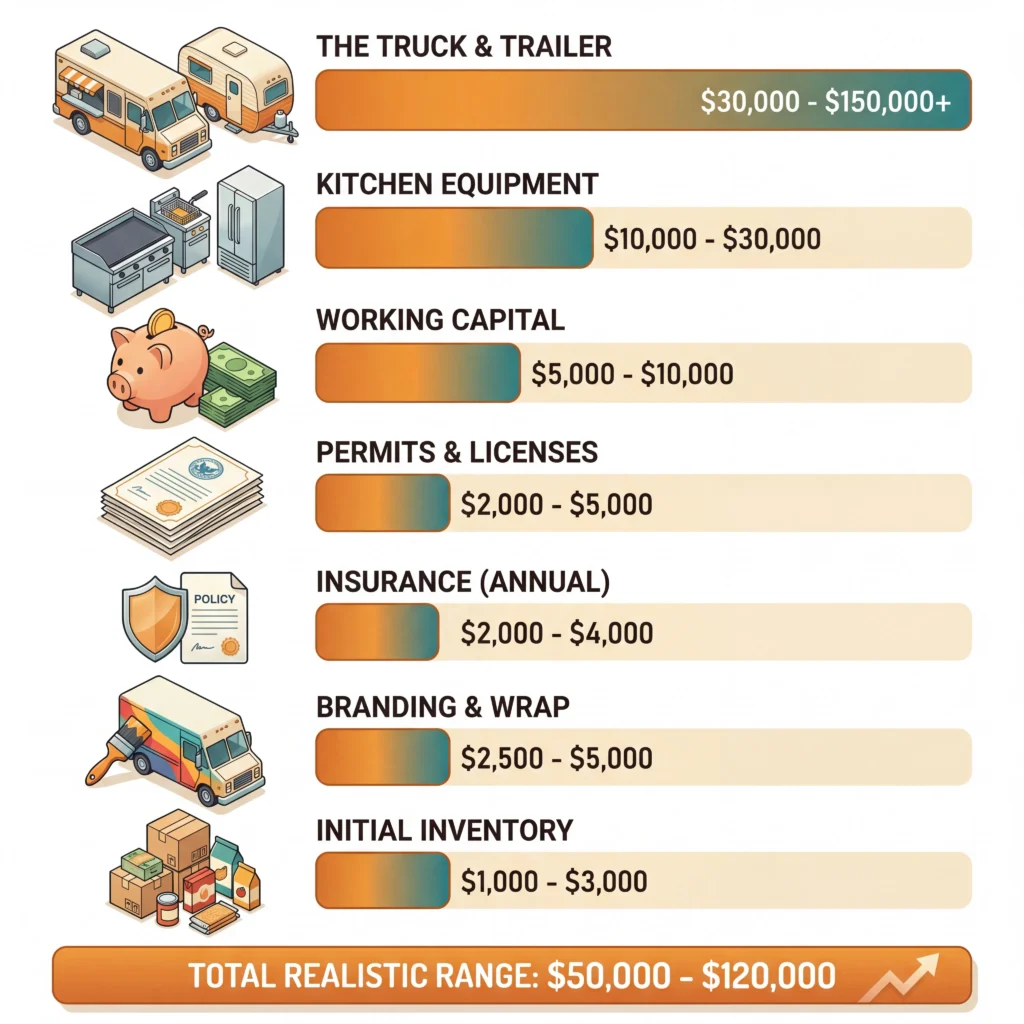
Here’s a realistic breakdown of where your money goes (prices reflect estimates as of early 2026 and vary based on location, condition, and market):
The truck or trailer itself eats the biggest chunk. A used food truck in decent condition runs $30,000 to $80,000. New custom builds start around $80,000 and climb past $150,000 easily. Trailers cost less (typically $15,000 to $40,000 used) but limit where you can operate. If you’re weighing this decision, our food truck vs food trailer comparison breaks down the trade-offs.
Equipment inside adds another $10,000 to $30,000. For burgers, you need a solid flat-top grill (that’s non-negotiable), a fryer for sides, refrigeration, and a reliable generator. We’ll cover specifics in the equipment section.
Permits, licenses, and inspections vary wildly by location. Budget $2,000 to $5,000 to be safe. Some cities make this easy. Others (looking at you, California) make it a months-long process with fees at every turn.
Initial inventory (food, packaging, supplies) runs $1,000 to $3,000 for your first week of service.
Insurance typically costs $2,000 to $4,000 annually for basic coverage.
Branding and wrap for your truck runs $2,500 to $5,000 for a professional look.
Working capital is the part people forget. You need cash to cover expenses before revenue kicks in. I recommend $5,000 to $10,000 minimum as a cushion.
Total realistic range: $50,000 to $120,000 for a properly equipped burger truck. Can you do it cheaper? Yes, but you’ll likely sacrifice equipment quality or operate with tighter margins. If the numbers feel overwhelming, Marcus has a detailed breakdown of food truck financing options that covers SBA loans, equipment financing, and creative funding strategies worth exploring.
Burger Food Truck Concepts That Actually Work
Not all burger concepts are created equal. Some crush it. Others struggle to find their audience. After watching dozens of trucks launch (and a few fail), patterns emerge.
The classic cheeseburger truck works because it’s simple. Three to five burger options, quality beef, fresh toppings, done. You’re not reinventing anything. You’re just doing the basics really well. This concept has the lowest learning curve and appeals to the widest audience.
Gourmet burger trucks charge more by adding premium ingredients. Truffle aioli. Wagyu beef. Brioche buns. Unusual cheese combinations. This works in urban areas with higher incomes and foodie culture. It struggles in blue-collar neighborhoods where $15 burgers feel ridiculous.
Smash burger trucks (more on this in the next section) have exploded in popularity. The technique creates those crispy, lacy edges people obsess over. It’s visually distinctive, which helps on social media. And the cooking method is actually efficient for high-volume service.
Slider concepts let customers try multiple flavors without committing to one burger. Great for events and festivals where people want variety. The downside? Lower per-customer revenue and more assembly complexity.
Breakfast burger trucks tap into morning crowds by adding fried eggs, bacon, and breakfast potatoes. Pair with coffee and you’ve got a complete morning menu that most burger trucks ignore entirely.
Plant-based burger trucks serve a growing market. Options like Beyond Meat and Impossible patties let you capture health-conscious customers and vegetarians without abandoning your burger identity. The margins on plant-based can actually exceed traditional beef if you price accordingly.
Build-your-own burger trucks put customers in control. They choose patty, cheese, toppings, sauce. This creates engagement and Instagram moments. It also creates longer lines and more chances for order mistakes. Proceed with caution.
The concept that works is the one that fits your market, your personality, and your operational capacity. I’ve seen “boring” classic trucks outperform flashy gourmet concepts because the owner understood their customers.
The Smash Burger Phenomenon: Is It Right for You?
Real talk: smash burgers aren’t just a trend anymore. They’re becoming the default expectation for a lot of burger lovers. If you’re starting a burger truck in 2026, you need to at least understand what’s happening here.
The technique is simple in theory. You take a ball of ground beef, smash it flat on a screaming hot griddle, and let the Maillard reaction create those crispy, caramelized edges. The result looks different from a traditional thick patty. It tastes different. People photograph it and share it. That visual distinctiveness matters when you’re competing for attention.
From an operational standpoint, smash burgers cook faster than thick patties (typically around 90 seconds per side for a thin smash). Faster cooking means more burgers per hour. More burgers per hour means more revenue during your peak windows. For a food truck where lunch rush makes or breaks your day, that speed advantage is real.
The equipment needs shift slightly. You want a flat-top griddle with serious heat retention. Cast iron or heavy steel. Flimsy griddles won’t give you the sear. You also need good smashing tools (a heavy-duty press or sturdy spatula) and a system for scraping the griddle between batches.
Here’s where it gets honest: smash burgers aren’t universally beloved. Some customers prefer thick, juicy patties. If your market skews toward traditional tastes, forcing the smash technique might backfire. The best approach? Offer both. Let the customer choose. You’ll learn quickly which one your crowd prefers.
Building Your Burger Food Truck Menu
Your menu is where the magic happens (or where everything falls apart). I’ve seen trucks with incredible burgers fail because their menu was a confusing mess. I’ve seen mediocre burgers succeed because the menu just made sense.
Start smaller than you think. Three to five burger options maximum when you launch. Maybe two sides. One or two drinks. That’s it. You can always add items later. You cannot easily recover from a chaotic first month where you’re drowning in prep and order mistakes.
Every menu item should share ingredients. If your signature burger uses caramelized onions, put those onions on at least one other item. If you’re making a special sauce, use it in multiple places. Shared ingredients mean less waste, simpler inventory, and faster prep.
Price for profit, not just sales. That $8 burger might fly out the window, but if it only nets you $2 profit after food costs, labor, and overhead? You’re working really hard to barely break even. Aim for 25% to 35% food cost on each item. A burger that costs $3 to make should sell for $9 to $12.
Consider combo pricing. A burger alone might be $10. Burger plus fries plus drink for $15. The combo increases average ticket size and feels like a deal to the customer. Most burger trucks I’ve mentored see 60% or more of orders as combos.
Your menu board matters more than you think. Big, clear text. Easy-to-scan layout. Photos if possible. People standing in line should be able to read and decide within 30 seconds. Confusion creates hesitation. Hesitation creates longer lines. Longer lines create walkways. I’ve got more on this in our food truck menu planning guide.
Essential Equipment for a Burger Food Truck
Let’s talk gear. You can’t make great burgers without the right equipment, and the wrong equipment will frustrate you daily. Equipment specifications below are examples that work for many operators; your specific needs may vary based on menu, volume, and local requirements.
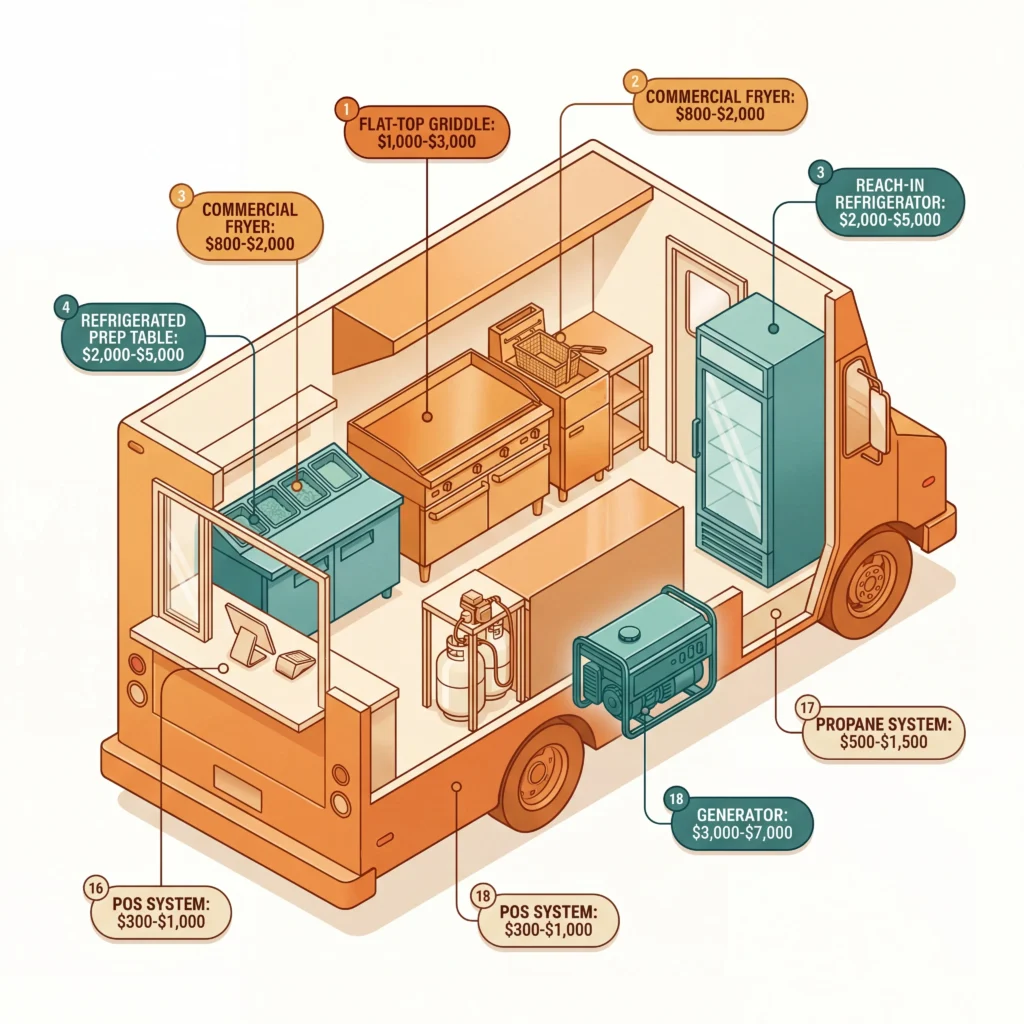
Flat-top griddle: This is your workhorse. For burgers, you want a commercial-grade griddle with at least 36 inches of cooking surface (48 inches is better for high volume). Brands like Vulcan, Star Manufacturing, and Atosa make reliable options that hold up under daily use. Budget $1,000 to $3,000 new. Used units in good condition run $500 to $1,500. Don’t cheap out here.
Commercial fryer: If you’re serving fries (and you probably should), you need a dedicated fryer. A 40 to 50 pound capacity unit handles most food truck volumes. Budget $800 to $2,000 new.
Refrigeration: A refrigerated prep table keeps your toppings cold and organized at arm’s reach while you work. You’ll also need a reach-in refrigerator or freezer for backup inventory. Combined budget: $2,000 to $5,000.
Generator: Most burger trucks need 10,000 to 15,000 watts to run everything. Propane or gas generators are common. Budget $3,000 to $7,000 for a quality unit that won’t die mid-service. Our food truck generator guide covers the details on sizing and fuel options.
Propane system: Your griddle and fryer likely run on propane. You’ll need tanks, regulators, and proper ventilation. Budget $500 to $1,500 for initial setup. Always keep a backup tank on hand.
POS system: You need a way to take orders and process payments efficiently. Square, Toast, and Clover all have food truck friendly options with offline capability for spotty wifi situations. Budget $300 to $1,000 for hardware plus monthly transaction fees. Toast integrates well with kitchen display systems if you’re doing high volume.
Smallwares: Spatulas, burger presses, tongs, squeeze bottles, thermometers, cutting boards, knives. These smaller items add up to $500 to $1,000.
Total equipment budget (beyond the truck itself): roughly $10,000 to $25,000 depending on whether you buy new or used. For deep dives on specific equipment categories, Darnell’s equipment guides cover maintenance, troubleshooting, and what to look for when buying used.
Permits and Licenses You’ll Need
Here’s where it gets overwhelming (and I say that as someone who ugly cried in a health department parking lot during my own permit process). Every city, county, and state has different requirements. What I’m sharing here is a general framework. You absolutely must check your local regulations.
Business license: Basic requirement everywhere. Register your business, pay a fee, get the license. Usually $50 to $400 depending on location.
Food service license: Issued by your local health department. Requires an inspection of your truck. Fees range from $100 to $1,000 annually.
Food handler certification: You and anyone working on your truck need food safety certification. ServSafe is the most common program. Budget $15 to $200 per person depending on your state’s requirements. Some states accept online courses; others require in-person training.
Mobile food vendor permit: Separate from your food service license. This permits you to actually operate as a mobile vendor. Some cities require multiple permits for different zones.
Fire safety permit: Your truck needs fire suppression equipment (usually an Ansul system for the griddle and fryer area). The fire department inspects and permits this. Budget $200 to $500 for the permit, plus $3,000 to $5,000 for the suppression system if your truck doesn’t have one.
Health department inspections: Expect announced and unannounced inspections. Your commissary (the commercial kitchen where you prep and store food) also needs inspection.
Vehicle registration: Your truck is a vehicle. It needs plates, registration, and possibly commercial vehicle permits depending on weight.
Parking permits: Many cities require permits to park and vend in specific locations. Fees and availability vary wildly.
The process takes anywhere from two weeks (in food truck friendly cities) to six months (in heavily regulated areas). Start this process before you buy your truck. Nothing worse than owning a $60,000 vehicle you can’t legally operate. For the full breakdown, our food truck permits guide walks through each requirement.
Burger Food Truck Catering: Your Secret Revenue Stream
Most burger truck owners focus entirely on daily street vending. They’re missing a massive opportunity.
Catering (private events, corporate lunches, weddings, festivals) can generate more revenue per hour than any street location. When you book a catering gig, you’re guaranteed a crowd. No hoping customers show up. No competing with three other trucks on the block. Just you, a hungry group, and a set payment.
Corporate catering is particularly lucrative. Companies pay premium rates for office lunches, team building events, and company picnics. A single corporate booking might pay $2,000 to $5,000 for a few hours of service. Compare that to grinding street corners hoping for $800 days.
Wedding catering has exploded for food trucks. Couples love the casual vibe and unique experience. They’re also willing to pay well for it. Wedding bookings often include a minimum spend guarantee (regardless of how much food gets eaten), which protects your downside.
Festival and event work requires applications (sometimes months in advance), but the payoffs are huge. A busy festival day can generate five figures in revenue if your location is good.
Platforms like Roaming Hunger, Food Truck Catering, and local event booking sites can help you find gigs. Many trucks also build relationships directly with corporate offices, wedding planners, and event coordinators in their area.
To get catering business, you need a separate page on your website with catering info, packages, and pricing. You need to actively pitch to event planners and corporate offices. You need photos from past events to build credibility. It’s a different sales motion than street vending, but the effort pays.
Naming and Branding Your Burger Truck
Your truck’s name and branding do more work than people realize. A forgettable name gets forgotten (obviously). A clever name gets shared, remembered, and searched.
Good burger truck names tend to share a few traits: they’re short (three words max), they hint at what you sell, and they have personality. “Smash Bros Burgers” tells you exactly what to expect. “Dave’s Food Truck” tells you nothing.
Avoid names that are hard to spell, hard to pronounce, or too similar to existing businesses. You want people to find you when they Google. You want them to remember you when recommending to friends.
Your visual branding (logo, colors, truck wrap) should be bold and readable from 50 feet away. People driving by have maybe three seconds to register your truck. If your logo is too detailed or your colors are too muted, you’re invisible.
Consistency matters across every touchpoint: truck, menu board, social media, website, packaging. Everything should feel like it belongs to the same brand. That cohesion builds trust and recognition.
If you want more naming inspiration, our food truck names guide has ideas sorted by style and concept.
Marketing Your Burger Food Truck
You could have the best burger in your city and still fail if nobody knows you exist. Marketing isn’t optional. It’s survival.
Social media is your primary channel, and Instagram is probably where you start. Food photographs well (especially burgers with those crispy smash edges). Post daily when you’re operating: your location, your specials, your behind-the-scenes prep. Use local hashtags. Engage with people who comment. Show your personality.
Your Google Business Profile might matter more than Instagram for discovery. When someone searches “burger food truck near me,” Google shows the map pack. If you’re not listed, you don’t exist for that search. Claim your profile, keep your hours updated, and actively request reviews from happy customers.
Location announcements should go out every single day you operate. “We’re at Main and 5th today, 11am to 2pm!” Post it on Instagram, Facebook, Twitter, and your Google profile. Consistency trains your audience to check for your location.
Events and festivals put you in front of hundreds (sometimes thousands) of new customers in a single day. Even if the booth fee hurts, the exposure and new followers usually pay dividends.
Collaborate with other local businesses. Park at breweries (they have thirsty customers who need food). Partner with local businesses for their events. Cross-promote with complementary food trucks (a taco truck isn’t competition if you’re doing burgers).
Loyalty programs work. Simple punch cards (“buy 9, get the 10th free”) create repeat customers. Digital options through Square or Toast make tracking easy.
Common Mistakes Burger Truck Owners Make
I’ve mentored over a dozen food truck owners through their first year. I’ve seen the same mistakes repeat across almost all of them. If you can avoid these, you’re ahead of most.
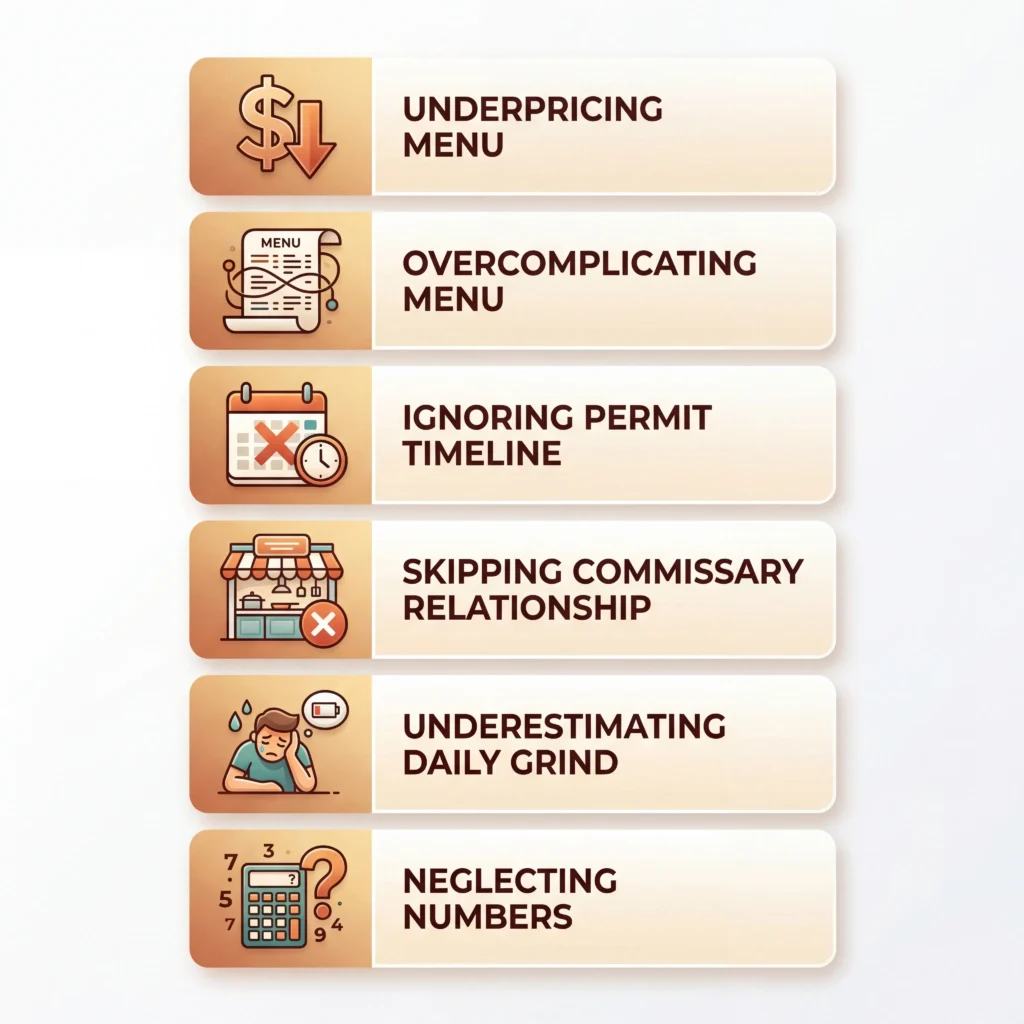
Underpricing the menu kills more trucks than bad food. New owners are scared to charge what they need. They price burgers at $7 because “that’s what the other guy charges” without realizing the other guy is barely surviving. Price for your actual costs plus profit margin. If customers won’t pay, you’re in the wrong location or need a better product.
Overcomplicating the menu creates operational chaos. Every additional item adds prep time, inventory complexity, and potential for mistakes. Start simple. Expand only when your system runs smoothly.
Ignoring the permit timeline leaves trucks sitting idle. Some owners buy a truck, then realize permits take four months. Meanwhile, they’re paying for a truck that’s generating zero revenue. Start the permit process first.
Skipping the commissary relationship creates legal problems. Most jurisdictions require food trucks to operate from a licensed commissary (commercial kitchen). You can’t just prep food at home. Secure your commissary before you open.
Underestimating daily operations grind burns people out. Food truck life is early mornings, late nights, standing on your feet, dealing with equipment issues, and working through exhaustion. The romance fades fast. Go in with eyes open.
Neglecting the numbers means slow death by a thousand cuts. You must track food costs, labor costs, and daily revenue. If you’re not profitable, you need to know why. I’m bad with spreadsheets myself (ask me about the time I thought I was making money but was actually losing $300 a week), but even I force myself to review numbers weekly.
Ignoring seasonality catches owners off guard. If you’re in Minnesota, your January looks very different from your July. Plan for slow seasons with savings, catering focus, or indoor event partnerships. Florida operators have opposite concerns during summer heat.
FAQ: Your Burger Food Truck Questions Answered
Are burger food trucks actually profitable?
They can be, with the right execution. Profit margins typically range from 10% to 25% after you account for food costs, labor, truck expenses, and overhead. Annual revenue varies enormously based on location and hours. Some trucks gross $50,000 in a year. Others clear $500,000. Profitability depends on controlling costs, pricing correctly, and operating consistently. It’s achievable but not automatic.
How long does it take to start a burger food truck?
Plan for three to six months from decision to opening day. The truck purchase or build takes time. Permits and inspections take time (sometimes lots of it, depending on your city). Equipment installation, menu development, branding, and practice runs add up. Rushing this process usually means expensive mistakes.
What’s the most profitable burger to sell?
Gourmet or specialty burgers with premium toppings typically carry the highest margins. A $4 food cost burger selling for $14 beats a $2.50 burger selling for $8. That said, classics sell in higher volumes. The sweet spot is often offering both: a value option that moves fast and a premium option that pads margins.
Do I need culinary experience to run a burger truck?
Helpful but not required. Burgers aren’t technically difficult to cook. What matters more is consistency, speed, and customer service. Many successful burger truck owners came from non-food backgrounds. They learned through practice, watching YouTube tutorials, and making mistakes. If you can follow recipes and stay organized under pressure, you can cook burgers. I had culinary school training and still made plenty of rookie errors my first year.
Should I buy a new or used food truck?
Used trucks cost significantly less and can work great if inspected carefully. New trucks offer warranties and customization but cost $80,000 to $150,000 or more. Most first-time owners do better starting used. You’ll learn what you actually need through operation, and your second truck (if you scale) can be customized perfectly.
What’s the biggest challenge running a burger food truck?
Consistency across all dimensions. Not just the burger quality (that’s the easier part), but showing up every day, managing inventory, dealing with equipment issues, handling slow days without panic, and staying motivated when the grind wears you down. The trucks that survive year one are owned by people who kept showing up even when it wasn’t fun.
Can I run a burger food truck part-time?
Yes, but profitability gets harder. The fixed costs (truck payment, insurance, permits, commissary fees) don’t disappear when you’re not operating. Part-time works best if you have low overhead and focus on high-value events (festivals, catering) rather than daily street vending.
Ready to Launch? Your Next Steps
Starting a burger food truck is absolutely possible. Plenty of people have done it with less experience and fewer resources than you probably have right now. The path forward involves getting clear on costs, choosing a concept that fits your market, sorting out permits and equipment, and building a menu that’s profitable and manageable.
A few things to take with you:
- Budget realistically ($50K to $120K for a proper setup, less if you’re scrappy with a trailer)
- Start with a simple menu and expand once your system runs smoothly
- Understand the smash burger trend and decide if it fits your vision
- Don’t underestimate permits (start the process before buying a truck)
- Catering can transform your revenue if you pursue it actively
If you want more detail on any topic covered here:
- How to Start a Food Truck breaks down the full startup process step by step
- Food Truck vs Food Trailer helps you pick the right vehicle type for your situation
- Do Food Trucks Really Make Money? goes deeper on profitability expectations and realistic numbers
For the complete picture on starting, running, and growing a mobile food business, our full Food Truck Startup Guide ties everything together.
Your burger truck is out there waiting to get built. Now you know what it takes to build it right.
— Jolene
