
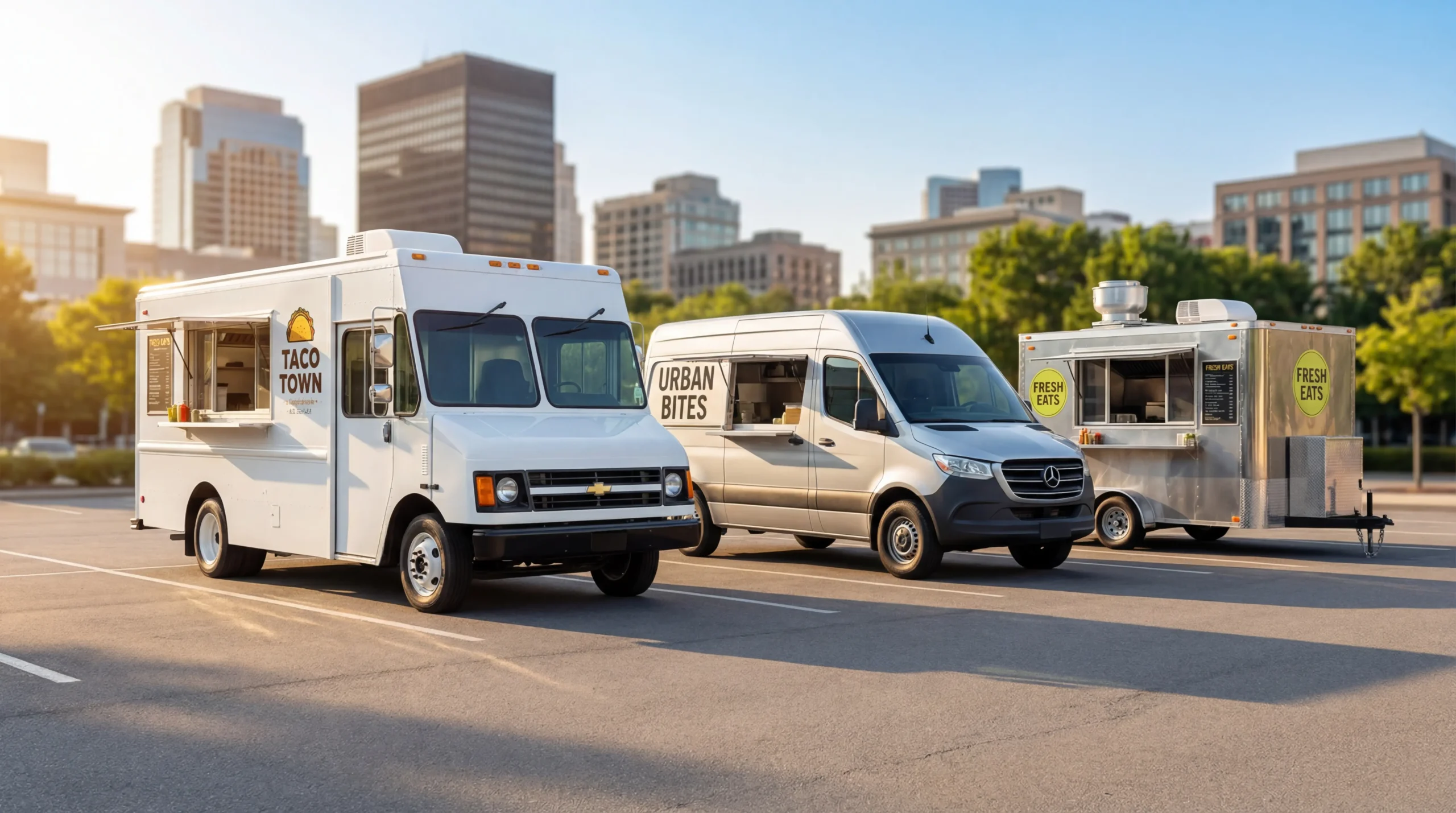

Choosing the right truck for food truck operations is the single most important decision you’ll make during startup. The vehicle you select will determine up to 40% of your total startup costs—and the wrong truck for food truck conversion can drain your profits for years through maintenance, fuel inefficiency, and operational limitations. Based on my analysis of equipment costs across our three-truck taco operation, the vehicle selection directly impacts everything from your daily fuel expenses to your maximum revenue capacity.
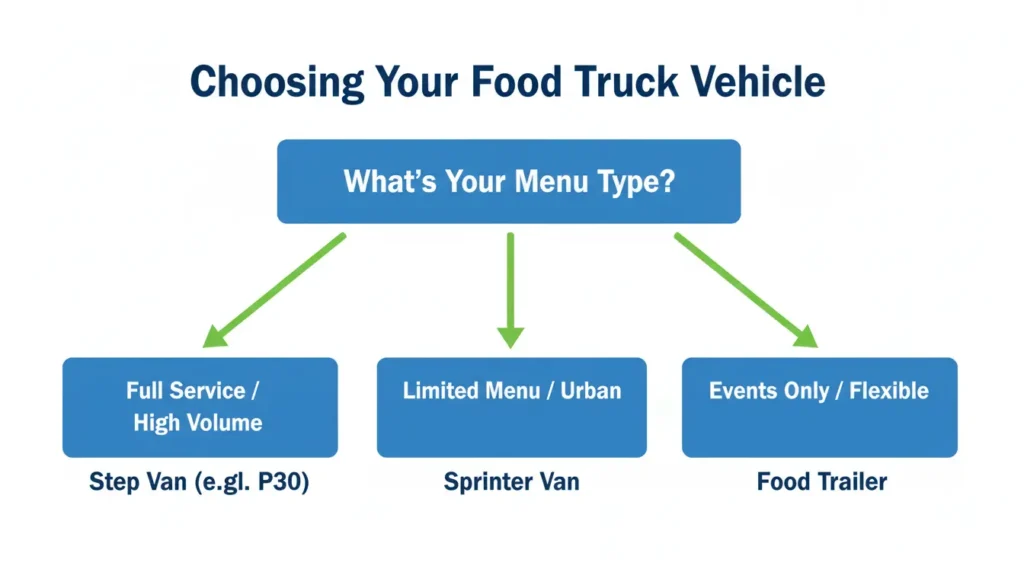
Bottom line: The best truck for food truck depends on your menu type, operating environment, and budget. Step vans like the Chevrolet P30 offer the best balance of space and reliability for most operators, while Sprinter vans excel in urban environments where maneuverability matters. Trailers provide maximum flexibility but require a tow vehicle. In this guide, I’ll break down the data on each truck for food truck option so you can make an informed decision that protects your investment.
For a broader perspective on evaluating mobile food equipment, our comprehensive food truck equipment reviews pillar covers everything from cooking gear to refrigeration systems that complement your vehicle choice.
📦 Related Reading: This guide focuses on the truck for food truck conversion itself. For specific equipment to install inside your truck, see our guides on food warmers for food trucks and AC systems for food trucks.
📖 Key Terms Defined:
Step Van — A commercial vehicle with a walk-in cargo area and low floor height, originally designed for delivery services. Popular brands include Chevrolet P30, Ford E-Series, and Grumman/Morgan Olson. The design allows standing operation without crouching.
GVWR (Gross Vehicle Weight Rating) — The maximum total weight a vehicle can safely carry, including the vehicle itself, passengers, cargo, and equipment. For food trucks, typical GVWR ranges from 10,000-16,000 lbs. Exceeding GVWR voids insurance and creates liability.
Buildout — The complete interior construction of a food truck kitchen, including flooring, walls, equipment installation, plumbing, electrical, ventilation, and finishing work. Buildout costs typically range from $30,000-$100,000 depending on complexity.
Quick Answer: Best Truck for Food Truck at a Glance
Before diving into the detailed analysis, here’s a comparison table summarizing the five main truck for food truck options used in the industry:
| Vehicle Type | Best For | Size Range | Price Range (Used) | Avg. MPG | Payload Capacity |
|---|---|---|---|---|---|
| Step Van | Full-service menus, high volume | 14-24 ft | $15,000-$45,000 | 8-12 | 3,000-6,000 lbs |
| Sprinter Van | Urban operations, limited menus | 12-18 ft | $20,000-$55,000 | 15-22 | 2,500-4,000 lbs |
| Food Trailer | Events, festivals, flexibility | 12-28 ft | $8,000-$35,000 | N/A | 3,500-10,000 lbs |
| Box Truck | Heavy-duty, commissary needs | 16-26 ft | $18,000-$50,000 | 8-14 | 5,000-10,000 lbs |
| Cargo Van | Simple menus, coffee/desserts | 10-14 ft | $8,000-$25,000 | 16-24 | 1,500-3,000 lbs |
My recommendation for most operators: A used Chevrolet P30 step van in the 18-20 foot range offers the optimal truck for food truck conversion, balancing kitchen space, reliability, parts availability, and resale value. When I evaluated 40+ equipment options before building out our second truck, the P30 consistently delivered the best ROI metrics.
Why Your Truck for Food Truck Choice Determines Your Profit Margin
The vehicle isn’t just transportation—it’s the foundation of your entire business. When I ran the numbers on our operation, I found that vehicle-related costs (fuel, maintenance, insurance, depreciation) represented 18-24% of our monthly operating expenses depending on the season.
Here’s what the data shows about how your truck for food truck selection impacts profitability:
Space directly correlates with revenue capacity. A 14-foot truck limits you to approximately $800-$1,200 in daily sales due to equipment constraints and prep area limitations. Moving to an 18-foot truck for food truck use typically increases daily capacity to $1,500-$2,500. The additional $5,000-$10,000 in vehicle cost often pays for itself within the first year through higher revenue potential.
Fuel efficiency compounds over time. The difference between 10 MPG (typical step van) and 18 MPG (typical Sprinter) translates to roughly $3,500-$5,500 in annual fuel savings if you’re driving 15,000 miles per year at current fuel prices. However, Sprinters typically cost $10,000-$15,000 more upfront, so the break-even point is 2-4 years depending on your mileage.
Maintenance costs vary dramatically by vehicle age and type. In my experience tracking expenses across our fleet, step vans over 15 years old averaged $340/month in maintenance, while those under 10 years old averaged $180/month. That $160 monthly difference ($1,920 annually) often justifies paying more for a newer truck for food truck operations.
The 5 Types of Truck for Food Truck Conversions Compared
Step Vans: The Industry Standard Truck for Food Truck
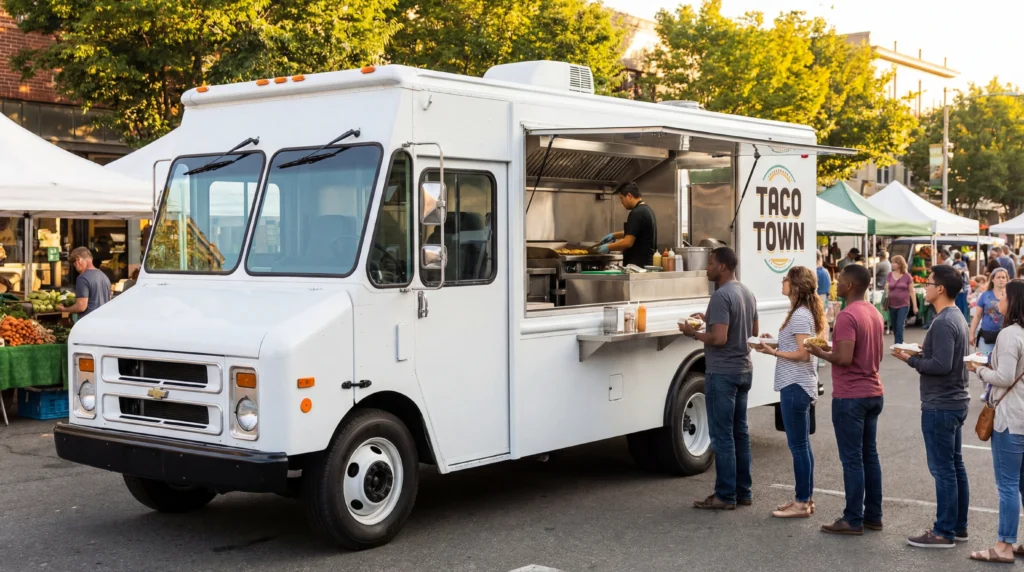
Step vans—sometimes called walk-in vans or delivery trucks—dominate as the preferred truck for food truck operations for good reason. These include popular models like the Chevrolet P30, Ford E-Series, Grumman/Morgan Olson, and Freightliner MT series.
Why step vans work as the best truck for food truck:
The walk-in design eliminates the need to crouch or climb, reducing fatigue during 8-12 hour service days. The typical 6-7 foot interior ceiling height allows comfortable standing for most operators. Standard widths of 7-8 feet provide adequate room for two-person operations with equipment on both sides.
Specifications to look for:
- Length: 18-20 feet is the sweet spot for most menus
- Engine: Look for Vortec 350/454 (Chevy) or Triton V10 (Ford)—parts are widely available
- GVW Rating: 10,000-14,000 lbs covers most buildout needs
- Floor condition: Aluminum diamond plate lasts longer than wood substrates
Typical costs:
- Used (10-20 years old): $15,000-$35,000
- Used (under 10 years): $35,000-$60,000
- Full buildout: $30,000-$80,000 additional
When researching options, you’ll find extensive listings in our guide to finding trucks for food service operations.
Sprinter Vans: Urban Efficiency Champions
Mercedes Sprinter vans, Ford Transit, and RAM ProMaster models have gained popularity as an alternative truck for food truck operations, especially among urban operators. Their narrower profile and superior fuel economy make them ideal for cities with tight parking and frequent street-to-street moves.
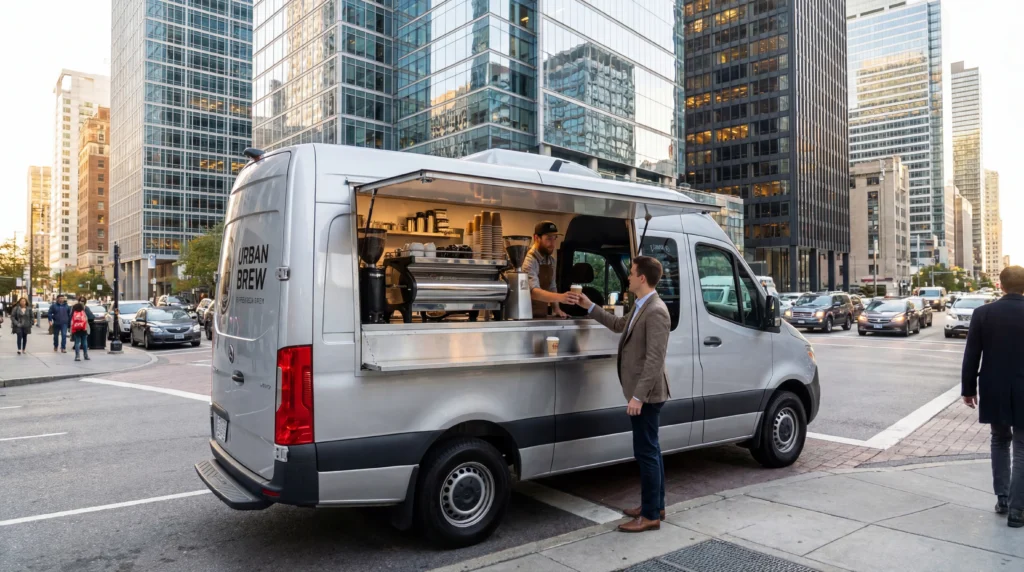
Best applications for Sprinter-style vans as a truck for food truck:
- Coffee and beverage service (limited cooking equipment)
- Dessert and ice cream trucks
- Urban environments with parking restrictions
- Operators prioritizing fuel efficiency over space
Key considerations:
The main limitation is interior height and width. Most Sprinters offer 6-foot ceilings (cramped for taller operators) and 5-6 foot interior widths. This restricts equipment layout to essentially a single service line rather than the dual-sided setup possible in step vans.
Mercedes Sprinter specifications:
- Length options: 144″ or 170″ wheelbase
- Cargo volume: 319-530 cubic feet
- Payload: 2,500-4,000 lbs
- Fuel economy: 15-22 MPG (significantly better than step vans)
The higher purchase price ($30,000-$55,000 for used models) and Mercedes-specific maintenance requirements increase operating costs compared to domestic step vans. Based on my testing, the total cost of ownership over 5 years often exceeds step vans despite better fuel economy.
Food Trailers: Maximum Flexibility
Food trailers offer unique advantages that a truck for food truck cannot match: lower initial investment, the ability to unhitch and use your tow vehicle separately, and generally simpler permitting in many jurisdictions.
When trailers make sense instead of a truck for food truck:
- Event and festival focus (you can leave the trailer on-site)
- Seasonal operations where you need a personal vehicle in the off-season
- Budget-conscious startups prioritizing equipment over vehicle
- Operators who want to upgrade incrementally
Towing requirements:
This is where many first-time operators make costly mistakes. A fully-equipped 20-foot food trailer can weigh 8,000-12,000 lbs. You’ll need:
- Tow vehicle rated for your trailer’s GVWR plus 20% safety margin
- Electric brake controller
- Properly rated hitch (Class IV or V for most food trailers)
- Possible CDL requirement in some states if combined weight exceeds 26,000 lbs
Trailer specifications by size:
| Trailer Length | Typical Weight (Empty) | Equipped Weight | Recommended Tow Vehicle |
|---|---|---|---|
| 12-14 ft | 2,000-3,000 lbs | 4,000-6,000 lbs | Half-ton truck (F-150) |
| 16-20 ft | 3,500-5,000 lbs | 7,000-10,000 lbs | 3/4-ton truck (F-250) |
| 22-28 ft | 5,000-7,000 lbs | 10,000-14,000 lbs | 1-ton truck (F-350) |
For a detailed comparison of truck versus trailer options, see our analysis on food trucks for parties where mobility requirements often determine the better choice.
Box Trucks: Heavy-Duty Operations
Box trucks (also called cube trucks or straight trucks) feature a separate cab and cargo area, similar to commercial delivery vehicles. Brands include Isuzu NPR, Mitsubishi Fuso, and Hino.
Best suited for:
- High-volume catering operations
- Commissary-style service requiring extensive refrigeration
- Operators planning multiple service windows
- Buildouts requiring reinforced flooring for heavy equipment
Advantages over step vans:
- Higher payload capacities (5,000-10,000+ lbs)
- Cab-over designs maximize cargo length for given overall length
- Diesel engines offer better torque for heavy loads
- Commercial-grade chassis handle daily use better than converted delivery vehicles
Disadvantages:
- No walk-through from cab to service area (weather exposure during transition)
- Diesel maintenance typically costs 20-30% more than gasoline
- CDL requirement for models over 26,000 lbs GVWR in most states
- Less aerodynamic, fuel economy typically 8-12 MPG
Cargo Vans: Budget-Friendly Starter Option
Standard cargo vans like the Ford Transit Connect, Nissan NV200, or RAM ProMaster City offer the lowest entry point for food service vehicles. These work as a starter truck for food truck operations with limited menus and minimal cooking equipment.
Realistic applications:
- Coffee and espresso service
- Pre-packaged foods and snacks
- Ice cream and frozen treats
- Farmers market vendors with pre-prepared items
Limitations to understand:
Interior dimensions severely restrict equipment options. A Ford Transit Connect offers approximately 4.5 feet of width and 4 feet of height in the cargo area. You’ll likely need to operate with side doors open, limiting your weather tolerance and security.
These vehicles are best viewed as stepping stones rather than long-term solutions. Most successful operators I’ve worked with started in cargo vans and upgraded within 18-24 months as their business grew.
Best Truck for Food Truck Models by Category
Based on my evaluation across dozens of food truck operations, here are specific model recommendations for each truck for food truck type:
Best Overall Truck for Food Truck: Chevrolet P30 Step Van
The P30 has earned its industry-standard status through decades of reliability. The Vortec 350 V8 engine (found in models from 1996-2002) balances power and fuel efficiency while parts remain readily available at any auto parts store.
Key specs:
- Typical length: 18-22 feet
- Engine: 5.7L Vortec V8 (255 hp)
- Transmission: 4L80E automatic (robust, easily serviced)
- Used price range: $15,000-$30,000
Best Urban Truck for Food Truck: Mercedes Sprinter 2500
When maneuverability and fuel efficiency outweigh space requirements, the Sprinter delivers. The 2500 series offers the best balance of cargo capacity and drivability for city environments.
Key specs:
- Typical length: 144″ wheelbase (22 feet overall)
- Engine: 3.0L V6 turbo diesel
- Fuel economy: 18-22 MPG
- Used price range: $25,000-$45,000
Best Budget Truck for Food Truck: Ford E-350 Cutaway
The E-350 cutaway with aftermarket box body offers step van functionality at cargo van prices. These are abundant in the used market from delivery company fleets.
Key specs:
- Typical length: 14-18 feet
- Engine: Triton V10 6.8L
- Transmission: 5-speed automatic
- Used price range: $12,000-$25,000
Best for Events: Airstream or Vintage Trailer
For operators targeting food trucks for hire at weddings and upscale events, vintage aesthetics command premium booking rates. Airstream trailers and restored vintage vehicles justify 25-40% higher catering rates.
How to Match Your Menu to the Right Truck for Food Truck
Your menu determines your equipment needs, which determines your minimum vehicle size. Here’s a decision framework based on the data:
High-Heat Cooking Menus (BBQ, Grilled Items, Fried Foods)
Minimum requirements:
- 18+ feet of length for hood/ventilation clearance
- 4,000+ lb payload for commercial cooking equipment
- Adequate electrical capacity (typically 200+ amp service)
- Fire suppression system mounting space
Recommended truck for food truck: Step van or box truck
Low-Heat/Assembly Menus (Sandwiches, Salads, Tacos)
Minimum requirements:
- 14-16 feet adequate for most operations
- 2,500+ lb payload
- Focus on refrigeration and prep space over cooking equipment
Recommended truck for food truck: Step van or large Sprinter
Beverage-Focused Menus (Coffee, Smoothies, Juice)
Minimum requirements:
- 10-14 feet sufficient
- Water tank capacity priority (50+ gallons minimum)
- Adequate counter space for espresso machines, blenders
Recommended truck for food truck: Sprinter van or cargo van
Dessert/Pre-Packaged Menus (Ice Cream, Cupcakes, Packaged Snacks)
Minimum requirements:
- 10-12 feet workable
- Refrigeration/freezer capacity priority
- Display case accommodation
Recommended truck for food truck: Cargo van or small trailer
How to Inspect a Used Truck for Food Truck: 10-Point Checklist
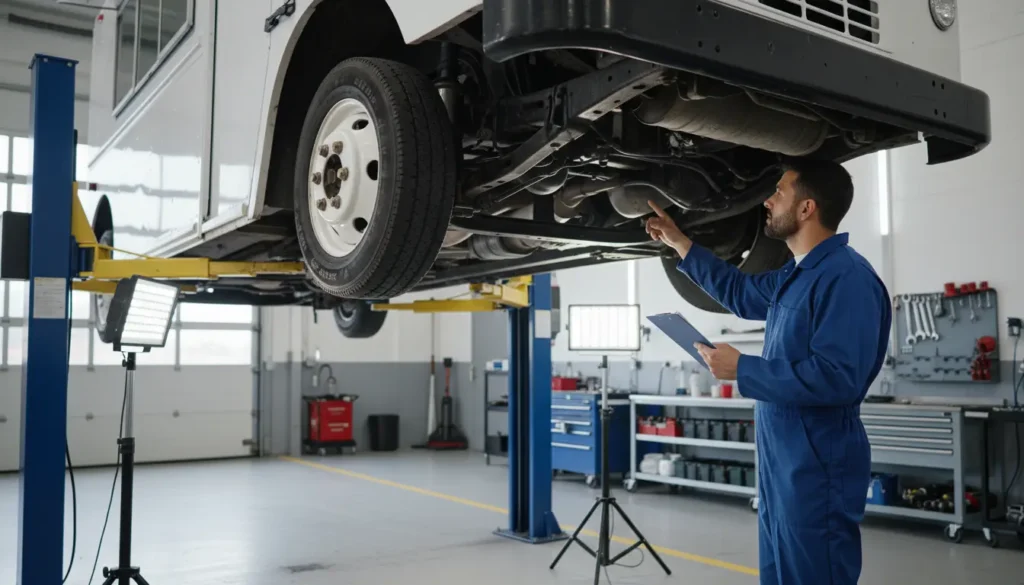
Before purchasing any used vehicle for food truck conversion, follow these inspection steps. I developed this truck for food truck inspection checklist after evaluating over 40 vehicles before our second truck purchase. Complete each step in order—structural issues make mechanical inspection irrelevant.
Step 1: Inspect Frame Condition
Check the entire frame for rust, cracks, or previous collision damage. Bring a flashlight and mirror to inspect the undercarriage thoroughly. Any structural rust is typically a deal-breaker—repair costs exceed vehicle value in most cases.
Step 2: Test Floor Integrity
Walk every inch of the cargo floor. Press firmly with your heel to detect soft spots that indicate rot or rust underneath. Replacement flooring costs $2,000-$5,000 depending on truck size and material choice.
Step 3: Examine Roof Condition
Look for patches, bubbling, or evidence of leaks from inside and outside. Water intrusion damages insulation and promotes mold growth—problems that become exponentially expensive after buildout completion.
Step 4: Check Door Seals and Operation
Test all doors including cab doors, service window locations, and rear entry. Worn seals compromise food safety inspections per health department requirements and allow pest entry. Verify smooth operation without sticking or grinding.
Step 5: Perform Engine Compression Test
A $50-$100 compression test reveals internal engine wear that visual inspection cannot detect. Compression variance over 10% between cylinders indicates potential problems requiring expensive repairs.
Step 6: Evaluate Transmission Behavior
Drive at least 20 minutes, testing all gears under various load conditions. Slipping, delayed engagement, or harsh shifts predict expensive repairs ranging from $2,500-$6,000 for commercial vehicle transmissions.
Step 7: Assess Brake System
Check pad thickness, rotor condition, and brake line integrity. Commercial vehicles wear brakes faster than passenger vehicles due to weight. Budget $800-$2,000 for complete brake system overhaul if needed.
Step 8: Verify Cooling System
Inspect radiator condition, coolant quality (should be bright, not rusty), and fan operation under load. Overheating under load destroys engines quickly—a failed cooling system can total a food truck.
Step 9: Test Electrical System
Test all lights, wipers, and accessories. Inspect wiring for rodent damage or previous amateur repairs. Verify battery age and alternator output with a multimeter. Electrical issues cause fire hazards in food trucks.
Step 10: Review Title and Documentation
Accept clean titles only—never salvage titles for food trucks (insurance complications). Request maintenance records; documented service history indicates owner care level. Fleet vehicles with complete records are preferable to private sales without history.
FAQ: Truck for Food Truck Questions Answered
What is the best truck for food truck operations?
For most operators, a Chevrolet P30 step van in the 18-20 foot range offers the best truck for food truck conversion, balancing space, reliability, parts availability, and purchase price. This vehicle type provides adequate room for full-service menus while remaining maneuverable enough for urban operations. Used models from 1996-2005 with the Vortec 350 engine typically cost $15,000-$30,000 and can run reliably for 200,000+ miles with proper maintenance.
How much does a truck for food truck cost?
Truck for food truck costs vary significantly by type and condition. Budget $15,000-$45,000 for a used step van, $20,000-$55,000 for a Sprinter van, or $8,000-$35,000 for a food trailer. Remember that the vehicle represents only 30-40% of total startup costs—budget an additional $30,000-$100,000 for kitchen buildout, equipment, permits, and initial inventory. For financing options, the Small Business Administration offers food truck-specific loan programs.
What size truck for food truck do I need?
Size requirements for your truck for food truck depend on menu complexity. Simple menus (coffee, pre-packaged items) work in 10-14 feet. Mid-range menus (tacos, sandwiches) need 14-18 feet. Full-service menus with grills, fryers, and extensive prep areas require 18-24 feet. When in doubt, choose larger—operators rarely regret having extra space, but frequently regret insufficient room.
Is a food truck or trailer better?
Trailers cost less initially and offer flexibility (you can unhitch and use your tow vehicle separately). A truck for food truck provides all-weather protection, professional appearance, and faster location changes. Most full-time operators prefer trucks for daily service, while trailers excel for event-focused or seasonal businesses. See our detailed trucks for food comparison for specific scenarios.
Can you turn any truck into a food truck?
Technically yes, but not all conversions are practical or legal for a truck for food truck use. Vehicles need adequate payload capacity, interior height for standing work, and structural integrity for equipment mounting. Most jurisdictions require specific safety features (ventilation, fire suppression, three-compartment sinks) that some vehicles cannot accommodate. Always verify local health department requirements before purchasing any vehicle.
What chassis is best for a truck for food truck?
Ford and Chevrolet chassis dominate the US truck for food truck market due to parts availability and mechanic familiarity. The Chevrolet P30 (now discontinued but widely available used) and Ford E-Series cutaway remain the most cost-effective choices. For new chassis, the Freightliner MT45 and Ford F-59 offer commercial-grade durability but at significantly higher prices.
Making Your Final Truck for Food Truck Decision
Selecting the right truck for food truck operation requires balancing multiple factors: menu requirements, operating environment, budget constraints, and long-term maintenance costs. The data consistently shows that spending slightly more upfront for a quality truck for food truck reduces total cost of ownership over your business’s lifetime.
Before making any purchase, I recommend:
- Test driving vehicles of each type you’re considering
- Getting pre-purchase inspections from mechanics familiar with commercial vehicles
- Calculating total cost of ownership (purchase + buildout + 5-year maintenance projection)
- Verifying insurance costs for each vehicle type—rates vary significantly
For additional guidance on evaluating food truck equipment and making informed purchasing decisions, explore our complete food truck equipment reviews section. And when you’re ready to find specific trucks for sale, our guide to best food trucks compares current market options.
The truck for food truck you choose today will be your mobile kitchen, your brand ambassador, and your daily workspace for years to come. Take the time to analyze the numbers, and you’ll build a foundation for sustainable profitability.
