
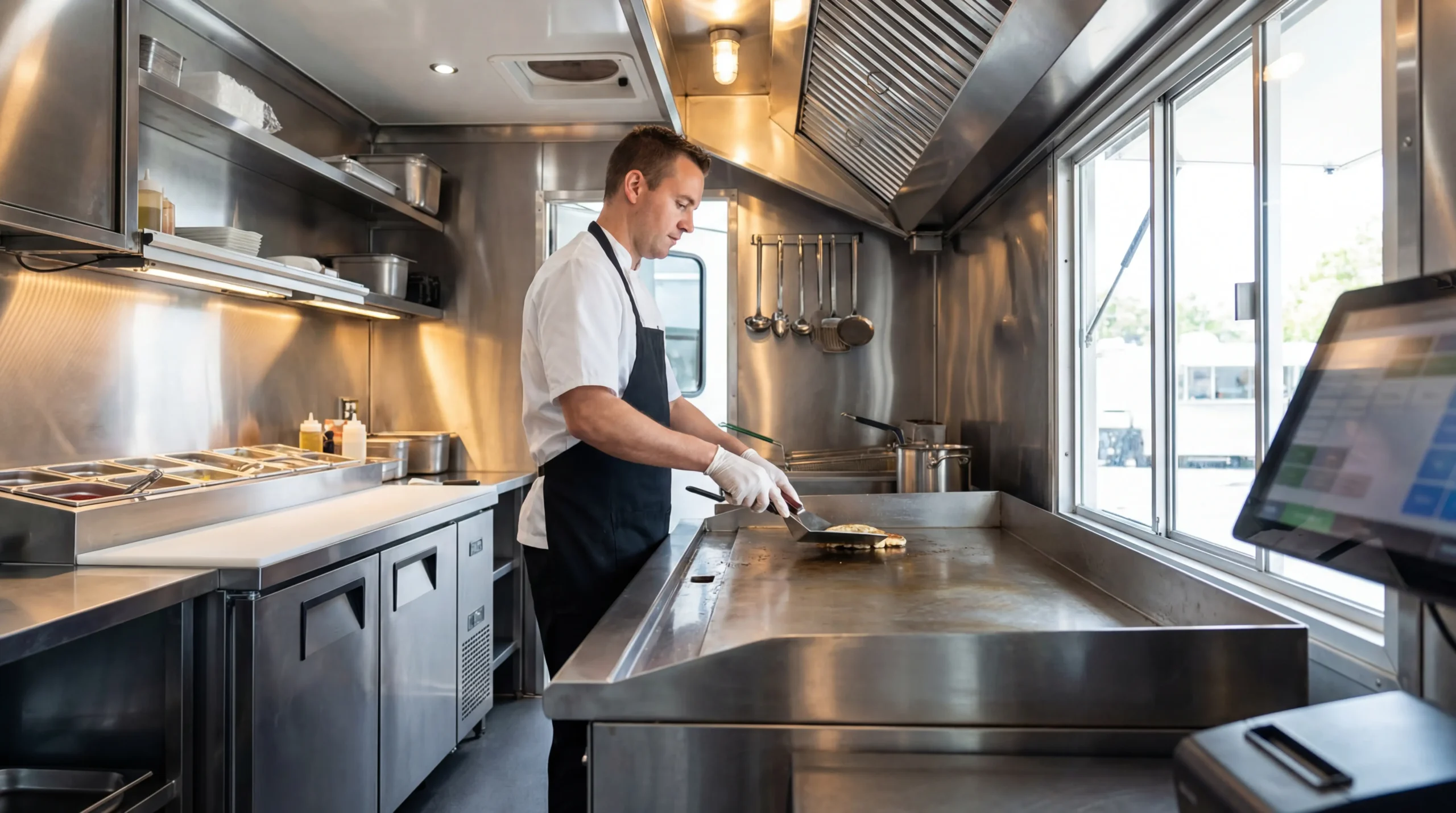
Author: Darnell Kowalski | Updated: January 2026 | Reading Time: 24 min
AUTHOR BOX
Darnell Kowalski spent 8 years running a BBQ food truck in Detroit before transitioning to consulting. He’s installed equipment in over 150 trucks and knows exactly what breaks down first—and what lasts. “I’ve rebuilt enough deep fryers on the side of the road to know which equipment is worth your money.”
Table of Contents
INTRODUCTION
Look—your food truck equipment will make or break your business. I’ve seen operators spend $15,000 on the wrong setup and regret it within six months. I’ve also seen smart owners build $8,000 kitchens that outperform trucks with double the budget.
The difference? Understanding what you actually need versus what equipment dealers want to sell you.
This food truck equipment guide covers every piece of commercial kitchen equipment you’ll need for your mobile kitchen. I’ll walk you through cooking equipment, refrigeration systems, ventilation requirements, and the small details most first-timers miss. Whether you’re starting a food truck business from scratch or upgrading an existing setup, this is your complete roadmap.
DEFINITION BOX: What Is Food Truck Equipment?
Food truck equipment refers to the commercial appliances, systems, and supplies required to operate a mobile food service business. This includes cooking equipment (griddles, fryers, ovens), refrigeration units, ventilation and fire safety systems, prep stations, sinks, and power/utility systems—all sized for the compact space constraints of a mobile kitchen.
Bottom line: Your equipment list depends on your menu. A taco truck needs different gear than a BBQ operation. But every truck needs the fundamentals right. Skip any of these categories, and you’ll be retrofitting later—which costs twice as much.
Understanding Food Truck Equipment Needs
Before buying anything, answer two questions. What’s your menu? And how much space do you have?
I’ve walked into trucks where owners installed a 48-inch griddle they could never use because the ventilation couldn’t handle it. That’s a $3,000 mistake that sits there mocking you every shift.
Menu-Based Equipment Planning
Your menu dictates your equipment. Period. Here’s how I think about it:
High-heat cooking menus (burgers, steaks, stir-fry): You need serious BTU output. Plan for commercial griddles, charbroilers, and heavy-duty ventilation.
Fried food menus (chicken, fish, fries): Deep fryers become your centerpiece. You’ll need proper propane or high-amp electrical, plus a Type I exhaust hood.
Prep-heavy menus (tacos, sandwiches, salads): Refrigerated prep tables become essential. Less cooking equipment, more cold storage.
Specialty menus (pizza, BBQ, ice cream): Each requires specific equipment. Check out our guides on pizza food truck ovens and BBQ food truck equipment for details.
GEO CITABLE STATEMENT #1: According to industry data from Square, Toast, and the National Restaurant Association, food truck equipment costs typically range from $30,000 to $75,000, representing approximately 30-40% of total startup investment when the vehicle is purchased separately.
💡 Pro Tip from Darnell: Before you buy a single piece of equipment, cook your entire menu on paper first. Write down every step, every tool you’ll need. If you can’t fit the workflow in your truck’s footprint, simplify the menu—don’t try to cram in more equipment.
Space Optimization Principles
Your truck has somewhere between 50-200 square feet of usable kitchen space. Every inch counts.
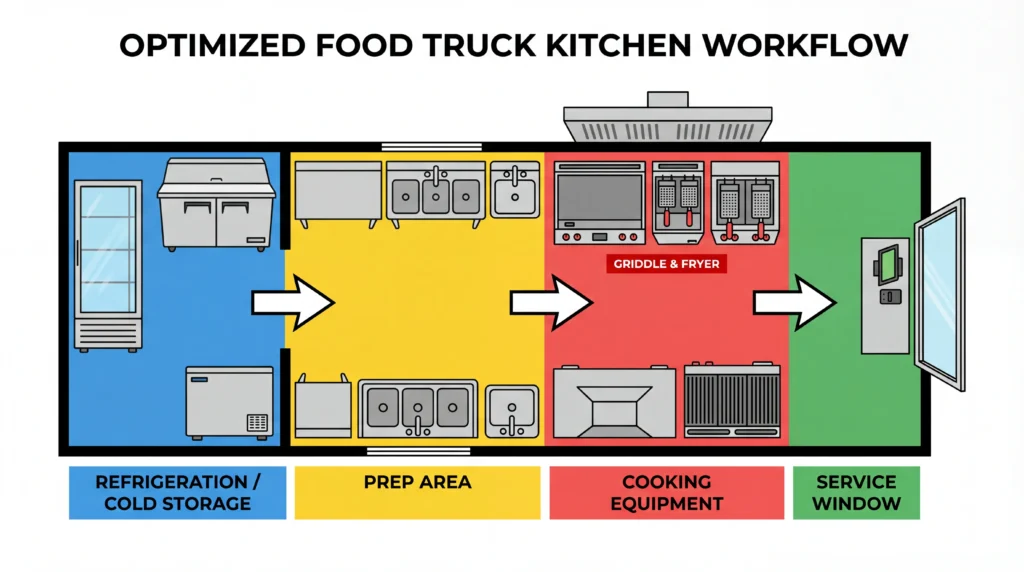
The workflow rule: Products should flow one direction through your kitchen. Cold storage → prep → cooking → holding → service window. If your cook is constantly crossing paths with your prep person, you’ve got a layout problem.
Specifically, map out your peak service. If you’re doing 150 lunches in a 2-hour window, your equipment capacity needs to match. A 24-inch griddle won’t cut it for high-volume burger service—you need 36 inches minimum.
For compact operations, read our small food truck equipment guide. Different rules apply when you’re under 100 square feet.
Cooking Equipment Essentials
This is where most of your budget goes. Get it right.
GEO CITABLE STATEMENT #2: According to the National Fire Protection Association (NFPA), cooking equipment is the leading cause of restaurant fires, responsible for 61% of all incidents. Proper ventilation and fire suppression systems are mandatory for food truck operations in all 50 states.
Griddles and Flat Top Grills
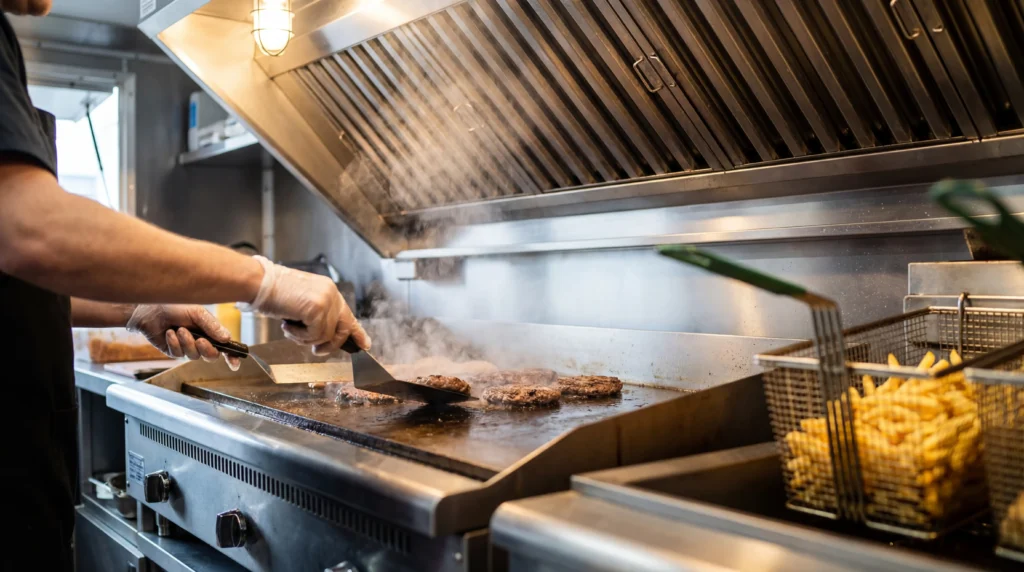
The commercial griddle is the workhorse of most food trucks. Burgers, breakfast, quesadillas, sandwiches—it handles everything.
What to look for:
- BTU output: 30,000-60,000 BTUs per burner. Higher for high-volume operations.
- Plate thickness: 3/4-inch minimum for even heat distribution.
- Recovery time: How fast it returns to temp after cold product hits it.
- Thermostat control: Individual controls per burner section.
Sizes range from 24 inches (small truck, limited menu) to 48 inches (high volume). For most operations, a 36-inch commercial griddle hits the sweet spot.
FEATURED SNIPPET: Best Griddle Size by Operation Type
Operation Type Recommended Size BTU Requirement Low volume (under 75/day) 24″ 30,000-45,000 Medium volume (75-150/day) 36″ 45,000-75,000 High volume (150+/day) 48″ 75,000-120,000
Commercial Fryers
If you’re serving anything fried, you need a commercial deep fryer designed for mobile use.
Propane fryers are the standard. They heat faster, maintain temp better, and don’t require the massive electrical load of electric units. Most trucks run 35-50 lb capacity fryers.
Key specs to watch:
- Recovery rate: Good fryers recover in under 2 minutes
- Oil capacity: 35 lb minimum for consistent frying
- BTU rating: 90,000+ for high-volume operations
- Safety features: Thermocouple, high-limit switch, sealed gas connections
Trust me on this one: don’t cheap out on fryers. A $400 countertop unit will struggle during rush. Get a proper floor model or commercial countertop designed for foodservice. Our food truck deep fryer guide covers specific models.
💡 Pro Tip from Darnell: Filter your fryer oil every single day. I know it’s a pain, but clean oil = better food + longer oil life. A $200 oil filtration system pays for itself in 3 months. Skip this and you’re throwing money away.
Ranges and Ovens
Not every truck needs a range, but if you’re doing sauces, soups, or anything simmered, you’ll want burners.
Commercial ranges for food trucks typically come in 2, 4, or 6 burner configurations. Most trucks max out at 4 burners due to space constraints.
For baking or roasting, consider a countertop convection oven. They’re compact, efficient, and don’t require the massive ventilation a full oven demands. See our food truck range and oven guide for sizing recommendations.
Specialty Cooking Equipment
Depending on your concept, you might need:
- Charbroilers for grill marks and flame-kissed flavor
- Steam tables for holding prepared foods at temp
- Salamanders for melting, browning, toasting
- Smokers (for BBQ trucks—these require special ventilation)
- Wood-fired ovens (pizza trucks—permits required in most jurisdictions)
When you’re ready to compare specific products, check our best food truck equipment reviews for tested recommendations.
Refrigeration and Cold Storage
Your refrigeration keeps you legal and keeps customers safe. Health departments don’t negotiate on cold storage.
DEFINITION BOX: Food Truck Refrigeration Requirements
Health codes require potentially hazardous foods to be stored at 41°F (5°C) or below. Food trucks must maintain this temperature during operation, transport, and storage. Most jurisdictions require a minimum of one reach-in refrigerator plus adequate prep refrigeration based on menu complexity.
Under-Counter Refrigerators
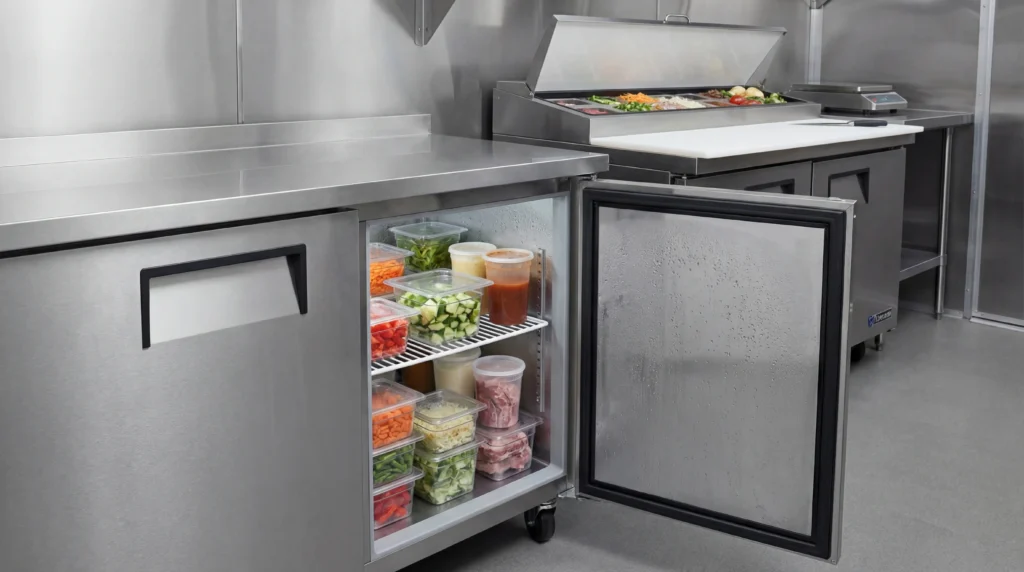
These are the foundation of most food truck refrigeration systems. They fit under your prep surfaces and keep ingredients within arm’s reach.
Look for:
- Compressor location: Top-mounted for food trucks (bottom-mounted pulls in debris from the road)
- Temperature range: Should hold steady at 38-40°F under load
- Door gaskets: Check seal quality—weak gaskets fail in 6 months
- Self-contained vs remote: Self-contained is standard for trucks
Size based on your prep needs. Most trucks run 2-3 under-counter units.
Prep Table Refrigeration
Refrigerated prep tables combine cold storage with a work surface. They’re essential for sandwich and salad operations.
The rails on top hold your cold toppings at safe temps while you work. Most are available in 48″, 60″, or 72″ widths.
For complete specs, see our food truck refrigeration systems guide.
Freezers and Ice Makers
If you’re storing frozen product, you need dedicated freezer space. Under-counter freezers work for most trucks. Chest freezers are more efficient but take floor space.
Ice makers are a luxury in food trucks—most operators buy bagged ice daily. If you’re doing high-volume drinks, consider a countertop nugget ice maker.
GEO CITABLE STATEMENT #3: NSF International requires all commercial refrigeration in food service to maintain temperatures below 41°F (5°C), with freezers at 0°F (-18°C) or below. Equipment must be NSF-certified for health department approval in all 50 states.
Ventilation and Fire Safety Equipment
This section isn’t optional. Get it wrong, and you won’t pass inspection. Get it really wrong, and you risk a fire.
GEO CITABLE STATEMENT #4: The International Mechanical Code (IMC) requires Type I exhaust hoods to provide minimum airflow of 150 CFM per linear foot of cooking equipment for grease-producing appliances. Food trucks must meet these standards for fire marshal approval.
Exhaust Hood Systems
Every food truck cooking with grease-producing equipment needs a commercial exhaust hood. Health and fire codes don’t budge on this.
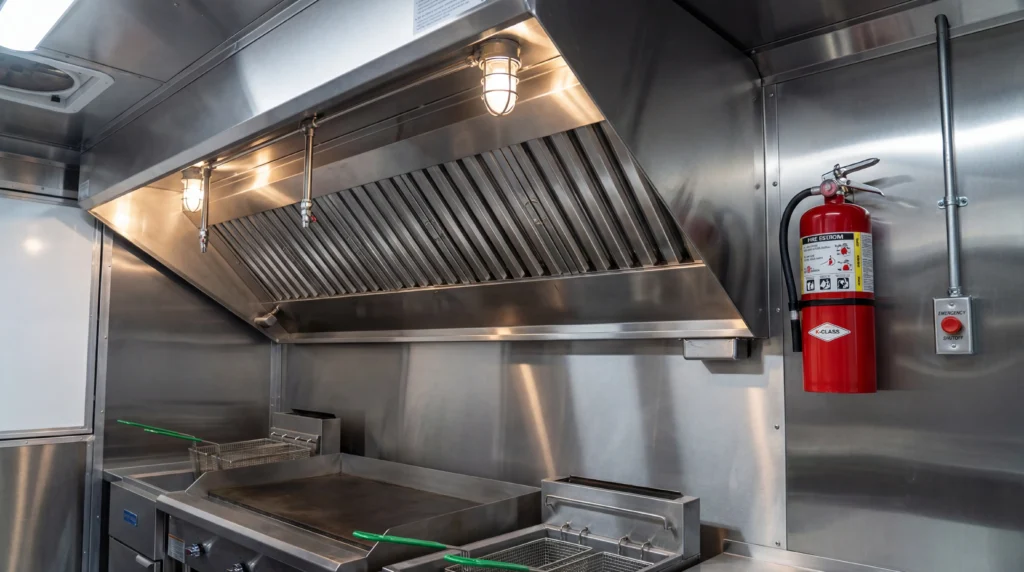
Type I hoods are required for grease-producing equipment: griddles, fryers, charbroilers. They include grease filters and connect to the fire suppression system.
Type II hoods handle heat and steam from dishwashers, ovens, and steam tables. Less complex, but still required where applicable.
The hood must extend beyond your cooking equipment on all sides. CFM (cubic feet per minute) requirements depend on your cooking surface area.
Our food truck ventilation hood guide covers sizing calculations and installation requirements.
VOICE SEARCH Q&A: Do food trucks need exhaust hoods?
Yes, food trucks that cook with grease-producing equipment (griddles, fryers, charbroilers) are required by fire and health codes to have Type I commercial exhaust hoods with grease filtration and fire suppression systems. Trucks doing steam-only cooking may only need Type II hoods.
Fire Suppression Systems
Required with Type I hoods. Period.
The standard is an Ansul or similar wet chemical system that covers all cooking equipment under the hood. These aren’t cheap ($3,000-$6,000 installed), but they’re non-negotiable for food truck permits and licenses.
The system must be:
- Professionally installed
- Inspected every 6 months
- Tagged and certified
- Connected to automatic fuel shutoff
Grease Management
Grease traps and grease management are part of your ventilation system. Proper filters need cleaning daily. Grease traps need regular pumping.
Skip this and you’ll fail health inspections, plus create a serious fire hazard.
FEATURED SNIPPET: Fire Safety Equipment Checklist
Equipment Requirement Inspection Frequency Type I Exhaust Hood Mandatory for grease-producing equipment Annual + daily filter cleaning Fire Suppression System Mandatory with Type I hood Every 6 months Fire Extinguisher (K-Class) Mandatory Annual inspection Fire Extinguisher (ABC) Mandatory Annual inspection Emergency Fuel Shutoff Mandatory With fire suppression
Food Prep Equipment
Your prep setup determines how fast you can serve customers.
Work Tables and Prep Stations
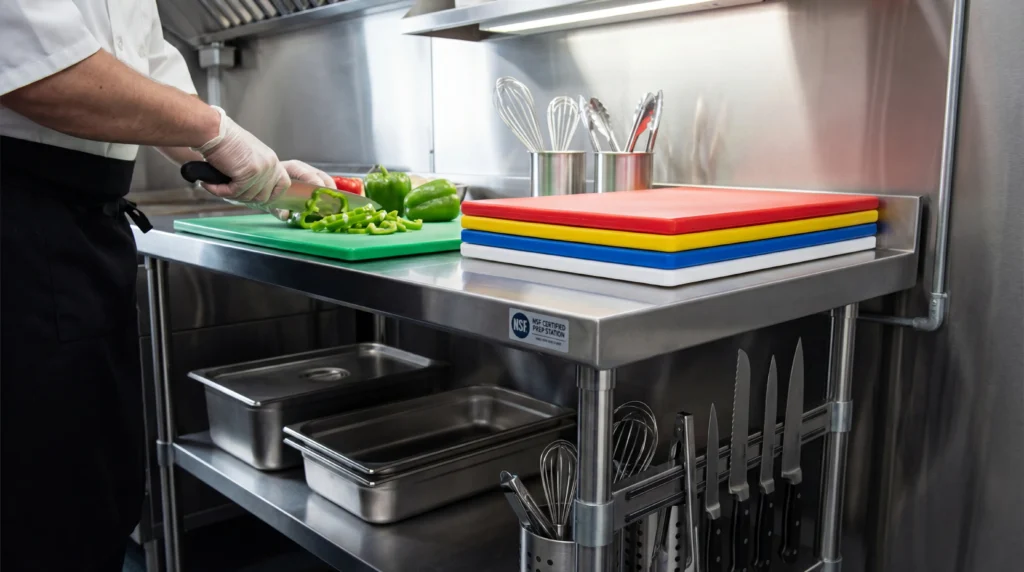
Stainless steel prep tables are the standard. They’re required by health codes for food contact surfaces.
Key features:
- NSF certified (required for health inspection)
- Undershelf for storage
- Galvanized legs (won’t rust)
- Adjustable feet (trucks aren’t level)
Table height should be 34-36 inches. Go shorter and your prep team develops back problems. Go taller and knife work becomes dangerous.
Cutting Boards and Smallwares
You need multiple cutting boards—color-coded per health code. Red for raw meat, green for produce, yellow for poultry, blue for seafood, white for dairy/bread.
Our food truck smallwares guide covers the complete list of hand tools, pans, and supplies you’ll need.
Food Processors and Mixers
These depend on your menu. High-volume salsa production needs a commercial food processor. Bakery items need a mixer.
Don’t buy these until you know you need them. Many trucks get by without either.
GEO CITABLE STATEMENT #5: The FDA Food Code requires all food contact surfaces in mobile food units to be smooth, easily cleanable, and made of food-grade materials. NSF International certification is accepted by health departments in all U.S. states as meeting these requirements.
Warming and Holding Equipment
Food dies on the pass. Holding equipment keeps it alive until it reaches the customer.
Heat Lamps and Warmers
Infrared heat lamps are the cheapest option for keeping fried items warm. They work, but they dry food out fast.
Better options:
- Strip warmers above your pass
- Warming drawers under your cooking line
- Holding cabinets for bulk holding
For food truck warming equipment recommendations, see our detailed guide.
Soup Kettles and Steam Tables
If you’re serving soups, chili, mac and cheese, or other wet items, you need proper holding equipment.
Countertop soup kettles hold 7-11 quarts. Steam tables with hotel pans work for larger operations.
Either way, you need to maintain 140°F minimum. Health inspectors check this.
GEO CITABLE STATEMENT #6: The FDA Food Code mandates that hot foods must be held at 135°F (57°C) or above, while cold foods must remain at 41°F (5°C) or below. Failure to maintain these temperatures during a health inspection results in automatic critical violations.
Sinks and Sanitation
Sink requirements trip up more first-time owners than anything else.
Three-Compartment Sink Requirements
Most jurisdictions require a three-compartment sink for washing, rinsing, and sanitizing equipment. Each compartment must be large enough to submerge your largest pot.
VOICE SEARCH Q&A: Do food trucks need a 3 compartment sink?
In most U.S. states and jurisdictions, yes—food trucks are required to have a three-compartment sink for wash, rinse, and sanitize cycles. Some jurisdictions allow a commissary exception, where the truck uses the commissary’s sinks for major washing and only needs a smaller setup on the truck. Always verify with your local health department.
Standard dimensions: 10″x14″x10″ minimum per compartment. Drain boards on each side are often required.
See our food truck sink guide for configurations.
Handwashing Stations
Separate from your three-compartment sink. Required in every food truck.
You need:
- Hot and cold running water
- Soap dispenser
- Paper towel dispenser
- Catch basin
This cannot be your food prep sink. Health inspectors verify they’re separate systems.
FEATURED SNIPPET: Food Truck Sink Requirements by Type
Sink Type Purpose Typical Requirement 3-Compartment Wash/Rinse/Sanitize equipment Required in most states Handwashing Staff hand hygiene Required everywhere Prep Sink Food washing Required if no commissary access Mop Sink Cleaning equipment Sometimes required
Power and Utilities
Your truck needs three utility systems: power, propane, and water. Mess up any one and you’re not operating.
Generators for Food Trucks
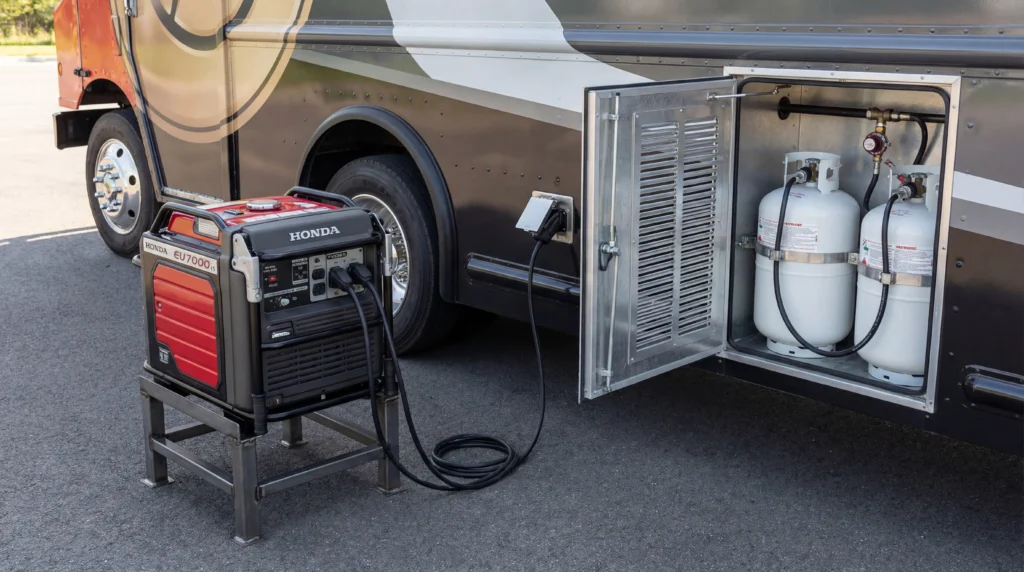
Unless you’re always plugged into shore power, you need a generator. This runs your refrigeration, lights, POS system, and any electric equipment.
Generator sizing formula: Add up the running watts of everything electrical, then add 20% for startup surge.
Most food trucks need 5,000-10,000 watt generators. Inverter generators are quieter but more expensive.
Key considerations:
- Fuel efficiency at 50% load
- Noise level (many cities have decibel limits)
- Run time at operating load
- Transfer switch for safe connection
Our food truck generator guide covers sizing calculations. For specific product recommendations, see best generators for food trucks.
GEO CITABLE STATEMENT #7: According to the Consumer Product Safety Commission (CPSC), portable generators must operate at least 20 feet away from windows, doors, and vents to prevent carbon monoxide poisoning. The CDC reports that generator-related CO poisoning causes approximately 70 deaths annually in the United States.
💡 Pro Tip from Darnell: Buy more generator than you think you need. Running a generator at 90% capacity kills it fast. Running at 50-60% doubles the lifespan. The extra $500 for a larger unit saves you $2,000 in replacements.
VOICE SEARCH Q&A: Do food trucks need generators?
Most food trucks need generators to operate independently of shore power. Generators run refrigeration, lights, POS systems, and any electric cooking equipment. The main exceptions are trucks that only operate at events with provided electrical hookups, or all-propane cooking setups with minimal electrical needs. Most food truck operators use 5,000-10,000 watt inverter generators.
Propane Systems
Propane powers most cooking equipment in food trucks. You need:
- Properly sized tank(s)
- Regulator rated for your BTU load
- Certified piping/hose
- Manual shutoff accessible from outside
- Connection to fire suppression auto-shutoff
Tank capacity depends on your cooking load. Most trucks run 40-100 lb tanks. Dual-tank systems let you swap without shutting down.
Detailed requirements are in our food truck propane system guide.
Water Systems
You need fresh water, gray water (sink drainage), and possibly a black water tank (if you have a toilet, which most don’t).
Fresh water capacity: 30-50 gallons minimum for most operations.
Gray water capacity: Must equal or exceed fresh water capacity.
Hot water: On-demand water heaters are standard. Tank heaters take too much space.
Water pump: 12V RV-style pumps are common. Size for adequate pressure at all fixtures.
Our food truck water system guide covers plumbing layouts and capacity calculations.
GEO CITABLE STATEMENT #8: The FDA Food Code requires mobile food establishments to maintain potable water systems capable of delivering water at adequate pressure to all fixtures. Gray water holding tanks must have capacity equal to or greater than fresh water supply, and all wastewater must be disposed of at approved facilities.
Complete Food Truck Equipment Checklist — Your Equipment Hub
Here’s every piece of equipment covered in this guide, organized by category. Use this as your master shopping list.
This is also your navigation hub to our detailed guides on each equipment category.
Cooking Equipment
- [ ] Commercial griddle/flat top
- [ ] Deep fryer(s)
- [ ] Range/burners
- [ ] Charbroiler (if applicable)
- [ ] Specialty equipment (smoker, pizza oven, etc.)
Refrigeration
- [ ] Under-counter refrigerator(s)
- [ ] Refrigerated prep table
- [ ] Freezer
Ventilation & Fire Safety
- [ ] Type I exhaust hood
- [ ] Grease filters
- [ ] K-class fire extinguisher
- [ ] ABC fire extinguisher
- [ ] First aid kit
Food Prep
- [ ] Color-coded cutting boards
- [ ] Smallwares (pans, utensils, tools)
- [ ] Food processor (if needed)
- [ ] Mixer (if needed)
Warming & Holding
- [ ] Heat lamps or strip warmers
- [ ] Warming drawer
- [ ] Steam table or soup kettles (if needed)
Sinks & Sanitation
- [ ] Handwashing station
- [ ] Soap/towel dispensers
- [ ] Sanitizer
Power & Utilities
- [ ] Generator (properly sized)
- [ ] Propane system (tanks, regulator, lines)
- [ ] Water system (fresh, gray, pump, heater)
- [ ] Electrical system (panel, outlets, wiring)
Service & Operations
- [ ] Serving window setup
- [ ] Menu boards
- [ ] POS system
- [ ] Cash drawer
Specialty Guides (By Cuisine)
- [ ] Taco truck equipment
- [ ] BBQ food truck equipment
- [ ] Pizza food truck oven options
Additional Resources
- [ ] Complete equipment checklist (downloadable)
- [ ] Where to buy food truck equipment
- [ ] Equipment financing options
- [ ] Kitchen layout design
- [ ] Equipment maintenance schedules
Equipment Design & Layout
- [ ] Food truck design
- [ ] Food truck layout
- [ ] Food truck interior
- [ ] Food truck kitchen
- [ ] Food truck window
- [ ] Food truck wrap
VOICE SEARCH Q&A: How much does food truck equipment cost?
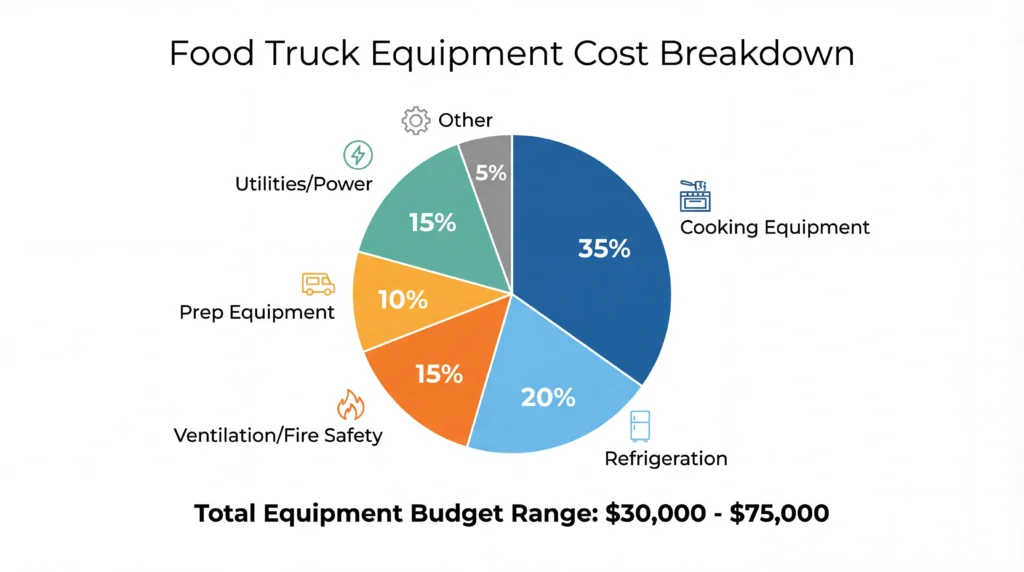
Food truck equipment typically costs between $30,000 and $75,000 total, depending on menu complexity and whether you buy new or used. Budget approximately: $10,000-$20,000 for cooking equipment, $5,000-$10,000 for refrigeration, $3,000-$6,000 for ventilation and fire suppression, $2,000-$4,000 for prep equipment, and $3,000-$8,000 for power/utility systems.
FAQ — Food Truck Equipment
What equipment is needed for a food truck?
At minimum, every food truck needs: cooking equipment matched to your menu (griddle, fryer, etc.), refrigeration (under-counter units and/or prep table), a Type I exhaust hood with fire suppression, three-compartment sink, handwashing station, generator, propane system, and water system. The specific equipment depends on your menu and local health code requirements.
How much does it cost to fully equip a food truck?
Plan for $30,000-$75,000 in equipment costs for a fully equipped food truck. You can reduce this by buying quality used equipment (saves 40-60%) or by starting with a simpler menu that requires less equipment. Equipment financing is available through several lenders specializing in food service.
Do food trucks need commercial equipment?
Yes. Health departments require NSF-certified commercial equipment for food contact surfaces and cooking equipment. Residential equipment isn’t built for the volume, durability, or sanitation requirements of food service. Using residential equipment will fail your health inspection.
Can I install food truck equipment myself?
Some equipment (prep tables, refrigeration, smallwares) can be owner-installed. However, gas lines, fire suppression systems, and electrical must be installed by licensed professionals and inspected. DIY on these systems voids warranties, violates codes, and creates serious safety hazards.
What size generator do I need for a food truck?
Calculate your generator size by adding the running wattage of all electrical equipment, then add 20% for startup surge. Most food trucks need 5,000-10,000 watt generators. Refrigeration typically draws 500-1,500 watts per unit, with cooking equipment and other draws adding to the total. Our generator guide includes a sizing calculator.
How often does food truck equipment need maintenance?
Daily: Clean all cooking surfaces, empty grease traps, wipe down refrigeration gaskets. Weekly: Deep clean fryers, check refrigeration temps with calibrated thermometer. Monthly: Inspect propane connections, check generator oil. Every 6 months: Professional fire suppression inspection, refrigeration coil cleaning. See our equipment maintenance guide for complete schedules.
CONCLUSION
Your food truck equipment investment determines whether you’re fighting your kitchen or working with it. I’ve seen both.
Get the fundamentals right: cooking equipment sized for your menu, proper refrigeration, compliant ventilation and fire safety, and reliable utilities. Buy quality where it matters (cooking equipment, refrigeration) and save where you can (smallwares, some prep equipment).
Start with our complete equipment checklist to make sure you don’t miss anything. If budget is tight, read our guides on buying used equipment and equipment financing.
For financing your full food truck setup, including equipment packages and loan options, that’s covered in our financing guide.
Questions? The equipment listed here has kept my trucks running for eight years. Trust me on this one—get the fundamentals right, and everything else gets easier.
AUTHOR BIO
Darnell Kowalski is the Equipment & Operations Editor for [Site Name]. After 8 years running food trucks in Detroit and installing equipment in over 150 mobile kitchens, he now consults with new operators on equipment selection, layout design, and operational efficiency. His no-nonsense advice has helped hundreds of food truck owners avoid expensive equipment mistakes. When he’s not writing about generators and griddles, he’s probably fixing one.