
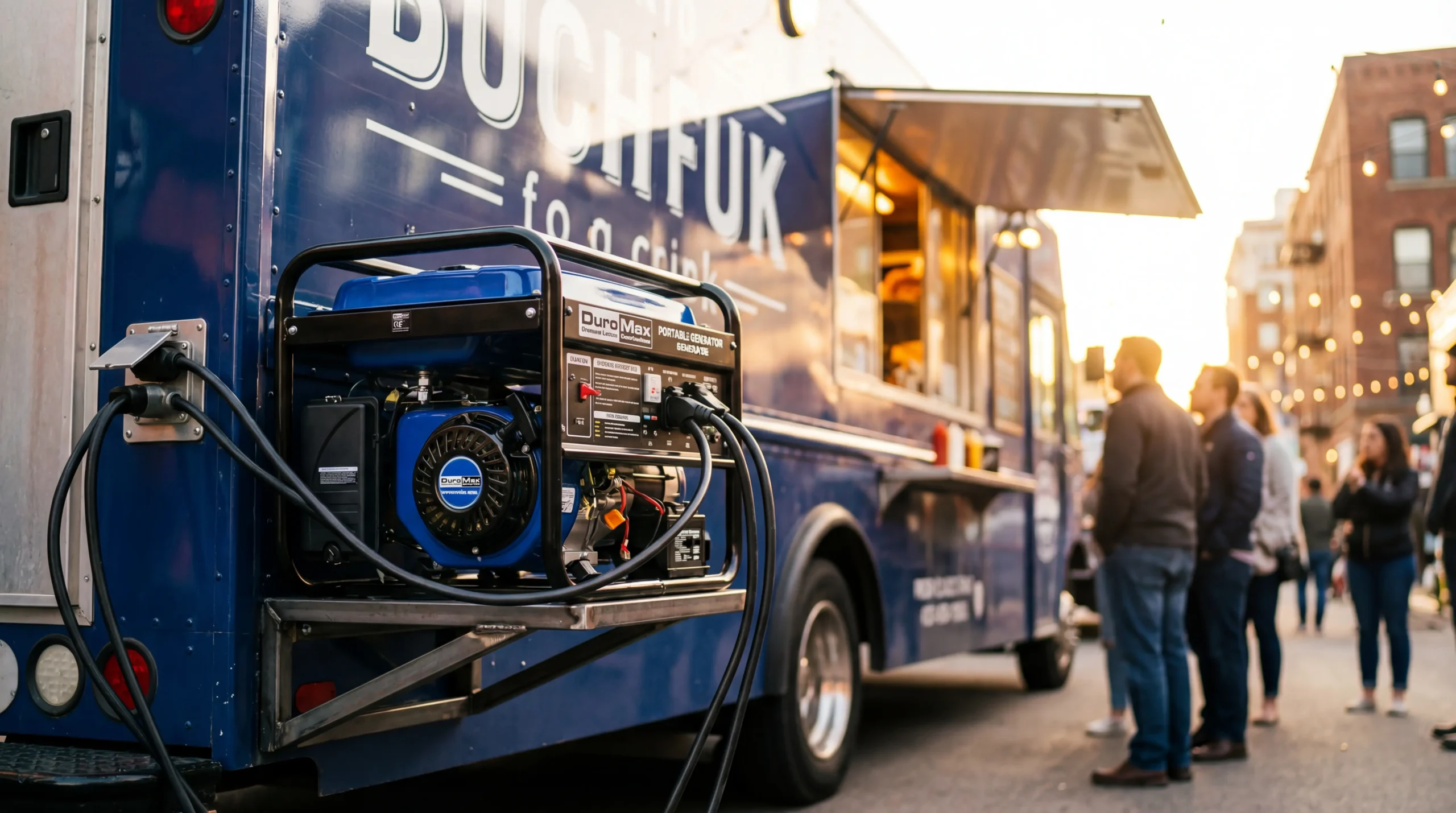

What Is a Food Truck Generator and Why Does It Matter?
A food truck generator is a portable power unit that supplies electricity to all equipment on a mobile food service vehicle, typically producing between 3,500 and 12,000 watts depending on the operation’s size.
Without a generator, you have no fridges, no fryers, no POS system, no lights. Nothing runs. This guide is part of our complete Food Truck Equipment Guide — but here we’re going deep on generators specifically.
I’ve rebuilt my own generator three times. I’ve troubleshot more of them for other owners than I can count. After testing that many units, I know what holds up and what doesn’t. Everything below comes from that hands-on experience.
Figure Out Your Food Truck’s Wattage Before You Buy Anything
Most food trucks need between 7,000 and 12,000 watts of generator capacity depending on the equipment load. To find your exact number, add up the running watts of every appliance you’ll run, then add the single highest starting wattage on top. That total, plus a 20-30% buffer, is your minimum generator requirement.
Most food truck owners buy a generator first and figure out the math later. That’s backwards. Before you spend a dollar, you need to know your total wattage draw.
Running watts is the steady power an appliance needs. Starting watts is the temporary surge it pulls when it kicks on. Compressor-based equipment like refrigerators and ice machines surge at two to three times their running watts. That surge trips breakers and overloads undersized generators.
Here’s how to calculate what you need. First, list every appliance you’ll run on the generator. Then write down the running watts for each — check the label or manual. Next, find the appliance with the highest starting wattage. Add up all running watts, then add that single highest starting wattage on top. That total is your minimum. Add 20-30% as a buffer.
Common food truck appliance wattage:
| Appliance | Running Watts | Starting Watts | Notes |
|---|---|---|---|
| Commercial Refrigerator | 400-800 | 1,200-2,400 | Compressor surges hard on startup — don’t run two at once if you’re close to capacity |
| Chest Freezer | 500-700 | 1,500-2,100 | Same surge issue as fridges |
| Deep Fryer (electric) | 1,500-3,500 | — | Resistive load — no surge, but draws hard and steady |
| Espresso Machine | 1,500-4,000 | — | Your power hog. Run nothing else when it’s heating up |
| Microwave | 600-1,200 | — | Quick bursts — manageable |
| Griddle/Flat Top (electric) | 1,500-3,000 | — | Steady heavy draw like the fryer |
| Ice Machine | 800-1,500 | 2,400-4,500 | Worst surge of any common food truck appliance |
| POS System + Register | 100-300 | — | Needs clean power — inverter generators protect these |
| Interior Lighting (LED) | 60-200 | — | Negligible draw |
| Blender (commercial) | 300-1,000 | 600-2,000 | Short bursts but the surge is real |
| A/C Unit | 1,200-2,000 | 3,600-6,000 | The single biggest surge on most trucks |
| Coffee Maker (commercial) | 1,000-1,500 | — | Heating element — steady draw |

Understanding your food truck electricity needs starts with this table. If your total pushes above 10,000 watts, look at how your kitchen is arranged to make sure you have physical space for a larger unit.
📎 Related: food truck equipment checklist
Know the Three Types of Food Truck Generators
Not all generators work the same way. There are three main categories. The right one depends on your truck size, budget, and noise tolerance.
Inverter generators produce clean, stable power by converting AC to DC and back again. They’re quiet — typically 50-65 decibels — and safe for sensitive electronics like POS systems. Most popular choice among operators running under 9,500 watts. The downside: they cost more per watt and top out at lower wattage.
Conventional portable generators are cheaper and produce more raw power. These are the workhorses — 5,000 to 15,000+ watts is common. The tradeoff is noise. Most run 70-90 decibels, loud enough to annoy customers and violate local ordinances. Best for outdoor events where noise isn’t a dealbreaker.
Built-in generators mount permanently inside the truck, often connected to the vehicle’s fuel tank. Highest power output, cleanest integration. But expensive to install, they eat kitchen space, and they need professional setup. Best for larger trucks and trailers with dedicated generator compartments.
If you need more power than a single inverter can deliver, some operators run two inverter generators in parallel using a parallel kit. Honda and Predator both offer parallel kits that combine two units into one power source. This gives you inverter-quality clean power at higher wattage, though it costs more than a single conventional generator and takes more space.
| Type | Wattage Range | Noise Level | Best For |
|---|---|---|---|
| Inverter | 2,000-9,500W | 50-65 dB | Small-mid trucks, sensitive electronics |
| Conventional Portable | 5,000-15,000W+ | 70-90 dB | High-power needs, outdoor events |
| Built-In (Onboard) | 7,000-25,000W+ | 55-75 dB | Large trucks/trailers, permanent setups |
Choosing between portable and built-in ties directly into how you design your truck — plan them together.
Pick the Right Fuel Type for Your Setup
Generators run on gasoline, propane, diesel, or a combination. Each fuel type has real consequences for your daily operation.
Gasoline is the most common. Widely available, cheaper up front. The problems: gas can start degrading after roughly 30 to 90 days depending on storage conditions and ethanol content, it’s more flammable than other fuels, and gas generators produce more carbon monoxide.
Propane burns cleaner and stores indefinitely without degrading. Many food trucks already carry propane for cooking. One fewer fuel type to manage. The downside is slightly lower BTU output per gallon compared to gasoline — marginally less runtime per tank.
Dual-fuel generators run on either gasoline or propane. Bottom line: this flexibility is worth the slight premium. If your propane runs low mid-event, switch to gasoline and keep going. Several reliable models in the 7,000-13,000 watt range come dual-fuel standard.
Diesel generators are efficient and long-lasting but heavier, louder, and pricier. Mostly found in built-in configurations. Unless you’re running a full-size operation with a dedicated generator compartment, diesel is probably overkill.
If you’re already running propane for cooking, check your propane tank setup before committing. You’ll need enough capacity to feed both your cooking and your generator.
Stop Ignoring Noise Levels — They Can Shut You Down
Look — this is the one most people don’t think about until it’s a problem. Many cities and counties have noise ordinances that apply to food truck generators. Some farmers markets and event venues set their own decibel limits, typically 65-75 dB at a set distance.
Here’s a rough scale for context:
| Decibel Level | Equivalent Sound | Generator Type |
|---|---|---|
| 50-55 dB | Normal conversation | Small inverter |
| 55-65 dB | Office background noise | Large inverter |
| 70-80 dB | Vacuum cleaner | Conventional portable |
| 80-90 dB | Lawnmower / busy traffic | Large conventional |
⚠️ Warning: Check noise regulations for EVERY location you plan to serve before buying. Some farmers markets cap generator noise at 65 dB. Show up with an 85 dB conventional and they will send you home. If you serve multiple jurisdictions, buy for the strictest one.
Inverter generators dominate in the food truck world partly because of this. A Honda EU7000iS runs at roughly 52-58 dB depending on load. A comparable conventional generator pushes 75-85 dB. That difference matters when you’re parked 15 feet from a line of customers.
Check the Plug Before You Buy: 30-Amp vs 50-Amp
Here’s where I see a lot of food truck owners get burned. Your truck’s electrical panel is wired for either a 30-amp or 50-amp connection. The generator you buy has to match.
A 30-amp connection delivers roughly 3,600 watts at 120 volts. That’s enough for smaller trucks with limited equipment. A 50-amp connection delivers roughly 12,000 watts at 240 volts, split into two 120V legs. It’s what most full-service food trucks require.
Buy a generator with only a 30-amp outlet when your truck is wired for 50 amps, and you’ll hit problems. You can use an adapter, but you’re capped at the lower amperage. High-draw equipment like espresso machines or A/C units will trip the breaker constantly because the adapter creates a bottleneck.
The fix is simple: match the plug to your panel. The Predator 9500 from Harbor Freight only has a 30-amp plug. The Genmax 10500 comes with a 50-amp plug. That single detail can determine whether your truck runs smoothly or trips breakers all day.
Generator Brands That Actually Hold Up on a Food Truck
I’ve seen a lot of generators come through food trucks. Some last years. Some don’t survive their first season. Here’s what holds up in real-world food truck use.
Honda is the gold standard. I ran a Honda EU7000iS on my first truck for over three years. Changed the oil religiously, never had a single failure. When I needed more power for the second truck, I kept the Honda as backup and bought a Genmax as the primary. Trust me on this one — the EU7000iS is quiet, fuel-efficient, and essentially bulletproof with proper maintenance. The downside is price. And the inverter line tops out at around 7,000 watts. If you need more, Honda alone won’t get you there.
DuroMax offers solid dual-fuel options at lower price points. The XP13000EH is popular with food truck owners needing 10,000+ watts. It’s a conventional generator, so it’s louder. But the dual-fuel capability and strong wattage output make it a workhorse for larger setups.
Predator from Harbor Freight hits the budget sweet spot. The Predator 3500 inverter is widely used on smaller trucks. Quiet, affordable, reliable with regular maintenance. The Predator 9500 inverter is one of the most popular mid-range options in the food truck community. Only knock: 30-amp plug, not 50-amp.
Genmax is a newer player gaining a strong reputation. The Genmax 10500 inverter comes with a 50-amp plug, runs quiet, and food truck owners running 700+ hours report no issues. Fills the gap between the Predator 9500 and pricier Honda options.
Champion makes reliable dual-fuel inverters in the 3,000-9,000 watt range. Good value, decent noise levels. Not as proven specifically in the food truck space, but a solid option on a tighter budget.
| Brand | Top Model | Wattage | Fuel | Plug | Noise | Price Range |
|---|---|---|---|---|---|---|
| Honda | EU7000iS | 7,000W | Gas | 30A | ~52-58 dB | $4,000-$5,000 |
| DuroMax | XP13000EH | 13,000W | Dual Fuel | 30A/50A | ~72-80 dB | $1,200-$1,600 |
| Predator | 9500 Inverter | 9,500W | Gas | 30A | ~57-65 dB | $1,800-$2,200 |
| Genmax | GM10500iEDC | 10,500W | Gas | 50A | ~58-66 dB | $2,000-$2,500 |
| Champion | 7500W Dual Fuel | 7,500W | Dual Fuel | 30A | ~64-74 dB | $900-$1,300 |
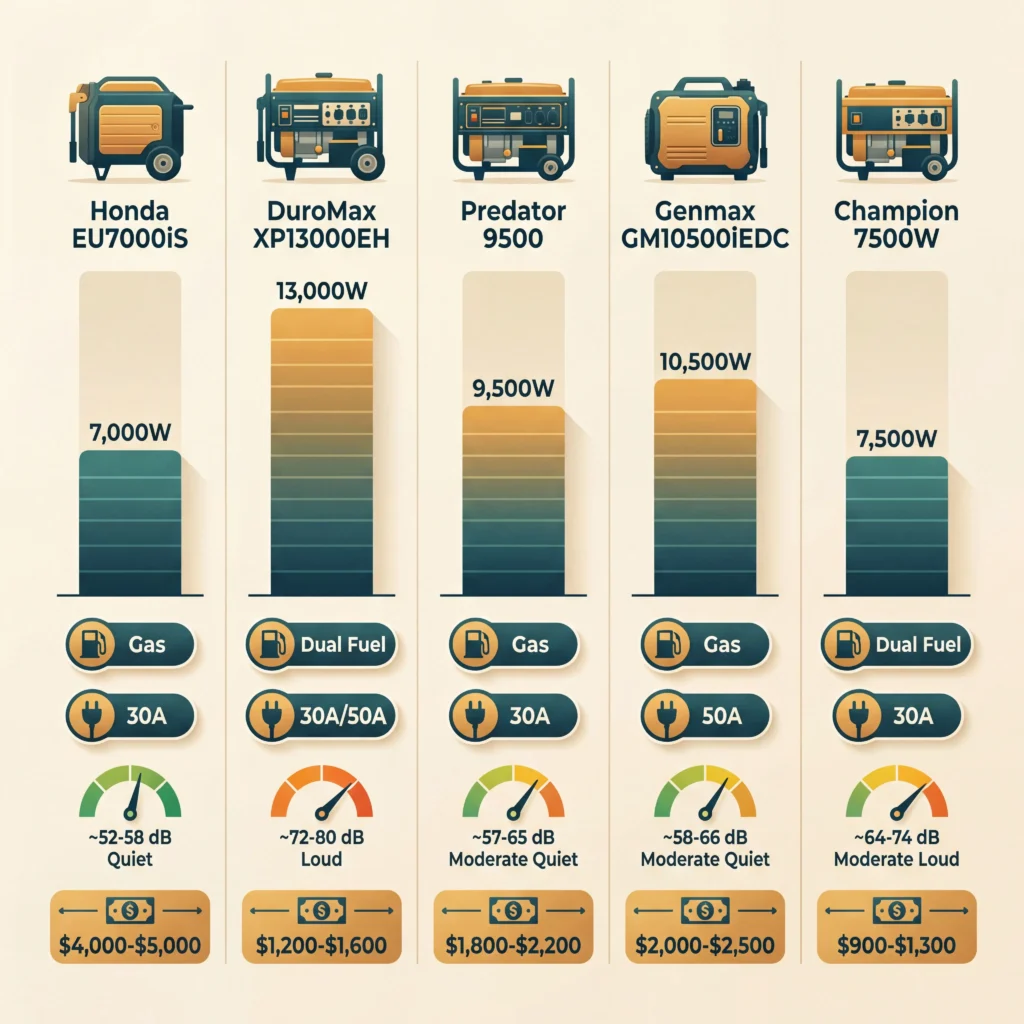
Prices and specs shift. Verify current model specs before purchasing. These ranges reflect typical street pricing.
Know What a Food Truck Generator Costs in 2026
Generator pricing ranges widely depending on type, wattage, and brand.
Small inverter generators in the 2,000-3,500W range typically run $400-$1,200. These work for minimal setups — a couple of coolers, lights, a POS system. Mid-range inverters from 5,000-10,000W run $1,500-$3,000. This is where most food truck operators land.
Large conventional or dual-fuel generators from 10,000-15,000W+ range from $1,000-$2,500. The lower noise of a comparable inverter pushes costs higher. Built-in systems including professional generator installation can run $3,000-$8,000+ depending on the unit and the complexity of your truck’s electrical system.
Beyond the purchase price, factor in ongoing costs. Fuel runs roughly $10-$30 per full-day event depending on load. Oil changes run every 50-100 hours. A well-maintained generator should last several thousand hours of operation.
Install and Mount Your Generator the Right Way
⚠️ Warning: Generator installation involves electrical connections and exhaust routing. I’m not a licensed electrician — know your limits. Consult a licensed electrician and review your local building codes before proceeding. Electrical codes vary by state and municipality. Improper installation can cause carbon monoxide poisoning, electrical fire, or death. What’s described here is general guidance, not a substitute for code compliance.
Where and how you mount your generator matters for safety, noise, and airflow.
External mounting — on a rear platform, bumper-mounted bracket, or underneath the truck — keeps heat and exhaust away from the kitchen. This is the preferred approach for conventional generators that run hot and loud. Secure the mounting with vibration-dampening brackets. Generators vibrate hard at full load. A poor mount loosens over time and creates rattling.
Internal mounting works only with a properly ventilated dedicated compartment. The compartment needs active ventilation: both intake and exhaust with sufficient CFM to prevent heat buildup. Carbon monoxide from gas or propane generators is lethal in enclosed spaces. Never run a fuel generator inside the truck without proper exhaust routing to the exterior.
As a ServSafe-certified operator and former equipment tech, I take this part personally. I’ve seen bad connections fry equipment and start fires. Both are preventable.
Connection basics:
- Run the generator’s power cord to your truck’s shore power inlet — the same plug you’d use at a commissary or event with grid power.
- Your truck’s electrical panel distributes power from there to all circuits.
- Use the correct gauge cord for your amperage — 10-gauge minimum for 30-amp, 6-gauge for 50-amp runs over 25 feet.
- Ground the generator properly. This isn’t optional.
What works in my region might need adjusting for your climate and local codes. Always verify with your local authority having jurisdiction before finalizing your setup.
📎 Related: proper ventilation ties into your ventilation system — make sure they’re planned together.
Keep Your Generator Running: A Maintenance Schedule That Works
A generator that gets maintenance runs for years. One that doesn’t will fail when you need it most — mid-service, on a Saturday, with 40 people in line.
Here’s the schedule I follow and recommend.
Every use (before each event):
Check oil level and top off if needed. Inspect fuel lines and connections for leaks. Make sure the air filter isn’t clogged. Test start the generator before loading equipment.
Every 50 hours of operation (roughly every 1-2 weeks for busy trucks):
Change the oil. This is the single most important thing you can do. Clean or replace the air filter. Check spark plug condition.
Every 100-200 hours:
Replace the spark plug. Inspect and clean the fuel filter. Check valve clearance per your model’s manual. Inspect the exhaust system for leaks or damage.
Seasonally or every 6 months:
Full inspection of all electrical connections. Load-test the generator to confirm rated output. Drain and replace fuel if using gasoline — stale gas causes most no-start issues. If storing for more than 30 days, run the carburetor dry or add fuel stabilizer.

Skipping oil changes is the number one killer of food truck generators. Oil is cheap. Generators are not.
Don’t Count on Battery Power Stations Yet
Battery-based power stations from brands like EcoFlow, Jackery, Bluetti, and Joule Case are getting attention in the food truck space. They’re silent, produce zero emissions, and require no maintenance. Some municipalities are starting to restrict or ban gas-powered generators.
The reality right now: battery power stations work well for low-draw setups. Coffee trucks, dessert trucks, beverage carts — anything under roughly 2,000-3,000 watts of consistent draw can run on a quality battery system. Pair it with solar panels on the roof and you extend runtime significantly.
For full-service food trucks running fryers, grills, A/C, ice machines, and refrigeration simultaneously? Not there yet for most operators. The storage capacity needed for an 8-10 hour day at 7,000+ watts would cost significantly more than a comparable generator setup. Recharge times during operation are a limiting factor.
Keep an eye on this space — it’s moving fast. Within a few years, battery systems may be viable for heavier loads. But today, for most food truck operators, a generator is still the practical choice. If you’re running a lighter setup though, a battery system is worth exploring. No noise, no fumes, no maintenance.
Common Generator Mistakes That Kill Your Service
I’ve seen every one of these kill a service day. Don’t be that truck.
❌ DON’T: Run at full capacity constantly.
✅ DO: Buy at least 20-30% above your maximum draw. Running at the ceiling burns out the generator fast.
❌ DON’T: Ignore startup surge.
✅ DO: Calculate the worst-case scenario where your ice machine and refrigerator kick on at the same time. If your generator can’t handle that combined surge, it trips and everything goes dark.
❌ DON’T: Use whatever extension cord you have lying around.
✅ DO: Match cord gauge to amperage and keep runs as short as possible. 10-gauge minimum for 30-amp. 6-gauge for 50-amp.
⚠️ Warning: An undersized extension cord will overheat under load. I’ve seen one melt through its insulation during a lunch rush. This is a fire hazard — not a shortcut.
❌ DON’T: Skip the break-in period on a new generator.
✅ DO: Follow the manual exactly. Usually 5-10 hours at varying loads with an oil change at the end. Skip this and you could void your warranty.
❌ DON’T: Forget spare oil and a spark plug.
✅ DO: Keep a quart of oil and a spare plug in the truck. They weigh nothing and can save an entire service day.
❌ DON’T: Run stale gasoline.
✅ DO: Add fuel stabilizer or drain the tank if your truck sits more than a few weeks. I left a backup generator sitting for about six weeks between summer events once. Tried to start it the morning of a festival. Nothing. Carburetor was gummed up from degraded gas. Missed the first three hours of service while I cleaned it out. Now I either drain the tank or add stabilizer any time a generator sits more than two weeks.
Frequently Asked Questions
What size generator is needed to power a food truck?
Most food trucks need between 7,000 and 12,000 watts. Smaller setups — a few coolers, lighting, and a POS system — can get by with 3,500-5,000 watts. Trucks running espresso machines, A/C, ice machines, and electric cooking equipment often need 10,000 watts or more. Calculate your actual appliance wattage before buying.
How much does a food truck generator cost?
Expect to spend $400-$1,200 for a small inverter, $1,500-$3,000 for a mid-range inverter suitable for most trucks, and $1,000-$2,500 for a large conventional or dual-fuel generator. Built-in systems with professional installation can run $3,000-$8,000 or more.
Can I run my food truck on a battery power station instead of a generator?
For low-draw setups under 2,000-3,000 watts — coffee trucks, dessert trucks, beverage carts — yes. Battery power stations are a viable and quieter alternative. For full-service trucks with heavy equipment loads, generator technology still offers better value and runtime for most operators.
What electrical hookup does a food truck need for a generator?
Your truck needs either a 30-amp or 50-amp shore power inlet depending on your electrical panel. The generator connects to this inlet via the appropriate power cord. Your panel distributes power to all circuits inside the truck. Match the generator’s outlet amperage to your panel — adapters create bottlenecks.
How often should I change the oil in my food truck generator?
Every 50 hours of operation. For busy trucks, that means every one to two weeks. Fresh oil is the cheapest insurance against a catastrophic engine failure. Check the level before every use.
Bottom Line
A food truck generator isn’t a purchase you want to guess on. Size it based on your actual wattage needs — not what some sales page recommends. Match the plug to your panel. Pick a fuel type that works with your existing setup. Maintain it on schedule and it’ll run for years.
If I had to pick one generator for a mid-range food truck today, I’d look hard at the Genmax 10500 or the Predator 9500 depending on whether I needed a 50-amp or 30-amp connection. If budget isn’t a concern and I want the quietest, most reliable inverter available, Honda is still the one to beat.
Your next steps depend on where you are in the build process:
- Still putting your truck together? Check the full food truck equipment checklist.
- Need to figure out ventilation for your generator mounting? Read our guide on food truck exhaust hoods.
- For the complete picture on building and outfitting your truck, head back to our Food Truck Equipment Guide.
— Darnell Kowalski
