

📌 Quick Answer
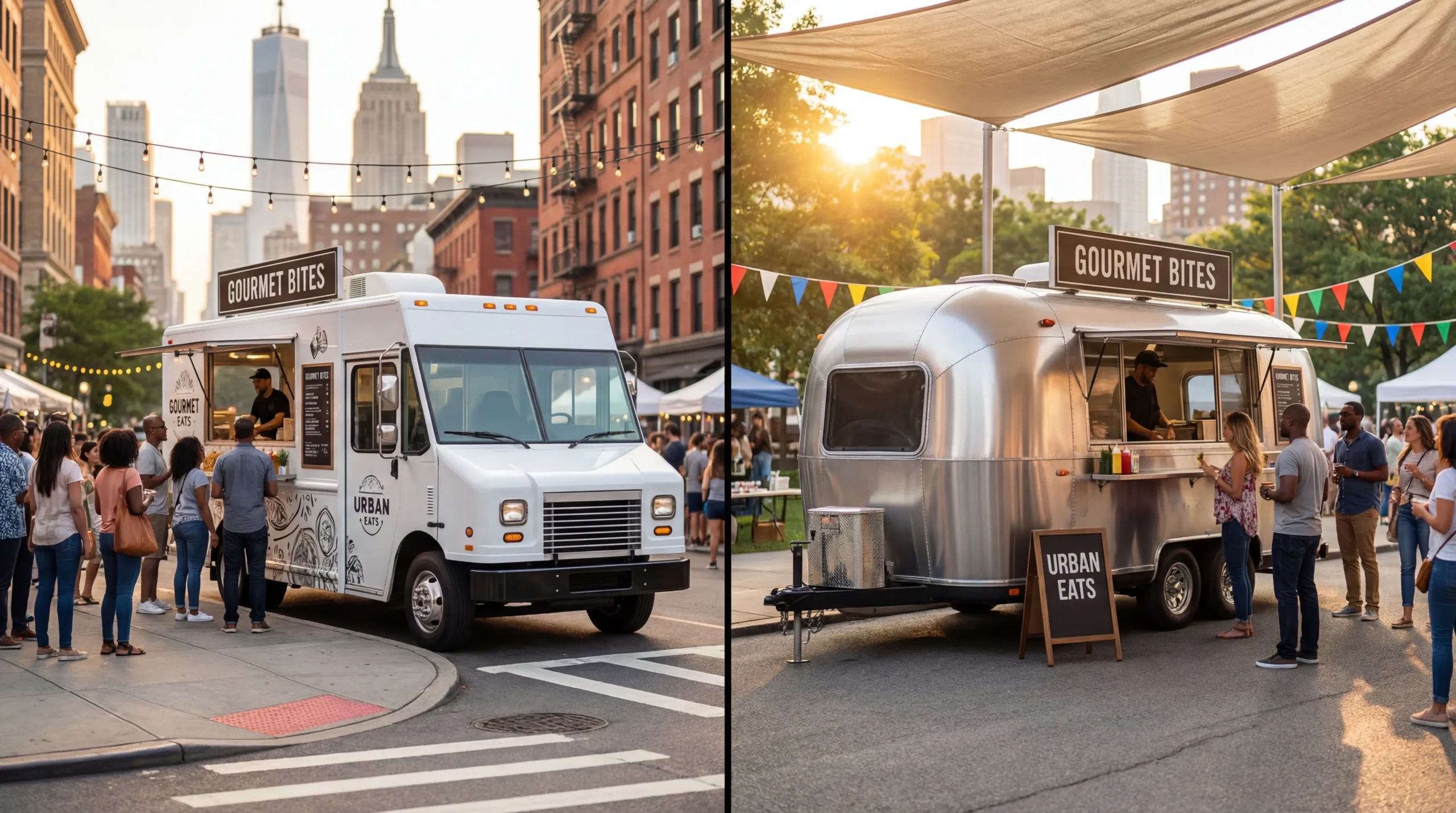
Choosing between a food truck and food trailer comes down to three things: your budget, how often you’ll move, and your menu size. Food trailers cost 30-40% less upfront ($50K-$100K vs $80K-$175K) and offer more kitchen space, but require a tow vehicle. Food trucks provide all-in-one mobility but cost more and have smaller kitchens. Most beginners do well with trailers; high-mobility urban operators prefer trucks.
Reading time: 10 minutes
📚 Part of: How to Start a Food Truck: Complete Guide
This guide covers food trucks vs trailers in depth. For the complete overview of starting your mobile food business, see our comprehensive Food Truck Startup Costs guide.
If you’re trying to decide between a food truck and a food trailer, I completely get why you’re stuck. When I started my food business in Portland, I spent three weeks going back and forth. I made spreadsheets. I lost sleep. I even test-drove someone else’s food truck around a parking lot at 6 AM.
Here’s the thing—there’s no universally “right” choice. But there absolutely is a right choice for your specific situation. And that’s what I’m going to help you figure out today.
I’ve talked to dozens of food truck and trailer owners over the years, and the ones who thrive almost always say the same thing: they picked the option that matched their business model, not the one that looked cooler on Instagram.
Let’s break this down so you can make a confident decision.
What’s the Actual Difference Between a Food Truck and Food Trailer?
Before we dive into costs and logistics, let’s make sure we’re on the same page.
A food truck is a self-contained vehicle with both a driving cabin and a kitchen built into one unit. You drive it to your location, park, open the window, and start serving. It’s all-in-one mobility.
A food trailer (sometimes called a concession trailer) is a kitchen unit that you tow behind a separate vehicle. Once you arrive, you unhitch the trailer, set up stabilizer jacks, and start cooking. The tow vehicle becomes available for other tasks.
That core difference—self-contained vs. towed—affects everything else: cost, maintenance, flexibility, and daily operations.
Here’s a quick side-by-side to get you oriented:
| Factor | Food Truck | Food Trailer |
|---|---|---|
| Mobility | Drive directly to location | Requires tow vehicle |
| Kitchen Space | 7-8 ft wide typical | 8-8.5 ft wide typical |
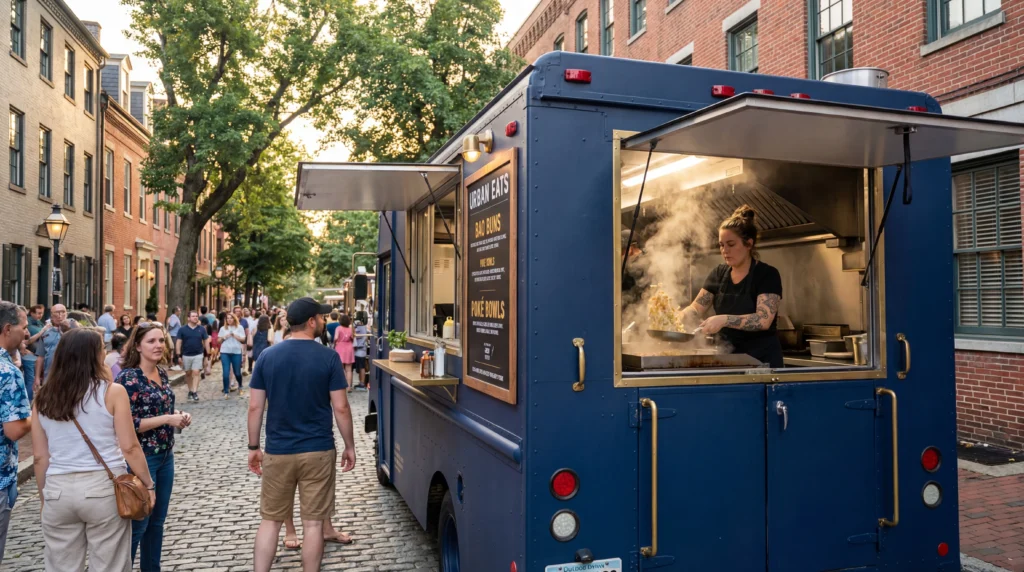
| Upfront Cost | $80,000 – $175,000 | $50,000 – $100,000 |
| Tow Vehicle Needed? | No | Yes (add $15K-$40K if you don’t have one) |
| Setup Time | 5-10 minutes | 15-30 minutes |
| Engine Maintenance | Yes (yours to manage) | No (only on tow vehicle) |
Food Truck vs Food Trailer: 2026 Cost Comparison
Real talk: cost is usually the biggest factor, so let’s get specific. These numbers reflect what I’m seeing in 2026 based on conversations with builders, dealers, and recent buyers.
Upfront Purchase Costs
Food Trucks:
- New, custom-built: $125,000 – $175,000
- New, pre-fabricated: $80,000 – $125,000
- Used (good condition): $45,000 – $80,000
Food Trailers:
- New, custom-built: $65,000 – $100,000
- New, pre-fabricated: $50,000 – $75,000
- Used (good condition): $25,000 – $50,000
But wait—if you go the trailer route and don’t already own a truck that can tow 7,000+ lbs, you’ll need to factor in a tow vehicle:
- Used heavy-duty pickup: $15,000 – $30,000
- New heavy-duty pickup: $40,000 – $65,000
Even with a tow vehicle purchase, most people save $15,000-$40,000 going the trailer route. That’s not nothing—especially when you’re just starting out and need capital for food truck startup costs like permits, insurance, and inventory.
Operating Costs (Annual Estimates)
| Expense | Food Truck | Food Trailer |
|---|---|---|
| Fuel | $4,000 – $8,000 | $2,000 – $4,000 |
| Insurance | $3,000 – $6,000 | $2,000 – $4,000 |
| Maintenance | $3,000 – $8,000 | $1,000 – $3,000 |
| Registration | $500 – $1,500 | $200 – $600 |
| Total Annual | $10,500 – $23,500 | $5,200 – $11,600 |
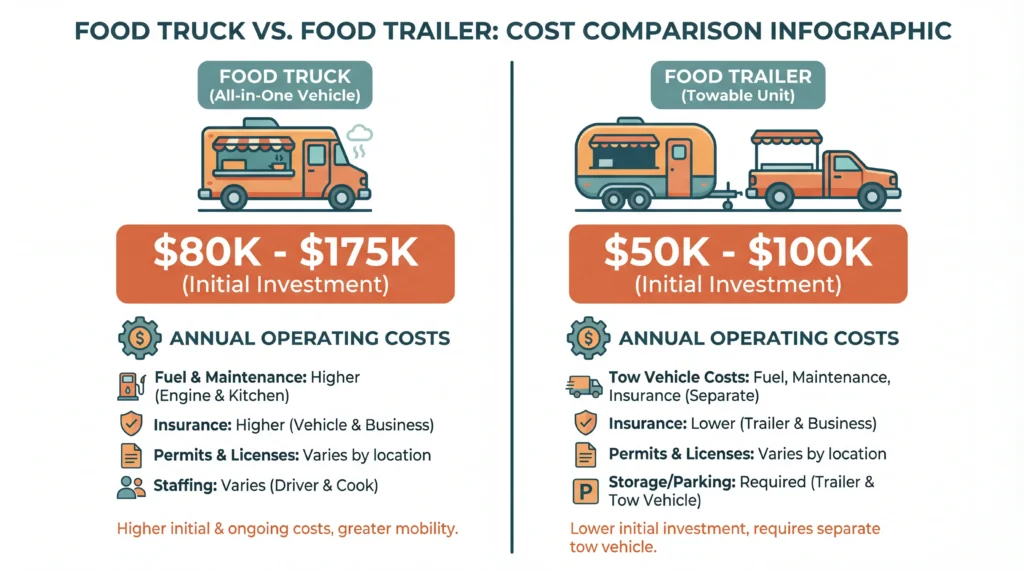
The maintenance difference is huge. With a food truck, you’re maintaining both a commercial kitchen AND a vehicle engine. If that engine needs major work, you’re completely shut down. With a trailer, mechanical issues on your tow vehicle don’t stop you from cooking—you can rent or borrow a truck and keep operating.
Mobility and Daily Operations: How They Really Differ
Okay, so here’s the deal. On paper, food trucks seem more mobile—and they are, in the sense that everything’s in one unit. But “mobile” means different things depending on how you operate.
Food Truck Mobility
Best for:
- Daily lunch routes in urban areas
- Moving between 2-3 locations per day
- Street parking in tight spaces
- Quick setup in high-competition areas
Challenges:
- If you’re parked at a multi-day festival, your only vehicle is tied up
- Urban parking can be brutal (ever tried parking a 24-foot truck in downtown Seattle?)
- If the engine dies, your whole business stops
Food Trailer Mobility
Best for:
- Weekend festivals and events
- Semi-permanent locations (food truck pods, private lots)
- Catering where you need to leave and return
- Operators who want their tow vehicle for other business tasks
Challenges:
- Longer setup time (unhitching, stabilizers, leveling)
- Requires confident towing skills
- Some events have tight maneuvering requirements
I’m not gonna lie—backing a 20-foot trailer into a festival spot takes practice. But most people get comfortable within a few weeks. And the flexibility of having your tow vehicle free is genuinely useful. One owner I mentored uses her truck for ingredient runs while her trailer stays parked at a brewery lot.
Kitchen Space and Layout: Which Gives You More Room?
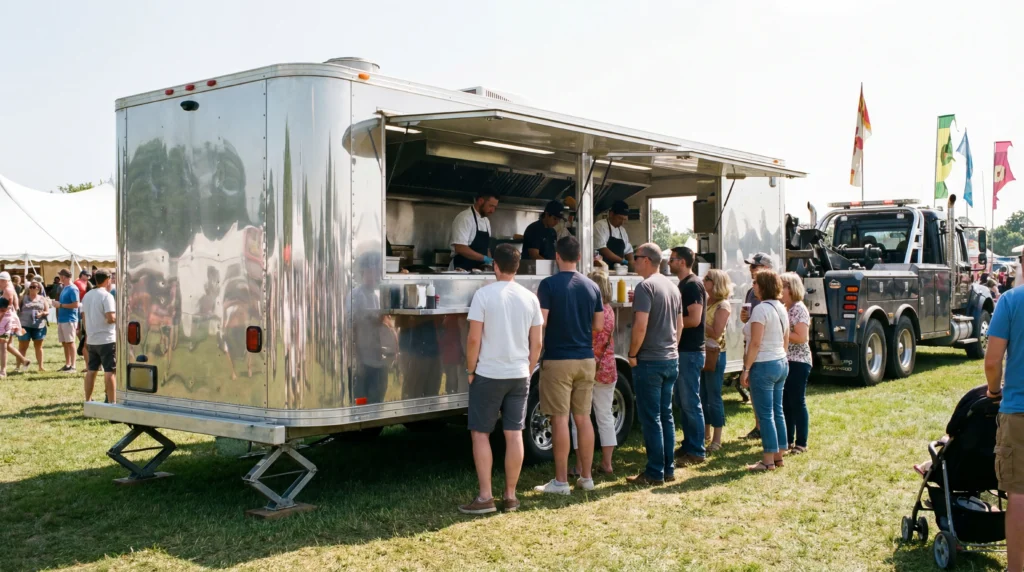
This surprised me when I first learned it: food trailers typically have more usable kitchen space than food trucks.
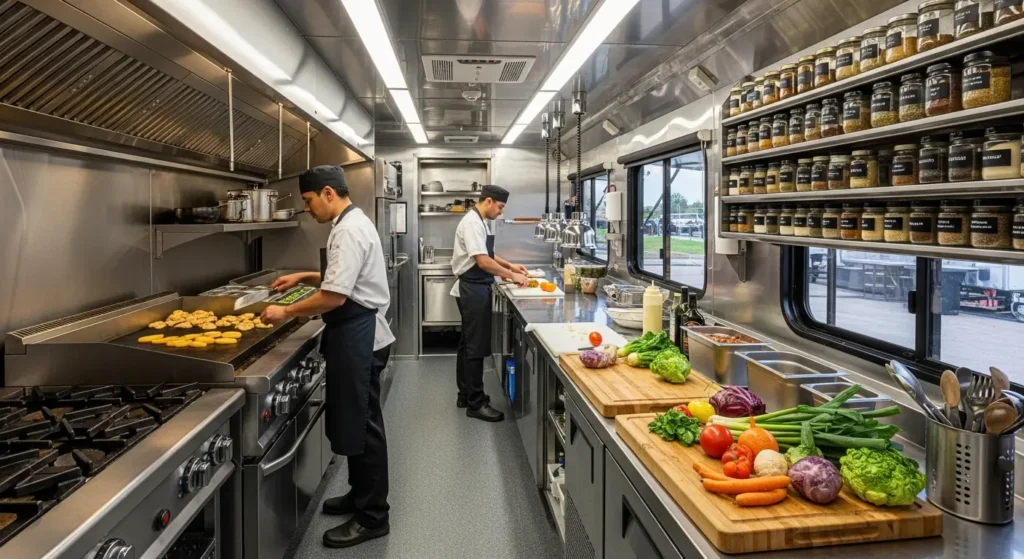
Why? Because trailers don’t need a driver’s cabin. That front 4-6 feet of a food truck is dedicated to driving—seats, steering wheel, dashboard. A trailer is kitchen from front to back.
Typical interior widths:
- Food truck: 7 feet (constrained by road regulations)
- Food trailer: 8-8.5 feet
That extra foot might not sound like much, but when you’re working in a space for 8+ hours with another person, it matters. I’ve talked to owners who switched from trucks to trailers specifically because they wanted a second prep station or a bigger griddle.
If your food truck concept requires a lot of equipment—think BBQ smokers, pizza ovens, or full taco setups with multiple proteins—a trailer will serve you better. If you’re doing coffee, ice cream, or simple sandwiches, a truck’s space is usually fine.
Permits, Licenses, and Insurance: What’s Different?
Can we talk about this? Because it’s one of the most confusing parts, and most comparison guides skip over it.
The permit requirements for trucks vs. trailers are mostly the same:
- Business license ✓
- Food handler’s permit ✓
- Health department inspection ✓
- Fire department approval ✓
- Mobile vendor permit ✓
But here’s where it gets different:
Vehicle Registration:
- Food trucks register as commercial vehicles (heavier fees, commercial plates)
- Food trailers register as… trailers (cheaper, simpler)
Insurance:
- Food trucks need commercial auto insurance + general liability
- Food trailers need trailer-specific coverage + general liability + your tow vehicle’s policy
Parking Permits:
- Some cities treat trucks and trailers differently for overnight parking
- Check your local regulations—this varies wildly
For a deep dive on all the paperwork, check out our guide on food truck permits and licenses. But the key takeaway: trailers are generally simpler from a registration and insurance standpoint.
Which Is Better for YOUR Business Type?
Alright, decision time. Based on everything I’ve seen and everyone I’ve talked to, here’s my honest breakdown:
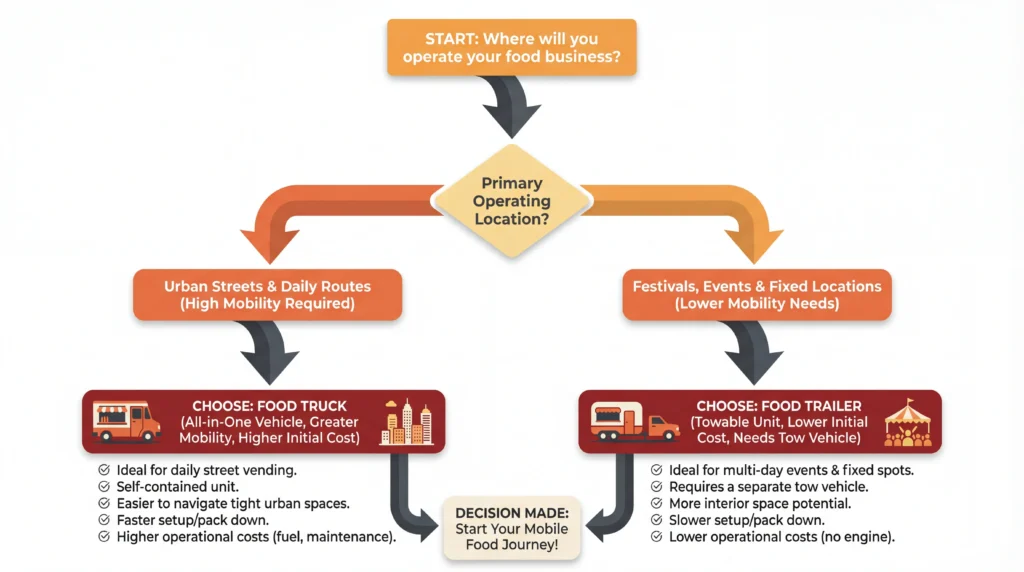
Choose a Food Truck If:
- ✅ You’ll operate in dense urban areas with street parking
- ✅ You move locations 2+ times per day
- ✅ You want the simplest possible setup (drive, park, open)
- ✅ You’re not doing multi-day events
- ✅ You have a bigger budget ($100K+)
- ✅ Your menu is compact (minimal equipment)
Choose a Food Trailer If:
- ✅ You’ll work festivals, events, and private catering
- ✅ You want a semi-permanent location (pods, lots)
- ✅ Budget is a concern (save $20K-$40K)
- ✅ You need more kitchen space for complex menus
- ✅ You want your tow vehicle available for other tasks
- ✅ Lower ongoing maintenance costs matter to you
Best for Beginners?
When I was in your shoes, I asked this same question to every experienced operator I knew. About 70% said: start with a trailer if you can.
The reasoning? Lower entry cost, lower risk, and easier to sell if things don’t work out. Food trailers tend to hold their value better than trucks (no engine depreciation), and they give you breathing room while you figure out your market.
That said, if you’re specifically targeting downtown lunch crowds and need to move fast between spots, a truck might genuinely be the better fit. Know your market.
Common Mistakes When Choosing (Avoid These)
After mentoring 15+ new food truck owners, I’ve seen these mistakes too many times:
- Choosing based on looks, not logistics. That vintage Airstream looks amazing. But can you cook 200 tacos during lunch rush in it? Test your workflow before committing.
- Forgetting the tow vehicle cost. “Trailers are cheaper!” Sure—until you need a $30,000 truck to pull it. Run the FULL numbers.
- Not checking local regulations first. Some cities restrict trailer parking. Some events only accept trucks. Know your market’s rules before you buy.
- Underestimating fuel costs for trucks. That E-450 food truck gets 8-10 MPG. If you’re driving 50+ miles daily, fuel adds up fast.
- Buying too big too soon. A 26-foot trailer sounds great until you can’t find a spot to park it. Start smaller than you think—you can always upgrade later.
For more on avoiding costly errors, see our guide on food truck financing options to make sure you’re not overextending.
FAQ: Food Truck vs Food Trailer
Is it cheaper to buy a food truck or food trailer?
Food trailers are typically 30-40% cheaper upfront, ranging from $50,000-$100,000 new compared to $80,000-$175,000 for food trucks. However, if you don’t own a capable tow vehicle, add $15,000-$40,000 to the trailer cost.
Can you make more money with a food truck or trailer?
Revenue potential is similar—it depends more on your location, menu, and marketing than the vehicle type. However, trailers have lower operating costs (no engine maintenance, cheaper insurance), which means better profit margins on the same revenue.
Do you need a CDL to drive a food truck?
In most states, no. Food trucks under 26,000 lbs GVWR don’t require a CDL. However, some states have additional requirements for vehicles over 10,000 lbs. Check your state’s DMV website for specifics.
Which is better for festivals and events?
Food trailers are generally better for multi-day events because you can leave the trailer parked and use your tow vehicle for supply runs, returning home, or other tasks. Food trucks tie up your only vehicle for the entire event duration.
How long does a food trailer last compared to a food truck?
Food trailers often outlast food trucks by 5-10 years because they don’t have engines that wear out. A well-maintained trailer can last 20+ years; food trucks typically need major engine work or replacement after 10-15 years of commercial use.
Can I convert a food truck into a food trailer or vice versa?
Converting a truck to a trailer isn’t practical—you’d essentially be removing the front half. However, many owners upgrade from trailers to trucks (or vice versa) by selling their first unit and buying new. The used market for both is active.
Bottom Line: Making Your Decision
Here’s what I want you to take away from this:
There’s no wrong choice—only the wrong choice for your specific situation. A food trailer that works perfectly for festival catering would be terrible for downtown lunch routes. A food truck that dominates urban streets would be overkill for a semi-permanent brewery location.
Before you spend $50K-$150K, get crystal clear on:
- Where will you operate? (City streets vs. events vs. permanent spots)
- How often will you move? (Daily vs. weekly vs. rarely)
- What does your menu require? (Equipment needs = space needs)
- What’s your realistic budget? (Including ALL vehicle costs)
Once you’ve answered those questions honestly, the right choice usually becomes obvious.
Ready to take the next step? If you’re leaning toward buying, check out our guides on how to buy a food truck and used vs new food trucks to make sure you get the best deal.
You’ve totally got this.
—Jolene
