Food truck financing is the part nobody warns you about, and it decides whether your first summer feels like a business or a slow bleed. I am Sal, I run a flat-top truck in Austin, and I have signed for gear, chased a used chassis, and lost a Saturday market when my generator quit mid-rush with forty tickets on the rail. The truck is the fun part. Paying for it without handcuffing yourself for the next five years is the part that separates the folks still serving in year three from the ones who fold by Labor Day. Let me walk you through the money the way I wish someone had walked me through it.
The financing chapter is still the one new operators email me about the most, and from my 8 years running trucks in this city, I have seen sharp cooks go under because they signed a note without reading it twice.
I checked the rates and numbers below against what lenders are quoting me and two other operators this season, so nothing here is stale.
Quick answer: Most first-time operators fund a truck with a mix of personal savings plus one loan. The realistic paths are an SBA microloan (up to $50,000, rates around 8%-13%), an SBA 7(a) loan (up to $5 million but slow), equipment financing (5%-25% APR with the truck as collateral), a term loan, or a business line of credit. Expect to put 10%-20% down and to show a credit score, a written plan, and cash reserves. A build runs roughly $85,000-$120,000 on average, so borrow only what your projected sales can actually service.
What the money actually has to cover
Before you shop for a loan, you need the real number, because lenders fund what you can prove, not what you hope. A food truck build runs about $50,000 to $250,000 depending on new versus used and how much cooking you do onboard, with most first-timers landing somewhere around $85,000 to $120,000. That figure is not just the vehicle. The truck itself is usually 50-70% of the total, and then permits, equipment, initial inventory, and working capital pile another chunk on top. When I built my first truck, I lowballed that soft-cost pile by almost ten thousand dollars, a mistake I still see newer operators make.
Here is how it broke down for me and for most operators I know. The kitchen buildout, meaning the flat-top or fryer, refrigeration, a hood, fire suppression, and a decent point-of-sale, runs about $10,000 to $45,000. First-year permits and licenses swing wildly by city, anywhere from $1,000 to $30,000 or more once you add commissary fees and health inspections. Then you need cash you are not allowed to spend, because payroll and propane do not wait for a busy weekend. If you want the full teardown, I put the numbers side by side in my guide to what a food truck really costs, and I would read that before you sign anything.
One line item people underquote is fire suppression, and according to NFPA standards, that system over your flat-top or fryer needs a professional inspection at set intervals, not just an install-and-forget. Skipping the follow-up service is a fast way to void your insurance the day you actually need it.
The reason this matters for financing is simple. If you borrow the whole $110,000 and forget the $15,000 of soft costs, you open with an empty bank account and a monthly payment. That is the trap I see most, borrowing the full build and forgetting the soft costs entirely. Finance the truck and gear, but keep three to six months of operating cash out of the loan entirely.
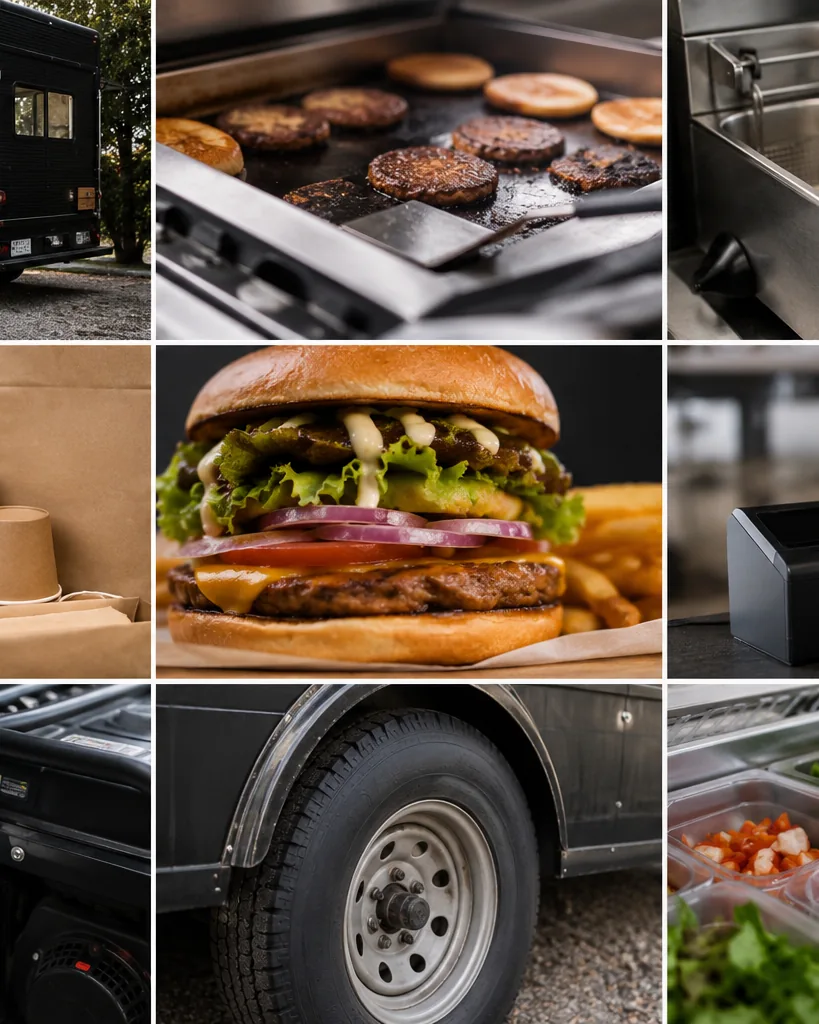
The seven ways to fund a truck
There is no single best way to pay for a truck. There is only the option that matches your credit, your cash, and how fast you need to open. Below are the seven paths that actually get first-timers on the road, with the tradeoffs I have watched play out at markets and commissaries around Texas. Most people end up stacking two of them: savings for the down payment, and one loan for the rest, and in my experience, the operators who stack two sources close faster and sleep easier than the ones betting everything on one big loan.
| Option | Typical amount | Rate / cost | Best for |
|---|---|---|---|
| Personal savings | Whatever you have | 0% interest, real risk | Keeping the loan small |
| SBA microloan | Up to $50,000 | About 8%-13% | Used truck, thin credit |
| SBA 7(a) loan | Up to $5 million | Roughly 9.75%-14.75% max | Bigger build, patient buyer |
| Equipment financing | Cost of the truck/gear | 5%-25% APR | Fast approval, truck as collateral |
| Term loan | $10,000-$100,000+ | Varies by credit | Established credit, quick cash |
| Business line of credit | Revolving limit | Interest on what you draw | Smoothing slow months |
| ROBS (401k rollover) | Your retirement balance | ~$5,000 setup, no interest | Debt-free start, high risk |
A few of these deserve a closer word. A term loan is a lump sum you pay back on a fixed schedule, usually $10,000 to $100,000 or more, and it fits an operator with established credit who wants cash fast without pledging a specific piece of gear. A business line of credit is different: it is a revolving limit you draw against only when you need it, and you pay interest just on what you use. I do not fund the truck with a line of credit, but I keep one open for the ugly months, when propane, a busted compressor, and a slow February all hit the same week. It is a cash-flow tool, not a startup tool.
Tip: Do not confuse the crowdfunding hype with a funding plan. A Kickstarter can cover a wrap, a launch event, or a chunk of your first inventory, and it doubles as marketing, but I have never seen one fully fund a truck. Treat it as a bonus on top of savings and a loan, not the loan itself.
SBA loans, up close
The SBA does not hand you cash directly. It backs loans made by banks and nonprofit lenders, which lowers their risk and gets a first-timer in the door who a regular bank would wave off. For a food truck, two SBA programs matter, and they serve very different buyers. Everything about them is spelled out on the government site, and I would read the source before you trust any blog, mine included.
The SBA Microloan is the one most new operators should look at first. It goes up to $50,000, the average loan is around $13,000, terms run up to seven years, and rates generally land between 8% and 13%. It is run through community-based intermediary lenders who also give you real business coaching, which is worth more than people think when you have never priced a menu. The catch is that $50,000 does not buy a new build, so this is a used-truck or gear-only tool. You can see the program terms straight from the U.S. Small Business Administration.
What most guides get wrong is treating the microloan and the 7(a) as interchangeable. According to the SBA, the microloan tops out at $50,000 and moves through community lenders, while the 7(a) can reach $5 million through banks, and picking the wrong one at the start wastes weeks you do not have.
The SBA 7(a) loan is the big one, up to $5 million, and in 2026 the variable-rate maximums sit somewhere around 9.75% to 14.75% depending on loan size and term, and according to SBA reporting, most food-service borrowers land closer to the middle of that range than the top end.
The rate is capped as a spread over the prime rate: roughly prime plus 3.00% on loans of $50,000 or less, prime plus 2.75% from $50,000 to $250,000, and prime plus 2.25% above that. Most 7(a) deals want about a 10% equity injection, which is your down payment. The upside is a lower rate and a longer runway. The downside is speed. A 7(a) can take weeks of paperwork, so it fits the operator building a serious rig, not the one who found a used truck on Facebook and needs to close Friday.
Equipment financing and leasing
Equipment financing is the workhorse of this industry because the truck itself is the collateral. That means the lender can move fast, often approving in one to three business days, and your credit does not have to be spotless because they can repossess the asset if you default. APRs run wide, about 5% to 25%, and food-service equipment tends to sit at the higher end, roughly 9% to 22%, because a used fryer and a scratched flat-top do not resell for much. Terms usually run three to seven years, and most operators land on a five-year term because it balances the monthly payment against the total interest you pay over the life of the loan.
One trap I fell into early: quoting a truck builder before I had my financing lined up. When you walk in pre-approved, you negotiate the price of the truck and the price of the money as two separate deals, and you keep the leverage. When you let the dealer arrange the financing, the payment can look fine while the rate quietly runs high, because they make a margin on the loan too. Get your own equipment-financing or SBA quote first, then shop the truck with a number in your pocket. The overlooked detail here is that dealer-arranged financing often bakes in a hidden markup on the rate, one most operators never think to ask about.
Leasing is the cousin of financing, and it splits operators into two camps. With a lease you make lower monthly payments and sometimes get a buyout at the end, which keeps cash free for inventory and marketing in a lean first year. But over the life of the deal you often pay more than you would to buy outright, and at the end you may own nothing.
I launched my truck on a loan instead of a lease because I wanted the truck as an asset I could sell, but I have seen a taco operator who leased her first rig for two years, learned the business risk-free, then bought a truck she actually wanted. Both are defensible. What is not defensible is leasing gear you will use hard for a decade just to shrink this month’s payment.
Warning: Watch the total cost, not the monthly payment. A $1,400 payment feels friendlier than $1,900, but if the cheap one runs seven years and the other runs four, the “cheap” loan can cost you thousands more in interest. Always ask for the total repayment number in dollars before you sign, and run it against your slow-season sales, not your best Saturday.
What lenders actually want before they say yes
Every lender is answering one question: will this person pay me back. You make that a yes with three things, and none of them are a secret. Get these in order before you apply and your rate drops, sometimes by several points, which on a $90,000 loan is real money every month, and in my experience, the operators who walk in with these three things ready get a faster yes and a noticeably better rate than the ones hoping the lender will coach them through it.
Have these ready before you apply, because the intake call goes faster when you are not scrambling for paperwork:
- Personal tax returns for the last two years, or as many as you have filed
- A month-by-month sales and expense estimate for your first year
- Bank statements showing your down payment funds are real and sitting there
- A signed commissary agreement or proof of a legal place to park and prep
- Your menu with prices, even if it is still a working draft
First, your personal credit score, because a brand-new business has no credit of its own. The tiers are blunt. Around 720 and up you see roughly 5% to 8% APR, from 660 to 719 about 8% to 14%, from 580 to 659 about 14% to 25%, and below 580 you are looking at 20% to 30% if you get approved at all. If your score is soft, spend three months fixing it before you apply. The Consumer Financial Protection Bureau explains how scores and APR work in plain language over at consumerfinance.gov, and it is worth an hour of reading.
Second, a real business plan with numbers, not a dream. Lenders want to see your menu, your projected daily covers, your food cost percentage, and where you will park and sell. This is the document that turns “I want a taco truck” into “I will sell 120 plates a day at a 30% food cost.” I keep a template and a walkthrough in my food truck business plan guide, and honestly, writing it is what showed me my first pricing was too low.
Third, a down payment, usually 10% to 20% of the loan. Putting 20% or more down almost always earns a better rate, and going with 0% down, where it is even offered, typically adds a 0.5% to 1.5% rate premium because the lender is carrying more risk. Skin in the game is not just a phrase; it is the single fastest way to move your rate in the right direction.

Leasing versus buying your first truck
If you are torn between leasing and buying, decide based on how sure you are about the concept, not on the payment alone. Buying builds an asset and usually costs less over time, but it locks up cash and commits you before you have proven the idea. Leasing costs more long-term but lets you test the water and walk away, which has real value when you are not yet certain people will line up for your food, and the pattern I see is simple: operators who lease to test an unproven idea rarely regret it, while the ones leasing gear they already know will sell just pay more for no reason.
My honest read after years at the window: if you have never run a truck, there is a strong case for buying a solid used rig and keeping the loan small, or leasing for a season to learn. A used truck runs about $30,000 to $100,000 versus $50,000 to $175,000 for a new build, and that gap is the difference between a payment you can cover on a rainy month and one that keeps you up at night.
I bought used my first year on purpose. When you are ready to shop, I keep a running breakdown of what to look for in buying a used food truck, because a cheap truck with a dying engine is not a deal.
The debt mistake I made in year one
I want to be straight with you, because most financing articles will not be. My first year I borrowed a little more than I needed, told myself the extra was a “cushion,” and then treated it like income. I underpriced my plates for a solid month before I sat down and did the unit math, and by the time I fixed it I had eaten through that cushion and my payment had not moved. Nothing about the loan was wrong. My discipline was. Having spent six seasons at the window since that mistake, I can tell you the operators who last are the ones who treat the loan like a tool, not a lifeline.
Here is the rule I live by now. Borrow for the truck and the gear that makes money, never for the vague middle. Keep three to six months of operating cash out of the loan and in a separate account you do not touch. And run every financing offer against your slow week, a rained-out February, not your festival Saturday, because the payment is due either way. One more thing people skip: before you drive a foot, get commercial food truck insurance sorted, because a lender will require it and one fender-bender without it can end the whole business.
ROBS deserves a specific warning. Rolling your 401(k) into your business through a Rollover as Business Start-Up sounds great because you pay no interest and take on no debt. It is legal, but the IRS runs a dedicated compliance project on it, it costs around $5,000 to set up with a provider, and it forces you into a C-corporation with a new retirement plan. According to the IRS, the part that keeps me up is that their own research found a lot of ROBS businesses fail, and when the business goes, so does the retirement money.
Read the rules directly from the Internal Revenue Service and talk to a real accountant before you touch it. Betting your retirement on your first truck is a bet I would not make.
The order I would follow today
From my years on the truck, here is the sequence that actually works, in the order I wish I had followed on day one, not the order I actually did it in. I have helped other operators walk this exact sequence before they signed anything, and the ones who follow it in order rarely call me back with regrets.
- Step 1 – Nail down your real total cost, truck plus permits plus three months of cash, before you talk to a single lender.
- Step 2 – Pull your credit report and spend thirty days fixing anything you can before you apply.
- Step 3 – Get pre-approved for equipment financing or an SBA microloan before you shop for a truck.
- Step 4 – Put down 10% to 20% and keep three to six months of operating cash out of the loan entirely.
- Step 5 – Sign the loan that survives your slowest week, not the one that looks best against your busiest Saturday.
Frequently asked questions
How much do I need for a down payment on a food truck loan?
Plan on 10% to 20% of the loan amount. On a $90,000 loan that is $9,000 to $18,000 out of pocket. Putting 20% or more down usually earns a better rate, and a 0% down deal, where offered, typically adds a 0.5% to 1.5% rate premium because the lender carries more risk. More down almost always means a lower payment.
Can I get food truck financing with bad credit?
Sometimes, but it costs you. Below a 580 score you are looking at roughly 20% to 30% APR if approved, often through equipment financing where the truck secures the loan. A better move is to spend three months lifting your score, add a co-signer, or make a larger down payment. Even a jump from 640 to 700 can cut your rate by several points.
What credit score do I need for an SBA loan?
There is no single federal cutoff, but most SBA lenders want to see a personal score in the high 600s or better, plus a solid business plan and some cash to put down. The microloan program is friendlier to thinner credit because it runs through community lenders. Check current requirements straight from the SBA, since individual lenders set their own bar on top of the federal rules.
Is it cheaper to lease or buy a food truck?
Buying is usually cheaper over the full life of the truck because you stop paying once the loan is done and you own an asset you can sell. Leasing costs more long-term but keeps monthly payments and upfront cash lower, which helps in an unproven first year. If you are confident in your concept, buy. If you are testing, a short lease limits your downside.
How long does it take to get approved?
It depends on the path. Equipment financing and some online term loans can approve in one to three business days, occasionally same-day with funding in 24 to 48 hours. An SBA 7(a) loan is the slow one, often several weeks of documentation and underwriting. Match the timeline to your deal: use equipment financing if you need to close on a truck fast, and SBA if you can wait for a lower rate.
The bottom line
Financing a truck is not about finding free money. It is about borrowing the smallest amount that gets you cooking, at the lowest rate your credit can earn, on a term your slow season can survive. Start with your real cost, put 10% to 20% down, keep operating cash out of the loan, and pick the tool that fits: a microloan or equipment financing for a used rig, a 7(a) for a serious build, savings to shrink all of it.
None of this is financial advice, and your city’s permit office and your accountant get the final word. But if you treat the loan like the serious partner it is, you give yourself the one thing every new truck needs most, which is enough runway to get good before the money runs out.