Food truck prices confuse people because the phrase hides two very different numbers: what you pay for the truck, and what you pay to actually open it. After years running trucks and coaching friends through their first buys, I can tell you the second number is the one that sinks budgets. Folks see a $45,000 truck, wire the money, and then discover the truck was barely half of what it really took to get the window open. This guide lays out both numbers honestly, with the ranges I see on real invoices and city paperwork this season.
The first time I priced out a build, I did what most first-timers do: I added up the truck and the oven, called it my budget, and figured the rest was pocket change. It was not. Permits, working capital, and the boring recurring bills nearly doubled my real number, and I felt every dollar of the gap in my first slow month. In my experience, the operators who survive are the ones who price the whole thing before they buy anything, not the ones who fall in love with a sticker.
Every price, permit range, and margin below is checked against live listings and what I am paying on my own orders and renewals this year.
Quick answer: Food truck prices break into buying and opening. To buy, a used truck runs about $40,000-$80,000, a used trailer $20,000-$40,000, and a new custom build $90,000-$175,000. To open, the full startup lands at $50,000-$200,000, with the average setup around $85,000-$120,000, because the truck is only 50-70 percent of the total. Add permits at $811-$17,000+ depending on your city, plus inventory, insurance, and a working-capital cushion. If you are not ready to buy, a ready-to-run truck rents from about $1,800 a month. Price it all before you commit, because roughly 60 percent of trucks fail in year one, mostly on money they did not plan for.
What food truck prices really include
The word price does a lot of hiding here, so let me split it cleanly. There is the purchase price, which is the sticker on the truck or trailer you buy. Then there is the startup price, which is everything it takes to legally open and run: the truck plus permits, equipment upgrades, inventory, insurance, and a cash cushion. Buyers who only price the first number are the ones who run out of money before their first good weekend.
The single most important fact about food truck prices is that the vehicle is only 50-70 percent of your total startup. That means if you buy a $50,000 truck, your real all-in number is closer to $75,000-$100,000 once everything else is in. I have watched more than one new operator treat the truck as the whole cost, open with an empty account, and fold on the first slow week. Price the whole thing, not the shiny part. My full walkthrough of food truck cost breaks the startup math down line by line if you want the deeper version.

Purchase prices by type
Let me put real ranges on the buying side, because vague talk helps nobody. There are three doors, and they are priced very differently. A used food truck runs about $40,000-$80,000 depending on condition and equipment, though budget models can start as low as $20,000 and well-maintained recent trucks reach $30,000-$70,000. A used concession trailer is the cheapest viable path at about $20,000-$40,000, as long as you already own or can borrow a vehicle to tow it. And a new custom build, made to your exact line with a warranty, climbs to $90,000-$175,000.
The gap between these doors is real money, and the right one depends on your cash and your certainty. I steer most first-timers toward a used truck or trailer, because you can prove your concept without borrowing six figures. The catch with used is that the price on the ad is rarely the price you pay; a tired generator or a dead reefer is a hidden repair you inherit. Inspect hard, get a mechanic, and price every deferred repair into your offer. My notes on used food trucks for sale cover the inspection walk-through I run on every rig before money moves.
| Buying option | Typical price | Who it fits |
|---|---|---|
| Used concession trailer | $20,000-$40,000 | Lowest entry, if you can tow it |
| Budget used truck | $20,000-$40,000 | Tight budget, expect repairs |
| Solid used truck | $40,000-$80,000 | Most first-timers |
| New custom build | $90,000-$175,000 | Well-capitalized, certain of market |
The full startup number, line by line
Here is where the honest number lives. Across the industry, total startup lands between $50,000 and $200,000, with the average setup running $85,000-$120,000. That is 12-18 percent higher than it was a few years back, mostly because used-truck prices climbed. When I sketch a startup budget for a new operator, it is never just the truck; it is six lines, and every one of them is real.
The used truck itself runs $40,000-$100,000 in that average build. On top of it, budget $10,000-$20,000 for equipment upgrades the previous owner skimped on, $811-$17,000-plus for city permits depending on where you operate, $3,000-$5,000 for opening inventory, and $10,000-$20,000 for two months of working capital. That last line is the one people cut to afford a nicer truck, and it is the one that saves them when the first month is slow. Cut the cushion and one dead generator ends the whole thing.
| Startup line | Typical range | Notes |
|---|---|---|
| Used truck | $40,000-$100,000 | 50-70% of total; biggest single line |
| Equipment upgrades | $10,000-$20,000 | Reefer, prep, generator fixes |
| City permits and licenses | $811-$17,000+ | Wildly location-dependent |
| Opening inventory | $3,000-$5,000 | First stock order |
| Working capital (two months) | $10,000-$20,000 | Do not open with zero cushion |
Permit and license prices by city
If one line on the food truck price sheet surprises people the most, it is permits. The spread is not small. One widely cited range runs from about $811 in Denver to $17,000-plus in Boston, and everything in between depends on your city and county. A business license alone typically runs $50-$500, but that is just the front door; you also need a mobile food facility permit, food handler cards, a health inspection, and often a fire inspection on top.
You cannot copy another city’s number, and I wish more guides said that plainly. A friend’s $900 permit in one town tells you nothing about the $6,000 you might owe two states over. The only reliable price is the one your own health department quotes you when you call. On the food-safety side, most jurisdictions build their rules on the framework in the federal Food Code, which the U.S. Food and Drug Administration maintains, so reading that framework tells you what a compliant build even needs before you pay for anything. When I renewed my own permits this season, the surprises were never the fee itself; they were the extra inspections the fee assumed I already knew about.
Rental prices: the lower-risk path
Not everyone should buy on day one, and I say that as someone who owns trucks. Renting is the door people forget when they compare food truck prices. A ready-to-run truck rents from about $1,800 a month, and for a season that is a cheap way to prove your food actually sells before you sink six figures into owning. If the concept flops, you walked away for a few thousand dollars instead of being stuck with a truck you cannot resell.
There is a second kind of rental worth knowing about: renting a truck out for a single event, which is what caterers and party hosts pay for. In a market like New York, that event rental runs roughly $1,500-$5,000 depending on size and hours. If you already own a truck, that is a revenue line for you; if you are a buyer testing the waters, it tells you what customers will pay for a truck to show up. Either way, my breakdown of food truck rental covers both sides of that deal, renting to launch and renting out to earn.
The prices that never stop
The startup number gets the attention, but the recurring bills are what actually close trucks. Most first-time owners underestimate ongoing costs by 40-60 percent, and that gap is a big reason roughly 60 percent of trucks fail within the first year. The truck price is a one-time hit; the monthly bills come every month whether you had a good weekend or not.
Here is what keeps coming due after you open:
- Commissary rent, because most cities require you to prep and park in a licensed kitchen, not your driveway.
- Fuel and propane for the truck and the cooking line, which move with mileage and volume.
- Generator maintenance and the occasional repair, since the generator is the hardest-working part on the rig.
- Insurance, where a solo operator with a roughly $40,000 truck should budget about $200-$280 a month.
- Permit and inspection renewals, which come around every year and are never free.
None of these show up on the sticker, and all of them are why the working-capital cushion matters so much. When I coach a new operator, I make them list these before they fall in love with any truck, because the rig that fits your purchase budget can still bury you on the monthly bills. Price the whole life of the truck, not just the day you buy it.
Menu prices: how you make the money back
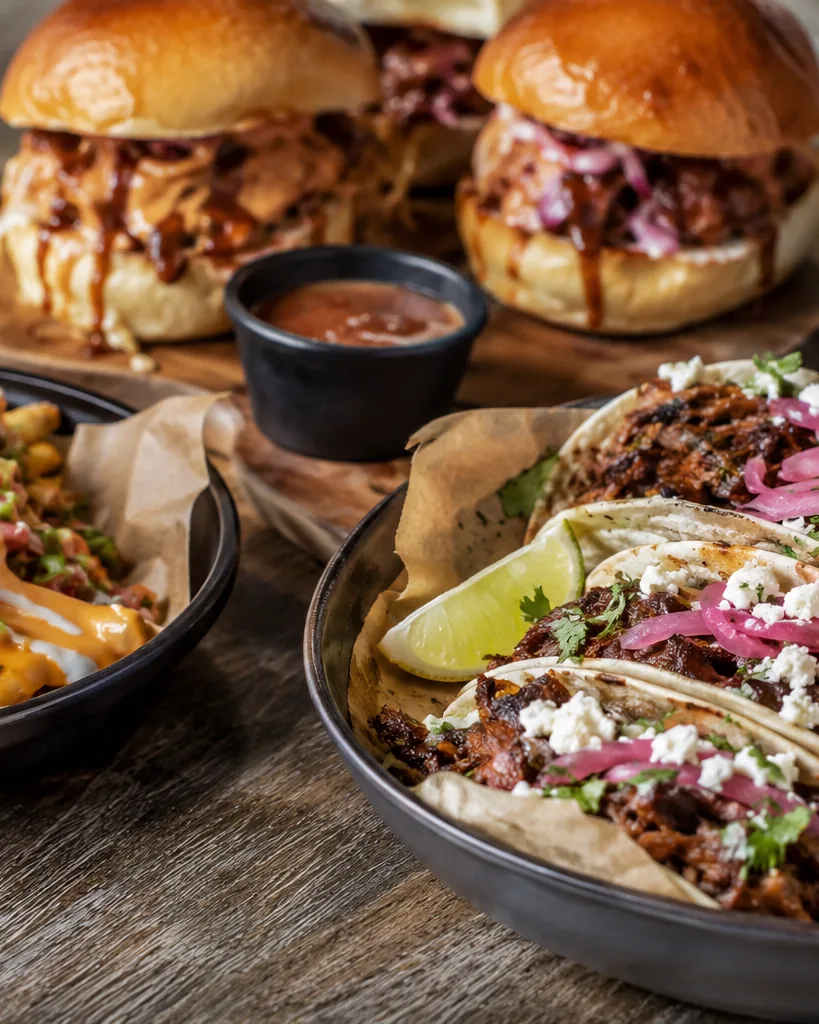
Food truck prices only matter if the menu earns them back, so let me close the loop on the side of the ledger that pays for everything. Your target is a food cost of 25-35 percent of revenue, with a blended goal around 28-33 percent once you mix in drinks and sides. That means for every $10 that hits the drawer, no more than about $3.00-$3.50 should be the food itself.
The formula I keep in my head is simple: menu price equals your ingredient cost times a waste factor, plus packaging and labor, divided by your target food cost percentage. Run it on every item, then balance the board so high-margin add-ons carry the low-margin mains. Drinks and sides run 15-22 percent food cost and are almost pure margin; protein-heavy mains run 32-38 percent and need the sides to pull the blended number into range. The 30-30-30 rule is my benchmark: roughly a third to food, a third to labor, a third to overhead, and what is left is profit.
Does it add up? At an average annual revenue near $346,000, a healthy truck nets 6-9 percent, and an owner-operator who works the window can push 7-15 percent. That is $24,000-$70,000 in take-home for a lot of hard hours, which is why holding those percentages is not optional. On a busy day an urban truck grosses $1,000-$2,000, with peaks past $2,500 at the right event. Those are real numbers, but only if you priced the menu off your actual food cost instead of copying the truck down the block. On financing the whole thing, the U.S. Small Business Administration is where I send everyone first, and the IRS rules on startup deductions and equipment expensing can change what your real out-of-pocket looks like at tax time. My guide to food truck financing walks through loans and what lenders want to see.
Run the formula on every item, then check the whole board against the 30-30-30 rule before you print a menu. A single underpriced hero item can quietly drag your blended food cost out of range no matter how disciplined the rest of the board is.
Tip: Before you price anything, weigh a real portion and cost it to the penny. I underpriced my early menu by guessing instead of weighing, and a busy week never felt like money. Five minutes with a scale and a calculator is the cheapest insurance on this whole list.
Where the price hides: build quality versus sticker
Two trucks can wear the same price tag and be worth thousands of dollars apart, and learning to see that gap is the most valuable skill a buyer can have. The sticker tells you what the seller wants. The build quality tells you what you will actually spend over the next two years. I have looked at a $55,000 truck that was a bargain and a $55,000 truck that was a money pit, and the only way to tell them apart was to get under them with a flashlight.
The parts that hide the real price are always the same. The generator is first, because it is the hardest-working component and a rebuild runs into the thousands; ask for the running hours the way you would ask a car’s mileage. Refrigeration is second, because a failing compressor is a quiet four-figure surprise you will not notice until the reach-in stops holding temperature on a hot day. The cooking line, the hood, and the fire suppression are third, because an expired suppression tag means you cannot pass your own inspection until you pay to service it. When I price a used truck, I add up every one of those deferred repairs and subtract it from what I am willing to pay. A cheap sticker with $12,000 of hidden work is not cheap.
This is also why a new build costs what it does. That $90,000-$175,000 is not just a nicer truck; it is a truck with no mystery repairs, a warranty behind the gear, and a line built to your exact workflow. Whether that premium is worth it depends entirely on your cash and how certain you are of your market. For a first-timer testing a concept, I would almost always rather see a well-inspected used truck with money in the bank than a shiny new rig that ate the whole budget.
Mistakes I see people make on price
The first mistake is anchoring on the truck and ignoring everything else. I did a version of this myself, adding the truck and the oven and calling it my budget, then getting buried by permits and recurring bills that nearly doubled my real number. The truck is 50-70 percent of startup, never the whole thing, and treating it as the whole thing is how you open with an empty account.
The second is chasing the cheapest sticker without inspecting. A $22,000 truck feels like a win right up until the generator dies in your second week and the repair costs more than you saved. Cheap is only cheap after the inspection confirms it. I would rather pay $45,000 for a truck I have vetted than $25,000 for a gamble, and I have watched the gamble go wrong enough times to mean it.
The third is skipping the working-capital cushion to afford a nicer rig. Every dollar you move from your cash reserve into a fancier truck is a dollar that is not there when the first slow month hits. I would rather see a $30,000 trailer with $15,000 in the bank than a $60,000 truck with nothing behind it. The truck does not carry you through a bad stretch; the cushion does. Price for survival, not for the photo.
Frequently asked questions
How much does a food truck cost to buy in 2026?
A used food truck runs about $40,000-$80,000, with budget models as low as $20,000. A used concession trailer is cheaper at $20,000-$40,000 if you can tow it. A new custom build climbs to $90,000-$175,000. Remember the vehicle is only 50-70 percent of your total startup, so the sticker is never the whole price.
What is the full startup price for a food truck?
Total startup lands at $50,000-$200,000, with the average setup running $85,000-$120,000. That covers the truck, equipment upgrades at $10,000-$20,000, permits at $811-$17,000-plus, inventory at $3,000-$5,000, and two months of working capital at $10,000-$20,000. The cash cushion is the line most people cut and most regret cutting.
Why are food truck permit prices so different by city?
Because every city and county sets its own fees and required inspections. The spread runs from about $811 in Denver to $17,000-plus in Boston. A business license alone is $50-$500, but you also need a mobile food permit, health inspection, food handler cards, and often a fire inspection. Only your own health department can quote your real number.
Is renting a food truck cheaper than buying?
For testing a concept, yes. A ready-to-run truck rents from about $1,800 a month, which lets you prove your food sells before committing six figures. Renting a truck for a single event, from the host side, runs roughly $1,500-$5,000 in a market like New York. Renting first is the cheapest way to learn whether your concept actually works.
What ongoing prices do food truck owners forget?
Commissary rent, fuel and propane, generator maintenance, insurance at about $200-$280 a month for a solo operator, and annual permit renewals. Most first-time owners underestimate these ongoing costs by 40-60 percent, and that gap is a major reason roughly 60 percent of trucks fail in year one. Price the whole life of the truck, not just the purchase.
How do I price my menu to cover all this?
Target a food cost of 25-35 percent of revenue, blended 28-33 percent. Use the formula: ingredient cost times a waste factor, plus packaging and labor, divided by your target food cost percentage. Balance high-margin drinks and sides at 15-22 percent against protein mains at 32-38 percent. Weigh and cost a real portion instead of copying the truck next door.
The bottom line
Food truck prices are really two numbers, and the honest one is the bigger one. Budget $20,000-$40,000 for a used trailer, $40,000-$80,000 for a used truck, or $90,000-$175,000 for a new build, then remember the truck is only 50-70 percent of a startup that averages $85,000-$120,000. Add permits at $811-$17,000-plus, insurance, inventory, and a working-capital cushion, and price the recurring bills that most owners underestimate by 40-60 percent. If you are not ready, rent from about $1,800 a month and prove the concept first. Then price your menu off a real 25-35 percent food cost, read the SBA and your local health code, and open with your eyes open instead of your account empty.