


What Is a Food Truck License?
A food truck license is the legal authorization you need from your city, county, and state to sell food from a mobile unit. It typically includes a business license, a mobile food vendor permit, a health department permit, and supporting certifications. First-year licensing costs usually range from $500 to $10,000 or more depending on your market.
I’ll be honest — when I was getting my truck licensed in Portland, I figured it would be one form and a handshake. It was not. But once you understand each step and the right order to tackle them, the process goes from terrifying to completely manageable.
I’m not a lawyer and this isn’t legal advice — I’m sharing what worked for me and the food truck owners I’ve mentored. Always verify requirements with a licensed professional or your local authorities.
This guide is part of our complete Food Truck Legal resource, and I’ll walk you through every food truck license, permit, and certification you need to start serving legally.
What’s the Real Difference Between a License and a Permit?
Before we dig into specifics, let me clear up something that trips up almost every new food truck owner I work with.
A license establishes your legal right to operate a business. Your business license, your EIN, your LLC registration — these say “this business exists and is allowed to operate.” A permit grants you permission to do specific activities under certain conditions. Your health department permit, fire safety permit, parking permit — these say “this business can do X in Y location under Z conditions.”
Why does this matter? You typically need your licenses before you can apply for permits. I showed up to get my health department permit and was told I couldn’t even submit the application without a registered business entity. That set me back two extra weeks I really didn’t have.
💡 Pro Tip from Jolene: Call your city clerk’s office before you start any paperwork. Ask them specifically which licenses are prerequisites for which permits. Fifteen minutes on the phone can save you weeks of backtracking.
What Licenses Does Every Food Truck Need?

Regardless of where you operate in the U.S., these core licenses form your foundation. Costs and processing times vary by location, but the licenses themselves are fairly universal.
General Business License
This is where everything starts. A business license — sometimes called a vendor license or basic business operation license — registers your food truck as a legitimate business with your city and state.
The cost typically ranges from $50 to $500 depending on your municipality, according to the U.S. Small Business Administration. Some cities cap the number of mobile food vendor licenses available at any given time, so do not sit on this.
For a deeper look, check out our guide on business licenses for food trucks.
Employer Identification Number (EIN)
Your EIN is a federal tax ID issued by the IRS that lets you open a business bank account, build credit, and hire employees.
It’s completely free. Apply online at IRS.gov and you’ll receive your number immediately. If you apply by fax, expect about four business days. By mail, it’s closer to four weeks.
DBA or LLC Registration
If you’re operating under a brand name, you’ll need a “Doing Business As” (DBA) registration. Many food truck owners also form an LLC for liability protection — it creates a legal separation between your personal assets and the business.
Filing fees range from about $50 to $1,000 depending on your state and entity type. I’d strongly recommend talking to a lawyer about which structure fits your situation.
Driver’s License — and Do You Need a CDL?
You need a valid state driver’s license to operate your food truck. If your truck plus all equipment, fuel, and food weighs over 26,000 pounds gross vehicle weight, you’ll need a Commercial Driver’s License (CDL) per FMCSA regulations. Most standard food trucks fall well under that threshold.
A standard license costs between $10 and $100 depending on your state. Check with your local DMV.
What Permits Does a Food Truck License Require?
Once your licenses are squared away, it’s time for operational permits. These let you actually prepare and sell food to the public.
Health Department Permit
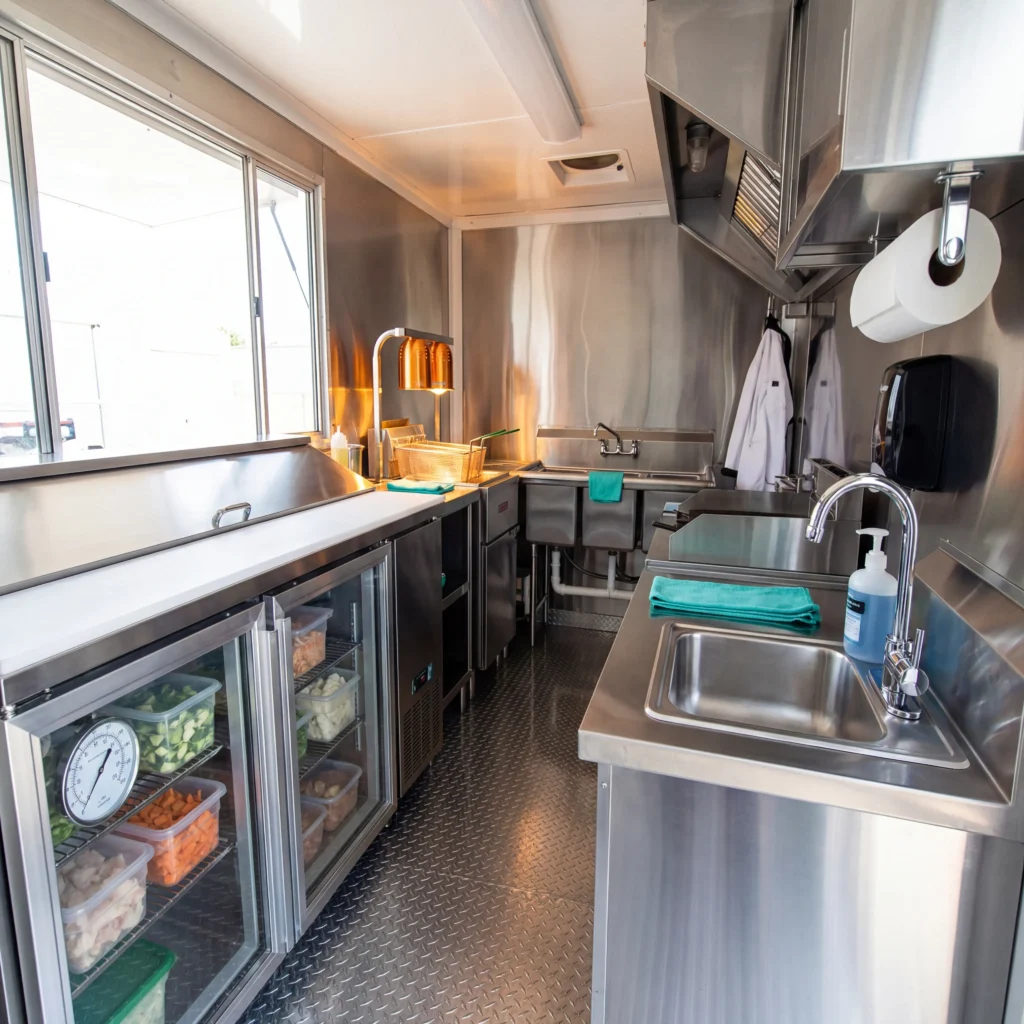
This is the big one. Your health department permit — sometimes called a food service license or mobile food facility permit — proves your truck passed a health inspection and meets food safety standards. An inspector examines your food storage, cleanliness, handwashing stations, refrigeration, and HACCP plans (the system for preventing foodborne illness hazards).
Costs range from roughly $50 to $1,000 depending on your city. Most jurisdictions require your health score to be visible to customers.
I spent an entire weekend deep-cleaning my truck before my first inspection, and it still almost didn’t pass because my handwashing station wasn’t configured to code. Every detail matters.
💡 Pro Tip from Jolene: Schedule your health inspection for a weekday morning. Inspectors tend to be less rushed, and you’ll have time to fix small issues on the spot before they become formal violations.
Food Handler’s Permit and Food Safety Certification
Most states require at least one person on your truck to hold a food manager certification through a program like ServSafe, and many require all employees handling food to carry a basic food handler’s permit.
A food handler’s permit typically costs $10 to $50 and is valid for two to five years. The manager certification runs $125 to $200 including the course and exam. Some cities require these cards displayed on the truck at all times.
Fire Safety Permit
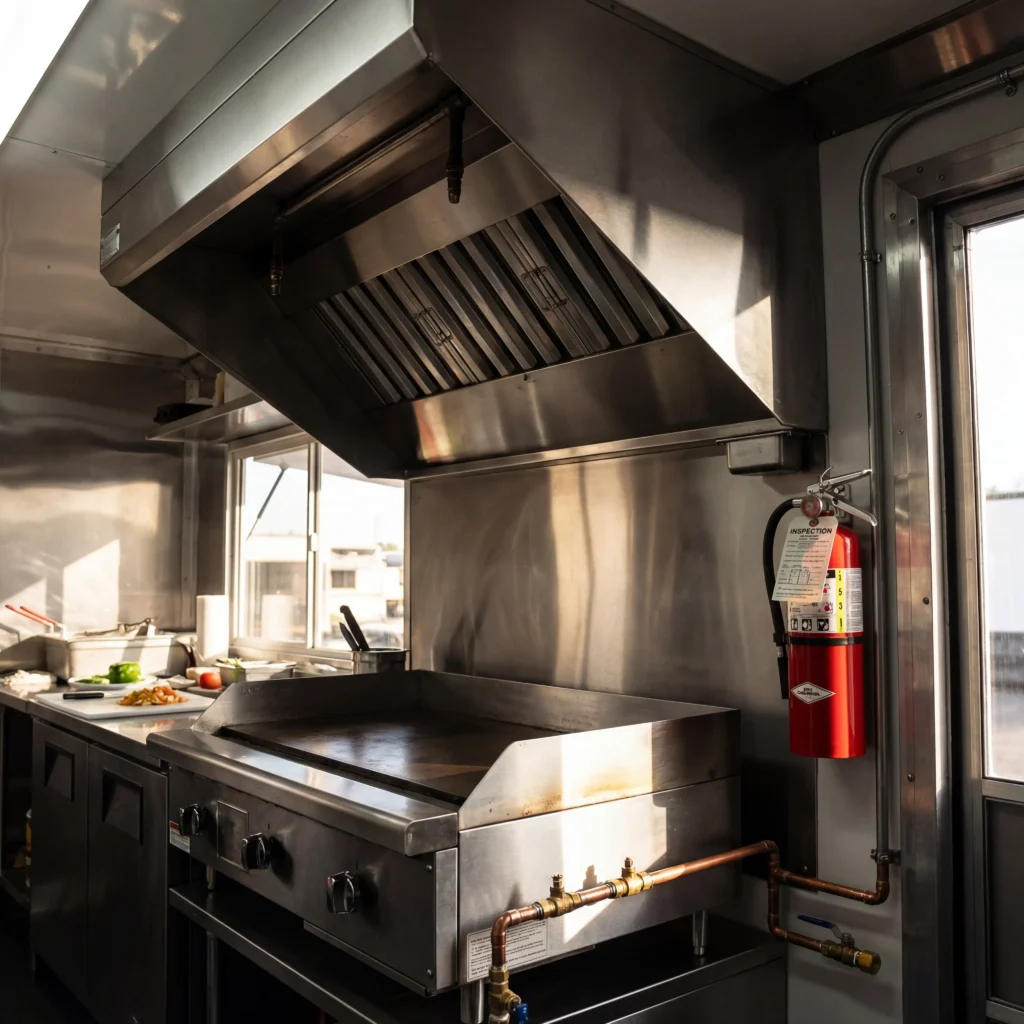
If your truck has cooking equipment and gas lines, you’ll need a fire department inspection and permit. The fire marshal checks your cooking equipment, electrical wiring, propane setup, and fire suppression system (the hood system that automatically activates to extinguish grease fires).
Expect costs between $50 and $300 annually. Some cities require this inspection before you can even apply for your health department permit — getting this out of order was one of my most expensive mistakes. For specifics on suppression systems, see our guide on fire suppression systems for food trucks.
Sales Tax Permit
To collect and remit sales tax on food sales, register with your state’s Department of Revenue or Taxation. This permit is generally free or under $100, but missing filing deadlines can trigger serious fines.
In some states, this also lets you purchase ingredients at wholesale prices without paying sales tax — the tax gets collected from the end customer instead.
How Much Does a Food Truck License Actually Cost?
Can we talk about money for a second? Nobody gives you one honest total because every jurisdiction is different. But after going through this myself and working with a dozen-plus food truck owners through the process, here’s a realistic picture.

| License or Permit | Typical Cost Range | Where to Apply | Usual Renewal |
|---|---|---|---|
| General Business License | $50–$500 | County clerk / city hall | Annual |
| EIN | Free | IRS.gov | One-time |
| DBA / LLC Registration | $50–$1,000 | Secretary of State | Varies by state |
| Driver’s License | $10–$100 | State DMV | Every 4–8 years |
| Health Department Permit | $50–$1,000 | Local health department | Annual |
| Food Handler’s Permit (per person) | $10–$50 | ServSafe or approved provider | Every 2–5 years |
| Food Manager Certification | $125–$200 | ServSafe or approved provider | Every 5 years |
| Fire Safety Permit | $50–$300 | Local fire department | Annual |
| Sales Tax Permit | $0–$100 | State Department of Revenue | Ongoing filings |
| Parking / Zoning Permit | $50–$500 | City zoning office | Annual |
| Mobile Food Vendor Permit | $100–$1,000 | City / county | Annual |
| Special Event Permits | $25–$200 per event | Event coordinator / city | Per event |
Realistic first-year total in a mid-size market: roughly $800 to $3,500 in licensing and permit fees. In major metro areas like New York City, Los Angeles, or Chicago, expect $5,000 to $10,000 or more — some cities have lottery systems and premium-priced vendor permits that push costs much higher.
These figures don’t include your commissary rental (typically $400–$1,500 per month), vehicle insurance, or the truck itself. You’ll also need liability insurance — often required before you can register your vehicle — which our commercial food truck insurance guide covers in detail.
Real talk: budget an extra 30% beyond what you calculate for the major permits. The smaller fees that nobody warns you about add up fast.
What About City-Specific Permits?
Beyond the universal requirements, your city may throw some curveballs.
Parking and Zoning Permits
Many cities regulate exactly where food trucks can park, for how long, and on what days. Some streets are completely off-limits. Others have designated food truck zones with time restrictions. Violating zoning rules can mean fines or having your truck towed.
Research your city’s zoning laws before committing to a location strategy. Some high-demand spots involve a lottery or waitlist.
Commissary Letter of Agreement
Depending on your city, you may be required to prep and store food in a licensed commissary kitchen (a commercial kitchen facility you share with other food businesses) rather than on your truck. You’ll need a signed agreement with the commissary owner confirming your access.
This isn’t a permit fee, but it’s a requirement that carries significant monthly cost. For everything you need to know, see our food truck commissary guide.
Special Event Permits
Planning to serve at festivals, weddings, or concerts? You’ll usually need a temporary event permit for each venue. Costs run $25 to $200 per event. Check with the event organizer — they’ll know exactly what’s required.
What’s the Right Order to Apply for Your Food Truck License?

I’m not gonna lie — this is the part that stresses everyone out the most. And I get it, because the order genuinely matters. Apply for things out of sequence and you’ll hit dead ends.
Here’s the general timeline that works in most U.S. cities:
Step 1: Business Foundation (Weeks 1–2)
Form your business entity (LLC or DBA), apply for your EIN, and get your general business license. Nothing else can move forward until these exist.
Step 2: Safety and Training (Weeks 2–4)
Get food handler certifications and your food manager certification. Schedule your fire department inspection. Start conversations with commissary kitchens if your city requires one.
Step 3: Health and Vendor Permits (Weeks 3–5)
With your business entity and certifications in hand, apply for your health department permit and schedule the inspection. Apply for your mobile food vendor permit.
Step 4: Operations Permits (Weeks 4–6)
Apply for parking and zoning permits. Register for your sales tax permit. Secure your commissary letter of agreement.
Step 5: Final Approvals (Weeks 5–8)
Pass your health inspection. Receive your permits. Display everything on your truck.
Total timeline: roughly six to ten weeks if everything goes smoothly. Mine took closer to twelve because I didn’t know the right sequence and had to backtrack twice — once because I hadn’t completed my fire inspection before applying for my health permit, and my city requires that specific order.
💡 Pro Tip from Jolene: Before you start any applications, call your local health department and ask for their specific order of operations. Every city sequences things a little differently, and this one phone call is the highest-ROI fifteen minutes you’ll spend.
For a deeper dive into permit applications specifically, see our complete guide on food truck permits.
Food Truck License Requirements by State

Requirements vary significantly across states. Here’s a snapshot of key differences — always verify current rules directly with your state’s agencies, as regulations change frequently.
| State | Key Requirement | Notable Detail | Official Resource |
|---|---|---|---|
| California | Mobile Food Facility Permit + county health permit | Most counties require commissary agreement; LA County permits run $100–$1,000+ | CA Dept. of Public Health |
| Texas | Mobile food unit permit + sales tax permit | No general state business license required; local health dept. approval mandatory | TX DSHS |
| Florida | MFDV license through DBPR + state food service license | Commissary agreement required; fire permits in most counties | FL DBPR |
| New York | Mobile Food Vending Permit (limited supply, lottery system) | Among the most restrictive in the country; expect waitlists | NYC DOHMH |
| Illinois | Mobile Food Vendor license + food manager cert | Chicago has specific distance rules from brick-and-mortar restaurants | Chicago BACP |
Other states with active food truck scenes — Oregon, Georgia, Colorado, Ohio, Pennsylvania — each have their own county-level requirements. Your best starting points are your local health department and the SBA’s state licensing guide.
For a broader understanding of how regulations work across jurisdictions, see our food truck regulations guide.
The 3 Most Expensive Mistakes New Owners Make with Licensing

After working with food truck owners through their first year, I keep seeing the same costly errors. Here’s what to watch for.
Applying out of sequence. One owner I mentored submitted her health permit application before her business entity was registered. The application was rejected, she lost the filing fee, and it pushed her opening date back five weeks. Always confirm the required order with your local authorities first.
Budgeting only for the big permits. Everyone accounts for the health department permit and business license. But smaller fees — food handler cards for each employee, parking permits at multiple locations, event permits every weekend — stack up quickly. One truck owner I worked with blew through his licensing budget by month three because he hadn’t accounted for the $75-per-event permits he needed for Saturday farmers markets.
Assuming one city’s rules apply everywhere. If you plan to operate in multiple cities — even within the same state — you may need separate permits for each jurisdiction. I’ve seen owners get fined for crossing a county line without realizing their permits didn’t transfer. Always check requirements for each specific area you plan to serve.
Your Food Truck License Checklist
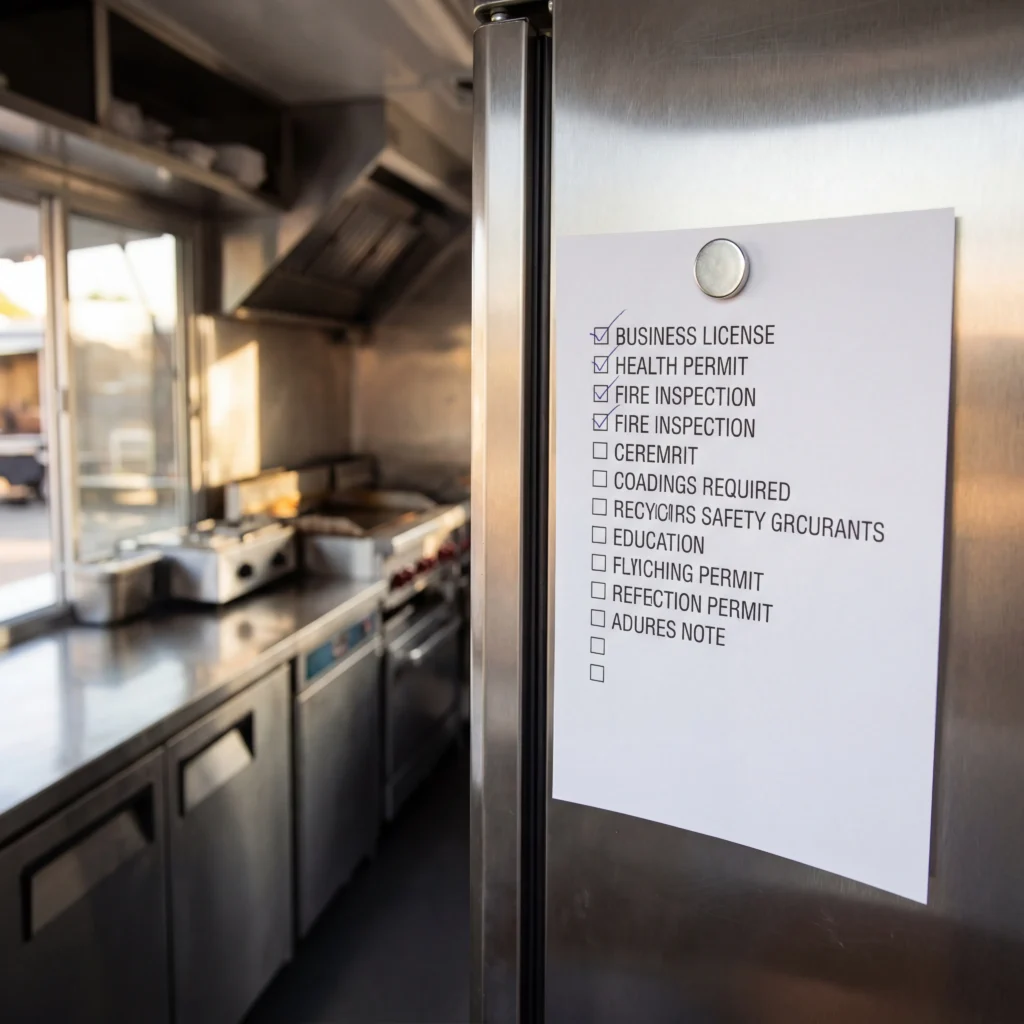
Here’s everything in one place. Print this, stick it on your fridge, and check items off as you go.
Business Foundation: ☐ Choose business entity (LLC / DBA / Sole Proprietorship) ☐ Register with Secretary of State ☐ Apply for EIN at IRS.gov ☐ Obtain general business license from city/county ☐ Open business bank account
Certifications and Insurance: ☐ Complete food manager certification (ServSafe or equivalent) ☐ Obtain food handler permits for all employees ☐ Secure liability insurance (often $1M minimum coverage required) ☐ Secure vehicle/auto insurance
Inspections and Permits: ☐ Schedule and pass fire department inspection ☐ Schedule and pass health department inspection ☐ Obtain health department permit / food service license ☐ Apply for mobile food vendor permit ☐ Register for sales tax permit
Operations: ☐ Obtain parking / zoning permits for operating locations ☐ Secure commissary agreement (if required in your city) ☐ Register vehicle with DMV (commercial registration if needed) ☐ Confirm CDL is not required (check gross vehicle weight) ☐ Set up renewal date tracking for every permit and license
Before First Service: ☐ Display all required permits visibly on truck ☐ File standard operating procedures (if required by your city) ☐ Confirm insurance certificates are current ☐ Do a full self-inspection using your health department’s checklist
Frequently Asked Questions About Food Truck Licenses
How long does it take to get a food truck license?
Most food truck owners can expect the full licensing process to take roughly six to ten weeks from start to finish. This includes forming your business entity, earning certifications, passing inspections, and receiving permits. Cities with waitlists or lottery systems — like New York City — can take significantly longer. Start as early as possible.
Can I operate my food truck in multiple cities or states?
In most cases, you’ll need separate permits for each city or county where you operate. Some states offer statewide permits that cover multiple jurisdictions, but this isn’t universal. If you plan to cross city or county lines, check the specific licensing requirements for each area before you serve.
What happens if I operate without the proper food truck license?
Operating without required licenses can result in fines ranging from several hundred to several thousand dollars, forced shutdowns, and even permanent revocation of your ability to get a permit in that jurisdiction. Your insurance may also be voided, leaving you personally liable for any incidents. It is never worth the risk.
Do food trucks have to be FDA-approved?
The FDA doesn’t directly license food trucks. However, your truck must comply with local health department regulations, which are typically based on the FDA Food Code. Your local health department handles inspections, permits, and enforcement for all mobile food operations.
How often do I need to renew my food truck licenses?
Renewal timelines vary by location and permit type. Health department permits and food service licenses typically need renewal every one to three years. Business licenses are usually annual. Fire safety inspections are often annual. Set calendar reminders for every single renewal date — a lapsed permit can shut you down mid-service.
How much should I budget for food truck licensing in my first year?
In a mid-size market, plan for $800 to $3,500 in permit and licensing fees. In major metro areas, budget $5,000 to $10,000 or more. Add commissary costs ($400–$1,500/month), insurance, and the truck itself for your complete startup budget. Always add a 30% buffer for unexpected fees.
Wrapping Up: Your Next Steps
Getting your food truck license feels overwhelming at first. I remember the day I finally had every permit approved and displayed on my truck — it felt like finishing a marathon. But here’s the thing: once you understand the steps and the order, it’s just a checklist you work through one item at a time.
Start with your business foundation — EIN, LLC or DBA, and business license. Get your certifications early. Budget honestly, including the smaller fees. Check your specific city and state requirements because rules vary widely. Track every renewal date from day one.
And remember — I’m sharing what worked for me and the owners I’ve mentored in Portland, but your city’s requirements may differ. Always confirm details with your local health department, fire department, and city clerk’s office before making decisions based on any guide, including this one.
Ready to keep building? Check out our guide on food truck permits for a deeper dive into the permit application process, or head to our commercial food truck insurance guide to make sure you’re covered once you hit the road.
For the full picture on everything legal, head back to our complete Food Truck Legal guide.
You’ve totally got this.
— Jolene
