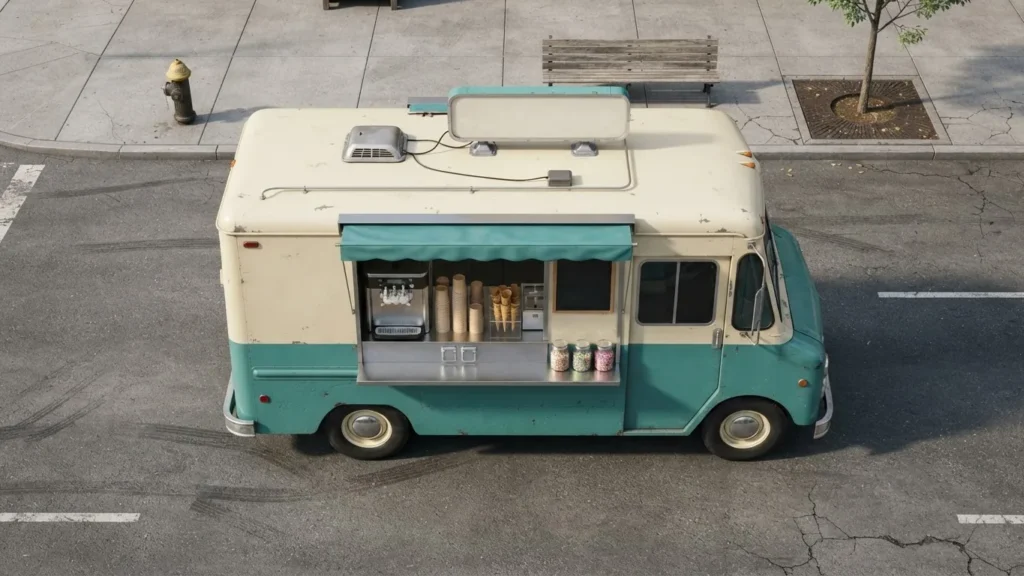
The white-and-blue truck idling on your corner is probably one of two competing businesses that look nearly identical. A New York ice cream truck you’d call a Mister Softee might actually be a New York Ice Cream unit, run by former operators who broke from the franchise. Mister Softee Inc. traces itself to 1956 in Philadelphia, founded by brothers William Conway and James Conway, and reports around 350 franchisees running 625 trucks across 18 states on its own history page.
That two-brand split is where most curbside confusion starts, and it changes what you can assume about the cone in your hand.
A New York ice cream truck is not a single brand. The two you’ll see most are Mister Softee, the Philadelphia-born franchise, and New York Ice Cream, an operator-owned business that formed after a fight over the “Master Softee” name. Both sell soft serve from a three-nozzle machine: vanilla, chocolate, and a swirl of the two, finished with sauces, dips, and sprinkles. The parent company standardizes only the soft serve, so flavors and extras vary truck to truck. The mix can be churned at 6 or 10 percent butterfat, which is a machine setting, not the federal legal definition of ice cream.
Mister Softee and New York Ice Cream: how one truck became two

The split was reported by Eater NY: operators who left the franchise regrouped under the New York Ice Cream name after the “Master Softee” trademark dispute. On the street, the two are hard to tell apart – similar paint, similar jingle, similar window. Which brand you’re actually buying from comes down to the individual truck and its operator, not a clean citywide map, so it’s a truck-by-truck question. If you’re weighing the business side rather than the scoop, see our food truck business plan template.
Three nozzles, two bases, and a 2015 ingredient list
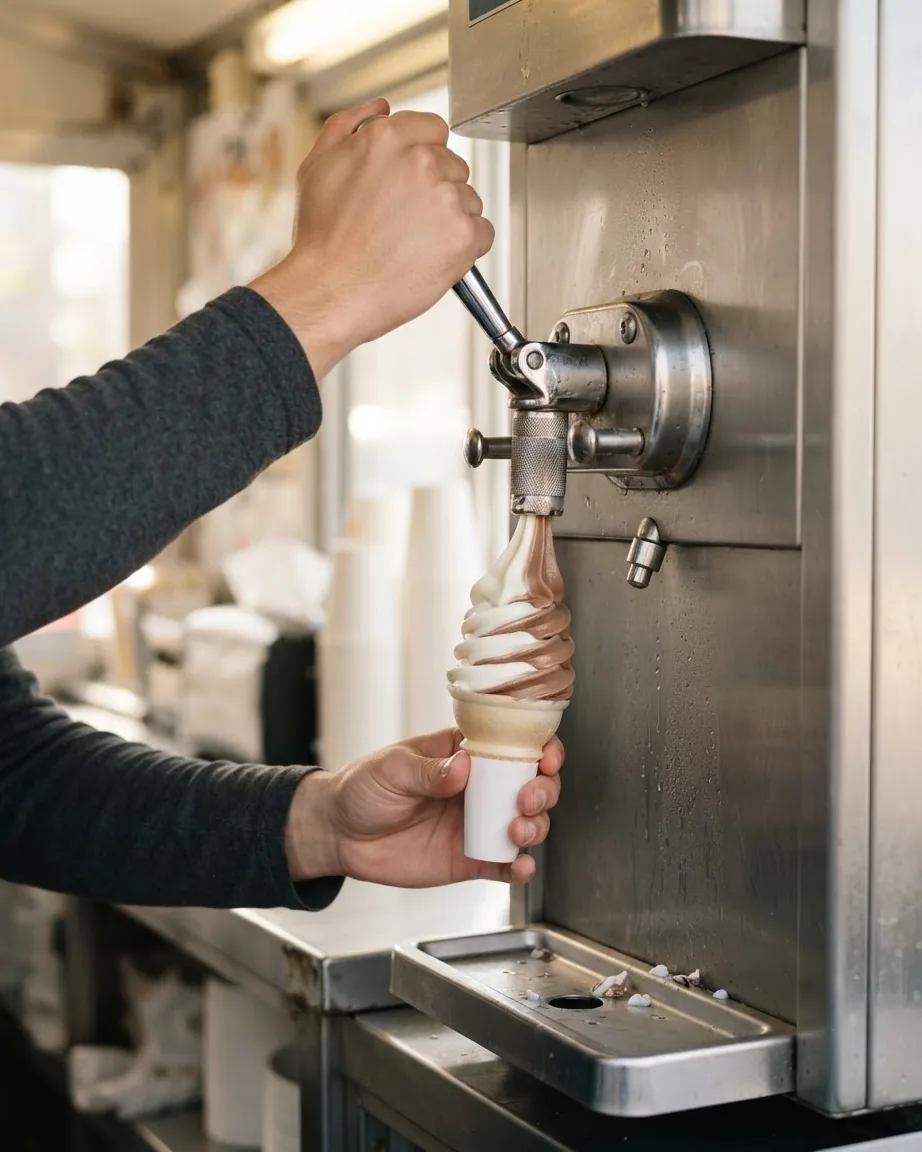
The machine format was documented by Eater in 2015: a vanilla base, a chocolate base, and the swirl drawn from both at the nozzle, plus sauces, dips, and sprinkles added at the window. The swirl isn’t a third recipe – it’s the same two bases pulled together as the lever moves, which is why the texture reads identical across all three.
That same reporting carried an ingredient composition for the vanilla and chocolate bases. Two cautions ride with it. The list dates to 2015 and may not match what’s churned today. And because the company dictates only the soft serve, the rest of a truck’s menu isn’t standardized, so you can’t generalize one truck’s extras to every New York ice cream truck. For the documented reported breakdown, Eater’s 2015 piece is the source that carries it in full.
The 6-or-10 percent butterfat setting versus the federal “ice cream” standard
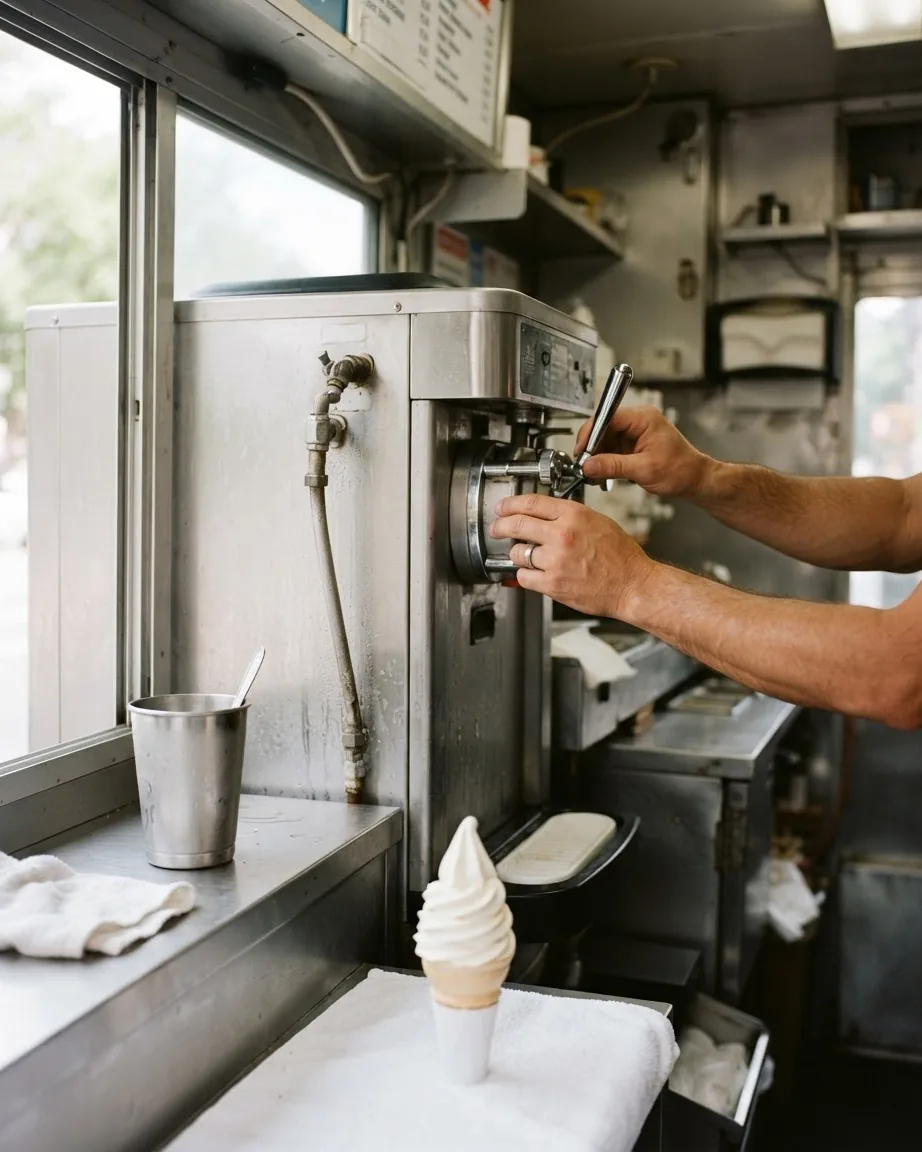
Eater reported that the proprietary machines can run a mix at either 6 or 10 percent butterfat. That number describes a churn setting on the equipment. It is a separate thing from what the law lets a product be called “ice cream,” and the two should not be read as the same spec.
The federal standard of identity, published in the Electronic Code of Federal Regulations and administered by the U.S. Food and Drug Administration, sets the floor for the name. Ice cream must contain, in the regulation’s words, “not less than 10 percent milkfat”, plus no less than 10 percent nonfat milk solids.
Two clauses of that same rule are worth keeping side by side rather than collapsing into one number:
| Frozen-dessert threshold ladder (federal standard of identity) | Milkfat floor | Milk-solids floor | Egg yolk |
|---|---|---|---|
| Plain ice cream | 10 percent | 10 percent nonfat milk solids | – |
| Ice cream with bulky flavors added | 8 percent | 16 percent total milk solids | – |
| Frozen custard | 10 percent | – | 4 percent egg yolk solids |
When bulky flavors go in, the regulation drops the floor but never past a point: in no case less than 8 percent milkfat and 16 percent total milk solids after subtracting the flavor weight. Egg yolk is its own fork – add 4 percent egg yolk solids and the product becomes frozen custard; stay under that 4 percent and it can be labeled ice cream. The 10 percent general minimum and the 8 percent bulky-flavor minimum are both live; one does not override the other.
Vending a New York ice cream truck: Class B, Class C, and the decal gear

How you’re allowed to work a New York ice cream truck in the city turns on what you’re dispensing. The mobile-food-vending construction and equipment rules published by the City of New York split on-unit soft serve from prepackaged product:
- Class B – covers soft serve made and served on the unit, the churn-at-the-window operation most people picture.
- Class C – covers prepackaged frozen treats handed over sealed, a different equipment and handling profile.
- Decal equipment – the City’s rules call for safety gear on the vehicle, including warning beepers and a signage arm, so the truck can stop and serve curbside without becoming a traffic hazard.
These are New York City rules. Your own city and county write their own vending classes and equipment lists, and those local codes are what bind you, so confirm them before you build. See also our food truck design ideas guide.
The jingle can only play while the truck is moving
The music is tied to motion. Guidance from NYC311 is that an ice-cream-truck jingle is allowed only while the vehicle is in motion; once it parks to serve, the music is supposed to stop. It’s a short rule with a long reach – the sound you associate with the truck is exactly the thing that can’t play while you’re standing at the window. Enforcement runs through city agencies, and other jurisdictions set their own noise limits, so this is a local matter wherever you operate.
Dipper wells at 135 degrees and the 24-hour commissary reset
The sanitation detail that trips first-time operators sits in the same City of New York rules. Utensils used to serve ready-to-eat foods may be held in a water well kept hot – the code allows them to be “stored in a container of water heated to and maintained at 135 degrees” Fahrenheit (57 degrees Celsius) or higher. That well isn’t a set-and-forget fixture. The container has to be cleaned and sanitized at least once every 24 hours at the permittee’s commissary, and it has to be large enough to fully immerse the biggest utensil you use. Both pieces – the 135-degree hold and the 24-hour reset – are enforced by the local health authority, not left to the operator’s judgment.
Why no home batch reproduces today’s curb cone
No verified home or copycat formula reproduces the current product. The reported ingredient list is from 2015 and may no longer match what’s being churned, and since only the soft serve is standardized, two trucks can legitimately differ. If you want the documented formulation on paper, the Eater report is where that reported breakdown lives.
The part you can’t copy isn’t a secret flavoring – it’s the machine. A proprietary churn running at the 6-or-10 percent butterfat setting controls overrun and body in a way a home unit doesn’t, and the swirl is a nozzle trick, not a third mix. Match the bases and you’ll still miss the texture, because the texture comes from how the mix is frozen, not what’s poured in.
Do all New York Ice Cream trucks serve the same flavors and prices?
Not necessarily. Beyond the core soft serve, menus aren’t dictated from a central office, so toppings, novelty items, and pricing can shift from one truck to the next and from one operator to another. Two units under the same name can stock different sprinkles and charge different amounts, and neither is doing anything irregular by varying it.
Can a truck sell something below the 10 percent milkfat ice cream floor?
Yes. A frozen product that doesn’t meet the federal milkfat minimum simply can’t carry the standardized name “ice cream” and gets labeled as something else instead. The 6-or-10 percent butterfat figure is a churn setting on the machine, separate from that labeling floor, so a lower-fat mix can be sold legally under a different product name.
Does the jingle rule mean no music at all when parked?
Effectively, yes for the jingle. The permission is attached to the vehicle being in motion, so a stationary truck actively serving a line isn’t meant to run its music. How strictly that plays out depends on the city agency handling complaints in that area, and noise rules elsewhere are written and enforced by each locality on its own terms.
Ce que 625 camions pour 350 franchisés révèlent du réseau Mister Softee
La marque annonce environ 350 franchisés exploitant 625 camions dans 18 États. Fais la division et tu vois ce que « l’un des plus gros franchiseurs de soft » veut vraiment dire au niveau de la rue : des petits opérateurs, pas des flottes.
- 1,8 camion par franchisé (625 ÷ 350) : le franchisé type roule avec un, parfois deux camions. C’est un métier d’indépendant, pas une grosse structure.
- 34,7 camions par État (625 ÷ 18) : densité moyenne faible, concentrée en réalité sur quelques marchés urbains comme New York.
- 19,4 franchisés par État (350 ÷ 18) : une vingtaine d’exploitants par État en moyenne, ce qui explique pourquoi la marque que tu croises dépend du camion et de l’opérateur, pas d’une carte nationale propre.
Ces ratios sortent uniquement des chiffres publiés par Mister Softee ; ils décrivent le réseau national, pas la répartition exacte à New York.