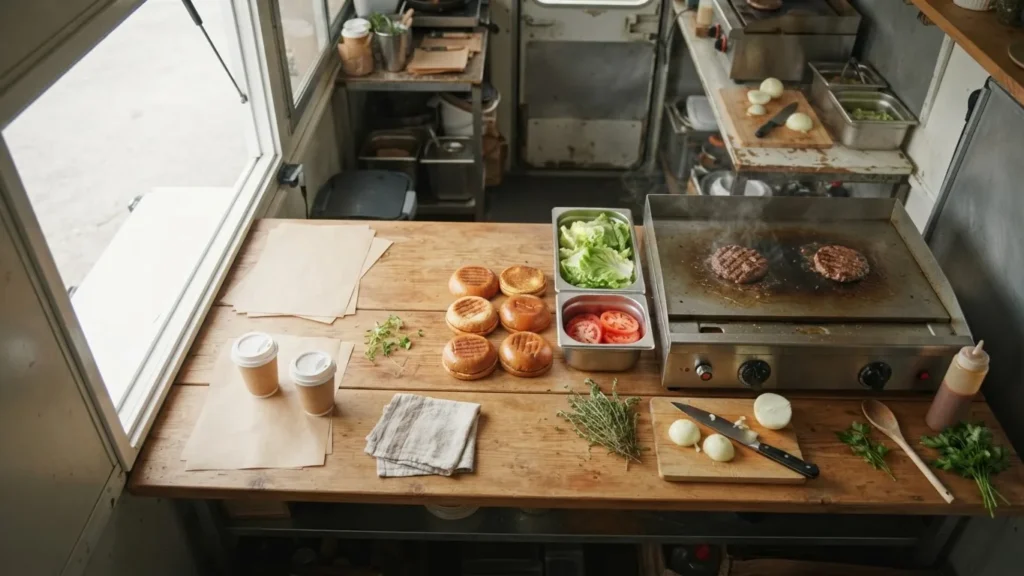
Here is the one that trips up almost every first build: a gray-water tank has to be at least 15 percent larger than the fresh-water tank, a rule written into both the FDA Food Code 2026 model language and the September 2025 King County plan-review guide. Miss it, and your plans get bounced before you ever turn a wrench. Most food truck design ideas you’ll run into online start with color palettes and serving windows. That’s backwards. The visual stuff matters for sales, but it’s the dimensions, the tanks, and the fire code that decide whether the thing is legal to cook in at all. This guide puts both halves in the order you actually need them.
The short version: good food truck design runs in a fixed sequence – menu first, then equipment, then layout, then the truck itself – because every later choice is locked by the one before it. Size the interior at 7 to 8 feet wide and 14 to 24 feet long, keep aisles at 30 inches minimum (36 for a two-person crew), and set the gray tank 15 percent above the fresh tank. On the outside, a wrap running $2,500 to $6,000 with 2 to 3 colors matched to your logo does the selling. Get your plans approved before you build. Fire and health codes are set locally – confirm every number with your own city and county.
Why the build order is menu, then equipment, then layout, then truck
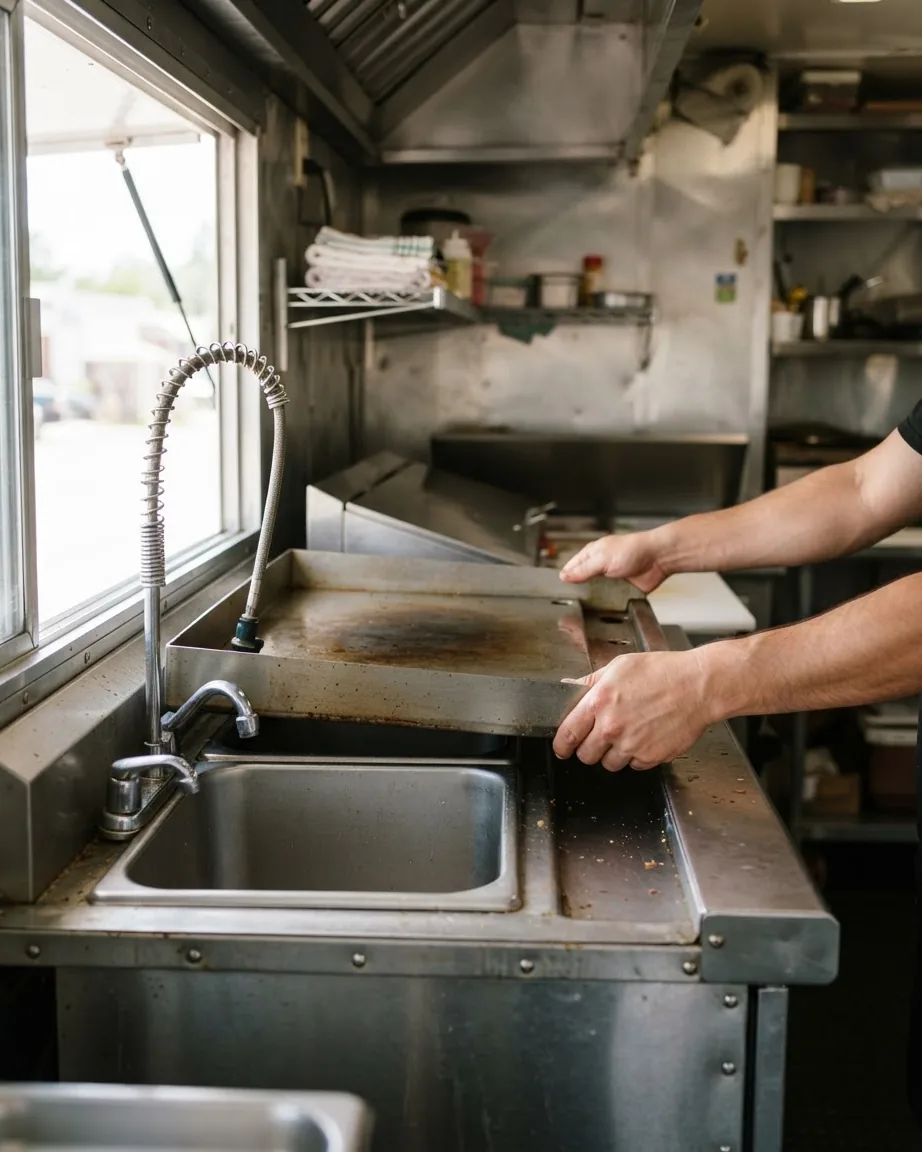
The correct build sequence is menu, then equipment, then layout, then truck. That order is not a style preference – it’s a dependency chain. Your menu decides which appliances you need. The appliances decide how much floor and wall space gets eaten. The equipment footprint decides the layout. And only then do you know what size and spec of truck can actually hold it all.
Flip any step and you pay for it twice. Buy the truck first because you liked the look, and you’ll find a six-burner range won’t leave room for the three-compartment sink. Pick equipment before you’ve settled the menu, and you’ll own a fryer you never use while scrambling for griddle space.
It goes deeper than fit. Under the FDA Food Code 2026, menu and process decisions move you into different regulatory columns – a unit selling both prepackaged temperature-controlled food and food prepared onboard gets evaluated under the stricter food-preparation requirements. Your menu is a regulatory decision before it’s a flavor one. If you want the wider build picture, The Truck Chef’s equipment section lays out the pieces you’ll be slotting into this sequence.
Interior dimensions that decide whether your equipment fits
Interior width typically falls between 7 and 8 feet, with length anywhere from 14 to 24 feet; the 16-to-18-foot range turns up most often, according to The Truck Chef’s layout breakdown. Height has a hard ceiling set by the road, not by you: street-legal overall height stays under 14 feet, dropping to 13.5 feet in New York City.
Inside, the numbers get tight. The FDA Food Code sets a recommended minimum aisle of 30 inches; most two-person crews widen that to 36 inches so two people can pass without a collision mid-rush. Counters sit at 36 inches high and 24 to 30 inches deep.
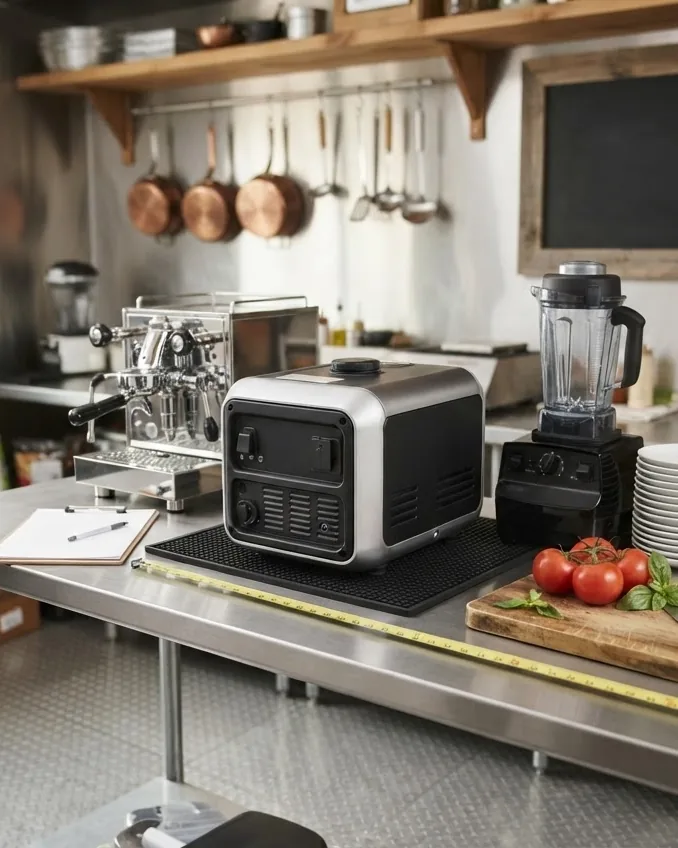
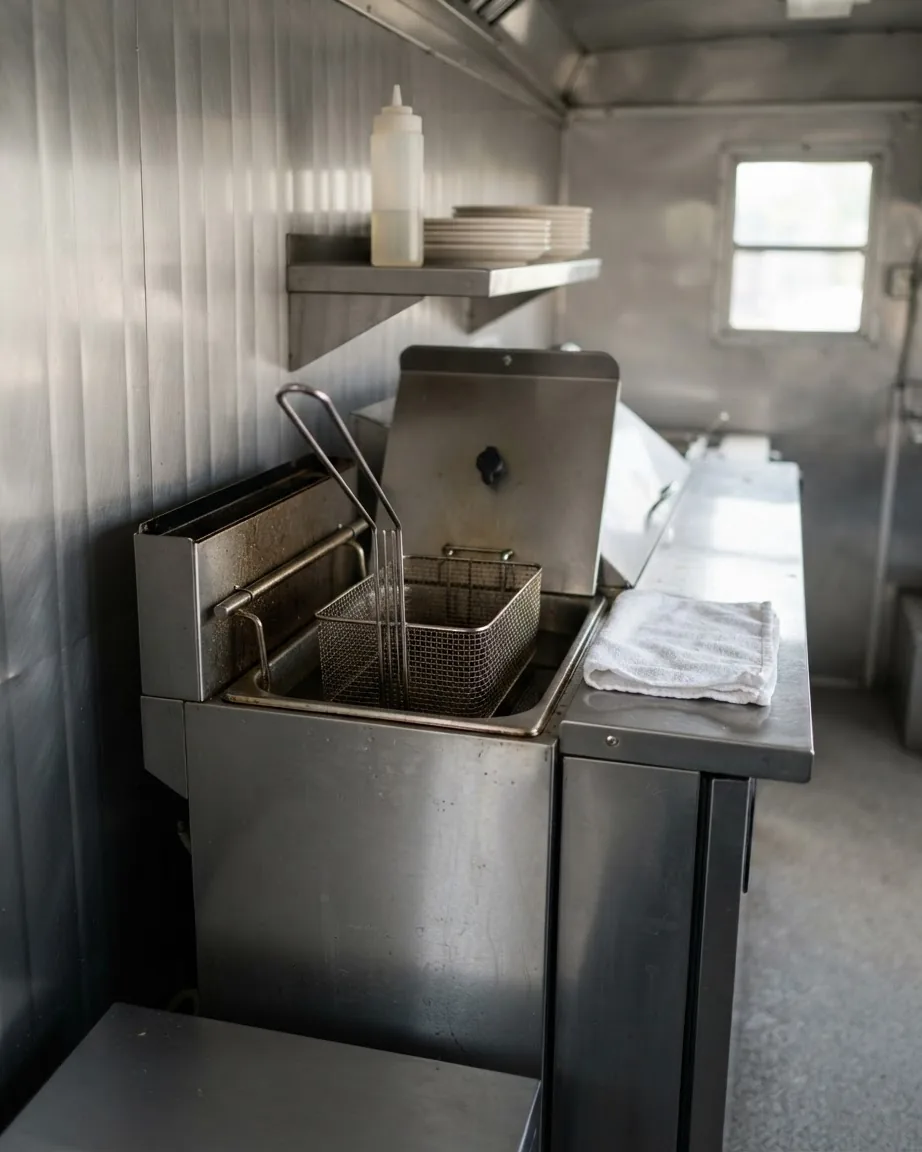
Here’s the one measurement that saves a return shipment. In a standard interior, a fryer is unlikely to fit once its width passes 24 inches or its height passes 36 inches. Before you buy any appliance, check it against that rule and map it onto your 7-to-8-foot wall. The common dimensions worth keeping on a sticky note:
- Interior width: 7 to 8 feet, with equipment mapped against that wall before purchase.
- Aisle: 30 inches minimum, 36 inches for two-person crews.
- Counter: 36 inches high, 24 to 30 inches deep.
- Appliance fit cutoff: over 24 inches wide or 36 inches tall likely won’t fit.
Laying out the service line so it survives a rush
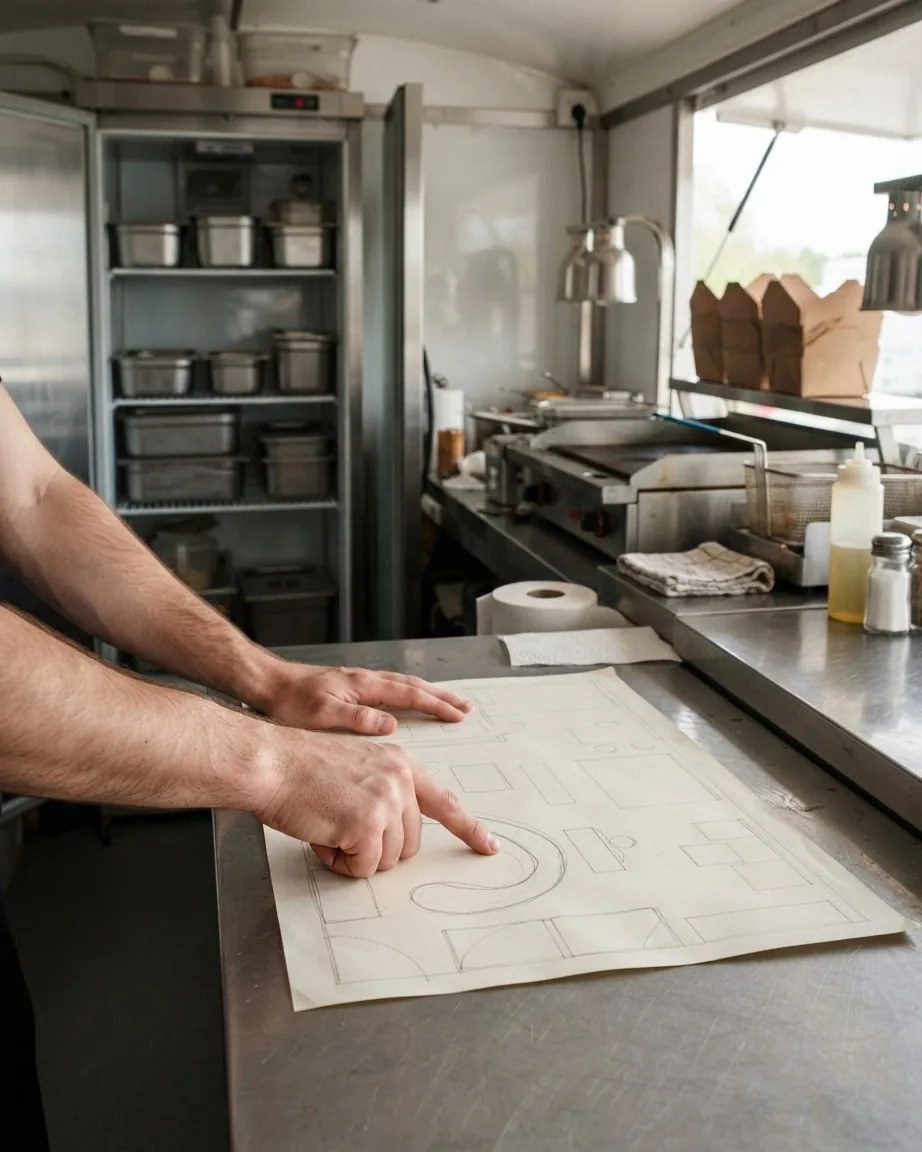
A layout that looks fine on paper can fall apart the second a line forms. The tool that catches that early is the spaghetti diagram: you draw every path a worker walks to complete a single order. If the lines cross themselves five times, your flow is broken, and it’s far cheaper to fix on paper than after the stainless is bolted down.
Cold storage and cold display belong near the service window. Why there specifically? Because the plating and handoff happen at the window, and every step a cook takes back to a reach-in at the far end of a 16-foot box is time the next order waits. Put the cold stuff within arm’s reach of where food leaves the truck and you shorten the loop that matters most during a rush.
WebstaurantStore’s design guide makes a point worth the money: professional layout design can reduce cost by up to $40,000 against a build that gets reworked. Planning the zones before construction is cheaper than moving a sink after an inspector flags it.
Water and plumbing: tanks, the three-compartment sink, and the hand sink
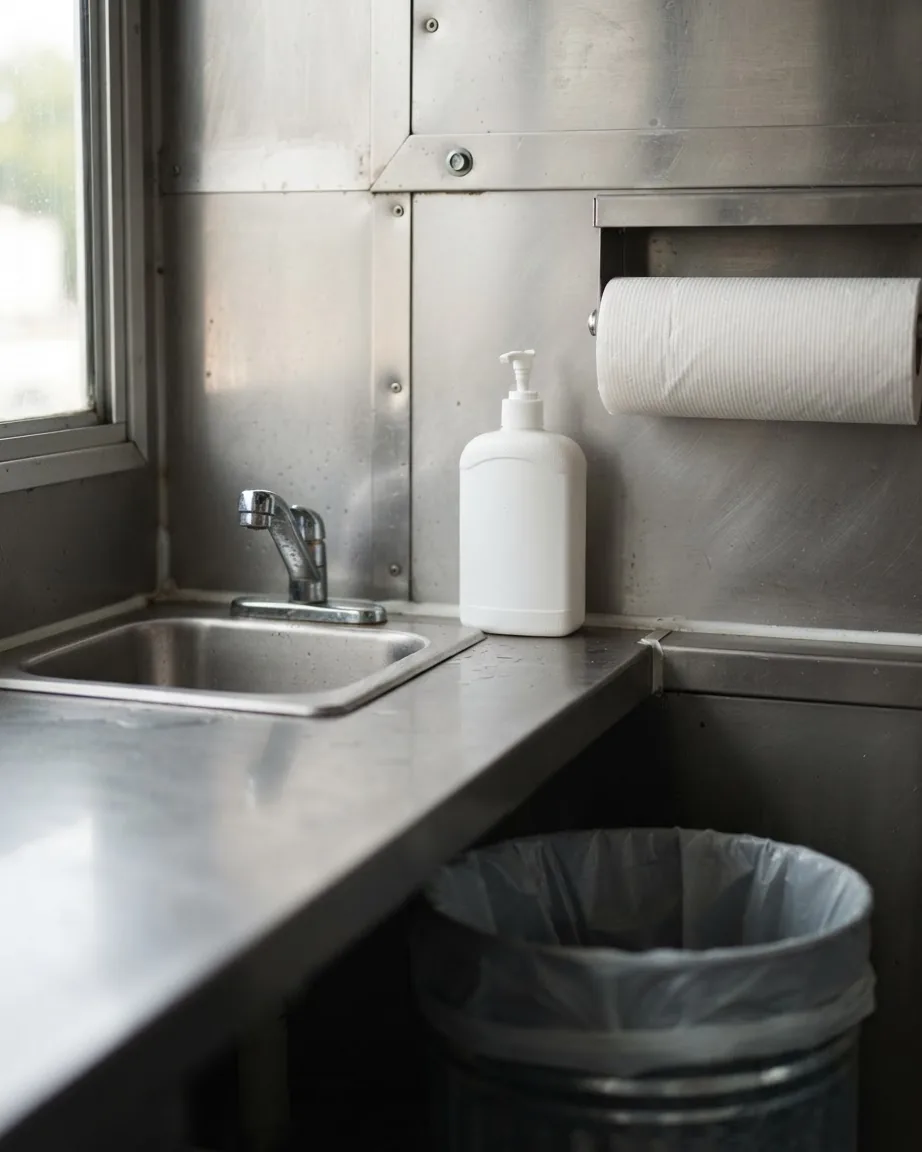
The plumbing is where plan reviewers spend their red pens. Start with the tank ratio, because it’s non-negotiable in the model code. The FDA Food Code 2026 states a sewage holding tank in a mobile food establishment shall be sized 15 percent larger in capacity than the water-supply tank. King County’s September 2025 guide carries the same rule in plainer words: the waste-water tank must hold at least 15 percent more than the freshwater tank. The USA Trailer Store works the math small-scale – a 5-gallon freshwater tank needs at least 5.75 gallons of wastewater capacity.
Worth a note: the FDA figure is a federal model code that states adopt, while King County’s is jurisdiction-specific guidance. The number lines up at 15 percent, but that agreement doesn’t mean the two regulatory schemes are identical – your own county writes the binding version.
Every occupied mobile food unit needs a three-compartment dishwashing sink supplied with pressurized hot and cold water, with space on both sides for dishes, per King County’s plan guide. On top of that sits a separate handwashing sink – it has to be within 25 feet of the prep area with soap, paper towels, and a trash bin. A turnkey station bundling a space-saver three-compartment set, handwash sink, and 6-gallon water heater runs about $1,000 to $1,600.
The handwash water temperature your code actually requires
This is where the sources split, and the split is the useful part. There is no single national handwash temperature you can trust from memory – it depends on which code your jurisdiction adopted.
The USA Trailer Store reports that the FDA changed the model-code handwashing minimum from 100°F to 85°F beginning with the 2022 edition, and 85°F remains current in the model language. Public Health – Seattle & King County, in its September 2025 guide, requires the hand-wash sink to deliver hot and cold or warm running water at 100 to 120°F, be roughly 10 by 10 by 6 inches, and hold at least five gallons of fresh water. So the federal model floor and one real local jurisdiction don’t match.
The resolution is not to pick a favorite number. It’s to size your water heater for the higher range you might face and confirm the exact figure with your own health department before you build. A heater that can hit 120°F covers you under either standard; one sized only for 85°F could fail a King County-style review. When codes disagree, build to the stricter one.
Fire code: the hood and suppression your menu triggers
Your menu writes your fire-code bill, and most first-timers don’t see it coming. Any appliance producing grease vapors triggers a Type I hood under NFPA 96 plus a UL-300 listed wet chemical suppression system. Heat-only equipment – think a steam table or a panini press – can get by with a Type II hood. The 2024 edition of NFPA 96 now includes Chapter 17 written specifically for mobile operations, so this is not borrowed restaurant code anymore.
Fuel choice pulls the fire authority in directly. King County requires Fire Department approval and a permit if you’ll use liquid propane, charcoal, wood, or oil-frying equipment. Denver runs its own process: effective January 1, 2023, the Denver Fire Department Fire Prevention Division’s mobile food-truck permit process handles propane permits and requires you to attach your fire-suppression-system inspection report to the application. Two cities, two procedures – and yours may differ again.
At minimum, a cooking truck carries one Class K unit for cooking oils plus one ABC-rated 2A:10BC extinguisher. A design fork worth sitting with before you commit:
- Fryer or griddle menu: Type I hood, UL-300 suppression, Class K extinguisher, fuel permit. Higher build cost, more plan review.
- Drinks or dessert menu, no grease: Type II hood or none, lighter suppression demands, fewer fire triggers.
Fire codes are set and enforced locally – treat the above as the shape of the decision, not the final spec for your city.
Plan approval and the drawings inspectors want before you build
You get your plans approved before construction, not after. King County’s guide is blunt about it: preparing to open a new or remodeled mobile unit requires approval of those plans by Public Health – Seattle & King County before you begin to build. Build first and you risk tearing out work that doesn’t pass.
What they want to see on an occupied-unit submittal is specific: scale drawings with interior length-and-width dimensions, every food-service equipment location, surface materials, and the make and model of your equipment. That last part is why the build order matters – you can’t submit equipment make and model if you haven’t chosen equipment yet.
One design decision that quietly adds a permit: seating. If you provide customer seating, King County requires a plumbed restroom available within 500 feet of your unit. Put out a few stools without checking that, and a nearby-restroom problem becomes your problem.
Do you actually need a commissary?
Short section, because the answer is short: it depends, and the FDA says so. Whether a mobile operation needs a commissary or servicing area should depend on its menu, operating model, and the adequacy of onboard or onsite equipment – not assumed as a universal requirement. A truck that preps everything onboard and dumps waste at an approved site may not need one; a truck that relies on offsite prep almost certainly does. Ask your menu first, then ask your local authority, which makes the actual call.
Exterior food truck design ideas that move more product
Now the part most lists start with. The outside is your sign, and the data backs spending on it. In a 70-truck study cited by Image Graphics Inc., a truck with a good wrap should sell 20 percent more food than a truck without a wrap. That figure is a vendor-restated industry claim rather than an independent study, so weigh it as a directional signal, not a guarantee.
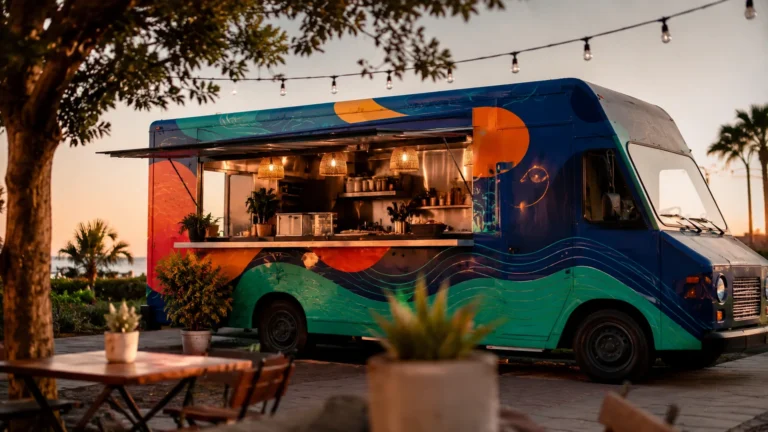
For the look itself, keep the palette disciplined. The Fud Trailer Company’s advice: use 2 to 3 main colors that match your logo and concept. More than that and the truck reads as noise from across a parking lot. The color, the lettering, and the serving window should all say what you sell before anyone reads a word of the menu.
On cost, a food truck or trailer wrap can run anywhere from $2,500 to $6,000 depending on size and complexity, per Image Graphics. Turnaround is quick – about 2 days for a wrap once the vehicle is in hand. Wrap versus paint usually comes down to that: a wrap goes on fast, protects the panel underneath, and comes off when you rebrand.
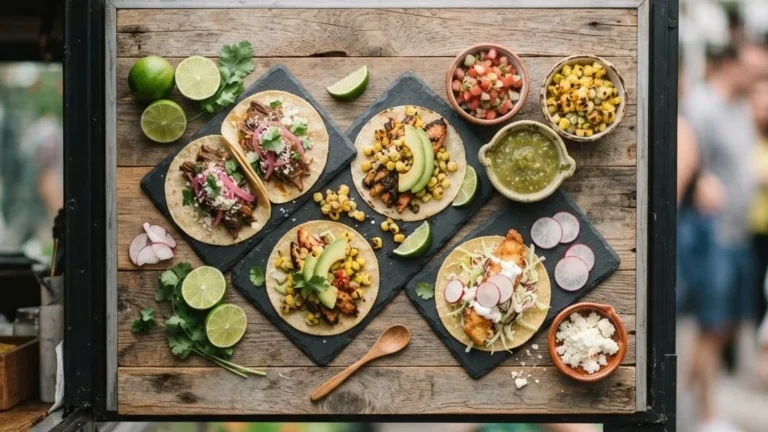
If your concept is a cuisine with its own visual language, let the exterior carry it. The way a Mexican concept reads differently at the curb than a dessert window is the same instinct that shapes a taco truck for parties, and a frozen menu earns its own treatment the way a soft serve ice cream truck does.
The materials bill: 430 versus 304 stainless
One quiet spec decides whether your surfaces survive. 430 stainless can rust in 2 to 3 years; 304 stainless holds up. The 430 is cheaper at purchase, which is exactly why it ends up in budget builds, and then it corrodes under the daily wash-down and salt a truck lives with. For anything that gets wet, splashed, or sanitized constantly – sinks, backsplashes, prep surfaces – 304 is the one that pays off across the life of the truck. This is a small line item with a long tail: a surface that rusts is a surface an inspector can flag.
What the whole build costs, and why the figures disagree
Startup numbers are all over the place, and the reason is that different sources define the build differently. WebstaurantStore lists an average range of $130,000 for a used truck to $180,000 for a new one. The Truck Chef’s layout guide gives a wider spread: a used truck runs roughly $30,000 to $100,000, while a new custom build lands between $100,000 and $200,000.
These don’t contradict so much as measure different things – one quotes an average point, the other a full spread from bare-bones used to new custom. Use WebstaurantStore’s figure as a middle-of-the-road expectation and The Truck Chef’s range to understand how low and how high it can actually swing. Against either, remember professional layout design can shave up to $40,000 by preventing rework. And for context on how crowded the field is: there were 47,033 food truck businesses in the United States as of 2023, per the IBISWorld figure cited by MenuTiger.
None of these are quotes for your build. Fuel choices, hood class, and local permits move the final number, and they move it differently in every jurisdiction.
The 15% Rule in Gallons: How Much Extra Waste Capacity You Actually Buy
The code states the ratio, but what you buy at the tank supplier is a number of gallons. Working the article’s small-scale example backward shows exactly how much bigger the gray tank has to be, not just by what percentage. On the 5-gallon setup, the required 5.75-gallon gray tank is 0.75 gallons extra. Divide that delta by its fresh-tank size and you get 0.15 gallons of waste capacity per gallon of fresh water, which is the 15% rule restated in a form you can carry straight to a spec sheet.
- 5 gal fresh → 5.75 gal gray: 0.75 gallons extra (5.75 − 5).
- Per-gallon rule: 0.75 ÷ 5 = 0.15 gal of gray for every gallon of fresh – the 15% ratio in buyable units.
FAQ
If I only have room for one sink upgrade, which matters most?
The handwashing sink, because it carries the strictest placement rule – within 25 feet of prep – and the temperature fight. A water heater that reaches 120°F covers you under both the 85°F model floor and a 100-to-120°F local requirement. Skimp here and a single inspection line can shut the window.
Can I add seating later without re-permitting?
Not safely. Adding customer seating can trigger a restroom-proximity requirement – King County wants a plumbed restroom within 500 feet once seating exists. Decide on seating during plan review so the reviewer accounts for it, rather than bolting on stools after approval and inviting a correction notice.
Is a wrap worth it on a tight startup budget?
At $2,500 to $6,000 it’s one of the cheaper line items against a build that can top $100,000, and the sales-lift claim points up, not down. On a truly bare budget, prioritize a clean 2-to-3-color scheme and legible signage over full-vehicle coverage; you can wrap the rest once cash flow steadies.
What single mistake forces the most expensive rework?
Buying the truck before finalizing the menu and equipment. Everything downstream – tank sizing, hood class, aisle width, sink placement – is locked by equipment you haven’t chosen yet. Reverse that order and you’re cutting into finished stainless, which costs far more than redrawing a plan.