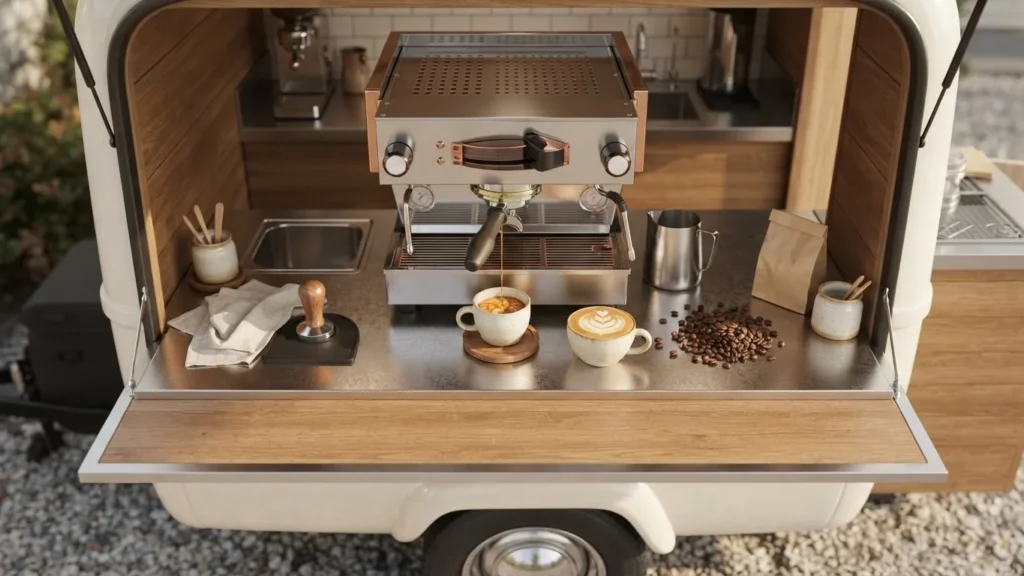
Beginning July 1, 2026, every mobile food vendor in Texas – and the Texas Department of State Health Services names coffee trucks first on its list of examples – has to hold a statewide license before it serves a single cup. That one change tells you how a mobile coffee truck actually gets evaluated: not as a vibe, but as a food establishment with a classification, a fee, and an inspection standing between you and your first sale. This guide works the money and the rules in the order a new operator hits them – format, permits, power, menu, and the sales volume that decides whether any of it pays.
Quick answer: A mobile coffee operation ranges from a $7,500 cart to a $100,000 truck, with built-out trailers in between. The cheapest path that still fits your venue almost always wins, because gross margins on coffee run high but a truck is a physical throughput ceiling. Texas classifies a coffee truck as Type II (a $618 application fee), separate from cooking trucks. Serve only non-dairy milk and you can skip the heaviest dairy-handling code burden. A single-barista truck needs 100+ cups on a weekday, 150+ on a weekend, to be viable. Start permits 60 to 90 days out.
Cart, Kiosk, Trailer, or Truck: Matching Format to Where You Actually Trade
The format gap is wide, and the numbers don’t average cleanly. Texas Coffee School puts carts at $7,500 to $15,000, fixed kiosks at $15,000 to $60,000, trailers at $15,000 to $55,000, and trucks at $35,000 to $100,000. Cart-King, modeling the lower end from the other direction, frames a cart as requiring 65 to 75 percent less capital than a coffee food truck, which it brackets at $71,000 to $198,000. Those two truck figures – $35,000 to $100,000 versus $71,000 to $198,000 – are not the same range, and they shouldn’t be merged. They describe different build levels. Read the lower bracket as a bare roadworthy build and the higher one as a turnkey, premium-equipped rig.
Budget isn’t the deciding factor, though – venue access is. Pulo Coffee, a mobile catering operator, draws the line by where each format can physically go: carts move indoors for design-forward events and tight venues, while trailers and trucks stay outside and need parking, towing, and room to maneuver. If your bookings are office lobbies, gallery openings, and indoor weddings, a truck locks you out of the room. If you’re chasing outdoor festivals and farmers markets, a cart leaves you exposed and undersized.
Coffee Machine Depot narrows the espresso-cart band further: a lean cart starts around $8,000, and a fully outfitted setup with a premium machine can exceed $25,000. Trailers, on their numbers, run $15,000 to $40,000 depending on the build-out. Pick the format that reaches your paying rooms; don’t buy the biggest thing the loan allows.
What a Texas or Florida Coffee Truck Is Legally Classified As
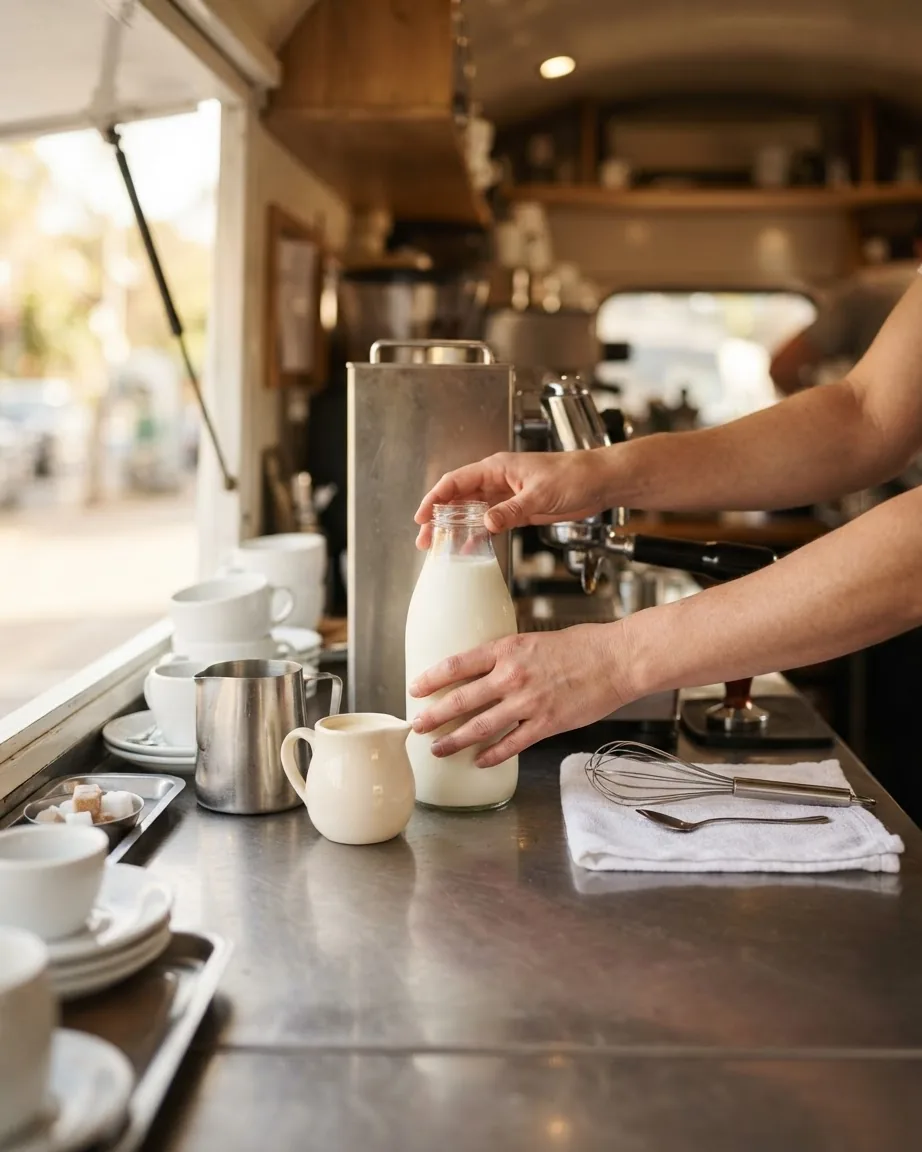
A coffee truck is not treated like a full cooking food truck, and that distinction saves you money and equipment. Texas DSHS places coffee trucks in Type II, distinct from the Type III cooking trucks that fry and grill. Under the rules taking effect July 1, 2026, a Type II mobile food vendor owes a $618 application fee, and the pack carries a $400 pre-licensing inspection fee alongside it – both due at application submission, per DSHS, which states the application and pre-licensing fees are both due then. The license runs one year from the date of your completed pre-licensing inspection.
Florida draws the line even more plainly. The Florida Department of Agriculture and Consumer Services, Division of Food Safety, explicitly lists coffee beverages – café con leche, latte, cappuccino, with or without dairy or synthetic dairy – among the items a mobile establishment may serve, provided it has equipment, utensils, and facilities that adequately protect the food. That conditional clause is the whole game: the drink is allowed, but the dairy handling sets your build.
These classifications change your equipment list and your fees, so confirm yours before you spec anything. The binding rules come from your own city and county, not from a national summary.
The Dairy Rule You Can Legally Sidestep
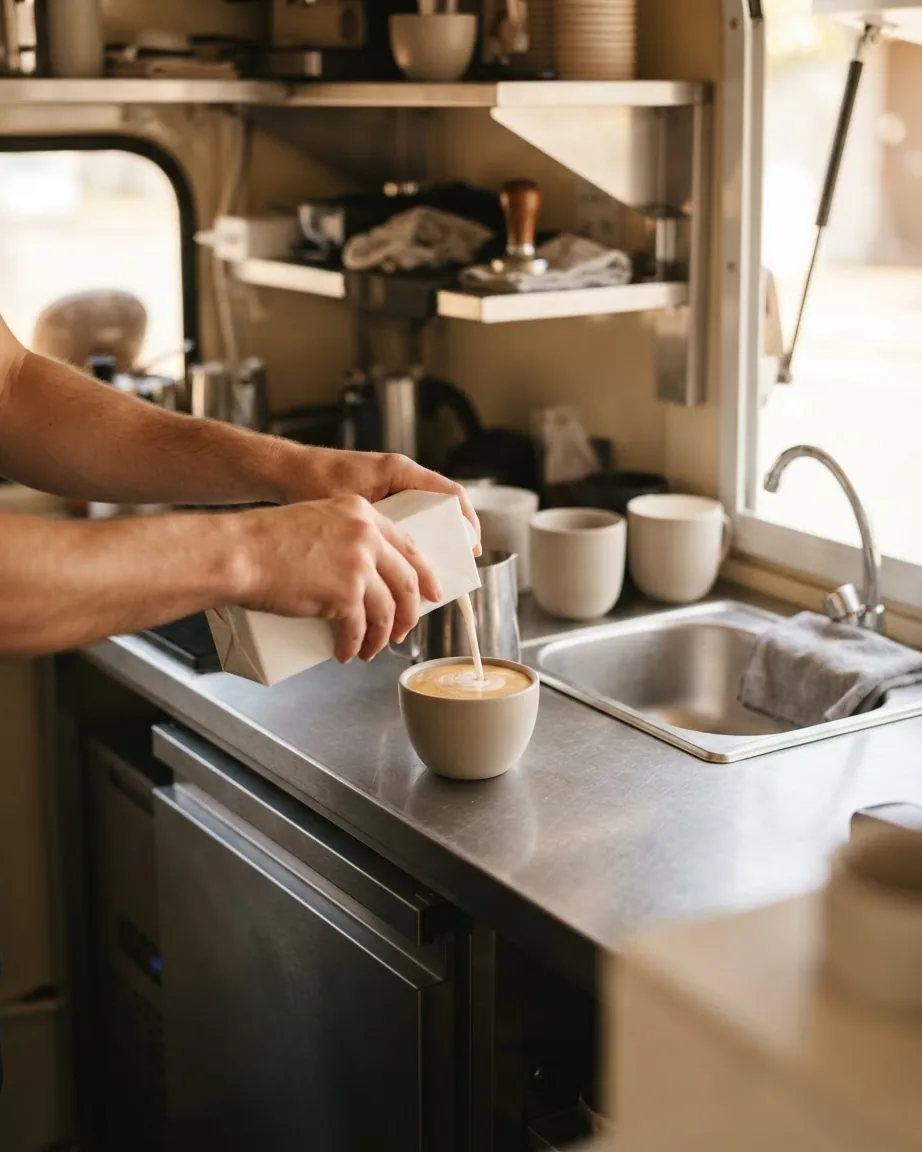
Here is the lever most new operators never notice. Prima Coffee Equipment, which built and ran its own cart, flags dairy handling as the quiet driver of cost and complexity on a mobile setup – the sinks, the cold storage, the code it triggers. One operator-level read on it: serving only non-dairy milks sidesteps the dairy-handling requirements, and the gap that opens up is roughly a second cart’s worth of space, cost, and plumbing you no longer have to carry.
That’s a real strategic fork, not a gimmick. An oat- and almond-only menu can shrink your refrigeration load and your sink count. The catch worth naming: Florida’s language permits dairy with proper equipment, so going non-dairy is a way to trade menu breadth for a lighter, cheaper build – not a legal requirement. Decide which matters more for your room before you order a three-compartment sink you may not need.
Water, Waste, and Handwash Specs Your Build Has to Hit
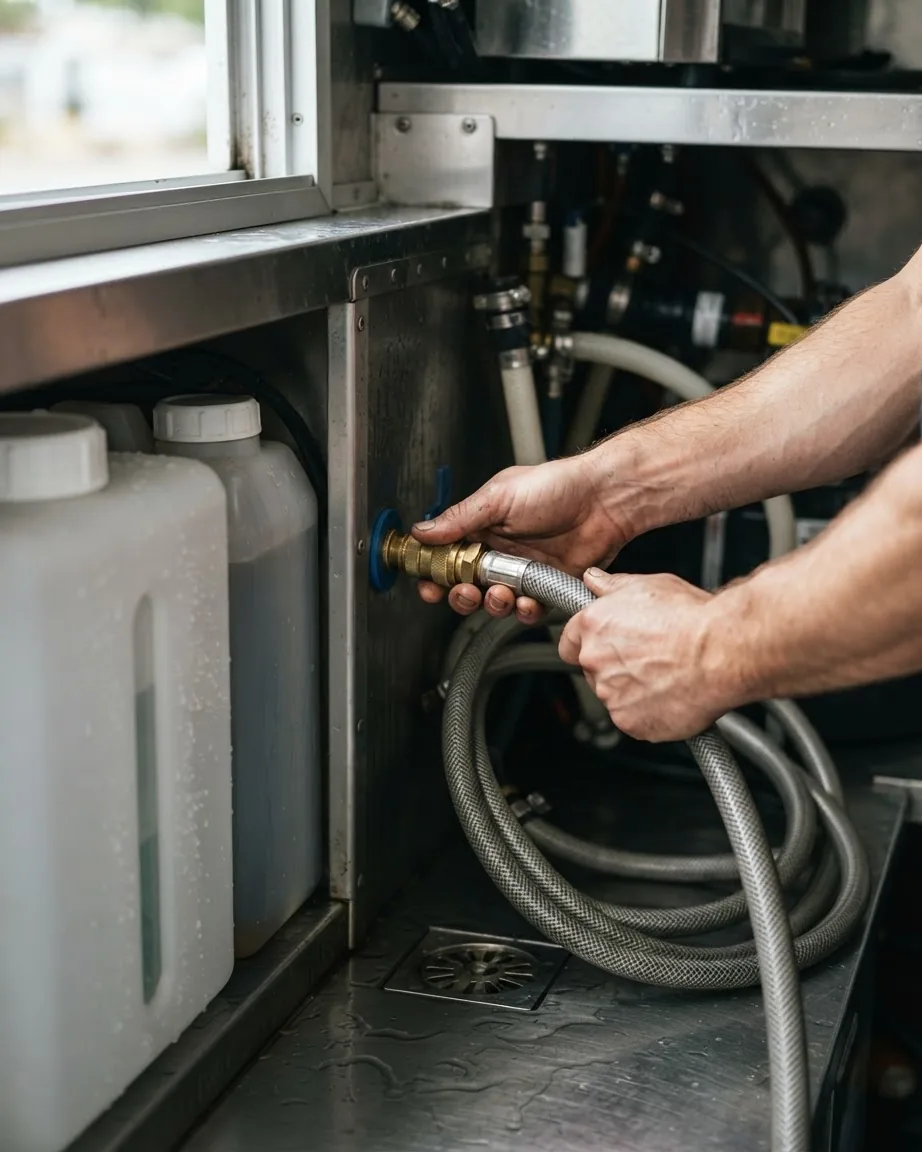
Mobile plumbing specs are written into code, and inspectors measure them. Florida FDACS requires a liquid waste holding tank with a capacity 15 percent larger than the potable water supply tank – size the gray-water tank up, or you fail. The Commonwealth of Massachusetts, publishing its Retail Food Code standards under 105 CMR 590, requires handwashing water delivered at a minimum of 100°F through a mixing valve or combination faucet, and a water inlet three-fourths inch in diameter fitted with a hose connection sized so it can’t be used for any other service. That last detail – a non-interchangeable inlet – exists so nobody cross-connects a waste line to your potable supply.
Commissary rules decide where the truck sleeps and refills. Florida states plainly that a private residence may not be used as a commissary. Los Angeles County’s Department of Public Health defines a mobile food facility as a vehicle operating in conjunction with a commissary or other permanent food facility – meaning the truck is one half of a system, never a standalone kitchen. One useful note from LA County for operators worried about eligibility: you don’t have to be a U.S. resident or citizen to get a public health permit. The sink count and tank specs are local, so build to your own jurisdiction’s sheet.
Permit Timelines and the Fee for Opening Early
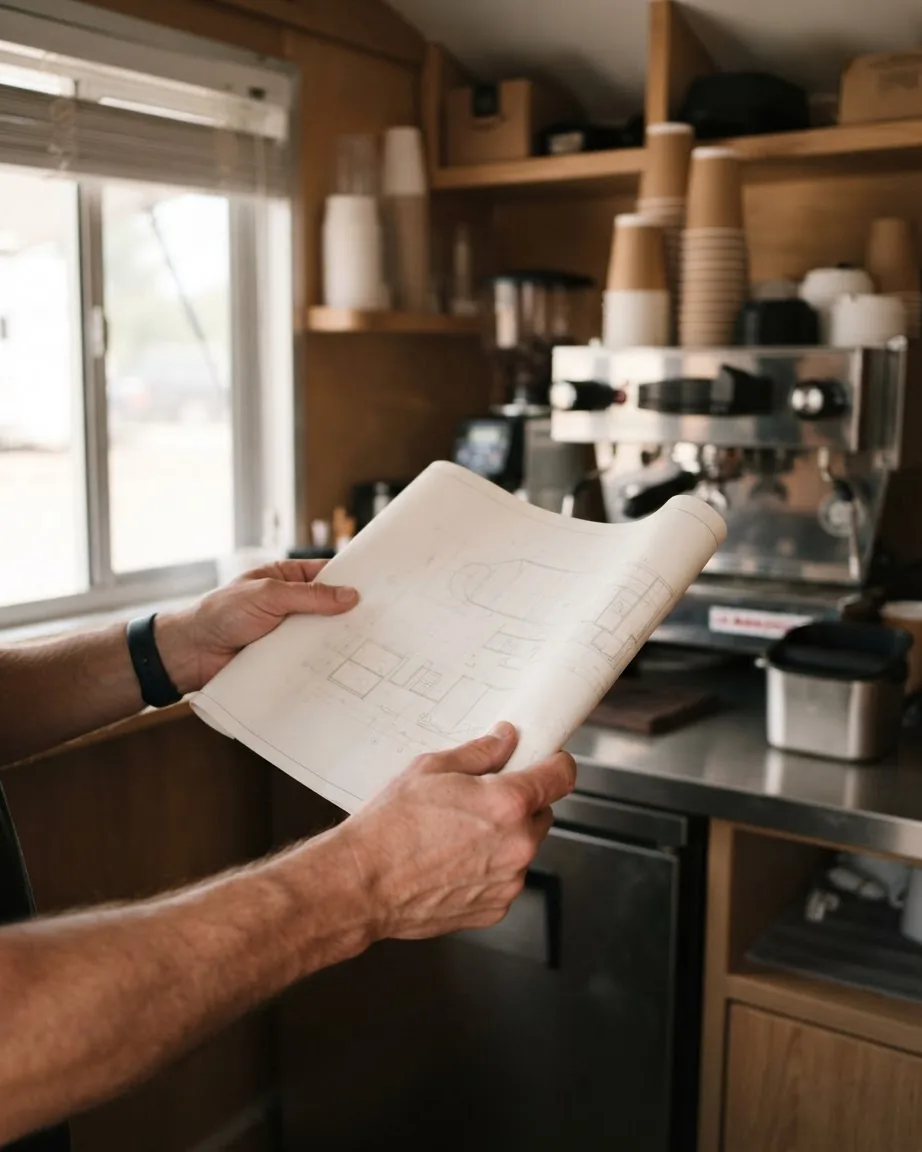
The slowest part of launching a mobile coffee truck is not the build – it’s the approval. Coffee Machine Depot advises starting the permit process at least 60 to 90 days before your planned launch date, and that’s not padding. King County Public Health in Washington warns it may take 8 to 10 weeks for a plan reviewer to complete an initial review. Plan a launch date to that clock and you’ll miss it; plan the clock to your launch date and you won’t.
Opening before you clear inspection is the expensive mistake. King County states that opening without completing a pre-operational inspection can result in closure of the business plus fees, including 50 percent of the annual permit fee. That penalty lands on the exact operators most tempted to rush – the ones already bleeding rent and insurance with no revenue coming in. Among the costs you should line up in that gap is coverage; our food truck insurance guide is a sensible stop before a plan reviewer ever sees your drawings.
Sizing a Generator So It Doesn’t Trip Mid-Rush
A coffee truck’s power problem isn’t running load – it’s the startup surge. Coffee Machine Depot gives the rule in hard numbers: a heat-exchanger single-group machine drawing 1,500W needs a generator rated for at least 2,000W continuous output, because the heating element spikes when it kicks on. Size a generator to the machine’s running watts and it trips the moment the boiler fires during a line. Build in that 500W cushion and it holds.
Inverter generators are the right call for the places a coffee truck actually parks. They produce clean sine-wave power that electronics prefer, run quietly enough for farmers markets and office parks, and offer 8 to 10 hours on a single tank at quarter load. Designing your rig around single-phase power also widens where you can plug in, since standard sockets at venues and events are single-phase. The deeper build tradeoffs – layout, power runs, ventilation – sit in our wider equipment coverage.
A 6-to-8 Drink Menu and the Cold-Brew Escape Hatch
The espresso-only menu that feels pure is what kills you at a busy event. Every latte funnels through one grind-tamp-brew chokepoint, and a single barista can only move the line so fast. Coffee Machine Depot’s read is blunt: the most profitable cart menus have 6 to 8 drinks maximum. A short board speeds the window and cuts waste; a long one slows every order and strands inventory.
The fix for the chokepoint is batch, not speed. Prima Coffee found that with cold brew pre-made and nitro on tap, they could serve both flat and nitro cold brew in under 30 seconds per drink – no grinder, no tamp, no wait. That’s the drink to lead with at a festival rush: it pulls volume off the espresso machine and lets the barista clear a backup. The food-science reason it works is that cold brew’s slow, cold extraction is done hours before service, so the window step is just pour-and-go.
Milk texture is where the espresso drinks earn their price. Coffee Machine Depot recommends steaming milk to 62 to 65°C for the best texture and sweetness – hot enough to develop the lactose sweetness, cool enough that the proteins don’t scald and flatten. Overheat past that band and you lose both the microfoam and the sweetness you’re charging for. For plumbing math, plan roughly 150mL total per milk-based drink once you account for steam, waste, and rinsing, and about 36mL at the group head for a double espresso. Operators who want a model for building a tight, costed board can borrow the discipline in our taco food truck menu build sheets.
The Water Spec That Decides Whether Your Espresso Tastes Right
Water chemistry isn’t a detail – it’s most of the cup. Coffee Machine Depot points to the SCA recommendation of water between 75 and 150 ppm TDS for optimal extraction. Too soft and the shot pulls flat and sour; too hard and it scales the boiler and tastes dull. The make-or-break reason to filter to that window before launch is that the minerals in the water are what actually pull flavor compounds out of the grounds, so a cart running on untreated tap is leaving extraction – and repair-free boiler life – on the table.
Margins, Break-Even, and the Cups-Per-Day Line
Coffee’s economics look generous until you meet the ceiling. Cart-King models coffee and ingredients at 25 to 30 percent of revenue as the largest variable cost, and Coffee Machine Depot puts net margins between 30 and 45 percent for a well-run operation. Break-even comes fast relative to brick-and-mortar: Cart-King sees most cart operators reaching it within 3 to 6 months, against 12 to 24 months for a traditional café. Those are US-oriented, cart-weighted numbers.
The cash-flow reality is less tidy. Budget 5 to 10 percent of equipment value annually for maintenance and repairs, and expect mobile refrigeration to fail more often than a fixed kitchen’s – vibration on the road is hard on compressors. FLTR Magazine’s operator also plans for 2 to 4 weeks of zero revenue per year, weather and off-season baked in. Cart-King’s own worked example lands a cart at 924 drinks a month for $5,544 in monthly revenue – a concrete picture of what a modest site actually produces.
Then the viability line. FLTR Magazine, writing from Anthony Duckworth’s first-hand account of running Dear Coco Street Coffee, sets the threshold: a single-barista coffee truck needs to sell 100+ cups per day on a weekday and 150+ cups on a weekend to be viable. Duckworth reports Dear Coco achieving 40 percent net profit where many brick-and-mortar cafés might range 5 to 15 percent – but that’s one UK operator in GBP, not a benchmark you should bank on in dollars. His other guardrail is worth keeping: investing an amount that takes more than 12 to 18 months to pay off in full risks over-capitalizing the business. For a path onto the street without a bank, our rent to own food trucks breakdown is the companion read.
Is a Texas coffee truck taxed the same as a cooking truck?
No. DSHS sorts coffee trucks into Type II, apart from the Type III classification used for trucks that cook. That matters because Type II carries the $618 application fee cited above and a lighter equipment expectation than a full cooking line. Your city and county layer their own permits on top, so the state class is the floor, not the whole bill.
Can I prep cold brew at home to save on commissary trips?
Not legally in several places. Florida bars a private residence from serving as a commissary outright, and LA County ties every mobile facility to a commissary or permanent food facility. Even your batched cold brew – the drink that saves you 30-second service windows – has to be made in approved space. Price a commissary rental into your startup math from day one.
How many drinks should I expect to lose to steam and rinsing?
Plan volume, not just count. Each milk-based drink eats roughly 150mL of water once steam, waste, and rinsing are in; a double espresso pulls about 36mL at the group head. Multiply by your daily cup target and you’ll size your potable tank – and therefore your 15-percent-larger waste tank – before an inspector does it for you.
What does a bare-minimum espresso machine cost versus a premium one?
Coffee Machine Depot prices espresso machines across a $2,500 to $12,000 spread. The low end gets you pulling shots; the high end buys boiler stability and recovery speed that hold a line during a 150-cup weekend. If weekends are your volume, the machine is where overspending actually earns back, unlike a bigger truck or a longer menu.
The Weekly Cups Number That Actually Decides Viability
The article gives the single-barista viability threshold as two separate daily minimums: 100+ cups on a weekday and 150+ cups on a weekend. On their own, those are easy to wave away in the moment – but strung across a real trading week they turn into a hard floor you can hold any pitch or route up against. Clearing five weekdays at the minimum means 100 x 5 = 500 cups, and two weekend days at the higher bar means 150 x 2 = 300 cups. Added together, a week that only just meets the viability line still demands 800 cups out of one barista.
That reframing is what a reader can’t get without doing the arithmetic: the question isn’t whether you can hit 100 on a good Tuesday, it’s whether your location sustains 800 a week, every week, through one pair of hands. Score a prospective spot against that 800-cup floor before you sign anything.
- Weekday load: 100 cups x 5 days = 500 cups.
- Weekend load: 150 cups x 2 days = 300 cups.
- Weekly viability floor: 500 + 300 = 800 cups, single barista.