Rent to own food trucks promise a way onto the street without a bank, a credit pull, or two years of tax returns, and that promise is exactly why the arrangement hides its real price so well. The seller advertises a small weekly payment. What almost none of them publish is the total-of-payments, the buyout figure, or who holds the title while you cook. Those three numbers decide whether you built equity or rented an asset the seller can recall on one missed payment. This guide fills the gap the seller landing pages leave open: the actual dollars, the legal frame under the Uniform Commercial Code, and the compliance layer that decides if your unit can even open.
Quick answer: Rent to own food trucks are seller-financed lease-purchase deals, typically running 36 to 60 months with a 5 to 10 percent down payment and a residual buyout at term end. They are fastest for buyers with no credit history who want to start earning inside about 6 to 8 weeks. The catch is cost: sellers advertise the weekly payment and hide the total, so the implied interest can dwarf an SBA microloan at roughly 8 to 13 percent. Before signing, get the total-of-payments in writing, confirm who holds title, and verify the unit can pass a local health and fire inspection.
What “rent to own” actually means for a food truck
Rent to own is one label stretched across five different deals that behave nothing alike, and conflating them is the most expensive mistake a first-time buyer makes. A true lease-purchase is seller-financed with weekly or monthly payments and a predetermined residual. A one-dollar buyout lease, sometimes written as an equipment finance agreement, functions as a loan: you own from day one with a lien against the unit. A fair market value lease carries a lower payment but an unknown buyout, with return or renew options at the end. An equipment loan through the U.S. Small Business Administration or a bank is a straight purchase. A short-term rental is not a path to ownership at all.
The money gap between these is wide. A short-term rental runs from a few hundred to a couple thousand dollars, while long-term rentals sit at $6,000 to $8,000 per month, per FoodTruckr. Rentals build no equity.
Where these deals split by name:
- Lease-purchase: weekly or monthly, seller-financed, ends in a set buyout.
- One-dollar buyout / EFA: a loan in lease clothing; you are the owner with a lien.
- FMV / true lease: lower payment, uncertain buyout, return-or-renew at term end.
- Equipment loan: bank or SBA financing of an outright purchase.
- Short-term rental: event or test use only, zero ownership.
If you are still choosing a cuisine before you choose a financing structure, some concepts carry lighter buildouts than others; a pared-down setup like an ice cream truck startup cost breakdown shows how equipment load changes the number you have to finance.

The cost math sellers refuse to publish
The single number that decides a rent to own deal is total-of-payments, and it is the number every seller landing page omits. A weekly payment tells you nothing until you multiply it out across the full term and add the down payment and any lease-to-own fee. Only then can you compare it against the unit’s cash price and estimate the implied cost of the financing. Sellers know this, which is why “low weekly payment” is the headline and total cost is nowhere on the page. You have to compute it yourself before you sign anything.
Published deposit and term structures vary sharply by provider. OMG Grills runs a 12-month plan with a 10 percent deposit, no credit check, and a 5 percent lease-to-own fee, per ProfitableVenture. US Custom Concessions requires Florida residents only, 20 percent down, and no credit check. Trailer King Builders offers 1 to 6 year terms with 100 percent funding, no down payment, and approvals often in 24 to 48 hours. Mehmi Financial Group pegs the typical lease-to-own term at 36 to 60 months with a down payment of as little as 5 to 10 percent of the truck’s value and a predetermined residual buyout.
Here is a compact way to read four financing paths for the same unit:
- Rent to own, 20 percent down, 36 months: lowest bar to entry, highest hidden cost, seller often holds title.
- One-dollar buyout lease, 60 months: you own from day one, longer term, lower monthly.
- SBA microloan plus cash: stated rate, you own outright, slower approval.
- Used purchase in cash: zero financing cost, full engine and equipment risk on you.
Roaming Hunger’s program shows how sellers frame value to justify the payment. It advertises a 3-year lease-to-own with total program benefits valued at up to $90,000 over the program’s life, including a minimum of one catering opportunity per month estimated at $1,000 or more per booked event. That revenue-side pitch answers “how do I make the payment,” but the value of a monthly catering gig depends entirely on metro density, and the figure is not qualified by market.
Cadence matters too. A weekly payment schedule pulls cash out of the till before slow weeks recover, so match the cadence to your revenue rhythm, not the seller’s preference. Peak hours cluster tight: 63.6 percent of operators report 5 to 8 PM as their busiest window, per a Food Liability Insurance Program survey cited by Mordor Intelligence, which means most of your payment has to come from a narrow daily band. When you model the buildout that generates that revenue, a tight dimensioned food truck kitchen layout is what keeps that dinner rush moving.
Is your “lease” actually a disguised loan?
A rent to own contract that calls itself a lease may legally be a secured loan, and that distinction changes everything about your rights on default, in bankruptcy, and at tax time. Under Uniform Commercial Code section 1-203, a transaction in the form of a lease creates a security interest, not a lease, if the lessee cannot terminate the deal and any one of three conditions holds: the term runs at least as long as the goods’ remaining economic life, the lessee is bound to become owner or may buy for nominal consideration, or the lessee may renew for nominal consideration covering that remaining life. The Equipment Leasing and Finance Association lays out this bright-line test, and it notes parties cannot contract around the characterization.
The practical version is the economic realities test. If exercising the purchase option is the only sensible move at term end, a court treats the deal as disguised financing no matter what the paper says.
Why a buyer should care:
- Repossession: a security interest triggers UCC Article 9 procedures rather than a simple lease recall.
- Bankruptcy: the asset is treated differently depending on characterization.
- Depreciation: only an owner can depreciate the truck, which flows straight into your tax position.
The one honest counter-voice in this market frames rent to own bluntly as a private loan with hidden interest rates, where the seller can recall and re-sell the asset on breach. That framing is worth taking seriously, because most state rent-to-own consumer statutes cover consumer goods, so a commercial food truck deal usually falls outside those protections. Verify your own state before assuming any statute shields you.
Before signing, get in writing who holds title during the term, the exact early-payoff terms, the FMV valuation method if it is a true lease, line-by-line maintenance responsibility, and what happens on a single missed payment. If the seller will not put the total-of-payments on paper, treat that as the answer.
Permits, inspections, and food-safety compliance costs
The failure mode nobody selling a truck mentions is signing a 36-month obligation on a unit that cannot pass inspection, so the compliance layer belongs in your buying decision, not after it. Sanitation standards trace to the U.S. Food and Drug Administration Food Code, 2022 edition, which is a model that becomes law only when a state or locality adopts it. The City of Albuquerque Environmental Health Department, for example, adopts the 2022 Food Code by ordinance and requires commissary use. Your actual permit, plan review, and commissary approval come from the county or city health department, not the FDA directly.
Fire is governed separately and is where cheap units fail. The National Fire Protection Association sets the rules through NFPA 96 (ventilation and fire protection of commercial cooking, with Annex B on mobile cooking, 2017 edition), NFPA 1 Fire Code section 50.7 on mobile and temporary cooking (2018 edition), NFPA 17A for wet chemical suppression, NFPA 10 for portable extinguishers, and NFPA 58 plus NFPA 54 for LP-gas. The mobile provisions themselves were drafted by a task force convened by the International Fire Marshals Association. Your local fire marshal, the authority having jurisdiction, issues the operating permit and inspects the propane and suppression install.
What that install must include, keyed to the standards:
- Suppression: an NFPA 17A wet chemical system with automatic gas shut-off, inspected every 6 months.
- Detection: a propane detector where propane and an electrical system coexist, plus an exterior audible and visual notification appliance.
- Fuel: DOT propane cylinders requalified every 5 or 12 years depending on design, with pressure regulator and excess-flow valve.
- Hood and duct: stainless or noncombustible, per NFPA 96.
The FDA Food Code side dictates a three-compartment sink, a separate hand sink, hot and cold holding, adequate wastewater capacity, and a Certified Food Protection Manager. Health departments also look for NSF International or Intertek ETL certification marks on installed equipment, so uncertified gear can sink a plan review even if the deal price looked good. The U.S. Fire Administration publishes a Mobile Food Vendor Fire Safety guide worth reading before you tour a unit; you can find the federal guidance at the U.S. Fire Administration mobile vendor guide.
Costs here are real and local. Total startup costs reached USD 28,276 in Boston, and California mobile food facility permits can reach USD 1,000 annually, per Mordor Intelligence. Most jurisdictions also require a licensed commissary for water, food storage, and waste disposal; building your own runs $30,000 to $200,000 in capital investment, per StartPermit. Section 179 tax rules published at the Section 179 deduction reference matter here too, because whether you can depreciate the truck depends on the lease characterization discussed above. Insurance sits around $1,000 per year on average; the deeper coverage picture, from liability to physical damage on a financed unit, is laid out in this food truck insurance cost and coverage guide.
Rent to own versus SBA loans and other financing
Rent to own is the right call in a narrow set of conditions and the wrong one the moment you qualify for cheaper money. It makes sense when you have no credit history, want to test a concept before committing capital, or need to be earning inside roughly 6 to 8 weeks. It is the wrong choice when you can access an SBA microloan or equipment loan at 8 to 13 percent, or when you hold 10 to 20 percent cash and a credit score above 650. The whole value of a no-credit-check deal is that it clears a bar you cannot clear elsewhere; if you can clear the bar, you are overpaying for a convenience you do not need.
The SBA Microloan is the most direct alternative. It caps at $50,000, with an average loan around $13,000 per the SBA and an FY2026 average of $15,399 cited by NerdWallet from the agency’s Microloans Segment Report. Rates typically run 8 to 13 percent, the maximum repayment term is 6 years, and intermediary fees run up to 3 percent of the loan amount. Notably, 26 percent of FY2026 microloans went to businesses operating two years or fewer, which is exactly the audience most rent to own pages target. You can read program terms at the SBA microloan program page.
Financing paths ranked by cost and access:
- Cash used purchase: cheapest lifetime cost, hardest to fund, full mechanical risk.
- SBA microloan or 7(a): stated 8 to 13 percent rate, slower approval, you own the asset.
- Equipment finance / one-dollar buyout: ownership from day one, moderate rate.
- Rent to own: fastest and no credit check, highest hidden cost.
- Long-term rental: $6,000 to $8,000 per month, builds zero equity.
Approval thresholds decide which door is open. Traditional loans generally want 650 or higher; many lease-to-own programs accept 600 or higher; some bundled marketplace programs screen for 675 plus, two years operating, under $20,000 revolving credit, and two years of business tax returns, which quietly excludes the no-credit audience the category advertises to.
How the unit and the market shape the deal
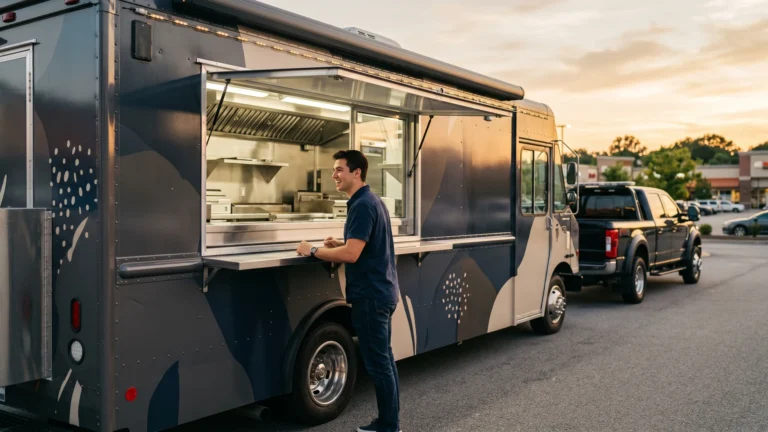
The physical unit and your local market together determine whether a rent to own payment is survivable, and both get glossed over on seller pages. A trailer is cheaper but needs a tow vehicle; a truck carries an engine you inherit mid-lease, meaning a blown motor can leave you owing payments on something that will not move. Standard maximum legal width is 8.5 feet, sizes run 12 to 28 feet, and a custom build takes roughly 6 to 8 weeks for manufacturing and delivery, per Universal Food Trailer. Settle in writing who pays for engine, generator, and refrigeration failures during the term, because on a financed unit that clause is worth thousands.
The market backdrop is genuinely contested, and the honest version is a range, not a single figure. Average US food truck revenue sits around $346,000 per year with a profit margin near 6.2 percent, per B2B Reviews and foodtruckprofit.com. Average spend per customer is $12.76, the typical truck runs 1.8 full-time employees, and 91 percent of trucks are independent operations. Operating costs rose 7.9 percent from 2020 to 2026.
Truck counts and market size vary by definition. Estimates run from about 48,400 operating trucks (Restroworks) to roughly 58,000 employer-reported trucks (B2B Reviews) to over 100,000 operators (National Street Food Vendors Association extrapolation). Market size spans IBISWorld’s roughly $2.8 billion in 2025 to Mordor Intelligence’s USD 1.09 billion in 2025 growing at a 6.53 percent CAGR, a spread driven by value-added revenue versus gross-sales accounting.
Startup cost itself ranges from $50,000 to $200,000 or more (B2B Reviews) to $75,000 to $250,000 (NSFVA), against $250,000 to $500,000 or more for a brick-and-mortar restaurant. Survival is better than the folklore suggests: 60 percent of trucks last 3 or more years, and PitStop notes failures are almost always undercapitalized or flying blind on their numbers. That is the case for knowing your total-of-payments before you sign. Cuisine choice drives the equipment bill that payment has to cover; the margin structure of a burger truck cost and margin breakdown looks nothing like a low-equipment dessert concept. A heavier comfort-food menu, like the kind featured in this cheesy baked mostaccioli recipe, needs more cooking equipment and a bigger propane and suppression footprint than a dessert truck, which feeds straight back into the financing math above.
Red flags to check before you sign
A handful of contract signals separate a workable rent to own deal from a trap, and each one is a specific line item you can demand before committing. The pattern across the ranking seller pages is the same: a headline payment, an “interest-free” or “no credit check” claim, and total silence on the numbers that let you compare deals. Treat every omission as information. A seller confident in the deal will put the total cost, the title arrangement, and the default terms in writing; a seller who deflects is telling you where the cost is buried.
Run this checklist before signing:
- Geographic limits: some programs are single-state only, like the Florida-residents offer.
- Undisclosed total-of-payments: if it is not on paper, the deal is unpriced.
- “Interest-free” claims: cost is usually loaded into an inflated cash price and fees instead of a stated rate.
- Title during the term: know exactly who owns the unit while you pay.
- One missed payment: get the default and repossession terms in writing.
- Inspection fitness: confirm the unit can pass local plan review before you owe 36 payments.
Between planning meals and financing metal, it helps to keep the operational side simple; sourcing efficient, shelf-stable staples from a solid pantry basics list keeps food cost predictable while you service the payment. Trucks catering to dietary restrictions also do well to plan a gluten free menu ahead of the build-out, since ingredient swaps rarely change the equipment list. Menu efficiency matters just as much, and a batch-friendly approach in the spirit of high protein recipes can lift ticket value without adding equipment. Operators leaning on frozen prep to speed service often study air fryer frozen foods techniques to cut cook times during the 5 to 8 PM rush.
Frequently asked questions
Are rent to own food trucks a good deal?
They are a good deal only when cheaper money is closed to you. If you have no credit history and need to start earning inside about 6 to 8 weeks, the speed can justify the cost. But when you qualify for an SBA microloan at roughly 8 to 13 percent, or hold 10 to 20 percent cash with a score above 650, rent to own usually costs more for no added benefit.
What down payment do rent to own food trucks require?
Down payments vary widely by provider. Mehmi Financial Group cites 5 to 10 percent of the truck’s value as typical. In published programs, OMG Grills asks a 10 percent deposit, US Custom Concessions requires 20 percent down for Florida residents, and Trailer King Builders advertises 100 percent funding with no down payment and approvals often in 24 to 48 hours.
Can I get a food truck with no credit check?
Yes, several sellers advertise no-credit-check rent to own deals, including OMG Grills and US Custom Concessions. The tradeoff is cost and terms. No-credit-check programs typically load the expense into an inflated cash price, deposits, and fees rather than a stated rate, so verify the total-of-payments and default terms in writing before you commit to anything.
Will a rented food truck pass health and fire inspection?
Not automatically, which is why you check first. The unit needs an NFPA 96 hood, NFPA 17A suppression inspected every 6 months, a propane detector, and an FDA Food Code sink setup with a Certified Food Protection Manager. Confirm the truck can clear local plan review and that you have a licensed commissary before signing a multi-year obligation.
How does rent to own affect my taxes?
It depends on the legal characterization. A one-dollar buyout lease or equipment finance agreement is treated as a purchase, making the truck eligible for the Section 179 deduction and bonus depreciation. A fair market value lease is different: payments are deducted monthly as an operating expense with no depreciation. Confirm which structure your contract creates before filing.
What is the difference between renting and rent to own?
Renting builds no equity and ends with you owning nothing; short-term rentals run from a few hundred to a couple thousand dollars, and long-term rentals cost $6,000 to $8,000 per month per FoodTruckr. Rent to own applies your payments toward a buyout, so ownership transfers at term end, though usually at a higher total cost than an outright loan.
Note: financing structures and lease characterization carry legal and tax consequences that vary by state. This is general information, not legal or financial advice; consult a licensed attorney and accountant, and verify current SBA terms and local permit rules before you sign.