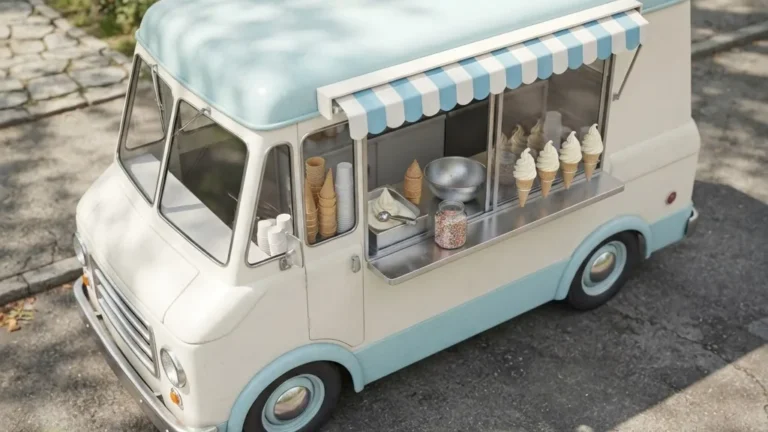
Ice cream food truck dreams usually die in the paperwork, not the freezer. The romantic version is a wrapped step-van, a summer route, and a line of kids. The real version starts with an Employer Identification Number from the IRS, a commissary agreement, and a health-department plan review that has to clear before you scoop a single cone. This guide runs the informational track: how to start, what it costs, what the rules demand, and what an ice cream food truck can honestly earn once the novelty wears off and the second August rolls around.
You can spend anywhere from about $10,000 for a used vehicle up to $60,000 or more for a new, custom-fitted truck, according to a Lightspeed startup guide updated in March 2026. That single spread hides a dozen line items nobody explains. So this walkthrough breaks the money, the licensing, the cold chain, and the child-safety rules into steps you can act on, using the numbers operators and regulators actually publish.
Quick answer: An ice cream food truck costs roughly $10,000 used to $60,000-plus new. Food cost typically sits at 18 to 25 percent of revenue and net margins at 25 to 35 percent. Before selling, you need a business entity, an EIN, a mobile food establishment permit from each local health department, a commissary agreement, DMV commercial registration, and a food-manager certification. A home kitchen is not allowed.
What It Really Costs to Start an Ice Cream Food Truck
Startup cost for a mobile frozen-dessert operation ranges from about $10,000 for a used vehicle to $60,000 or more for a new, custom-fitted build, per Lightspeed’s March 2026 guide. That range is not a mystery, it is a stack of line items. The vehicle is the biggest single number, but the build-out, first inventory, point-of-sale hardware, insurance, permits, and a truck wrap all pull real cash before opening day. Treat the low end as a bare used van and the high end as a purpose-built rig with a soft-serve machine and onboard power.
Here is how the money tends to break out when you itemize instead of quoting one scary range:
- Vehicle: the used-to-new spread of roughly $10,000 to $60,000-plus dominates everything else.
- Build-out and equipment: freezer or cold plate versus a soft-serve machine, plus a hand-wash sink and a three-compartment sink that most health codes require.
- Power: a generator or inverter sized to your freezer and any soft-serve draw. Getting this wrong is the top rookie failure.
- First inventory, POS, insurance, permits, and wrap: smaller individually, together they can rival a used vehicle’s price.
Financing framing aside, the real decision is buy used versus new-build versus franchise. A used refrigerated step-van gets you moving cheaply but inherits someone else’s electrical and refrigeration debt. If you want to understand the power side before you buy anything, the sizing math in this food truck generator sizing and cost guide is the piece to read first, because an undersized generator turns your freezer into an expensive cooler by mid-afternoon.
The U.S. Small Business Administration is the right first stop for business formation and financing guidance, and it costs nothing to use before you commit capital.
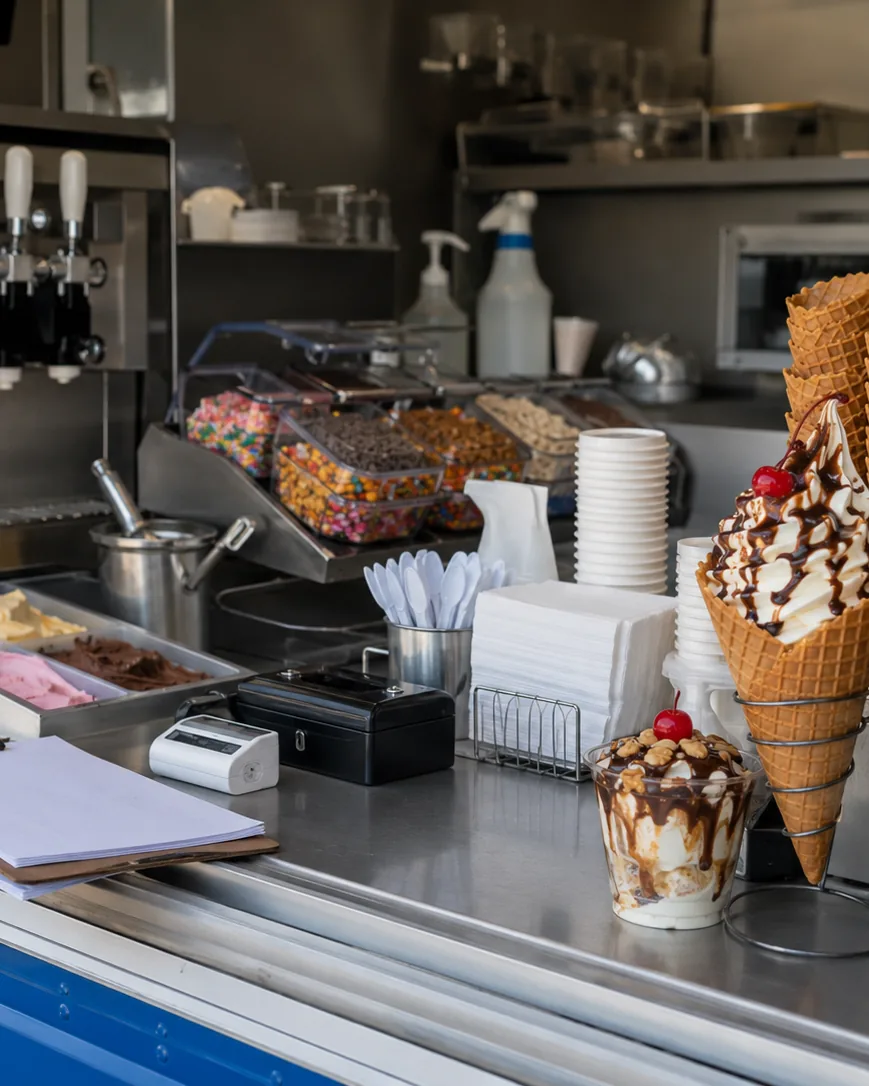
Licensing and Permits: The Part Beginners Underestimate
Permits are where the ice cream food truck plan meets reality, and the reality is that you need permission from more than one agency. You register a business entity, pull an Employer Identification Number from the IRS, and then earn a mobile food establishment permit from each local health department where you intend to sell. Every jurisdiction you cross can require its own permit. That is the single fact most startup guides wave past, and it changes your whole route strategy from day one.
The sequence that keeps you out of trouble runs roughly like this:
- Register the entity and get an EIN from the IRS for tax identity.
- Pull a local business license.
- Pass a health-department plan review of your build.
- File a commissary agreement and a restroom agreement.
- Clear a pre-opening inspection.
- Obtain the per-jurisdiction mobile food establishment permit.
- Register the vehicle and get commercial plates through the state DMV.
- Pass a fire inspection with the local fire marshal if propane or a generator is aboard.
- Earn a food-manager certification, commonly the ServSafe Food Protection Manager credential from the National Restaurant Association.
State layers vary. In Florida, for example, the Florida Department of Agriculture and Consumer Services permits prepackaged, non-hazardous mobile vendors, while the state’s Department of Business and Professional Regulation handles mobile food service. That split is illustrative, not universal, so confirm with your own state before assuming which desk you belong at.
The FDA publishes the U.S. Food Code that local health departments adopt, and the agency’s own Food Code reference page is worth reading before your plan review so you walk in knowing the baseline rules on handling, handwashing, and cold-holding. Naming your truck legally and defensibly is its own small project; the trademark reasoning in this piece on picking a food truck name that survives a trademark check applies just as much to frozen desserts as to tacos.
Why a Home Kitchen Is Not Allowed: The Commissary Rule
A commissary is mandatory in most jurisdictions, and a private residence may not be used to prep, store, or service a mobile food truck. This is the rule beginners discover only after they have bought a van. To operate legally you file a commissary agreement plus a restroom agreement, then pass a plan review and a pre-opening inspection. Salt Lake County Health guidance and Utah Administrative Code R392-102-4 spell this out; FDACS enforces a parallel expectation in Florida. Different states, same principle.
The commissary is a licensed commercial kitchen where you park overnight, refill water, dump wastewater, restock inventory, and store product at safe temperatures. It gives inspectors a fixed, approved address to tie your mobile permit to. Skipping it is not a shortcut, it is grounds to shut you down.
Budget for a monthly commissary fee as a fixed cost, and choose one close to your route so the daily dead-mileage does not eat your margin.
Cold Chain and Food Safety: The Rules That Keep You Open
Food safety is not paperwork theater for a frozen-dessert truck, it is the difference between passing inspection and losing your permit. Keep freezers at 0 degrees Fahrenheit or below as a standard frozen-storage target, cold-hold temperature-control-for-safety foods at 41 degrees Fahrenheit or below per the FDA Food Code, and log your temperatures daily. Handle ready-to-eat food with no bare-hand contact. These four habits, done every shift, are what an inspector checks first and what protects your customers when the sun is punishing your freezer at 3 p.m.
The FDA sets the baseline the states adopt, but the enforcement is local. The CDC studies foodborne illness patterns, FoodSafety.gov and nutrition.gov translate the rules for operators, and FSIS and the USDA govern the meat and dairy supply chain feeding your inventory. You do not need to memorize which agency does what, but you should know the food-safety stack is layered from federal guidance down to the county inspector who signs your permit.
Practical daily discipline looks like this:
- Check and record freezer temperature at open, mid-shift, and close.
- Keep a written or digital temperature log the inspector can review.
- Use scoops, gloves, or tissue so hands never touch a finished cone or a topping.
- Rotate inventory so the oldest novelties sell first.
For deeper reference on official handling guidance, the USDA’s FSIS freezing and food safety page covers frozen-storage principles you can lean on when a customer asks why the freezer stays so cold. If you want to understand how dairy ingredients behave when you move into artisanal or milkshake territory, the numbers in these cream cheese nutrition facts give a useful sense of how fat content drives both texture and cost in dairy-based menu items.
The Unit Economics: Modeling What an Ice Cream Truck Actually Earns
Revenue for a frozen-dessert truck is smaller in absolute dollars than a taco or pizza rig but richer in margin, and that trade-off is the whole business. Other sources cite summer gross at $200 to $400 and up to $200 to $500 on busy days. A broader owner range is cited near $30,000 to $60,000 and a ZipRecruiter average around $30,000-plus per year. Those are the honest ceilings.
Margin is where the model gets interesting. Food cost often runs 18 to 25 percent of revenue, and net margins land at 25 to 35 percent for ice-cream and coffee trucks, per mobilefoodmath.com data from June 2026. Most food trucks net $3,000 to $10,000 a month once established. Run the arithmetic: on a busy $300 day at a 25 percent food cost, your product costs $75 and leaves $225 in gross profit before labor, fuel, and the commissary fee.
The lever most operators ignore is menu model. Prepackaged novelties are freezer gold with predictable cost, soft-serve trades higher equipment load for better per-cup margin, and artisanal or rolled ice cream commands premium pricing but demands more prep and skill. A common operator benchmark targets under 90 seconds of service time per customer and a review average at or above 4.5 stars, because throughput and reputation compound faster than any single menu tweak.
If you want to see how much richer margins behave on a lower-revenue frozen concept versus a savory one, the honest cost breakdown in this burger truck cost and margin analysis makes the contrast concrete. Menu diversification also helps: a well-stocked base of ingredients smooths cash flow, and simple staples like the ones covered in this rundown of essential pantry basics keep a milkshake or affogato menu running without emergency supply runs. For frozen inventory sourcing logic, the approach in these frozen food handling ideas translates surprisingly well to managing a novelty freezer.

Child-Pedestrian Safety and the Insurance Stack
Child safety is the section top competitors skip, and it is the one that protects your business the day something goes wrong. An ice cream food truck draws children into the street, so the on-street setup matters as much as the freezer temperature. Standard precautions include a convex mirror to see low around the truck, flashing lights, serving only from the passenger side away from traffic, never reversing without a spotter, and slow-down signage. Several states carry stop-arm or signage provisions in their vehicle codes, so verify the exact statute for your state before you assert a specific law.
Behind the physical safeguards sits the insurance stack, and skipping any layer leaves a hole a single incident can drive through:
- General liability: covers customer injury and property damage claims.
- Commercial auto: required because a personal policy will not cover a business vehicle.
- Product liability: protects against claims tied to the food itself.
- Workers’ compensation: needed once you hire your first operator.
The NHTSA and state vehicle codes address on-street child-pedestrian safety in several jurisdictions, though the exact provisions differ, so treat any named statute as something to confirm locally rather than a national rule.
Branding reinforces safety when it broadcasts your slow-and-visible approach; a thoughtful wrap does double duty as a rolling billboard and a visibility tool, and the payback math in this guide to wrapping a food truck for return on investment shows why the spend is rarely wasted.
Seasonality, Routes, and Where the Money Actually Comes From
Seasonality defines the ice cream truck calendar more than any other food-truck category. Peak runs late spring through early fall, winter demand collapses, and the operators who survive plan for that gap before it arrives. Route strategy compounds the timing problem: schools, parks, beaches, and events all peak at different hours, and route density determines whether you burn fuel between customers or stack sales in a tight loop. Timing your school-adjacent routes against the actual school calendar is a lever most first-year owners miss entirely.
Events and catering are the revenue multiplier that flattens the seasonal curve. Weddings, corporate bookings, and birthday parties pay a flat rate that beats street vending per hour and books in advance, which stabilizes cash flow when street traffic is thin.
The soft-serve category itself was born from a truck: Tom Carvel invented soft-serve in 1929 when his ice cream truck broke down, and the Carvel brand now spans more than 500 locations across 25 states. That origin is a reminder that the mobile channel has always fed the fixed one.
If you want to add high-margin private bookings, the pricing and logistics in this caterer’s guide to booking a truck for a reception map cleanly onto a dessert truck’s event calendar.
The Market Context and 2025-26 Trends Worth Chasing
The U.S. ice cream truck market is real money, though the research houses disagree on its exact size. Grand View Research valued it at USD 1,480.0 million in 2022 with a projected CAGR of 9.3 percent from 2023 to 2030, while Emergen puts it nearer USD 1.8 billion in 2023 at a 4.2 percent CAGR, with independents holding about 58 percent share in 2024. Call it an estimated $1.5 to $1.8 billion and growing. For context, IBISWorld pegs U.S. ice cream shops at roughly $7.4 billion in 2026 across 12,781 businesses, an adjacent industry that shows the appetite is there.
The trends worth building around in 2025 and 2026 are concrete, not vague:
- Non-dairy and vegan: a growing slice the supplier-led guides underplay.
- Rolled ice cream and nitro: premium, theatrical formats that justify higher pricing.
- Cashless and QR pay: faster checkout that supports the sub-90-second service target.
- Tech-enabled ordering: real-time location posting that turns social followers into a line.
Menu breadth is the through-line. Adding a vegan option or a milkshake with a house sauce widens your addressable crowd without a second truck; the technique in this guide to building smooth cream sauces transfers directly to caramel and fudge toppings that lift a plain scoop into a premium sundae.
Frequently Asked Questions
How much does it cost to start an ice cream food truck?
Startup cost ranges from about $10,000 for a used vehicle up to $60,000 or more for a new, custom-fitted truck, according to Lightspeed’s March 2026 guide. The vehicle dominates the total, but build-out, first inventory, point-of-sale hardware, insurance, permits, and a wrap add up. Buying used lowers the entry price while inheriting older refrigeration and electrical systems you may pay to fix later.
How much money can an ice cream truck make?
Summer gross reaches $200 to $500 on busy days. Because food cost sits at 18 to 25 percent and net margins reach 25 to 35 percent, most established food trucks net $3,000 to $10,000 a month.
Do I need a commissary for an ice cream truck?
Yes, in most jurisdictions a commissary is mandatory and a private residence may not be used. You file a commissary agreement and a restroom agreement, then pass a plan review and a pre-opening inspection. Salt Lake County Health guidance and Utah Administrative Code R392-102-4 illustrate the rule; confirm the specific requirement with your local health department.
What permits does an ice cream truck need?
You need a registered business entity, an EIN from the IRS, a local business license, a mobile food establishment permit from each health department where you sell, DMV commercial vehicle registration, a fire inspection where propane or a generator is aboard, and a food-manager certification such as the ServSafe credential from the National Restaurant Association.
Are ice cream trucks profitable year-round?
Rarely without diversification. Peak season runs late spring through early fall, and winter demand drops sharply. Operators smooth the curve with events and catering such as weddings, corporate bookings, and birthday parties, which pay flat rates and book in advance. Some add year-round products like coffee to keep the truck earning when street traffic thins.
Can I use my home kitchen to prep ice cream truck inventory?
No. In most jurisdictions a private residence may not be used to prep, store, or service a mobile food truck, which is why the commissary agreement is required. The commissary gives inspectors a fixed, licensed address tied to your permit for restocking, water refill, wastewater disposal, and safe overnight storage of product.