A food truck wedding lives or dies on two numbers nobody puts on the Pinterest board: the per-head price and the minimum spend. I cater weddings on weekends between my regular market shifts, and the calls I get almost always start the same way – a couple has a budget in their head, a guest count on a spreadsheet, and no idea that the truck runs on a floor price, not just a per-plate rate. This is the guide I wish I could email every couple before they ever ask me for a quote, and it is just as useful if you run a truck and want to price the gig without losing your shirt.
The first wedding I catered, I under-quoted it badly. I gave the couple a straight per-head number for 60 guests, forgot that 60 plates barely covered my food and gas, and gave up a Saturday route that would have earned more. It cost me most of a weekend for the privilege of breaking even. A wedding is not a busy lunch rush with a bigger crowd. It is a single seating, a hard start time, and a line of hungry guests who all show up at once, and what most guides get wrong is treating it like any other service day. In my experience that single-seating crush changes every number on the sheet.
Every price, deposit percentage, and logistics figure below is what couples are actually paying this season and what I quote on my own contracts.
Quick answer: Expect a food truck wedding to run about $18-$45 per guest for a main and a side, clustering around $31-$36 per head for a real reception, against $60-$85 per head for traditional plated catering. Most trucks charge a minimum of $1,000-$2,500 that covers 2-3 hours of service; you pay the higher of the per-head total or that minimum, not both stacked. Plan on a 25-50% deposit to hold the date, one truck per 75-100 guests, and a 15-20% tip. A 100-guest wedding most often lands between $2,000 and $2,800 all in, before travel, overtime, and gratuity.
Why couples put a truck at the reception
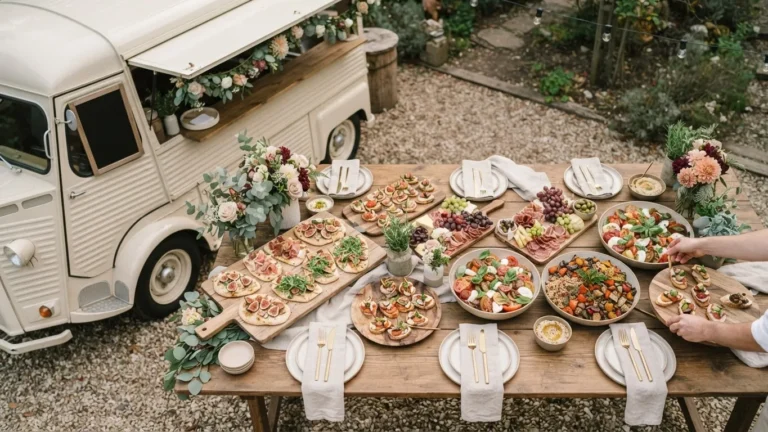
The appeal is real, and it is not just the budget. A food truck reception feeds people fast, gives the night a relaxed backyard feel, and lets guests eat what they actually want instead of choosing chicken or fish on an RSVP card six months early. Speaking from my 8 years running trucks, the couples who love it most are the ones who wanted their wedding to feel like a great party and not a banquet hall, and the ones who did the math and realized they could feed 100 people well without spending the price of a used car on catering alone.
But a truck at a wedding is a different animal from a truck at a festival, where people trickle up over four hours. At a wedding, 120 guests finish the ceremony, grab a drink, and hit your window inside a twenty-minute wave. That single-seating crush is the whole design problem, and it is why couples who plan it well end up thrilled while the ones who wing it get a 45-minute line and cold guests. When people ask me for low-risk food truck catering ideas for a private event, a wedding is at the top of the list precisely because it can go so right or so wrong on logistics alone.
What it really costs to hire one
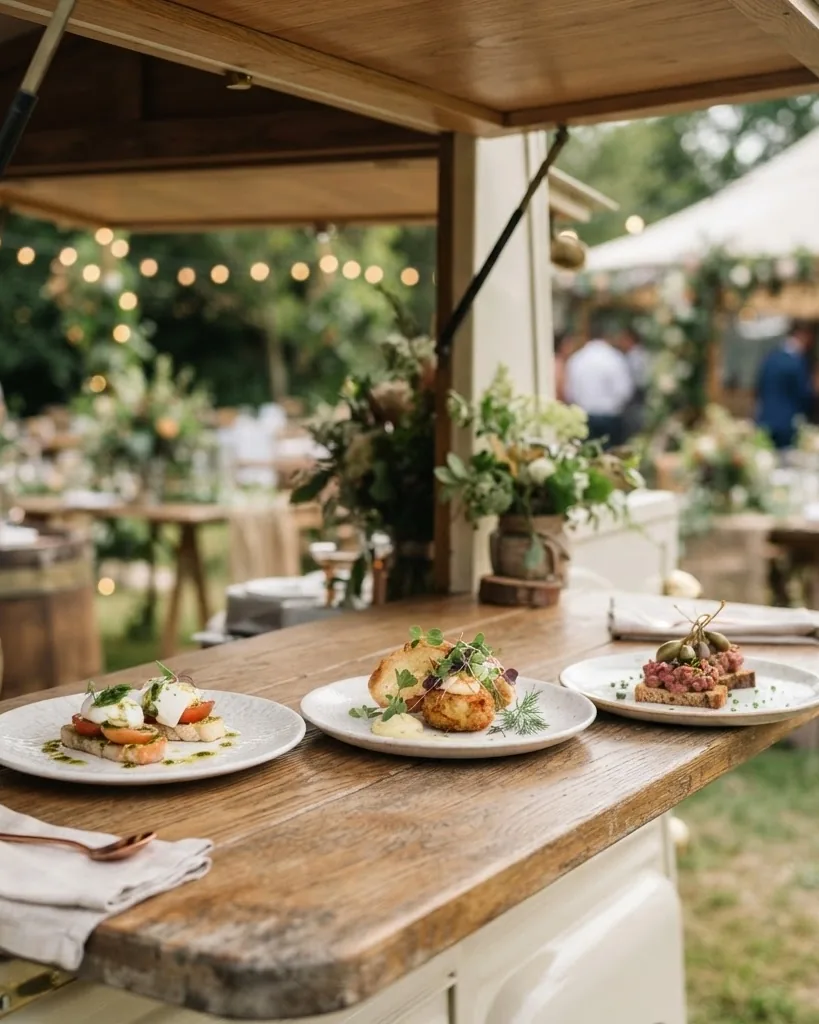
Here is the honest range. For 2026, a food truck reception runs about $18-$45 per guest for a main dish and one side. Simple concepts like tacos, sliders, or wood-fired pizza sit at the low end; custom bowls, gourmet entrees, and premium proteins push toward $45. Weddings specifically tend to land at $31-$36 per head once you add the extras couples want. Layer in appetizers, a dessert truck, or a second protein and the all-in climbs to $50-$65 a guest. That is still a bargain next to traditional plated catering, which averages $60-$85 per person before you talk about a bar.
The number couples miss is that per-head is only half the quote. Every serious truck carries a minimum spend, usually $1,000-$2,500 for a private event, and that floor covers 2-3 hours of service plus setup and breakdown. High-demand trucks that specialize in weddings quote $2,500-$3,500 on a peak Saturday in spring or fall. I have seen couples treat the minimum as a surprise fee bolted on top of the plate price, and that is not how it works – you pay the greater of the two, which I will break down in the next section. For a typical 100-guest wedding, most confirmed bookings I have seen land between $2,000 and $2,800 before travel and tip. Below is roughly how the full cost splits out.
| Cost line | Typical range | Notes |
|---|---|---|
| Per guest (main + one side) | $18-$45 | Weddings cluster at $31-$36; add-ons push higher |
| Minimum spend / buyout | $1,000-$2,500 | Covers 2-3 hours; $2,500-$3,500 on peak Saturdays |
| Deposit to hold the date | 25-50% of total | Often non-refundable inside 2-4 weeks |
| Travel fee | Varies | Applies beyond a 25-40 mile base radius |
| Extra service hour | $100-$200 each | Overtime past the booked window |
| Event / health permit | $50-$200 | Plus a $200-$500 venue food-truck fee at some sites |
| Gratuity | 15-20% | Of the catering total; more for extra effort |
Add those up and a 100-guest wedding at $28 a head is $2,800 of food, but if your count is 60 and the truck’s minimum is $1,800, you are paying the $1,800 floor, not $1,680. If you are an operator reading this and thinking about adding wedding work, the financing and planning basics from the U.S. Small Business Administration are worth a read before you buy a second truck, and the IRS guidance on deducting travel and event expenses will matter at tax time; according to SBA, most microloans for a mobile food business land under $50,000, which is plenty to add catering capacity without a giant note.
Per-head versus the minimum, and how pricing works
This is the part that confuses everybody, so let me draw it clean. There are two ways a truck prices a wedding, and you pay whichever one is larger. The first is per-head: a set price times your confirmed guest count, which is how you should think about it any time your crowd is comfortably above the truck’s floor. The second is the flat minimum, also called a buyout, which is the least the operator will accept to give up a Saturday route and roll a full crew and a prep day at your event.
The choice between them is simple math. Say the truck charges $30 a head and carries a $2,000 minimum. At 100 guests, per-head wins: 100 times $30 is $3,000, so you pay $3,000. At 55 guests, per-head is only $1,650, which falls under the floor, so you pay the $2,000 minimum instead. That is the whole logic. The minimum is a floor, not a surcharge, and the trap I see is couples with a small guest list assuming a truck will be cheap – a 40-person wedding often costs almost the same as a 65-person one because both sit under the minimum. If your count is small, you are usually better off packing the menu with a second protein or a dessert round to get real value for the floor you are already paying.
Why does the floor exist at all? Because a wedding pulls my truck completely off its route. A booked Saturday is a market day I am giving up, a full crew I am paying, and a dedicated prep day for your headcount. The minimum is not greed; it is the cost of committing the whole operation to one event, and operators who price weddings like an average lunch service lose money on every one. Having spent enough weekends catering to know my true cost, I would rather quote an honest floor than surprise a couple later.
Guest-count math and keeping the line moving
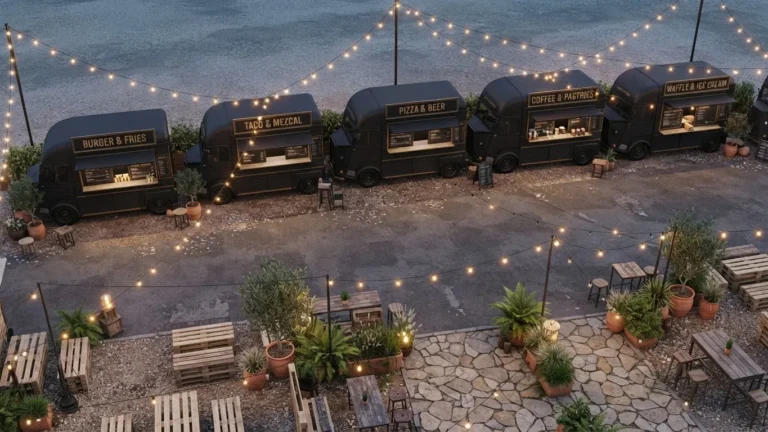
The single biggest failure mode at a food truck wedding is the line. Plan for one truck per 75-100 guests. A single window serves roughly 60-75 people per hour on a tight menu, which means about 90 minutes to feed 100 guests without anyone waiting too long. Push past 150 guests on one truck and you are looking at a line that outlasts the toasts. That is why two trucks are common for 100-150-plus guests: you double the throughput and you give people variety, which doubles as a talking point.
Speed comes from the menu, not the crew. I built my whole wedding service around a fixed event menu of two or three items, not my full public board, and it roughly doubled how fast I clear a line. The other lever is pre-ordering: when guests hand a place card to the window like a ticket instead of reading a menu, the line moves dramatically faster – one widely cited figure puts the speed-up as high as 400 percent, and while I would not swear to that exact number, the effect on the ground is real and large. Here is the sequence I walk every couple through.
- Step 1 – Lock a fixed event menu of two or three items with the truck, not the full public menu, so every guest decides fast.
- Step 2 – Collect meal choices with the RSVP and print each guest’s pick on their place card or escort card.
- Step 3 – Have guests hand that card to the window like a ticket so the line never stalls on someone reading options.
- Step 4 – Release tables to the truck in waves rather than dumping all 120 guests at once right after the ceremony.
- Step 5 – Staff a second window or a second truck the moment your count clears 100-120 guests.
Here is the pattern I see: the weddings that run smooth treat the truck like a plated dinner with a moving part, not a free-for-all. Give the operator a real headcount, a locked menu, and a release plan, and one truck can feed a hundred people faster and hotter than a buffet line ever will.
Building a wedding menu that serves fast
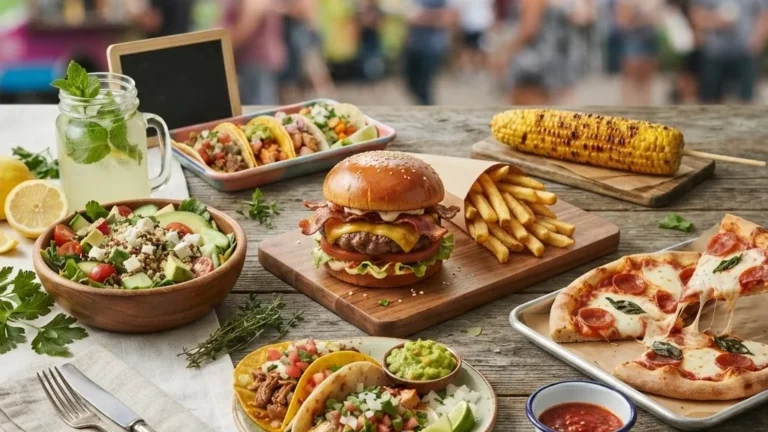
Do not hand guests your food truck’s twenty-item road menu at a wedding. Build a streamlined version with the operator, because simpler menus mean shorter lines and food that comes out hotter and more consistent, and in my experience the sweet spot is one crowd-pleasing main, one alternative for the vegetarians and the picky eaters, and a single strong side, with the option of a second protein if the couple wants to spend up. Popular concepts that cater weddings well include tacos, barbecue, wood-fired pizza, gourmet sliders, loaded fries, and dessert or coffee trucks as a second act later in the night.
Here is how I would frame a menu conversation with your truck so it serves fast and covers your guests:
- Pick one signature main almost everyone will happily eat – tacos, pulled pork, a smash burger, or a pizza.
- Add one vegetarian or vegan option so no guest is stuck with a side plate for dinner.
- Keep sides to one or two that hold well in a warmer and do not slow the window.
- Flag allergies and dietary needs from the RSVP so the kitchen preps them, not improvises them.
- Consider a late-night second wave – a dessert truck or sliders at 10pm reads as generous and costs little per head.
If you want a running start on concepts, my rundown of food truck menu ideas and my deeper guide to building a food truck menu both cover how to trim a board down to what actually serves fast under pressure. A wedding is the hardest test of a lean menu, because you are cooking for a crowd that all arrives on the same clock.
Deposits, contracts, and the tip
Once you pick a truck, the paperwork protects both sides, so read it. Most operators want a 25-50 percent deposit to hold your date, and that deposit is usually non-refundable if you cancel inside 2-4 weeks of the event, because by then the operator has turned away other work for your Saturday. Book early: peak wedding season, roughly May through June and September through October, gets claimed 6-12 months out, and the good trucks go first. I have turned down three weddings for one prime Saturday, and the couples who called late were stunned.
Ask for an itemized contract, not a one-line quote. It should spell out the per-head rate or the minimum, exactly what hours of service you are buying, staffing levels, the travel fee beyond the base radius, overtime at $100-$200 per extra hour, and the cancellation terms. What most guides skip is telling you the truck usually does not bus tables or handle cleanup – that is on you or your coordinator – so confirm in writing who is doing what after the food comes out. The trucks that feel expensive up front are often the ones being honest about every line, and the cheap quote is the one hiding a travel fee and an overtime surprise.
On tipping: yes, you tip a catering truck. Standard is 15-20 percent of the catering total, and I would push toward 20-25 percent if the crew stays late, absorbs a last-minute headcount change, or handles special diets without complaint. Build the gratuity into your budget from the start so it is not an awkward scramble at the end of the night. Some couples hand it to the lead at the truck; others add it to the final invoice. Either works, but do not skip it – a wedding crew is giving up their weekend and cooking under real pressure to feed your guests.
Day-of logistics: power, space, and permits
This is where bookings die on the day, and almost no couple asks about it until it is too late. A truck needs a level, solid parking spot of about 12-25 feet within roughly 100 feet of your reception, on ground that will not turn to mush if it rains. I have seen a beautiful venue booking nearly collapse because the only flat spot was a soggy lawn 200 feet from the nearest outlet after a Thursday storm. Walk the site or send photos and measurements before you sign.
Power is the quiet dealbreaker. Commercial griddles and fryers run on 220-240 volts and can pull 20-50 amps under load, and a single reach-in refrigerator draws 800-1,500 watts continuously. If your venue has a 50-amp RV plug, a lot of trucks can tie straight into it and skip the generator entirely, which venues love because it kills the noise. Otherwise the truck runs a generator, and you want to confirm it is a quiet inverter unit parked so the fumes and hum point away from your guests and the ceremony. On the safety side, propane and generator handling on a crowded site is no joke; the Occupational Safety and Health Administration publishes the workplace rules a good operator already follows, and a professional crew will have a fire extinguisher and a plan.
Then there is the food-safety paperwork, which is the operator’s job but worth your knowing. Serving prepared food at a private event usually means the truck needs a temporary food establishment or event permit from the local health authority, typically $50-$200, and some venues add their own food-truck fee of $200-$500. The federal Food and Drug Administration Food Code is the backbone your county’s rules are built on, and USDA Food Safety and Inspection Service guidance on holding food at safe hot and cold temperatures is what keeps a wedding from becoming a stomach-bug story. Ask your operator to confirm permits and insurance in writing; a truck that hesitates there is telling you something.
Food truck versus traditional catering
Let me put the two side by side, because the choice is not just about money. Traditional plated catering at $60-$85 per head buys you table service, china, linens, a captain, and a staff that pours water and clears plates – a full-service experience where guests never leave their seats. A food truck at $18-$45 a head buys you food, a window, and a vibe, and it hands the table service and cleanup back to you or your coordinator. That is the real trade: you are paying roughly half the per-head cost, and in exchange you take on the logistics that a banquet caterer would have absorbed.
For the right couple, the truck wins going away. If you want a relaxed party, distinctive food, and a budget that leaves room for the photographer or the honeymoon, the math is hard to argue with – roughly half the per-plate cost of plated service, versus a formal seated dinner that costs double. If you want white-glove service and a seated four-course meal, the truck is the wrong tool. Neither is wrong; they are different products for different nights. From my 8 years catering both crowds, the couples happiest with a truck are the ones who chose it on purpose for the feel, not just to shave a number.
Frequently asked questions
How much does a food truck wedding cost per person?
Budget about $18-$45 per guest for a main and one side in 2026, with real weddings clustering at $31-$36 per head. Add appetizers, a dessert truck, or a premium second protein and the all-in reaches $50-$65 a guest. That is still well under traditional plated catering, which averages $60-$85 per person before the bar.
What is the difference between per-head pricing and the minimum?
Per-head is a set price times your confirmed guest count. The minimum, or buyout, is the least the truck will accept to book your date at all, usually $1,000-$2,500. You pay whichever is larger, not both. Above the floor you are effectively on per-head pricing; below it, a small wedding pays the minimum regardless of headcount.
How many food trucks do I need for my guest count?
Plan one truck per 75-100 guests. A single window serves roughly 60-75 people per hour, so it takes about 90 minutes to feed 100 guests without a punishing line. For 100-150-plus guests, book two trucks to double throughput and add variety, and release tables to the window in waves rather than all at once.
How big a deposit do food trucks require, and when should I book?
Most trucks want a 25-50 percent deposit to hold the date, often non-refundable if you cancel inside 2-4 weeks. Book 6-12 months ahead for peak season, roughly May-June and September-October, because the best wedding trucks claim prime Saturdays first. Get an itemized contract covering hours, staffing, travel, and overtime.
How much do you tip a food truck at a wedding?
Tip 15-20 percent of the catering total, and 20-25 percent if the crew stays late, absorbs a headcount change, or handles special diets. Build it into your budget from the start so it is not a scramble at the end. You can hand it to the lead at the truck or add it to the final invoice; either is fine, but do not skip it.
Do food trucks need power and permits at a wedding venue?
Usually yes. Trucks run 220-240-volt griddles and fryers pulling 20-50 amps; a venue 50-amp RV plug can replace the generator, otherwise expect a quiet inverter unit. The truck also typically needs a temporary event or health permit, around $50-$200, and some venues charge a $200-$500 food-truck fee. Confirm permits, insurance, and a level parking spot in writing.
The bottom line
A food truck wedding is a genuinely smart way to feed a crowd well for roughly half the per-plate cost of plated catering, but only if you respect the two numbers that run it: the per-head rate and the minimum. Know that you pay the larger of the two, budget a 25-50 percent deposit and a 15-20 percent tip, and book your date 6-12 months out. Get the guest-count math right with one truck per 75-100 people and a fixed, pre-ordered menu, and nail the day-of logistics on power, parking, and permits before you sign. Do those things and the truck that pulls up will feed your people fast, hot, and happy, and leave you money for the rest of the night. After 8 years catering both trucks and formal service, that is the wedding I would want at my own.