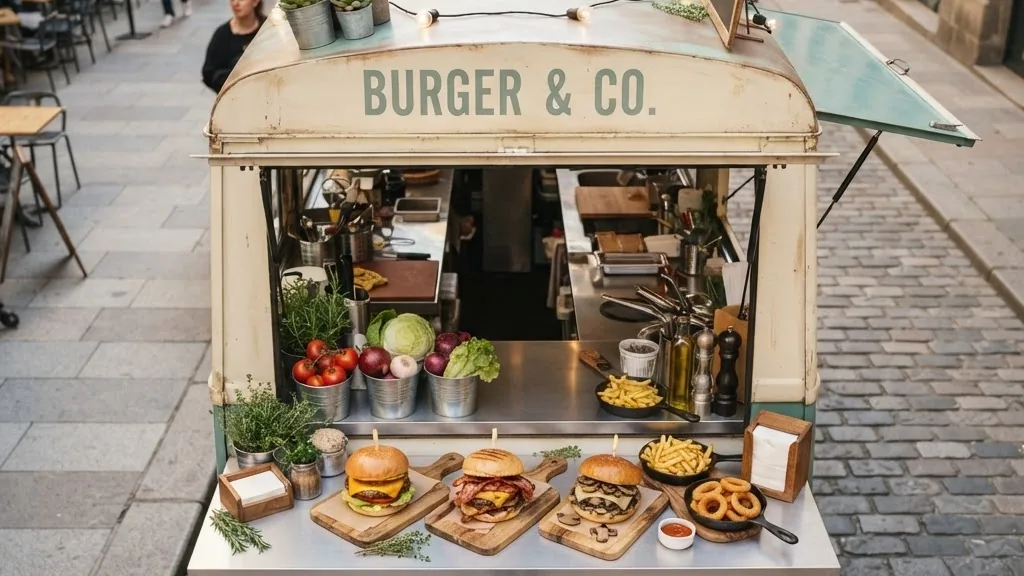
Burger truck economics beat almost every other food-service format, and the numbers back it up. IBISWorld puts food truck margins around 6.8 percent against 1 to 3 percent for traditional restaurants, and the best burger operations clear roughly $500,000 a year out of a kitchen smaller than most restaurant walk-ins. The catch is that most guides teach the business and skip the food, or teach the food and skip the health inspector. This one covers the griddle, the permits and the spreadsheet, in the order they tend to sink new operators, using sourced figures from IBISWorld, the United States Department of Agriculture and the National Fire Protection Association.
Quick answer: A burger truck costs $50,000 to $200,000 or more to launch, runs $5,000 to $10,000 a month to operate, and averages about $346,000 in annual revenue at a 6.8 percent margin. The food side is a solved problem: 80/20 chuck in 2 to 4 oz balls, smashed once within 30 seconds on a 400 to 450 F griddle, cooked to an internal 160 F. The compliance side is not optional: a mobile vendor permit, a health inspection built on the FDA Food Code, NFPA 96 fire suppression, NFPA 58 propane rules and a commissary agreement near $400 a month, all before your first service.
What a burger truck really costs to launch
Expect $50,000 to $200,000 or more to put a burger rig on the road, against $250,000 to $500,000 and up for a brick-and-mortar restaurant. A used truck alone runs $30,000 to $100,000 depending on age, mileage and the state of the kitchen build-out. Sources disagree on the ceiling, and it matters: foodtruckprofit.com quotes $50,000 to $100,000 in its summary and $50,000 to $200,000 plus in its detailed figures, so plan against the wider range and treat the low number as a best case for a used trailer with equipment already installed. The pattern repeats across concepts, which is why the budget in what a hot dog truck really costs reads so much like a burger budget. The vehicle and the code-compliant kitchen dominate. The menu barely moves the total.
Where the money actually goes:
- The vehicle. Used step vans and trailers sit in that $30,000 to $100,000 band. New builds push you toward the top of the $200,000-plus range, and zacsburgers.com makes the fair point that renting first is a legitimate way to test a concept before committing.
- Kitchen equipment. Flat-top griddle, refrigeration, fryer, generator, water tanks, ventilation hood and fire suppression. This is the part buyers underestimate on used trucks, because a cheap rig with a dead hood system is not a cheap rig.
- Wrap and branding. The truck is the billboard. A forgettable wrap wastes the single biggest marketing asset you own.
- Permits, licensing and inspections, covered in detail below because they deserve their own section.
- Working capital. Zacsburgers.com pegs commissary fees around $400 a month and a starting inventory float above $1,000, and those bills arrive whether or not you sold a single patty.
Then come the recurring costs. Plan on $5,000 to $10,000 a month for fuel, propane, insurance, ingredients, commissary rent and maintenance. Labor runs $16 to 20 per hour per person, and a two-person window during a lunch rush is the realistic minimum for burgers, since one cook cannot smash, flip, dress and take payment at volume.
Financing options are better than most first-timers assume. The Small Business Administration backs loans that fit this purchase size, and SCORE, an SBA partner network, offers free mentoring that is genuinely useful for a first business plan. Equipment financing covers the griddle and refrigeration line, and crowdfunding has funded plenty of trucks in towns where the concept has a built-in audience. Whichever route you take, the business plan comes first: local competition, demographics, price sensitivity, and a hard look at whether your city already has three smash concepts parked downtown.
Smash technique built for a service window
Truck-style smash burgers start with 80/20 chuck portioned into loose 2 to 4 oz balls, smashed hard within the first 30 seconds on a 400 to 450 F griddle, once and only once, down to about a quarter inch. That first half minute is the whole trick: the fat has not rendered yet, so pressing the ball flat maximizes contact with the steel without squeezing out juice. The patty then rides untouched for roughly 2 minutes on the first side, gets scraped up with a stiff spatula rather than pried, and finishes 30 to 60 seconds after the flip. Press it again mid-cook and you undo everything, because at that point the juices are mobile and the griddle drinks them. One smash. A scrape, not a lift. A short second side. That is the entire technique, and it scales beautifully.
Why 400 to 450 F is the whole game
The Maillard reaction, the browning chemistry that builds a crust, starts around 320 F. A griddle held at 400 to 450 F gives you enough headroom that the surface stays above that threshold even when a rail of cold beef lands on it. Run cooler and the patty steams gray. Run hotter and the crust turns bitter before the center is safe.
Thin patties also change the geometry of flavor. A quarter-inch smash patty is nearly all crust-to-meat ratio, which is why a 3 oz smash can out-eat a 6 oz pub patty. On a truck, thin also means fast, and fast means shorter ticket times, which is the difference between a line that grows and a line that gives up.
The 160 F rule has no exceptions
The USDA’s Food Safety and Inspection Service (FSIS) sets 160 F (71 C) as the minimum internal temperature for ground beef, and the reasoning is mechanical, not bureaucratic. Grinding takes bacteria that live on the surface of a whole cut and distributes them through the entire patty. A rare steak is seared on the outside where the bacteria were. A rare burger is raw in the middle where the bacteria now are. The Centers for Disease Control and Prevention (CDC) tracks foodborne illness in the United States, and E. coli outbreaks tied to undercooked ground beef are a recurring entry in that data.
So there is no medium-rare on a truck. Use a fast probe thermometer, keep raw and cooked tools separated, and hold your cold line cold. Thin patties make compliance almost automatic: a quarter-inch patty at these griddle temps blows past 160 F in its normal cook time.
A menu the truck can actually execute
Keep the board short. A focused menu means fewer SKUs, faster prep, bulk buying power on 80/20 chuck, and an assembly line that a new hire can learn in a shift. The elements that separate a good truck menu from a copy-paste one:
- One signature sauce. It is the cheapest differentiation available and the thing customers name when they recommend you.
- Buns that survive transport. Potato rolls and brioche both hold structure and take steam well; flimsy buns collapse in a paper wrap.
- Toppings that hold. Shredded lettuce weeps, whole leaves do not. Pickles, grilled onions and American cheese are truck-proof.
- One plant-based option. It removes the veto vote in a group of five office workers, which is often the entire lunch order.
- Local beef if your market rewards it. Sourcing is a story, and stories sell at a window.
Prep is where speed of service is won or lost. Balls portioned and chilled before service, sauce in squeeze bottles, cheese unwrapped, buns staged. During the rush, nobody portions anything.
Permits, inspections and the compliance bill
Every mobile food unit in the United States answers to a local or county health department, and most of those departments write their rules from the FDA Food Code, the federal model regulation that states and counties adopt for retail food service. On top of health rules sit fire rules: NFPA 96 governs ventilation hoods and fire suppression over cooking equipment, and NFPA 58 governs propane storage and LP-gas systems, which matters because a burger griddle usually runs on propane a few feet from a fryer. Add a business license, a mobile food vendor permit, food handler or food manager certification, a fire inspection, parking and zoning restrictions, and a signed commissary agreement, and the paperwork stack becomes its own project. None of it is optional, and the sequence matters, because inspectors will not schedule a truck that has no commissary lined up.
What each authority actually governs, in practice:
- Your local or county health department issues the mobile vendor permit and inspects the truck. Rules vary sharply by jurisdiction, a problem the U.S. Chamber of Commerce Foundation documented city by city in its Food Truck Nation report on regulatory burden.
- The FDA maintains the Food Code those departments build on; its food regulation hub lives at the FDA food safety and regulation section.
- FSIS, the USDA’s inspection arm, sets the 160 F ground beef standard; its guidance is published at the Food Safety and Inspection Service site.
- The CDC supplies the illness data behind those rules, and FoodSafety.gov consolidates federal guidance in one place, useful for staff training.
- NFPA standards drive your hood, suppression and propane inspections. Budget for suppression service contracts, not just installation.
Exact permit fees vary too much by city to quote honestly. The one compliance cost you can pencil in everywhere is the commissary, around $400 a month, because almost no jurisdiction lets a truck prep, wash and dump gray water on its own.
Margin math on a $346,000 year
The average food truck grosses about $346,000 a year, and IBISWorld’s 2024 figures put margins near 6.8 percent, which works out to roughly $23,500 of profit on that average year. Traditional restaurants keep 1 to 3 percent on far larger fixed costs, and that spread is the entire financial argument for wheels over walls. Top burger trucks push revenue toward $500,000 a year, and they get there less by raising prices than by stacking revenue streams: daily street service as the base, festivals and events for volume spikes, corporate catering for guaranteed minimums, and food truck parks for predictable foot traffic. Run the cost side against it and the picture stays coherent: $5,000 to $10,000 a month in operating costs is $60,000 to $120,000 a year that revenue has to clear before labor and debt service see a dime.
Catering deserves special attention because it inverts the risk. Street service means guessing demand and eating waste. A catering contract means a known head count, a deposit, and prep scaled to the order. Weddings alone can anchor a shoulder season.
The same stream-stacking logic holds outside burgers. Sweet concepts run the identical playbook with different margins on ingredients, and the breakdown in what dessert food trucks cost and earn makes a useful comparison point when you are deciding which concept fits your market.
Two levers move the profit line more than anything else: food cost percentage, controlled by bulk buying and a short menu, and labor at $16 to 20 per hour, controlled by prep systems that let two people run a rush that would otherwise need three.
Equipment that earns its footprint
A burger build lives and dies on six systems: the flat-top griddle that holds 400 to 450 F under load, refrigeration sized for a full day of patties and toppings, a fryer if the menu includes fries, water tanks sized to your health code, a hood and suppression package that passes NFPA 96, and the generator feeding all of it. Every one of these competes for the same few square feet and the same amps, so the build is a budgeting exercise before it is a cooking one. Griddle recovery time is the spec that matters most for burgers: a thin steel top that drops 80 F when the rail hits it will bottleneck every rush, no matter how fast the crew moves.
The generator is the system people size wrong most often, because refrigeration, griddle igniters, POS and lighting all draw at once. The math on watts, fuel burn and noise limits is worked through in sizing a food truck generator properly, and it is worth reading before you buy a truck, not after.
On the front of house, the tech stack is short and cheap relative to the kitchen: a POS that handles tap payment, QR menus for the line, mobile ordering if your market supports it, and GPS-driven location updates on social media. That last one is not decoration. Around 50 percent of customers discover trucks through social channels.
Market numbers worth knowing in 2025
IBISWorld sizes the US food truck market at $2.8 billion in 2025, with revenue growing at a 13.2 percent compound annual rate from 2020 to 2025. The business count sits at 92,257 trucks, up 16.9 percent over 2024, after growing roughly 23.8 percent per year across the same five-year stretch. Globally, estimates land between $4.9 and 5.4 billion for 2024, with projected growth of 6.3 to 6.7 percent annually through 2030 to 2033, a range across studies rather than a single verified figure. The customer base skews young: 25 to 44 year-olds account for 38.3 percent of food truck spending. Read those numbers both ways. Demand is real and growing, and so is the count of trucks competing for the same curb.
FAQ
How much does it cost to start a burger food truck?
Plan on $50,000 to $200,000 or more, depending on whether you buy used or build new. A used truck alone runs $30,000 to $100,000. Add equipment, permits, a wrap, a commissary deposit and working capital, then budget $5,000 to $10,000 a month in operating costs once you are rolling.
What internal temperature do burgers need on a truck?
Ground beef must reach 160 F (71 C) internally, per USDA FSIS. Grinding spreads surface bacteria through the whole patty, so there is no safe medium-rare the way there is with steak. Use a fast probe thermometer during service; quarter-inch smash patties on a 400 to 450 F griddle clear the threshold in their normal cook time.
Do I really need a commissary agreement?
In almost every US jurisdiction, yes. Health departments require a licensed commercial kitchen for prep, dishwashing, gray water disposal and overnight parking, and they typically will not schedule your truck inspection without a signed agreement. Budget around $400 a month for commissary fees, and treat it as a fixed cost from day one, not an extra.
Why do smash patties beat thick patties on a truck?
Speed and crust. A 2 to 4 oz ball smashed to a quarter inch cooks in about 2 minutes on the first side plus 30 to 60 seconds after the flip, and its high crust-to-meat ratio delivers more Maillard flavor per ounce. Thick patties cook slower, temp less predictably and stall the line during a rush.
How much do food truck owners actually make?
The average truck grosses about $346,000 a year at roughly a 6.8 percent margin, around $23,500 in profit using IBISWorld’s figures, while top burger trucks reach about $500,000 in revenue. The spread comes from stacking street service with festivals, corporate catering and food truck parks, and from keeping food and labor costs disciplined.
Which permits should I line up first?
Start with the commissary agreement and your local health department, since the mobile vendor permit and truck inspection hinge on both. Then handle food manager certification, the business license, and the fire side: NFPA 96 hood and suppression plus NFPA 58 propane compliance. Parking and zoning rules come last but decide where you can actually sell.
Where to go from here
Order the work the way inspectors and customers will: technique first, because a mediocre smash burger cannot be marketed out of trouble; compliance second, because the health department decides whether you open at all; money last, because the margin math only works once the first two are solid. Talk to operators in your market before you sign anything, run the SBA and SCORE resources for the plan, and check the IBISWorld figures against the original reports before you build a pitch on them. And if catering is part of the model from day one, the vendor-side details in booking a food truck for wedding receptions show what that revenue stream demands in practice.