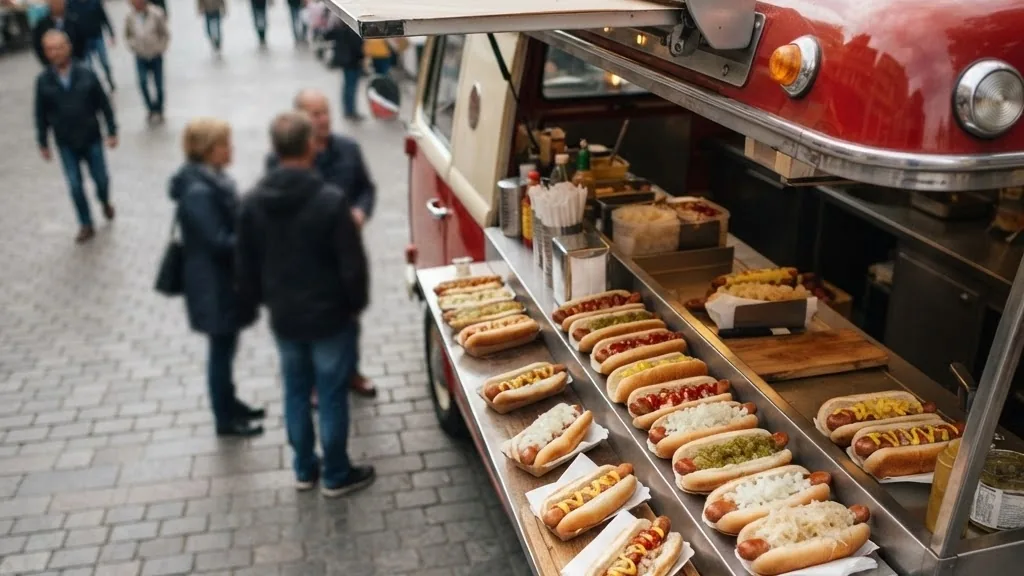
Hot dog truck money is the best-kept secret on the street, and I say that after eight years running trucks and carts out of Austin. When people ask me the cheapest honest way into mobile food, I never say tacos and I never say barbecue. I say a cart or a small dog rig, because nothing else lets you get legal, buy gear, stock a cooler, and start ringing sales for the price of a used sedan. The food is cheap, the ticket times are fast, and the margins are the fattest on any menu I have ever run. Let me walk you through the real numbers before you spend a dollar.
Here is the short version. A hot dog cart gets you fully set up for roughly $8,000-$21,000, and you can go used and lean for around $5,000. A full truck runs $75,000-$250,000, so the cart is where almost everyone should start. Your food cost on a dog sits at 25%-30% of the price, which leaves a gross margin of 65%-70%, better than burgers, better than barbecue, better than anything with a protein that spoils fast. A well-placed cart nets $100-$300 a day, and a good weekend spot can push $500-$1,000 in sales. Low money in, high margin out. That is the whole pitch.
I checked every price against what I am paying right now, not what some old guide claims from three years back.
What a hot dog truck really costs to start
Start with the cart, because that is the number that surprises people in a good way. A brand-new hot dog cart with warranty and shipping runs about $4,299-$10,000, and a basic new unit lands closer to $2,500-$4,300. Add product, permits, utensils, and a little cushion, and your all-in startup lands at $8,000-$21,000. Go used and you can find a running cart for as low as $2,000, which is how a lot of operators I know got their first corner without a loan, and that matches what I learned from my 8 years buying both new and used gear for my own carts and trucks.
Now compare that to a full rig. A food truck startup runs $75,000-$250,000 new, and even a used truck sits at $30,000-$70,000 before you wrap it or fix the generator. So when someone says they want a hot dog truck on day one, I ask why. The dog menu needs a corner, a permit, and gear that holds temperature, not a truck. Scale up once the corner proves itself. I ran a cart for two seasons before I built my first truck, and that cart paid for it without a loan. For a fuller breakdown of rig pricing across concepts, I keep a running guide on real food truck startup costs that lays out every line item.
The reason dogs win on startup is inventory. A brisket program ties up cash in meat that spoils and takes fourteen hours to cook. Franks, buns, and canned toppings hold for days, freeze well, and cost pennies per serving. You are not gambling on prep. You buy what you can sell, and what you do not sell today still sells tomorrow. According to the SBA, low-inventory food concepts are friendlier for first-time owners than anything that spoils fast, and you can read their startup guidance at the SBA before you write a business plan.
Cart vs truck: which entry point actually fits you
The honest answer is that most people should start with a cart and graduate to a truck only when demand outruns the cart. A cart is cheaper, easier to permit in many cities, and it parks where a truck cannot. A truck gives you cover from weather, more cooking surface, and a bigger menu, but it also brings a generator, a bigger insurance bill, and a health inspection with more boxes to check. Match the rig to your corner, not to your ego, since in my experience the cart-first path is what keeps a new owner out of debt long enough to find out whether the corner even works.
Here is how I lay the decision out for people who call me about it. If your best spot is a farmers market, a ballpark gate, or a bar district at close, a cart wins because it is nimble and cheap to insure. If you are chasing weekday office lunch rushes, catering gigs, and forty-plus covers in twenty minutes, the truck earns its keep. Neither is wrong. The mistake is buying a truck to sell a five-item dog menu you could have run off a cart for a fifth of the money. I have seen this exact mistake sink an otherwise solid operator before their first season even ended.
| Factor | Hot dog cart | Hot dog truck |
|---|---|---|
| Startup cost | $8,000-$21,000 | $75,000-$250,000 (used $30,000-$70,000) |
| Insurance / year | $600-$1,200 | $2,000-$4,000+ |
| Menu size | 4-8 items | 10-15 items |
| Best for | Markets, events, bar close, single corner | Office lunch rush, catering, high volume |
| Setup time on site | 15-20 minutes | 30-45 minutes |
| Power needed | Propane + small 2.2 kW generator | Onboard generator 3.5-7 kW |
Tip: Before you buy anything, drive your target corners at the exact hours you plan to sell. Count the foot traffic yourself for a week. The cart or truck is the easy part. Location is the whole business, and no rig fixes a dead corner.
The equipment that survives a Saturday rush
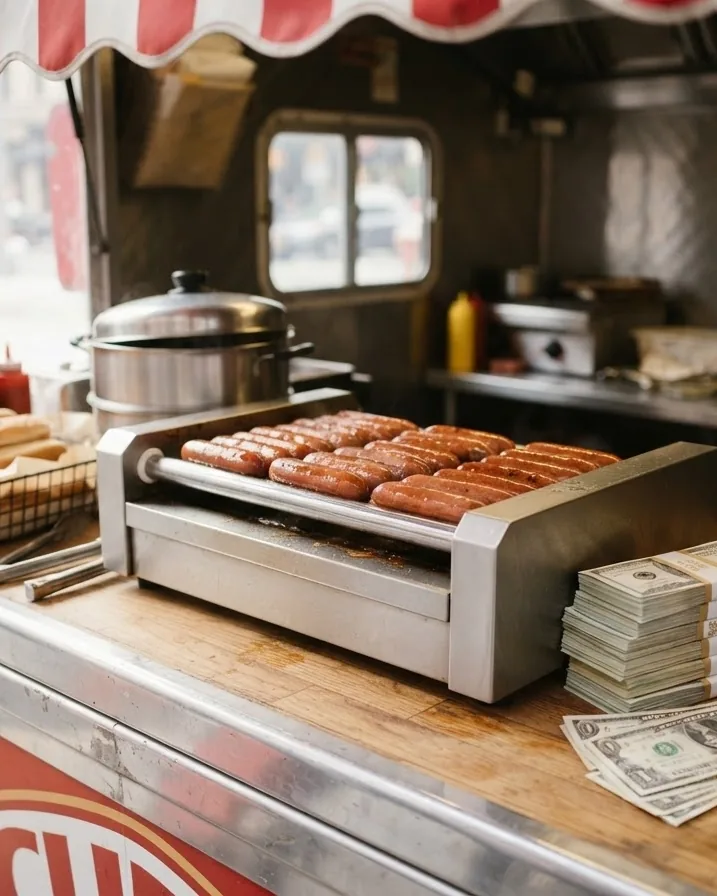
You need less than you think, but what you buy has to hold temperature through a four-hour rush without quitting. The core of a dog program is a way to cook and a way to hold, and you can do both cheaply. Having spent six seasons at the window running nothing but a steamer and a griddle, I can tell you a steamer runs $100-$500 and keeps franks and buns moist, which is why old-school New York vendors swear by it. A roller grill runs $150-$800, cooks evenly, and sells for you because customers see the dogs turning. A flat-top griddle runs $200-$1,000 and gives you a bacon-wrapped Sonoran and grilled onions that a steamer cannot touch.
The overlooked detail here is generator wattage, not the cook surface. A 120V roller grill commonly pulls about 1,050-1,650 watts, so a small inverter generator eats most of its 2.2 kW right there. A propane flat-top burner runs roughly 30,000 BTU, plenty for a cart but thirsty for fuel, so carry a spare 20-pound tank. My generator quit on me mid-rush at a Saturday market my first summer, so I learned to run the grill on propane and save the generator for lights and the card reader. Redundancy is not paranoia when a dead grill means forty people walking away.
Round out the kit with a bun warmer at $50-$300, two or three coolers at $50-$300 each, and propane tanks at $50-$100 apiece. That is the whole cook line. Compare that to the fryers, hoods, and refrigeration a burger truck needs and you see why dogs win on both startup and repair bills. If you are weighing a dog rig against a griddle concept, I break down the tradeoffs in my guide to running a burger food truck, and the gear gap is stark. On propane storage, according to NFPA guidance on portable cylinders, you keep spares upright, outside the cook line, and away from open flame, which is a five-minute habit that keeps your insurance valid.
Here is the core gear list I hand to anyone building their first cook line from scratch:
- Steamer or roller grill for the main cook, $100-$800
- Flat-top griddle for bacon-wrapped or grilled builds, $200-$1,000
- Bun warmer, $50-$300
- Two or three coolers, $50-$300 each
- Small inverter generator plus a spare propane tank, $50-$100 per tank
Warning: Do not cheap out on holding temperature. Health inspectors check that hot food stays at or above 135 F, and a bargain steamer that cannot hold that on a windy day is how you fail an inspection or, worse, make someone sick. Buy the holding gear new.
The signature menu that sells regional dogs
A dog menu is not one item. It is a short list of regional builds that give people a reason to choose you over the gas-station roller. Five or six tight options outsell twelve sloppy ones every time, and the trap I see is new operators loading the board with ten builds instead of anchoring on two or three regional stars that sell themselves. Pick two or three regional dogs to anchor the board, price them well, and let the toppings do the marketing. Here is the lineup I would build around.
The Chicago dog is the workhorse. All-beef frank on a poppy-seed bun, yellow mustard, sweet green relish, chopped white onion, tomato slices, a dill pickle spear, sport peppers, and a dusting of celery salt. No ketchup, ever, or the Chicago folks will let you hear about it. It looks loaded, photographs well for your social feed, and the toppings cost almost nothing per serving while letting you charge a premium.
The New York dog keeps it fast and simple. An all-beef frank cooked in water, spicy brown mustard, sauerkraut, and a warm onion sauce made from slow-cooked onions with a little tomato and spice. It is built for eating on the move, which makes it perfect for a bar-close crowd that wants one bite and gone. Fast to assemble means faster ticket times, and faster tickets mean more sales per hour.
The Sonoran dog is my catering money-maker. It came out of Hermosillo, Mexico in the 1980s, and it is a bacon-wrapped frank on a bolillo roll loaded with hot pinto beans, grilled and raw onion, diced tomato, mustard, jalapeno salsa, and a stripe of mayo or crema. It needs a flat-top for the bacon, it takes longer, and people happily pay more for it. Round the board out with a chili dog, which is nothing but a beef chili, mustard, and onion build, plus a slaw dog for the Carolina crowd if your region leans that way. For the full concept build-out with pricing psychology, my food truck menu strategy post goes deeper than I can here.
The food-cost math nobody shows you
This is where dogs quietly beat every other concept. Here is what most guides get wrong: they quote food cost off the sticker price and ignore labor and waste. Your target is a food cost of 25%-30% of the selling price, and dogs hit it easily. Say a Chicago dog costs you about $1.10 in frank, bun, and toppings and you sell it for $5. That is a 22% food cost and a $3.90 gross before labor and overhead. The general food-service target is 28%-35%, so a dog program that runs 22%-28% is already ahead of the pack. That gap is the whole reason I still run dogs alongside my truck menu.
Turn that into a gross margin and you are living at 65%-70%, with a net profit margin that lands somewhere in the 50%-70% range once you back out fuel, permits, and your own time. One vendor breakdown I trust shows an average profit of about $2.75 per sale at 85 sales a day, which pencils out to roughly $60,000 a year on a five-day week from a single cart. That is not a truck, a crew, or a loan. That is one person and a corner.
Now scale the day. A well-placed cart nets $100-$300 after expenses on a normal day. I shoot for $300-$500 in sales on weekdays and $500-$1,000 on weekends at the right event. Annual take runs $20,000-$50,000 for a part-time or single-corner operator, and prime locations with steady events push past $100,000. The lever is not the recipe. It is volume times margin times days worked, and dogs give you the best margin to multiply. Underpricing is the silent killer here. I sold my plates too cheap for a month my first summer because I was scared of the tag, and I left real money on the table until I sat down and did this exact math.
Price with a little psychology. A combo of dog, chips, and a drink at a clean round number moves more units than three separate prices, and it lifts your average ticket without feeling greedy. If you want a deeper menu-engineering playbook and a few more concepts to test, my running list of food truck ideas that make money covers how margin should drive every board you build. On survival odds alone, according to SBA data on first-year closures, thin-margin concepts fail fastest, which is exactly why I steer new operators toward the highest-margin menu on the street. I have seen operators skip this pricing step entirely and wonder why their margin never matches the math.
Permits, health inspection, and insurance reality
Nothing kills a launch faster than skipping the paperwork, so treat this like part of the cook. Permits vary wildly by city, but plan on $100-$500 at the low end and up to $500-$3,000 a year once you add a mobile food permit, a commissary agreement, and event fees. Insurance for a cart runs about $600-$1,200 a year, and a truck runs several times that, and in my experience the insurance quote always comes back higher than a new operator expects, so get it before you fall in love with a specific truck or cart. These are not optional. An event will ask for your certificate of insurance before they let you park.
Health rules are set locally, and you follow the department that has jurisdiction over your corner. I am in Texas, so I work under the Texas Department of State Health Services mobile food unit rules, and according to Texas DSHS, you can start at the Texas DSHS site if you are here, or your own county health department if you are not. Almost every jurisdiction requires a commissary, a licensed base kitchen where you prep, store, and clean, because a cart is not allowed to be your only food-handling space. Do not build your business plan until you have called your health department and asked what they require, because a rule in Austin is not the rule in Denver.
Here is the order I tell new operators to follow, step by step:
- Step 1 – Call your city and county health department and ask exactly what a mobile food unit needs in your area.
- Step 2 – Line up a commissary agreement before you buy any gear, since most permits require proof of one.
- Step 3 – Apply for your mobile food permit and any event or zoning permits your corner requires.
- Step 4 – Get insurance quotes and lock in a policy that covers a parked food business, not just a vehicle.
- Step 5 – Buy your cook gear only after the paperwork is moving, so you are not sitting on cash tied up in equipment you cannot legally use yet.
For the trade side of the paperwork and the advocacy that keeps mobile vendors legal, the National Food Truck Association is worth knowing. You can find them at the National Food Truck Association, and they track the permit and zoning fights that decide where you are allowed to park. None of this is legal advice, and I am an operator, not a lawyer, so confirm every permit fact with your own city and county before you spend.
Mistakes I made my first summer
I underpriced my dogs for a solid month because I thought a $5 tag would scare people off. It did not, since the pattern I see with almost every new operator is the same: they price scared for the first month and leave real margin sitting on the table. Foot traffic bought the same volume at $6 that they bought at $4.50, and that dollar was pure margin I threw away. Charge what the build is worth, especially on a loaded regional dog that took real toppings and a flat-top to make.
I also bought too much cook gear too early. I had a roller grill, a flat-top, and a steamer running on day one, and I spent the whole rush babysitting three surfaces alone. Start with a steamer and one cook surface, learn your volume, and add gear when a specific dog demands it. And I ran everything off one undersized generator until it quit on me mid-service. Split your power, carry propane backup, and never let one dead machine end your day. Those three lessons cost me a season. From my years on the truck since, I have never let a new hire skip them either. They do not have to cost you one.
Frequently asked questions
Is a hot dog cart or a hot dog truck cheaper to start?
A cart is far cheaper. A full setup runs $8,000-$21,000, and a used cart can start near $2,000. A truck runs $75,000-$250,000 new, or $30,000-$70,000 used. Almost everyone should start with the cart, prove the corner, and only move up to a truck once demand and catering gigs outgrow what the cart can serve in a rush.
What profit margin can a hot dog business make?
Food cost on a dog sits at 25%-30% of the price, which leaves a gross margin of 65%-70% and a net profit margin around 50%-70% after fuel, permits, and time. That beats burgers and barbecue because franks and toppings are cheap and shelf-stable. A single well-placed cart nets $100-$300 a day, and prime-location operators clear past $100,000 a year.
What equipment do I need to start selling dogs?
At minimum, a way to cook and a way to hold. A steamer runs $100-$500, a roller grill $150-$800, and a flat-top griddle $200-$1,000. Add a bun warmer at $50-$300, two or three coolers, and propane tanks at $50-$100 each. Start with a steamer and one cook surface, then add gear only when a specific menu item requires it.
Do I need a permit and a commissary for a hot dog cart?
Yes, in almost every city. Plan on $100-$3,000 a year for permits and event fees, plus $600-$1,200 for insurance. Most health departments also require a commissary, a licensed base kitchen for prep and storage. Rules are local, so call your county or city health department before you buy anything, because requirements differ from one jurisdiction to the next.
Which regional dogs should go on my menu?
Keep it to five or six. Anchor with a Chicago dog for the loaded look, a New York dog for fast tickets, and a Sonoran dog as your bacon-wrapped premium item for catering. Add a chili dog and a slaw dog if your region leans that way. Short menus with strong regional builds outsell long, sloppy boards and keep your food cost tight.
How many dogs do I need to sell to make money?
At an average profit near $2.75 per sale, about 85 sales a day pencils out to roughly $60,000 a year on a five-day week. Weekday sales targets of $300-$500 and weekend targets of $500-$1,000 are realistic in a good spot. Volume times margin times days worked is the whole formula, so location and hours matter more than the recipe.
The bottom line
A hot dog truck is a dream you can grow into, but a cart is the smart way to buy the ticket. For $8,000-$21,000 you get legal, you get gear that survives a rush, and you get the highest-margin menu on the street. Do the food-cost math, price your loaded dogs like they are worth it, call your health department before you spend, and put your rig where the feet already are. Start small, prove the corner, and let the margins do the rest. I have helped several first-time owners run this exact math before they signed a lease, and the ones who listened skipped my worst mistakes. That is how I did it, and it still works.