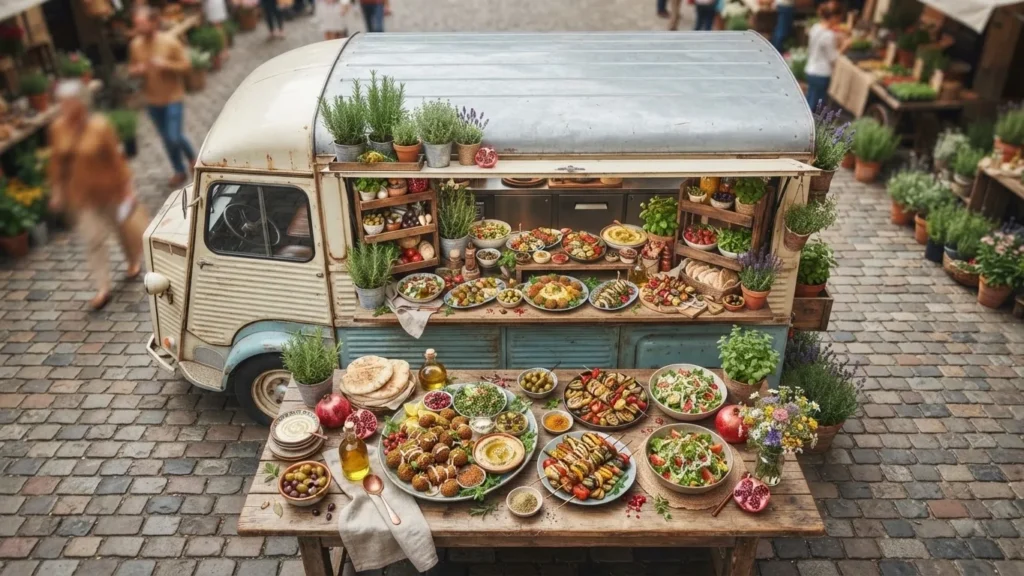
Mediterranean food truck money lives or dies on two decisions you make before you ever open the window: what goes on the menu, and whether the vertical broiler earns its spot. After eight years running trucks in Austin, I still remember the first summer I chased a Med concept: I underpriced my bowls for a solid month before I sat down and did the food-cost math. That mistake cost me real money. This guide is the version of that math I wish someone had handed me, plus the gear, sourcing, and permit reality nobody puts on the pretty listing pages.
I am not going to sell you a dream here. A Mediterranean truck is one of the better concepts you can run because the ingredients are cheap, the food photographs well, and customers already believe it is healthy. But that only works if you price it right and pick equipment that survives a Saturday rush. Let me walk you through it the way I would over a coffee at the commissary.
I refreshed the price ranges and equipment costs below to match what is showing up on my invoices this season.
Quick answer: A Mediterranean food truck sells gyros, shawarma, falafel, hummus, pita wraps, and build-your-own bowls at an average ticket of $13 to $18. Blended food cost runs 22 to 32 percent, with falafel and hummus down at 16 to 24 percent and lamb gyro up at 30 to 36 percent. Expect $50,000 to $160,000 to start, with most builds landing around $85,000 to $120,000. A full vertical broiler runs $3,500 to $8,000; a flat-top griddle runs $2,000 to $5,000. Sell 100 to 280 orders on a good day and the numbers work.
What a Mediterranean food truck actually sells
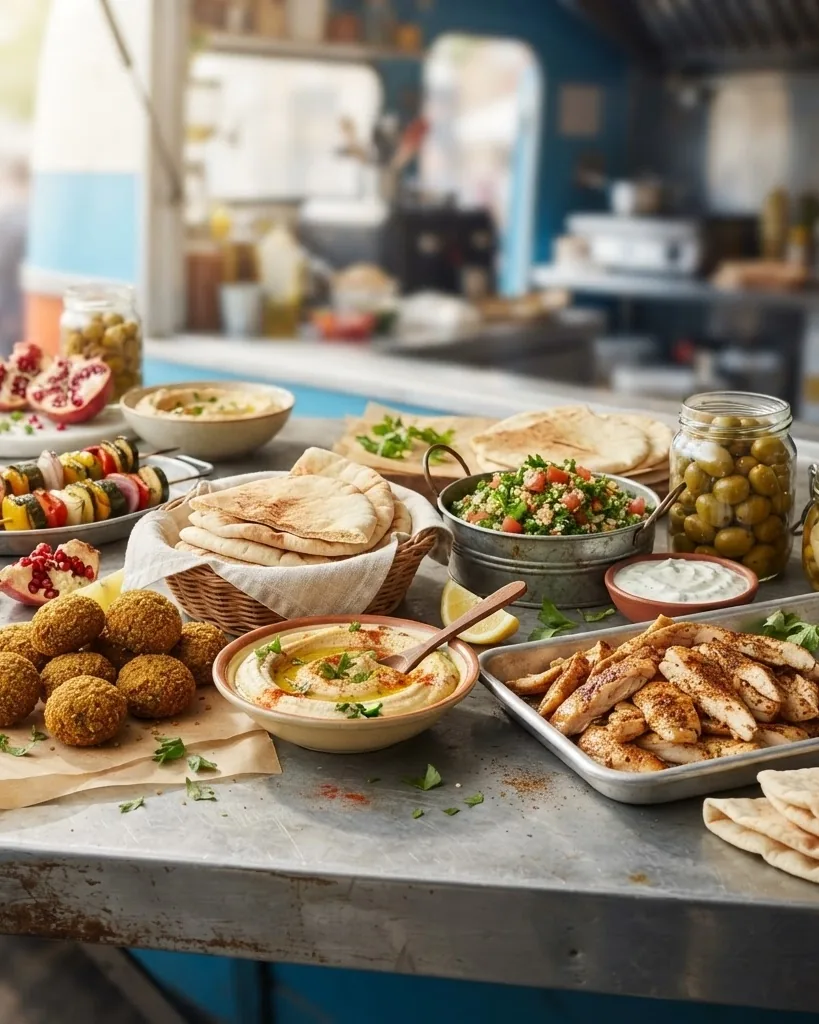
A Mediterranean truck is a broad umbrella menu built around grilled protein, legumes, olive oil, fresh vegetables, and warm pita. That breadth is the whole advantage. You can pull from Levantine, Greek, and Eastern Med traditions and still serve one coherent window. The core lineup almost every successful Med truck runs: shawarma, gyro, falafel, hummus, tabbouleh, a mezze plate, and a bowl format that lets people mix and match.
The bowl is your workhorse. Rice or greens as a base, one protein, three or four cold toppings, a sauce, and you have a $13 to $16 item that costs you very little to assemble. Falafel wraps run $10 to $13, a hummus bowl sits at $11 to $14, and a loaded lamb gyro can carry $13 to $16. Mint lemonade or a hibiscus cooler at $4 to $5 keeps beverage cost under 12 percent, which is the cheapest margin on the whole truck.
Here is the thing new operators miss: the menu should share components. Your falafel, your rice, your pickled onions, your tahini and garlic sauces, your pita, and your salad all show up across six or seven menu items. That means one prep list, low waste, and fast tickets. If you want a deeper look at how I structure a lineup that cross-uses prep, I broke it down in my guide to building a food truck menu. Tight component overlap is what keeps a small window moving 200 covers.
Mediterranean vs halal vs Greek: know the difference before you source
People use these three words like they mean the same thing. They do not, and the difference decides your sourcing and your signage. Get this wrong and you either mislead customers or you leave money on the table.
A Greek truck is regional and narrow: pork or chicken gyro, tzatziki, souvlaki skewers, Greek salad, maybe spanakopita. It is a subset of Mediterranean, not a synonym. If you plant a Greek flag, customers expect specific dishes and you lose the flexibility to run shawarma and falafel bowls.
Halal is not a cuisine at all. It is a sourcing and slaughter standard. A halal truck is defined by certified protein, not by a region, which is why halal-cart menus in a lot of cities look like chicken over rice with white sauce. You can absolutely run a Mediterranean menu and make it halal by certifying your supply chain, but that is a supplier decision and a certification cost, not a genre.
Mediterranean is the widest, most forgiving umbrella of the three. That is exactly why I recommend it for a first concept. You can run vegetarian-forward with falafel and hummus carrying most of your margin, layer a halal claim on top if your customer base wants it, and still serve a gyro that a Greek-food fan recognizes. If you are weighing this against other cuisines, my roundup of food truck concepts lays out how the margins compare across the board.
The equipment call: vertical broiler or flat-top?
This is the single most expensive concept decision on a Med truck, so slow down here. A vertical broiler (the rotating gyro and shawarma spit) is what makes the authentic shaved-cone look and flavor. But it is heavy, it is hungry, and it locks you into a format. Here is what most guides get wrong: they treat the broiler as your identity instead of an equipment decision, and that framing has cost more than one new operator a season of margin. You do not always need one.
A full-size vertical broiler costs $3,500 to $8,000 and draws 40,000 to 80,000 BTU per hour of propane. It adds 36 to 48 inches of height and 180 to 250 pounds to your build, which matters when your generator and your axle weight are already tight. A cone holds 80 to 120 pounds of stacked meat, and a 60-pound cone yields roughly 38 to 42 pounds of finished shaved protein once you account for trim and shrinkage. That yield number is the one you plan your day around.
The flat-top griddle is the flexible alternative at $2,000 to $5,000 for a 36 to 48 inch unit. You can griddle chicken shawarma strips, sear kafta, warm pita, and grill vegetables on the same surface. Plenty of high-volume Med trucks skip the broiler entirely, marinate and griddle their shawarma, and nobody complains. A countertop broiler at $1,200 to $1,800 splits the difference if you want the cone look without the full-size commitment.
Tip: If you are unsure, open on a flat-top for your first season and add the vertical broiler once you know your daily volume. A broiler cone you cannot sell through in a day is spoilage on a stick, and I have watched more than one new operator eat that loss.
| Equipment | Cost range | Output / spec | Best for |
|---|---|---|---|
| Full vertical broiler | $3,500-$8,000 | 40k-80k BTU/hr; 80-120 lb cone | High-volume authentic gyro/shawarma |
| Countertop broiler | $1,200-$1,800 | Smaller cone, lower BTU | Cone look on a lean build |
| Flat-top griddle (36-48 in) | $2,000-$5,000 | Multi-use searing surface | Flexible menu, first season |
| Deep fryer | $1,500-$4,500 | For falafel and fries | Any Med truck with falafel |
| Type I hood + suppression | $4,500-$9,500 | NFPA fire compliance | Required once you fry or broil |
One line item people forget: the moment you fry falafel or run a broiler, you need a Type I hood with fire suppression, which runs $4,500 to $9,500 and has to meet the fire standards your inspector enforces. The National Fire Protection Association publishes the suppression standards most jurisdictions adopt, and your local fire marshal will check the tag date. According to NFPA, suppression systems need periodic recertification, not just an install-and-forget tag, so budget for that inspection cycle too. Budget it from day one, because a truck that fails fire inspection does not open.
Menu, food cost, and pricing math that holds margin
Here is the money section, the one I got wrong my first month. Food cost is the percentage of an item’s menu price that goes to the ingredients in it. On a Mediterranean truck your blended food cost should land at 22 to 32 percent, which is genuinely good for street food. But that blend hides a wide spread, and menu engineering means pushing the cheap-to-make items.
Falafel and hummus sit at 16 to 24 percent food cost. Chickpeas, tahini, and spices are pennies per serving, so every falafel wrap and hummus bowl you sell is close to pure margin. Chicken shawarma runs 24 to 28 percent. Beef and lamb gyro climb to 30 to 36 percent because the protein itself is expensive. Lamb kafta can push 38 percent. The lesson: price your lamb items to carry that cost, and merchandise the falafel and bowls hard, because those are what keep your blended number healthy.
When I priced my first bowls, I set them by gut feel at what felt fair, and I was running a lamb bowl at close to 40 percent food cost without knowing it. The fix was simple once I saw it: raise the lamb items a dollar or two, add a premium-protein bowl at $15 to $18, and lean the specials board on falafel. Same customers, same window, and my blended food cost dropped back into the mid-twenties inside two weeks.
This is the exact process I run every time I add or re-price a menu item now:
- Step 1 – Cost every ingredient in the dish down to the ounce, including sauces, pickles, and garnish, not just the headline protein.
- Step 2 – Set a target food cost band by category, such as 16 to 24 percent for falafel and hummus and 30 to 36 percent for lamb gyro.
- Step 3 – Price the mid-tier bowl first, then anchor the wrap below it and the premium gyro above it.
- Step 4 – Run the math separately for a slow Tuesday and a packed Saturday, since waste eats margin harder on slow days.
- Step 5 – Revisit the whole board every quarter as protein and pita prices move.
Warning: Do not price your whole menu off your cheapest item. If your falafel wrap sets the customer’s price expectation at $11, your $16 lamb gyro feels expensive by comparison even though it is the one carrying your food cost. Anchor the board with a mid-priced bowl and let the wrap read as the value option.
Sourcing without blowing the number
Sourcing is where a Med truck quietly wins or loses. The ingredients are cheap in bulk, but the wrong supplier relationship eats your margin one delivery at a time. These are the numbers I work from, and they hold up across most US metros in 2026.
Pita is your volume item. Wholesale national-brand pita runs $0.30 to $0.55 each; a local Mediterranean bakery will charge $0.45 to $0.80 but the quality difference is real and customers notice. Tahini runs $14 to $22 a gallon, and a gallon goes a long way. Good olive oil is $28 to $45 per 3-liter tin, and you will use it on everything, so buy a grade you are proud of. Dry chickpeas are $25 to $40 per 25-pound bag, and soaking your own instead of buying canned is one of the biggest hidden margin wins on the truck.
Protein is your biggest line. Chicken thigh runs $2.20 to $3.50 per pound wholesale, or $2.60 to $4.30 if you go halal-certified. Ground and shoulder lamb runs $5 to $12 per pound, which is why your gyro carries the food cost it does. Having spent six seasons at the window, the overlooked detail in sourcing is never the unit price, it is the distributor’s minimum order size against your sell-through. Lock a standing order with one protein distributor and one produce supplier, price-check them quarterly, and never let a rep set your order size. Over-order lamb on a case deal and you are storing money in a cold well hoping it sells.
Startup cost, permits, and insurance reality
Total startup for a Mediterranean truck runs $50,000 to $160,000. A lean build on a used truck with a flat-top and a fryer can open near the bottom of that; a custom build with a full vertical broiler pushes the top. Most operators land at $85,000 to $120,000, and a brand-new, fully fitted truck from a specialty dealer averages around $109,500. Do not let a dealer talk you into more truck than your route can feed.
Permits are local, and they are not optional. You will need a mobile vendor license, which ranges wildly from $150 to $2,000 a year depending on your city, plus a commissary agreement at $600 to $2,000 a month for your legally required prep and water base. A certified food protection manager credential runs about $125, and food-handler cards for your crew are around $15 each. Every one of these is set by your city or county, so confirm the specifics with your local health department before you spend a dollar on the truck.
- Mobile vendor license: $150 to $2,000 a year, set by your city or county
- Commissary agreement: $600 to $2,000 a month for required prep and water access
- Certified food protection manager credential: about $125 per operator
- Food-handler cards: about $15 each for every crew member on the truck
The Small Business Administration has a solid plain-language walkthrough of business licensing and financing if you are starting from zero; read the SBA small-business resources before you sign anything. According to the SBA, most new food-truck financing problems trace back to owners underestimating permit and commissary costs before they ever sign a lease, and I have watched that exact mistake sink a friend’s first year.
Insurance is the cost new operators underestimate. A full food-truck policy runs $3,500 to $5,500 a year, with general liability alone averaging about $147 a month. Your menu drives the price: the fryer and the broiler raise your fire risk and your premium. Get quotes before you finalize equipment, because sometimes the cheaper broiler costs you more in insurance than the pricier one. For the regulatory and advocacy side, the National Food Truck Association is worth knowing; browse the National Food Truck Association resources, and always cross-check any rule against your own state health department because mobile-unit rules change by jurisdiction.
Mistakes I made running a Med concept
The underpricing I already confessed to was the expensive one, but it was not the only one. I built my first truck around a full vertical broiler because I thought I needed the authentic cone to be taken seriously. My daily volume that first season could not sell through a cone, so I was tossing product twice a week. I should have opened on the flat-top and earned the broiler with proven volume. That is the single most common Med-truck mistake I see, and it is a five-figure one.
My second mistake was menu sprawl. I opened with fourteen items because I wanted to show off. Fourteen items means fourteen prep lines, more waste, slower tickets, and a confused board. I cut it to eight, built everything around shared components, and my line got faster and my food cost dropped. A Mediterranean menu is supposed to be built from a small set of parts recombined, so lean into that instead of fighting it.
Third, I did not respect the generator load. A vertical broiler on propane plus a fryer plus a reach-in fridge plus lights and a point-of-sale is real draw, and I browned out mid-rush at a Saturday market because I had spec’d my generator for a simpler concept. Size your power for everything running at once, not for the quiet Tuesday. Every one of these mistakes was avoidable if I had done the math first, which is the whole reason I write this stuff down. If you are still choosing your concept, it is worth comparing the operation against a Mexican food truck build, since the equipment and margins run differently.
Frequently asked questions
Is a Mediterranean food truck profitable?
Yes, when the pricing is right. Blended food cost of 22 to 32 percent is strong for street food, and cheap-to-make falafel and hummus carry most of the margin. On a good day you move 100 to 280 orders at a $13 to $18 average ticket, so a lunch shift targeting $1,500 to $3,000 is realistic. The killers are underpricing lamb items and over-ordering perishable protein.
Do I need a vertical broiler to run a gyro menu?
No. A full vertical broiler at $3,500 to $8,000 gives the authentic shaved-cone look, but plenty of high-volume trucks marinate and griddle their shawarma on a flat-top instead. I recommend opening on a $2,000 to $5,000 flat-top your first season and adding the broiler only once your daily volume can sell through an 80 to 120 pound cone without waste.
What is the difference between a Mediterranean and a halal food truck?
Mediterranean is a regional cuisine umbrella covering Levantine, Greek, and Eastern Med dishes. Halal is a sourcing and slaughter standard, not a cuisine. You can run a Mediterranean menu and make it halal by certifying your protein supply, but the two words answer different questions: one is what you serve, the other is how the meat is sourced.
How much does it cost to start a Mediterranean food truck?
Plan on $50,000 to $160,000, with most builds at $85,000 to $120,000 and a new fully fitted truck averaging around $109,500. Add ongoing costs: a commissary at $600 to $2,000 a month, a mobile vendor license at $150 to $2,000 a year, and insurance at $3,500 to $5,500 a year. Confirm every permit figure with your local health department.
Which Mediterranean menu items have the best margins?
Falafel and hummus, at 16 to 24 percent food cost, are your margin champions because chickpeas and tahini cost pennies per serving. Chicken shawarma runs 24 to 28 percent. Beef and lamb gyro climb to 30 to 36 percent because the protein is expensive. Merchandise the falafel and bowls hard and price your lamb items to carry their cost.
Is Mediterranean food really a healthier truck concept?
It reads that way to customers, which supports a higher average ticket. The menu leans grilled protein, legumes, olive oil, vegetables, and whole-grain pita, and the bowl format lets people control portions. That said, you still fry falafel and fries, so it is not calorie-free. The health halo is a genuine marketing advantage, but do not oversell it.
The bottom line
A Mediterranean food truck is one of the smartest concepts you can open because the ingredients are cheap, the menu shares components, and customers walk up already believing it is good for them. But none of that saves you if you underprice your lamb or buy a broiler your volume cannot feed. Do the food-cost math before you set the board, open on a flat-top until you have earned the broiler, and keep the menu tight around shared parts. Get those three right and the window pays for itself. From my years on the truck, pricing discipline beats equipment every time. Get them wrong and you will spend a season learning the lessons I paid for the hard way.