Every listing you see for a pizza food truck for sale is really two decisions stacked on top of each other: what vehicle you are buying, and what oven is bolted inside it. After years running trucks and helping friends buy their first rigs, I can tell you the second decision is the one people get wrong. They fall for a clean paint job and a nice wrap, then find out the oven cannot hold temperature through a Saturday rush. This is the guide I give anyone about to wire money to a seller, built around the numbers I actually see on invoices this season.
The first pizza rig I looked at was a gorgeous used trailer with an imported brick oven, and I almost bought it on the spot. What stopped me was a boring hour with a flashlight checking the hood, the fire suppression tag, and the tongue weight against the tow rating. That hour saved me from a truck that would have failed its first health inspection. The buyers who win treat a pizza truck like a used commercial kitchen on wheels, not like a car.
Every price, oven spec, and permit range below is checked against live listings and what I am paying on my own paperwork this year.
Quick answer: A pizza food truck for sale generally lands in three buckets. A used, already-built pizza truck runs roughly $40,000-$80,000. A used concession trailer with an oven starts lower, about $20,000-$40,000. A new custom build climbs to $90,000-$175,000 depending on the oven and layout. The vehicle is 50-70 percent of your whole startup, so buy the oven and the mechanicals right and you win. Get a wood-fired or gas brick oven that holds heat, verify the fire suppression is current, and price your pies off a real food cost of 25-35 percent. Done well, a pizza truck is one of the fastest, highest-margin windows on the street.
What a pizza food truck for sale actually means
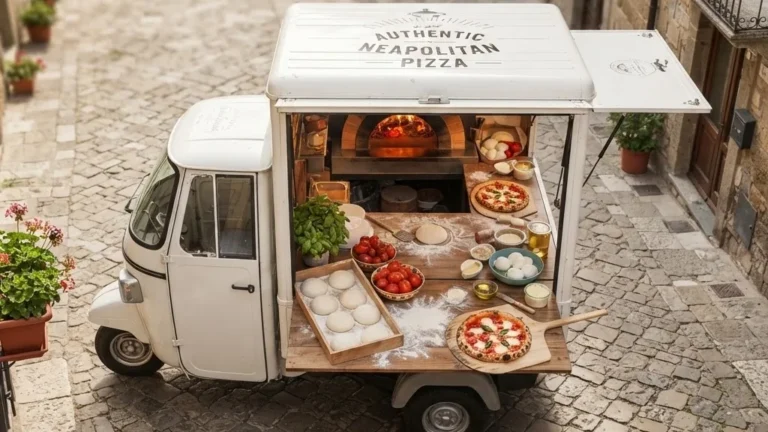
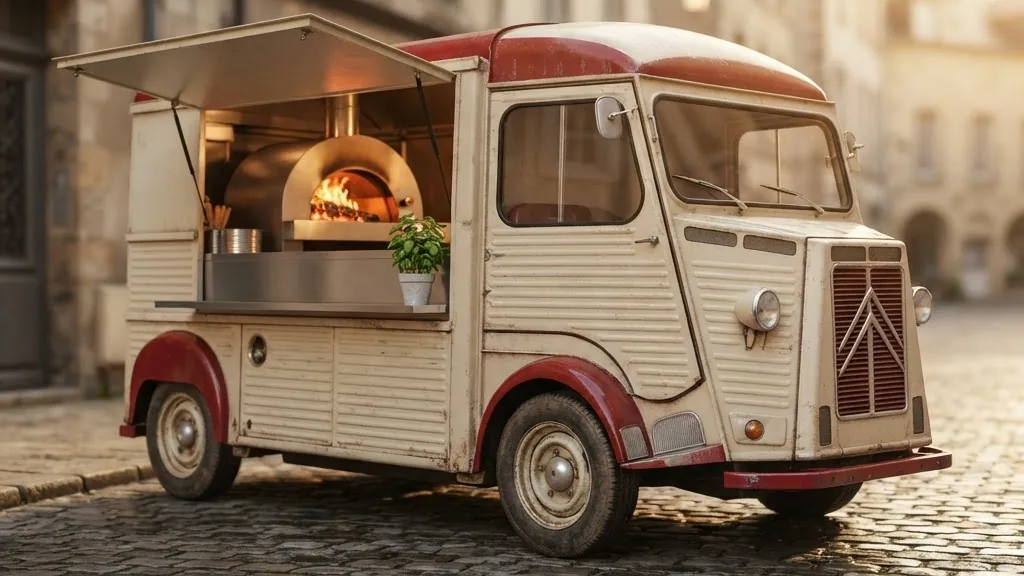
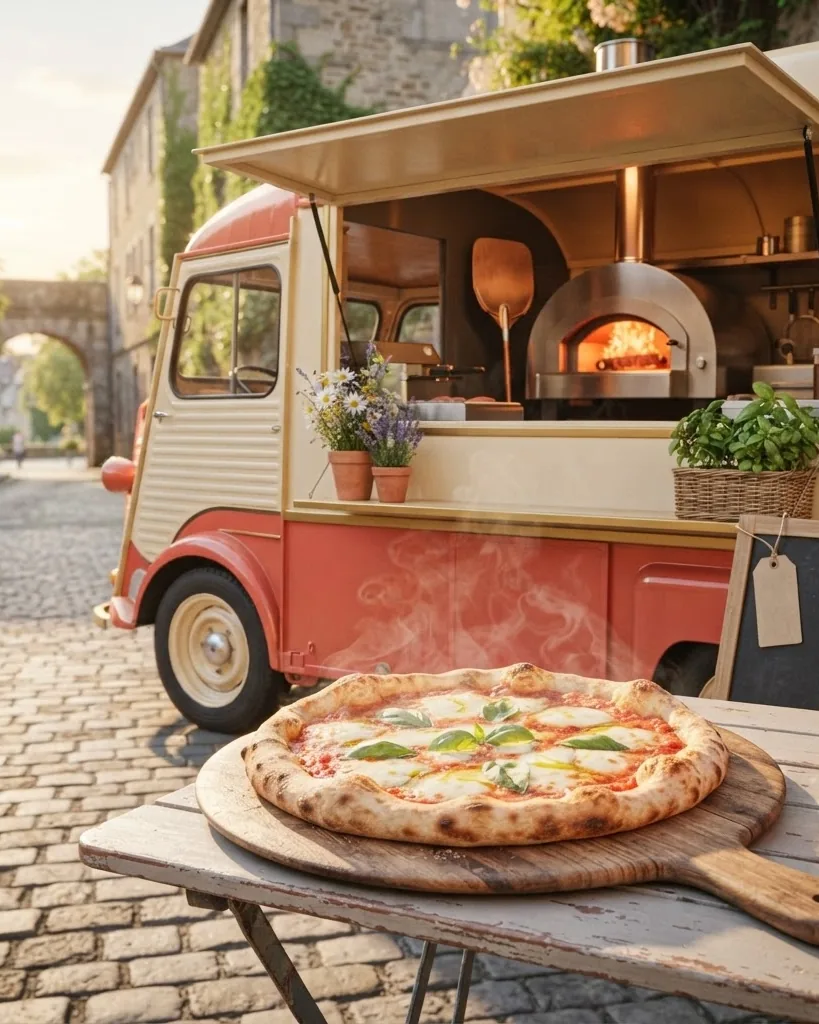
When a listing says pizza truck, it can mean one of two very different machines, and the price gap between them is the first thing to understand. On one side you have a self-propelled truck: a Ford E350 or E450, an old Workhorse step-van, or a box truck retrofitted with a kitchen and an oven. You drive it to the spot, you drive it home. On the other side you have a towable concession trailer with the oven built in, which you pull behind a pickup and drop at the event.
Both formats sell every day. I have seen a 2002 Workhorse pizza truck with a 2023 kitchen build and an imported Italian wood-fired oven, and a 2012 Ford E350 re-outfitted in 2025 with professional gear. On the trailer side, new 8×26 brick-oven builds show up wrapped around a proper wood oven with a proofing cabinet. The word pizza in the ad tells you almost nothing until you know which format, which oven, and what year the kitchen was actually built, which is often newer than the vehicle itself.
My rule for a first-time buyer is simple. If you want lower entry cost and can tow, the trailer is the cheaper door in. If you want to work tight urban curbs where you cannot park a truck and trailer combo, the self-propelled truck earns its higher price. When people ask me for a starting point, I point them at my breakdown of how to buy a pizza truck and my notes on used food trucks for sale, because the same inspection logic carries across both formats.
What you should pay in 2026
Let me put real ranges on the table, because vague talk about pizza trucks costing a lot helps nobody. Across the whole food-truck industry, startup lands between $50,000 and $200,000, with the average setup running $85,000-$120,000. That is 12-18 percent higher than it was a few years back, mostly because used-truck prices climbed. Pizza sits at the pricier end of concepts for one reason: the oven.
Here is how the buckets shake out for a pizza-specific rig. A used, already-built pizza truck runs roughly $40,000-$80,000 depending on mileage, oven quality, and how recently the kitchen was done. A used concession trailer with an oven is the budget path at about $20,000-$40,000, and a full trailer operation, once you add permits and working capital, lands around $30,000-$55,000. A new custom build with a premium wood oven and a fresh wrap climbs to $90,000-$175,000. Whatever bucket you pick, remember the vehicle and its built-in kitchen are 50-70 percent of your total startup, so this is the line where discipline pays off most.
The mistake I watch new buyers make is treating the sticker price as the whole cost. Beyond the truck, budget $10,000-$20,000 for equipment upgrades the previous owner skimped on, $3,000-$5,000 for opening inventory, and $10,000-$20,000 for two months of working capital. Skip that cushion and your first slow week can end the whole thing. Below is how I sketch a pizza-truck budget for someone buying used.
| Line item | Typical range | Notes |
|---|---|---|
| Used pizza truck (self-propelled) | $40,000-$80,000 | Oven quality and kitchen year drive the price |
| Used pizza trailer | $20,000-$40,000 | Cheapest door in if you can tow it |
| New custom build | $90,000-$175,000 | Premium oven, fresh wrap, warranty |
| Equipment upgrades after purchase | $10,000-$20,000 | Refrigeration, prep, gen fixes |
| Opening inventory | $3,000-$5,000 | Flour, cheese, tomato, boxes |
| Working capital (two months) | $10,000-$20,000 | Do not open with zero cushion |
The oven is the whole deal
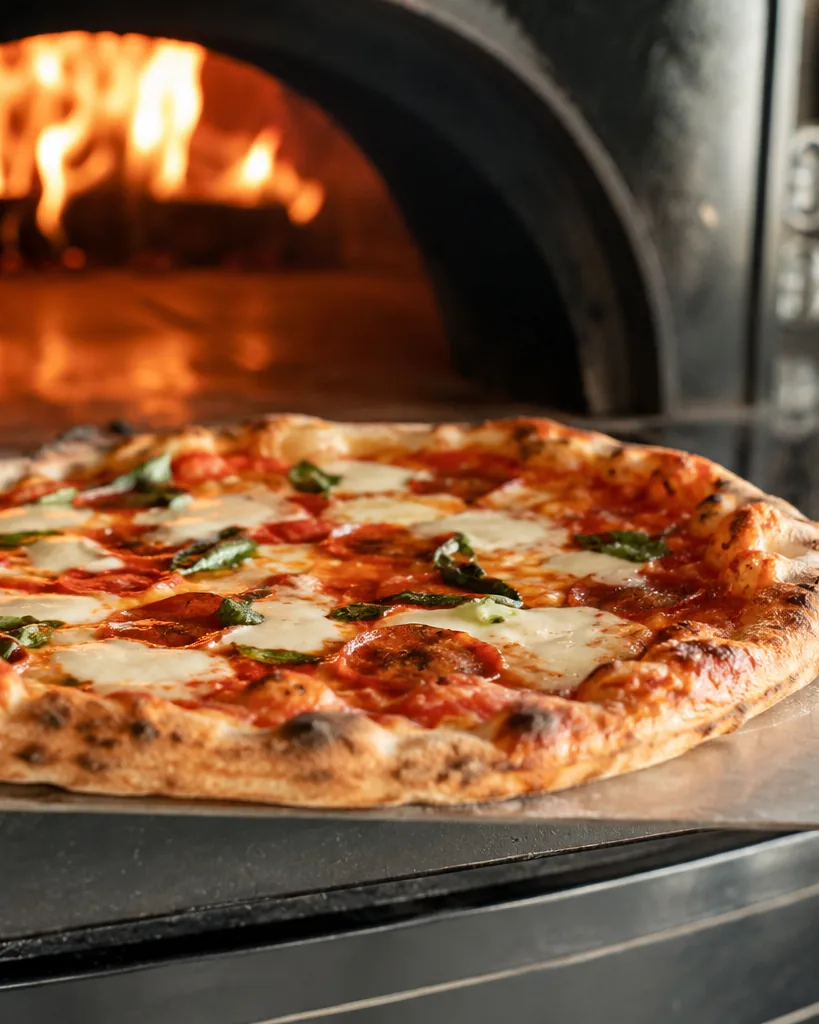
I will say it plainly: on a pizza truck you are buying an oven that happens to come with a vehicle attached. The oven decides your speed, your product, and a big chunk of your price. A wood-fired brick oven runs roughly 700-900 degrees Fahrenheit and bakes a Neapolitan-style pie in about 90 seconds. That heat and that speed are exactly why pizza works as a truck concept: you can push a long line through the window faster than almost any plated food, because the bake is measured in seconds, not minutes.
There are three oven families you will meet in listings. A pure wood-fired brick oven gives you the char, the theater, and the flavor customers photograph, but it demands skill and is the heaviest option. A gas oven is the steadiest through a rush and the easiest to run, which is why high-volume trucks pick it. A hybrid splits the difference, using gas to hold the floor temperature while wood adds flavor. What matters is that the oven recovers its temperature after you load it, because a brick oven that sags mid-rush backs up your whole line.
Weight is the part buyers forget. A brick oven is heavy, and on a trailer that heat and mass change your tongue weight and your tow rating. On a truck it changes your axle load and your fuel burn. Before you buy, know the oven’s dry weight and confirm the vehicle is rated to carry it legally, because an overloaded rig is both a safety problem and a ticket waiting to happen. If you want the deeper equipment rundown across concepts, my notes on food truck equipment cover ovens, refrigeration, and the generator sizing that has to keep up with all of it.
What to inspect before you hand over money
This is the section that saves you the most, so slow down here. A pizza food truck for sale is a used commercial kitchen, and you inspect it like one. The single most expensive surprises live in three places: the oven and its fire suppression, the refrigeration and generator, and the paperwork that says the kitchen was ever legal to begin with. Miss any of these and you can buy a truck you cannot open.
Start with fire. A cooking oven of that heat needs a hood and a fire suppression system that meets code, and the standard your inspector will hold you to is spelled out by the National Fire Protection Association (NFPA 96 for the hood and a UL 300 wet-chemical system for the cooking line). Look for a current inspection tag on the suppression system. If it is expired or missing, budget for a full service before you can pass your own inspection, and price that into your offer. In my years around trucks, an out-of-date suppression tag is the first thing a fire marshal flags, and it is a five-figure headache if the system itself is dead.
Then check the mechanicals. Here is the walk-through I run on every rig:
- Engine miles and generator running hours; a tired generator that cannot hold the oven, reefer, and lights is a hidden rebuild.
- Refrigeration that actually holds temperature; open the reach-in, let it run, and watch the thermometer, because a failing compressor is thousands of dollars.
- The oven cold and hot; fire it if the seller will let you, and watch how fast it recovers after you open the door.
- Clean title, service records, and any proof the kitchen was permitted and inspected in its last jurisdiction.
- Propane and plumbing lines for leaks, corrosion, and hack repairs around the regulator and tank fittings.
Here is the exact order I move in so I do not skip anything under a seller’s sales pressure:
- Step 1 – Get an independent mechanic on the drivetrain and a separate hood and fire inspection before any money moves.
- Step 2 – Confirm clean title and ask for the last health permit or inspection report from where it operated.
- Step 3 – Run the oven, the reefer, and the generator all at once for twenty minutes and watch for brownouts or temperature sag.
- Step 4 – Price every deferred repair you found into your offer, in writing, before you agree on a number.
Warning: Never buy a pizza truck sight unseen off photos alone. I have watched a friend wire a deposit on a rig that looked spotless online and turned out to have a dead suppression system and a generator on its last legs. The wrap was perfect. Everything under it was not. Photos sell the paint; your inspection buys the truth.
The plate math that decides if a pizza truck pays
A pizza truck can be a money machine because the core inputs are cheap. Flour, tomato, and cheese cost very little per pie, which is exactly why the format forgives you more than a protein-heavy menu does. But cheap inputs only matter if you actually run the numbers, and this is where I underpriced my early menus before I wised up. Your target is a food cost of 25-35 percent of revenue, with a blended goal around 28-33 percent once you mix in drinks and sides.
Run a pie cold. A margherita is a ball of dough, a ladle of sauce, a handful of mozzarella, and a few basil leaves. Sourced right, you can build that pie for a couple of dollars in food. Price it at $14-$18 and your food cost sits comfortably in range, with room for a loaded specialty pie to carry a little more margin. Drinks and sides are your friends here: a canned soda that costs you 60 cents and sells for $2 is almost pure margin and lifts every ticket.
The lever most operators ignore is throughput, not price. Because a wood oven bakes in about 90 seconds, your real ceiling is how fast you can stretch, top, and box, not how fast the pie cooks. On a busy day an urban truck grosses $1,000-$2,000, and a great day at the right event pushes past $2,500. Hit that volume with a food cost held in range and a labor line at 20-30 percent, and pizza clears healthy margins. The 30-30-30 rule is the benchmark I keep in my head: roughly a third to food, a third to labor, a third to overhead, and what is left is yours. If you want the full cost picture before you buy, I laid it out in my guide to food truck cost.
Financing, permits, and the paperwork that comes with the keys
Buying the truck is the fun part. The paperwork is the part that decides whether you can legally open it, and pizza buyers underestimate it constantly. Two things travel with any pizza food truck for sale: how you pay for it, and the permits you need to run it once it is yours.
On financing, do your reading before you talk to a single dealer. The U.S. Small Business Administration is where I send everyone first, because most microloans for a mobile food business land under $50,000, which is plenty for a used trailer or a solid used truck. That number keeps you from assuming you need a giant loan for a six-figure custom build when a $35,000 used trailer would prove your concept just as well. And when tax time comes, the IRS rules on business vehicle and equipment expensing, plus first-year startup deductions, can change what your real out-of-pocket looks like, so factor that in before you sign.
On permits, the cost swings wildly by city. One widely cited spread runs from about $811 in Denver to $17,000-plus in Boston. You cannot copy another city’s number; you have to call your own health department and ask what a mobile food unit with a cooking oven requires. On the food-safety side, most jurisdictions build their rules on the framework in the federal Food Code, so reading how mobile food safety is structured before you buy will tell you what a compliant build even looks like. Buy a truck whose kitchen already meets those standards and you save yourself a painful, expensive retrofit. For the money side of the purchase specifically, my walkthrough on food truck financing covers loans, down payments, and what lenders want to see.
New build vs used vs rent: which path fits you
Not everyone should buy, and I say that as someone who owns trucks. There are three doors into a pizza concept, and the right one depends on your cash and your certainty. Buying used is the value play: a $20,000-$40,000 trailer or a $40,000-$80,000 truck gets you rolling for the least money, as long as you inspect hard and fix what you find. This is the door I steer most first-timers toward.
Buying new, at $90,000-$175,000, buys you a warranty, a premium oven, and a truck built to your exact line, with no mystery repairs waiting. It is the right call if you are well capitalized and certain of your market. The tradeoff is obvious: you pay top dollar and eat the depreciation that hits the day you drive it off the builder’s lot.
Renting is the door people forget. A ready-to-run truck rents from about $1,800 a month, and for a season that is a cheap way to prove your pizza actually sells before you sink six figures into owning. I have told more than one nervous first-timer to rent for a summer, dial in the menu and the locations, and only then decide whether to buy. If the concept flops, you walked away for a few thousand dollars. If it flies, you buy with real numbers in hand instead of a hunch.
Tip: Whichever door you pick, size your generator for the whole load at once. A pizza line running a gas oven blower, refrigeration, and lights wants a generator in the 5-7 kW range with headroom to spare. The rig that browns out mid-rush teaches you this the hard way, and it is always cheaper to buy the watts up front than to lose a Saturday to a stalled oven.
Mistakes I have watched pizza buyers make
The first one is falling for the wrap. A beautiful exterior sells the truck before the buyer ever checks the oven, and I have seen people pay for paint and inherit a dead kitchen. Photos and wraps are marketing. The oven, the suppression tag, and the generator hours are the product. Inspect those coldly and let the wrap be a bonus.
The second is underpricing the pie because a competitor down the block sells cheap. I did a version of this on my early menus, copying a neighbor’s sign instead of costing my own pie, and a busy week never felt like money. The fix is boring: weigh your cheese, price your inputs, and set your pie off your actual food cost. A pizza truck’s cheap inputs give you room to price with confidence, so use it.
The third is skipping the working-capital cushion to afford a nicer truck. Opening with an empty account means one slow week or one dead generator ends you. I would rather see a buyer get a $30,000 used trailer with $15,000 in the bank than a $60,000 truck with nothing behind it. The truck does not save you; the cushion does.
Frequently asked questions
How much does a pizza food truck for sale cost?
Plan on three buckets. A used pizza trailer with an oven runs about $20,000-$40,000, a used self-propelled pizza truck about $40,000-$80,000, and a new custom build $90,000-$175,000. The vehicle and its built-in kitchen are 50-70 percent of your total startup, so the oven quality and the year the kitchen was built matter more than the age of the chassis.
Wood-fired or gas oven for a pizza truck?
Wood-fired gives you char, flavor, and theater but demands skill and adds weight; it runs around 700-900 degrees and bakes a pie in about 90 seconds. Gas is the steadiest through a rush and the easiest to run, which is why many high-volume trucks choose it. A gas-and-wood hybrid holds temperature with gas while adding wood flavor. Pick for your volume and your comfort, and always confirm the oven recovers heat fast after a load.
What should I inspect before buying a pizza truck?
Check the fire suppression tag and hood against NFPA 96 and UL 300, the generator running hours, the refrigeration holding temperature, and the oven’s heat recovery. Confirm clean title, service records, and the last health permit from where it operated. Get an independent mechanic and a separate hood and fire inspection before any money moves, and price every deferred repair into your offer.
Is a pizza food truck profitable?
It can be strong because the core inputs, flour, tomato, and cheese, are cheap per pie. Hold food cost at 25-35 percent, price pies around $14-$18, and lift tickets with drinks and sides that run 15-22 percent food cost. A busy urban truck grosses $1,000-$2,000 a day with peaks past $2,500. The 90-second bake means throughput, not the oven, is usually your real ceiling.
Should I buy new, buy used, or rent?
Buy used ($20,000-$80,000) for the best value if you inspect hard. Buy new ($90,000-$175,000) if you are well capitalized and certain of your market and want a warranty and no surprises. Rent from about $1,800 a month if you want to prove the concept for a season before committing six figures. Renting first is the cheapest way to learn whether your pizza actually sells in your market.
What permits do I need for a pizza food truck?
The same mobile food permits as any truck, plus fire and hood compliance for the oven. Costs swing from about $811 in Denver to $17,000-plus in Boston, so call your own health department. Most jurisdictions build their rules on the federal Food Code framework, and your fire inspector will hold you to NFPA and UL 300 standards. Always confirm current requirements with your own city or county before you buy.
The bottom line
A pizza food truck for sale is a used commercial kitchen with a vehicle attached, and you buy it like one. The oven decides your speed and a big share of your price, so verify it holds and recovers heat, confirm the fire suppression is current, and check the generator and refrigeration before you fall for the wrap. Pay in the right bucket for your path, from a $20,000 used trailer to a $175,000 custom build, and keep a working-capital cushion so one slow week cannot end you. Price your pies off a real 25-35 percent food cost, lean on the 90-second bake for throughput, and read the SBA and your local health code before you sign. Do that, and the cheapest inputs on the street will carry you a long way.