A Filipino food truck wins on two things that most new operators never sit down and measure: how bold the plate tastes and how honest the food cost is behind it. After eight years running trucks out of Austin, this is the concept I keep telling people to look at hard, because a short board of lumpia, sisig, and adobo over garlic rice pulls flavor most street food cannot touch, off a pantry small enough to keep waste down. This is the guide I wish someone had handed me before I guessed at prices and watched a busy week feel like no money.
The mistake I see people make is treating this like a menu project when it is a math project. The food is the easy part. Filipinos have been feeding crowds off vinegar, garlic, and pork for generations, and the recipes are proven. What is not proven is your pricing, your portioning, and whether your pork cold-chain holds on a hot Saturday. That is where the money is won or lost, and in my experience it is the part every food listicle skips entirely.
I checked every price, permit range, and equipment spec below against what I am paying on my own orders and city paperwork this season, and against current cost guides.
Quick answer: A Filipino food truck costs roughly $50,000-$200,000 to start, with most builds landing near $85,000-$120,000, versus $250,000-$500,000 for a sit-down restaurant. The menu stays short on purpose: lumpia, sisig, adobo, and pancit built off a shared pork-and-rice pantry, served as silog plates, rice bowls, or fusion burritos and tacos, with ube and halo-halo for dessert. Keep food cost at 25-35% of revenue, price a sisig rice bowl around $12-$15 depending on your city, and sell lumpia in threes and fives where the margin is fat. The profit comes from low SKUs, fast throughput, and desserts that cost pennies and sell for dollars.
What a Filipino food truck actually sells
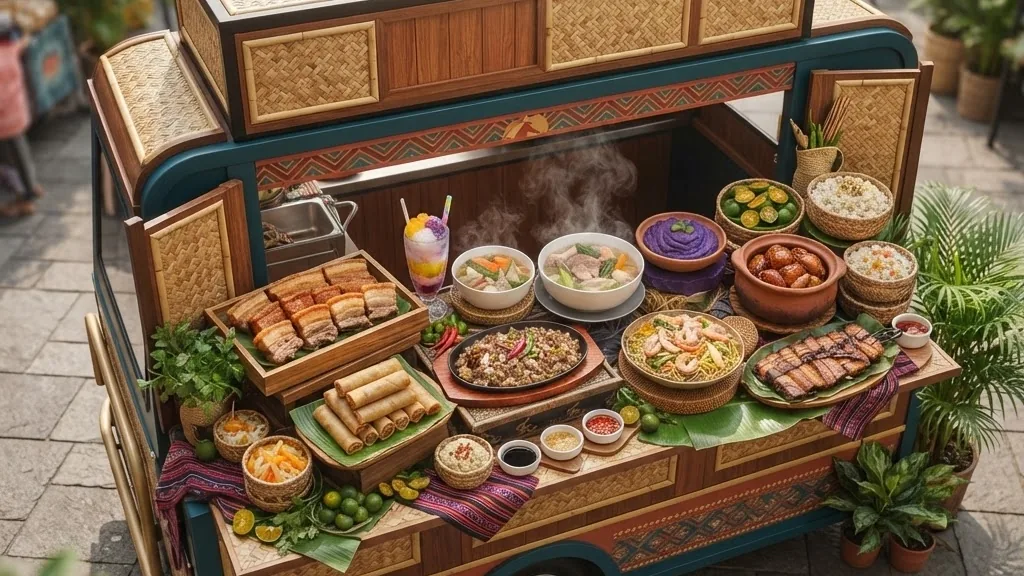
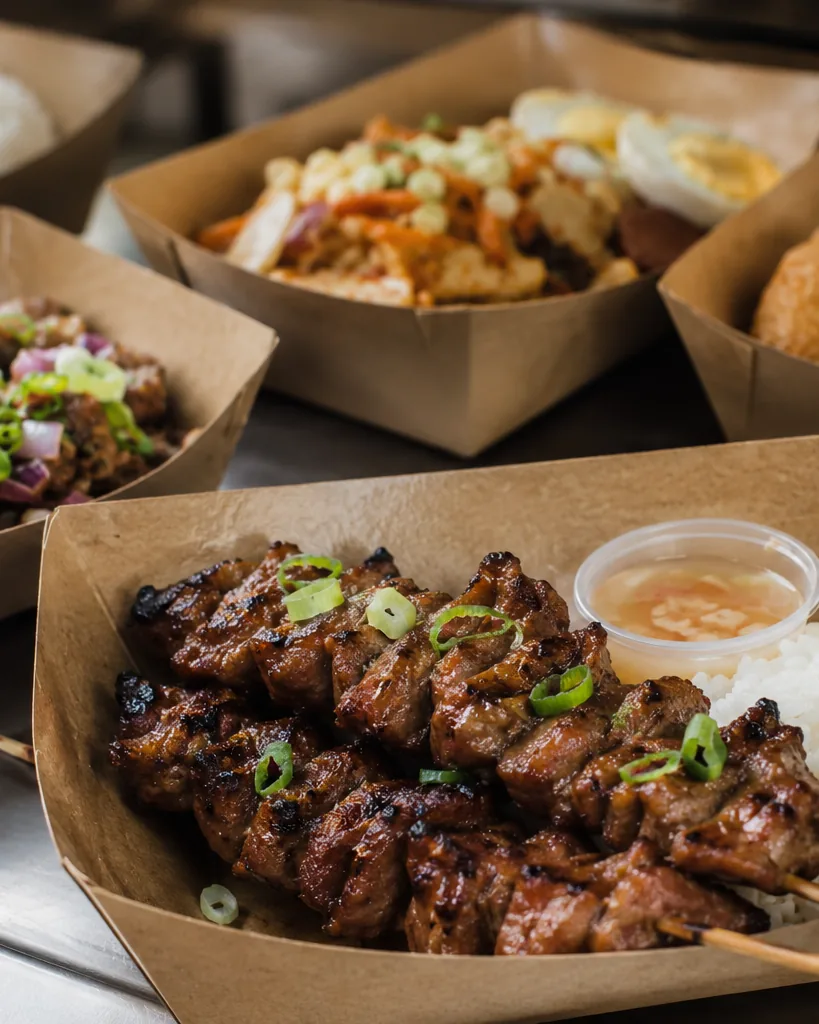
The menu is the whole concept, and the trick is that a handful of dishes share the same pantry. A Filipino food truck built for the street sells lumpia (crispy pork spring rolls), sisig (chopped seared pork with onion, chili, and calamansi), chicken or pork adobo, and pancit noodles, plus a couple of desserts. You are not running twenty recipes; you are running one griddle, one fryer, one rice warmer, and a small cold line really well. The most reliable format is the silog plate: a protein over garlic rice with a fried egg on top.
From that base you fan out without adding much cost. The same sisig goes into a rice bowl, a burrito, or a taco, which is exactly how Filipino trucks broke into the mainstream. Lumpia sells by the piece, usually three to five for $6-$9, and it holds under a heat lamp better than almost anything, so it carries your slow stretches. Adobo and pancit round out the board for people who want something saucy or a noodle plate. When people ask me for a lean, high-flavor concept, I point them at this and my list of food truck menu ideas, because the ingredient overlap here is unusually tight.
Do not sleep on dessert. Ube (purple yam) and halo-halo (shaved ice layered with milk, sweet beans, jellies, leche flan, and ube ice cream) are the highest-margin items on the truck and the thing nobody else at the event is selling. A halo-halo that costs you a dollar in ingredients can carry a $6-$8 price because it is a photo, a novelty, and a reason to come back. Six to eight savory items, three or four proteins off one pantry, and two desserts is a full, defensible board.
Stocking the pantry without bleeding waste
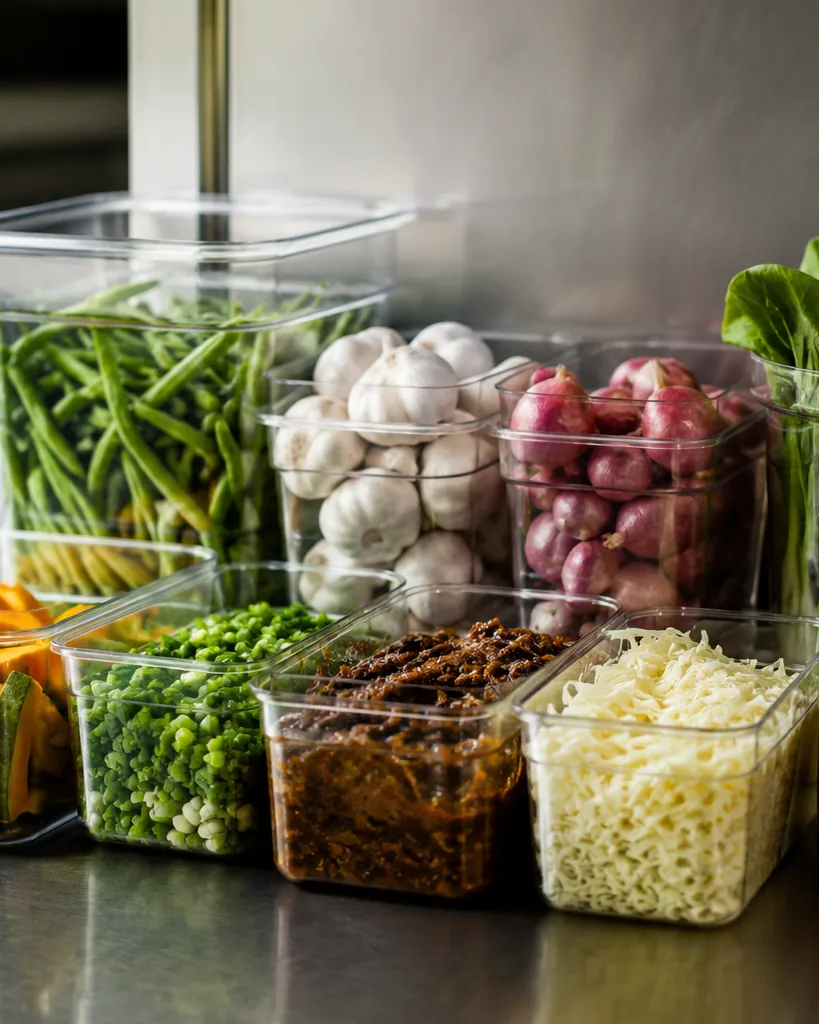
The reason this concept scales on a truck is the pantry, so build it deliberately. The adobo base is vinegar, soy sauce, garlic, bay leaf, and black peppercorn, and it costs almost nothing per portion. Sisig runs on pork jowl or belly, onion, chili, and calamansi or lime. Lumpia is ground pork, aromatics, and egg-roll wrappers. Add jasmine rice, banana ketchup, and you have covered most of the board. That overlap is the point: the same case of pork feeds adobo, sisig, and lumpia, so you are not carrying dead inventory across three separate menus.
Here is what most guides get wrong about a pork-heavy truck. They obsess over recipes and ignore cold-chain, and pork is the one protein that will end your season if you get lazy with it. The USDA Food Safety and Inspection Service regulates meat and poultry safety and labeling, and the FDA Food Code is what your local health inspector actually enforces on the truck. You can read the meat-handling rules straight from the USDA Food Safety and Inspection Service and the retail-food standards from the U.S. Food and Drug Administration. Cook your pork to a safe internal temperature, hold cold food cold, and label your prep dates. I have seen an operator lose a whole event because a reefer drifted warm overnight and the health officer pulled the pork on sight.
Keep the pantry honest with a short buy list you actually track:
- Pork belly or jowl and ground pork, bought as one order and split across sisig, adobo, and lumpia to kill waste
- Cane or coconut vinegar, soy sauce, garlic, bay leaf, and black peppercorn for the adobo base
- Calamansi or lime, onion, and fresh chili for sisig and for finishing plates bright
- Egg-roll wrappers and jasmine rice, your two highest-volume staples, ordered ahead of a big weekend
- Ube, sweet beans, jellies, and leche flan for the dessert line that carries your margin
What it costs to start a Filipino food truck
A Filipino food truck is one of the friendlier commercial kitchens to build, because a fryer, a flat-top, and a rice warmer cover most of the board. All in, plan on $50,000-$200,000, with the average build landing around $85,000-$120,000, versus $250,000-$500,000 for a bricks-and-mortar restaurant. The single largest line is the vehicle: a used truck runs $30,000-$60,000, while a new custom build runs $75,000-$150,000, and the average fully fitted new truck in 2026 sits near $109,500. I built my first truck on the cheap, and when I launched I learned fast that from my 8 years running trucks it is the vehicle line where I have watched the most money get wasted chasing custom when clean-and-used does the same job.
The cooking package is where a Filipino concept saves you. A flat-top, a two-basket fryer, a rice warmer, and a reach-in reefer come in around $10,000-$30,000, because you are not buying a pizza oven or a smoker you will barely touch. Add a commissary kitchen at $500-$1,500 a month, permits and licenses of $1,000-$5,000 in year one, and working capital so you are not opening with an empty account. Note that 2026 numbers run about 12-18% higher than older guides because of inflation since 2022, so do not trust a 2019 spreadsheet.
If you are financing, according to the U.S. Small Business Administration, that is where I would read before you ever talk to a dealer, and the IRS guidance on deducting business expenses will save you real money at tax time. and according to SBA, most microloans for a small food business land under $50,000, which is worth knowing before you assume you need a giant loan for the whole rig. For a deeper line-by-line, I keep my full food truck cost breakdown current. Here is roughly how the startup splits out on a Filipino concept.
| Startup line item | Typical range | Notes |
|---|---|---|
| Truck or trailer (used to new) | $30,000-$150,000 | Used $30k-$60k; new custom $75k-$150k; 2026 avg new near $109,500 |
| Cooking equipment package | $10,000-$30,000 | Flat-top, fryer, rice warmer, reefer |
| Permits, licenses, first-year fees | $1,000-$5,000 | Wildly location-dependent |
| Commissary kitchen rent | $500-$1,500/mo | Prep and overnight storage |
| Insurance (BOP plus auto) | $200-$280/mo | Solo operator, roughly $2,400-$3,360/yr |
| Working capital (inventory, reserve) | $5,000-$15,000 | Do not open with zero cushion |
The plate math that actually decides it
This is the section I underpriced my way through, so pay attention. Food cost should land at 25-35% of revenue, and I aim for 30%. The formula that keeps you honest is simple: menu price equals your cost per serving divided by your target food-cost percentage. If a sisig rice bowl costs you $3.60 in pork, rice, aromatics, and the egg, you divide by 0.30 and price it at $12, and every dollar in the drawer keeps 30 cents against food. Do not eyeball this. Weigh a portion, price your inputs, and run the number.
Where a Filipino truck really prints is the spread between items. A sisig bowl at $12-$15 carries a healthy plate cost, but lumpia is the quiet winner: an order of five that costs you maybe $1.50 in pork and wrappers sells for $7-$9, which is a food cost well under 25%. Desserts are better still. A halo-halo built for about a dollar sells for $6-$8. The play is to build your board so the cheap-to-make items are the easy add-on at the window, the same way a canned drink at $2 that costs you 60 cents is nearly pure margin.
Now weigh the two ways operators go wrong. Copying the truck next door versus costing your own plate is not a close call: the sign down the block encodes their pork price, their portions, and their rent, none of which are yours. Labor is the other silent line, typically 25-35% of revenue, so a plate that looks profitable on ingredients alone can still lose once two people are working the window. The pattern I see is new operators pricing off vibes and volume, then wondering why a packed Saturday did not pay. Cost the plate, then price it. If you want the full framework, I lay it out in my food truck business plan guide.
Equipment for a lumpia-and-griddle line
Buy for the Saturday rush, not the Tuesday trickle. Having spent years at the window, I trust a lean setup over anything fancier: a flat-top griddle for sisig and silog, a two-basket fryer for lumpia, a rice warmer, and a reach-in reefer. A 36-inch flat-top pulls roughly 90,000 BTU across its burners, and that is what lets me hold a full griddle of sisig and eggs without the surface crashing when the line hits. In my experience, a cold griddle mid-rush is how tickets back up and customers walk fastest, so I never undersize the flat-top.
The fryer is non-negotiable on this concept because lumpia is your volume item. A 50-lb tube fryer runs about 120,000 BTU and recovers oil temperature fast enough to keep the wrappers crisp instead of greasy when orders stack. Power is the other thing that will humble you. Most cart-style trucks run a generator in the 5-7 kW range, and the Honda EU7000is that a lot of operators swear by puts out 7,000 watts peak and 5,500 watts rated, burning roughly 84,000 BTU per hour on propane under load with about a 6.4-hour runtime on its 5.1-gallon tank. Size it so you can run the reefer, lights, and a fryer at once without browning out. For the full rundown, see my food truck equipment guide.
Tip: Keep a spare griddle scraper, a backup propane regulator, and a small toolkit bolted somewhere you can reach mid-service. From my years on the truck, the fixes that cost you a whole lunch rush are almost always five-dollar parts you did not have on hand. I lost a good afternoon once to a $9 regulator I should have had in the drawer.
Permits, insurance, and fire suppression
The paperwork is where the food truck dream meets city hall, and it is the least glamorous money you will spend. Permits and licenses swing wildly by location. One widely cited spread runs from about $811 in Denver to $17,000-plus in Boston, with the average across major food-truck cities landing near $1,864. You cannot copy another city’s number; you have to call your own health department and ask, then confirm whether they require a commissary agreement before they will even issue the permit.
Insurance is not optional. A solo operator should budget about $200-$280 per month for a business owner’s policy plus commercial auto, call it $2,400-$3,360 a year, though a bare general-liability policy can start much lower. And do not skip fire suppression: a hot griddle-and-fryer line needs a hood system that meets code, and the National Fire Protection Association standards, NFPA 96 and UL 300 systems, are what your inspector will hold you to. An overdue hood inspection is the first thing a fire marshal will flag, and a failed inspection means a dark truck on a paying weekend.
Here is the order I run every new build or renewal through, because doing it out of sequence wastes weeks:
- Step 1 – Call your county health department and get the exact permit list and fee before you buy anything.
- Step 2 – Lock a commissary agreement, since many cities will not issue a mobile permit without one.
- Step 3 – Get the hood and fire-suppression system inspected to NFPA 96 and UL 300 before your health inspection, not after.
- Step 4 – Bind insurance and keep proof in the truck, because events and permits will ask to see it on the spot.
Why the Filipino food truck format works
The concept you are building on has a real origin story, and it is worth knowing because it explains the economics. The modern gourmet food-truck movement started in Los Angeles in 2008, when Roy Choi’s Kogi Korean BBQ taco truck proved that fusion street food, pushed through social media, could pull crowds a restaurant would envy. Filipino operators ran the same playbook a couple of years later, and the format stuck because the food was built for it.
In 2010, two high-school friends, Evan Kidera and Gil Payumo, bought a refurbished Chinese food truck off Craigslist and launched Senor Sisig in San Francisco, the first Filipino-Mexican truck in the city. They grew it through Off the Grid street-food events into a fleet of about six trucks and a brick-and-mortar on Valencia Street. That same July, James Du, Michael Dimaguila, and Melvin Chua launched White Rabbit in Los Angeles, whose sisig burrito turned a Pampanga dish into a mainstream American order. By 2013, Dollar Hits was grilling dollar skewers over charcoal in LA, and the pattern I see is the same every time: bold food, a tight board, and a diaspora over 4 million strong that carries a good truck by word of mouth.
Mistakes I made pricing and sourcing
I underpriced my plates for a month before I did the math, and I want you to skip that. I set my bowls at what the truck down the block charged, never costed my own plate, and could not figure out why a busy week did not feel like money. The fix was boring: weigh your portions, price your inputs, and set the menu off your real food cost, not a competitor’s sign. Once I did that, the same volume finally paid, and I stopped resenting the busy days.
My second mistake was portion drift, and it is worse on this menu than most. When you are slammed, your rice scoops get generous and your lumpia count creeps, and a half-ounce of extra pork on every plate across a weekend is real money gone, and the trap I see most often is operators who never re-weigh once they open, so the plate that penciled out in the spreadsheet quietly balloons in service. I mark my scoops and re-weigh five plates in a row every season to catch the creep before it eats a month.
The third one was chasing cheap pork without minding the cold-chain. I took a bargain case once, crammed my reefer past where it could hold temperature, and spent a nervous night wondering if I would open the next morning. Now I buy pork to a plan, keep the reefer with headroom, and treat food safety as part of the product rather than an afterthought. After 8 years, the boring disciplines are the ones that kept me open while flashier trucks folded.
Frequently asked questions
How much does it cost to start a Filipino food truck?
Plan on $50,000-$200,000 all in, with most builds landing near $85,000-$120,000, compared with $250,000-$500,000 for a restaurant. The truck is the biggest line at $30,000-$60,000 used or $75,000-$150,000 new, and the cooking package runs $10,000-$30,000. A clean used truck plus a smart build-out is the single best way to keep the number down without cutting corners on the line.
What sells best on a Filipino food truck?
Lumpia and sisig carry most trucks. Lumpia holds under a lamp and sells in threes and fives with a fat margin, and sisig, the chopped-pork dish from Pampanga, is the breakaway item that put Filipino food in the American mainstream. Serve them as silog plates and rice bowls, add adobo and pancit for range, and use ube and halo-halo desserts to pull repeat customers and social photos.
What should a sisig rice bowl sell for?
Price it where your food cost lands at 25-35% of the sale. Sourced right, a sisig bowl costs about $3.60-$4.50 to build, so $12-$15 keeps you in range in most cities. Restaurant and delivery menus list sisig plates near $17 or more, but you are working a truck window, so cost your own plate, divide by 0.30, and let the local market tell you the ceiling.
Is lumpia profitable on a food truck?
Lumpia is one of the most profitable items you can run. An order of five costs roughly $1.50 in ground pork and wrappers and sells for $7-$9, a food cost well under 25%. It fries fast, holds well, travels for catering, and pairs with everything else on the board, which is why nearly every Filipino truck leans on it as a volume anchor.
What equipment do I need for a Filipino truck?
The core is a 36-inch flat-top griddle at about 90,000 BTU for sisig and silog, a 50-lb two-basket fryer near 120,000 BTU for lumpia, a rice warmer, and a reach-in reefer. Power it with a 5-7 kW generator such as the Honda EU7000is, which puts out 5,500 watts rated and burns roughly 84,000 BTU per hour on propane. Size the generator to run the reefer, fryer, and lights at once.
Do I need special permits for a Filipino food truck?
You need the same mobile-food permits as any truck, plus a commissary agreement in most cities. Permit costs range from about $811 to $17,000-plus depending on location, averaging near $1,864 across major markets, and your hood must meet NFPA 96 and UL 300 fire-suppression code. Always confirm current requirements with your own city or county health department before you buy the truck.
The bottom line
A Filipino food truck is a bold-flavor, low-SKU concept that rewards discipline more than talent. Keep the menu tight around lumpia, sisig, adobo, and a couple of desserts off one shared pantry, hold food cost at 25-35%, and price every plate off your real cost instead of the sign next door. Overbuy your generator watts and your griddle BTU so a Saturday rush does not break you, mind your pork cold-chain like your permit depends on it, because it does, and treat licenses and insurance as the cost of staying open. Do those things and the format Kogi and Senor Sisig proved on the West Coast will carry you just as well from your own window.