I have spent enough late nights scraping a flat-top and counting register tape to tell you that a taco truck is not a romantic idea. It is a small kitchen on wheels that has to feed a line of hungry people in the time it takes them to lose patience. When it runs well, it is one of the most forgiving small businesses in food. When it runs badly, the propane bill and the spoiled carnitas remind you fast. This guide walks through how a taco truck actually works, what the numbers tend to look like, and the unglamorous decisions that decide whether you make money or just make tacos.
I am writing this the way I would explain it to a friend who called me from the parking lot of an auction, about to bid on a used rig. Practical, honest, and free of the fairy-tale revenue figures you see thrown around online. Costs and earnings here are ranges drawn from what operators commonly report. They are not promises, and your city, your menu, and your spots will move every one of these numbers.
What a taco truck really is
Strip away the wrap and the string lights and a taco truck is three things stacked together: a vehicle, a permitted commercial kitchen, and a tiny retail counter. Each one answers to a different set of rules. The vehicle has to be registered and roadworthy. The kitchen has to pass a health inspection and tie back to a licensed commissary. The counter has to collect sales tax and hand food across a service window in under a few minutes. Most people who fail in this business fail because they only thought about one of those three.
There are two body styles you will choose between. A true truck has the kitchen built into a step-van or box truck, so you drive it as one unit. A trailer is a towed kitchen, usually cheaper to buy and easier to repair, but you need a tow vehicle and a place to park both. Trucks win on speed of setup at an event. Trailers win on price and on keeping a breakdown from stranding your whole operation. Plenty of taco operators I respect run trailers for exactly that reason.
The taco concept itself is what makes this such a strong first truck. Tacos are built from a short list of shared parts: tortillas, a few proteins, onion, cilantro, lime, and a couple of salsas. That overlap is the secret. The same carnitas that fills a taco fills a burrito, a quesadilla, and a rice bowl. You are not cooking ten dishes. You are cooking five components and recombining them. That keeps prep sane and the line fast.
How a taco truck works on a service day
Here is the rhythm of an actual day, because the brochures skip it. You start at the commissary, not the curb. That is where you load fresh prep, fill your fresh-water tank, dump yesterday’s gray water, and restock propane. Health codes in most jurisdictions require that a mobile unit operate out of a commissary, and they will ask for the paperwork. Skipping the commissary is the fastest way to get shut down.
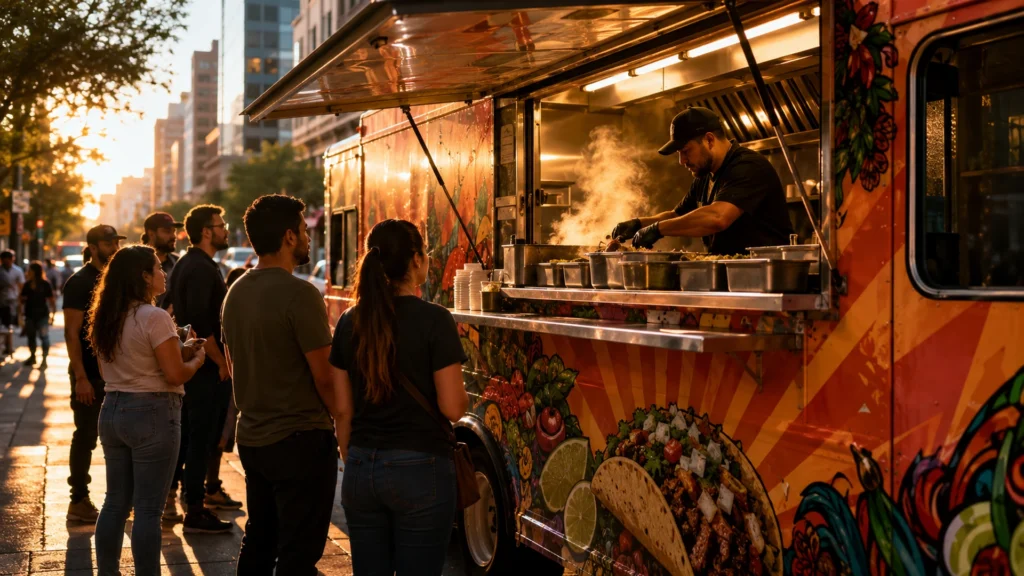
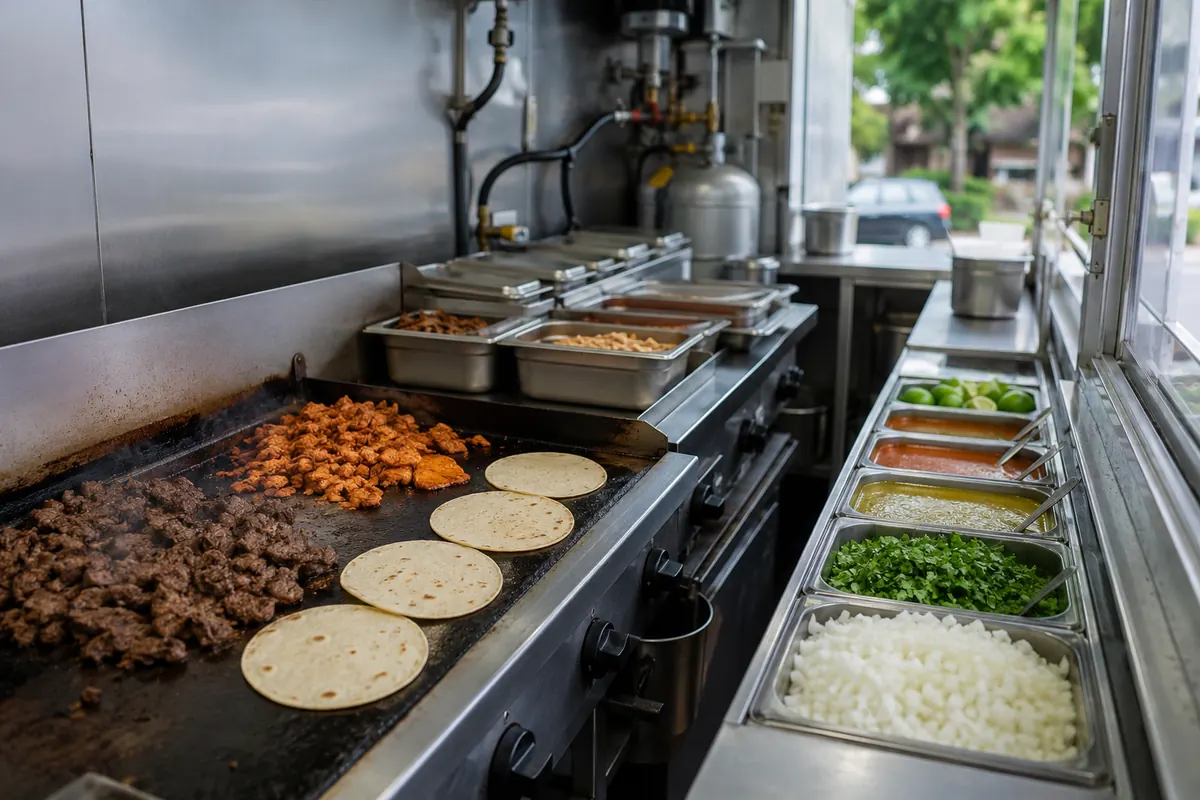
Then you drive to your spot, level the rig, fire the flat-top and the steam table, and bring proteins up to safe holding temperature. Once the window opens, the whole game becomes ticket speed. A taco line lives and dies on getting an order out in two to three minutes during a rush. That means proteins are already cooked and held hot, tortillas are warming in batches, and the only thing happening at the moment of the order is assembly. If you are searing carne asada to order during a lunch rush, the line backs up and walks away.
At close you are not done. You break down the flat-top, wipe and sanitize every surface, log holding temperatures, and drive back to the commissary to clean, refill water, and dump waste. A clean shutdown is part of passing your next inspection. The owners who last treat the boring after-shift hour as seriously as the lunch rush.
What a taco truck costs to start
This is the question everyone asks first, and the honest answer is a wide range. Most taco operations come together somewhere between roughly fifty thousand and two hundred thousand dollars, and where you land depends almost entirely on one choice: buy used or build new. A clean used truck that already passed inspection somewhere can cut your startup nearly in half. A new build lets you design the workflow you want but ties up cash you will wish you had for the first slow winter.
The table below shows the rough buckets operators tend to report. Treat these as planning estimates, not quotes. Get real numbers from local sellers, your commissary, and your city before you commit a dollar.
| Cost area | Used setup (typical) | New build (typical) |
|---|---|---|
| Truck or trailer | $30,000 – $70,000 | $90,000 – $175,000+ |
| Kitchen equipment | $15,000 – $40,000 | $20,000 – $50,000 |
| Permits, licenses, first inspections | $2,000 – $10,000 | $2,000 – $10,000 |
| Commissary (monthly) | $400 – $1,200 | $400 – $1,200 |
| Opening inventory | $1,000 – $2,500 | $1,000 – $2,500 |
| Wrap, signage, POS | $3,000 – $8,000 | $3,000 – $8,000 |
The single biggest line is always the rig itself, often three quarters of your total startup. That is why used equipment is so tempting and so dangerous. A cheap truck with a kitchen that will never pass your local health code is not cheap, it is a paperweight with tires. Before you buy any used unit, find out exactly what your jurisdiction requires for sinks, water capacity, fire suppression, and ventilation, then confirm the truck already has it. The same discipline you would put into a written plan belongs here. If you have not mapped the full picture yet, start with the fundamentals of starting a food truck business before you fall in love with a specific truck.
The permits and paperwork nobody enjoys
Permitting is where excitement goes to die, and also where unprepared owners lose months. There is no single national license. You are stacking permits from several different authorities, and the exact list changes from city to city and state to state. The U.S. Small Business Administration keeps a plain-language overview of how to apply for licenses and permits, and it is a good place to start before you ever call city hall.
At a minimum you will register the business and get a federal Employer Identification Number, which you can apply for directly through the IRS guide to getting an EIN. From there you layer on the food-specific approvals. Here is the core set most taco trucks need, though your local health department is the final word on the details.
| Permit or document | Issued by | Why a taco truck needs it |
|---|---|---|
| Business registration / EIN | State + IRS | Legally form the business and hire staff |
| Mobile food vendor permit | City or county | Permission to sell food from the street |
| Health department permit | Local health dept | Proves the build and handling meet code |
| Commissary agreement | Licensed commissary | Required base for prep, water, and waste |
| Fire inspection | Local fire marshal | Covers propane, hood, and suppression |
| Seller / sales tax permit | State tax authority | Collect and remit sales tax |
The commissary agreement surprises a lot of first-timers. Many cities will not issue a mobile food permit at all unless you can show a contract with a licensed commercial kitchen where you prep, store, and clean. Budget for it as a fixed monthly cost from day one. The health department permit is the other gatekeeper, and it usually comes with a plan-review step where an inspector checks your build against the local adoption of the model food code. Build to that standard the first time and re-inspections stop being scary.
One honest warning, because this is a money topic and I will not pretend otherwise: I cannot tell you what your permits will cost or guarantee a timeline. First-year permit and license spending for food trucks is reported across an enormous range, from under two thousand dollars in light-touch towns to well over twenty thousand in strict markets like parts of California. Call your specific city and county early, because that number shapes your whole budget.
Building the truck and equipping the kitchen
The build is where taco trucks either flow or fight you. The layout has to support that cook-ahead-and-assemble rhythm. You want proteins held hot and within arm’s reach of the assembly line, a flat-top for searing and reheating, a tortilla warming station, and a cold rail for onion, cilantro, cabbage, and salsas right at the window. Steps cost seconds, and seconds during a rush cost sales.
Power and water are the two systems people underestimate. Tacos do not need much specialized equipment, but everything you do have needs reliable propane and electricity. Most trucks run a generator sized with real headroom, because a flat-top, a fridge, lights, and a POS all pulling at once will trip an undersized unit at the worst possible moment. Your fresh and gray water tanks have to be large enough to get through a full service plus handwashing, since codes set minimums and inspectors check them.
Keep the equipment list short and bought to last. A heavy commercial flat-top, a reliable refrigerator and a small freezer, a steam table or hot wells for proteins, a three-compartment sink plus a separate handwash sink, and a fire suppression system over the cooking line. Those are the bones. Resist the urge to cram in a fryer, a grill, and a smoker for menu items you have not sold yet. Every extra appliance is more propane, more cleaning, more to break, and more to power. If you want to dig into the rest of the network’s thinking on concepts and layouts, the food truck cuisines and concepts hub is where those ideas live.
Designing a taco menu that actually sells
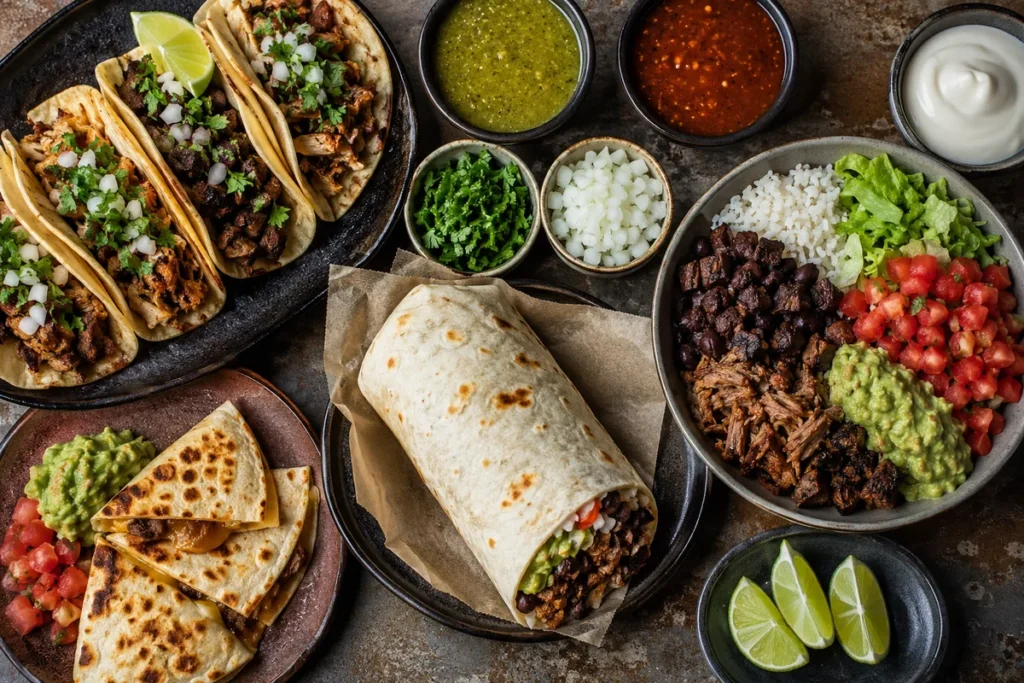
The most common rookie mistake is a giant menu. It feels generous. It is actually a trap. A sprawling board slows every ticket, multiplies prep, and guarantees waste when half the items do not sell. The trucks that print money usually run five to eight items built from the same handful of components. Tacos, burritos, quesadillas, and bowls can all come off the same proteins and toppings, so your prep stays tight while the menu looks varied.
| Menu approach | Items on the board | Effect on the line |
|---|---|---|
| Tight and focused | 5 to 8 items from shared parts | Fast tickets, low waste, easy training |
| Sprawling | 15+ unrelated items | Slow tickets, spoilage, prep chaos |
Price with food cost in mind. Many operators aim to keep food cost somewhere around a quarter to a third of the menu price, which is how a few-dollar taco still leaves room for labor, propane, and the rig payment. Build a simple par sheet so you prep the right amount of each protein for the day and stop guessing. Underprep and you sell out early and disappoint regulars. Overprep and you are throwing money in the gray-water tank.
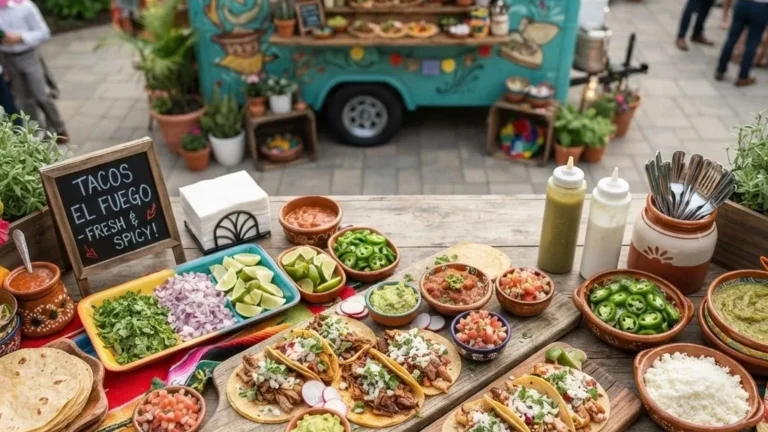
Salsas and crema are where a taco truck earns its reputation. Two or three distinct, well-made salsas do more for repeat business than a fourth protein ever will, and they cost pennies. If you want to push that further, it is worth studying how the broader network treats sauces and spreads over at the salsa and sauce ideas collection, then adapting the technique to your own roasted-chile and avocado blends. A signature green sauce is cheap to make and impossible for a competitor to copy exactly.
One smart, low-cost menu add is a plant-based option. A meaningful slice of customers are vegetarian or fully vegan, and a single well-built plant filling captures a group that would otherwise drive past. A roasted mushroom or seasoned bean taco, or a hearty bowl, fits the same line and the same tortillas. For inspiration on fillings and combinations, the plant-based taco bowls ideas translate cleanly to a taco truck format without adding a single new appliance.
Location, events, and how trucks find customers
A taco truck does not have a fixed address, so location is a daily decision instead of a one-time lease. The strongest operators mix three streams of business. Daily vending puts the truck where hungry people already gather: office clusters at lunch, breweries and bars at night, busy intersections and construction zones. Events and festivals bring volume but often charge a fee or a percentage. Private catering, especially weddings and corporate lunches, is the quiet profit center because you know the headcount and the pay in advance.
The honest gap in most online guides is that they pretend location is solved by parking somewhere busy. It is not. You need legal parking, which means checking zoning and vendor rules for every spot, and you need foot traffic that actually wants tacos at the hour you are open. A brewery with no kitchen is a gift. A crowded street where vending is banned is a ticket. Scout spots on foot, talk to other vendors, and lock in a few reliable anchors before you chase the glamorous festival circuit.
Marketing for a moving business is mostly about being findable. Post your location and hours the same way every day so regulars can plan. A simple, repeatable schedule beats a clever campaign. Catering inquiries are worth chasing hard, since one booked wedding can equal several ordinary service days, and the food cost is locked because you know the count.
The money reality, told straight
Here is the part the hype skips. The often-quoted figure of roughly three hundred fifty thousand dollars a year for a food truck is gross revenue, not what you keep. Out of that come food costs near a quarter to a third, labor that can run another quarter or more, propane and fuel, the commissary, insurance, permits, and the truck payment. Reported profit margins for food trucks commonly land in the high single digits to the mid teens as a percentage of sales, and plenty of trucks land below that, especially in year one.
Seasonality is real and it will test your nerves. Summer and festival season can be wonderful. A cold, wet January in a northern city can be brutally slow, and your fixed costs do not pause. The operators who survive build a cash cushion during the good months instead of spending it. They also keep a written plan and revisit it; the SBA’s guidance on how to write a business plan is genuinely useful for forcing yourself to confront these numbers before the bank account does.
I am not going to hand you a guaranteed payback timeline, because I do not know your city, your spots, or your discipline, and anyone who promises one is selling something. What I can tell you is that the trucks that make it share habits, not luck: a tight menu, fast tickets, clean books, scouted locations, and a calm grasp of the difference between revenue and profit.
Frequently Asked Questions
How much does it cost to start a taco truck?
Most taco operations come together somewhere between roughly fifty thousand and two hundred thousand dollars, with the biggest swing being whether you buy a used rig or build new. The truck or trailer is usually the largest single cost, often around three quarters of the total. These are planning ranges, not quotes, so get real figures from local sellers, your commissary, and your city before committing.
What permits do I need to run a taco truck?
There is no single national license. You typically stack a business registration and EIN, a mobile food vendor permit from the city or county, a local health department permit, a commissary agreement, a fire inspection, and a sales tax permit. The exact list and cost vary widely by jurisdiction, so your local health department and city hall are the final word.
How many items should a taco truck menu have?
Tight beats big. The strongest trucks usually run five to eight items built from the same shared components, so tacos, burritos, quesadillas, and bowls all come off a handful of proteins and toppings. That keeps prep manageable, tickets fast, and waste low. Two or three great salsas do more for repeat business than adding another protein.
Is a taco truck profitable?
It can be, but profit is not the same as revenue. The commonly cited annual figures are gross sales, and after food, labor, fuel, commissary, insurance, permits, and the truck payment, reported margins often land in the high single digits to mid teens as a percentage of sales. Many trucks run thinner than that in year one, and seasonality matters, so a cash cushion and a tight operation are what make the difference.