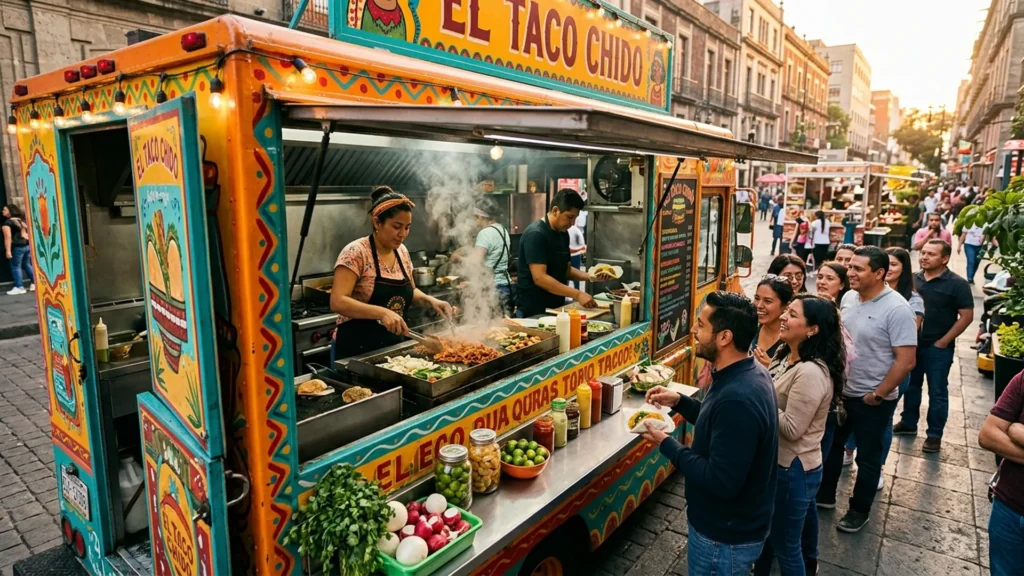
A Mexican food truck is one of the strongest concepts you can put on wheels, and the reason has almost nothing to do with tacos being popular. It is about the economics of the cuisine itself. A short list of shared ingredients recombines into a dozen sellable items, the food cost stays low, the line stays fast, and the demand is everywhere. I have worked these trucks and watched them outperform fancier concepts that cost twice as much to run. This guide is about the Mexican food truck as a business and a menu, the whole cuisine on wheels, not just the taco it is famous for.
If you want the deep dive on the taco itself, the build, the costs, the salsas, I have written that separately, and you can read the full taco truck guide for that focus. Here I want to zoom out to the broader Mexican concept: burritos, tortas, bowls, quesadillas, aguas frescas, and the regional proteins that let one kitchen sell far more than tacos. The numbers below are typical market ranges, not quotes, and your city and menu will move them.
Why Mexican is a top food truck concept
Industry rankings regularly put Mexican near the top of the most profitable food truck concepts, and operators who run the numbers understand why. The base ingredients, tortillas, beans, rice, onion, cilantro, lime, and a few proteins, are inexpensive and transform into high-value menu items. That gap between cheap inputs and a five or six dollar sale is the engine of the whole business, and it is why a well-run Mexican truck can hold its food cost in the twenty-five to thirty percent range while the industry norm drifts higher.
The second advantage is demand. Mexican cuisine appears in something like eighty-five percent of U.S. counties, which means you are not educating customers on what your food is, you are just being the best version of something they already crave. The third advantage is speed. Because the menu is built from pre-cooked, held-hot components, assembly is fast, and fast assembly during a lunch or event rush is the difference between a profitable day and a line that walks away.
The shared-component menu architecture
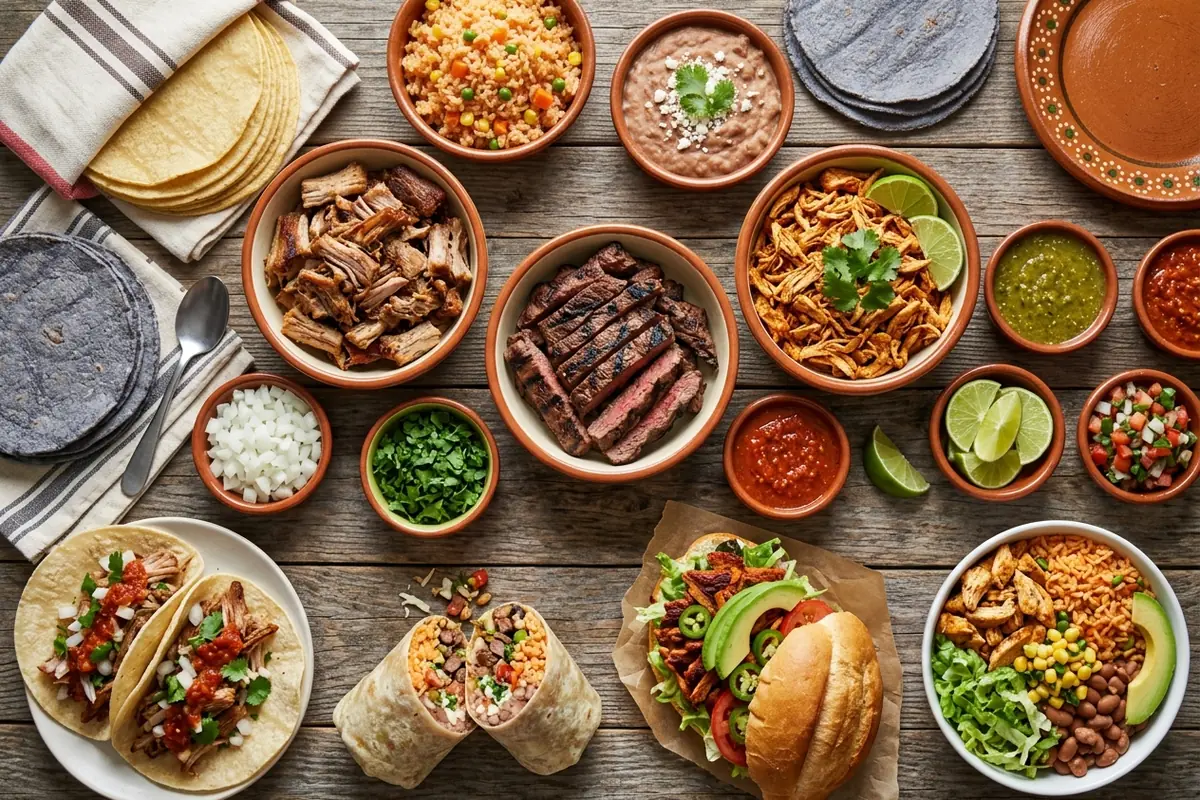
Here is the idea that makes the whole concept work, and the one most guides miss because they stop at tacos. You do not cook a dozen different dishes. You cook a handful of components and recombine them. The same carnitas that fills a taco fills a burrito, a torta, a quesadilla, a bowl, and a plate of nachos. Master five or six proteins and a set of toppings and salsas, and your menu looks generous while your prep list stays short and your waste stays low.
Think of it as a grid. Down one side, your proteins. Across the top, your formats. Every intersection is a menu item built from things you already have hot and ready. That is how a truck offers fifteen things off a board while prepping only a few, and it is the single biggest reason Mexican concepts run lean. Build your menu this way and you get variety without the chaos of a sprawling, slow, wasteful kitchen.
| Format | What it is | Built from |
|---|---|---|
| Tacos | The fast classic, two or three per order | Protein, onion, cilantro, salsa, tortilla |
| Burritos | Higher ticket, filling and portable | Protein, rice, beans, cheese, salsa |
| Tortas | Mexican sandwich on a bolillo roll | Protein, beans, avocado, crema, roll |
| Bowls | Tortilla-free, captures low-carb diners | Rice, beans, protein, toppings |
| Quesadillas | Cheese-forward, kid and crowd friendly | Protein, cheese, tortilla |
| Nachos / loaded fries | Shareable, high perceived value | Protein, cheese, beans, salsas |
The proteins that carry the menu
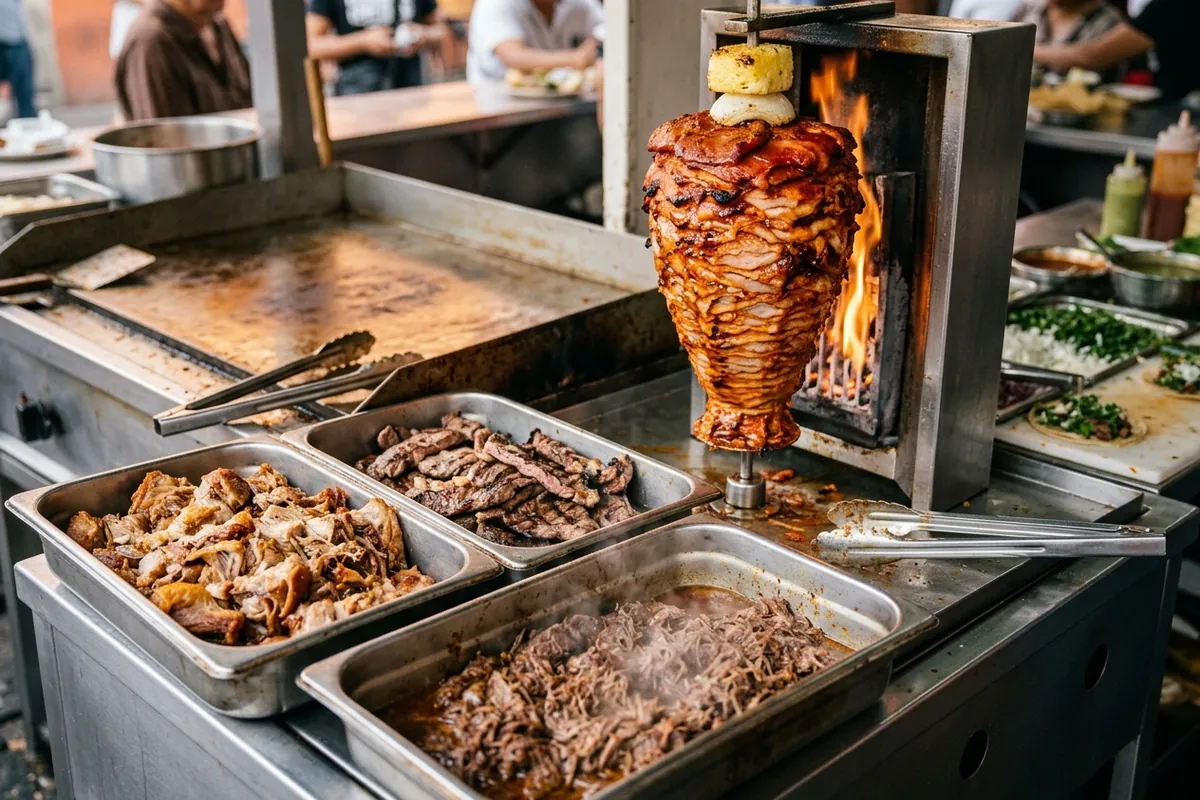
Your proteins are the spine of a Mexican truck, and a strong lineup gives every format something to offer. The core set most trucks run includes al pastor, the marinated pork traditionally shaved off a vertical trompo, carnitas, slow-cooked and crisped pork, and carne asada, grilled and chopped beef. Add pollo, grilled and seasoned chicken, and barbacoa, slow-cooked and shredded, and you have covered the range most customers want.
Then there is birria, the slow-braised, chile-rich beef or goat that has driven one of the biggest street-food waves in years. Quesabirria, the cheesy birria taco served with a cup of consomme for dipping, sells itself and commands a premium. Carrying birria as a special or a signature is one of the easiest ways to stand out, because customers actively seek it out. Round the lineup with chorizo for breakfast and at least one vegetable or plant-based filling, and you have a menu that serves nearly everyone who walks up. You do not need every one of these on day one; pick three or four you can execute flawlessly and add the rest as you learn what your customers actually order.
Do not skip the plant-based option, because it captures whole groups that would otherwise pick a different truck. A rajas, mushroom, or seasoned bean filling fits the same line, the same tortillas, and the same formats, no new equipment required. If you want ideas for building hearty meatless fillings that hold up in a bowl or burrito, the plant-based burrito bowls ideas translate cleanly to a truck format and give your vegetarian and vegan customers a real reason to stop.
Salsas, sides, and the high-margin extras
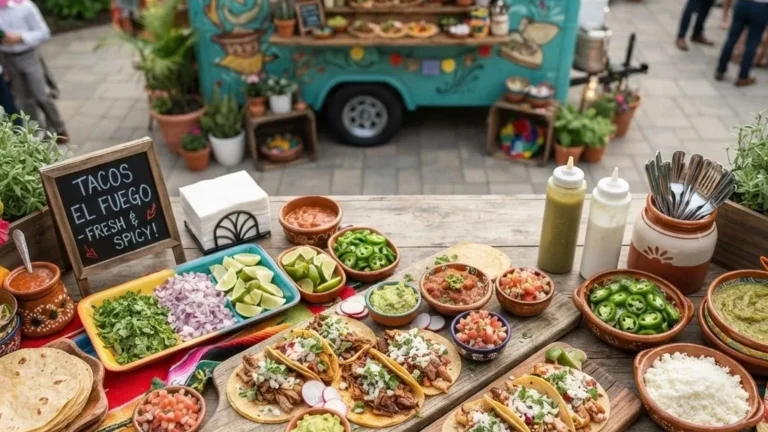
Salsas are where a Mexican truck earns its reputation and almost none of its cost. Two or three distinct, well-made salsas, a bright tomatillo green, a smoky chile de arbol red, a chunky pico, do more for repeat business than a fourth protein ever will, and they cost pennies to produce. A signature salsa is cheap to make, impossible for a competitor to copy exactly, and the thing customers remember when they decide where to eat next week. If you want to sharpen your house salsas and fresh dips, the technique behind a good fresh dip and salsa carries straight over.
The high-margin extras are aguas frescas and a simple dessert. Aguas frescas, the fruit-and-water coolers like horchata, jamaica, and tamarindo, cost very little to make and sell for real money, lifting your average ticket with almost no added labor. A churro or a small sweet rounds out the order. These add-ons are where a lot of a Mexican truck’s profit quietly lives, so price them deliberately and offer them at the window rather than hoping customers ask. A simple line of “drink with that?” from whoever takes the order lifts your average ticket more than any new protein, and it costs you nothing but the habit.
| Menu element | Role on the truck | Margin note |
|---|---|---|
| Core proteins | The reason customers come | Low food cost from cheap cuts |
| House salsas | Signature and repeat-business driver | Pennies to make, hard to copy |
| Aguas frescas | Lifts average ticket | Very high margin, low labor |
| Birria special | Standout that commands a premium | Higher price, strong demand |
What it costs and what it can make
A Mexican truck comes together in roughly the same range as any food truck, somewhere between fifty thousand and a hundred seventy-five thousand dollars to start, with the biggest swing being whether you buy used or build new. A used truck runs about fifty to a hundred thousand, a new build seventy-five to a hundred fifty thousand or more. The Mexican concept does not need exotic equipment, a flat-top or plancha, a steam table for held proteins, a tortilla warmer, and a cold rail for toppings cover most menus, with a vertical trompo only if you commit to traditional al pastor.
On the revenue side, the often-cited figures of an average food truck grossing around three hundred forty-six thousand dollars a year, with top-performing states reaching nearly half a million, are gross sales, not take-home. Net margins for food trucks commonly land in the high single digits, and a tight Mexican operation with its low food cost can sit at the better end of that range. The point is not the headline number, it is that the cuisine’s economics give you a real shot at keeping a healthy slice, if you run a focused menu and clean books.
Permits and food safety are non-negotiable, and the slow-cooked proteins this cuisine loves make temperature discipline especially important. Cooling and reheating carnitas, barbacoa, and birria safely is exactly the kind of thing inspectors check, so build to your local code and lean on the CDC’s guidance on food safety for the handling fundamentals. Register the business and get a tax ID through the IRS guide to getting an EIN, and work through your local requirements using the SBA overview of how to apply for licenses and permits.
Sourcing, prep, and the workflow that keeps it fast
The shared-component menu only works if the prep behind it is disciplined, and this is where a lot of Mexican trucks quietly lose money. The whole model depends on proteins that are cooked ahead, held safely hot, and assembled to order, so your prep day at the commissary matters as much as your service day at the curb. Batch-cook your proteins, carnitas and barbacoa and birria all reward slow cooking in volume, then cool and store them properly so service is pure assembly. The day you try to cook carne asada to order during a lunch rush is the day your line backs up and walks away.
Salsa production is its own small operation, and it pays to treat it that way. Make your two or three signature salsas in batches, store them cold, and keep the cold rail at the window stocked so a taco or a bowl comes together in seconds. Your tortilla strategy is a real decision too: warming quality tortillas from a trusted supplier keeps things simple and consistent, while pressing fresh masa is a genuine differentiator that costs you labor and equipment space. Either can work, but pick one deliberately rather than drifting into whichever is cheapest that week.
Waste control ties the whole thing together. Build a simple par sheet so you prep the right amount of each protein for the day instead of guessing, because underprepping means selling out early and disappointing regulars, while overprepping means throwing money in the gray-water tank. The beauty of the shared-component approach is that leftover proteins flex across formats, today’s taco filling is tomorrow’s burrito, so a tight, cross-utilized menu is also your best defense against spoilage. Run the prep this way and the cuisine’s naturally low food cost actually shows up in your pocket.
Standing out in a crowded cuisine
Mexican is popular, which means you will have company, so differentiation matters. The trucks that stand out usually do one of three things well: they own a regional authenticity, real al pastor off a trompo, a specific Oaxacan or Jalisco style, rather than a generic menu; they make a signature people travel for, a particular salsa or a birria worth the line; or they nail a niche the local trucks ignore, like a strong vegan menu or a breakfast service. Pick a lane and be the best at it instead of being one more decent taco option.
The menu strategy ties back to the whole point of the concept. Keep the board focused, build everything from shared components, lead with one or two standouts, and let the high-margin extras do quiet work on every ticket. For more on building a board that sells and the broader concept thinking across the network, the food truck menus and ideas hub goes deeper on costing and menu design. A Mexican truck does not win by being the cheapest or the fanciest, it wins by being focused, fast, and unmistakably yours.
Location and timing matter as much for a Mexican truck as the menu, because even the best al pastor cannot save a bad spot. The strongest operators mix daily vending where hungry people already gather, office clusters at lunch, breweries and bars in the evening, busy intersections and worksites, with events and private catering that bring volume and predictability. Mexican food travels especially well across all of these, since it photographs beautifully, eats one-handed, and suits both a quick weekday lunch and a late-night crowd. Scout your spots on foot, confirm vending is legal where you want to park, and lock in a few reliable anchors before you chase the festival circuit.
Catering is the quiet profit center worth pursuing hard, because the cuisine is a natural fit for it. A taco or burrito bar with a couple of proteins, a tray of rice and beans, and a spread of salsas scales cleanly to a wedding, a corporate lunch, or a graduation party, and you know the headcount and the pay in advance, which locks your food cost. One booked event can equal several ordinary service days. Build a simple catering package off your existing menu, price it for the guaranteed volume, and you turn the same prep and the same proteins into the steadiest, most profitable part of your week.
Frequently Asked Questions
Why are Mexican food trucks so profitable?
Because the cuisine’s economics are unusually good. The base ingredients are cheap and recombine into many high-value menu items, which keeps food cost low, often in the twenty-five to thirty percent range. The components are pre-cooked and held hot, so assembly and service are fast, and demand is nearly universal since Mexican food appears in around eighty-five percent of U.S. counties. Low input cost, fast tickets, and broad demand together make it one of the top-ranked food truck concepts.
What should a Mexican food truck menu include?
Build it from shared components so a few proteins fill many formats: tacos, burritos, tortas, bowls, quesadillas, and nachos or loaded fries. Run a core of proteins like al pastor, carnitas, carne asada, pollo, and barbacoa, add birria as a standout, and include at least one plant-based filling. Round it out with two or three signature house salsas and high-margin extras like aguas frescas and a simple dessert. Keep the board focused so the line stays fast.
How much does it cost to start a Mexican food truck?
Roughly fifty thousand to a hundred seventy-five thousand dollars, with the main swing being used versus new. A used truck runs about fifty to a hundred thousand and a new build seventy-five to a hundred fifty thousand or more. The concept needs no exotic equipment, mainly a flat-top, a steam table, a tortilla warmer, and a cold rail, plus a vertical trompo only if you serve traditional al pastor. These are planning ranges, so get real local numbers before committing.
How is a Mexican food truck different from a taco truck?
A taco truck focuses on the taco as its core product, while a Mexican food truck runs the broader cuisine, burritos, tortas, bowls, quesadillas, aguas frescas, and multiple regional proteins, with tacos as just one format among several. The Mexican concept leans harder on shared-component menu architecture to sell many items from one prep list. If you specifically want the taco-focused build and costs, that is covered in detail in the dedicated taco truck guide.