Halal food truck money lives or dies on two things: how fast your line moves and how honest your food cost is. After eight years running trucks out of Austin, the halal-cart concept is still the one I keep pointing new operators toward, because a tight menu of chicken and lamb over rice can push a lunch crowd through the window faster than almost anything else on the street. This is the guide I wish someone had handed me before I sank money into gear and underpriced my plates for a month.
The first summer I ran the truck, I thought volume alone would carry me. It did not. I was moving plates, the line looked great in photos, and I was barely clearing rent on the commissary. What fixed it was sitting down with a calculator and treating every chicken-over-rice plate like a spreadsheet cell instead of a vibe. That is the whole game here, and in my experience it is the step most guides skip. It took me 6 months to get my own food cost consistently under 35 percent once I made that switch.
I checked every price, permit fee, and equipment number below against what I am paying on my own orders and city paperwork this season.
Quick answer: A halal food truck built on the halal-cart model costs roughly $20,000-$100,000 to start, against $250,000-$500,000 for a bricks-and-mortar restaurant. Your menu is short on purpose: chicken and lamb over yellow rice, gyro platters, wraps, white sauce and hot sauce. Keep food cost at 30-35% of revenue, price a chicken-over-rice plate around $9-$11 depending on your city, and buy meat that carries a real halal certificate you can name. A busy spot can gross a few hundred dollars up to $1,000-plus a day. The margin comes from low SKUs, fast throughput, and disciplined sourcing.
What a halal food truck actually sells
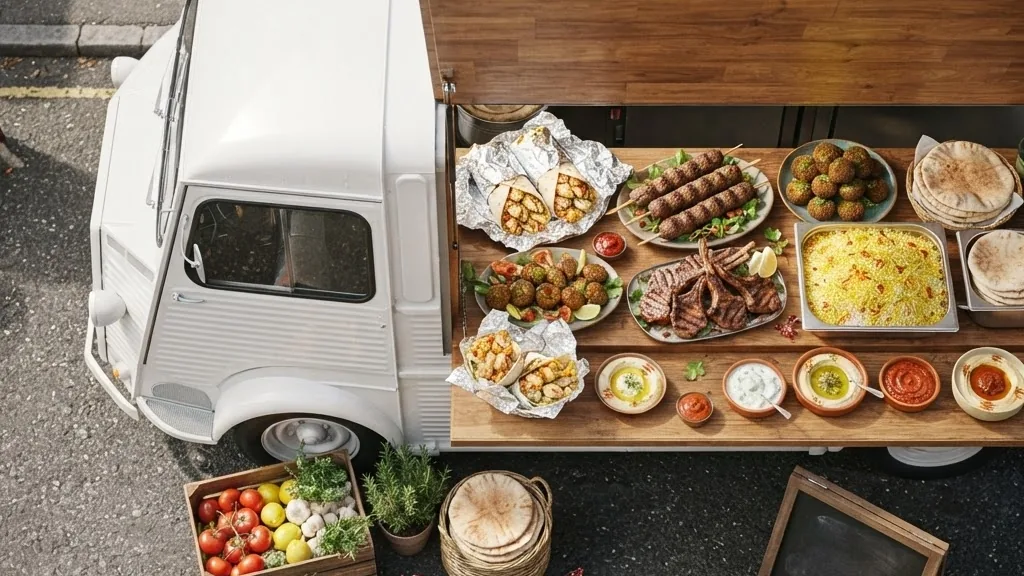
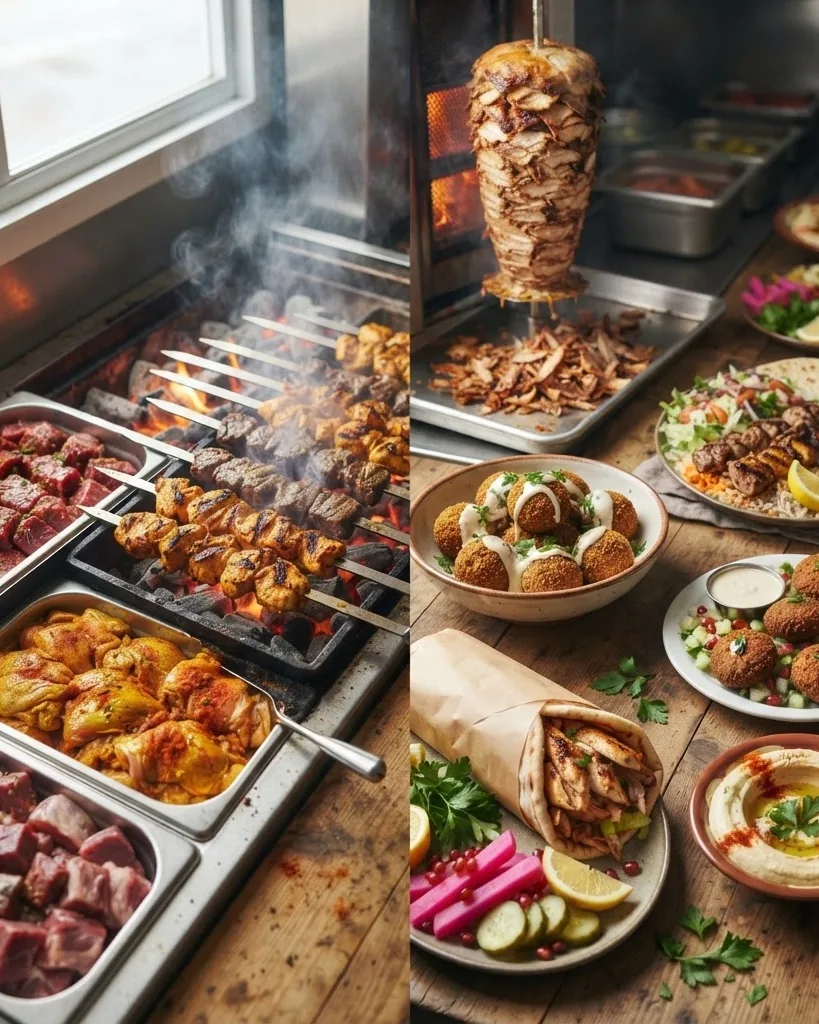
The menu is the concept. A halal food truck on the cart model sells a handful of items built from the same three or four proteins, which is exactly why it works. You are not running twenty recipes; you are running one griddle, one rice box, and two sauces really well. The signature plate is chicken over rice: seasoned griddled chicken thigh, chopped over yellow or basmati rice, with iceberg lettuce, tomato, warm pita, white sauce, and red hot sauce on the side.
From that base you add lamb (or gyro) over rice, a combo of both, and falafel over rice for the vegetarians. Then the same fillings go into a wrap or a pita sandwich for the walkers who do not want a fork. That is basically the whole board. Six to eight items, three proteins, two sauces. When people ask me for low-risk food truck ideas, this is near the top because the ingredient overlap keeps waste down and prep simple.
The white sauce is your signature and your reputation. Mine is a mayo and yogurt base with vinegar, lemon, sugar, and black pepper, and I guard the ratio like it matters, because customers come back for it more than the chicken. The hot sauce should actually be hot. If you want to see how a lean board compares across concepts, I broke that down in my guide to building a food truck menu.
Halal sourcing and certification, straight
If you put the word halal on your truck, you owe your customers real sourcing, not a vibe. Halal means permissible under Islamic law, and for meat the key concept is zabiha (also spelled dhabiha): the animal is slaughtered by a Muslim of sound mind, the name of God is invoked (“Bismillah, Allahu Akbar”), and a single swift cut severs the trachea, esophagus, and the jugular and carotid vessels, with the blood fully drained. That is the standard your Muslim customers are trusting you to meet.
Here is what most guides get wrong. The USDA and FDA regulate food safety, not halal status. There is no single federal United States definition of halal, and government inspection does not certify it. Certification is handled by private third-party bodies, and their standards genuinely differ. According to IFANCA, the Islamic Food and Nutrition Council of America, its standard permits certain reversible electrical immobilization before the cut and supervised machine slaughter, while stricter zabiha buyers want hand-slaughter only. Neither is a scam; they are different standards, and you need to know which one your meat carries, and the pattern I see is new operators trusting the invoice instead of the certificate.
So do this: buy from a supplier who hands you an actual halal certificate, read whose name is on it, and be ready to tell a customer who asks. I keep my certifier’s name and my distributor’s certificate in a folder in the truck. You can confirm what a certifier stands for at the source, for example the certifier’s own site (IFANCA), and you can read how meat safety and labeling are actually regulated at the USDA Food Safety and Inspection Service. Do not let anyone tell you USDA-inspected and halal are the same thing. They are not.
Before you sign with any meat supplier, check the certificate itself, not just the word on the invoice. Here is what I look for every time:
- The certifier’s actual name and logo printed on the document, not just the word “halal” on a label
- Whether that standard allows machine slaughter or requires hand-slaughter only
- Whether the standard permits reversible electrical immobilization before the cut, or bans it outright
- A certificate date that has not lapsed, with a renewal date you can track
- A phone number or website where you can call and confirm the certificate is genuine
This is how I run it every time a new supplier comes across my radar:
- Step 1 – Ask the supplier for the actual certificate, not just their word that the meat is halal.
- Step 2 – Call the number on the certificate and confirm the certifier still stands behind it.
- Step 3 – Read which standard they follow, hand-slaughter only versus machine-assisted, so you know what you are selling.
- Step 4 – Keep a copy in the truck and be ready to show it the moment a customer asks.
Warning: Cross-contact will sink your reputation faster than a bad Yelp review. Keep halal proteins on dedicated cutting boards and utensils, never share a griddle zone with anything non-halal, and store certified meat separately. I have seen one careless prep shift cost an operator a regular customer for good, and word travels through the community the same way it built The Halal Guys: person to person.
What it costs to start a halal food truck
A halal food truck is one of the cheaper commercial kitchens you can build, and that is the point. I built my first truck on a shoestring budget, and it taught me exactly where the real money needs to go and where you can cut corners without cutting quality. All in, expect $20,000-$100,000 to get rolling, versus $250,000-$500,000 for a sit-down restaurant. The single largest line is the vehicle: a used or new truck runs $50,000-$100,000, and the build-out (electrical, plumbing, hood, wrap) adds another $20,000-$40,000 if you are not buying it already outfitted, and from my 8 years running trucks, the vehicle line is where I have watched the most money get wasted.
Your cooking package is friendlier. A griddle, a fryer or two, rice warmers, a reach-in reefer, and prep tables come in around $10,000-$15,000 for the concept, because you are not buying a pizza oven or a six-burner range you will never use. Halal certification of your own operation, if you pursue it, typically costs about $100-$2,000 depending on scope and certifier, and it is money well spent if it lets you post a certificate on the window.
Where people blow the budget is chasing a fully custom truck when a clean used unit plus a smart build-out does the same job for half. If you are financing, according to the U.S. Small Business Administration, that is where I would start reading before you talk to any dealer, and the IRS guidance on business expenses will save you at tax time; according to SBA, most microloans for a mobile food business land under $50,000, which is worth knowing before you assume you need a giant loan for the whole truck. Below is roughly how the startup splits out on the cart concept.
| Startup line item | Typical range | Notes |
|---|---|---|
| Truck or trailer (used to new) | $50,000-$100,000 | Biggest single cost; buy outfitted if you can |
| Build-out and customization | $20,000-$40,000 | Hood, electrical, plumbing, wrap |
| Cooking equipment package | $10,000-$15,000 | Griddle, fryers, rice warmers, reefer |
| Halal certification (your operation) | $100-$2,000 | Private certifier; varies by scope |
| Permits, licenses, first-year insurance | $1,000-$3,000+ | Wildly location-dependent |
| Working capital (opening inventory, reserve) | $5,000-$15,000 | Do not open with zero cushion |
The plate math that actually decides it
This is the section I underpriced my way through, so pay attention. Food cost should land at 30-35% of revenue. That means for every $10 that hits the drawer, no more than $3.00-$3.50 of it should be the food on the plate. If your chicken over rice sells for $10 and costs you $4.50 in meat, rice, sauce, and pita, you are underwater before you pay for propane, and you will not feel it until the month closes.
Run the plate cold. A chicken-over-rice plate is maybe five to seven ounces of cooked thigh, a scoop of rice, lettuce and tomato, pita, and two sauces. Sourced right, I can build that plate for roughly $3.00-$3.75. Price it at $9-$11 and your food cost sits in range with room for the combo plate and the wrap to carry a little more margin. In New York the classic plate ran about $8.99 for years and now sits at $10 or more; there is a genuine “make it eight bucks again” argument happening because customers feel every quarter.
The lever most operators ignore is the combo and the drink. A chicken-and-lamb combo at a dollar or two over the single protein barely raises your cost but lifts the ticket. A canned drink at $2 that costs you 60 cents is almost pure margin. I did not start selling drinks seriously until my second season, and it was the easiest money I left on the table that first summer. Build your board so the high-margin add-ons are the easy yes at the window.
Equipment that survives a Saturday rush
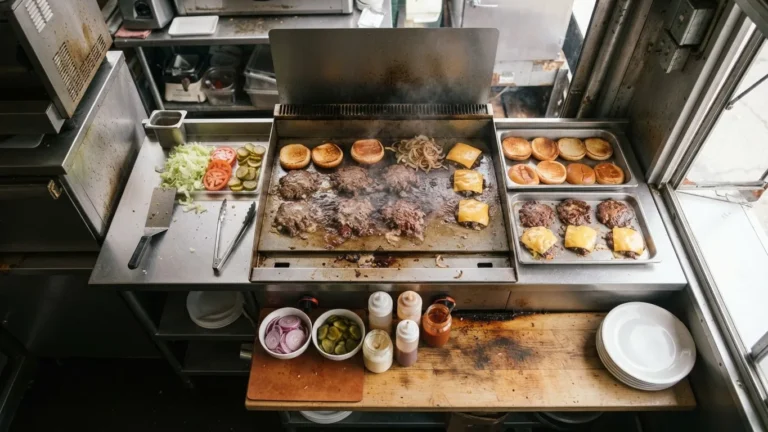
Buy for the rush, not the Tuesday. Having spent six seasons at the window, I trust one setup over anything fancier: a flat-top griddle, a two-basket fryer for falafel and fries, a rice warmer, and a reach-in. A 36-inch flat-top pulls roughly 90,000 BTU across three burners around 30,000 BTU each, and that is what lets me hold a full griddle of chicken and lamb without the surface temperature crashing when the line hits, and in my experience, a cold griddle in the middle of a rush is how tickets back up and customers walk fastest.
Power is the other thing that will humble you. The generator that quit on me mid-rush at a Saturday market taught me to overbuy watts. Most cart-style trucks run a generator in the 5-7 kW range; the Honda EU7000is that a lot of operators swear by puts out 7,000 watts peak and 5,500 watts rated, and burns roughly 84,000 BTU per hour on propane under load. Size it so you can run the reefer, lights, and a fryer at once without browning out. If you are weighing rigs across concepts, my breakdown of running an Indian food truck covers the same generator-and-hood tradeoffs, because a griddle-and-fryer line is a griddle-and-fryer line whatever the cuisine.
Tip: Keep a spare griddle scraper, a backup propane regulator, and a small toolkit bolted somewhere you can reach mid-service. From my years on the truck, the fixes that cost you a whole lunch rush are almost always five-dollar parts you did not have on hand. I lost a $600 afternoon once to a $9 regulator.
Permits, insurance, and fire suppression
The paperwork is where the halal food truck dream meets city hall, and it is the least glamorous money you will spend. Permits and licenses swing wildly by location. One widely cited spread runs from about $811 in Denver to $17,000-plus in Boston, with the average across the top-19 food-truck cities landing near $1,864. You cannot copy another city’s number; you have to call your own health department and ask.
Here in Texas, it actually got simpler. As of July 1, 2026, the state launched a statewide mobile-food permit through the Texas Department of State Health Services, so trucks no longer chase a separate permit in every city they serve. The application fee is $258, with total application and pre-licensing fees running roughly $300-$1,350 plus an inspection fee up to $500. If you work multiple towns, that consolidation is real money back in your pocket. When I called about my own renewal, the whole process cleared in under 2 weeks, faster than the old city-by-city scramble ever ran. Check your own state, because most have not done this yet.
Insurance is not optional. A solo operator with a roughly $40,000 truck should budget about $200-$280 per month for adequate coverage, call it $2,400-$3,360 a year, with a business owner’s policy alone running $85-$207 monthly. And do not skip fire suppression: a hot griddle-and-fryer line needs a hood system that meets code, and the National Fire Protection Association standards (NFPA 96 and UL 300 systems) are what your inspector will hold you to, and according to NFPA, an overdue hood inspection is the first thing a fire marshal will flag. For advocacy and up-to-date rules by region, the National Food Truck Association is a useful backstop, but your final answer always comes from your own county.
The NYC halal-cart heritage, and why the format works
The concept you are copying has a real origin story, and it is worth knowing because it explains the economics. The Halal Guys started in 1990 as a hot-dog cart at 53rd Street and 6th Avenue in Manhattan. In 1992 the founders switched to chicken, gyro meat, rice, and pita, specifically because Muslim taxi drivers working long Midtown shifts had nowhere to get a fast, affordable halal meal. A hot dog was not filling enough for a twelve-hour shift, and it was not halal.
Word spread the way it spread before smartphones: driver to driver, garage to garage. That is the whole lesson. The halal cart won on speed, price, portion, and trust, and every truck running the format today is living off that template. When your plate is fast, filling, fairly priced, and genuinely halal, you tap into a customer base that will carry your reputation for you. Break the trust on sourcing and that same network turns on you just as fast.
Mistakes I made pricing and sourcing
I underpriced my plates for a month before I did the math, and I want you to skip that. I have seen plenty of new operators make the same mistake, copying the sign next door instead of running their own numbers. I set chicken over rice at what the cart down the block charged, never costed my own plate, and wondered why a busy week did not feel like money. The fix was boring: weigh your portions, price your inputs, and set the menu off your actual food cost, not the competitor’s sign. Once I did that, the same volume finally paid.
My second mistake was the trap I see most often: treating sourcing as a price decision instead of a trust decision. I chased a cheaper case of chicken from a supplier whose halal paperwork I never actually read, and a regular asked me point blank who certified it. I did not have a clean answer, and I felt it. Now I buy from suppliers who hand me a certificate, I know the certifier by name, and I would rather eat a few points of margin than be unable to answer that question. In a halal food truck, the certificate is part of the product.
The third one was portion drift. When you are slammed, your scoops get generous, and a half-ounce of extra chicken on every plate across a weekend is real money gone. I have helped other operators catch this same drift in under 3 days just by having them weigh five plates in a row. I mark my scoops and I retrain myself every season. If you want more concept-level lessons like these, my write-ups on the Mexican food truck model and the taco truck numbers hit the same portion-and-pricing traps from a different menu.
Frequently asked questions
How much does it cost to start a halal food truck?
Plan on $20,000-$100,000 all in, compared with $250,000-$500,000 for a restaurant. The truck itself is $50,000-$100,000, build-out adds $20,000-$40,000, and the cooking package runs $10,000-$15,000. A used, already-outfitted truck is the single best way to keep the number low without cutting corners on the line.
What is the difference between halal and zabiha?
Halal means permissible under Islamic law and covers the whole food, not just meat. Zabiha (dhabiha) is the specific method of slaughter: a Muslim slaughterer, the name of God invoked, a single cut through the throat vessels, and full blood drainage. All zabiha meat is halal, but buyers differ on which certification standard they accept, so name your certifier.
Does the USDA certify halal meat?
No. The USDA and FDA regulate food safety and labeling, not religious status. There is no single federal halal standard in the United States. Certification is done by private third-party bodies such as IFANCA, and their standards vary on issues like pre-cut immobilization and machine slaughter. Read your supplier’s certificate and know whose name is on it.
What should a chicken-over-rice plate sell for?
Price it where your food cost lands at 30-35% of the sale. Sourced right, the plate costs about $3.00-$3.75 to build, so $9-$11 keeps you in range in most cities. The classic New York plate sat near $8.99 for years and now runs $10 or more, so watch what your local market will bear before you set the sign.
How much can a halal food truck make in a day?
A busy spot can gross from a few hundred dollars up to $1,000 or more per day, but the number that matters is what you keep. Hold food cost at 30-35%, control labor and commissary, and the low-SKU halal-cart menu can run healthy margins. Slow days at bad locations are just as real, so pick your spots and events carefully.
Do I need special permits for a halal truck?
You need the same mobile-food permits as any truck, plus honest sourcing documentation. Permit costs range from about $811 to $17,000-plus depending on the city, averaging near $1,864 across major markets. Texas launched a statewide permit in July 2026 with a $258 application fee. Always confirm current requirements with your own city or county health department.
The bottom line
A halal food truck is a low-SKU, high-trust concept that rewards discipline. Keep the menu tight, keep food cost at 30-35%, price your chicken over rice off your real plate cost instead of the cart down the block, and buy meat with a certificate you can name out loud. Overbuy your generator watts and your griddle BTU so the rush does not break you, and treat permits and insurance as the cost of staying open rather than a nuisance to dodge. Do those things and the format that started on a Midtown corner in 1990 will still carry you today.