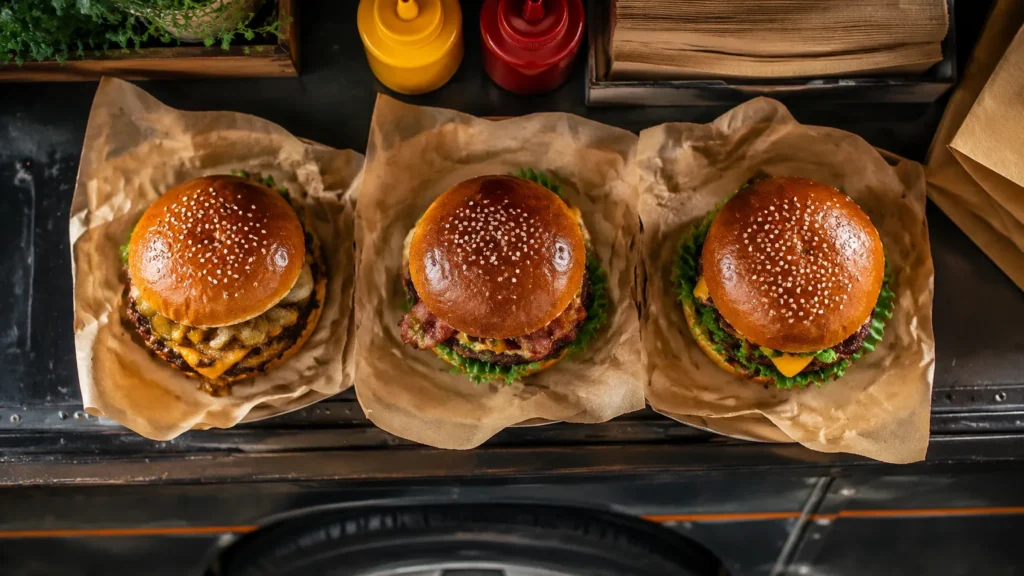
A burger food truck is the concept everyone understands and half the industry underestimates. The demand is universal, the ingredient list is short, and the smash-burger style that took over the last decade happens to be the single fastest thing you can cook on a flat-top, which matters more than any branding decision you will make. I have cooked burgers at 70 tickets an hour and watched beautiful half-pound patties strangle a line at 25. This guide covers the whole business: the $50,000 to $100,000 startup, the cost of every component on the bun, the pricing method that protects margin, and the throughput math that decides what your truck can actually gross.
Why burgers earn their place on a truck
Three reasons the concept keeps working, decade after decade. First, zero explanation cost: nobody reads a burger menu twice, and at a festival window that translates directly into ticket speed. Second, a tight ingredient list, beef, buns, cheese, a short topping bench, means simpler ordering, less waste, and fewer suppliers than almost any other savory concept.
Third, the smash burger rewrote the physics. A 3-to-4 ounce ball smashed thin on a 375-degree Fahrenheit flat-top cooks in roughly two minutes with a crust a thick patty cannot match. In my experience that two-minute cook is the difference between a truck that caps at $800 on a good lunch and one that pushes $1,800 at the same corner. Speed is not a bonus in this concept; it is the concept.
Startup costs and where the money goes
According to Square’s 2025-2026 food truck cost guide, trucks launch between $50,000 and $200,000, and burger builds cluster in the lower-middle of that range: $50,000 to $100,000 is the realistic planning band for a used truck with a proper griddle line. Industry startup breakdowns put the split in consistent proportions.
| Budget line | Share of startup | On a $80,000 build |
|---|---|---|
| The truck itself (used, fitted) | 50 – 60% | $40,000 – $48,000 |
| Kitchen equipment | 15 – 25% | $12,000 – $20,000 |
| Permits, licenses, inspections | 5 – 10% | $4,000 – $8,000 |
| Working capital (first months) | 10 – 15% | $8,000 – $12,000 |
The equipment line centers on the flat-top griddle, the largest your hood and power plan support, plus a fryer for sides, cold storage sized for ground-beef turnover, and the generator or shore-power arrangement. The fryer-and-griddle combination puts a burger truck in the strictest fire-inspection class, so hood suppression is a budget line, not an afterthought; our food truck equipment guide walks the buy-used-versus-new call for each piece.
The working-capital line is the one first-timers cut and regret. Ten to 15 percent of the budget held back as cash is what survives the slow first quarter, the surprise generator repair, and the three weeks a permit office sits on your paperwork. The SBA’s small business guidance (sba.gov) treats undercapitalization as the classic first-year killer, and food trucks are not the exception.
The cost-per-burger build, at 2026 prices
Every pricing decision starts from an honest build cost. Here is a standard smash cheeseburger costed at 2026 wholesale prices, with the ranges reflecting supplier and region.
| Component | Spec | 2026 cost |
|---|---|---|
| Beef patty | 4 oz 80/20 ground chuck | $1.30 – $1.75 |
| Bun | Potato roll, commercial case | $0.40 – $0.60 |
| Cheese | American slice | $0.20 – $0.30 |
| Toppings | Onion, pickle, sauce | $0.25 – $0.45 |
| Wrap, foil, napkin | Service packaging | $0.15 – $0.25 |
| Total build | $2.30 – $3.35 |
Add bacon or a second patty and the build crosses $3.20 to $4.50, which is exactly the range the pricing method below is built for. Two cost-control rules matter more than any supplier switch: portion the patties by weight, every time, because a crew eyeballing 4-ounce balls drifts to 4.5 ounces and quietly eats 12 percent of your beef margin; and track the cheese, since slices vanish into staff meals and remakes faster than any other line item. What I learned running the numbers weekly is that beef price swings get blamed for margin erosion that portioning drift actually caused.
Pricing: the 65 percent method
According to Toast’s food truck pricing methodology, you price from a target gross margin: divide the build cost by one minus the margin target. Their worked example is the industry reference: a burger carrying $3.20 in ingredients at a 65 percent gross margin target prices at $9.14, because $3.20 divided by 0.35 equals $9.14. Round to $9 or $9.50 and the math holds.
The band that results is where nearly every successful burger menu lives: $8 to $15 per item, with combo and premium builds pushing tickets to the $14 to $22 range that industry benchmarks report for premium burger concepts. Resist the urge to price the signature burger like a restaurant does, as a loss-leader; on a truck the signature is most of what you sell, so it must carry full margin. Price the plain build as the value anchor instead.
Fries change the ticket math more than any burger decision. A serving of fries costs $0.35 to $0.55 in potatoes and oil and sells for $4 to $5, a margin profile close to coffee’s. A $9 burger alone is a decent ticket; a $14.50 burger-fries-drink combo built on the same two minutes of griddle time is a great one. That is the whole argument for carrying the fryer and its fire-suppression cost.
Throughput: the real revenue ceiling
Here is the math no startup-cost page runs, and it decides your gross more than any menu decision. Revenue per hour equals tickets per hour times average ticket, and tickets per hour is capped by griddle area divided by cook time.
Work an example on a 36-inch flat-top, which holds roughly 12 smash patties with working room. At a two-minute smash cook plus turnover, that surface produces around 250 to 300 patties per hour flat out, far more than the window can sell, which means a smash truck’s bottleneck is order-taking and assembly, fixable with staffing. Now run the same math with 8-ounce pub patties at a six-to-seven minute cook: the same griddle yields 70 to 90 patties an hour, and suddenly the griddle is the bottleneck and no amount of staffing raises the ceiling. Having spent long service windows on both sides of that trade, I will take the thin patty every time the line is longer than five people.
Translate to money. A four-hour lunch window at 50 tickets an hour and a $12.50 average ticket grosses $2,500; the same window bottlenecked to 25 tickets an hour grosses $1,250 with identical food, identical fees, identical labor hours. The $500 to $2,000 daily revenue range the industry reports is substantially a throughput spread, not a demand spread. Design the menu for the flat-top’s fast lane and reserve the slow builds for a two-item premium section that never blocks the line.
Menu architecture and the fries question
The standard guidance holds: 8 to 12 items, every one sharing the same station flow. For a burger truck the architecture that works is a spine of three builds, plain, cheese, signature, at escalating price, one chicken or veggie option that cooks on the same surface, fries two ways, and drinks. That is nine items and a complete menu.
- The signature carries the brand. One build with a name, a sauce you make, and a photo that travels: it is the reason to choose your window over the chain across the street.
- The plain build anchors value. An $8 honest cheeseburger reads fair at every event and makes the $12 signature look reasonable next to it.
- Loaded fries are the ticket-lifter. The overlooked detail in burger menus is that loaded fries, $2 of added cost sold at $8 to $9, outperform a second premium burger on both margin and prep simplicity.
- Cap the toppings bench. Every added topping is inventory, prep time, and a slower decision at the window. Five toppings cover 95 percent of orders.
Menu costing and station-flow design get the full treatment in our food truck menu guide; the burger-specific rule is simply that nothing on the board should take longer than the patty.
Route strategy by daypart
Burgers sell everywhere, which is a trap: the concept works so broadly that weak spots feel acceptable. The route that maximizes the concept plays to volume windows.
- Weekday lunch, office and industrial districts. The core: 11 a.m. to 1:30 p.m., speed-dependent, smash-friendly. A locked weekly rotation beats roaming; lunch crowds are habit buyers.
- Brewery evenings. The classic pairing. Breweries without kitchens want exactly one reliable burger truck, and the 5-to-9 window at a good taproom rivals a lunch corner with none of the parking fight.
- Weekend events and festivals. Burgers are a top-three festival category every year. Trim to the three fastest builds and let throughput do the work.
- Late-night, where your city allows it. Bar-close crowds buy burgers at premium prices with zero sales resistance; check local vending hours before building the plan around it.
The weekly calendar that results, five lunches, two brewery nights, one weekend event, is a realistic $5,000 to $9,000 gross week for a well-run truck in season, sitting comfortably inside the industry’s $250,000 to $500,000 annual gross band.
Sourcing beef without losing the margin
The beef line is half the build cost, so sourcing discipline is margin discipline. The workable options, in the order most trucks graduate through them: restaurant-supply case-lots of pre-ground 80/20 chuck, the simplest start; a standing order with a local butcher or small distributor, which usually buys better consistency at a similar price once volume justifies it; and custom grinds with a named blend, a brisket-chuck mix is the classic, which cost more per pound and earn it back only if the menu says so out loud.
Two rules protect the line. First, lock the patty spec in writing, fat ratio, grind size, ball weight, and audit deliveries against it, because grind drift is invisible until the crust stops forming and the shrink changes. Second, hedge price swings with the menu rather than the supplier: when chuck moves 15 percent, a fifty-cent menu adjustment on the signature build recovers it, and burger customers tolerate honest small increases far better than shrunk patties. Cheese and buns reward the same case-lot attention at a tenth of the stakes.
The first 90 days: proving the concept
The launch sequence that de-risks the investment runs in three legs. Days 1 to 30: one locked lunch spot plus one brewery night, menu capped at the three-build spine, every shift’s numbers logged, tickets per hour, average ticket, waste. You are not building revenue yet; you are calibrating the machine. Days 31 to 60: add the second and third lunch corners and the first weekend event, and start the combo push, because the fries attach rate is the single number that moves the ticket average fastest.
Days 61 to 90: raise prices where the line says you can, an eight-minute wait at $9 is the market telling you the signature carries $10, cut the item nobody orders, and book the next quarter’s events off the numbers you now trust. When I managed this ramp on a new build, the useful discovery was that the second month’s data made every decision the first month argued about: the route, the pricing, and the menu all stopped being opinions. Ninety days of honest logs is what turns the industry’s benchmark ranges into your own operating numbers.
The business numbers, assembled
Pull it together with the benchmark figures attributed where they belong. Startup: $50,000 to $100,000 for the burger build, per the Square-range planning above. Revenue: $250,000 to $500,000 gross annually, $500 to $2,000 per day depending on spot and season, per industry benchmark data. Net margins: 7 to 15 percent, translating to owner profit of roughly $30,000 to $75,000 on a single truck, with break-even typically arriving 9 to 18 months in. The concept’s edge inside those averages is the throughput ceiling: a smash-focused menu at strong locations pushes daily figures toward the top of the range on the same cost base.
The honest risks are beef price volatility, which moved patty costs double digits in recent years and must be priced ahead of, not behind; the fire-inspection burden of the fryer-griddle combination; and concept saturation in strong markets, which the signature build and the route discipline answer. A written plan tying the numbers together, and our food truck business plan template does exactly that, is what a lender or investor will ask for first.
Frequently asked questions
How much does a burger food truck cost to start?
Plan for $50,000 to $100,000: 50 to 60 percent on the truck, 15 to 25 percent on equipment, 5 to 10 percent on permits, and 10 to 15 percent held as working capital. New custom builds push toward the top of the industry’s $200,000 ceiling.
What should I charge for a burger?
Price from the build: divide ingredient cost by 0.35 for a 65 percent gross margin. A $3.20 build prices at $9.14 by Toast’s method. Keep the menu in the $8 to $15 band and let combos and premium builds carry tickets to $14 to $22.
How much can a burger truck make?
Industry benchmarks: $250,000 to $500,000 gross per year, $500 to $2,000 per day, 7 to 15 percent net, owner profit of $30,000 to $75,000 on one truck, break-even in 9 to 18 months. Throughput and location decide where in those ranges you land.
Why do smash burgers dominate trucks?
Cook time. A thin smashed patty finishes in about two minutes against six-plus for a thick patty, which doubles or triples the tickets a griddle can produce per hour. In a four-hour window, that cook-time difference is the revenue ceiling.
Do I really need the fryer?
Financially, yes. Fries cost around $0.50 a serving and sell at $4 to $5, and loaded fries lift tickets further at almost no station cost. The trade is stricter fire-suppression requirements, which belong in the startup budget from day one.
About the author and sources
Sal Bendetti cooks on food trucks and writes the operational guides on The Truck Chef, from batch prep to route strategy. Figures in this guide are attributed to Square’s food truck cost guide (startup ranges), Toast’s pricing methodology (the 65 percent example), industry startup breakdowns for budget splits, and industry revenue benchmarks for daily and annual gross. Build costs and throughput figures are 2026 operating ranges from service practice; your suppliers and market move them.
Costs, revenues, and margins are published benchmarks and operating ranges, not guarantees. Permits, fire codes, and vending rules vary by city and county; verify locally, and take real financing decisions to someone qualified to review your numbers.