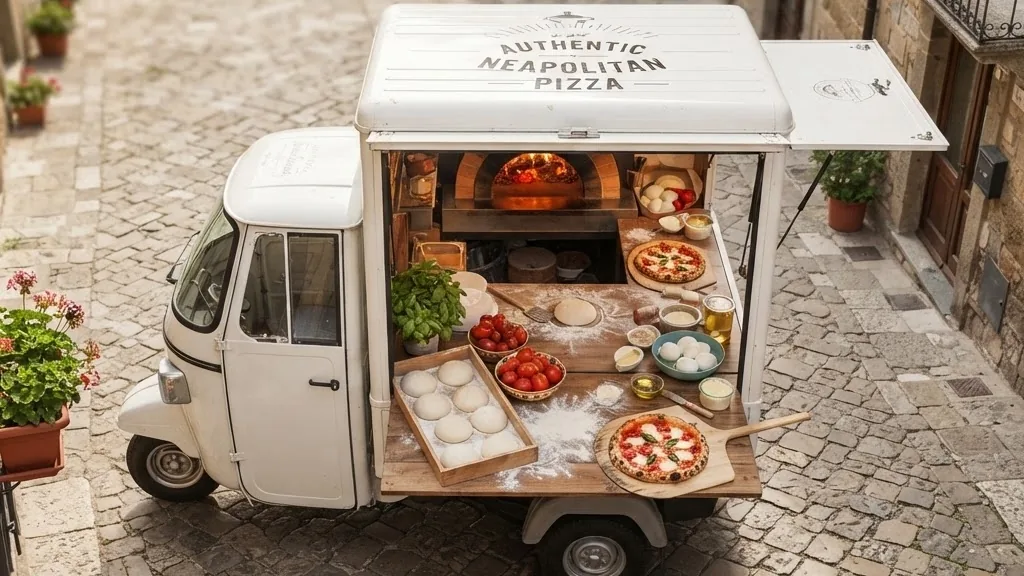
Pizza truck economics live or die on one thing the glossy startup guides skip: how fast the oven can push finished pies out the window. A pizza truck can be built beautifully, wrapped perfectly, and staffed by a real pizzaiolo, and still lose money if the cook line caps out at a rate the lunch line outpaces.
The trade uses the term throughput, and it is the single limiting factor of the mobile model. Everything else, permits, branding, financing, menu, hangs off that constraint. This guide treats the oven as the center of the business and works outward from there.
That makes the physics of baking, not the recipe, the thing you plan around first.
Quick answer: A pizza truck is a mobile kitchen built around a high-temperature oven, and it works as a business when the oven’s output matches your busiest hour. Expect startup costs of roughly $50,000 to $175,000 and a break-even window of 6 to 12 months (pizzapreptable). The industry’s average net margin runs about 6.8 percent versus 1 to 3 percent for a fixed restaurant (IBISWorld, 2024). Fire compliance under NFPA 96 and a health-department-approved commissary are non-negotiable before you serve a single slice.
Why the oven, not the recipe, decides the business
The oven is the bottleneck of every pizza truck, and picking one is a throughput decision before it is a flavor decision. A wood-fired oven baking true Neapolitan pizza runs at 430 to 485 degrees Celsius, roughly 905 degrees Fahrenheit, and cooks a single pie in 60 to 90 seconds, per the Associazione Verace Pizza Napoletana (AVPN).
That speed is spectacular, but the chamber usually fits only a few pies at once, so your ceiling is set by floor space and recovery time, not by how fast a single pizza cooks. Gas and electric decks trade the theatrical char for steadier temperature and simpler venting. Your menu style follows the heat you choose, never the other way around.
- Wood-fired: highest heat, fastest single bake, most maintenance and fuel handling. It also carries the heaviest permitting load because solid fuel and grease-laden vapor both trigger stricter NFPA 96 hood and suppression rules.
- Gas deck: predictable recovery, easier to hold temperature during a rush. Propane supply then falls under NFPA 58, which aligned with NFPA 96 in the 2024 code cycle.
- Electric: simplest venting and cleanest permitting profile, lower peak heat. It is often the practical choice where a jurisdiction is strict about open flame or where power is available at your regular stops.
Match the dough to the deck. A Neapolitan crust wants the 905 degree Fahrenheit blast and the 60 to 90 second window; a New York style pie wants a lower chamber and a longer bake. Trying to run both off one oven means one of them cooks wrong.
The edge case worth naming is the operator who wants both styles for menu variety. In practice a single deck cannot hold two target temperatures at once, so you either commit to one style or carry a second oven, which eats floor space and fuel. On a truck where every square foot competes with prep and refrigeration, that second oven is rarely worth it.
Throughput math: the number that caps your revenue
Throughput is pizzas per hour, and it is the ceiling on what a pizza truck can earn during a rush. If a wood-fired chamber cooks a Neapolitan pie in 60 to 90 seconds per the AVPN, that single-pie speed is misleading, because you also lose time launching, turning, and pulling pies, plus oven recovery between loads.
A truck that looks fast on paper stalls when forty people arrive at noon and the deck holds only a handful of pies. Two levers relieve the pressure:
- Par-baking crusts during slow periods so peak service becomes topping and finishing only, which cuts the per-order time the customer actually waits through.
- A tight menu so the cook is not hunting for obscure toppings mid-rush and every order draws from the same short prep line.
Work a simple example: if that noon crowd is forty orders and your effective pace after turning and recovery is one finished pie every two minutes, a single oven clears thirty pies in an hour and you have lost the last ten customers to the wait. Par-baking or a second finishing station is what closes that gap, not a faster recipe.
Staffing tracks the same math. Most trucks run lean, and the food truck industry averages about 1.8 full-time-equivalent employees per operation (B2B Reviews / IBISWorld). On a pizza truck that usually means one person on the oven and one working the window, occasionally a third during festival volume.
If you are still shopping for the vehicle itself, our practical pizza truck buying guide walks through what to inspect on a used build before you commit.
Startup costs: what a pizza truck really takes to launch
A pizza truck typically costs between $50,000 and $175,000 to launch, with a break-even window of 6 to 12 months in most markets, according to pizzapreptable. That range spans everything from a modest used conversion to a fully outfitted new build, so the spread is real rather than sloppy.
A second breakdown from foodtruckprofit splits the same order of magnitude into line items, which is more useful when you are writing a budget. Neither framing contradicts the other; they are two ways of slicing one number. The point is to know where the money actually goes before a lender asks.
| Line item | Range | Source |
|---|---|---|
| Truck (new or used) | $50,000 to $150,000 | foodtruckprofit |
| Used-truck modifications | $10,000 to $40,000 | foodtruckprofit |
| Equipment | $15,000 to $50,000 | foodtruckprofit |
| Permits and licensing | $2,000 to $10,000 | foodtruckprofit |
Insurance runs about $3,000 to $7,000 per year (foodtruckprofit). If buying feels premature, leasing a truck for roughly $2,000 to $4,000 per month lets you test a market before you sink capital (koronapos).
The used-truck modification line is the one that ambushes budgets. Pizza-ready trucks are rare on the used market, which is exactly why that line exists.
Financing usually comes through Small Business Administration (SBA) loans, equipment financing, or crowdfunding. Equipment financing is worth a second look because it lets the oven and refrigeration secure their own loan rather than tying up the whole build, which keeps the truck itself on separate terms.
Permits, inspections, and food-safety compliance that gate the launch
Permits and fire compliance are the part of a pizza truck build that operators underfund and regret, because a failed inspection means no revenue at all. The Food and Drug Administration (FDA) publishes the model Food Code that most local health departments adapt, so the rules you actually answer to are set by your local Authority Having Jurisdiction (AHJ).
That AHJ controls your commissary requirement, your potable water and wastewater setup, and your inspection cadence. Rules vary by city, county, and state, which is why the one instruction every seasoned operator repeats is to call your health department before you buy the truck. A build that passes in one county can fail across the line.
The commissary is the piece newcomers miss. Many jurisdictions require an approved commissary or base of operations where you prep, store, and clean, and where the truck reports for servicing. That address often appears on your health permit itself, so it is not optional paperwork you sort out later.
Fire is the other half, and it is where the National Fire Protection Association (NFPA) codes bite. The relevant standards for a pizza truck stack up like this:
- NFPA 96: ventilation and hood plus suppression; the 2024 edition added a dedicated chapter for mobile and temporary cooking operations, formerly Annex B. Any equipment producing grease-laden vapors requires a Type I hood; Type II covers only heat and steam.
- NFPA 17A and UL 300: the automatic wet-chemical extinguishing system mounted over the cooking line, with professional inspection every 6 months and minimum clearance of 10 feet, about 3 meters, from combustibles per your AHJ (NFPA 96 / brothersfire).
- NFPA 10: portable extinguishers. A minimum of one Class K unit for cooking oils and grease plus one ABC unit rated 2A:10BC, with the Class K required within a 30 foot radius, about 9 meters (NFPA / usmadesupply).
- NFPA 58: the liquefied-petroleum-gas code for propane, aligned with NFPA 96 in 2024.
- NFPA 1, Section 50.7: the Fire Code provision that establishes food-truck applicability.
Read the hood rule carefully, because it decides half your build. A pizza oven that produces grease-laden vapor, which most cheese-and-meat topping loads will, pushes you into Type I hood territory rather than the cheaper Type II. Guessing wrong here means rebuilding the ventilation after a failed inspection, so confirm the classification with your AHJ during design, not after.
The 6-month suppression inspection is a recurring cost, not a one-time box to tick. Budget for the professional service twice a year for the life of the truck, and keep the paperwork, because inspectors ask for the current tag. A lapsed UL 300 certificate can shut a truck down as fast as a missing permit.
The U.S. Fire Administration, part of the Federal Emergency Management Agency, publishes a Mobile Food Vendor Fire Safety Guide worth reading before you finalize the layout. For the sanitation side, the FDA keeps its retail food guidance current at fda.gov/food, and the Centers for Disease Control and Prevention (CDC) documents the foodborne-illness risks the Food Code exists to reduce at cdc.gov. Between the NFPA fire stack and the FDA-derived health code, this is the section that decides whether your opening day happens on schedule.
The market in real numbers: is a pizza truck worth it?
A pizza truck is worth it when you treat the margin honestly, and the industry numbers give a clear frame. The U.S. food truck market reached roughly $2.8 billion in 2025 with a revenue compound annual growth rate of 13.2 percent across 2020 to 2025, per IBISWorld.
The count of businesses climbed to about 92,257 in 2025, up 16.9 percent versus 2024, with a business-count CAGR of 23.8 percent over the same five years. That growth is real, but it also means more competition at every curb, and the business count is climbing faster than total revenue, which quietly compresses the average take per truck.
The number that matters most is margin: about 6.8 percent net for a food truck against 1 to 3 percent for a conventional restaurant (IBISWorld, 2024). The mobile model wins on that comparison mainly because it strips out the rent and the front-of-house labor a fixed restaurant carries.
Average annual revenue lands near $346,000, ranging from roughly $250,000 to $492,000 in dense urban markets (B2B Reviews / IBISWorld).
One honesty note on the data: the $346,000 revenue figure is attributed to B2B Reviews / IBISWorld without a clean primary citation, and it sits alongside the IBISWorld 6.8 percent margin. Treat it as an order-of-magnitude benchmark rather than a promise, and pressure-test it against real bookings in your own market before you build a plan on it.
Menu, dough style, and where a pizza truck earns its keep
Menu design on a pizza truck is a throughput tool disguised as a creative choice. A tight lineup of five to seven pizzas keeps the cook fast and the inventory lean, and the smartest operators maximize ingredient overlap so one dough and a shared set of toppings cover the whole board.
Extra dough becomes garlic knots rather than waste, which turns a spoilage risk into a second revenue line. Building in a vegetarian, vegan, or gluten-free option widens the crowd without widening the prep list much, especially if the vegan and vegetarian pies share the same vegetable mise as your standard board.
The dough style then locks to your oven: a true Neapolitan pie uses a 200 to 280 gram dough ball, a 22 to 35 centimeter diameter, and a cornicione of 1 to 2 centimeters, per AVPN standards. Pizza Napoletana has held European Union Traditional Speciality Guaranteed (TSG) status since February 5, 2010, and the art of the Neapolitan pizzaiolo sits on the UNESCO intangible heritage list.
Where the money comes from is often off the daily street corner. Festivals, corporate catering, breweries, campus stops, and weddings smooth out the demand curve that a lunch-only curb cannot, and those bookings are usually paid in advance, which steadies cash flow between slow weeks.
The AVPN itself, founded in 1984 in Naples, exists to protect a standard that customers recognize and pay for, which is a branding asset if you cook to it. For the private-event side, our guide to booking a truck for the reception covers the pricing and logistics that catering gigs demand, and if you are still weighing whether pizza is the right concept at all, picking a concept that actually makes money lays out how to test demand before you spend.
Service workflow: par-bake, minute-cook, and holding the line
Service flow is where a pizza truck converts oven capacity into paying customers, and the two models are par-bake and cook-to-order. Par-baking means partially cooking crusts during quiet stretches so the rush is topping and finishing only, which lifts effective throughput when a festival crowd hits.
Cook-to-order gives a fresher pie and a cleaner Neapolitan result but pins your line speed to raw oven capacity. The tradeoff is quality versus volume: a purist Neapolitan program leans cook-to-order and accepts a lower ceiling, while a festival-heavy operation par-bakes to survive the surge.
Most trucks blend the two: minute-cook during slow periods, par-bake buffer before a known surge. Line management is the third leg. A single well-run window with clear order numbers moves more customers than two disorganized ones, and it keeps the cook from firing pies for a queue that has already walked away.
Marketing and daily discovery
A pizza truck lives or dies on being found, and that is a marketing problem the fixed restaurant does not fully share. Because the truck moves, the customer has to know where it is today, so social media is not a vanity channel, it is the location board.
Two habits carry most of the weight. First, post the day’s location every morning on the platform your crowd already watches, so the corporate lunch line and the festival browser can both find you. Second, treat Instagram as the discovery front door, because the visual nature of a well-charred pie does the selling that a text listing on a directory cannot.
This matters because the raw search results for pizza trucks are crowded with directory listings and local catering pages, which means the customer often finds you through images and a daily location post rather than a generic search. A consistent posting rhythm is cheaper than paid reach and compounds over a season.
Frequently asked questions
How much does it cost to start a pizza truck?
Plan for roughly $50,000 to $175,000 to launch, according to pizzapreptable. Broken into line items, foodtruckprofit puts the truck at $50,000 to $150,000, equipment at $15,000 to $50,000, permits at $2,000 to $10,000, and insurance at $3,000 to $7,000 per year. Break-even commonly lands within 6 to 12 months.
Is a pizza truck actually profitable?
It can be. Food trucks average about a 6.8 percent net margin versus 1 to 3 percent for a fixed restaurant, per IBISWorld’s 2024 figures. Average annual revenue sits near $346,000, reaching $250,000 to $492,000 in dense urban markets. Profit depends on controlling oven throughput and passing inspections without costly delays.
Do I need a commissary for a pizza truck?
Usually yes. Many local health departments require an approved commissary or base of operations for prep, storage, cleaning, and servicing, and that address often appears on your health permit. Requirements vary by city, county, and state, so contact your local health department before buying any vehicle.
Does a pizza truck need a wood-fired oven?
No. Wood-firing delivers the AVPN standard of 430 to 485 degrees Celsius and a 60 to 90 second bake, but gas and electric decks are fully viable. Electric often simplifies venting and permitting. Choose the oven by the throughput and dough style you need, then match your menu to that heat.
What fire equipment does a pizza truck require?
Under NFPA codes, expect a Type I hood over grease-producing equipment, a UL 300 wet-chemical suppression system inspected every 6 months, and portable extinguishers including at least one Class K within a 30 foot radius plus one ABC unit rated 2A:10BC. Propane installations follow NFPA 58. Your local AHJ sets the final clearances.
How many pizzas can a truck make in an hour?
It depends on the oven and the workflow, not the recipe alone. A wood-fired chamber bakes a single Neapolitan pie in 60 to 90 seconds, but turning, pulling, and recovery lower the real hourly count, and the deck only holds a few pies at once. Par-baking during slow periods is the main lever for raising effective throughput during a rush.