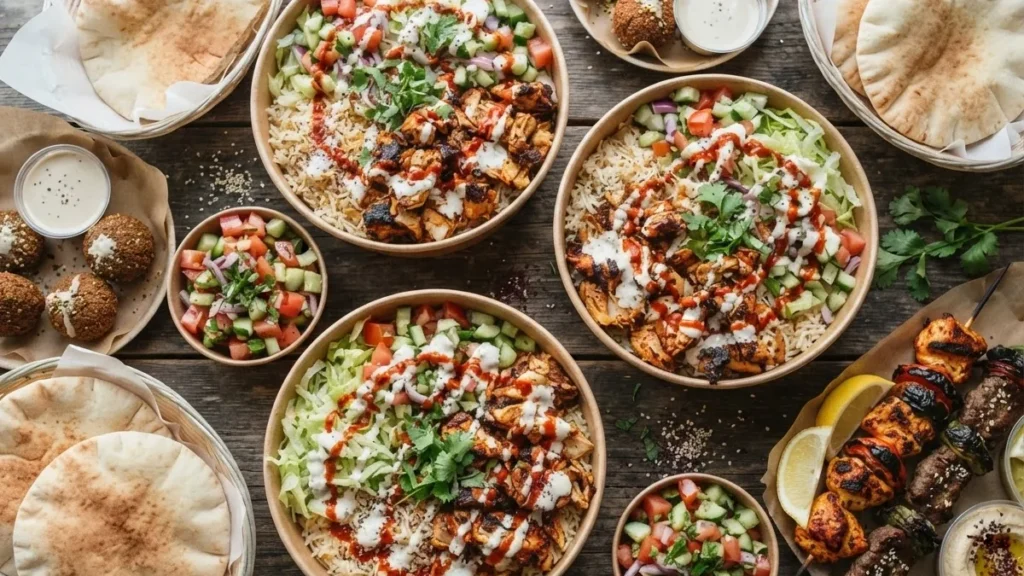
Halal truck food built its reputation on one plate: charred chopped chicken over turmeric yellow rice, drenched in white sauce and a spoon of red. Most recipes online copy the taste and skip everything that makes the food actually halal, and none of them tell you how to hold 20 portions at a safe temperature. This guide fixes both. If you are thinking about taking this to the street, pair it with our operator’s playbook for running a halal food truck, because sourcing and permits change the math fast. Everything below runs on food-safety temperatures, named certifiers, and real numbers you can plan against.
Quick answer: a real halal truck platter has four parts. Marinated chicken thigh, or lamb and beef gyro, cooked hot and fast on a griddle to 165 degrees F. Turmeric yellow rice toasted in fat, then simmered in broth. A white sauce of mayonnaise and yogurt with vinegar, garlic, sugar, and dried herbs. A chili-based red sauce for heat. For it to be halal and not just halal-style, the meat must be certified by a body like the Islamic Food and Nutrition Council of America, and every sauce, bread, and spice mix has to be checked for alcohol-based additives and non-halal gelatin.
Where the halal cart came from, and the market behind it
The halal cart is a New York invention from the late 1980s and early 1990s, built to feed Muslim taxi drivers and late-night workers cheap, fast plates. The most documented example is The Halal Guys, founded in 1990 as a hot-dog cart at West 53rd Street and 6th Avenue in Manhattan before it pivoted to halal chicken and gyro. Three Egyptian immigrant founders, commonly rendered as Mohamed Abouelenein, Ahmed Elsaka, and Abdelbaset Elsayed, ran that cart into a brand that now spans 100 or more locations worldwide.
The wider street-food surge came later. After the 2008 and 2009 recession, low startup costs pushed cooks toward wheels instead of rent, and carts multiplied well past Manhattan into cities across the country and abroad. The dish traveled with them, which is why chicken over rice now reads as street food from Los Angeles to London.
The customer base behind that growth is real. The Pew Research Center estimated about 3.45 million Muslims in the United States in 2017, near 1.1 percent of the population, with a projection close to 8.1 million by 2050. Globally the spend is larger. The DinarStandard State of the Global Islamic Economy Report 2022 put Muslim food and beverage spending near US$1.27 trillion in 2021, on track for roughly US$1.67 trillion by 2025. For the trucks themselves, IBISWorld-based estimates place U.S. food truck revenue in the rough US$1 to 2 billion range in the early 2020s, with pre-pandemic growth often cited around 7 to 8 percent.
What makes a halal truck genuinely halal
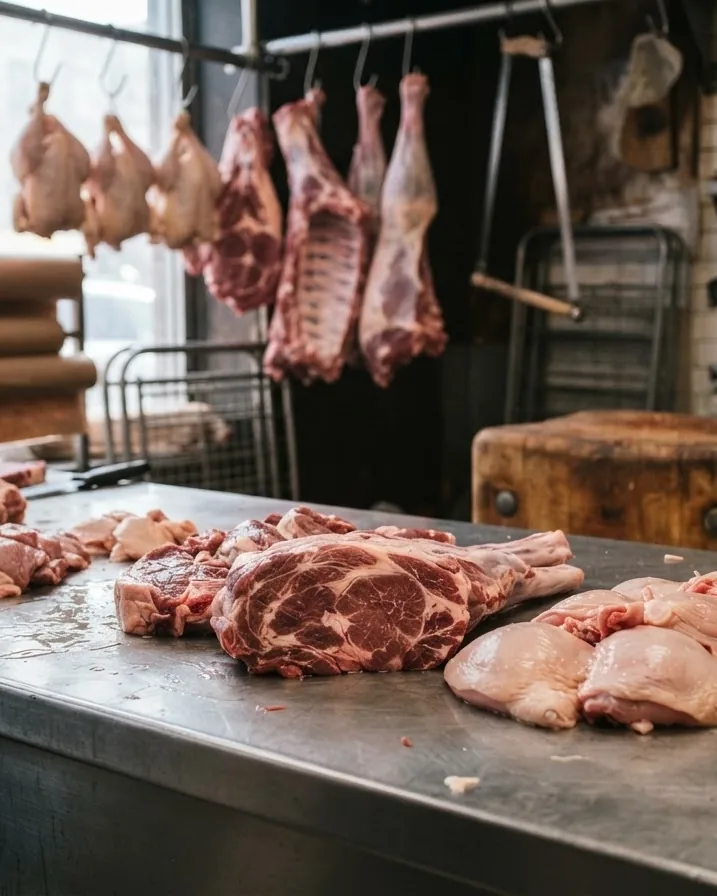
Halal means permissible under Islamic law, and haram means forbidden. For meat, the dividing line is the Dhabiha method: a swift cut severing the jugular veins, carotid artery, and windpipe while the animal is alive and healthy, with the blood fully drained and God’s name invoked. Pork, blood, and alcohol are off the table entirely. None of that shows up in taste, which is the trap most home cooks fall into.
The rules trace to the Quran, including Surah Al-Baqarah (2:168 and 2:172 to 173), Surah Al-Ma’idah (5:3 to 5), and Surah Al-An’am (6:118 to 121 and 6:145). Certifiers do not read every detail the same way. Mechanical slaughter and hand slaughter get treated differently depending on which body signs off, which is exactly why a certification stamp carries more weight than the word halal printed on a menu board.
Here is the practical split most recipes never make:
- Halal-style means the flavor profile only. You can hit every spice note with supermarket chicken and still serve something that is not halal.
- Certified halal means the meat and every added ingredient carry a documented, verifiable chain from slaughter to package.
For anyone cooking at home for a Muslim guest, that difference is the whole point. A gorgeous platter built on non-certified chicken is a lovely dinner, but it is not halal, and calling it halal is a real problem. The fix is not more cumin. It is a certified supplier and clean ingredients.
The two signature sauces, deconstructed
The white sauce is a mayonnaise-and-yogurt base cut with vinegar, sugar, garlic, and dried herbs. It is not tzatziki: there is no cucumber in it, and that single swap changes the whole texture. The red sauce is a separate build entirely, dried red chilies or chili paste loosened with vinegar and sharpened with cumin and garlic. Both get slept on by the recipes that only chase the chicken.
Getting them right is mostly balance and restraint. The white sauce should read tangy and creamy at once, with the vinegar and herbs keeping the mayo from going flat. The red sauce should carry heat without drowning the plate. You spoon it, you do not pour it. Nail both and the same rice and chicken taste twice as good. Balance beats any single secret ingredient here.
If you want the marination science laid out end to end, food outlets like Serious Eats have documented the halal cart platter in detail, and the technique holds up.
The white sauce
Start with the base, then correct. Mayonnaise brings richness and body; Greek yogurt brings tang and thins it out. Vinegar wakes the whole thing up, a little sugar rounds the edge, and garlic plus dried herbs give it savor. Whisk it, taste it, adjust the acid and salt, and rest it cold so the flavors marry. The common mistake is dumping in garlic raw and heavy, which turns harsh and hot instead of mellow.
The red sauce
The red sauce is where the plate gets its edge, and it is the element competitors skip most often. Build it from dried red chilies or a chili paste, loosen with vinegar, and lean on cumin and garlic for depth. Toasting the chilies before you blend them wakes up the oils and deepens the color. Keep it separate from the white sauce until assembly, or you lose the contrast that makes the two-sauce combo work.
The reason this platter tastes the way it does is chemistry, not luck. Acid in yogurt and vinegar tenderizes the chicken by loosening its proteins, and turmeric blooms its color and flavor in fat before it ever hits the rice. That is why cooks marinate in yogurt and toast spices in oil rather than boiling everything together.
The mistakes that flatten both sauces are consistent:
- Skipping the rest time, so the garlic and herbs never mellow into the base.
- Treating the white sauce like tzatziki and adding cucumber or dill.
- Under-seasoning the red sauce, then over-pouring it to compensate.
- Mixing both sauces in advance, which muddies the color and kills the contrast.
Sauces scale cleanly, which is what makes them truck-friendly. You can build a large batch of each a day ahead, hold them cold, and squeeze them from bottles on the line. Keep the acid a touch higher in a big batch, because a large volume of mayo and yogurt dulls the tang faster than a small bowl does.
Chicken, turmeric rice, and griddle technique
The signature chopped, charred texture comes from a hot flat-top griddle, not a gentle skillet. Chicken thigh takes the char better than breast and stays juicy once you chop it. Turmeric, from the plant Curcuma longa, gives the rice its yellow, and toasting the raw rice in fat before you add broth keeps the grains separate instead of gummy.
The core spice profile is short and repeatable: cumin, coriander, paprika, turmeric, oregano, garlic, and lemon. Bloom the ground spices in oil to pull out their flavor, then build from there. A small amount of saffron or extra cumin can add depth to the rice, but turmeric does the heavy lifting on color and base flavor. Miss the bloom step and the spices taste dusty. Heat and fat are the two things doing the work.
For a home cook chasing truck-level char, a cast-iron griddle or a heavy skillet run screaming hot gets close, and test kitchens like America’s Test Kitchen have mapped searing behavior in detail. Get the surface hot, keep the pieces in a single layer, and resist stirring so the meat can actually brown.
Assembly order matters more than people expect. Rice down first, then chopped meat, then lettuce and tomato, then white sauce, then a controlled line of red. Keep the lettuce off the hot rice until the last second so it stays crisp instead of wilting into the plate.
Halal certification, sourcing, and what it costs to comply
Halal-style flavor and certified-halal ingredients are two different things. Flavor is spices; certification is a documented chain from slaughter to package that someone independent has verified. In North America, the names to look for are the Islamic Food and Nutrition Council of America, the Islamic Society of North America, and Islamic Services of America. Each one certifies meat, ingredients, and food-service operations against its own published standard.
These organizations carry real history. The Islamic Food and Nutrition Council of America was established in 1982 and is headquartered in Chicago, Illinois. Islamic Services of America was established in 1975 and is based in Cedar Rapids, Iowa. In the United Kingdom, the Halal Food Authority certifies products and restaurants, while the Halal Monitoring Committee focuses on watching the slaughter and processing chain itself. Between them they cover most of the certified supply a truck operator will ever touch.
Certification is only half the job. Labeling and additives fall under the U.S. Food and Drug Administration, and the FDA Food Code is the baseline many local health departments adopt for storing sauces and prepared salads. Read the U.S. Food and Drug Administration food program before you finalize a supplier list.
When you read a label or vet a butcher, the checks that actually matter are:
- A visible certification mark from a recognized body, not just the word halal.
- Gelatin in dairy, sauces, or desserts, which can come from non-halal sources.
- Alcohol-based flavorings and extracts hiding in spice mixes and breads.
- Non-halal enzymes in cheese and some processed dairy.
- Shared fryers, griddles, and utensils that cross-contaminate with pork or non-halal meat.
The certifiers do not all govern the same thing, and that is worth understanding before you pick a supplier. The Islamic Society of North America and Islamic Services of America both reach into slaughterhouses and processors, so their marks travel with the raw meat. The Islamic Food and Nutrition Council of America is heavy on manufacturers and ingredients, which matters when your spice blend or sauce base is a packaged product rather than something you built from scratch. Match the certifier to the part of your supply chain that carries the most risk.
Cross-contamination is the quiet failure point. A perfectly certified chicken cooked on a griddle that just seared non-halal sausage is no longer being served halal. For a home cook, that means dedicated boards and pans. For a truck, it means a documented cleaning routine and separate equipment, a real cost in time and gear that the flavor-only guides never mention.
Permits, inspections, and the legal basis for Dhabiha
If you sell from a cart or truck in New York City, the NYC Department of Health and Mental Hygiene licenses you, inspects you, sets the permit rules, and enforces temperature control. Permit supply has been the hard constraint for decades. Historically the citywide cap has been cited somewhere around 3,000 to 5,100 permits depending on the category and the year, which kept legal permits scarce and expensive on the gray market. Do not budget on a fixed historical figure.
That started to shift in 2021. A New York City Council law began phasing in up to 445 additional permits per year for 10 years, which works out to 445 times 10, or 4,450 new permits over the phase-in. The live number moves, so confirm it directly with the NYC Department of Health and Mental Hygiene before you plan a launch.
On the slaughter side, U.S. law makes room for Dhabiha. The Humane Methods of Slaughter Act carries a religious-slaughter exemption codified at 7 U.S.C. 1906, the legal anchor that lets certified halal processing happen inside the federal system. Federal meat and poultry inspection itself runs through the USDA Food Safety and Inspection Service, so any supplier you use sits under both frameworks at once.
Safe temperatures and scaling for 10 to 20 servings
Cook and hold by the numbers, not by feel. The USDA Food Safety and Inspection Service requires all poultry, chicken included, to reach an internal temperature of 165 degrees F (73.9 degrees C) at the thickest part. Ground beef and lamb, which covers gyro-style meat, must reach 160 degrees F (71.1 degrees C). Once the food is cooked, the FDA Food Code says hold it hot at 135 degrees F (57 degrees C) or above so bacteria cannot take hold.
Those three numbers are the whole game when you scale up. Cooking one portion is easy. Holding 20 portions safe on a hot line for hours is where operations fail, and it is why a thermometer beats instinct every time. Agencies like FoodSafety.gov and the Centers for Disease Control and Prevention push the same core rule for a reason.
Scaling for a crowd of 10 to 20 or more portions changes the method, not the recipe. Marinate in bulk the day before. Cook in batches so the griddle stays hot instead of steaming a cold, crowded load. Then move finished food to a hot-holding setup rather than leaving it to coast.
The equipment that gets you there at home or on a small truck:
- A cast-iron griddle or heavy flat-top for real char at volume.
- A steam-table pan or a low oven as a hot-holding substitute at 135 degrees F (57 degrees C) or above.
- An instant-read thermometer to verify 165 degrees F (73.9 degrees C) on poultry, not guess it.
- Squeeze bottles for the two sauces so the line moves fast.
Storage is the last safety piece. If you meal-prep and keep the components separate, cooked chicken, rice, and sauces hold roughly 3 to 4 days in the fridge. Keeping them apart is not fussiness. It stops the lettuce from wilting, the rice from turning gummy, and the sauces from watering out, and it lets you reheat the meat and rice back up to a safe temperature without murdering the fresh elements.
Beyond New York: global halal street food
Halal street food is not one cuisine, and treating it as New York chicken and rice misses most of it. Pakistani carts run biryani, seekh kebab, and nihari. West African trucks plate jollof rice, suya, and kelewele. Somali kitchens serve bariis iskukaris and canjeero. Malaysian and Indonesian vendors bring satay and nasi lemak, and Bangladeshi trucks add their own rice-and-curry traditions to the map.
What ties them together is the certification chain, not a shared flavor. A Somali rice plate and a Pakistani nihari share almost nothing on the palate, but they can share the same verified supplier and the same food-safety discipline. The chicken-over-rice platter is the famous entry point, not the ceiling.
A quick map of what shows up well outside Manhattan:
- Pakistani: biryani, seekh kebab, and slow-cooked nihari.
- West African: jollof rice, grilled suya, and fried kelewele plantains.
- Somali: bariis iskukaris spiced rice and canjeero flatbread.
- Malaysian and Indonesian: skewered satay and coconut-rich nasi lemak.
- Bangladeshi: rice-and-curry plates with their own regional spicing.
Chasing this breadth is not just cultural credit. It is where the unserved search traffic lives, because almost nobody writing about this food covers anything past the Manhattan platter.
Calories, and how to make it lighter
A fully loaded platter is commonly reported in the 1,000-plus calorie range, driven by the oil-heavy marinade and the mayo-based white sauce. That is not a reason to skip it, but it is a reason to plan around it if you eat it weekly. Cutting the load is straightforward. Swap most or all of the mayonnaise for Greek yogurt in the white sauce, go lighter on the griddle oil, and tilt the plate toward rice, lettuce, and tomato instead of piling on meat and sauce.
The platter also flexes for dietary needs. Dairy-free cooks can run a yogurt-free sauce or lean on the red sauce alone. Vegetarians and vegans can build a falafel-forward plate that keeps the same spice profile intact. Gluten-free eaters skip the pita and pile onto rice, which is naturally gluten-free as long as the broth and spice mix are clean.
Halal truck FAQ
Is halal cart white sauce the same as tzatziki?
No. The white sauce is a mayonnaise-and-yogurt base with vinegar, sugar, garlic, and dried herbs. Tzatziki is a yogurt sauce built around cucumber and dill. The halal cart version has no cucumber at all, which gives it a smoother, tangier, more pourable texture that works as a dressing rather than a dip.
What temperature should halal cart chicken reach?
Poultry has to reach an internal temperature of 165 degrees F (73.9 degrees C) at the thickest part, according to the USDA Food Safety and Inspection Service. Gyro-style ground beef or lamb needs 160 degrees F (71.1 degrees C). After cooking, hold everything at 135 degrees F (57 degrees C) or above under the FDA Food Code.
How do I know if meat is really halal and not just halal-style?
Look for a certification mark from a recognized body such as the Islamic Food and Nutrition Council of America, the Islamic Society of North America, or Islamic Services of America. The word halal on a menu proves nothing on its own. A documented, stamped chain from slaughter to package is what makes meat genuinely halal.
How long do meal-prepped halal platter components last?
Kept separate in the fridge, cooked chicken, rice, and the two sauces hold roughly 3 to 4 days. Storing components apart is the key move. It stops the lettuce wilting and the rice going gummy, and it lets you reheat the meat and rice back to a safe temperature without wrecking the fresh toppings.
Do I need a special permit to sell halal food from a truck?
In New York City you need a mobile food vendor permit from the NYC Department of Health and Mental Hygiene, which stayed capped near 3,000 to 5,100 for years. A 2021 law is phasing in up to 445 more per year for a decade, 4,450 in total. Confirm the current number with the department before launching.
Is halal truck food always Middle Eastern?
No. Middle Eastern-style chicken and rice is the most famous version, but halal trucks span Pakistani biryani and nihari, West African jollof and suya, Somali bariis iskukaris, Malaysian and Indonesian satay and nasi lemak, and Bangladeshi rice plates. Halal is a compliance standard for the ingredients, not a single regional cuisine.
Putting it on a plate
Get four things right and the rest follows: certified meat, a tangy white sauce, a real red sauce, and temperatures you actually hit. The USDA Food Safety and Inspection Service and the FDA Food Code give you the numbers. Bodies like the Islamic Food and Nutrition Council of America give you the sourcing. Everything else is spice and practice. If chicken and rice is your anchor and you want to widen the board, our Mediterranean food truck menu and margins guide covers the crossover dishes worth adding next.