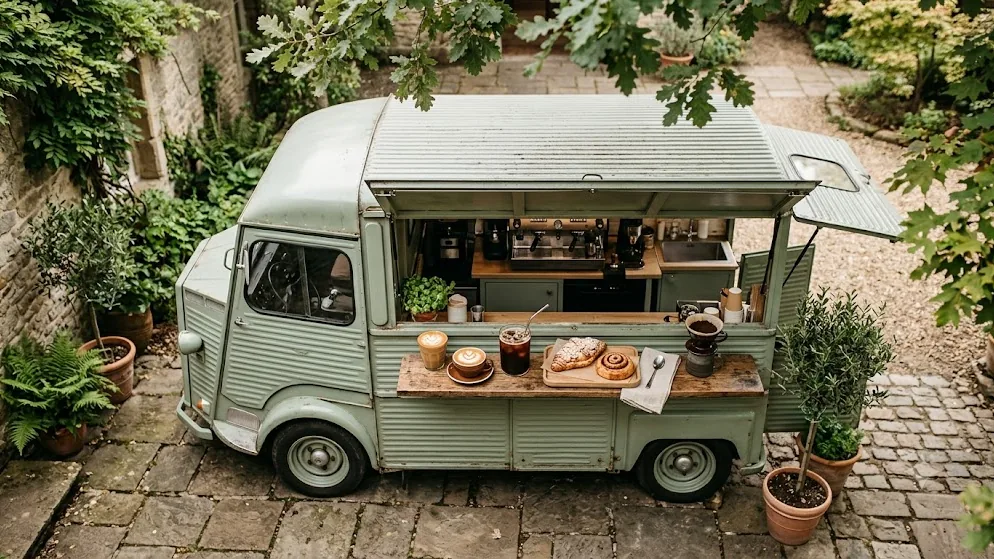
Coffee food truck operators live and die on two numbers the generic startup guides never connect: the 66 percent of American adults who drink coffee every single day, and the roughly 5 percent net margin the whole food truck sector averages. One number is your demand pool. The other is the razor you walk. This guide ties every claim to a named source, because the difference between a truck that clears health inspection and one that gets red-tagged usually comes down to a temperature you can read in the FDA Food Code. The National Coffee Association reports that daily coffee drinking now beats tea, juice, soda and bottled water combined, which tells you the market is real. What follows is how to actually build against it.
Below you will find start-up cost logic, the espresso and water setup a beverage operation demands, the permits and food-safety law that govern a mobile unit, and the unit economics that decide whether you survive year two.
Quick answer: A coffee food truck is a mobile beverage business built on a step van or trailer, running an espresso machine, water tanks and a point-of-sale, and regulated as a mobile food unit under the FDA Food Code (cold holding at or below 41 F, hot holding at or above 135 F). The pull is strong: 66 percent of US adults drink coffee daily and cold coffee now makes up 31 percent of all coffee consumed. The catch is margin: food trucks average about 5 percent net, so menu discipline and location strategy matter more than the truck itself.
Coffee truck vs coffee trailer vs pop-up cart: what each format actually costs you in mobility
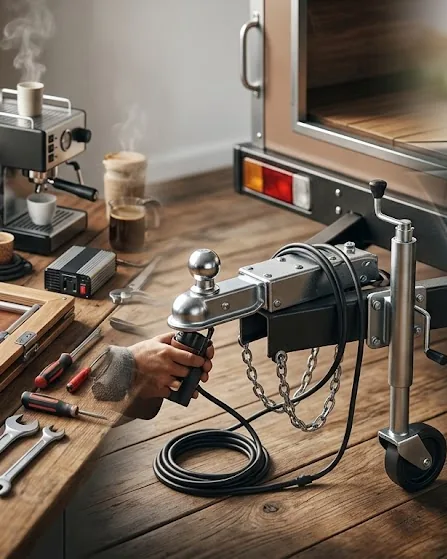
The format you pick sets your ceiling before you brew a single shot. A self-propelled coffee truck, usually a step van in the 14 to 18 foot range, gives two baristas room to work and moves under its own power, which matters when you rotate between a morning office park and a lunchtime market. A towable coffee trailer separates the kitchen from the tow vehicle, so you can drop it at a recurring spot and free the truck, but you need a capable tow rig and a place to park both. A pop-up cart is the cheapest way in and the easiest to store, yet it caps your equipment and your throughput, which caps your revenue.
Think of it as a trade between fixed mobility and drop-and-leave flexibility. Trucks win on speed of repositioning. Trailers win on cost per square foot of counter. Carts win on entry price and lose on peak-hour volume.
- Coffee truck: highest mobility, best for multi-stop days, most expensive to build and insure.
- Coffee trailer: more counter space per dollar, but needs a tow vehicle and dual parking.
- Pop-up cart: lowest barrier, limited equipment, best as a test before committing capital.
Whatever the shell, the workflow inside decides your line speed. Getting the counter geometry right is its own discipline, and the dimensioned food truck kitchen layout guide walks through the clearances two baristas need to pass without collisions during a rush.
Sizing the espresso machine, grinder and water system for peak-hour throughput
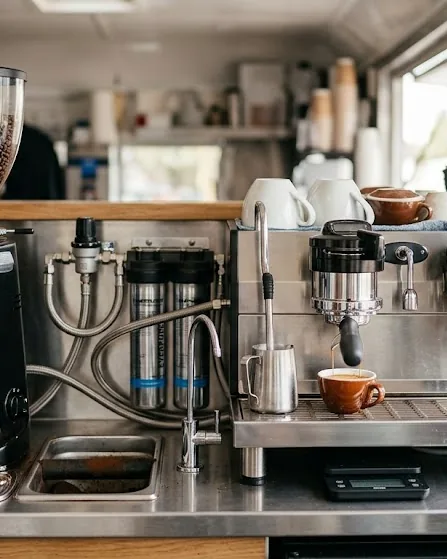
A coffee food truck is not a taco truck with a kettle. The equipment core is a two-group espresso machine, a dedicated grinder, a water softener, and separate potable and wastewater tanks, and every one of those choices flows from how many drinks you must pull per hour when the line is deep. The Specialty Coffee Association National Coffee Data Trends report found 43 percent of US adults drank an espresso-based beverage in the past week, so espresso is not a niche add-on, it is the spine of your menu. Two groups let one barista pull while another steams milk, roughly doubling your effective throughput versus a single-group setup at the exact moment demand spikes.
Water is the quiet killer. A beverage operation moves far more water than a food truck, both in and out, so your potable and wastewater tanks and your generator all have to be sized around continuous brewing, not occasional handwashing.
- Two-group espresso machine: lets pulling and steaming run in parallel during peak.
- On-demand grinder: keeps dose consistent and cuts staling versus pre-ground hoppers.
- Water softener: protects the boiler from scale, the most common cause of machine failure.
- Potable and wastewater tanks: sized for a brewing day, not a cooking day.
Power is where new operators underestimate. An espresso boiler pulls hard on startup and again every time it reheats, so the generator has to cover that surge alongside your grinder, fridge and point-of-sale. The generator sizing and code guide for food trucks lays out how to add up those loads before you buy, because a generator that trips under a two-group machine is a wasted morning of sales.
Permits, licenses and food-safety law: what the FDA Food Code actually requires of a mobile unit
This is where most coffee truck guides go vague and where inspectors get specific. A mobile food unit in the United States is regulated primarily through the FDA Food Code, a model that individual states adopt and enforce, so your obligations trace back to a real document with real numbers. The FDA Food Code sets cold holding at or below 41 F (5 C) and hot holding at or above 135 F (57 C), and those thresholds apply to mobile food units, not just brick-and-mortar kitchens. For a coffee operation that means your milk, cold brew and any perishable syrups or foods have to stay at or below 41 F, and that is the first thing an inspector checks.
The paperwork stack sits on top of the food-safety rules. Expect to register a business structure such as an LLC or sole proprietorship, hold a general business license, obtain a mobile vending or food service permit from your local health department, and carry a Certified Food Protection Manager credential. Many jurisdictions also require a commissary, a licensed base kitchen where you clean, restock and dump wastewater, plus a three-compartment sink for wash, rinse and sanitize.
- Cold holding: at or below 41 F (5 C) per the FDA Food Code, milk and cold brew included.
- Hot holding: at or above 135 F (57 C) for any hot food you carry.
- Commissary: a licensed base for restock, cleaning and wastewater disposal.
- Three-compartment sink: wash, rinse, sanitize, required in most mobile units.
- Certified Food Protection Manager: a credential most health departments demand.
Allergens changed recently in a way that touches coffee menus directly. In the 2022 edition of the FDA Food Code, sesame was added as a major allergen, which matters the moment you sell pastries, sesame-topped bagels or bakery items alongside drinks. The FDA describes the change in its 2022 Food Code release announcement, and the full framework, including the 41 F and 135 F thresholds, sits in the Food Code 2022 reference. A further supplement arrived in 2024 and the next complete edition is expected in 2026, so the rules you build against today are not frozen.
State agencies translate the model into enforceable local rules, and their guidance is often more concrete than the federal document. The USDA Food Safety and Inspection Service publishes broad food-handling guidance, and FoodSafety.gov and nutrition.gov offer consumer-facing temperature and handling references worth knowing. For a working example of how a state spells out commissary and sink requirements for a mobile operator, the Pennsylvania Department of Agriculture Mobile Food Facility Operation Guide is a model of the detail you should expect from your own state before opening day.
Why the commissary requirement catches new operators off guard
New owners budget for the truck and forget the base. It is also where your wastewater legally goes, so skipping it is not a shortcut, it is a shutdown risk. Build the commissary line into your cash flow from month one, not month three.
The 2025 market by the numbers: demand, supply and the margin you inherit
The demand side of a coffee food truck is unusually strong, and the numbers are recent enough to plan against. According to National Coffee Association data from Spring 2025, 66 percent of US adults drink coffee every day, more than any other beverage including bottled water. Fall 2025 figures put the average US coffee drinker at about 3 cups a day, with 85 percent drinking coffee at breakfast, which is exactly the daypart a well-placed truck can own. The cold shift is the strategic story: cold, iced and frappe drinks reached 31 percent of all coffee consumed in a June 2025 survey, up 23 percent from January 2025, so a menu built only for hot drinks is fighting the trend.
The supply side is crowded and the margins are thin, which is the honest counterweight to all that demand.
- 92,257 food truck businesses operated in the US in 2025, up 16.9 percent versus 2024, on a 23.7 percent compound annual growth rate across 2020 to 2025 (IBISWorld).
- $2.8 billion US food truck market size in 2025, nearly flat at down 0.2 percent (IBISWorld).
- About 5 percent average net margin across 2020 to 2025, with 2025 revenue growth estimated near 0.2 percent, which is why so many operators pivot toward catering.
- 43 percent of adults drank an espresso-based beverage in the past week, versus 28 percent for a non-espresso drink; drip remains the top method at 36 to 38 percent (Specialty Coffee Association).
Read those together and the play becomes clear. Demand is enormous and rising toward cold and specialty formats, but the field is growing fast and the sector margin is a thin 5 percent. You win by owning a daypart and a spot, not by out-spending competitors. You can see the numbers behind the IBISWorld count on its food truck number of businesses page, and the CNBC report on the sector’s margin and catering pivot is worth reading before you finalize a business plan.
Menu design and unit economics: turning volume into a survivable margin
A tight menu is the single biggest lever a coffee food truck controls. Your morning volume is your business, and every extra menu item slows the line during the exact window when speed is money. A restrained core of espresso drinks, drip and a cold option covers the demand shown in the data (43 percent espresso, 28 percent non-espresso, drip at 36 to 38 percent) without forcing your baristas to hunt for ingredients mid-rush. Add seasonality on top of that core, leaning into cold and iced drinks that now make up 31 percent of consumption, rather than doubling the permanent board.
The economics are unforgiving at a 5 percent sector net margin. That thin figure means throughput and cost control, not price alone, carry the business.
- Speed per order: a two-group machine and a short menu keep peak-hour lines moving.
- Cold-drink share: cold, iced and frappe formats are 31 percent of consumption and rising, so batch cold brew ahead.
- Daypart focus: with 85 percent of drinkers taking coffee at breakfast, mornings pay the rent.
- Diversification: catering, corporate mornings and weddings smooth the flat retail growth of about 0.2 percent.
Wholesale sourcing sits underneath all of it: a roaster relationship, reliable milk and syrup supply, and cup and lid consumables priced per unit so you know your true cost per drink. If events and private bookings are part of your revenue plan, the mechanics of pricing and staffing a private gig are covered in the honest caterer’s guide to booking a truck for a reception, which applies cleanly to coffee service at receptions and corporate mornings.
The serving window and the branding that decides whether a stranger stops
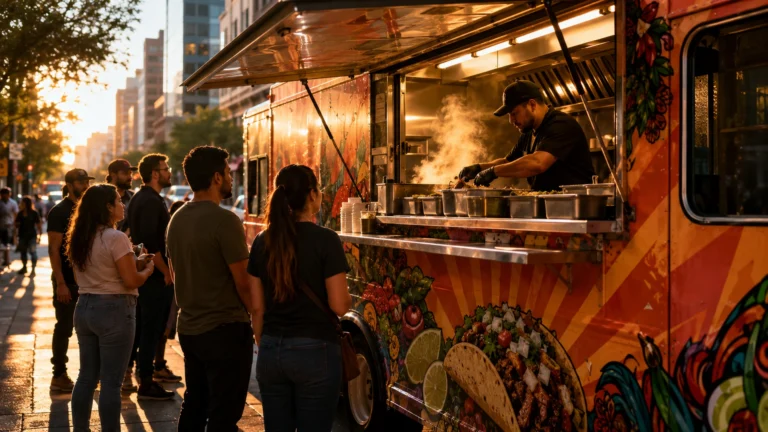
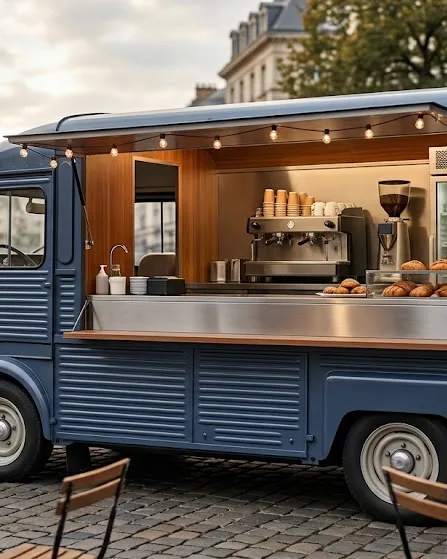
Your window and your wrap do the selling before anyone tastes the coffee. Social media is the number-one discovery channel for mobile food, but the physical truck is what converts a passerby into a customer, and that conversion happens at the serving window. A clear, well-lit window with a legible menu and a fast handoff turns a curious glance into a sale, while a cluttered or slow window loses the impulse buyer who was already walking. Consistency of location compounds this: a spot people can count on becomes a habit, and habit is where 3-cups-a-day demand actually lands on your counter.
The exterior is a rolling billboard that works even when you are parked. A strong wrap earns impressions on every commute between spots.
- Legible menu at the window: fewer items, larger type, faster decisions.
- Consistent spot: recurring locations convert daily coffee habit into repeat revenue.
- Social-first discovery: post the day’s location before the morning rush.
The window deserves obsessive attention because it is the entire transaction surface, a point made in depth in the guide arguing your serving window is the whole business. For the exterior, a good wrap pays for itself in impressions over its lifespan, and the food truck wrap breakdown covers the design and cost tradeoffs. If you are still deciding between concepts, comparing a beverage build against a food build can sharpen your plan, and the ice cream food truck cost and permit breakdown is a useful sister case with similar cold-holding and commissary demands.
Bench findings that shape the build
Frequently asked questions
How much of the coffee food truck market is cold drinks now?
Cold, iced and frappe drinks reached 31 percent of all coffee consumed in a June 2025 survey, up 23 percent from January 2025. That rising share is why operators batch cold brew and keep a permanent iced option rather than treating cold coffee as a summer-only add-on. A hot-only menu now fights the strongest trend in US coffee consumption.
What temperature rules apply to a mobile coffee unit?
The FDA Food Code, which states adopt and enforce, requires cold holding at or below 41 F (5 C) and hot holding at or above 135 F (57 C), and both apply to mobile food units. For a coffee truck that means milk, cold brew and perishable syrups must stay at or below 41 F. Inspectors check these thresholds first, so a reliable refrigeration setup is not optional.
Is espresso worth the machine cost for a startup truck?
The data supports it. Specialty Coffee Association figures show 43 percent of US adults drank an espresso-based beverage in the past week, versus 28 percent for non-espresso drinks. A two-group machine lets one barista pull shots while another steams milk, roughly doubling peak throughput. Given how thin sector margins run, that peak-hour speed is what makes the machine pay for itself.
Why do so many food trucks add catering?
Because retail growth is flat. Catering, corporate mornings and weddings add higher-value bookings that smooth the thin, slow-growing retail line and improve the yearly picture.
Do I really need a commissary for a coffee truck?
In most jurisdictions, yes. A commissary is your licensed base for restocking, cleaning and legal wastewater disposal, and a beverage operation generates a large amount of wastewater. State guides such as the Pennsylvania Department of Agriculture Mobile Food Facility Operation Guide spell out commissary and three-compartment sink requirements. Budget the monthly commissary fee as a fixed cost from your first month of operation.
What did the sesame allergen change mean for coffee trucks?
Sesame became a major allergen in the 2022 edition of the FDA Food Code. It only affects you if you sell food alongside drinks, such as bagels, pastries or sesame-topped items, but then it requires proper labeling and cross-contact awareness. A further supplement arrived in 2024 and the next full Food Code edition is expected in 2026, so review your state’s current adoption.
[req:6678607]