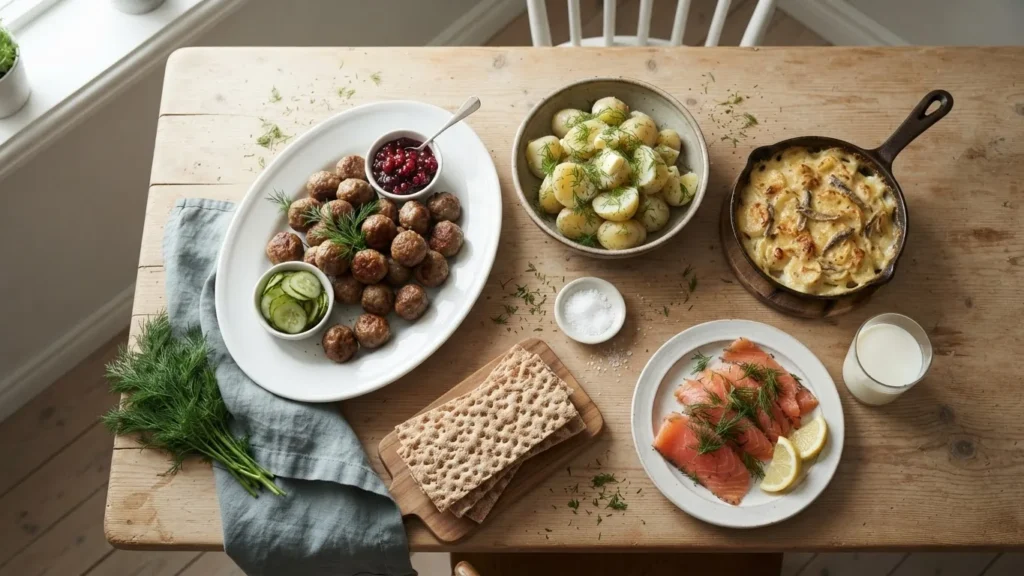
What makes a meatball Swedish is spice, not herb: warm allspice and nutmeg, never oregano or basil. That single swap is why frozen store-bought meatballs taste generic until you fix the sauce. Among easy Swedish recipes at home, the five that reward a small kitchen are köttbullar (meatballs), pannkakor (thin pancakes), chokladbollar (no-bake chocolate balls), raggmunk (potato pancakes), and kanelbullar (cinnamon buns). Each has one step that decides the outcome, and the numbers below come straight from the cooks and the food agency that publish them.
The short answer: start with chokladbollar if you want a no-oven win, or meatballs if you want a weeknight plate. Meatballs are spiced with allspice and nutmeg, baked at 450°F for about 12 minutes or pan-fried, then finished in a cream gravy. Pancake batter must rest at least 2 hours. Chokladbollar chill at least 15 minutes. For minced meat, the Swedish Food Agency points to roughly 70 °C core temperature as the doneness reference that replaces guesswork. Those four figures carry most of the easy Swedish recipes at home worth cooking.
The five easy Swedish dishes that fit a small kitchen
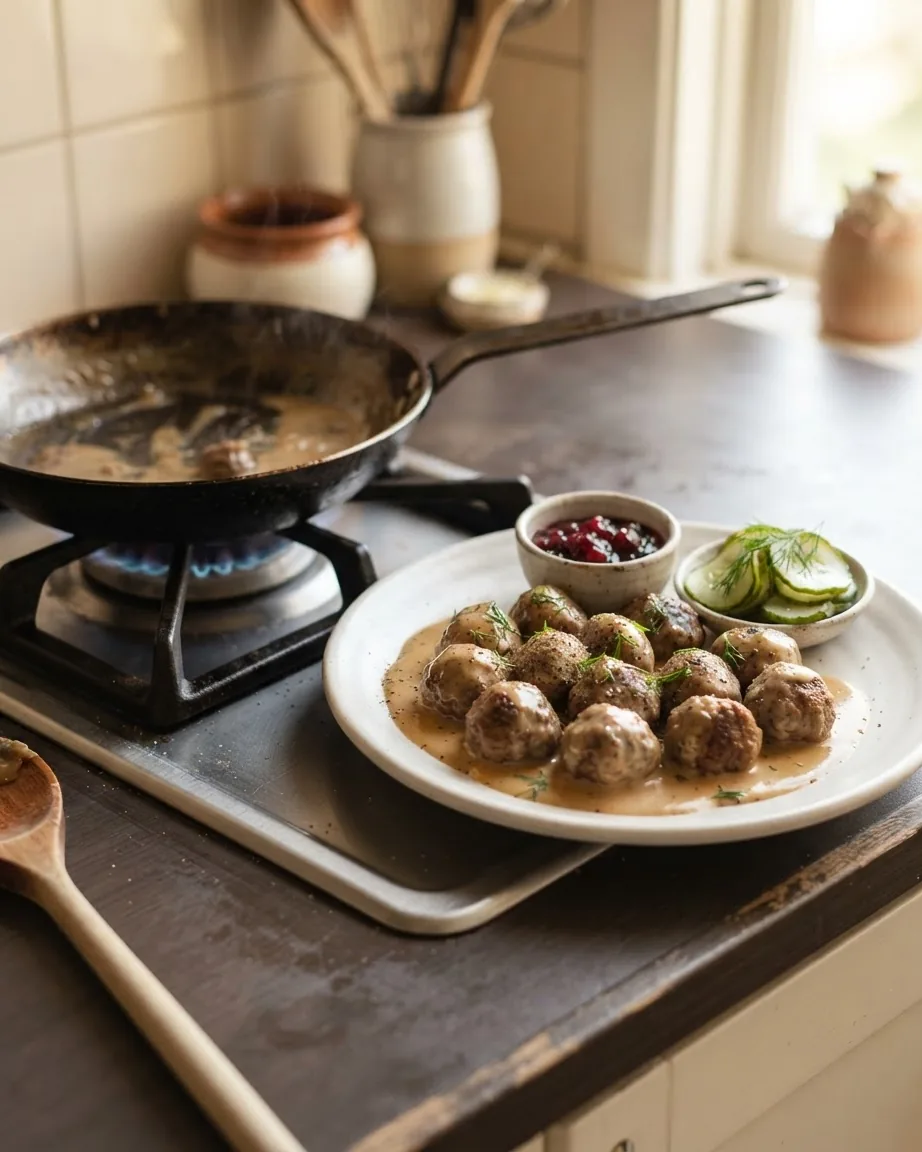
You do not need a smörgåsbord’s worth of range to cook Swedish food well. These are the dishes that scale down to a home burner and up to a service line without falling apart:
- Köttbullar (meatballs), spiced mince in cream gravy; the dish most people mean by “Swedish food.”
- Pannkakor (thin pancakes) (crepe-thin, no leavening, served with lingonberry).
- Chokladbollar (chocolate balls) (no-bake, no-oven, kid-friendly first recipe).
- Raggmunk (potato pancakes): grated-potato fritters, usually with bacon and lingonberry.
- Kanelbullar (cinnamon buns): a batch bake, roughly 40 buns at a go.
Leftover cooks also lean on korvstroganoff (sausage in cream over rice) and pyttipanna (a hash of diced leftovers under a fried egg): both low-effort and both built for whatever is already in the fridge. Del’s Cooking Twist, written by an author who spent 7 years in Sweden, catalogs these alongside the buns and pancakes for cooks who want cultural context with the method.
How to make easy Swedish meatballs at home: spice first, method second
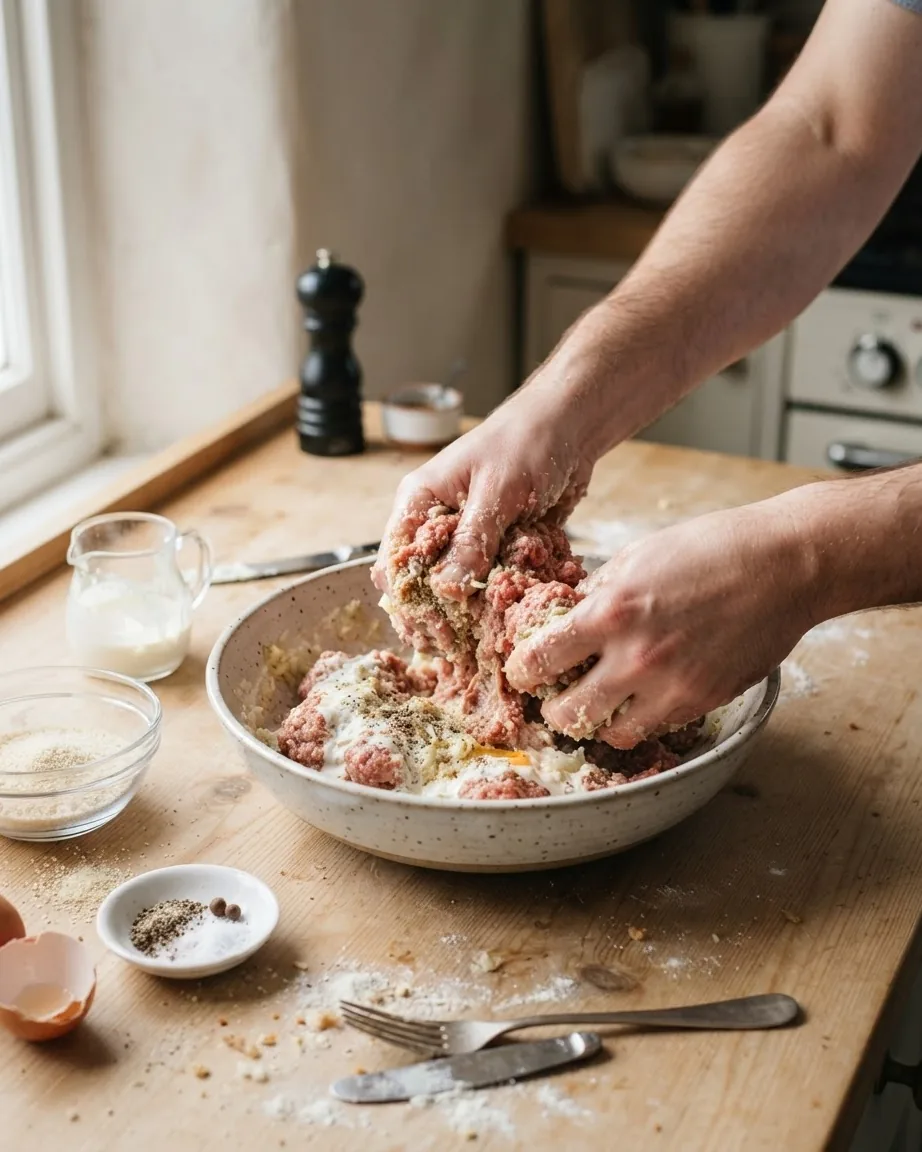
The spice is the identity. Blogghetti frames the meatball’s character around allspice rather than Italian herbs, and allspice carries a scent that reads like cinnamon, nutmeg and cloves at once, which is why a pinch of it plus nutmeg is doing the heavy lifting. Get those two spices in and you have a Swedish meatball; leave them out and you have a generic one.
Ingredients (adapted from True North Kitchen):
- ½ pound ground pork
- ½ pound ground beef (80-85% lean)
- ¼ cup grated onion
- ¼ cup panko bread crumbs
- ¼ cup heavy cream
- 1 large egg yolk
- 1 teaspoon fine salt
- ½ teaspoon packed brown sugar
- ¼ teaspoon ground allspice
- ⅛ teaspoon ground nutmeg
- ⅛ teaspoon ground pepper
- 2 tablespoons unsalted butter
- 2 tablespoons flour
- ¾ cup low-sodium chicken broth
- ¾ cup beef broth
- ½ cup cream
- 2 teaspoons soy sauce
- Lingonberry jam and pickled cucumbers for serving
Steps:
- Heat the oven to 450°F. Combine all meatball ingredients and mix just until the mixture turns smooth and slightly sticky: overmixing past that point packs the texture too tight.
- Scoop level tablespoons onto a sheet pan and roll into balls with damp hands so the mix does not stick. Keep them small, at most about an inch across, which is the traditional size.
- Bake until browned and cooked through, about 12 minutes. Move the meatballs to a plate and save the pan drippings for the gravy.
- Melt butter in a 12-inch skillet, whisk in the flour, and cook one minute so the raw-flour taste cooks off before any liquid goes in: that minute is what keeps the gravy from tasting pasty.
- Whisk in the drippings, both broths, soy sauce and cream; simmer to thicken, return the meatballs to warm through, and serve with lingonberry and pickled cucumber.
Blogghetti’s version instead pan-fries the balls about 1-2 minutes on all sides before building the sauce, and their batch runs much larger: roughly 70 to 75 meatballs from 2 lb of beef. Both are legitimate; the oven route just frees your hands for the gravy.
The meatball numbers that conflict, and how to read them
Here is the synthesis no single recipe gives you: the same dish is cooked four different ways across trusted cooks, so there is no one “correct” temperature. This box lines up the methods side by side with the body that publishes each, so you can pick by your equipment instead of guessing.
| Source | Cooking method | Time / temp |
|---|---|---|
| True North Kitchen | Bake | 450°F, about 12 minutes |
| Blogghetti | Pan-fry, then oven option | ~ |
| The Cozy Cook | Simmer in sauce | 10 to 15 minutes |
| Visit Sweden | Fry until golden | until thoroughly cooked |
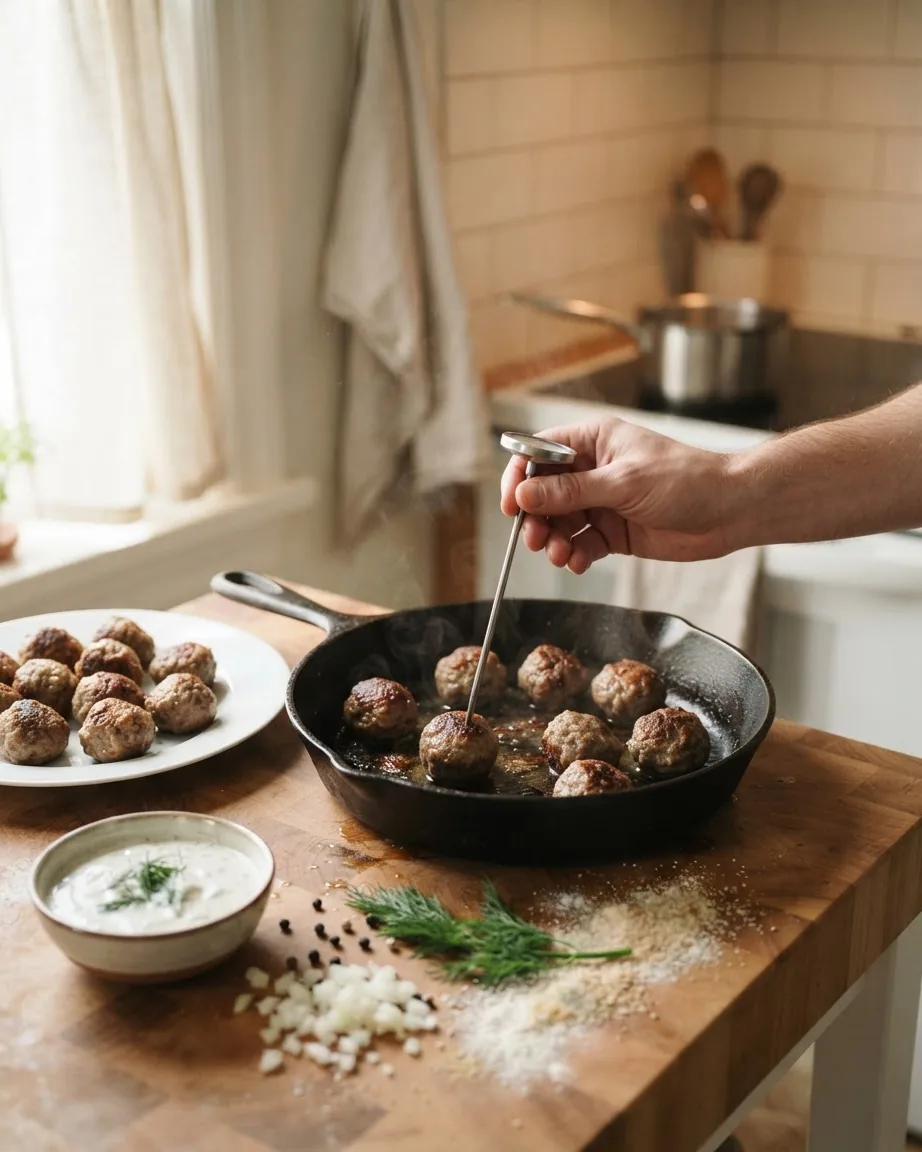
Rather than trust any single timer, check doneness by core temperature. The Swedish Food Agency’s Kontrollwiki notes that minced-meat products should be cooked through, and that cooking to roughly 70 °C core temperature normally kills harmful bacteria quickly. That turns Visit Sweden’s non-numeric “thoroughly cooked” cue into something you can read off a thermometer. These temperatures are guidance, not a guarantee, and in a U.S. kitchen your own local health rules set the enforced figures: use this as your reference point, not your last word.
One more pair that readers collapse by mistake: the roughly 70 °C above is a cooking target for raw mince. For reheating already-cooled food, the same agency gives a separate guideline of 70 °C or hotter. Same number, two different operations: do not treat one instruction as the other.
Using frozen meatballs without losing the Swedish flavor
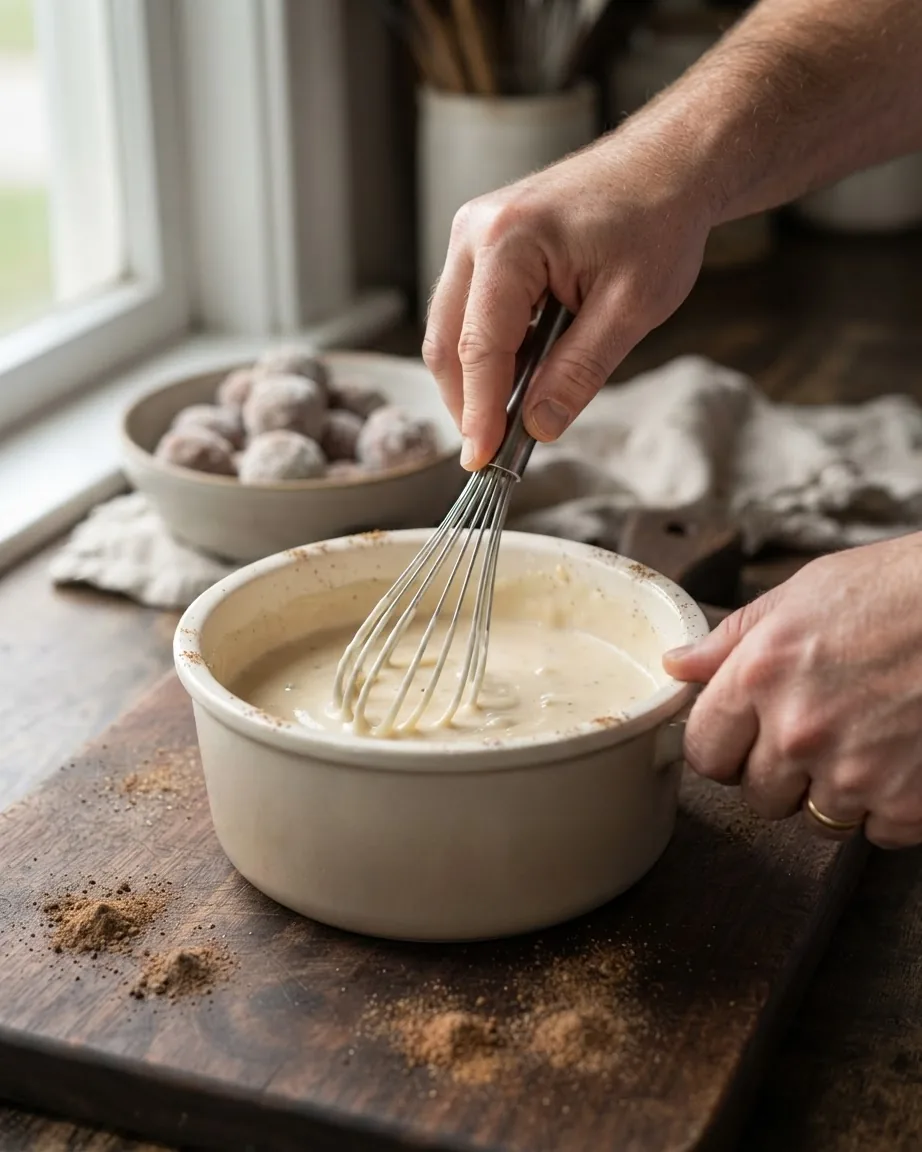
Frozen store-bought meatballs are a fair shortcut on a slammed night, but they come unseasoned for this dish. The Cozy Cook (which honestly tags its recipe as American cuisine) supplies the fix: because the spice lives in the meat and bagged meatballs skip it, add about ¼ teaspoon each of allspice and nutmeg to the sauce so the gravy carries what the meat does not.
True North Kitchen also makes the from-scratch batch freezer-friendly. Baked meatballs hold up to 3 months frozen and go into the gravy straight from the freezer: no thaw step, just extra time to heat through. For a food-truck line or a weekday plan, that means you bake once and plate fast all week. A quick scaling reality: The Cozy Cook’s batch makes 33 meatballs, so a single sauce recipe pairs cleanly with that count.
Swedish pancakes: why resting the batter is make-or-break
Pannkakor are not American pancakes. There is no baking powder, so they should run thin and crepe-like, and that is a feature, not a flaw. Three fixable things decide whether yours work: a batter rest, the right pan, and no expectation of fluff.
Ingredients (from True North Kitchen):
- 1 cup all-purpose flour
- 1 tablespoon sugar
- ¼ teaspoon salt
- 2 eggs
- 1 cup whole milk
- 6 tablespoons water
- 3 tablespoons unsalted butter, melted and cooled
- ½ teaspoon vanilla
Steps:
- Blend all ingredients until completely smooth.
- Rest the batter in the refrigerator at least 2 hours, up to 2 days. The rest is what gives you a uniform, tender texture.
- If serving right away, warm the oven to 200 degrees to hold cooked pancakes. Heat an 8-inch or 10-inch nonstick pan over medium: no special equipment beyond that.
- Brush with butter, pour a thin layer, swirl to coat, cook until the edges brown and lift, flip, finish briefly.
- Serve with lingonberry jam and butter.
To make them savory, drop the sugar and leave out the vanilla. Leftovers keep: wrap the stack tightly and refrigerate up to 3 days. If yours come out thick and bready, you skipped the rest or expected leavening the batter never had.
Chokladbollar: the no-oven Swedish recipe to start with
If you have never cooked Swedish food, start here. Chokladbollar are no-bake chocolate-oat balls: no oven, no thermometer, friendly for cooking with kids. Food and Journeys, a Stockholm-based recipe site, lays out the one rule that matters and the one fix for the usual failure.
- The rule: use rolled oats, not instant, so the balls hold texture instead of turning to paste.
- The chill: refrigerate the shaped balls at least 15 minutes before serving so they firm up.
- The fix: if the mix is too wet to shape, chill it 15 minutes first to solidify, then roll.
For example, if your dough slumps instead of rolling into a ball, that is the too-wet case (the fridge step, not more oats, is the correction). This is the entry point Food and Journeys describes when it says to “place the chocolate balls into the refrigerator for at least 15 minutes to chill”: see their no-bake chokladbollar method for the full mix.
Raggmunk and kanelbullar: the timing details that save the batch
Two more classics, each with a failure mode worth naming before you start.
Raggmunk (potato pancakes). Visit Sweden’s recipe rests the grated-potato batter 30 minutes before frying, then cooks on medium, about 4 minutes per side. The warning is specific: too much heat colors the outside before the potato cooks through. For example, if your raggmunk is brown but gummy inside, your pan was too hot: drop the heat and give it the full 4 minutes a side.
Kanelbullar (cinnamon buns). The same official source bakes buns at 225 °C, which is 435 °F, until golden brown, and the recipe makes approximately 40 buns. That yield is a batch-planning number: anything not eaten the day of or the day after is meant for the freezer, so decide your portions before you shape 40 buns and find yourself storing most of them.
What Swedish food costs you per plate, at a glance
For anyone costing these dishes for a menu rather than a dinner, the published nutrition gives one honest per-serving anchor: with a caveat built in. The figures below come from a single recipe and are not interchangeable with per-meatball counts from another, so read them as one source’s serving, not a universal value.
| Per serving (True North Kitchen meatballs + gravy) | Amount |
|---|---|
| Calories | 564 kcal |
| Carbohydrates | 10 g |
| Protein | 24 g |
| Fat | 47 g |
The Cozy Cook’s figures, by contrast, are reported per single meatball including sauce across a batch of 33: a different unit entirely. Combining the two would produce a meaningless number, so pick whichever unit matches how you plate and portion. If you are building a wider menu around Nordic dishes, our site’s cuisine section runs deeper on concept-level planning, and you can find a neighboring approach in our Easy Finnish Recipes guide. For a frozen-dessert pairing on a route, there is also our Mini Donut Food Truck write-up.
How Many Meatballs Per Pound? Scaling Your Batch
Recipes quote totals, not rates, which makes them hard to resize. Blogghetti’s batch of roughly 70 to 75 meatballs comes from 2 lb of beef, so dividing count by weight gives a working rate of about 35 to 37.5 meatballs per pound at the traditional small (about one inch) size. Once you know the rate, you can buy meat for the plate you actually want instead of over- or under-shooting.
- Low end: 70 ÷ 2 = about 35 meatballs per pound.
- High end: 75 ÷ 2 = about 37.5 meatballs per pound, if you roll them at the smaller limit.
These rates assume the small, roughly one-inch meatball; rolling larger (such as the 1½-inch size one source uses) lowers the count per pound.
Frequently asked questions
What is Sweden’s most famous dish?
Köttbullar (meatballs in cream gravy with lingonberry) is the dish most people name. What sets them apart is spice rather than herb: allspice plus nutmeg. If you reach for a frozen bag, restore that profile by stirring about ¼ teaspoon each of allspice and nutmeg into the sauce, since the bagged meat carries none of it.
What are some traditional Swedish dishes?
Beyond meatballs, the home standards include thin pancakes rested at least 2 hours, raggmunk potato fritters fried about 4 minutes a side, chokladbollar chilled 15 minutes, and cinnamon buns baked at 225 °C. Korvstroganoff and pyttipanna round out the weeknight end, both built from leftovers and cream.