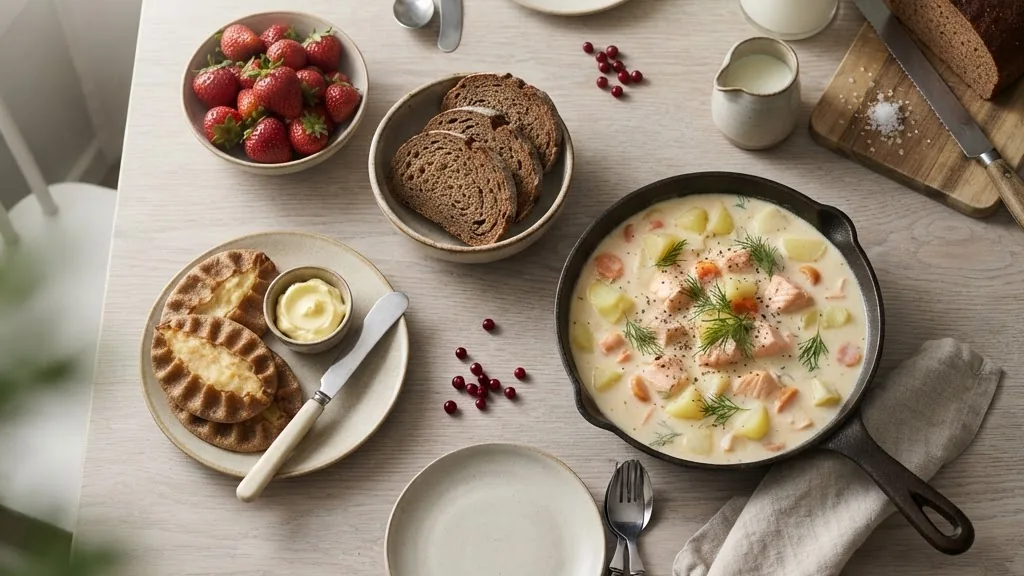
The fastest win among easy Finnish recipes at home is lohikeitto (salmon soup): one pot, about 30 minutes, and the only move that can wreck it is cooking the salmon too long. Add the fish in the last few minutes, simmering it for 4-5 before you cut the heat. Everything else Finnish that a home cook or a window-service line can run falls into two camps: fast stovetop dishes like that soup, or long passive oven bakes you load and forget. The temperature is not universal, and cross-applying heat settings is where most batches fail.
Here is the short version before the sections. Salmon soup lohikeitto serves 4-6 and runs in about 30 minutes; the leeks sweat for 10 minutes and the potatoes boil another 10 before the fish ever touches the pot. Karelian pasties carry a legal name in the EU and a very high bake. Oven porridge is nearly all waiting. Meatballs are done in 3-5 minutes for small ones, 5-8 for large. A home cook feeding a crowd leans on the casseroles and the three-meat hot pot. None of these needs rare ingredients once you swap fresh dill for dried.
Finnish Chicken Recipes: Why the Classic Lineup Skips the Bird
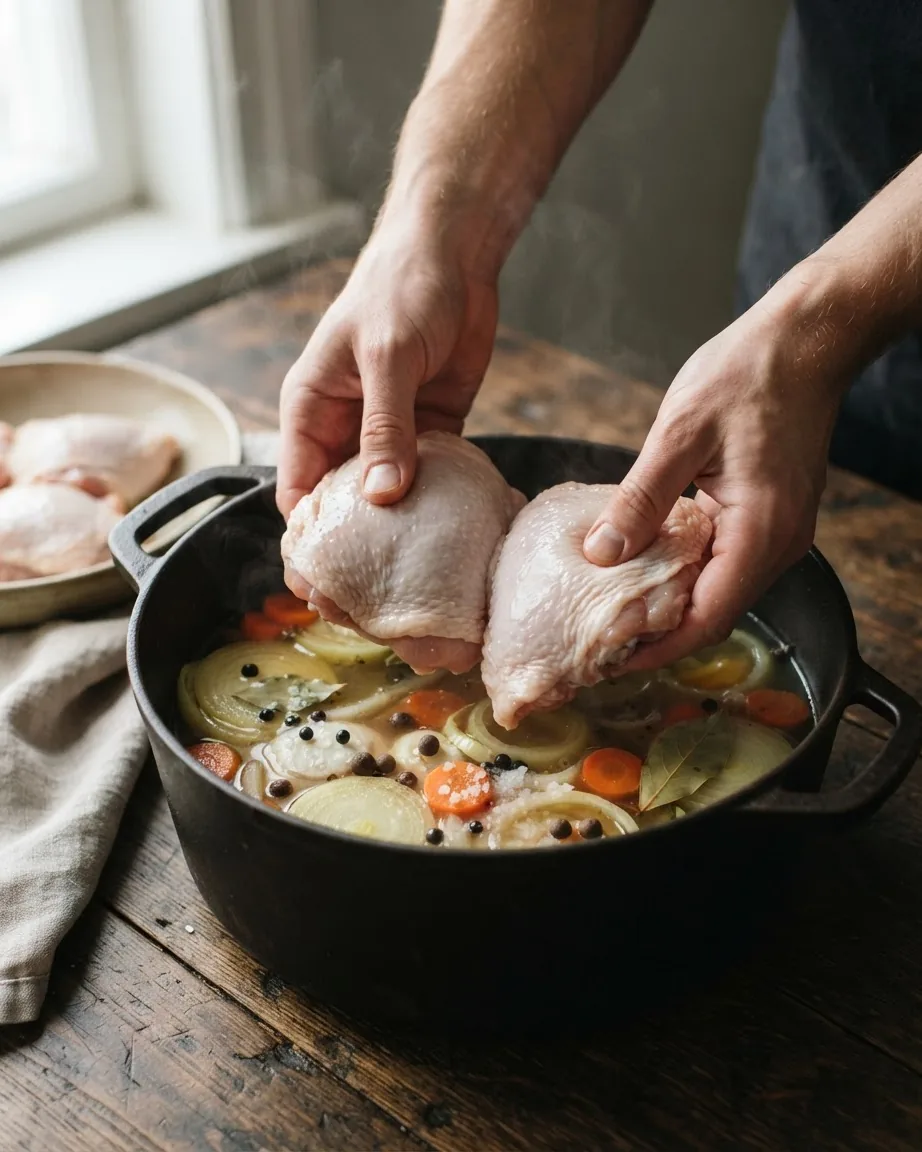
Everyday Finnish cooking leans on pork, beef, lamb, salmon, white fish and dairy, not chicken. The country’s documented staples: the three-meat Karelian hot pot, beef meatballs, salmon soup, macaroni casserole, cabbage rolls (are built around the proteins that were cheap and local for generations). Food and Journeys and other recipe collections characterize the cuisine the same way: hearty, ingredient-led, northern.
That matters for a home cook or a truck operator for one practical reason. You can absolutely cook chicken Finnish-style, but you do it by borrowing the method, not by hunting for a sacred chicken recipe that does not really exist in the canon. Two transfers work cleanly:
- Swap into the hot pot. Karjalanpaisti is a layered, uncovered oven braise. Chicken thighs (bone-in, dark meat) hold up to that slow heat far better than breast, which dries out. You lose the lamb-and-pork character but keep the technique.
- Swap into the soup. The kalakeitto and lohikeitto templates (sweat aromatics, simmer potatoes, add protein near the end, finish with dairy) work with poached chicken added late, the same way salmon goes in only at the finish to stay tender.
The takeaway: don’t search for an authentic chicken dish to anchor your lineup. Pick a Finnish method with a documented temperature and time, then run chicken through it. For the broader category of concepts a mobile kitchen can build around, our cuisine section is the wider map.
Lohikeitto vs Kalakeitto: Two “Finnish Fish Soups” That Are Not the Same Dish
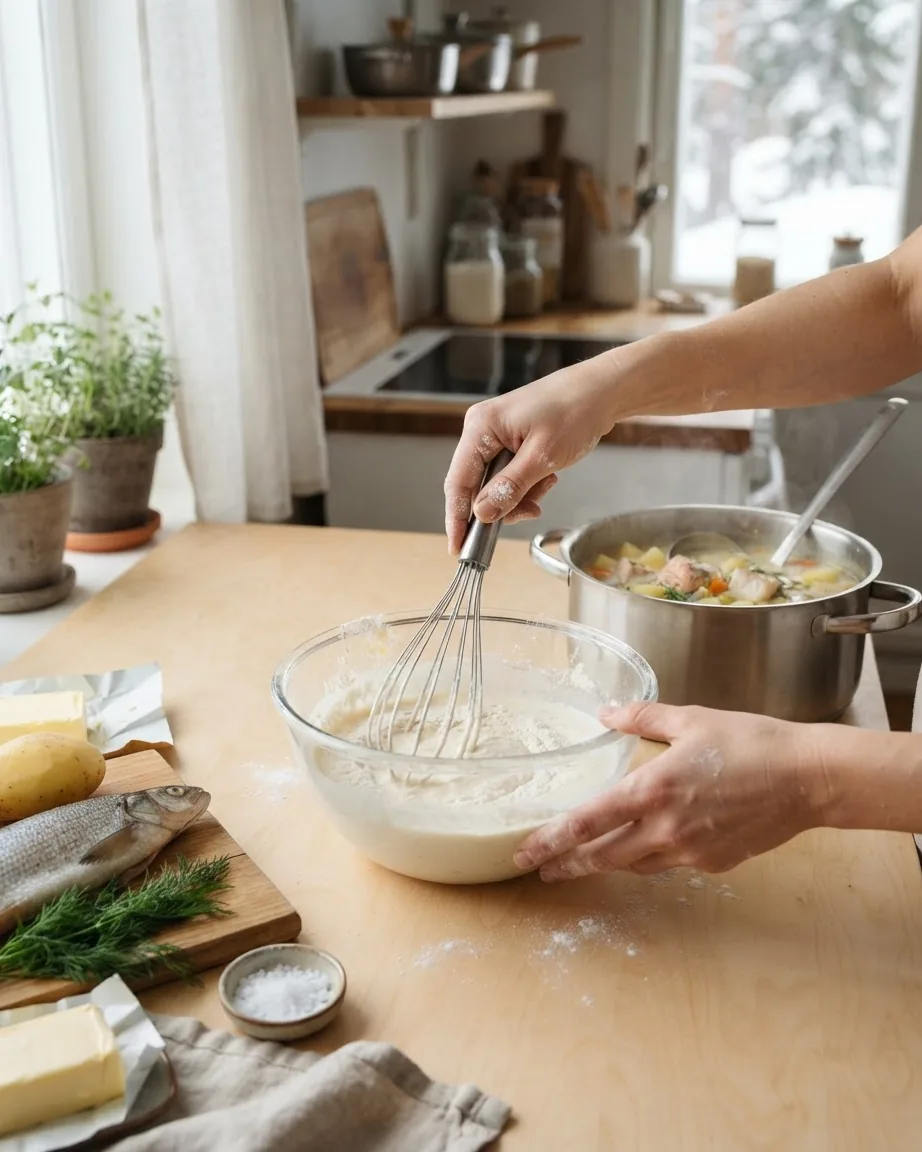
People expect one canonical Finnish fish soup. There are two, and they differ in fish, dairy and thickening, so decide which one you’re making before you shop.
The cream version is lohikeitto, documented by Little Family Adventure as a creamy salmon soup. It uses 1 pound salmon, a leek, 5 cups stock, 1 pound potatoes, 1 cup heavy cream and a quarter teaspoon of allspice, finished with dill. No flour. The richness comes straight from the cream.
The other is the official fish soup, kalakeitto, published by finland.fi (This is Finland). It is not salmon-specific and not cream-based: it’s a general fish soup thickened at the very end with milk and flour. Finland.fi’s recipe for 4-5 uses 1 kg fish, 1 litre water, 4 dl milk and 1 tablespoon of flour, and the instruction is plain: “Mix the flour with milk and add to the soup” before a short final simmer. If you buy ready fillets, you need 300-400 g instead of the whole fish.
The decision rule is simple:
- Want it rich and salmon-forward? Cook lohikeitto with heavy cream and skip flour entirely.
- Want it lighter, thickened, and flexible on fish? Cook kalakeitto with milk-and-flour, using whatever white fish or salmon you have.
- Feeding a window or a crowd on fish you can’t control? Kalakeitto scales more forgivingly because the thickening does the work, not the dairy fat.
Do not merge them. A cream soup thickened with flour turns gluey; a milk soup without flour stays thin. These are two recipes wearing one English name.
Easy Finnish Salmon Soup (Lohikeitto): The 30-Minute One-Pot Recipe
This is the cream version, adapted from the Little Family Adventure method. Read the two blocks below and you can cook it without scrolling back up. The make-or-break step is #6: salmon goes in last and cooks only 4-5 minutes, because (as the source warns) “Overcooked salmon can be rubbery”. Carryover heat keeps cooking it after the pot leaves the burner, so pull it at just-opaque.
Ingredients (serves 6)
- 1 pound salmon filets, skin removed
- 4 Tablespoons butter
- 1 large leek, thinly sliced
- 5 cups fish or vegetable stock
- 1 pound potatoes, peeled and cubed
- 1 large carrot, sliced
- 2 Tablespoons dried dill
- 1 cup heavy cream
- 1/4 teaspoon allspice
- Salt and pepper to taste
Steps
- Melt the butter in a Dutch oven or large pot over medium heat.
- Sweat the sliced leeks in the butter for 10 minutes, until soft but not browned: this builds the base flavor without bitterness.
- Pour in the stock and add the cubed potatoes, carrot and dried dill.
- Bring to a boil and cook 10 minutes, until the potatoes give to a fork.
- While that cooks, cube the salmon into uniform pieces so they cook evenly.
- Lower the heat, add the salmon, cream and allspice, and simmer gently 4-5 minutes: stop the moment the fish turns opaque.
- Season with salt and pepper at the end, since stock can already be salty.
- Ladle into bowls and serve with rye or sourdough bread.
Make-ahead for a line: build the soup through the potatoes, hold it, and add the salmon only to order in the last 4-5 minutes. That keeps the fish from going rubbery during holding: the whole reason it’s added late in the first place.
Dill swap: dried dill is a documented, taste-close substitute for fresh here; the recipe is built on it. Fresh looks better but isn’t required. One serving runs 685 calories with 70 g protein and 400 mg sodium, so it eats as a full meal, not a starter.
Finnish Oven Temperatures by Dish: One Table You Can Trust
There is no single “Finnish oven temperature.” The figures below are each tied to one dish, and swapping them is the most common home failure: a pasty baked at pulla heat stays pale and soft; porridge baked at pasty heat scorches. This is the synthesis table: documented bake temperatures and times pulled from three sources (finland.fi, EUR-Lex, and feelslikefinland), side by side so you can match heat to dish at a glance.
| Dish | Temperature | Time |
|---|---|---|
| Oven porridge (uunipuuro) | – | 4-5 hours |
| Karelian hot pot (karjalanpaisti) | – | 2.5 to 3 hours |
| Cabbage casserole (feelslikefinland) | 300 °F | 3 hours |
| Sweet buns (pulla) | – | 8-10 minutes |
| Oven sheet pancake | – | until golden |
| Karelian pasties (karjalanpiirakka) | 250-300 °C | – |
Read it as a range, not an average. The porridge and the pasty sit at opposite ends because they do opposite jobs: one is slow starch-swelling over hours, the other a fast blast that sets a thin rye crust before the filling dries. Finland.fi’s own pasty instruction runs even hotter in practice, baking at 300 C for about 10 minutes, which tells you how extreme the top of this scale is. Pick the dish, then set the dial to its number.
Karjalanpiirakka: The Legally Protected Name and the Crust Ratio That Decides Texture
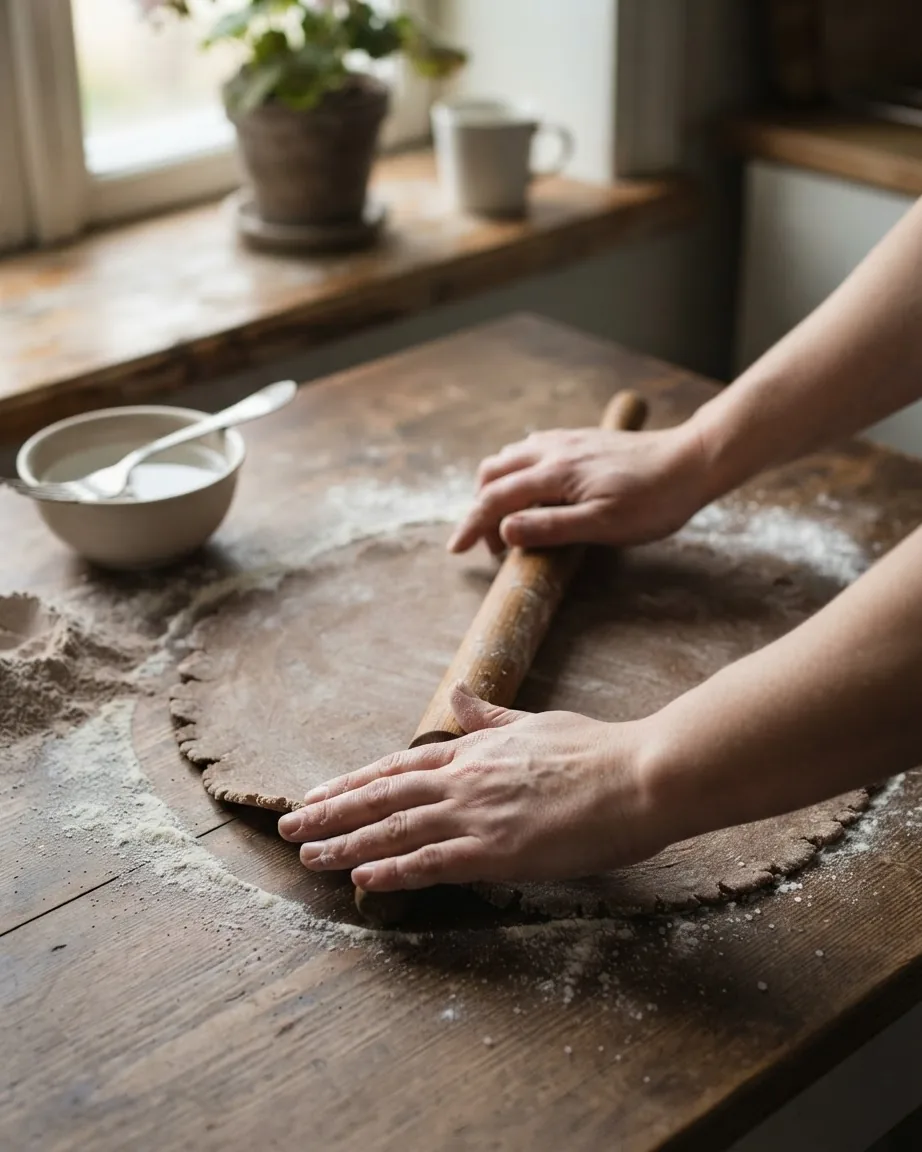
Here’s a constraint no generic recipe mentions: you may not legally call a homemade pasty karjalanpiirakka unless it follows the traditional recipe. Wikipedia records that Karelian pasties have held EU Traditional Speciality Guaranteed (TSG) status since 2003, and that “any producer not following the traditional recipe cannot call them karjalanpiirakka”. For a truck selling to the public, that’s a labeling rule, not a suggestion: if your version strays, call it riisipiirakka or perunapiirakka instead.
The traditional spec, published in the EU product specification, is tight on two levers that decide whether your pastry comes out right. First, the crust is water, salt and rye or wheat flour only, rolled nearly translucent, then baked at a very high heat. Second, the proportions: EUR-Lex states “The crust usually makes up about one third of the entire product, with about two thirds consisting of the filling”, roughly a one-to-two crust-to-filling split.
Why soggy or tough pasties happen: too much crust relative to filling, or an oven that isn’t hot enough to set that thin shell fast. Both levers point the same way: keep the crust minimal and the heat extreme.
Oven Porridge, Hot Pot and the Dishes That Feed a Crowd Cheaply
When the job is volume on a budget (a family table or a slow-day batch), three documented dishes carry it, each trading active work for passive oven time.
- Oven porridge (uunipuuro) is the set-and-forget option: pearl barley, water and milk baked for 4-5 hours. Almost no labor, scales to any dish size, and finland.fi notes whole oats, wheat, rice or buckwheat work the same way. For a truck, this is a prep-ahead breakfast item that costs pennies per serving.
- Karelian hot pot (karjalanpaisti) for 4-5 uses three meats (chuck, pork shoulder and stewing lamb) layered with onion and baked uncovered. Across the three cuts, split among 4-5 eaters, the per-serving portion lands at a satisfying size before shrinkage.
- Cabbage casserole is the budget workhorse feelslikefinland describes with just four ingredients, baked low at 300 °F for 3 hours. The source notes this build predates common rice in Finland and “dates back way over 100 years”; rice was only ever added to stretch the pan further.
For example, if you’re staffing a single-window service and want one hot item that holds all day without babysitting, the hot pot wins: it’s forgiving at a steady oven temperature, and the long braise means late-arriving customers get the same tender result as the first. Macaroni casserole (makaronilaatikko) is the everyday equivalent: minced meat, macaroni and an egg-milk mix, one of the most-eaten dishes in Finland and built for a baking dish, not a plate.
Meatballs, Pulla and the Fast Finnish Items for a Service Line
Not everything Finnish is a multi-hour bake. Two documented items run fast enough for a window.
Finnish meatballs (lihapullat) for 4-5 start with 500 g minced beef bound with breadcrumbs soaked in water and cream, fried in a hot pan. The timing is tight and worth memorizing: small meatballs are done in 3-5 minutes, larger ones in 5-8 minutes. Finland.fi serves them with lingonberry jam and gherkins. For a line, roll them uniform so a whole batch finishes on the same clock.
Pulla (cardamom sweet buns) is the bakery item. The dough is enriched with 1 tablespoon of cardamom and about 1 kg of flour, and once shaped, the buns bake fast and hot. Because the bake is so short, pulla is realistic to batch mid-service rather than only at open.
For example, if you’re running a dessert or coffee-forward concept and want a Finnish anchor, pulla reheats and holds better than a cream-filled cake and carries that signature cardamom note customers remember. If your interest runs toward the cold side of the window instead, see our Ice Cream Truck Catering notes, and for the margin math on single-SKU sweet programs, our Mini Donut Food Truck breakdown.
One more fast item: thin pancakes (ohukaiset) from a batter of 0.5 l milk, 1.5 dl flour and 2 eggs, griddled to order. Pour the same batter into a greased pan and finland.fi has you bake it into a sheet pancake: the oven version (pannukakku) yields multiple portions from one pour, which is the better math for feeding a group at once.
Is Finnish Food Bland? Mild Is a Choice, Not a Mistake
The reputation that trips up newcomers: that Finnish food is bland. The accurate framing is different: it’s deliberately mild and ingredient-led, not under-seasoned. The easiness comes from few steps and short ingredient lists, not from a lack of flavor. The flavor is carried by the components themselves: dill in the soup, cardamom in the buns, allspice in the hot pot and the meatballs, lingonberry alongside.
That distinction changes how you cook it. Don’t “fix” a Finnish dish by dumping in heat or acid it never had: you’ll cook something else. Season to let the salmon, the rye, the berries read clearly. The restraint is the recipe. Where a dish genuinely needs salt, finland.fi’s method tells you to add it at the end, after tasting, precisely because the broth or stock may already be salty enough.
What a Full Pot of Lohikeitto Actually Feeds
The recipe quotes one serving at 685 calories, 70 g protein and 400 mg sodium, and the ingredients make 6 servings. The whole pot is a crowd-feeder you can plan against instead of guessing. The protein number is what makes it a meal rather than a starter: 70 g divided by 685 calories is 10.2 g of protein for every 100 calories, so each bowl is genuinely protein-dense, not just filling.
- Protein density: 70 ÷ 685 × 100 = 10.2 g protein per 100 calories, which is why one bowl eats as a full meal.
Frequently Asked Questions
What is Finland’s national dish?
There’s no single official one, but Karelian pasties (karjalanpiirakka) carry the strongest formal claim: they hold EU Traditional Speciality Guaranteed status, with a tightly defined water-salt-rye crust baked at high heat and a one-third crust to two-thirds filling ratio. The hot pot karjalanpaisti is the other common contender.
What is a popular Finnish dessert?
Pulla, the cardamom sweet bun, is the everyday favorite, baked hot and fast. Blueberry pie (mustikkapiirakka) is the seasonal standout: in Finland it’s technically made with wild bilberries rather than cultivated blueberries, though the two taste close enough to swap. Thin pancakes with jam also count as a dessert at home.
What is Finland’s most popular food?
By everyday frequency, macaroni casserole (makaronilaatikko) is among the most-eaten dishes in the country: minced meat, macaroni and an egg-milk mixture, usually with ketchup. Salmon soup (lohikeitto) is the most recognizable to visitors: a 30-minute one-pot that serves 4-6 and shows up on menus across Helsinki.