Book a truck for 50 guests at a $12 per-person menu rate and you can still end up paying an effective $24 per person, because a $1,200 minimum applies no matter how few plates go out the window. That worked example comes from Food Truck Club’s wedding pricing breakdown, and it tells you more about what a taco truck wedding costs than any per-plate quote will.
Tacos are the cheapest cuisine you can park at a reception. The invoice is a different animal: a minimum, a gratuity line, mileage, maybe a generator, a permit, a venue fee. This guide goes through that bill line by line, then through the two things couples tend to find out late: how many plates an hour one truck can push, and whether the city where it parks wants paperwork for a private party.
A taco truck wedding typically prices at $9-15 per person on the menu, but the all-in bill, extras included, runs $20-35 per person. Most trucks set a booking minimum of $800-1,500 per truck regardless of headcount, so small weddings pay more per plate than the quote suggests. A single truck puts out 50-65 plates per hour, which means 100 guests need about 90 minutes of service. Budget separately for a 15-20% gratuity, travel charges, a possible generator rental, permits and any venue food-truck fee. Whether a permit is required for a private reception depends on the city or county where the truck parks.
What a taco truck wedding costs per person, by service model
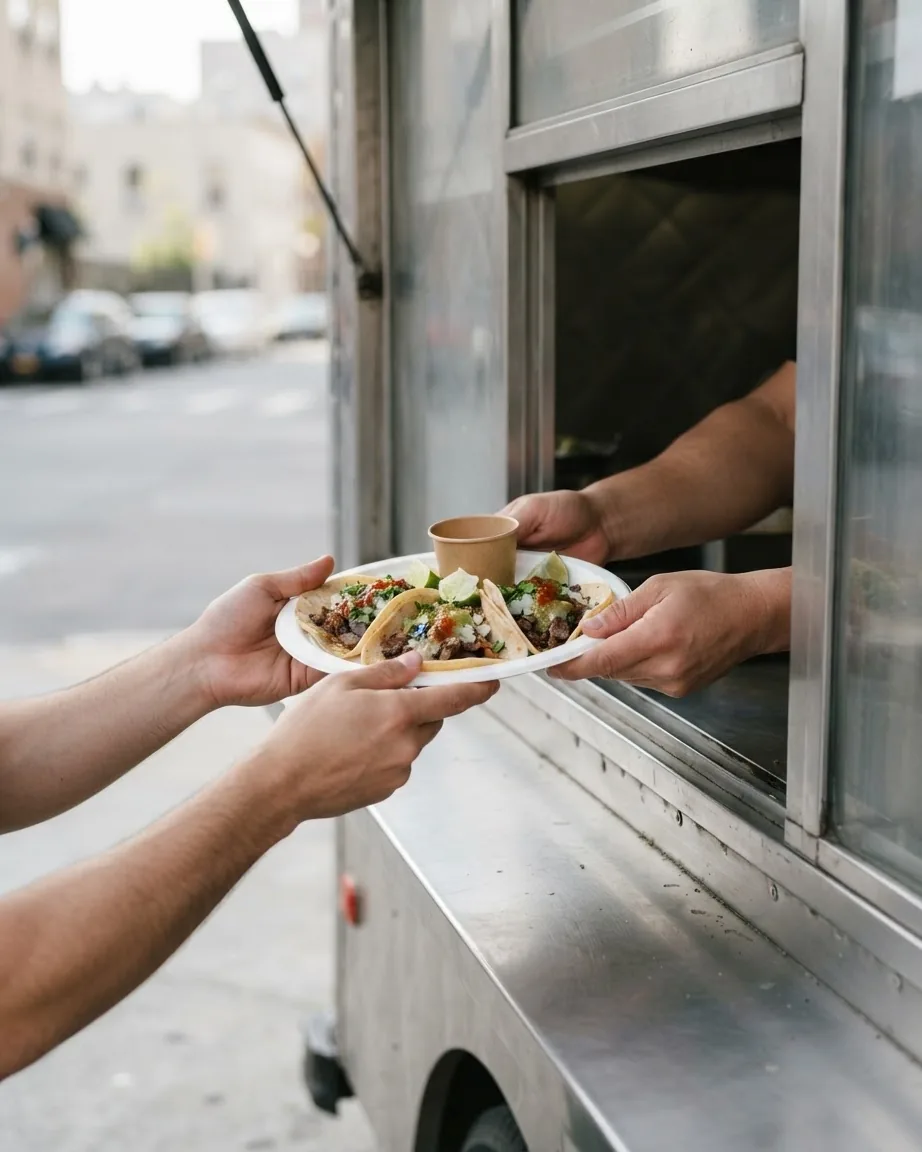
You will see per-person prices for wedding tacos that range from $6 to $35. They are not competing quotes for the same thing. They describe four different services, and comparing them straight across is how budgets go wrong.
The clearest ladder comes from Scratch Catering and Fine Foods, a Dallas-Fort Worth wedding caterer, which splits a taco bar into three tiers:
- DIY: $6-10 per person for bulk raw ingredients. That figure buys food only. It does not include labor or equipment.
- Mid-tier drop-off: $10-18 per person. Cooked food arrives; you run the line.
- Full-service professional: $20-35 per person.
A truck is a fourth model: a vendor per-plate rate, cooked and handed out the window. Food Truck Club puts taco trucks at the low end of wedding truck pricing, $9-15 per person, against $15-28 for BBQ and gourmet concepts. Truckster, a food-truck catering marketplace, estimates tacos and burritos higher, at $12-18 per person with a minimum around $900 and up.
Those two don’t agree, and neither is wrong. They are different platforms reading different trucks in different markets.
One more number floats around: $10-35 per person, with $1,000-3,500 expected for a 100-person wedding. Wedding Spot reports it, citing Social Tables. It is a cross-cuisine average for wedding food trucks generally, not a taco figure, so use it as the outer fence and price tacos toward its lower half. For how tacos compare with other concepts on the operator side, see our food truck cuisines section.
Not every taco vendor quotes per head at all. If you get a quote shaped like that, compare it to a per-plate truck by total, not by a rate you worked out yourself, and check what service hours the package includes.
The booking minimum that sets the price of a small wedding
Food Truck Club reports that most trucks require a minimum booking fee of $800-1,500 per truck regardless of guest count. Read that as the price of the truck showing up. A Saturday reception takes the truck off the street for the night, and the prep, crew and drive cost roughly the same whether 50 or 150 people eat.
That is why the opening example lands where it does. At 150 guests the per-plate math clears the minimum and the menu rate starts to mean something. A couple with a small guest list should ask for the minimum first and the per-plate rate second.
Food Truck Club’s all-in budget estimates by headcount show the same pattern from the other direction:
| Guests | All-in estimate | Trucks assumed |
|---|---|---|
| 50 | $1,200-2,200 | 1 truck |
| 100 | $2,800-4,500 | Not specified |
| 150 | $3,800-6,500 | 2 main + 1 dessert |
| 200 | $5,000-8,500 | Not specified |
Two things in that table matter more than the totals. The floor of the 50-guest row is the same $1,200 as the minimum in the worked example, so at that size you are buying the minimum plus extras. And the 150-guest row is not one taco truck: it assumes two main trucks and a dessert truck, which means two minimums before dessert. These are platform estimates across cuisines, not guarantees, and a taco-only booking should sit toward the low side of each range.
If you run the truck, the same table works as a pricing tool. A minimum that only covers food cost at 50 plates loses money on a Saturday in wedding season, and the published range tells you what couples have already been told to expect.
See also: our taco truck for parties guide.
The add-on stack between the quote and the invoice
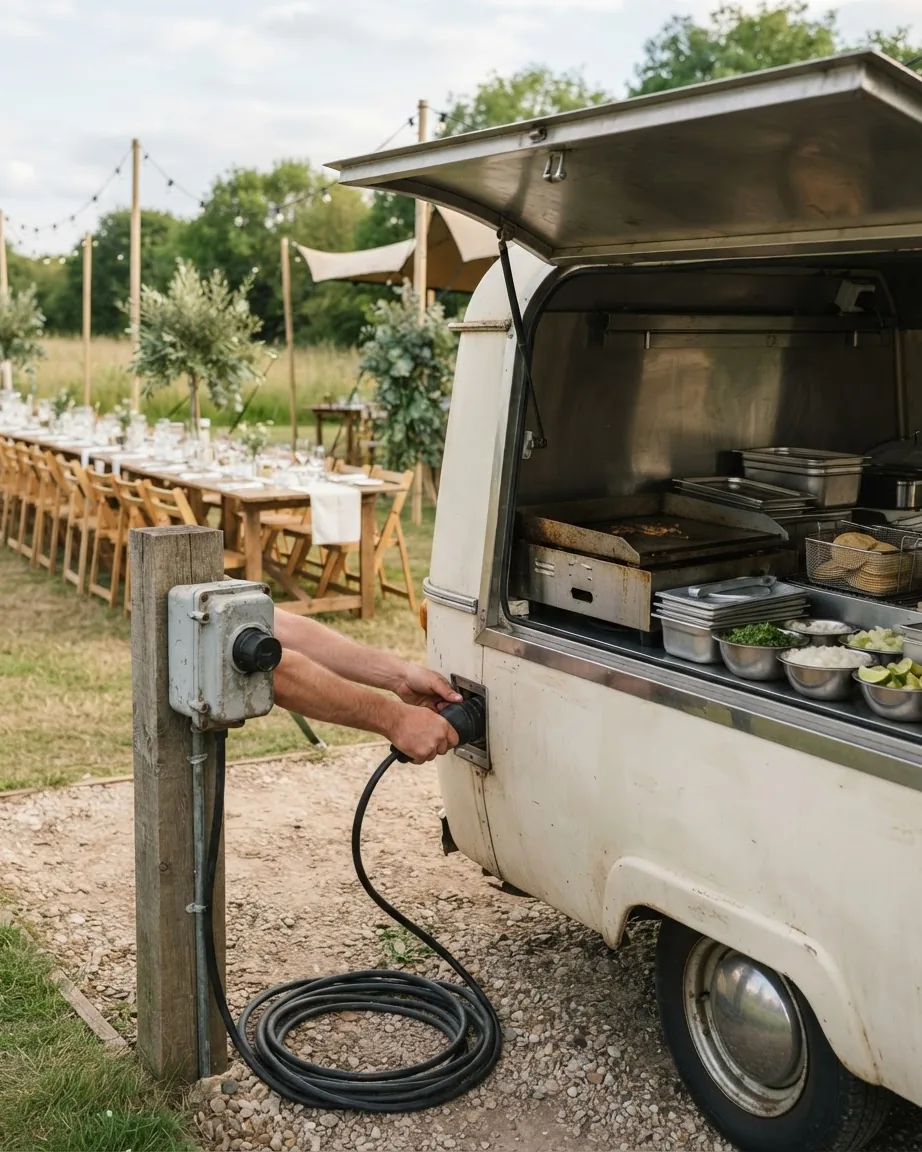
The gap between a $9-15 menu rate and a $20-35 all-in figure is made of line items, and each one has a published range. Here is the stack, which we’ll call the Minimum-First Quote Check. Run it in this order on any quote you receive.
Step one: get the per-truck minimum in writing. Step two: have the vendor multiply the per-plate rate by your headcount, and take whichever is larger, that figure or the minimum, as your base. Step three: add every line below that applies to your date and venue.
- Gratuity: 15-20% on the total is standard for catered events, per Food Truck Club. Ask whether it is already written into the quote or expected on the day.
- Travel: $1-3 per mile when the venue sits outside the truck’s standard 25-50 mile service radius. A ranch or vineyard wedding is where this line appears.
- Generator: $150-300 if the venue requires a rented one.
- Weekend and peak-season premium: 10-20% on Saturday evenings in June through October.
- Permits: typically $50-200 for a food truck wedding, according to Honeyfund’s 2026 cost guide.
- Venue food-truck fee: some venues charge $200-500, per the same Honeyfund guide, or require specific insurance instead.
- Dessert truck: the most popular multi-truck combination, budgeted at $5-12 per person on top of the main course truck.
Three of those lines are within your control. The peak premium disappears if you marry on a Friday or in a month outside June through October. The travel line disappears if you shortlist trucks based inside their own radius of your venue. The generator line disappears if the venue has power the truck can use, which you can settle with one question on the site visit.
The gratuity line is the one that surprises people, because it scales with everything else on the bill.
Why the gap to a traditional caterer is that wide, and when it narrows
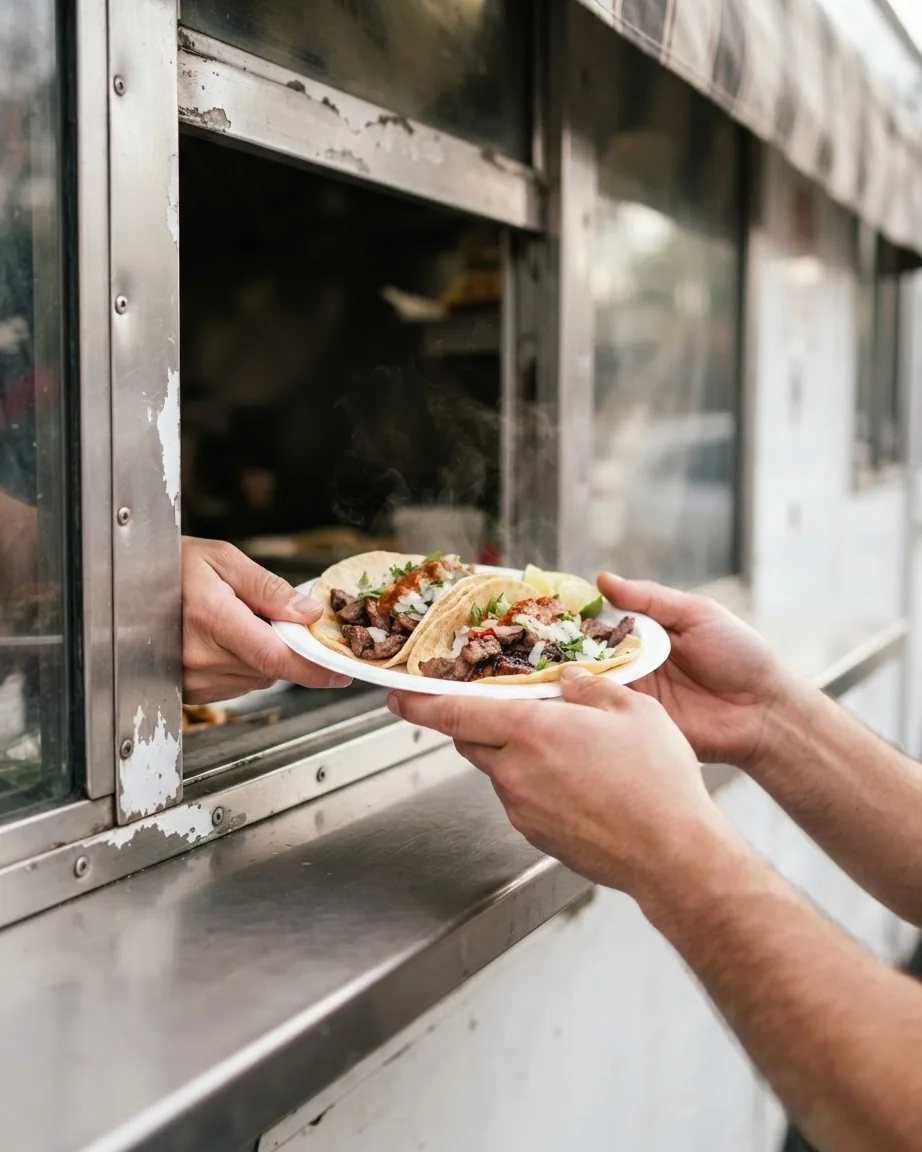
Food Truck Club puts the all-in cost of a food truck wedding at 50-70% less than a traditional wedding caterer, and prices a 100-guest wedding at $2,800-4,500 by truck against $7,000-10,000 with a traditional caterer. Truckster frames it per head: food trucks at roughly $10-25 per person against traditional catering at roughly $70 per person.
The traditional benchmark differs between the two, and so does the truck figure. Truckster’s is a per-person rate, while Food Truck Club’s is all-in with extras. For planning, read the traditional number as a range that starts around $70 per person and climbs from there, and always put the truck’s all-in figure next to it, never the menu rate.
The gap exists because the two are different service models. A truck quote contains no linens, no china and no waitstaff. Guests walk up, get a plate and find a seat. If your reception needs set tables, bussing and someone pouring water, you will source those separately, and each one you add back closes some of that 50-70%. Decide which of them you want before you compare totals.
One truck or two: plates per hour against your dinner window
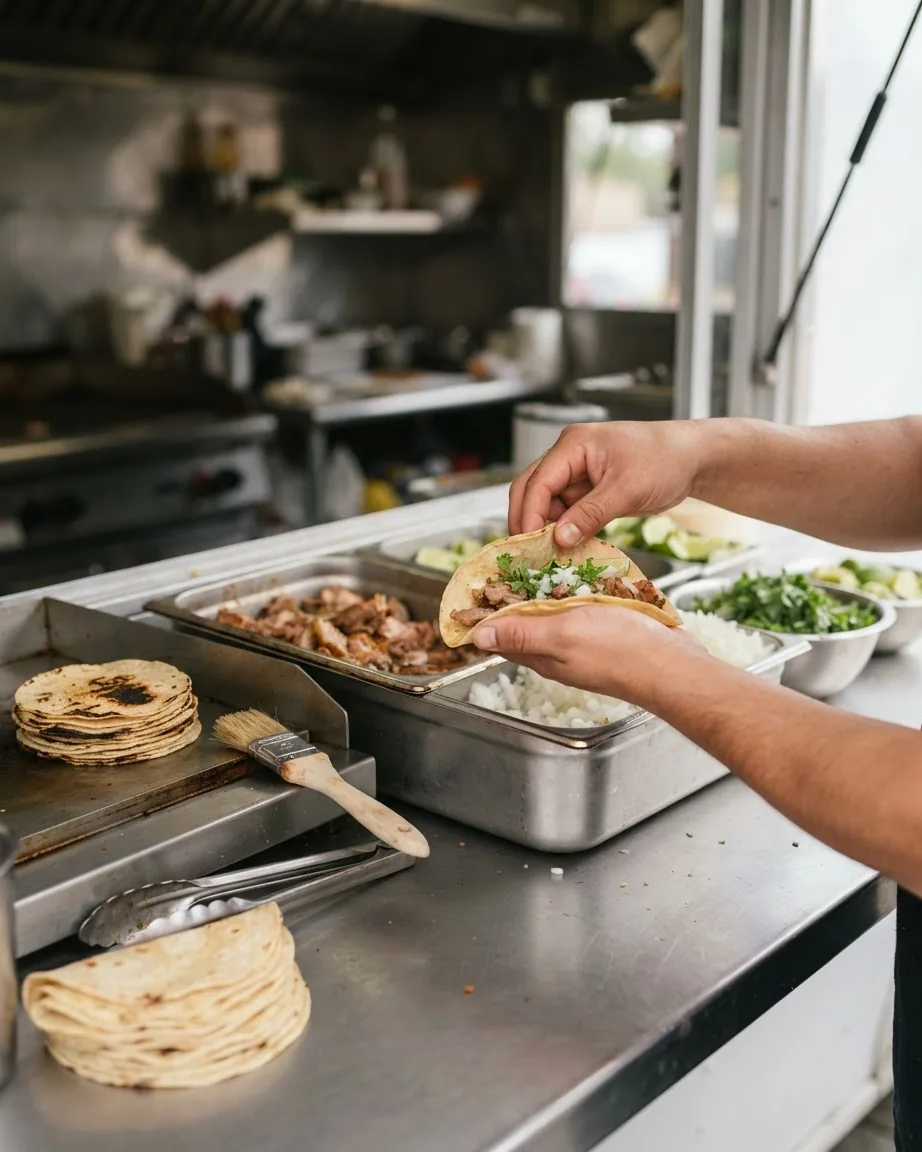
This is the decision where the published numbers split, and the split matters.
Honeyfund’s guide gives a single food truck 50-65 plates per hour, which works out in its own math to about 90 minutes of service for 100 guests. Food Truck Club gives a standard rate of 50-75 plates per hour per truck and adds that assembly cuisines like tacos run faster, with taco service taking 60-90 minutes for 150 guests.
Both can be true. The first is a general figure across cuisines, including trucks that cook each order from raw. The second accounts for what a taco line is: proteins already cooked and held, tortillas warmed, each plate assembled in seconds. Plan on the conservative rate if your menu includes anything cooked to order, such as quesadillas pressed one at a time, and on the taco-specific window if the menu is strictly build-and-hand-off.
Then set that against the evening. Honeyfund’s guidance on total time is plain: “Expect 2-3 hours of service time for most weddings.” That window covers the whole booking, not the dinner rush. The rush is the 60 to 90 minutes when every guest wants a plate at once, and the question is whether your timeline can absorb it.
- Around 50 guests: one truck. The budget estimates above assume exactly that.
- Around 100 guests: one truck works if about 90 minutes of dinner service fits between the ceremony and the first dance. If toasts are scheduled 45 minutes after doors open, it does not.
- Around 150 guests: a taco truck can clear the line in 60-90 minutes on the taco-specific figures, but the cross-cuisine budget for this size assumes two main trucks. Choose one taco truck if the menu is short and the schedule is loose, and two if either is not.
A second truck doubles the minimum, so the cheaper fix is usually the menu. Fewer choices at the window means fewer questions per guest, and that is where a line slows down. Ask the operator which of their items are assembled and which are cooked to order, and build the wedding menu from the first group.
Where the truck parks: 100 feet, power and the venue’s paperwork
Honeyfund lists three site requirements: level parking within 100 feet of the reception area, access to power, and proper permits. Level matters because fryers, flat-tops and refrigeration are built to sit flat. The 100 feet matters because every extra yard is a longer walk with a full plate, in formalwear, possibly in the dark.
Walk the site with those two numbers before you book either the venue or the truck. A gravel overflow lot at the bottom of a hill fails both tests. If the only level spot is far from the tables, move the tables.
The venue adds its own conditions. Food Truck Club reports that most venues require the truck to carry $1 million in general liability insurance and may require being named as additional insured. Ask the venue for its exact wording and send it to the truck early. An operator who can’t produce that certificate can’t work the property, however good the al pastor is.
Some venues also keep preferred-vendor lists. Ask whether outside trucks are allowed at all before you fall for one, and whether the venue’s food-truck fee applies per truck or per event.
See also: our food truck insurance guide.
“Private event” does not mean “no permit”: how the answer changes by city
The most common assumption about a wedding truck is that an invitation-only party on private land is outside the health department’s reach. Sometimes it is. Sometimes it is the opposite. The rules below are examples from specific jurisdictions, and none of them transfers to yours. Event permits are issued locally, and the binding answer comes from the city or county where the truck will park.
Albuquerque: a defined exemption, with conditions
The City of Albuquerque Environmental Health Department defines a private event by invited guests, and says a Temporary Food Establishment Permit is not required when the food is non-TCS, comes from a valid permitted food establishment, or the event has no more than 25 participants. Non-TCS is health-code shorthand for food that doesn’t need time and temperature control, and cooked meat is not that kind of food.
So for a taco truck at a full-size wedding, the condition that matters is the middle one: the truck itself must hold a valid permit. Trucks at events there also need City business registration and a Fire Marshal mechanical permit. Where a temporary permit is needed, applications should be filed at least 5 days before the event. Late ones may be reviewed, but approval is not guaranteed.
Long Beach: private property is its own permit category
Long Beach, California regulates food-truck gatherings fully contained on private property as their own category, the MFF event. Under the City of Long Beach’s 2026 application, an MFF Event permit costs $102 per day. The organizer and participating vendors need Long Beach business licenses, and food vendors need a Health Department permit.
Here is the detail a wedding couple would never guess: entertainment changes the permit. Without entertainment, a private-property MFF event may operate for up to 3 consecutive days. With entertainment, the event requires an Occasional Event Permit and is limited to one day. A reception has a DJ or a band almost by definition. Whether a single truck at a backyard wedding counts as a “gathering” is a question for the city’s special events office, and it should be asked before the deposit.
Sacramento County: self-contained does not mean exempt
The Sacramento County Environmental Management Department lists a taco truck by name as a Category D mobile food facility. Category D facilities must use a commissary. They also need a Restroom Verification Form for every location where they operate longer than one hour, and a wedding service runs longer than that.
The county also states that its permit is not valid in another California county, because each county requires its own. A truck you love from a neighboring county is not automatically cleared to work your venue.
Texas: one statewide license, plus local event rules
Texas now runs the other way. The Texas Department of State Health Services states that, effective July 1, 2026, “all mobile food vendors must be licensed by the Texas Department of State Health Services to operate a food vending vehicle in Texas.” A taco truck falls under Type III in the agency’s classification: a vehicle that prepares, cooks, holds and serves food.
The agency’s June 4, 2026 release explains that the statewide license replaces a separate license in each local jurisdiction, while vendors remain subject to applicable state and local laws. For a couple, that means a truck from across the state is easier to hire than it used to be. One caution: a new vendor with no current Texas license cannot operate until the pre-licensing inspection is completed. A truck that just launched may not be legal on your date.
Local event paperwork can still apply. The City of Universal City, Texas, for instance, lists a Temporary Event License at $50 that must be obtained no later than 72 hours before the event.
The three questions that follow from all of this
- Ask the local health department: does a truck serving invited guests on private property at this address need an event or temporary permit?
- Ask the truck: is your permit or license valid in this county or city, and can you send a copy?
- Ask both: who files, and what is the deadline? The examples above run from 72 hours to 5 days, and a late filing can be refused.
Permit lead time belongs in vendor selection, not in the final week. A truck that already works your jurisdiction has done this before.
Doing the taco bar yourself for 150: meat, tortillas and toppings
The $6-10 per person DIY tier is the cheapest way to serve wedding tacos, and it is the tier with the most ways to come up short. The quantities below are for 150 guests and come from two sources that can be checked against each other.
Meat. Scratch Catering and Fine Foods puts the need at 50-75 lbs of raw meat, cooking down to about 4 oz per person. Buy by raw weight, because meat sheds water and fat as it cooks and the cooked yield is what reaches the tortilla. A rule of thumb shared on a WeddingWire planning thread lands in the same place: at 3 servings per pound, 150 people need about 50 pounds, giving 4-5 oz per person, enough for 2-3 tacos each plus cooking shrinkage.
The two agree on the portion and differ on the cushion. Take 50 pounds as the floor and move toward 75 if tacos are the only main dish, the crowd skews young, or dinner is late. Scratch’s sample split sits at the top of its own range: 45 lbs of carne asada and 30 lbs of shredded chicken, raw weight. Shift the ratio toward chicken if you need to bring the per-person number down.
Tortillas. Plan 3 tacos per person, which comes to roughly 450-500 tortillas for 150 guests. Scratch notes that many DIYers buy 800 to be safe. The buffer is cheap, and running out of tortillas ends dinner even when the meat pans are still full.
Toppings. The same guide lists 10 lbs of shredded cheese, 5 gallons of salsa, 3 large bags of onions, and at least 20 bunches of cilantro.
Three tacos or five? The Taco Guy Catering recommends 4-5 tacos per person, which looks like it contradicts the 3-taco plan. It doesn’t. That recommendation is for unlimited service, where guests come back as often as they like. The 3-taco figure sizes a fixed portion. Decide which party you are throwing, then buy for it. If you announce seconds, shop to the higher number.
Line layout. Two cheap levers keep a self-serve line moving. Set the table so guests can build down both sides, which lets two people work the same pans at once. Put rice, beans and other sides ahead of the proteins, so plates are partly full when guests reach the most expensive pan on the table.
Two traps. First, beans labeled vegetarian are often made with lard. If you have vegetarian guests, specify oil when you order or cook them yourself. Second, 50-75 lbs of cooked meat has to be held safely for hours, and that takes equipment a home kitchen doesn’t have. Holding temperatures are set by the food code your local health department enforces. If you can’t meet them for the full service, buy the drop-off tier instead. Scratch’s guide has the complete DIY list and its setup notes.
See also: our taco food truck menu guide.
The terms to get in writing before the deposit clears
A wedding truck booking is a small contract, and vague wording costs both sides. Nothing here is legal advice, and no checklist replaces reading the operator’s actual agreement. These are the terms the numbers above say to pin down.
- Minimum or per-plate, and which governs. If the headcount drops after you book, does the bill drop with it or stop at the minimum?
- What “service time” includes. The Taco Guy Catering defines its standard service as three hours: one hour of preparation and two hours of serving. A contract that says “three hours” may mean two at the window. Get the serving start and end times on paper.
- Fixed portion or unlimited. State the number of tacos per guest, or state that guests may return. It changes how much food the truck loads.
- Gratuity. Included in the total, added automatically, or left to you.
- Travel. The truck’s service radius, and the per-mile rate beyond it.
- Power. Who supplies it, and who rents the generator if the venue requires one.
- Insurance certificate. A date by which the truck delivers it, with the venue named if the venue asks for that.
- Permits. Which party files with the city or county, and by what date.
- Peak pricing. Whether a Saturday-evening or seasonal premium is already in the quoted figure.
Operators benefit from the same list. A minimum stated up front, serving hours defined to the minute and a permit deadline with a name beside it prevent most disputes that surface after a wedding.
Combien de temps un camion met à servir 150 invités (et pourquoi la grille en prévoit deux)
L’article donne une cadence d’un camion (50-65 plats/heure) et dit que 100 invités tiennent en ~90 minutes. Pousse le calcul jusqu’à 150 et le problème saute aux yeux : un seul camion garde la fenêtre de service ouverte entre 2,3 et 3 heures, bien au-delà d’une réception normale. C’est exactement pour ça que l’estimation à 150 invités suppose deux camions principaux, pas un.
- Un camion, 150 invités : 150 ÷ 50 = 3 h (cadence basse) ; 150 ÷ 65 = 2,3 h (cadence haute). Trop long.
- Deux camions : la cadence passe à 100-130 plats/heure (50 × 2 et 65 × 2).
- Deux camions, 150 invités : 150 ÷ 100 = 1,5 h ; 150 ÷ 130 = 1,15 h. On repasse sous la barre des ~90 minutes de la ligne 100 invités.
Conclusion opérationnelle : au-delà de ~100 invités, le second camion ne sert pas à faire joli, il ramène le temps de file dans une fenêtre tenable. Compte deux minimums de réservation dans ce cas, pas un seul.
Questions couples ask once the truck is shortlisted
Does a Texas truck’s statewide license last through a wedding booked a year out?
Not automatically. After a successful pre-licensing inspection, the Texas Department of State Health Services mobile food vendor license expires one year from the inspection date. If your wedding falls past that expiration, the truck has to renew before it works your reception. Ask for the expiration date when you book, and check again closer to the day.
Can we hire a truck from another state for an Albuquerque wedding?
Yes, with extra paperwork on the truck’s side. Albuquerque has out-of-state trucks apply for a Temporary Mobile Food permit and supply the food permit issued by their home jurisdiction. That comes on top of the registration and fire requirements every event truck meets there, so give a traveling vendor more runway than a local one.
Could one truck cover a rehearsal dinner, the reception and a brunch in Universal City?
Possibly. A temporary food establishment there may operate no more than 14 consecutive days in conjunction with one event or celebration, so a three-day wedding weekend fits inside that window. Confirm with the city whether a single Temporary Event License covers every day of your celebration or whether each day needs its own.
Can one Long Beach property host two truck events a week apart?
Check the spacing rule first. Long Beach’s application sets 15 days between event applications for private-property food-truck events without entertainment, and 10 days between applications for events with entertainment. Two separate events at one address inside those gaps may conflict with it, so ask the special events office how it would treat your dates.